So, what are we really talking about when we say "ads for education"? At its core, it’s about using smart, targeted digital campaigns to find and enroll the right students for your institution. This isn't your old-school marketing playbook. We're talking about data-backed strategies to connect with potential students and their parents on the platforms they use every day, like Google, Meta, and TikTok, guiding them from that first spark of interest all the way to submitting an application.
Why Your Education Ads Need a Modern Strategy
Let’s be honest: the days of relying on a stack of glossy brochures and a booth at the local school fair are long gone. Today's student journey starts online, often months—sometimes even years—before they ever think about stepping onto a campus. This means a strategic, data-driven approach to ads for education isn't just a nice-to-have. It’s a must-have for staying relevant and growing in a very crowded market.
The real win isn't just getting more clicks or website visits. It's about attracting, engaging, and ultimately enrolling students who are a perfect fit for what your school has to offer.
From Outreach to Engagement
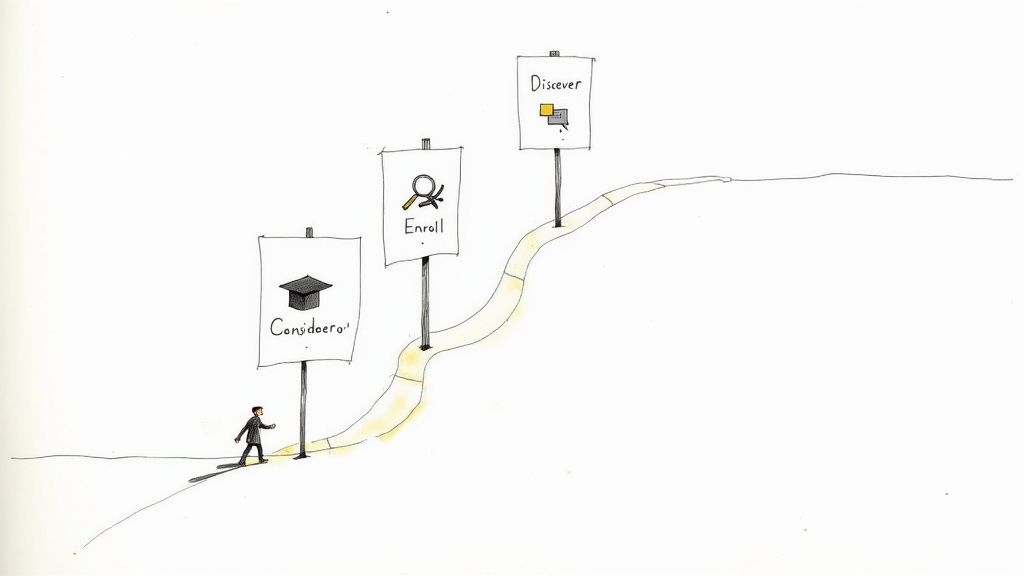
Picture the modern student’s path to enrollment. It's less of a straight line and more of a winding journey. They’re researching programs on their phone during their lunch break, watching campus tour videos on YouTube, and scrolling through student reviews on social media. Your ads need to be the helpful signposts they encounter along this path, offering the right information exactly when they need it most.
This move from old-school outreach to a living, breathing digital world means every interaction counts. And schools are putting serious money behind capturing that attention.
Marketing budgets tell the story. In higher education, online programs are spending an average of $1.18 million a year on marketing. On top of that, a whopping 70% of institutions are planning to spend even more on their digital ads.
The competition is intense. The average cost to get a single student enrolled has climbed to nearly $2,849, which really drives home the need for a strategy that’s both effective and efficient. You can dig deeper into these university marketing statistics to get a better sense of the competitive landscape.
Mapping the Student Journey
A winning ad strategy doesn't just blast a single message into the void; it meets students where they are. This journey usually unfolds across three key phases:
- Discovery: This is the "just looking" phase. A student is starting to explore what's out there. Your ads here should focus on building awareness and showing off what makes your school unique. Think big-picture value.
- Consideration: Now, they're getting serious and actively comparing schools. This is where your ads should offer more substance—think virtual tours, detailed program info, and testimonials from current students to build confidence.
- Decision: They're on the verge of applying. Your ads need to make this final step as easy as possible with clear calls-to-action, application deadline reminders, and direct links to get started.
When you understand this journey, you can craft ads that feel relevant and helpful at every stage, turning a curious browser into an enrolled student.
Building Your Ideal Student Personas
Let's be honest, effective advertising all comes down to knowing exactly who you're talking to. If you want to run successful ads for education, you have to get past generic assumptions and build out detailed student personas.
Think of it like this: you wouldn't give the same campus tour to a high school senior obsessed with robotics as you would to a working parent looking to finish their degree online. Your ads need that same specific, personal touch.
These personas aren't just about basic stats like age and location. The real magic is in the psychographics—their values, what drives them, their biggest goals—and their behaviors, like how they research schools or which social media platforms they live on. Getting this right is the foundation for creating messages that actually land.
Where to Find Your Persona Data
So, where do you get the raw material to build these profiles? The good news is, you're probably sitting on a mountain of it already. The answers are often hiding in plain sight.
Start by digging into the systems you use every day:
- Your CRM: This is a goldmine. Look for common threads among your best-fit, currently enrolled students. What programs are they in? What was their journey to enrollment?
- Website Analytics: Jump into your Google Analytics account. Which pages are prospective students spending the most time on? Is it the financial aid section or the details of a specific degree? This tells you exactly what’s on their minds.
- Social Media Insights: Take a look at your follower demographics and engagement. What kind of content sparks a conversation? This is a direct line into what your audience finds genuinely interesting.
When you start weaving these data points together, a clear picture of who you need to reach will emerge.
A persona isn't just a list of facts; it's a story about a real person with challenges, aspirations, and a specific problem your institution can solve. This storytelling approach makes your marketing more empathetic and effective.
Crafting Your Core Personas
For most schools, a handful of core personas will cover the bulk of your target audience. The goal is to create a few truly distinct profiles for each key segment you serve.
For example, you might end up with personas like these:
- "Future Leader Felicia": A high-achieving high school junior, heavily influenced by her parents and university rankings. Prestige and a clear path to a great career are everything to her.
- "Career Changer Carlos": A 35-year-old professional who feels stuck. He's looking for a flexible online program that gives him new skills he can use now and a clear return on his investment.
- "Supportive Parent Sarah": The parent of a high school senior. Her main concerns are safety, cost, and the long-term value of the degree. She's the one digging into financial aid options and student support services.
Once you have these personas clearly defined, you can use a comprehensive Google Ads audience targeting guide to find them where they spend their time online. This is how you turn all that great research into smart campaign settings, making sure your budget is spent reaching students who are a perfect fit.
Choosing the Right Advertising Channels
Once you have a clear picture of who you're trying to reach, the next big question is where to find them online. Running effective ads for education isn’t about just picking one platform and hoping for the best. It’s about building a connected, multi-channel strategy that shows up at every step of a prospective student's journey.
Think of it like this: your search ads are the helpful librarian pointing a student to the exact book they were looking for. Your social media ads? They’re the eye-catching posters in the hallway that first sparked their curiosity. Both are critical. The real magic happens when you build a funnel that guides students smoothly from that first flicker of interest all the way to hitting "submit" on their application.
Search Ads for Capturing High Intent
When a parent or prospective student types "best K-12 STEM programs near me" or "online MBA degrees" into a search bar, they aren't just browsing. They have a specific need, and they're actively looking for a solution. This is where search engine advertising really shines. It lets you put your school right in front of people at the exact moment they're looking for what you offer.
- Google Ads: As the undisputed leader, Google Ads is an absolute must. You can reach a massive audience with high intent, and its targeting options let you zero in on specific keywords, locations, and demographics.
- Microsoft Advertising (Bing): Don't overlook Bing. Its user base often skews a bit older and more professional, and the cost-per-click can be lower than Google's. It's a smart, cost-effective way to round out your search strategy.
Social Media for Building Awareness and Community
Social media is your virtual campus quad—it's where you build your brand’s story, foster a sense of community, and connect with people on a human level. These platforms are perfect for top-of-funnel activities, introducing your school to audiences who might not be actively searching yet but perfectly fit your ideal student profile.
This is where you move beyond simple demographics and start thinking about the mindsets and behaviors that drive decisions.
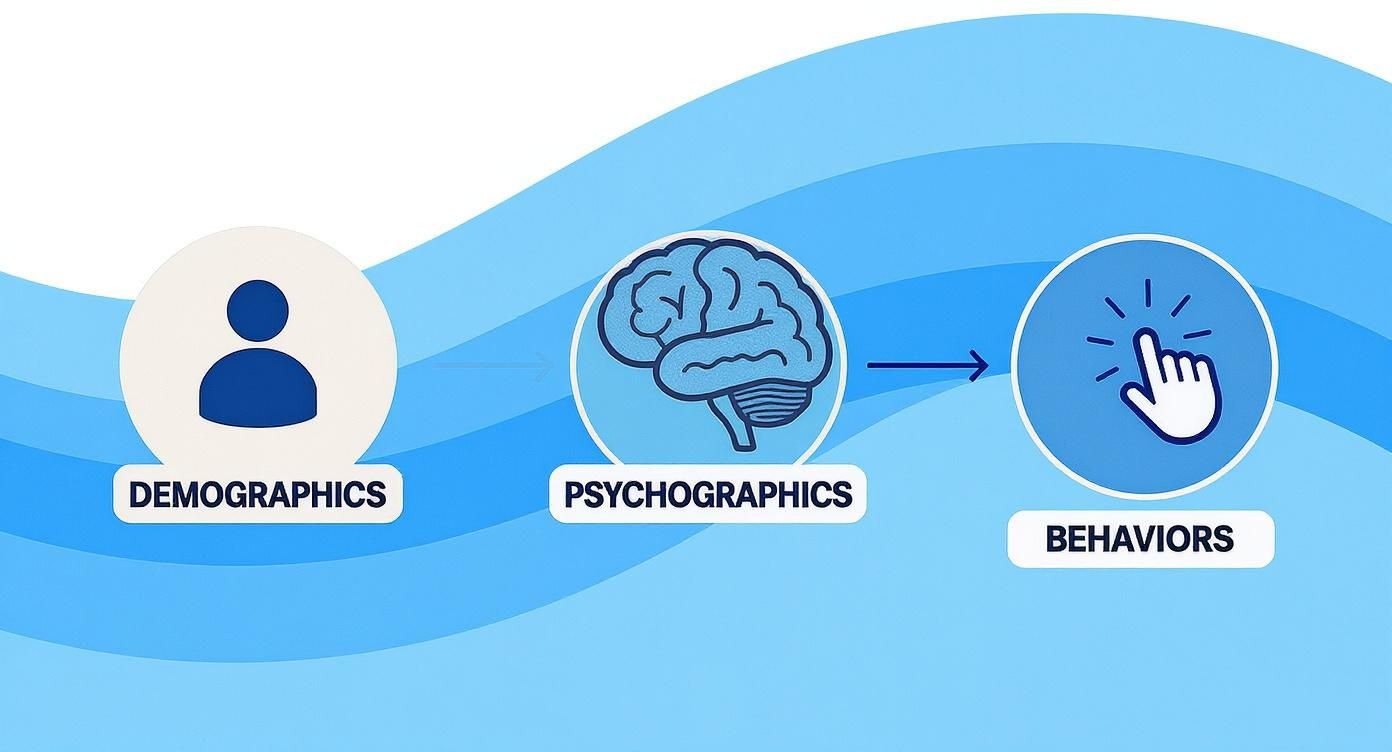
Understanding these layers helps you choose the platforms where your ideal students actually spend their time. After all, you need to be where they are.
The data backs this up. Spending on short-form video ads is projected to hit an incredible $99.4 billion in 2024. Meanwhile, Google is expected to command over 72% of all U.S. search ad spending by 2026. And while costs can be a concern, the return is often worth it—Google Ads delivers an average return of $2 for every $1 spent.
Successful social media for schools isn't just about follower counts. It’s about creating authentic content—like student takeovers, faculty interviews, and virtual campus tours—that gives prospects a real feel for your culture and community. Learn more by checking out our guide on how targeted social media ads work.
- Meta (Facebook & Instagram): With its powerful demographic and psychographic targeting, Meta's ad platform is second to none for visual storytelling and reaching both prospective students and their parents.
- TikTok: This is the place to be if you want to reach Gen Z. The key here is authentic, short-form video that feels organic, not like a polished corporate ad. Think "day-in-the-life" content, not a formal commercial.
- LinkedIn: For graduate programs, professional certificates, and any offering geared toward adult learners, LinkedIn is essential. You're reaching people who are actively thinking about their next career move.
To help you decide where to focus your efforts, here's a quick cheat sheet comparing the most popular platforms for education marketers.
Education Advertising Platform Cheat Sheet
| Platform | Best For | Primary Audience | Key Metric |
|---|---|---|---|
| Google Ads | Capturing high-intent leads actively searching for programs | Students & parents with specific needs | Cost-Per-Lead (CPL), Conversion Rate |
| Meta (FB/IG) | Building brand awareness & visual storytelling | Students (especially high school & undergrad), Parents | Reach, Engagement Rate, Link Clicks |
| Promoting graduate degrees & professional programs | Working professionals, Adult learners, Alumni | Lead Quality, Cost-Per-Application (CPA) | |
| TikTok | Reaching Gen Z with authentic, short-form video | High school & undergraduate students | Video Views, Engagement Rate, Brand Awareness |
| Programmatic | Scaled awareness campaigns across diverse websites | Broad or niche audiences based on behavior | Impressions, View-Through Conversions |
This table is just a starting point. The best mix will always depend on your specific goals and the unique personas you're trying to attract. Your strategy should be dynamic, using insights from one channel to inform and improve your efforts on another.
Creating Ads That Actually Connect and Convert
Let's be honest: a great ad is so much more than a glossy photo and a catchy slogan. It has to act as a conversation starter. In the endless stream of digital content, your ads for education can't just be present—they have to be powerful enough to stop the scroll, make someone curious, and actually motivate them to take the next step.

This means you have to get real. It’s time to move past the generic stock photos and stiff, corporate language. The creative you put out there needs to feel authentic and speak directly to the specific audience you've worked so hard to identify.
Writing Copy That Resonates
Think of your ad copy as your first handshake. It has to be clear, persuasive, and centered on a student's goals and struggles—not just a laundry list of your school's features.
- Lead with Empathy: Your headline should immediately connect with a pain point or a dream. Instead of the flat "Enroll in Our Business Program," try something that speaks to their ambition, like "Ready to Lead? Turn Your Ambition Into a Career."
- Focus on Outcomes: Families aren't just buying a degree; they're investing in a future. Don't just tell them what they'll do at your school; show them what they'll become because of it.
- Keep it Scannable: People scroll fast, especially on their phones. Use short sentences, punchy bullet points, and simple language. No one is going to stop and decipher a dense paragraph.
Your copy is the bridge that connects their problem to your solution. It should guide them, both logically and emotionally, right to the point of action.
Your ad creative grabs their attention, but your copy holds it. The goal is to make the prospective student feel understood and show them a clear path forward. This synergy is what turns a passive viewer into an active lead.
Choosing Visuals That Build Trust
In today's world, authenticity is your most valuable asset. Prospective students want to see what your school is really like—the real campus, the real students, the real experiences. It’s time to say goodbye to those overly polished, generic stock photos for good.
Here’s what truly builds a genuine connection:
- Student and Alumni Testimonials: Short, punchy video clips or graphics with quotes from real people who found success are incredibly powerful. This is social proof in its purest form.
- Behind-the-Scenes Content: Give them a peek behind the curtain. A "day-in-the-life" video, a tour of a cool lab, or a quick clip from a campus event feels personal and real.
- User-Generated Content (UGC): Sharing photos and videos from your current students (with their permission, of course) gives an unfiltered, trustworthy look into your community.
These kinds of visuals feel less like a corporate ad and more like a recommendation from a friend, which immediately helps build trust.
Finally, every single ad you run needs a clear and compelling Call-to-Action (CTA). It's the final instruction. Whether it’s "Download a Program Guide," "Schedule a Virtual Tour," or "Start Your Application," your CTA has to be specific and direct. This button is the destination of your ad's journey, and it should take them to a dedicated landing page that delivers exactly what you promised. To dive deeper, check out our guide on how to optimize landing pages to get better results.
Moving Beyond Clicks: How to Measure What Really Matters
A successful ad campaign isn't about guesswork; it's about data. For anyone marketing a school, that means looking past surface-level vanity metrics like clicks and impressions and digging into the numbers that actually move the needle on enrollment.
Think of your ad budget as fuel. You wouldn’t just pour gas in a car without checking the MPG, right? The same logic applies here—you need to know exactly how your ad spend is translating into real-world results.
Making data-driven decisions is no longer optional in this competitive market. By 2025, global digital advertising spend is projected to fly past the $1 trillion mark, with education being a massive part of that. Social media ads alone are expected to hit $242 billion. The takeaway? Your competition is spending, so you need to spend smarter. You can read the full research about these digital ad spend statistics to get a sense of the scale.
Pinpointing Your Essential KPIs
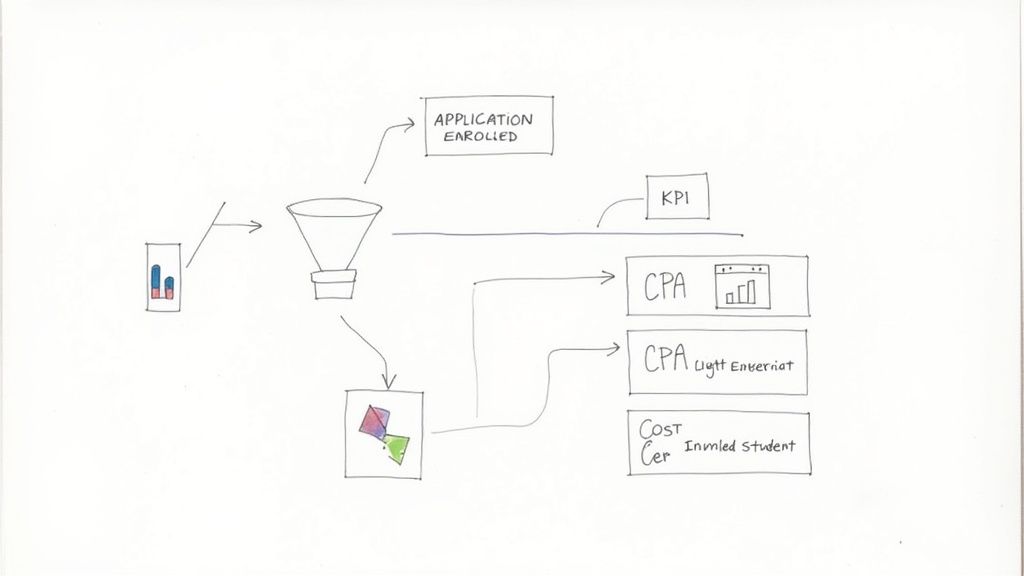
Every click might feel like a tiny victory, but clicks don't keep the lights on. The real story of your campaign’s success is told through your Key Performance Indicators (KPIs)—the metrics that align perfectly with each step of your enrollment funnel.
These are the numbers you should be laser-focused on:
- Cost Per Inquiry (CPI): This is what you pay for a single, qualified lead. Think of it as the cost to get a prospective family to request an info packet or sign up for a campus tour.
- Cost Per Application (CPA): This metric tells you exactly how much ad spend it took to convince a prospective student to hit "submit" on their application.
- Cost Per Enrolled Student: This is the big one. It’s the total marketing cost to secure one new, tuition-paying student.
Keeping a close eye on these KPIs is how you prove your marketing team's value and make sharp, confident decisions about where to invest your budget for the next term.
Connecting Ad Dollars to New Students
The real magic happens when you connect the dots between your ad platforms and your internal systems. By setting up conversion tracking with tools like the Google Ads tag or the Meta Pixel, and then integrating them with your school’s CRM, you build a powerful, closed-loop reporting system.
This setup is the difference between knowing your ads got clicks and knowing which specific ad brought in ten new students. It’s how you directly tie tuition revenue back to your marketing spend.
This connection allows you to demonstrate a tangible return on investment. You can walk into a meeting and say with complete certainty that for every dollar spent on ads for education, you generated a specific, measurable amount of revenue. Understanding this flow is the key to truly owning your marketing performance. If you want to go deeper on this, you can learn more about how to measure marketing ROI in our detailed article.
Navigating Compliance and Privacy in Your Ads
When you're running ads for education, you're handling more than just campaign data; you're often dealing with sensitive information about families and, in many cases, minors. This isn't just a marketing best practice—it's a serious legal and ethical responsibility.
Think of these regulations as the guardrails on a winding road. They aren't there to stop you, but to keep you, and your audience, safe. Getting this wrong doesn't just lead to hefty fines; it can shatter the trust you've spent years building with your community.
Key Regulations Every School Marketer Should Know
The legal landscape can feel a bit overwhelming, but for most school marketers, a handful of key regulations are the ones you really need to keep on your radar. Getting a handle on their purpose is the first step to building campaigns that are both effective and responsible.
- COPPA (Children's Online Privacy Protection Act): If there's any chance your ads could reach children under 13, COPPA is your number one priority. It puts strict rules on how you can collect and use their data, almost always requiring clear parental consent first.
- FERPA (Family Educational Rights and Privacy Act): FERPA is mostly about protecting student education records, but its influence bleeds into marketing. If you want to use a student's photo in an ad or share a testimonial, FERPA’s principles mean you absolutely need to have the right permissions in place.
- GDPR & CCPA: These are the big data privacy laws from Europe (GDPR) and California (CCPA). If you're marketing to people in those areas, you have to follow their rules, which focus on being transparent and giving people control over their personal information.
At the end of the day, all these laws boil down to a simple idea: be upfront, be careful, and always put the user’s privacy first. When you build your advertising strategy on that foundation of trust, you're setting yourself up for success that lasts.
Beyond the specific laws, it’s just good practice to be completely honest in your advertising. Don't stretch the truth about accreditation, fudge job placement numbers, or overpromise on what students will achieve. Every claim you make should be something you can back up.
Finally, compliance goes beyond just your ad copy. It's also about making sure your website, landing pages, and digital content are accessible to everyone. For a deeper dive into this, check out the complete guide to web accessibility in education. Weaving these practices into your everyday work helps you create a marketing presence that feels safe, trustworthy, and welcoming to all families.
Common Questions About Ads for Education
Diving into paid advertising can feel overwhelming, but most of the uncertainty boils down to just a few key questions. Once you get these figured out, you'll have a much clearer path forward for launching your school's ad campaigns with confidence.
How Much Should We Budget for Digital Advertising?
There's no magic number here. The right budget is tied directly to your enrollment goals and how competitive your local market is.
A great way to start is by working backward. If you know the industry average Cost Per Enrollment is around $2,800, and you need 50 new students, you’re looking at a target acquisition budget of $140,000.
But you don't have to jump in with that full amount. It’s smarter to start with a smaller, manageable test budget for a single campaign. See what works, measure everything, and then pour more resources into the channels that are actually delivering enrollments. As a general rule of thumb, many schools find success by allocating 5-10% of their total operating budget to marketing.
What Is the Best Advertising Platform for Student Recruitment?
The "best" platform is wherever your ideal students are spending their time. There’s no one-size-fits-all answer.
- Reaching traditional high schoolers (ages 17-18)? You'll want to be on platforms like TikTok, Instagram, and YouTube. These are perfect for building awareness with fun, visual, and authentic content.
- Targeting prospective grad students or professionals? Your focus should shift to LinkedIn and Google Search ads. People on these platforms are actively looking for career advancement and educational opportunities, so your message will land with a much more receptive audience.
Ultimately, the strongest strategies don’t rely on just one channel. They use a mix of platforms to connect with families at every stage—from that first spark of interest on social media to the moment they actively search for a school like yours on Google.
How Do We Measure the True ROI of Our Education Ads?
Measuring true ROI is about more than just tracking clicks and views. You have to connect the dots all the way from the ad to a confirmed enrollment. The secret lies in tracking pixels, like the Meta Pixel or the Google Ads Conversion Tag. By placing these little snippets of code on your application "thank you" pages and integrating your ad platforms with your school's CRM, you can see exactly which campaigns are bringing in new students. This gives you a crystal-clear Cost Per Enrollment and shows you exactly where your marketing dollars are making the biggest impact.
At The MarCom Society, we provide the tools and community K-12 marketing professionals need to master these strategies. Join our network of experts to get access to live workshops, proven resources, and a private community dedicated to helping you drive real results for your school. Learn more and become a member.