Let's be honest, when most people hear "AI in education," their minds jump straight to sci-fi movie scenes of robots teaching classrooms. But that's not what we're talking about here. The reality is much more practical and, frankly, more helpful.
It’s better to think of AI as a digital co-pilot for your school's staff. It's a powerful set of tools designed to work with your team, not replace them. It’s here to make their jobs easier and more impactful.
The New School Bell: What AI Really Means for Your School
Instead of picturing a new teacher, imagine an incredibly efficient assistant for your marketing and communications team. This assistant is brilliant at handling the time-sucking, data-intensive tasks that bog down your staff day after day.
By taking over the repetitive work, AI frees up your people to focus on what humans do best: building genuine relationships with families, nurturing community connections, and crafting the compelling stories that make your school special.
So, how does this digital assistant work? It all comes down to a few key technologies running in the background. The two you’ll hear about most are machine learning and natural language processing (NLP).
- Machine Learning (ML): This is the part of AI that learns from experience, just like a person does, but with data. For your school, it could sift through years of enrollment information to spot the hidden characteristics of families who thrive in your community. This helps you focus your outreach efforts where they’ll make the biggest difference.
- Natural language Processing (NLP): This is what gives AI the ability to understand and speak our language. It's the magic behind the chatbot on your website that can instantly answer a prospective parent's late-night questions about tuition or tour schedules, long after your admissions office has closed for the day.
Why This Matters Right Now
Thinking about AI in schools isn't just a futuristic exercise anymore—it's happening now, and it's picking up speed fast. The financial investment pouring into this space signals a huge shift in how schools will need to operate to stay relevant and attract families.
The global market for AI in education hit about USD 5.18 billion in 2024. Projections show it rocketing to nearly USD 112.30 billion by 2034. That’s a staggering compound annual growth rate (CAGR) of 36.02%, making it clear this isn't a passing fad.
This explosive growth is about more than just money. It reflects a deep change in strategy. Schools that get comfortable using AI for things like personalizing parent communications or analyzing marketing results are building a serious advantage.
For any modern school marketer, getting a handle on these tools is becoming non-negotiable. It's how you'll boost efficiency, stay ahead of the curve, and connect with your community in ways that truly resonate. If you're curious, you can explore the full AI in education market projections to grasp the sheer scale of this movement.
Real-World AI: How Schools Are Putting It to Work in Marketing

Let's move past the theory and get practical. The true power of AI in education isn't some far-off concept; it’s showing up in the day-to-day work of school marketing and communications teams. These aren't just fancy new toys—they are real tools that can solve some of your biggest headaches, from catching the eye of new families to handling the endless stream of questions.
Think of it this way: your team’s main job is to build real connections, but you’re often buried under the administrative side of marketing. AI can help lift that weight. It gives you the power and speed to make every family feel like they're getting a one-on-one conversation, freeing you up to focus on the human side of telling your school's story.
Making Every Family's Journey Personal
One of the most impressive things AI can do is create deeply personal outreach on a scale that would be impossible for any person to manage alone. Forget the generic email blast sent to every prospective parent. AI allows you to shape each message around what a specific family actually cares about.
How does it work? By looking at the data you already have—like what they clicked on your website, the questions they asked on an inquiry form, or which events they attended. An AI system can quickly figure out that one family is all about your STEM program, while another is more interested in athletics and after-school clubs. From there, it can automatically send them stories, testimonials, and invitations that speak directly to those interests.
When you segment your audience this precisely, engagement naturally follows. Personalized emails can generate 6 times higher transaction rates, but a surprising 70% of brands still don't use them. For schools, that gap is a huge opportunity to connect in a way others aren't.
This kind of attention to detail makes families feel seen and understood right from the start. It shifts the conversation from a generic sales pitch to a genuine dialogue. Of course, this approach is only as good as the information you feed it, which is why it's so important to know how to conduct market research to fuel these powerful AI engines.
Never Run Out of Social Media Ideas Again
We’ve all been there—staring at a blank screen, trying to come up with yet another engaging social media post. This is a massive challenge for busy school marketing teams. AI content tools can act like a tireless brainstorming partner, helping you generate fresh ideas, write first drafts, and even figure out the best time to post.
For example, you could give an AI tool a quick summary of a recent science fair. In just a few minutes, it can spin that one event into several different pieces of content:
- A celebratory Instagram post with photos of student projects.
- A more detailed Facebook update for your parent community.
- A professional LinkedIn post about your school's focus on innovation.
- A few catchy captions for a video reel of the event highlights.
This doesn't just save a ton of time. It helps you maintain a lively and consistent presence across all your channels, keeping your community connected and in the loop.
Your 24/7 Digital Admissions Assistant
Prospective families don't stick to a 9-to-5 schedule. Their questions about tuition, admissions deadlines, and campus life can pop up late at night or over the weekend. An AI-powered chatbot on your website can provide instant, accurate answers around the clock.
And these aren't the clunky, frustrating bots from a few years ago. Today's chatbots use natural language processing to understand what people are really asking. They can handle common questions, help families book a campus tour, and capture contact info for follow-up, making sure no potential student slips through the cracks.
While AI can automate this initial outreach, the success of your open houses still depends on great planning. It's a perfect blend of new tech and proven methods, so understanding effective event marketing strategies remains crucial.
The growth in this field is happening fast. The AI in education market was valued at $2.5 billion in 2022 and is expected to rocket past $6 billion by 2025. A lot of that growth is driven by AI solutions like customized analytics, which is currently the fastest-growing part of the market. You can dig deeper into these trends in AI education statistics to get a sense of where things are headed.
AI Applications in K-12 Marketing and Communications
To make this even more concrete, let's look at some common challenges school marketers face and how specific AI tools can provide a solution. The table below breaks down a few examples.
| Marketing Challenge | AI-Powered Solution | Example Application | Potential Impact |
|---|---|---|---|
| Keeping up with inquiries | 24/7 AI Chatbot | A chatbot on the admissions page answers FAQs about tuition and deadlines, and schedules tours automatically. | Frees up admissions staff by 10-15 hours a week; captures leads outside of office hours. |
| Creating engaging content | Generative AI Writing Assistant | Use a tool like Jasper or Copy.ai to draft blog posts, social media updates, and parent newsletters from a few bullet points. | Cuts content creation time in half; ensures a consistent and active online presence. |
| Personalizing outreach | AI-Powered Email Marketing Platform | A system that tracks website behavior and sends automated, personalized emails about programs a family showed interest in. | Increases email open rates and tour sign-ups by making families feel understood. |
| Analyzing parent feedback | Sentiment Analysis Tools | Run survey responses and social media comments through an AI tool to gauge overall community sentiment and identify key concerns. | Provides a clear, data-backed view of parent satisfaction and highlights areas for improvement. |
As you can see, these tools aren't about replacing the human element of marketing. They're about amplifying it, allowing you to focus your energy on strategy, creativity, and building genuine relationships with families.
The Benefits of Integrating AI in Your School's Strategy

It’s one thing to understand what AI can do, but it's another thing entirely to see how it can truly benefit your school. Bringing AI into your marketing and communications isn't just about getting new software; it’s a strategic move that delivers real, measurable results. The advantages go far beyond simply doing things faster, impacting every aspect of how you connect with families and grow enrollment.
At its heart, AI gives your team a level of precision and insight that was once impossible. You can finally shift from gut-feelings to data-backed decisions, making sure your budget, time, and energy are all pointed where they’ll have the biggest impact. This isn't just about keeping up—it's about setting a new standard for how schools engage with their communities.
Enhancing the Prospective Family Journey
The path a family takes from a late-night Google search to their child's first day is incredibly personal. AI helps you honor that journey by making your communications feel just as personal. By looking at how families engage with your website, click on emails, or sign up for events, AI tools can build a surprisingly clear picture of what they care about most.
This allows you to send content that actually resonates. Imagine a family that keeps visiting your arts program page automatically getting an email with a student testimonial about the school play. Or a family interested in sports receiving an update about the upcoming soccer season. It’s a subtle shift, but it creates a much more meaningful conversation and shows families you're paying attention.
Key Insight: A personalized approach makes families feel seen and valued from their very first interaction. This builds a foundation of trust that is critical for enrollment decisions and sets a positive tone for their entire relationship with your school.
Modern chatbots are a fantastic tool for this. They’ve moved way beyond just answering "What time does school start?". Today's bots can guide families through the admissions process, schedule campus tours, and collect key information along the way. To get a better sense of how they work, you can explore the role of chatbots for education and see how they can transform your front-line communications.
Making Smarter, Data-Driven Decisions
Your school is probably sitting on a mountain of data—website traffic, social media likes, and years of enrollment records. Think of AI as your on-call data scientist, capable of digging through all of it to find patterns and opportunities your team could easily overlook.
This analytical power turns your marketing from a guessing game into a calculated strategy. For example, an AI tool might analyze your admissions data and discover a hidden pocket of high-converting families in a neighboring town you've never targeted before. With that insight, you can focus your ad spend on that specific area for a much better return.
Freeing Your Team for High-Value Work
Perhaps the most immediate and tangible benefit of AI is the gift of time. School marcom pros are constantly juggling. Their days get eaten up by repetitive tasks: manually scheduling social media posts, pulling weekly reports, or answering the same five questions in their inbox again and again.
AI can take over these time-consuming chores. This frees up your talented people to focus on the work that truly requires a human touch:
- Building Relationships: Spending more time connecting with prospective and current families face-to-face.
- Strategic Planning: Thinking bigger about long-term brand goals instead of just the next to-do list.
- Creative Storytelling: Crafting the compelling stories and videos that capture the unique spirit of your school.
This isn’t about replacing people. It’s about elevating their roles. When your team isn't bogged down by routine tasks, they have the mental space to be more strategic, more creative, and ultimately, more effective at building your community.
A Practical Roadmap for Getting Started with AI
Bringing AI into your school's marketing can feel like a massive undertaking, but it doesn’t have to be. The secret is to resist the urge to do everything at once. Adopting a "crawl, walk, run" mindset allows your team to build confidence and see real results without getting overwhelmed.
Think of it like teaching a new concept in the classroom. You'd never jump straight to advanced physics; you’d start with the basic laws of motion. It’s the same idea here. Kick things off with a small, manageable pilot project to learn the ropes and prove that this technology can actually help.
Start Small with a Pilot Project
Your first foray into AI should be low-risk but high-impact. The idea is to pick one specific, nagging pain point in your marketing workflow and use an AI tool to solve it. This gives you a quick win that builds momentum and makes it easier to get support for future projects.
Social media management is a perfect example. We all know how much time it takes to manually plan, write, and schedule posts across different platforms.
- The Challenge: Your communications director spends 5-7 hours every single week just creating and scheduling social media content.
- The Pilot Project: Try out an AI-powered social media scheduler for one month. These tools can brainstorm post ideas, draft captions in your school's voice, and schedule everything to go out at the best times.
- The Goal: Cut the time spent on social media admin by at least 50%. This frees up your director to focus on what really matters—engaging with your community and thinking strategically.
An experiment like this provides clear, measurable results. It changes the conversation about AI from an abstract idea into a tangible, time-saving solution.
Identify the Right Tools for Your School
Once you’ve got a successful pilot under your belt, you can start looking at other tools. The market is flooded with AI options, but the best one for you is the one that fits your school’s unique needs, budget, and tech-savviness. Don't get distracted by the flashiest new platform; stay focused on what solves a real problem for your team.
When you're evaluating different AI tools, keep these key factors in mind:
- Ease of Use: Can your team jump in and use it without needing a computer science degree? Look for tools with clean, intuitive layouts and helpful customer support.
- Specific Functionality: Does the tool do the one thing you need it to do really well, like personalizing parent emails or making sense of your website traffic?
- Data Privacy and Security: This is non-negotiable. How does the company handle student and family data? Make sure any tool you consider is fully compliant with all privacy regulations.
- Cost and ROI: Does the price tag fit your budget? Even more importantly, can you connect the cost to a real return, whether that’s in hours saved or a noticeable bump in enrollment inquiries?
Build Buy-In and Provide Training
A tool is only as good as the people who use it. Just dropping new software on your team and expecting them to run with it is a surefire way to see it fail. For AI to stick, you need to get your leadership and staff on board from the very beginning.
A recent report from RAND found a growing gap in AI training within schools. Even when professional development is offered, it doesn't always reach everyone. To make this work, training needs to be proactive and inclusive so that every staff member feels confident and capable.
Start by sharing the results from your pilot project. Don't just tell them how AI can help—show them the hours saved and the results achieved. This is the best way to turn skeptics into supporters. As you roll out more tools, think about how they fit into your school's bigger picture. Our guide on marketing strategies for schools can help you align these new capabilities with your broader institutional goals.
From there, it's all about professional development. You can't expect your team to master these tools without dedicated training.
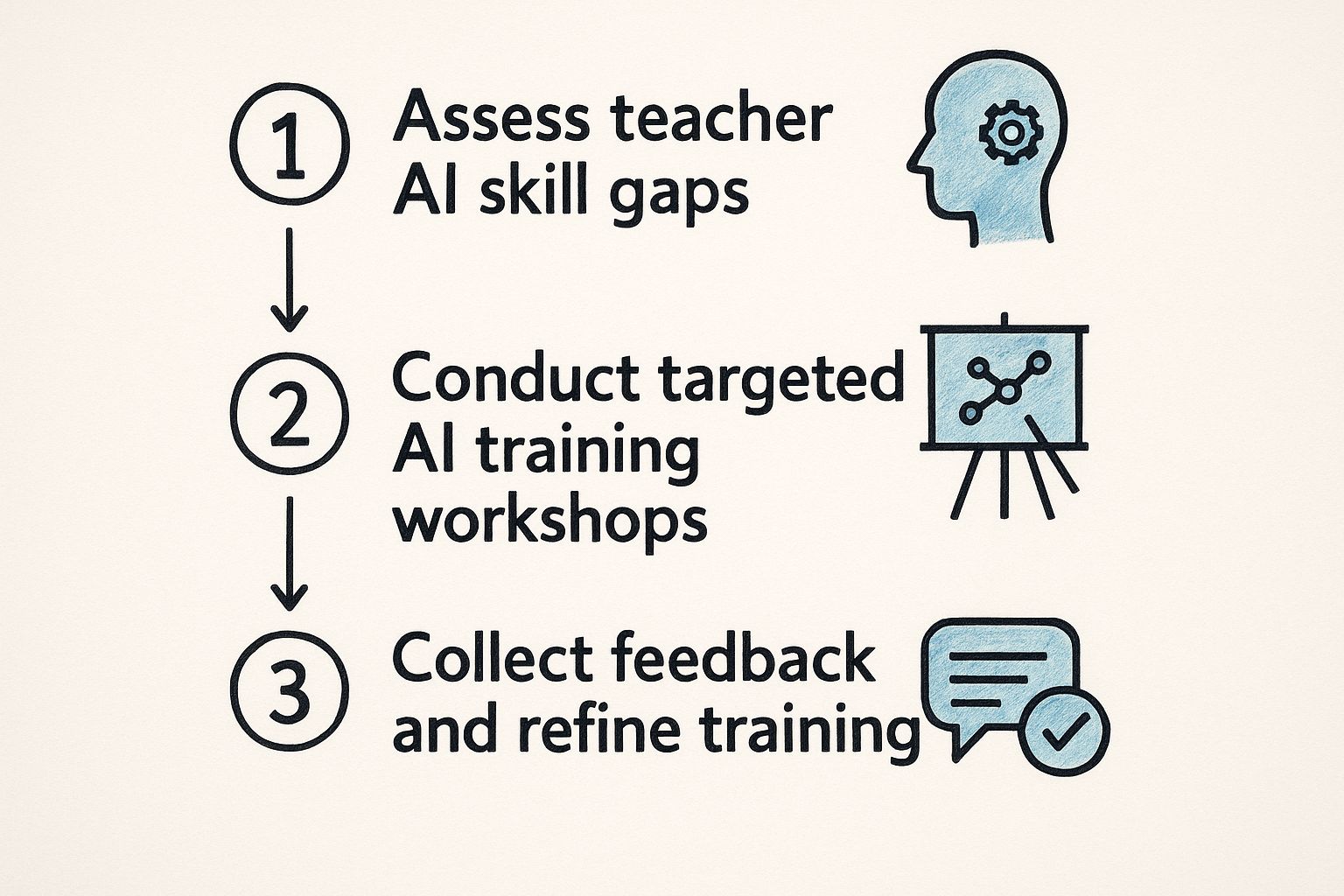
This simple cycle of assessing needs, providing hands-on training, and gathering feedback is what turns a one-off tech purchase into a genuine long-term capability for your school. It ensures your team’s skills evolve right alongside the technology.
Navigating the Ethical Landscape of AI in Education
Bringing AI into your school’s marketing is a big step. And while the potential is exciting, it’s not something to jump into without a serious look at the ethical side of things. With great power comes great responsibility, as they say. When we start automating communication and digging into data, we’re wading into complex territory, especially since we’re dealing with information about children and their families.
This isn’t just about ticking compliance boxes. It's about earning and keeping the trust of your community. Every school leader needs to become a champion for using AI responsibly. That means asking tough questions, drawing firm lines in the sand, and making sure these tools serve your mission—not undermine it. Protecting student privacy and ensuring fairness aren't just best practices; they're your fundamental duty.
Protecting Student Data Privacy
First and foremost, you have to be a fierce guardian of student data. This is the number one ethical priority. When you use an AI tool to personalize an email campaign or analyze website traffic, you're handling sensitive information about families. This data requires the highest level of care, well beyond just a strong password.
Before signing on with any AI vendor, you need to put their privacy standards under a microscope. Ask them direct, pointed questions: How is our data stored? Who has access to it? How is it being used by your platform? Make absolutely certain their policies align with federal regulations like COPPA (Children's Online Privacy Protection Act) and FERPA (Family Educational Rights and Privacy Act).
A recent report from Stanford and Common Sense Media drives this point home, flagging the risks AI can introduce for minors, from mental health impacts to a "blurring of reality." This is a stark reminder that schools must act as vigilant gatekeepers for any technology they bring into their community.
Creating an internal AI usage policy isn't optional—it's essential. This document should spell out exactly what data you can use, who on your team can access it, and for what specific marketing purposes. Think of it as your North Star, guiding your team to make sure everyone understands their ethical obligations.
Confronting Algorithmic Bias
An AI is only as smart or as fair as the data we feed it. If your historical data has biases baked into it—and most data does—the AI will learn those biases and, worse, amplify them. In school marketing, this can have very real consequences, like accidentally shutting out entire groups of prospective families from your outreach.
Imagine this scenario: Your past enrollment data skews heavily toward families from one or two specific neighborhoods or socioeconomic brackets. An AI trained on this data might logically conclude that it should focus all its energy on finding more families just like them. It could inadvertently ignore qualified, mission-fit students from other communities, creating an echo chamber that works directly against your diversity goals.
The only way to fight this is to actively look for it. You have to regularly audit your AI's performance. Review the results of your AI-powered campaigns and ask the hard questions. Are we genuinely reaching a diverse cross-section of our community? Do our automated messages feel inclusive to everyone? This is where you absolutely need a human in the loop, someone who can review the AI’s work and make sure it aligns with your school’s core values of equity and inclusion.
Keeping the Human Touch
This might be the trickiest ethical tightrope to walk. The whole point of AI is efficiency through automation, but you run the risk of automating the humanity right out of your relationships.
Families don't choose a school based on programs alone. They choose it for the feeling, the community, the culture. A chatbot is great for answering questions about tuition deadlines, but it can't offer the reassuring and empathetic ear of an admissions director. An automated email can deliver information flawlessly, but it lacks the warmth and personality of a real follow-up call from a human being.
The goal is to use AI to augment your team, not automate your relationships. It’s a tool to free up your people to do more of what they do best: connect with other people.
Here’s how you can strike that balance:
- Handle Complex Queries Personally: Let chatbots handle the simple, repetitive stuff. But create a system where any complex, sensitive, or emotional question is immediately flagged and routed to a real person.
- Follow Up with a Personal Touch: After an automated message goes out, have a team member make a personal phone call or even send a handwritten note to families who seem particularly interested. That personal effort stands out.
- Use AI for Insights, Not Decisions: Let the AI do the heavy lifting on data analysis to uncover trends and insights. But the final strategic decisions? Those must be made by your team, filtered through a lens of human experience, empathy, and judgment.
The Future of School Communications Powered by AI

The role of AI in education is quickly evolving from a behind-the-scenes administrative tool to a forward-looking strategic partner. What we're seeing today is just the first wave. In the next three to five years, AI won't just make your communications more efficient; it will help you actively anticipate and shape your school’s future.
Think beyond simply analyzing last year’s enrollment numbers. Soon, predictive analytics will be able to forecast future enrollment trends with remarkable accuracy. These systems can pinpoint which student profiles are most likely to enroll and succeed, letting your admissions team focus its energy with precision long before application season kicks off.
This isn't just wishful thinking—it's backed by serious investment. The global EdTech market is on track to reach $404 billion by 2025, a surge fueled almost entirely by AI breakthroughs. That represents a 16.3% compound annual growth and sends a clear message: AI is becoming fundamental to how schools operate. You can dig deeper into these accelerated AI education market projections to see what this shift means for schools like yours.
Beyond Text and into Visuals
As we look ahead, the integration of powerful AI content creation tools is set to completely change how schools connect with their communities. The next big thing? Dynamic video. Before long, AI will give your marketing team the ability to generate personalized video messages or create immersive virtual tours using just a few text prompts and a bank of school photos.
This opens up fantastic new ways to connect with families who can't visit in person. Imagine giving them a rich, customized look into your school’s unique culture and community from anywhere in the world.
A Hyper-Personalized Parent Experience
The impact on current families will be just as profound. Think about a parent portal where the experience is genuinely personalized, with content curated for each family's specific situation.
The Goal of AI: It's not about replacing the human touch; it's about amplifying it. By taking on complex data analysis and repetitive tasks, AI frees up your team's most valuable resource—time to build real, lasting relationships with students and families.
This kind of smart portal would know which sports your child plays, the clubs they've joined, and the subjects they're finding tough. It would then proactively serve up relevant news, event reminders, and helpful academic resources, making parents feel more connected and in-the-loop than ever.
This is the real promise of AI in education. It's a powerful partner built to enhance your school’s mission, not to replace it. By embracing these tools with care, you empower your team to focus on the human connections that have always been at the very heart of a great school.
Your Questions Answered
Diving into the world of AI in education naturally brings up a lot of questions. As school leaders think about folding these powerful tools into their marketing and communications, it's completely normal to have concerns about everything from cost to complexity. This FAQ section cuts through the noise to give you clear, straightforward answers to the questions we hear most often.
Think of this as your practical guide to getting started. We want to demystify the process so you can feel confident exploring what AI can do for your school's outreach.
Is AI Too Expensive for a School Budget?
This is probably the biggest myth out there. While some massive, enterprise-level AI systems can have a hefty price tag, many of the most useful tools for schools are surprisingly affordable. Some even have free versions to get you started. The trick is to begin small with tools that solve a specific, nagging problem, like drafting social media posts or brainstorming newsletter content.
The real conversation isn't about cost, but about return on investment (ROI). Ask yourself: if a $50 per month tool saves your communications director 10 hours of work, isn't that a huge win? You're not just buying software; you're buying back precious time for your team to focus on strategy and building relationships.
Will AI Replace Our Marketing Team?
No, and it's important to be clear about this. The purpose of AI in a school setting is to augment your team, not replace it. It’s best to think of AI as a tireless assistant, one that can handle the repetitive, time-draining tasks that often bog down your talented people.
By automating the routine work, AI frees up your team to focus on what humans do best: strategic thinking, creative problem-solving, building genuine connections with families, and telling the unique story of your school. It actually elevates their roles and makes their work more impactful.
Do We Need an IT Expert to Use These Tools?
Definitely not. You don't need a computer science degree to get real value from these platforms. The best AI marketing tools are built for communicators and marketers, not data scientists. They’re designed with user-friendly dashboards, simple instructions, and helpful customer support.
Honestly, the learning curve for most of these tools is pretty gentle. If you're comfortable using platforms like Mailchimp or Hootsuite, you already have the skills you need to learn a modern AI writing assistant or chatbot builder. The focus is always on practical use, not technical know-how.
How Can We Ensure AI Is Used Ethically?
This is the most important question of all. Protecting student data and communicating fairly must always be the top priorities. The first step is to thoroughly vet any AI vendor you're considering. Dig into their data privacy and security policies to make sure they are fully compliant with regulations like FERPA and COPPA.
Next, create a clear internal policy for your team that spells out exactly how these tools can and cannot be used. And crucially, always keep a human in the loop. Someone on your team should regularly review AI-generated content to check for hidden biases and ensure every message perfectly reflects your school's values of equity and inclusion.
Ready to lead the charge and confidently bring AI into your school's strategy? The MarCom Society offers the expert guidance, peer support, and practical resources you need. Join our community of K-12 marketing professionals to access exclusive workshops, expert sessions, and a network dedicated to navigating the future of school communications, together.