In the competitive landscape of K-12 education, families aren't just choosing a curriculum; they're choosing a community, a vision, and a future for their children. This is where brand storytelling moves beyond simple marketing and becomes your most critical asset. A compelling narrative can capture hearts and minds, building an emotional connection that data sheets and test scores alone cannot. It transforms your school from an institution into a living, breathing community that prospective families want to join.
This article explores seven iconic brand storytelling examples, breaking down their strategies into actionable takeaways specifically for K-12 marketing and communications professionals. We won't just look at what these brands did; we'll dissect how they did it and what lessons you can apply directly to your school's unique mission.
You will learn how to:
- Frame your school's journey to connect with prospective parents.
- Communicate your core values in a way that resonates emotionally.
- Build a loyal community that feels a sense of belonging.
From Nike's hero narrative to Patagonia's mission-driven activism, we'll uncover the mechanics behind powerful brand stories. We’ll show you how to engage your community, drive enrollment, and make your school’s story unforgettable. To solidify these connections, explore the power of custom promotional giveaways that create tangible connections, embedding your brand's story into everyday life. Let's dive into the examples.
1. Nike's "Just Do It" Hero's Journey
Nike has mastered one of the most powerful brand storytelling examples by consistently casting the customer, not the product, as the hero. Their "Just Do It" ethos is a classic execution of the hero's journey narrative. Instead of highlighting shoe technology or fabric breathability, Nike tells stories of struggle, perseverance, and ultimate triumph. This approach transforms athletic apparel into a tool for achieving personal greatness.
The brand's campaigns, from Michael Jordan’s origin story to Serena Williams' comeback narratives and the controversial Colin Kaepernick 'Dream Crazy' ad, all follow a similar three-act structure: a challenge is presented, the hero struggles against adversity, and they emerge victorious. By focusing on this emotional transformation, Nike creates a deep, values-based connection with its audience, making consumers feel like part of a larger movement of determination.
Strategic Analysis & Takeaways for Schools
For K-12 marketing professionals, Nike’s strategy offers a powerful blueprint. Your school’s "product" is education, but your story is about student transformation. Frame your students as the heroes of their own educational journeys.
- Focus on the Journey: Showcase student stories that highlight overcoming academic challenges, personal growth through extracurriculars, or finding a passion.
- Embrace the Three-Act Structure: Tell stories that follow a clear arc: the challenge (e.g., a difficult concept), the struggle (e.g., late-night studying, getting help from a teacher), and the triumph (e.g., acing the test, mastering the skill).
- Be Authentic: Just as Nike spotlights real athletes, use authentic testimonials and stories from your actual students, faculty, and alumni.
This bar chart illustrates the monumental revenue growth Nike experienced since launching its iconic storytelling campaign.
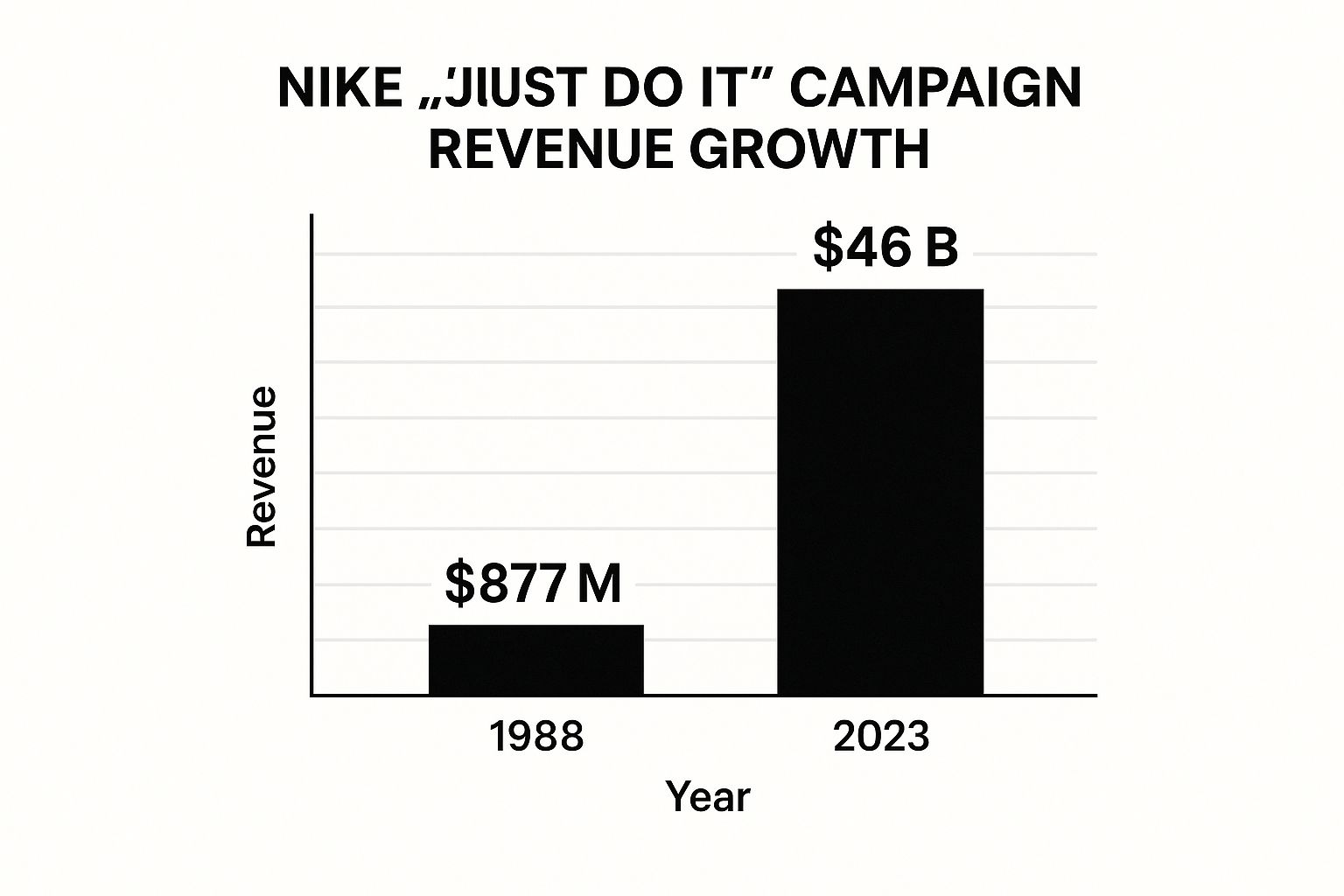
The data visualizes how a consistent, powerful brand narrative directly correlates with long-term financial success, growing from under a billion to over $46 billion. To further understand how powerful narratives drive commercial success, explore more examples of effective advertising. For schools, this means investing in storytelling can build a brand that attracts families for generations. Learn more about how to apply these concepts with these school branding strategies.
2. Apple's Simplicity and Innovation Narrative
Apple has built one of the most valuable brands in history by telling a consistent story of simplicity, creativity, and challenging the status quo. Instead of leading with technical specifications, Apple's narrative focuses on the "why" behind its products. Their story casts the brand as a thoughtful innovator and the user as a creative genius, freed from the complexity of traditional technology. This approach transforms a phone or computer from a simple tool into a key that unlocks human potential.
From the iconic "Think Different" campaign celebrating rebels and misfits to Steve Jobs' masterfully simple product keynotes, the story remains the same: Apple creates elegant solutions for complex problems. The famous "Mac vs. PC" ads didn't debate processing power; they personified the Mac as cool, creative, and hassle-free, directly contrasting it with the stuffy, complicated PC. This narrative frames choosing Apple as a lifestyle and identity choice, not just a hardware purchase, making it one of the most effective brand storytelling examples.
Strategic Analysis & Takeaways for Schools
For school marketers, Apple’s strategy demonstrates the power of simplifying the message and focusing on the experience. Your school offers a complex ecosystem of programs, faculty, and facilities, but your story should be about the simple, powerful outcome: a prepared, inspired, and successful student.
- Lead with the 'Why': Don’t just list your AP courses or athletic championships. Start by explaining why your approach to education matters and how it shapes students' futures.
- Focus on Emotional Benefits: Describe the feeling of discovery in a science lab, the confidence gained on the debate stage, or the sense of belonging in the school community. These are the emotional benefits that resonate with families.
- Use Simple, Jargon-Free Language: Avoid educational jargon. Communicate your school's value in clear, accessible, and human terms that every parent can understand and connect with.
This approach helps differentiate your school in a crowded market. You can explore how to better articulate these benefits through powerful imagery by reading up on visual storytelling techniques. By focusing on clarity and emotion, your school's brand can become synonymous with a transformative and empowering educational experience.
3. Dove's Real Beauty Campaign
Dove shifted the entire beauty industry's narrative by moving away from aspirational, unattainable ideals and focusing on authenticity. Their "Real Beauty" campaign is a masterclass in purpose-driven brand storytelling, creating a powerful emotional connection by celebrating the diverse beauty of real women. Instead of selling soap with supermodels, Dove sold self-esteem, turning a simple product into a symbol of a cultural movement.

The brand’s landmark initiatives, like the viral "Real Beauty Sketches" video and billboard campaigns featuring women of all shapes, sizes, and ages, challenged conventional norms. Dove’s storytelling centered on a single, powerful conflict: the gap between how women perceive themselves and their true beauty. By addressing this internal struggle head-on, Dove didn't just sell products; it built a community and fostered a global conversation, making it one of the most impactful brand storytelling examples in modern marketing.
Strategic Analysis & Takeaways for Schools
For school marketers, Dove’s strategy demonstrates the power of aligning your brand with a core, human value. Your school isn't just a building with classrooms; it's a place where students develop their identity and self-worth. Your story should reflect this deeper purpose.
- Champion a Core Value: Instead of just promoting academic rigor, tell a story about fostering confidence, resilience, or intellectual curiosity. Let this value guide your messaging.
- Show, Don't Tell: Use authentic student, parent, and faculty testimonials. Feature real, unscripted moments from campus life rather than staged photos. Show the diverse range of students who thrive in your community.
- Create a Movement: Build your narrative around a central mission that families can believe in and want to join. This transforms enrollment from a transaction into a shared commitment to a set of values.
4. Patagonia's Environmental Activism Story
Patagonia has built one of the most authentic brand storytelling examples by weaving its core mission, environmental activism, into every facet of its identity. Instead of a secondary marketing message, their commitment to "save our home planet" is the central plot. The brand's narrative is not about selling outdoor gear; it's about using business to inspire and implement solutions to the environmental crisis. This story is told through radical actions, not just words.
Their iconic "Don't Buy This Jacket" ad, which ran on Black Friday, is a prime example of this counterintuitive storytelling. It urged consumers to consider the environmental cost of consumption, reinforcing Patagonia's values even at the risk of short-term sales. Other story points, like donating 1% of sales to environmental causes, funding documentaries, and suing the government over environmental rollbacks, prove their commitment is real. This consistency makes their brand story incredibly powerful and trustworthy.
Strategic Analysis & Takeaways for Schools
For K-12 marketing leaders, Patagonia's model demonstrates how to build a brand around a core mission and values, creating a deeply loyal community. Your school’s story can be about its unique mission, whether that’s service learning, STEM innovation, or arts integration. The key is to live that story authentically.
- Align Actions with Messaging: If your school’s mission is community service, your marketing stories should feature students and faculty actively participating in service projects. Every piece of content should reinforce this central value.
- Embrace Your Values: Don’t be afraid to take a stand on what matters to your school community. This authenticity attracts families who share those values, creating a stronger, more engaged enrollment base.
- Empower Your Community: Patagonia engages its employees and customers in its activism. Involve your students, parents, and faculty in living out your school’s mission and let them be the storytellers.
5. Airbnb's Belonging Everywhere Story
Airbnb shifted its brand narrative from a transactional service for booking rooms to a powerful story about fostering human connection and community. Instead of focusing on the functional aspects of lodging, their storytelling centers on the universal desire to "Belong Anywhere." This approach transforms travel from a simple tourist activity into an opportunity for authentic, culturally immersive experiences.
The brand brilliantly uses its community of hosts and guests as the main characters. Through host story documentaries, the "We Accept" inclusion campaign, and user-generated content, Airbnb tells a consistent story that you aren't just renting a space; you are being welcomed into a home and a community. This emotional narrative is one of the most effective brand storytelling examples because it taps into a fundamental human need, creating a loyal following that sees Airbnb as a facilitator of meaningful experiences.
Strategic Analysis & Takeaways for Schools
For K-12 schools, Airbnb’s strategy demonstrates how to build a brand around the emotional benefit of community, not just the functional benefit of an education. Your story isn't just about classrooms and curriculum; it's about creating a place where every student, parent, and faculty member feels they belong.
- Focus on Community: Highlight stories that showcase your school as a welcoming and inclusive community. Feature testimonials from new families who felt immediately accepted or students who found their "tribe."
- Leverage User-Generated Content: Encourage parents, students, and alumni to share their stories and experiences on social media using a unique school hashtag. Repurpose this content to create authentic marketing materials.
- Emphasize Emotional Benefits: Your messaging should focus on the feeling of belonging, friendship, and support that your school provides, rather than just academic outcomes.
By building a narrative around a strong, welcoming community, schools can attract families looking for more than just an education; they're looking for a home. To explore this concept further, discover these effective community-building strategies.
6. Coca-Cola's Happiness and Unity Narrative
Coca-Cola has cemented its place in marketing history by building its entire brand story around the universal human desires for happiness, unity, and shared moments. Instead of focusing on the taste or ingredients of their product, they sell an emotion. Their narrative positions a simple beverage as a catalyst for connection, transcending cultural, social, and generational divides to bring people together.
This consistent theme is one of the most enduring brand storytelling examples. It is evident across decades, from the iconic 1971 'I'd Like to Buy the World a Coke' ad that promoted global harmony, to the modern 'Share a Coke' campaign that personalized connection, and the annual 'Holidays Are Coming' advertisements that have become synonymous with festive joy. Coca-Cola doesn’t sell a drink; it sells the feeling of opening happiness and sharing it with others, making its brand a symbol of optimism and togetherness.
Strategic Analysis & Takeaways for Schools
For K-12 schools, Coca-Cola's strategy demonstrates the power of owning a core human value. Your school isn't just a building with classrooms; it's a community that fosters belonging, friendship, and shared achievement. Your brand story should reflect this emotional core.
- Own a Universal Value: Define the core emotion your school community embodies. Is it curiosity, collaboration, resilience, or compassion? Build your stories around this central theme.
- Create Shared Moments: Highlight events and traditions that bring your community together, such as spirit week, science fairs, holiday concerts, or graduation. Frame these as cherished, unifying experiences.
- Showcase Connection: Your marketing materials should feature authentic interactions between students, teachers, and parents. Use visuals and stories that portray your school as a place where lasting bonds are formed.
7. Red Bull's Extreme Adventure Content Story
Red Bull provides one of the most compelling brand storytelling examples by transcending its product category entirely. Instead of marketing an energy drink, the company built a global media empire around the concept of pushing human potential. Red Bull doesn't just sponsor extreme sports; it creates, produces, and distributes high-octane content that embodies its brand ethos of "giving you wings." This content-first strategy positions the drink as the fuel for an extraordinary, high-energy lifestyle.
The brand's groundbreaking projects, like the Felix Baumgartner 'Stratos' space jump, and its ownership of entities like the Red Bull Racing Formula 1 team are not advertisements; they are the story. By establishing the Red Bull Media House, the company produces feature-length films, documentaries, and digital series that audiences actively seek out. This positions Red Bull as an entertainment provider, not just a beverage company, creating a powerful brand halo effect that drives product sales organically.
Strategic Analysis & Takeaways for Schools
For schools, Red Bull’s model demonstrates the power of becoming a content hub for your community’s passion points. Your "product" is education, but your story is what happens because of it. Instead of just promoting your school, create content that provides genuine value and entertainment related to your educational niche.
- Become a Media Hub: Create content that showcases your school's unique strengths beyond the classroom. If you have a strong arts program, produce a documentary on your students' creative process. If you excel in STEM, launch a YouTube series featuring student-led experiments.
- Invest in Quality: Red Bull is known for its high production values. While schools don't need Hollywood-level budgets, investing in good audio and video quality shows you value your community and their stories.
- Tell Stories of Ambition: Focus on narratives of students and faculty pushing boundaries, whether in academics, athletics, or community service. Frame your school as the place where ambitious goals are not just encouraged but achieved.
Brand Storytelling: 7 Iconic Campaigns Compared
| Brand / Campaign | Implementation Complexity | Resource Requirements | Expected Outcomes | Ideal Use Cases | Key Advantages |
|---|---|---|---|---|---|
| Nike's "Just Do It" Hero's Journey | High – requires scripted storytelling and authentic content | Significant investment in content production | Deep emotional loyalty; strong brand growth | Brands seeking emotional hero narratives | Memorable, shareable content; broad appeal |
| Apple's Simplicity and Innovation | Moderate – focused, minimalist storytelling | High for innovation and product design | Premium perception; cult-like loyalty | Tech brands emphasizing innovation and design | Strong differentiation; generates buzz |
| Dove's Real Beauty Campaign | Moderate – requires authentic representation | Ongoing social cause integration and campaigns | Genuine emotional connection; social impact | Brands addressing social issues and inclusion | Builds community and brand advocates |
| Patagonia's Environmental Activism | High – transparent activism and reporting | Significant commitment to environmental causes | Strong trust and loyal customer base | Purpose-driven brands with sustainability focus | Authenticity and strong differentiation |
| Airbnb's Belonging Everywhere Story | Moderate – user-generated and curated stories | Continuous content creation and community engagement | Emotional differentiation; scalable growth | Platforms focusing on community and experiences | Builds strong community and user advocacy |
| Coca-Cola's Happiness and Unity | Moderate – consistent global messaging | Extensive, culturally adaptive campaigns | Positive brand associations; global consistency | Global brands emphasizing universal values | Transcends cultures; emotionally resonant |
| Red Bull's Extreme Adventure | High – large scale multimedia content | Massive investment in media production | Engaging, shareable content; earned media value | Brands targeting active, adventurous demographics | Strong brand association with performance |
Crafting Your School's Next Chapter
The diverse collection of brand storytelling examples we have analyzed, from Nike’s aspirational hero’s journey to Patagonia’s mission-driven activism, illuminates a powerful, universal truth. The most resonant brands don't just sell products or services; they invite audiences into a shared story built on genuine human emotion and core values. They transform consumers into advocates by making them feel seen, understood, and part of something bigger than themselves.
For leaders in K-12 education, this lesson is profoundly relevant. Your school is not just an institution; it's a dynamic ecosystem of transformation, community, and purpose. The strategic breakdowns of giants like Apple and Dove show that the most compelling narratives are often the simplest and most authentic. Your story isn't hidden in rankings or facility specs. It lives in the "aha" moment in a classroom, the collaborative spirit on the athletic field, and the supportive network that empowers a student to overcome a challenge.
Distilling Your School's Core Narrative
The critical first step is to move beyond features and focus on the fundamental "why." Why does your school exist? What is the unique transformation you offer students?
- Identify Your Archetype: Are you the Sage, imparting wisdom (like Apple)? The Hero, empowering students to achieve greatness (like Nike)? Or the Caregiver, nurturing a supportive community (like Dove)? Defining this helps create a consistent emotional tone.
- Find Your Central Conflict: Every good story needs tension. Is your school's story about overcoming traditional educational models, preparing students for an uncertain future, or fostering inclusivity in a divided world? This conflict gives your narrative purpose.
- Empower Your Community as Storytellers: As Airbnb demonstrated, the most authentic stories often come from the community itself. Your students, teachers, alumni, and parents are your most credible storytellers. Create platforms and opportunities for them to share their experiences in their own words.
Putting Storytelling into Action
Mastering the art of storytelling requires a strategic shift from broadcasting information to building connections. It’s about showing, not just telling. This means translating your core narrative into tangible, consistent content and experiences across every touchpoint, from your website’s homepage to your social media feeds and campus tours.
By weaving a consistent and authentic narrative, you do more than just market your school. You build a powerful brand identity that attracts right-fit families, boosts faculty morale, and fosters a deep, lasting sense of community pride. You give prospective parents a reason to believe in your mission and current families a reason to champion it. The journey to becoming a story-driven brand begins today, with the simple act of asking: what is the story only we can tell?
Ready to move from theory to practice and become a master storyteller for your school? The MarCom Society provides a dedicated community and expert-led resources specifically for K-12 marketing professionals. Join us to access exclusive workshops, connect with peers, and gain the strategic tools needed to transform your school's narrative. Learn more and become a member today.