
A case of support is your school's foundational story. It’s the compelling, evidence-based argument explaining exactly why your organization deserves philanthropic investment. It weaves together your mission, your vision, and your most pressing needs into a single, powerful narrative designed to inspire donors to act.
What Is a Case of Support and Why It Matters

Think of your case of support as the central nervous system for your entire fundraising operation. It isn't just one brochure or a paragraph on your website. It’s the core message that fuels every appeal letter, every grant proposal, and every conversation you have with a potential supporter.
This is what provides a consistent, clear, and resonant answer to the one question every donor asks: “Why should I give to you?”
A well-crafted case of support goes way beyond just stating your mission. It builds an undeniable argument for support by artfully combining three key elements:
- Emotional Connection: It tells human-centered stories that show the real-world impact of your work on students and teachers.
- Logical Argument: It presents clear data and solid evidence to prove a need and outline a credible plan to address it.
- Urgent Call to Action: It defines the specific problem your fundraising will solve and what’s at stake if that goal isn't met.
More Than Just a Document
Before your case of support ever reaches a donor, it serves as a critical internal alignment tool. The process of creating it forces your leadership team, board members, and staff to get on the same page about priorities, goals, and messaging.
That unified front is absolutely essential for building trust and credibility with your community. It’s the strategic blueprint ensuring everyone is telling the same powerful story, creating a cohesive and persuasive fundraising effort from the ground up.
A strong case of support transforms your fundraising from a simple request for money into an invitation for donors to become partners in a shared vision for the future. It repositions the "ask" as an opportunity for meaningful impact.
Building Your Professional Story
The concept isn't so different from an individual building a resume to argue their value to an employer. In the same way, your organization builds a case of support to argue its value to donors.
To see the parallels in persuasive storytelling, it helps to understand how to create a CV that truly stands out. The core principles are the same: clarity, evidence of impact, and a compelling narrative that commands attention.
This strategic, evidence-based approach is gaining serious traction. In fact, the broader case management market is projected to grow from USD 8.01 billion in 2025 to USD 12.4 billion by 2029, a clear sign that structured, evidence-based arguments are becoming the standard.
The Four Pillars of a Powerful Narrative
A truly effective case of support isn't just a list of facts and figures. It’s a compelling story, carefully built to connect with donors emotionally and intellectually. To tell a story that genuinely resonates, you need to anchor it in four essential pillars. Each one answers a critical question that's already in your donor's mind, creating a natural flow that makes your funding request feel both urgent and inspiring.
Think of these pillars as the essential chapters of your school's story. If you skip one, you leave a gaping hole in the plot, which can confuse your audience and weaken your entire argument. But when you build them together, they create a rock-solid foundation for your whole fundraising strategy.
This infographic breaks down how a case of support delivers value by weaving together emotional connection, practical aid, and community growth.
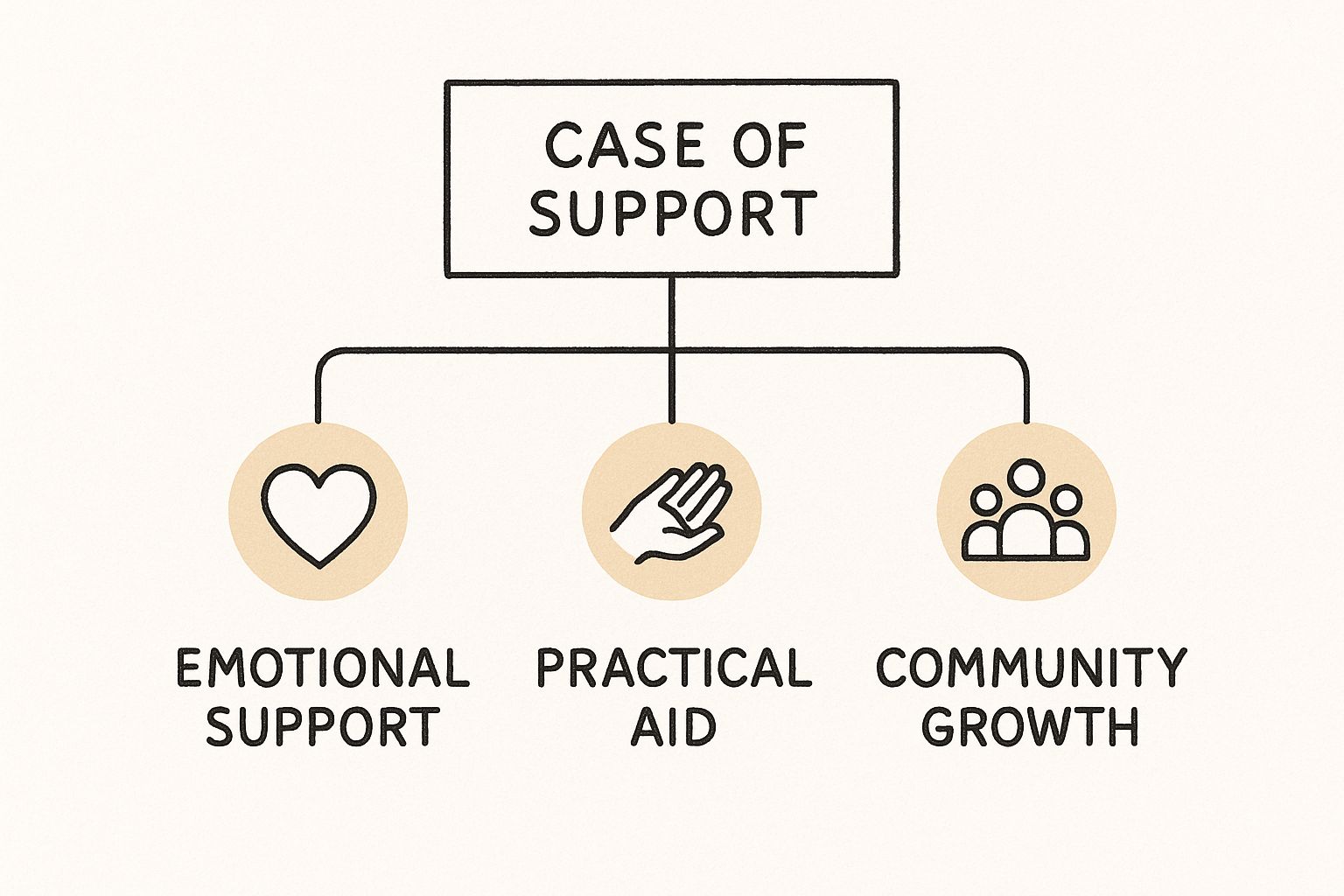
As you can see, a powerful case for support is about so much more than money. It’s about making a multifaceted argument that speaks to the needs of your entire school community.
To build that argument, let's break down the four pillars that every great case of support is built upon. Each one answers a distinct question, guiding your potential donor on a journey from inspiration to action.
The Four Pillars of a Case of Support
| Pillar | Key Question It Answers | Content to Include |
|---|---|---|
| The Vision | "Where are we going?" | A vivid, aspirational picture of the future you want to create for your students and community. Go beyond the day-to-day and paint the big picture. |
| The Need | "What is standing in our way?" | The specific, data-backed problem or opportunity that prevents you from reaching your vision. This is the gap between where you are and where you want to be. |
| The Solution | "What is your plan?" | Your concrete, well-researched plan to solve the problem. Detail the specific programs, projects, and initiatives you will implement. |
| The Impact | "What will my donation accomplish?" | The tangible, measurable outcomes that will result from the donor's investment. This is the return on their philanthropic gift, shown in real-world results. |
By addressing these four areas in order, you create a logical and emotional throughline that makes supporting your school feel like an obvious choice. Now, let’s look at each pillar more closely.
Pillar 1: The Vision
This first pillar answers the exciting question: “Where are we going?”
Your vision is the aspirational, big-picture future you’re working to create for your students and community. It’s the dream. Don’t just describe what your school does today; you need to paint a vivid picture of what it could be with the right resources.
For instance, a vision isn't just "to have a better science lab." It's "to become a hub of STEM innovation where every student has the hands-on experience to become a future scientist, engineer, or inventor." This story-driven approach makes your goals feel significant and compelling. If you're looking for inspiration, checking out some powerful brand storytelling examples can help you frame your own vision in a much more engaging way.
Pillar 2: The Need
The second pillar gets down to business, answering the urgent question: “What is standing in our way?”
Here, you move from the dream to the reality. This is where you clearly define the specific, pressing problem or opportunity that fundraising will solve. It’s the gap between where you are now and the vision you just laid out. Use hard data and real-world examples to make the need feel undeniable.
A need isn’t vague, like “our technology is outdated.” It’s specific: “45% of our classroom computers are over seven years old and can’t run the software required for state-mandated digital literacy programs.”
A clearly defined need creates a sense of urgency. It frames the problem in a way that makes the donor feel their contribution is not just helpful, but necessary.
Pillar 3: The Solution
The third pillar provides the reassuring answer to: “What is your plan?”
Once you've established a compelling need, you have to follow it up with a credible solution. This is your chance to detail the specific programs, projects, or initiatives that will fix the problem you’ve outlined. Your solution has to be realistic, well-planned, and directly tied to the need.
- Be Specific: Don't say, "we will buy new equipment." Instead, explain, "we will purchase 30 new laptops and 15 interactive whiteboards."
- Show Your Work: Briefly mention the research or planning that went into choosing this particular solution. It shows you've done your homework.
- Outline the Cost: Provide a clear, transparent budget. Donors need to see exactly where their money is going.
Pillar 4: The Impact
Finally, the fourth pillar answers the most important question of all: “What will my donation accomplish?”
This is where you bring the story full circle. Describe the tangible, measurable outcomes that will happen because of a donor's investment. Impact is the return on their philanthropic investment. It’s the proof that their contribution will make a real, lasting difference in the lives of students.
Instead of saying donors will "help students learn," show them the impact: "Your gift will enable 250 students per year to complete coding certifications, preparing them for high-demand careers and increasing their future earning potential." This connects all the dots, from the initial vision right through to real-world change.
How to Weave Data and Stories Together

Facts give your case of support its logical backbone, but it's the stories that build an emotional bridge to your donors. A truly powerful narrative does more than just present information; it masterfully blends hard data with real human experience, creating a message that is both credible and impossible to ignore.
Think of it like building a house. Your data is the concrete foundation and the steel frame—the essential structure proving your plan is sound and your project is viable. The stories, on the other hand, are the windows and doors that let people see inside, allowing donors to connect with the very individuals their gift will help. You need both to build something that not only stands strong but also feels like a place someone can call home.
This all comes down to combining the "what" with the "why." The "what" is your quantitative data: program costs, student performance stats, or facility upgrade needs. The "why" is the qualitative proof that brings it all to life: a single student's breakthrough moment, a teacher's heartfelt testimonial, or a parent's simple expression of gratitude.
Gathering Your Narrative Ingredients
To get this blend right, you need to collect both types of evidence. Start by pinpointing the data points that most powerfully illustrate your school's need and the incredible potential for impact. At the same time, begin gathering authentic, personal stories that make those numbers breathe.
Here’s a simple way to think about collecting your key ingredients:
- Find the Data: Look for statistics that clearly frame the problem. Instead of a vague statement like "our library is old," you could say that "60% of our books were published before the year 2000." It’s specific and impactful.
- Find the Story: Go talk to a student who discovered a love of reading in that very library, despite its limitations. Capture their excitement, their curiosity, and their dreams for the future.
- Connect Them: Now, weave them together. "While 60% of our library's collection is over two decades old, students like Maria still find magic between the pages. Just imagine what she could achieve with resources that match her ambition."
Positioning the Donor as the Hero
In fundraising, the most effective storytelling technique doesn't just ask the donor to watch from the sidelines. It invites them to become the central character who makes the happy ending possible. Your case of support should be an open invitation for them to step into the story and be the hero.
Your narrative should frame the donor's gift as the key that unlocks potential. It’s not just a donation; it's the specific action that enables a student to succeed, a teacher to innovate, or a community to thrive.
This push for evidence-based narratives is happening everywhere. Take the case management software market, for example, which was valued at USD 7.32 billion in 2023 and is projected to hit USD 15 billion by 2030. This growth, detailed in market analysis from platforms like Precedence Research, shows just how much value is placed on organizing information into a compelling case for action.
By weaving your data and stories together, you're not just asking for a handout—you're presenting an undeniable investment opportunity.
Designing Your Document for Maximum Impact
You can have the most powerful story in the world, but it will fall flat if it’s buried in a cluttered, uninspired document. The design of your case of support isn't just decoration; it’s a critical part of the message itself. A clean, professional look tells a donor you're competent and you care, building trust before they’ve even read a single word.
Think of your document's layout as the stage where your story unfolds. You need to shine a spotlight on the most important points, making it incredibly easy for donors to follow along. This means using visual elements to break up the text and guide them through your argument.
Crafting a Visually Compelling Narrative
Let's be honest: your donors are busy. A massive wall of text is an instant turn-off. Your goal is to make the document scannable and easy to digest, using smart formatting to highlight key information and give the reader’s eyes a break.
- High-Impact Photography: Use authentic, high-quality photos of your actual students and teachers. Ditch the generic stock photos. Real faces build real connections.
- Strategic White Space: Don't be afraid of empty space! Ample margins and spacing make the content feel much more approachable and less intimidating.
- Brand-Aligned Colors: Stick to your school’s color palette. This reinforces your identity and creates a polished, cohesive look that screams professionalism.
These design principles are non-negotiable, whether you're creating a detailed internal document or a glossy PDF for a major capital campaign. In fact, this same focus on clear, persuasive presentation is a cornerstone of many funding requests. It can be really helpful to look at a guide to writing winning grant proposals because they often master the art of combining strategic storytelling with smart design.
Structuring for Readability
Beyond the aesthetics, the very structure of your document can make or break its effectiveness. The right formatting ensures your key messages don't just get read—they get remembered.
Use pull quotes to lift powerful statistics or compelling testimonials right out of the main text. This is a classic design trick for a reason: it grabs the reader’s eye and makes your most persuasive points impossible to miss.
Use clear, descriptive headings and subheadings as signposts, letting readers know exactly what's coming next. Keep your paragraphs short and punchy—two or three sentences, tops. This maintains momentum and makes reading easier, especially on a screen.
For those also working on grant proposals, you'll find these design principles are just as vital there. You can dig deeper into these techniques in our guide on grant writing for schools. When you combine a powerful story with thoughtful design, your case of support will finally look as good as it sounds, making the biggest possible impact on every donor you reach.
Putting Your Case of Support Into Action

A well-crafted case of support isn’t a document you create once and then file away. It's a living, breathing messaging toolkit that’s meant to be used, pulled apart, and put back together across every single one of your school’s fundraising efforts. Its real power is only unlocked when you start putting it to work.
Think of it as your central message bank. From this bank, you can withdraw the exact stories, stats, and talking points you need for any situation. This ensures your school’s narrative stays consistent and powerful, no matter who you’re talking to or what platform you’re using.
This kind of consistency is what builds trust and momentum. When a potential donor reads the same core message in an appeal letter, sees it reflected on your website, and then hears it again from a board member, your argument for support becomes incredibly persuasive.
Adapting Your Message for Every Channel
Your full-blown case of support is likely a detailed internal document, but its components are meant to be repurposed. The trick is to pull the right pieces for the right context, tailoring the delivery without watering down the core message.
Here are a few practical ways you can activate your case of support:
- Annual Appeal Letters: Grab the most urgent “need” and the most compelling student story. You’ll create an emotional and time-sensitive call to action that gets results.
- Grant Proposals: This is where you lean on the detailed “solution” and “impact” sections, complete with your budgets and metrics. It’s all about building a logical, evidence-based argument for funders.
- Social Media Campaigns: Break your “vision” down into bite-sized, shareable graphics and short video testimonials. Think quick hits from students or alumni that tell your story.
- Website Content: Your "About Us" and "Support Us" pages should be a direct reflection of your case, giving curious visitors a comprehensive overview of who you are and why their support matters.
Equipping Your Team for Success
Your fundraising success depends on far more than just polished brochures; it relies on your people. Your board members, administrators, and key staff are your most important ambassadors, and they absolutely need to be fluent in your school’s story.
Your case of support should be condensed into a one-page summary or a set of key talking points. This simple tool equips everyone from your head of school to your newest board member to speak about your vision with confidence and clarity.
This idea of creating a unified, actionable plan is catching on everywhere. The global case management market, valued at USD 3.2 billion in 2024, is projected to hit USD 6.8 billion by 2033. This just underscores how important structured, case-based strategies have become.
By putting your case of support into action, you move beyond just asking for money. You start building a consistent, multi-channel narrative that nurtures relationships throughout the entire donor life cycle. This is how you transform your fundraising from a series of one-off asks into a sustained, story-driven campaign that truly connects with people.
Answering Your Top Questions About Building a Case
Once you start thinking about crafting your school’s story, a few practical questions always bubble to the surface. Building a powerful case of support can feel like a huge project, but breaking it down into manageable pieces makes it far less intimidating.
Let's walk through some of the most common questions we hear from K-12 leaders. Think of this as the practical, "how-to" part of the process.
How Long Should It Be?
This is the classic "it depends" question, but for good reason. There’s no magic word count. The best approach is to create one comprehensive, internal-only master document. This is your encyclopedia—it might be 10-15 pages and holds every detail, data point, and story you have.
From that master document, you’ll pull and remix content to create shorter versions for different people and situations.
- For Major Donors: A polished 4-6 page summary is often the sweet spot. It’s detailed enough to be taken seriously but brief enough to be read and digested in one sitting.
- For Grant Applications: The funder calls the shots here. You'll simply follow their length requirements, pulling the relevant sections from your master case.
- For a One-Page Leave-Behind: Never underestimate the power of a single, well-designed page. It's the perfect tool to leave behind after a meeting, highlighting your most compelling points.
The whole idea is to have your entire argument ready to go in one place. That way, you can adapt on the fly instead of starting from scratch every single time.
Your internal case of support is your playbook; the external versions are the specific plays you call for the right situation. You wouldn't show a donor the entire playbook when all they need to see is the game-winning drive.
How Often Should We Update It?
Think of your case of support as a living document, not a historical artifact carved in stone. To stay relevant, it needs consistent attention. A good rhythm is to schedule a major review and refresh annually, tying it to your fiscal year or strategic planning cycle.
That said, some events demand an immediate update, no matter when your annual review is scheduled.
- When You Hit a Major Goal: Did you just cut the ribbon on that new science lab? Great! It’s time to update your case to celebrate that win and pivot to the next big priority.
- When Your Strategy Shifts: If the board just approved a new five-year plan, your case needs to reflect that new vision immediately. It has to be perfectly aligned with where the school is heading.
- When You Get New, Compelling Data: Fresh statistics or an incredible new student success story can be fundraising gold. Weave them into your narrative right away to keep it powerful and current.
How Much Financial Detail Do We Really Need?
Transparency is key to building trust with donors, but that doesn't mean drowning them in spreadsheets. You want to share enough financial information to show you're a responsible steward of their investment, but not so much that their eyes glaze over.
For your public materials, focus on a clear, high-level project or campaign budget.
- Show the Big Number: State the total fundraising goal clearly and confidently.
- Break It Down Logically: Group your costs into simple categories people can actually understand, like Construction, Technology, Professional Development, and Endowment.
- Connect the Dots: For every budget category, explain why it matters. Tie every dollar back to the impact it will have on your students and your mission.
Keep the exhaustive financial statements in an appendix or have them ready for the few donors who will ask. For almost everyone, a clean, straightforward summary is not only enough—it’s far more effective.
At The MarCom Society, we provide the tools, resources, and expert community to help you master challenges just like this. Join our network of K-12 marketing professionals to gain access to workshops, expert sessions, and peer support designed to elevate your school's communication and fundraising strategies. Learn more and become a member.









