
It's a common pressure cooker for school marketers: the feeling that you need to be everywhere on social media. But let's be real—that's a fast track to burnout. The secret isn't being on every platform; it's about making a real impact on the one or two channels where your community actually lives and breathes.
Building a Smarter School Social Media Strategy
So many K-12 schools fall into the trap of stretching their teams thin, trying to juggle everything from Facebook and Instagram to TikTok and X. This scattergun approach almost always leads to the same place: a drained marketing team, inconsistent messaging, and results that just don't move the needle on enrollment or parent engagement.
The truth? A "less is more" mindset isn't just a relief; it's a far more effective strategy. When you focus your energy, you can create higher-quality, more resonant content that speaks directly to a specific audience. You stop shouting into the void and start having meaningful conversations where they count.
Why Strategic Platform Selection Matters
Your community's attention is split across countless apps and websites. Choosing your social media platforms with intention is critical, especially when you consider that the average person uses 6.83 different platforms every single month. With 5.66 billion social media users worldwide, you can be sure your audience is out there—you just need a smart plan to find them.
This reality brings a few key truths into sharp focus for school marketers:
- Your Audiences Are in Different Places: Prospective families might be scrolling through Instagram to get a feel for your school's culture, while current parents are probably looking for quick updates in a private Facebook group. They aren't all in one spot.
- Resources Are Finite: A small team simply can't create amazing, platform-native content for five different channels. A focused approach means your time, energy, and budget are invested for the biggest possible return.
- Different Platforms Achieve Different Goals: LinkedIn is a powerhouse for faculty recruitment and professional networking. Instagram, on the other hand, is the perfect stage for showcasing vibrant student life through photos and Reels.
This decision tree gives you a bird's-eye view of the core questions—goals, audience, and resources—that should be at the heart of your platform selection process.
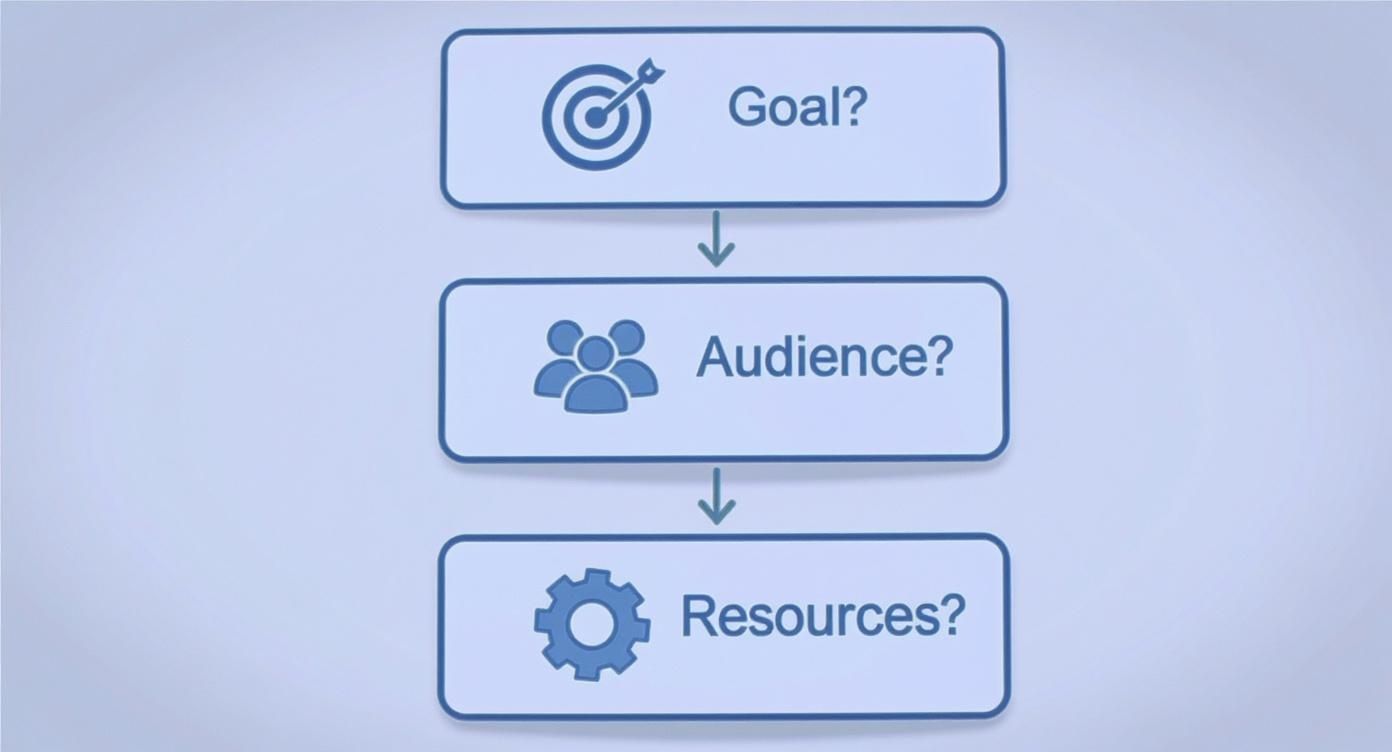
As the visual shows, a winning strategy starts with internal clarity before you even think about the platforms themselves. Once you've landed on the right channels, the next logical step is mapping out your content. A huge part of that is building a powerful social media content calendar to keep everything organized and on schedule.
The most successful school social media strategies aren't about being on every platform; they're about being on the right platforms, where you can genuinely connect with your community and achieve specific, measurable goals.
This guide will walk you through a clear framework for making that choice, helping you cut through the noise and build a sustainable, impactful social media presence.
To give you a head start, here's a quick rundown of where each major platform typically fits within a K-12 marketing strategy.
Quick-Look Platform Guide for K-12 Schools
| Platform | Primary Audience | Best For |
|---|---|---|
| Current Parents, Alumni, Local Community | Official announcements, event promotion, community building (especially in Groups), and sharing photo albums. | |
| Prospective & Current Students, Prospective Parents | Visual storytelling, showcasing campus life, student achievements, and behind-the-scenes content through Reels and Stories. | |
| X (Twitter) | Current Parents, Local Media, Peer Institutions | Quick updates, live-tweeting events, sharing news, and engaging in broader educational conversations. |
| Faculty/Staff (current & prospective), Alumni, Donors | Professional networking, staff recruitment, sharing thought leadership, and highlighting institutional achievements. | |
| TikTok | Prospective & Current Students | Fun, trend-based video content, student takeovers, and showing off school spirit in a casual, authentic way. |
| YouTube | All Audiences | Long-form video content like virtual tours, event recordings, student testimonials, and educational explainers. |
Think of this table as a starting point. The real magic happens when you align these general use cases with your school's specific goals and audience habits.
Define Your Goals Before You Choose a Platform
Before you even think about which social media platform to use, you need to answer a fundamental question: What does a "win" actually look like for our school?
Jumping onto a new platform without a clear answer is like setting sail without a map. You’ll be busy, sure, but you won’t get anywhere meaningful. Defining what success means for your school is the most critical first step you can take.
Your goals will dictate your entire strategy. Are you trying to boost new student applications by 10% this year? Or is the real priority to get more current families to show up for school events? Maybe your focus is on attracting and recruiting top-tier faculty. Each of these goals demands a completely different approach and will naturally point you toward different platforms.
From Vague Ideas to Specific Objectives
So many schools start with a goal like "increase engagement." That's a nice thought, but it’s not a goal—it's an idea. To make it truly actionable, you have to get specific. This simple shift transforms your efforts from just "posting content" into a focused marketing campaign with real, measurable outcomes.
Let's take another common one: "improve our school's reputation." A fuzzy goal like that becomes much more powerful when you reframe it. A better, more strategic goal would be: "Increase positive mentions of our school on local community Facebook groups by 25% over the next quarter." See the difference? Now you have a clear target and a way to measure what’s actually working.
Here’s how to sharpen up some common school marketing goals:
Vague Idea: Get more applications.
Specific Goal: Generate 50 qualified inquiries for our middle school through a targeted Facebook and Instagram ad campaign before the spring admissions deadline.
Vague Idea: Build a stronger community.
Specific Goal: Increase the comment rate from current parents on Instagram posts by 15% each month by sharing more behind-the-scenes student life content.
Real-World Goal Alignment in Action
I once worked with a private elementary school that was struggling to fill seats for its annual open house. Their primary goal was crystal clear: drive event registrations. Instead of just blasting the event info across every channel, they put their limited budget and energy into Facebook.
They used its powerful ad targeting to get in front of parents with 4- and 5-year-olds living within a 10-mile radius of the school. The result? A fully booked event and a waitlist for the next one.
In another instance, a high school was worried about "summer melt"—keeping newly enrolled students excited and committed over the summer. Their goal was all about community building and student retention. So, they created a private Instagram account exclusively for accepted students. They filled it with "get to know you" content, student takeovers, and live Q&As with teachers. It worked wonders to build connections before students even set foot on campus.
The platform doesn't come first; the purpose does. A well-defined goal acts as your compass, pointing you directly to the social media channels where you're most likely to find success.
Before your team even gets into a debate about TikTok vs. LinkedIn, sit down and hash out the answers to these three questions:
- What is the single most important outcome we need to achieve this semester?
- Who is the specific audience tied to that outcome?
- What specific action do we need that audience to take?
When you answer these honestly, your platform decision will feel less like guesswork and more like the smart, strategic choice it’s supposed to be.
Find Where Your Audience Actually Spends Their Time
So, you've got your goals locked down. The next, and arguably most important, question is: where are the people you need to reach actually hanging out online?
https://www.youtube.com/embed/ZywgvFSnH38
It’s a simple but powerful idea. Creating amazing content is pointless if it never reaches the right eyes. You wouldn’t put up a billboard in an empty field, so don't waste your time posting on a social platform your target families ignore. This is where we move from guessing to strategy.
You absolutely have to get specific here. It's not enough to say you're targeting "parents." You need to really dig in and learn how to identify your target audience and map their real-world online behaviors.
Think about it: are you trying to connect with a millennial mom looking for her child's very first kindergarten? Her search process, questions, and the platforms she trusts are worlds apart from a Gen X dad whose high school junior is thinking about college applications. They have completely different needs and live on different digital turf.
Mapping Your Key School Audiences
Before you can find them online, you have to be crystal clear about who you’re talking to. Your school serves a surprisingly diverse set of groups, and a one-size-fits-all message will fall flat.
This is where audience segmentation comes into play. It’s a total game-changer for school marketing. If you want to go deeper, we have a whole guide on what is audience segmentation that breaks it all down.
For now, start by jotting down your main audiences. They probably look something like this:
- Prospective Parents: Often millennials, actively comparing schools and looking for social proof.
- Current Parents: A mix of Gen X and millennials who need timely updates and want to feel part of the community.
- Current Students: Almost entirely Gen Z and Gen Alpha, depending on your school's grade levels. They’re your best brand ambassadors.
- Alumni: A huge age range, from recent grads to seasoned professionals, all looking for different ways to stay connected.
Once you have these groups defined, start building some quick, simple personas. Dive into your enrollment data. What are the common ages, zip codes, and interests of your current families? You'd be surprised what you find.
Even a quick one-question poll sent to current parents asking, "What social media platform do you use most often?" can give you an incredible amount of clarity and direction.
Aligning Personas with Platform Demographics
Now that you have your personas, you can finally start connecting them to the right platforms. Platform demographics are always in flux—what was true last year might be totally different today. Staying on top of these trends is part of the job.
Here’s a quick look at how different audience segments typically align with major platforms. This isn't set in stone, but it's a great starting point for focusing your efforts.
Platform Demographics vs. School Audience Segments
| Audience Segment | Primary Platform(s) | Secondary Platform(s) | Key Considerations |
|---|---|---|---|
| Prospective Parents (Millennial/Gen Z) | Instagram, Facebook | TikTok, Pinterest | Highly visual. They want to see your school's culture through Reels, Stories, and authentic student photos. |
| Current Parents (Gen X/Millennial) | Facebook (especially Groups) | Instagram, YouTube | Looking for community and information. Private Facebook Groups are gold for building a tight-knit parent community. |
| Current Students (Gen Z/Alpha) | TikTok, Instagram | YouTube, Snapchat | They create and consume short-form video. Authenticity is everything; polished marketing is a turn-off. |
| Alumni (All Ages) | LinkedIn, Facebook | Instagram, YouTube | LinkedIn is fantastic for professional networking, while Facebook is better for nostalgic community-building and event promotion. |
Understanding these nuances is everything. For example, as of 2025, the biggest slice of Facebook's user pie is adults aged 25-34, who make up a massive 31.1% of active users—right in that prime prospective parent demographic. Meanwhile, TikTok's audience is skewing slightly older but remains a Gen Z stronghold. The data tells a story, and you need to listen.
A prospective millennial parent is likely scrolling Instagram, looking at student life through Reels to get a feel for your school’s vibe. At the same time, a current Gen X parent is probably checking a private Facebook Group for the updated basketball practice schedule.
This kind of research will show you exactly where to invest your time. You might discover your ideal families are incredibly active in hyper-local Facebook parenting groups, or that your alumni network is just waiting to be engaged on LinkedIn.
These insights are what transform your social media from a content-blasting chore into a predictable engine for enrollment and community engagement. Stop shouting into the void and start having meaningful conversations where your people already are.
Match Your Content Strengths to Platform Formats
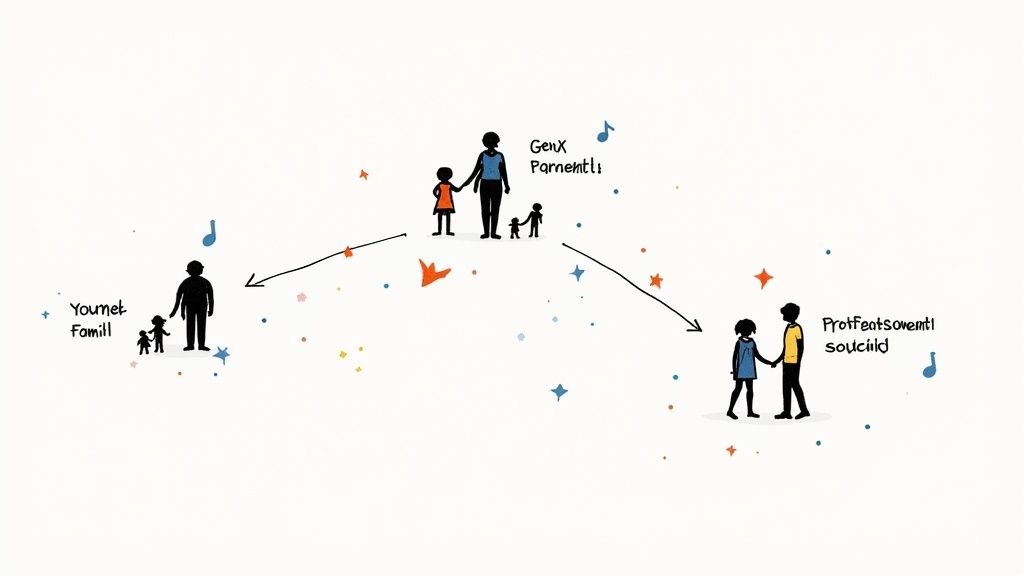
Every social media platform speaks its own language. A beautifully written, text-heavy update that gets great engagement on your school's LinkedIn page would completely flop on Instagram. This is why a crucial part of picking your platforms is getting real about what kind of content your school is already great at creating.
Don't try to force a square peg into a round hole. Instead, lean into your existing content strengths and find the platforms where that content will naturally shine. This approach not only feels more authentic to your audience but is also far more sustainable for your team in the long run.
Think about the raw materials you already have on hand. Is your student photography club constantly capturing stunning shots of campus life? That's an absolute goldmine for an Instagram feed. Does the drama department have amazing, high-energy clips from rehearsals? Those are practically made for TikTok or YouTube Shorts.
Aligning Your Assets with Platform Expectations
Start by taking an honest inventory of the content you can reliably produce. This isn't a wish list of what you hope to create someday; it's about what you can realistically and consistently generate week after week. This practical audit is the foundation of a smart social media strategy.
Got great photos? If your school consistently produces high-quality photography and sharp graphics, then Instagram and Pinterest are your natural homes. These platforms are built for visual storytelling, making them perfect for showing off your campus, student projects, and big game days.
Master of video? Dynamic video is a powerhouse almost everywhere, but the format is key. Short, punchy clips under 60 seconds are the bread and butter of TikTok and Instagram Reels. For longer pieces like virtual tours or event recaps, YouTube is still the go-to. If you're looking to up your game, our guide on how to create video content has some great tips.
Best at community news? When your strength lies in clear, concise communication, Facebook is a fantastic choice, especially for keeping current parents in the loop. Its flexibility with text posts, photo albums, and event pages makes it an ideal community hub.
Showcasing professional wins? For content centered on faculty achievements, alumni career success, or major school milestones, nothing beats LinkedIn. This is the place to highlight the academic and professional excellence that defines your school community.
Don’t build a strategy around content you don’t have. Lean into what your school already does well, and choose the platform that best amplifies that strength. This ensures your social media feels genuine, not forced.
By starting with what you're already good at, you're essentially reverse-engineering your platform choice. This sets you up not just to be on a platform, but to be there with content that feels native, engaging, and authentic from day one. You’ll build a presence where your school’s best stories can truly connect with the right people.
Take a Hard Look at Your Resources
It's easy to get swept up in an ambitious social media plan, but inspiration alone won't get the job done. Before you commit to any new platform, it’s time for an honest conversation about your team’s real-world capacity.
This isn't about limiting your vision; it's about making sure your strategy is sustainable. A fantastic plan on paper means nothing without the people and resources to bring it to life. A realistic self-assessment now will prevent burnout and inconsistent results down the road.
Let's break it down.
Time, Talent, and Budget: The Big Three
This quick audit will tell you which platforms are actually a good fit for your school's current reality. Be brutally honest here—it’s not about what you wish you had, but what you’re working with right now.
Time Commitment: How many hours per week can your team realistically dedicate to social media? Don't forget to factor in everything: creating content, scheduling posts, engaging with comments, and analyzing what's working.
In-House Talent: Look around. Who on your team is a natural storyteller? Do you have a staff member who’s great with a camera, a teacher who writes killer captions, or a student intern who instinctively knows what will work on TikTok? Tap into those hidden talents.
Available Budget: Social media is rarely completely free. Will you need a budget for scheduling tools like Buffer, design software like Canva, or paid promotions? Even a small ad spend can make a huge difference in reaching new families.
Choosing a social media platform without considering your resources is like planning a road trip without checking the gas tank. You might have a great destination in mind, but you won't get very far.
This assessment is your reality check. If you have a talented videographer and a small budget, focusing on a visual-first platform like Instagram or YouTube makes perfect sense. If you’re short on time but have a great writer, a Facebook or LinkedIn strategy might be far more manageable.
How to Succeed with Limited Resources
Let's face it: most school marketing teams are small and mighty. If you find your resources are stretched thin, don’t panic. It just means you have to work smarter.
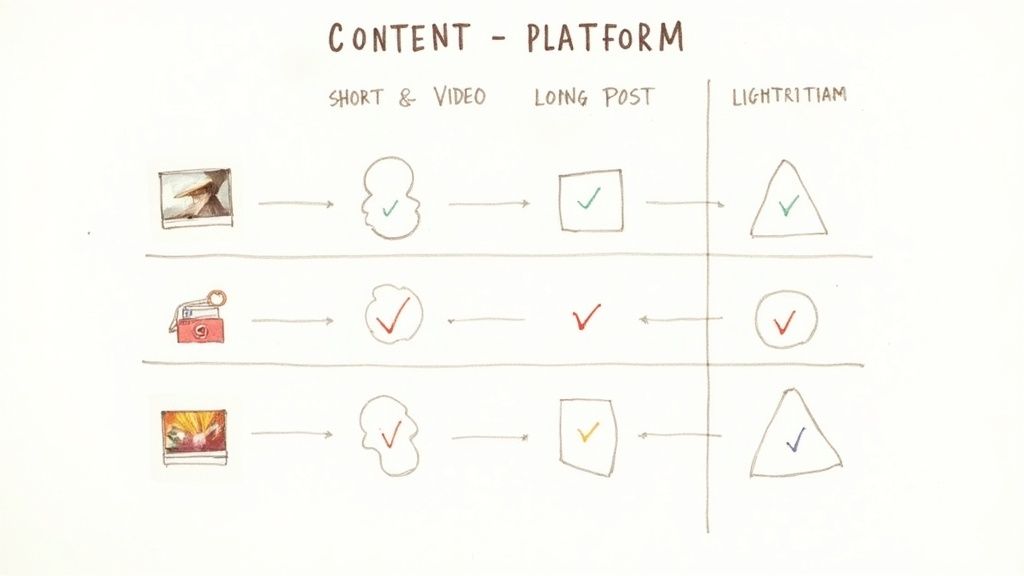
The key is to master content repurposing. A single long-form video, like a student testimonial, can be a goldmine. You can slice it into a short clip for an Instagram Reel, pull a powerful quote for a graphic, and summarize the key takeaways for a Facebook post. Mapping this all out is much easier when you know how to create a social media content calendar that organizes everything in advance.
Also, never underestimate the power of a small promotional budget. The impact of paid social is undeniable. Marketers consistently report that their top benefits are increased exposure (80%), more website traffic (73%), and better lead generation (65%), according to research featured by ClearVoice. Platforms like Facebook, in particular, offer incredible reach.
Even a modest budget can amplify your most important posts, ensuring they get in front of the right prospective families. By being realistic about what you can manage, you set your school up for consistent, sustainable success.
Sticking Points: Answering Your Toughest School Social Media Questions
When you get down to the brass tacks of running social media for a school, a lot of the same tricky questions pop up. It's one thing to have a plan, but it's another to navigate the day-to-day realities of your specific K-12 environment. Let's get straight to the point and tackle some of the most common hurdles I see school marketers face.
Think of this as the practical, "what-do-I-do-when…" part of the guide. Here are the honest answers you're looking for.
How Many Platforms Should We Really Be On?
This is the big one, isn't it? The simple answer is almost always "fewer than you think." I’ve seen so many schools stretch themselves thin trying to be everywhere at once. It’s a recipe for burnout and mediocre results.
Being truly excellent on one or two platforms where your key audiences actually are is a thousand times more effective than being a ghost on five or six. Start with the one platform that hits your most important goal dead-on. If that’s boosting enrollment applications from local families, your best bet is probably Facebook. Nail it. Get a rhythm, build a sustainable workflow, and start seeing real results. Only then should you even think about adding another channel, maybe to serve a different goal, like using Instagram to give prospective students a feel for campus life.
What About Student Privacy and Safety?
This is where the buck stops. It's a non-negotiable, top-of-the-list priority. Before you post a single photo, you absolutely must have a clear, board-approved social media policy. This should explicitly cover how you get parental consent for featuring students, and it needs to be dusted off and reviewed every single year.
On platforms that are popular with students, like TikTok or Instagram, the best practice is to shift the spotlight away from individual kids and onto the collective experience.
- Show off group projects and what a typical Tuesday in a science lab looks like.
- Feature clips from the basketball game or the spring musical.
- Celebrate school-wide wins and spirit days.
And get smart with the platform tools. You can and should limit or turn off direct messaging and use comment filters. The whole idea is to celebrate your students' journey in a safe, controlled way.
Here's a rule of thumb I always share: Your content should be about the school experience, not about individual students as personalities. That simple mental switch helps you stay on the right side of that crucial privacy line while still being authentic.
Should We Let Students Run School Accounts?
Handing over the keys to an official school account to a student, unsupervised? That's a hard no. It's just too risky. One ill-advised post, even with the best intentions, can create a reputational headache you don't need.
But that doesn't mean you have to shut them out. Student involvement, when it's structured, can be pure gold. A "student takeover" on Instagram Stories, for example, is a brilliant way to offer a genuine "day in the life" glimpse. The key is to build a real program around it with clear guidelines and a faculty advisor who signs off on everything. This way, you get all the benefits of their creativity and perspective without giving up control of your school's message. Just remember: always review all content before it goes live.
How Do We Know If Any of This Is Actually Working?
This question brings us right back to the beginning: your goals. If you don't know what you're trying to achieve, you'll never know if you've succeeded. Vanity metrics like follower counts feel good, but they don't pay the bills or fill seats.
Focus on metrics that show your social media activity is causing a real-world action.
If your goal is enrollment, you should be tracking clicks from a social post to your admissions page, how many lead forms were filled out from your Facebook ad, or the number of RSVPs you got for the virtual open house.
If your goal is community engagement, look at the sentiment in the comments, how often parents are sharing your big announcements, and the number of DMs you get from current families. This is the data that proves your strategy is creating real value.
At The MarCom Society, we help K-12 marketing professionals tackle exactly these kinds of challenges every day. It's a community built on expert guidance and peer support so you can stop guessing and start building winning strategies. Connect with peers, get into exclusive workshops, and stay ahead of the curve. Learn more about joining our K-12 marketing community.









