
School communication plans aren't just about sending newsletters and report cards anymore. They've evolved into crucial frameworks for managing your school's reputation, driving enrollment, and, most importantly, building a foundation of trust with your community. A truly effective plan is about getting the right message to the right people, at the right time, on the channels they actually pay attention to.
Why a Modern Communication Plan Is a Non-Negotiable
Long gone are the days of a monthly newsletter and a website that rarely gets updated. Today's parents and guardians expect instant, transparent, and accessible communication from their children's school. It’s a whole new ballgame.
This shift means you have to be proactive and strategic, not just reactive when an announcement is needed. A well-designed plan elevates communication from a simple administrative task to a core function of your school's leadership.
When you get this right, the benefits ripple out across the entire school ecosystem:
- Boosts Parent and Community Engagement: Families who feel informed and heard are far more likely to show up for events, volunteer their time, and champion school initiatives.
- Strengthens School Reputation: Consistent, professional messaging builds immense trust. It positions your school as a reliable, organized, and caring institution.
- Improves Student Outcomes: When teachers, students, and parents are on the same page about academics and behavior, it creates a powerful support network for every child.
- Increases Staff Morale: Clear internal communication makes your team feel valued and connected to the school's mission. It’s a simple but powerful way to build a positive culture.
The Shift from Crisis Management to Relationship Building
Recent years have been a catalyst for change in how schools communicate. A key finding from the National School Public Relations Association’s 2024 report is the definitive pivot away from purely crisis-driven messaging toward a focus on building long-term relationships.
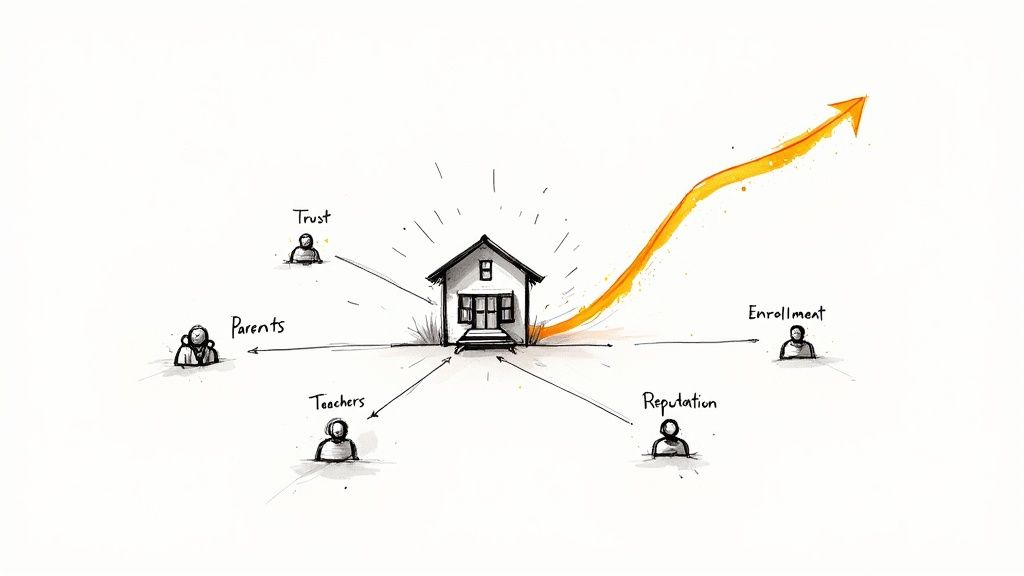
Think about it: during the pandemic, families got used to frequent, crystal-clear updates. That set a new standard for transparency that isn't going away. It’s pushed school leaders to invest in more robust communication teams and prioritize proactive community engagement like never before. You can learn more about this post-pandemic shift in school communications and what it means for your district.
A great communication plan isn't just about broadcasting information; it's about creating a conversation. It turns parents into partners, teachers into advocates, and the community into a support system.
A Real-World Example of Transformation
I once worked with a mid-sized elementary school struggling with low attendance at parent-teacher conferences and a virtually non-existent PTO. Their communication strategy was, to put it mildly, a mess—a random mix of crumpled flyers in backpacks and the occasional, outdated website post.
We helped them implement a real communication plan. The first step was assigning specific channels for specific purposes. A school app was designated for quick, urgent reminders. A weekly email newsletter consolidated all the important updates in one place. Targeted text messages went out for grade-specific news that wasn't relevant to everyone.
The results? Within a single school year, PTO meeting attendance doubled. Parent-teacher conference sign-ups shot up by over 30%. It was a powerful lesson: a deliberate strategy transforms communication from a chore into a tool that actively builds your community. As you build your own plan, using a solid https://blog.marcomsociety.org/communications-strategy-template/ can ensure you don’t miss any crucial steps.
A key part of modernizing your school's operations and communication is ensuring the campus is secure and visitor interactions are seamless. To dive deeper into this foundational piece of the puzzle, check out this ultimate guide to a visitor management system for schools.
Defining Your Audience and Core Goals
Jumping into a communication plan without knowing who you’re talking to or what you want to achieve is a recipe for wasted effort. It’s like trying to plan a road trip with no map and no destination. You'll burn through time and resources, only to end up completely lost.
The most effective communication plans for schools always start by answering two simple but powerful questions: Who are we trying to reach? And what does success actually look like?
Answering these questions upfront saves you from the "one-size-fits-all" trap, where you send out messages that are so generic they don't really connect with anyone. Think about it: the information a first-grade parent needs is worlds away from what a high school senior is looking for.
Identifying Your Key Audiences
Every school community is a vibrant ecosystem filled with different groups, and each one has its own unique needs, worries, and preferred ways of getting information. Your first real task is to map out who these people are. To craft messages that feel personal and relevant, you have to think beyond a single, generic "parent" category.
Start by breaking your community down into more specific, manageable groups:
- Parents by Grade Level: It's a classic for a reason. Elementary parents often crave frequent updates on daily activities, while high school parents are zeroed in on things like college prep and graduation requirements.
- Prospective Families: These are your "shoppers." They're actively looking for a reason to choose your school, so they need to see what makes you special—your unique programs, your school culture, and how to enroll.
- Current Students: Don't forget them! Depending on their age, students need to know about school events, deadlines, and all the extracurricular opportunities available to them.
- Teachers and Staff: Your internal team is one of your most important audiences. They need clear, consistent information about policies, professional development, and day-to-day operations to be successful.
- Community Members and Alumni: This group can be a huge asset. It includes local business owners, taxpayers without kids in the district, and former students who can become powerful advocates for your school.
The entire goal here is to shift from broadcasting generic information to narrowcasting targeted, meaningful messages. This practice is known as audience segmentation, and it's a game-changer for effective communication. If you want to go deeper, our guide on what is audience segmentation is a great place to start.
The biggest mistake I see schools make is assuming they already know what each audience wants. Please don't guess—just ask. Simple tools like Google Forms surveys or even informal coffee chats can give you incredible insight into how different groups prefer to be contacted and what they care about most.
Setting Meaningful and Measurable Goals
Once you know who you're talking to, you need to figure out why. Vague goals like "improve communication" or "increase engagement" sound nice but are impossible to measure. They lead to a lot of busywork with very little to show for it.
Instead, your objectives should be SMART: Specific, Measurable, Achievable, Relevant, and Time-bound.
The strongest communication goals are tied directly to real school outcomes. They give you a clear benchmark for success and help you justify the time and money you're investing in your plan.
Here's how you can turn those fuzzy ideas into powerful, data-driven goals:
| Vague Goal | SMART Goal |
|---|---|
| "Get more parents involved." | "Increase attendance at parent-teacher conferences by 15% over the fall semester." |
| "We need better digital reach." | "Boost parent portal sign-ups among new families by 20% within the first marking period." |
| "Keep the community informed." | "Achieve a 50% open rate on the monthly community e-newsletter for the entire school year." |
See the difference? Each SMART goal has a number and a deadline. That kind of specificity is everything. It gives your team a clear target to aim for and lets you show the tangible value of your work.
When you can go back to your leadership and report that parent portal sign-ups jumped by 20%, you’re not just talking about emails and social media. You’re talking about connecting more families directly to their child's academic life—and that’s a win for everyone. This data-backed approach is what turns a communication plan from a simple to-do list into a strategic tool for school success.
Choosing Your Communication Channels Wisely
So, you’ve figured out who you’re talking to and what you need to say. Now comes the big question: how are you going to say it? The list of options can feel endless—email, text alerts, social media, dedicated school apps. It's easy to get overwhelmed.
But here's the secret: the goal isn’t to be everywhere at once. It’s about picking the right tools for the job and using them strategically.
Think of your channels like a well-organized toolbox. You wouldn't use a sledgehammer to hang a picture frame, right? In the same way, sending an emergency snow day alert via the monthly newsletter that parents won't read until Saturday is a recipe for disaster. The best communication plans for schools give each channel a specific purpose. This simple step cuts through the noise and makes sure your messages land with the right impact, every single time.
Matching the Channel to the Message
When you’re strategic, you set clear expectations. Parents quickly learn that urgent news always comes via text message, so they pay attention when that notification pops up. They know the weekly email has all the non-urgent updates, so they don’t feel bombarded by a constant stream of messages.
Here’s a practical way I've seen successful schools break it down:
- SMS/Text Alerts: This channel is your red phone. Reserve it almost exclusively for urgent and emergency communication. Think school closures, security alerts, or last-minute bus delays. Its power is its immediacy and near-perfect open rate.
- Email Newsletters: Email is the reliable workhorse for detailed, non-urgent updates. It’s perfect for those weekly or bi-weekly roundups that pull together event recaps, upcoming dates, student achievements, and lunch menus in one easy-to-digest package.
- School Website: Your website is your school’s digital front door. It needs to be the single source of truth for static, important information—the things that don't change often but need to be easily accessible. We're talking enrollment forms, the official school calendar, staff directories, and board policies.
- Social Media: This is where you build your community and celebrate your school’s culture. Use platforms like Facebook or Instagram to share photos from the science fair, highlight the "student of the month," and post fun reminders for spirit week. It’s for storytelling, not for critical announcements.
This approach creates a clear connection between your audience, your goals, and the channels you use to reach them.
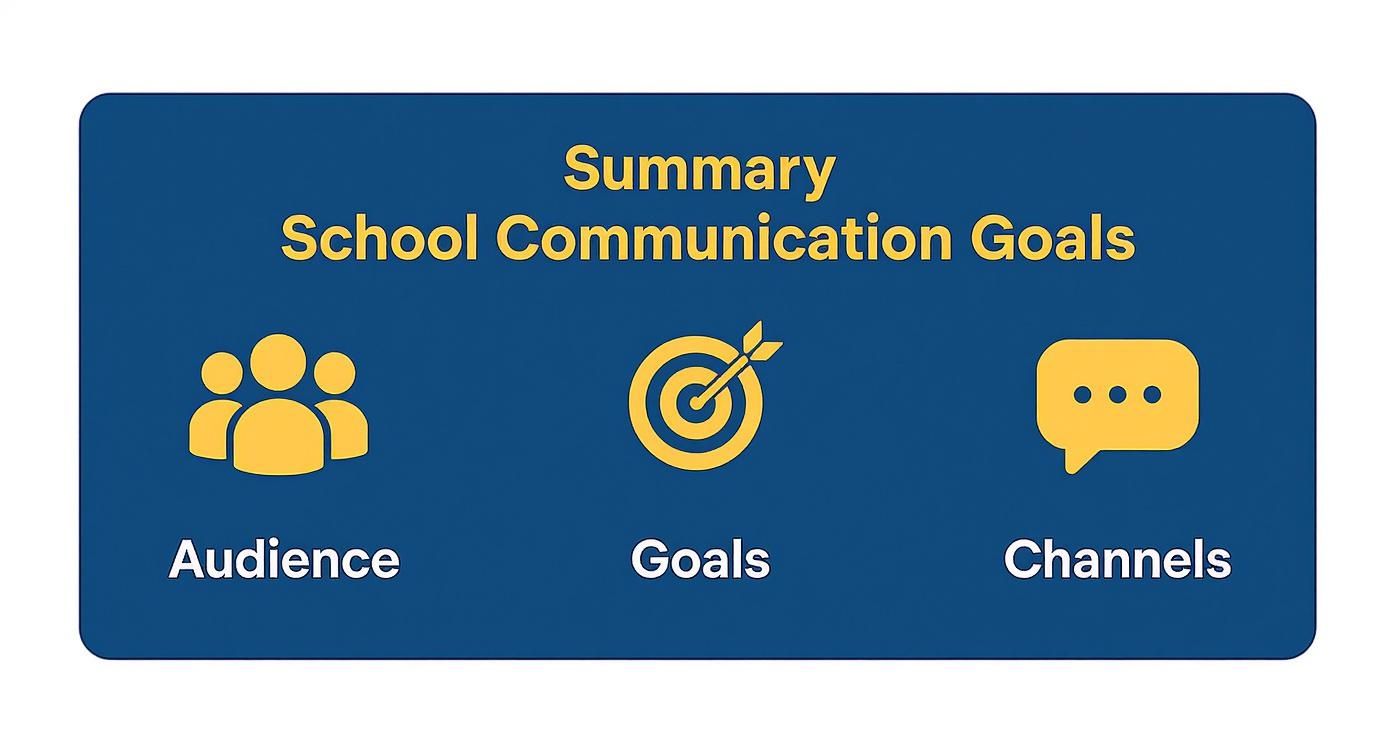
As you can see, a winning strategy is all about alignment. Every message is matched with the right platform to get the desired result with the right group of people.
Navigating a Complex Channel Landscape
Of course, the challenge is that things are always changing. The latest research shows that while schools are using more tools than ever, managing them all has become a real headache. In 2024, email is still king, even with everyone worrying about whether their messages are actually being read.
At the same time, text messaging has exploded in popularity because it’s so direct. Surprisingly, even printed letters have made a comeback, likely as a way to connect with families who don't have reliable internet access. Social media use is also up, but it brings its own set of problems, like a heavier workload for staff and tricky privacy concerns. You can discover more insights from the 2024 School Communications Report to see the full picture.
Choosing your channels isn't just a technical decision; it's a commitment to your community. By creating consistency, you reduce communication fatigue and build trust, ensuring families know exactly where to look for the information they need, when they need it.
To help you sort through the options, here's a quick reference table breaking down the most common channels.
School Communication Channel Selection Matrix
This matrix provides a snapshot of common communication channels, their ideal uses, and some real-world pros and cons to consider before you commit.
| Channel | Best For | Pros | Cons |
|---|---|---|---|
| SMS/Text Alerts | Urgent news, emergency notifications, and time-sensitive reminders. | Extremely high open rates; immediate delivery; excellent for short, critical messages. | Character limits; can be intrusive if overused; not suitable for detailed information. |
| Email Newsletters | Weekly updates, event summaries, announcements, and sharing multiple links. | Can contain rich media and detailed text; great for consolidating information; trackable open rates. | Lower open rates than SMS; can get lost in cluttered inboxes; not ideal for urgent news. |
| School Website | "Single source of truth" for official policies, calendars, and enrollment info. | Accessible to the public; centrally located; can host extensive resources and documents. | Requires users to actively seek information; can become outdated if not maintained. |
| Social Media | Building community, celebrating student success, and sharing school culture. | High engagement potential; great for visual storytelling; builds a positive brand. | Not all families are on social media; risk of negative comments; requires constant monitoring. |
| Mobile Apps | All-in-one communication: grades, attendance, messaging, and announcements. | Centralizes everything in one place; push notifications are highly effective. | Requires families to download and set up; can be costly to develop or license. |
| Printed Flyers | Reaching families with limited digital access; major event promotion. | Tangible and hard to ignore; highly effective for specific demographics. | Costly to print and distribute; difficult to update; lacks tracking. |
Picking the right mix from this list depends entirely on your specific community's needs and your team's capacity to manage them effectively.
A Quick Checklist for Evaluating New Tools
Before you jump on board with the latest, greatest communication app, press pause. Ask yourself if it truly adds value or just creates more noise. A shiny new tool might be tempting, but if it doesn’t solve a real problem or serve a unique audience, it will just stretch your team thin and confuse your families.
Run any potential new tool through this simple checklist:
- Does it solve a unique problem? Avoid adopting something new if it does the exact same thing as a tool you already use well.
- Is it accessible to all families? Think about parents with limited internet, older phones, or language barriers. Will this tool include or exclude them?
- Does it integrate with our Student Information System (SIS)? A tool that syncs automatically with your SIS is a massive time-saver and cuts down on human error.
- Is it secure and compliant? Any platform you use must meet student data privacy regulations like FERPA. No exceptions.
- Is it easy for staff to actually use? A tool with a steep learning curve will lead to inconsistent adoption and frustration. Look for something intuitive.
By being thoughtful and strategic about your channels, you’ll build a communication system that’s not only powerful but also simple for your entire community to navigate.
Preparing for the Unexpected: Your Crisis Communication Protocol
When an emergency hits—whether it's a burst pipe, a power outage, or a more serious security threat—how you communicate can make all the difference. A solid, well-practiced crisis protocol isn't just another binder on a shelf; it's your playbook for maintaining order and trust when things feel chaotic. Let's be honest, the middle of an emergency is the absolute worst time to start figuring out who needs to say what.

The best communication plans for schools are built long before you ever need them. It all comes down to having the right team, the right messages, and the right channels ready to launch in an instant.
Assemble Your Crisis Communication Team
Before anything goes wrong, you need to know exactly who is in charge of communications. A designated team is non-negotiable. It stops the rumor mill in its tracks and ensures every message is coordinated and authoritative. This isn't a one-person job; it’s a small, nimble group where everyone knows their role.
Your go-to crisis team should include:
- The Main Spokesperson: This is usually the superintendent or principal. They are the face and voice of the school, and critically, the only person authorized to speak with the media.
- The Communications Lead: This person is the engine room. They’re responsible for writing and pushing out every message, from a text alert to a website banner update.
- A Dedicated Family Liaison: This role is all about empathy and direct support. They handle communication with the families most directly impacted, offering clear, compassionate updates.
- A Social Media Monitor: You need someone with their eyes glued to social media, ready to squash misinformation and respond to community concerns before they spiral.
And for every one of these roles, you need a designated backup. No exceptions. People get sick, have emergencies, or are simply unreachable. This structure keeps your response moving forward, no matter what.
The golden rule of crisis communication is to speak with one voice. When parents hear different stories from different people, trust evaporates instantly. A defined team ensures everyone gets their information from a single source of truth.
Write Your Messages Before You Need Them
In an emergency, every second counts. You won't have time to workshop the perfect turn of phrase. This is where a library of pre-written and pre-approved message templates becomes your most powerful tool. With templates, you can just fill in the blanks and get crucial information out in minutes, not hours.
Start by drafting templates for the most likely scenarios:
- Weather Closures: A simple, direct message announcing the closure, the reason, and any instructions for at-home learning.
- Utility Failures: A quick update on a power or water outage, how it's affecting the school day, and when to expect the next update.
- Security Alerts (Lockdowns/Evacuations): Clear, calm instructions for parents explaining what's happening and—most importantly—where they should go for official information (and where they shouldn't go, like the school itself).
- Health Incidents: Factual, privacy-respecting information about a health issue on campus and the protocols being followed.
Getting these messages written and approved by leadership ahead of time means they're calm, clear, and legally sound. If you need a starting point, this crisis communication plan template is a fantastic resource to build from.
How It Looks in the Real World
I once worked with a district that had a major water main break flood a wing of their middle school right at dismissal. Chaos could have easily taken over.
Instead, their plan kicked in. The Communications Lead immediately sent a pre-written SMS alert to parents, letting them know dismissal was delayed and directing them to the district website for more info.
The principal, acting as the spokesperson, quickly recorded a short video from a safe location, calmly explaining the situation. At the same time, the Family Liaison was already coordinating with teachers to manage student pickup from an alternate, safe location on campus. What could have been a panic-inducing event became a managed inconvenience, all because they were prepared. They didn't just handle a crisis; they actively built trust.
Putting Your Plan Into Action with Limited Resources
It’s one thing to have a great school communication plan on paper, but it's a whole different ball game to bring it to life with a small team and an even smaller budget. Let's be real: for many schools, the "communications department" is just one person who already has a dozen other jobs. But that doesn't mean your impact has to be small.
The secret to pulling off powerful communication plans for schools on a shoestring budget isn't about working harder—it’s about working smarter. By getting strategic with your tools and empowering your entire staff, you can absolutely punch above your weight.
Embrace Time-Saving Tools and Automation
When time is your most precious resource, efficiency becomes your superpower. The goal is to get the repetitive, time-sucking tasks off your plate so you can pour your energy into what really matters: strategy and building relationships. A few simple (and often free) tools can make a huge difference here.
Start with a shared content calendar. This doesn't need to be a complex, paid software. A simple Google Calendar or a Trello board works perfectly. Use it to map out your major communication themes for the semester—think spirit weeks, parent-teacher conferences, testing periods—and get those messages scheduled ahead of time.
Next, build yourself a library of message templates. You know you'll need to send reminders about picture day and announce half-days every single year. Pre-writing these common messages saves you from reinventing the wheel every time you have to send an update.
Here are a few essential templates to get you started:
- Weekly Newsletter Intro: A standard greeting and a predictable structure you can just plug new information into each week.
- Event Reminders: Simple, clear copy for emails, texts, and social media that you can quickly adapt for any event on the calendar.
- Positive Student Stories: A basic framework for celebrating student achievements that makes it easy to drop in a name, a photo, and a quick quote.
These small acts of prep work will save you countless hours over the school year and keep your messaging consistent, even when you're feeling completely stretched thin.
Tapping into AI and Empowering Your Staff
If you feel like you're working in a silo, you're not alone. A 2024 survey of 600 school communicators found that a staggering 47% work completely by themselves. The good news is that technology is helping to bridge that gap. The same research revealed that 45% of school comms pros are now using AI tools weekly to help manage their workload. You can read the full research on school communication trends to see just how much the field is evolving.
Simple AI tools can be a lifesaver for getting a first draft of a newsletter, brainstorming social media posts, or even translating messages for multilingual families. It helps you conquer the "blank page" problem, freeing you up to focus on refining the content and adding that essential human touch.
Beyond tech, your greatest hidden resource is your own staff. Teachers, administrators, and front-office staff are on the front lines, communicating with parents and students every single day. When you empower them to be effective communicators, you exponentially extend your reach.
Your goal isn't to control every single message going out. It's to build a culture where clear, consistent communication is everyone's job. When the whole team feels equipped and confident, your one-person department suddenly feels a whole lot bigger.
Give your teachers a simple toolkit to help them out. It could include things like:
- Approved school branding files and logos.
- A one-page guide on the school's communication channels and what each one is for.
- A few templates for common classroom-level communications (e.g., project reminders, field trip info).
This approach helps ensure that even the messages coming from individual classrooms feel cohesive and professional. It transforms your staff from employees into true communication partners, ultimately creating a stronger, more connected school community.
How to Measure and Refine Your Strategy
A great communication plan isn't a "set it and forget it" document. It’s a living strategy that needs regular check-ups to make sure it’s actually working.
To do this right, you have to move beyond vanity metrics like social media likes or email open rates. Real success is measured by the impact your communication has on your community. The goal is to create a simple feedback loop: measure what matters, learn from the data, and make smart adjustments. This continuous refinement is what separates decent communication from a strategy that truly builds trust and engagement.
Key Metrics That Actually Matter
Don't drown yourself in data. Instead, focus on a handful of Key Performance Indicators (KPIs) that connect directly to your school's goals. These are the numbers that tell a story about how your community is responding to what you're putting out there.
A good approach is to track a mix of quantitative and qualitative data.
- Parent Survey Feedback: Simple tools like Google Forms make it easy to send short, biannual surveys. Ask direct questions like, "On a scale of 1-10, how informed do you feel about school events?" or "Which communication channel do you find most useful?"
- Website Analytics: Dig deeper than just total visits. Track metrics like time on page for crucial sections (like the enrollment page or school calendar) and the bounce rate. A high bounce rate might be a red flag that parents aren't finding what they need quickly enough.
- Engagement Quality on Social Media: Forget just counting likes. How many comments are you getting that ask meaningful questions or share positive experiences? This shows a much deeper level of connection than someone passively scrolling through their feed.
A communication plan that isn’t measured is just a set of good intentions. Data, paired with real human feedback, is the only way to know if your messages are truly connecting with your audience and driving meaningful action.
Creating a Simple Tracking Dashboard
You don’t need expensive software to monitor your progress. A basic spreadsheet is often all you need to create a dashboard that keeps your most important metrics in one place, making it easy to spot trends over time.
For instance, you could set up a simple table with columns for each month and track just a few key numbers:
| Metric | September | October | November |
|---|---|---|---|
| Newsletter Click Rate | 18% | 22% | 25% |
| Parent Portal Logins | 350 | 410 | 450 |
| Positive Social Mentions | 12 | 15 | 21 |
This kind of simple snapshot can reveal powerful insights. In the example above, you might see that a new segment in your newsletter is driving more clicks, or maybe a recent positive story is boosting sentiment on social media.
Using Feedback to Make Smart Adjustments
Data is only useful if you act on it.
Try scheduling quarterly check-ins with your team to review your dashboard and talk about what the numbers are telling you. What's working? What's falling flat?
If you find that your SMS alerts have a 95% open rate but your weekly email is hovering around 20%, that's a clear signal. Maybe it’s time to shorten the email and put the most critical info right at the top. If parent surveys show that families feel overwhelmed, you could try consolidating communications into a single, comprehensive weekly update.
This ongoing process ensures your communication plans for schools stay relevant and effective, constantly evolving to meet the real needs of your community.
FAQs About School Communication
Even with the best guide in hand, questions always come up when you're deep in the work of building and running a school communication plan. It's one thing to have the blueprint, but navigating the messy, real-world situations that pop up is another challenge entirely. This section tackles some of the most common hurdles and tricky questions we hear from school leaders on the ground.
Think of this as your go-to resource for getting unstuck. We're cutting through the noise with clear, practical answers to help keep your plan on track.
How Often Should We Update Our School Communication Plan?
Your communication plan should never be a document you write once and file away. It's a living guide that needs to breathe and adapt right along with your school community. You'll want to give it a full, top-to-bottom review annually, usually during the summer. This is the perfect time to sync it up with the goals and new initiatives for the upcoming school year.
But that doesn't mean you can set it and forget it for 12 months. Set a recurring calendar reminder for quarterly check-ins. This is your chance to look at what’s working, what's falling flat, and make small, smart adjustments based on your metrics. And if a crisis hits? The plan gets revisited immediately to bake in any lessons learned. Small, continuous tweaks are always more effective than a massive, painful overhaul every few years.
A communication plan that isn’t regularly updated is a plan that’s already failing. Community needs shift, technology changes, and your strategy has to be nimble enough to keep pace.
What Is the Most Common Mistake in School Communication?
Hands down, the single biggest misstep is creating a brilliant plan and then letting it gather dust. So many schools invest hours drafting a detailed document that never actually becomes part of anyone's daily routine. It's a roadmap that nobody uses to navigate.
A very close second? The one-size-fits-all message blast. When you don't segment your audiences and tailor your messages, you create widespread communication fatigue. This is that all-too-common scenario where parents start tuning out all school messages because most of them don't apply to their child. The best communication plans are actionable, consistently used, and highly targeted.
How Can We Get Staff Onboard with a New Plan?
Staff buy-in is everything. You simply can't succeed without it, and it starts with inclusion, not a top-down directive. The secret is to bring your teachers and staff into the process from the very beginning.
- Host listening sessions. Before you even start writing the plan, ask them what their biggest communication headaches are and what they need to succeed.
- Give them practical tools. Make it easy to participate. This means clear guidelines, ready-to-use message templates, and straightforward training on any new platform you’re introducing.
- Explain the "why" for them. Don't just add another task to their plate. Show them how this plan helps them. Frame it as a way to spend less time answering the same parent questions over and over, build stronger parent partnerships, and create a more positive culture for everyone.
When your staff sees the plan as a solution that genuinely makes their jobs easier and more effective, their support will follow.
Ready to move beyond theory and connect with a community of peers who are navigating these same challenges? The MarCom Society offers exclusive access to expert-led workshops, practical resources, and a supportive network of K-12 communication professionals. Elevate your strategy by joining a community dedicated to your growth.









