Let's be honest, communication skills training is often seen as a soft skill, a nice-to-have workshop on public speaking. But that's a huge misconception. It’s more like a fundamental upgrade to your school's entire operating system, giving your team the structured practice needed to turn abstract ideas like "clarity" and "empathy" into everyday habits.
The Power of Clear Communication in Schools
Think of your school's communication flow like its central nervous system. When it’s working well, information moves effortlessly. Departments are in sync, decisions are made quickly and intelligently, and everyone—from staff and students to parents—feels connected and in the loop. This doesn't happen by accident; it's the direct result of intentional, skilled communication.
But when that system breaks down, the fallout is swift and painful. Messages get garbled, leading to widespread confusion and frustration. Small disagreements blow up into major conflicts simply because people don't know how to talk through them productively. Big strategic goals get missed, not from a lack of effort, but from a simple misalignment caused by poor information sharing.
This is why communication skills training isn't just another box to check for professional development. For any school hoping to be resilient, effective, and trusted, it's a strategic must-have. And for the marketing and communications teams on the front lines, these skills are the absolute foundation of their work.
From Good Intentions to Reliable Skills
Every school leader hopes for a collaborative, open environment. The problem is, good intentions don't stop misunderstandings. Real training moves your team beyond just wanting to communicate well by giving them a shared language and a toolkit of practical methods. It equips them to handle tricky conversations with confidence, not just hope for the best.
Strong communication is the foundation for building trust with parents, authentically engaging students, and aligning staff around a shared mission. It is the single most critical investment for creating a connected school community from the inside out.
For instance, a marketing director who has mastered active listening can run a parent focus group that gets to the heart of what families truly need and want, sparking campaigns that genuinely connect. A communications coordinator trained in concise, clear writing can draft an emergency alert that informs parents without inciting panic. These aren't lucky breaks. They're the direct results of targeted skill-building.
Core Pillars of Effective Communication Training
To truly make a difference, training needs to cover a few essential areas. These pillars form the basis of most high-quality programs and give teams a comprehensive set of tools to work with.
| Pillar | Focus Area | Benefit for School Teams |
|---|---|---|
| Foundational Principles | Understanding communication models, active listening, and the impact of non-verbal cues. | Creates a shared vocabulary and understanding of what effective communication actually looks like. |
| Clarity & Concision | Writing and speaking in a clear, direct, and easily understood manner, avoiding jargon. | Ensures newsletters, emails, and website copy are accessible and impactful for all audiences. |
| Empathy & Emotional IQ | Recognizing and responding to the emotional states of others to build rapport and trust. | Helps manage difficult conversations with parents and navigate sensitive community issues. |
| Conflict Resolution | Using structured techniques to de-escalate disagreements and find common ground. | Equips staff to handle internal disputes and parent complaints constructively, preserving relationships. |
| Public Speaking & Presence | Presenting information confidently and engagingly to groups of any size. | Improves performance at open houses, parent nights, and community information sessions. |
| Storytelling | Structuring narratives to make information memorable, persuasive, and emotionally resonant. | Transforms marketing messages from simple facts into compelling stories that attract families. |
Ultimately, these components work together to build a team that is not only technically proficient but also adept at human connection.
Building a More Effective Organization
At the end of the day, creating a high-performing communications team isn't just about giving them the latest marketing software or a well-organized content calendar. It’s about making a deep investment in their ability to connect, persuade, and build lasting relationships. This guide is for school leaders who want to:
- Foster Trust: Cultivate a culture where every parent interaction makes them feel genuinely heard and respected.
- Boost Engagement: Develop messages that truly capture the attention of students and the wider school community.
- Strengthen Alignment: Make sure every single staff member not only understands the school's mission but can also share it compellingly.
This approach builds a stronger, more effective school from the inside out by focusing on the one thing that matters most—how your people connect with each other.
Why Communication Skills Training Is a Global Priority

The drive to get better at communication isn't just a local trend happening within school districts. It’s a strategic shift happening all over the world. Businesses in every industry are coming to terms with a core truth: how well they communicate directly shapes their success, innovation, and ability to stick around. This isn't a small realization—it's sparked a massive global investment in what’s now considered a fundamental business skill.
Just look at the numbers. The worldwide market for developing soft skills, where communication training is front and center, was valued at about USD 33.4 billion in 2024. And it’s not slowing down. Forecasts predict that number will practically triple by 2033, soaring to an estimated USD 92.6 billion. That kind of explosive growth, driven by an impressive 11.4% annual rate, tells you everything you need to know about where global priorities are shifting.
This isn’t just money being thrown around. It’s a deliberate response to huge changes in how we all work and connect, and schools are right in the middle of it.
The New Realities Driving the Demand
A few powerful forces are making communication skills training an absolute necessity for any organization that wants to stay ahead, including schools. These aren't just passing trends; they are fundamental changes in the professional world.
First, the rise of remote and hybrid work has completely changed the game. When your team isn't in the same room, the chances for miscommunication go through the roof. You lose the casual check-ins and the ability to read body language. Suddenly, every message has to be more deliberate and clear. A sloppy email or a vague Slack message can easily derail a project or weaken team trust.
On top of that, our school communities are more diverse than ever. This beautiful mix of backgrounds demands a much higher level of cultural awareness. Communicating effectively here is about more than just words. It's about understanding different conversational styles and cultural norms to make sure every single family and staff member feels truly seen and heard.
The Irreplaceable Value of Human Skills
But maybe the biggest factor is the growing role of automation and AI. As technology handles more of the repetitive, data-driven work, the skills that make us uniquely human become infinitely more valuable.
In an era where AI can draft reports and organize data, the ability to empathize, persuade, solve conflicts, and build real relationships becomes a massive advantage. These are the things that simply can't be automated.
Investing in communication skills training, then, is really an investment in future-proofing your team. It’s an admission that while tech gives us great tools, it’s human connection that delivers real, lasting results. A huge part of this is knowing how to improve writing skills for career advancement, as clear writing is essential to professional communication.
For school leaders, the message couldn't be clearer. The global business world is shouting from the rooftops that communication is a critical asset. Making it a strategic priority for your school's marketing and communications teams isn’t just about staying current. It's about giving them the essential skills they need to lead, connect, and succeed for years to come.
The Core Components of a Powerful Training Program
To really build a powerhouse team, we have to get past just telling people to "be better communicators." A truly high-impact communication skills training program isn't about vague ideas; it's a structured system built on specific, teachable skills. Think of it less like a single, boring lecture and more like a series of hands-on workshops. Each one hones a vital skill, and when you put them all together, you get a masterful communicator.
For a school's marketing and communications team, mastering these components is what turns everyday tasks into major wins. It’s the difference between a school newsletter that gets instantly deleted and one that’s forwarded to other prospective parents. These core pillars are the blueprint for building a team that genuinely connects with its community.
Active Listening: The Art of Hearing What Isn’t Said
Here’s a secret: the most critical communication skill isn’t talking, it’s listening. And I don’t just mean being quiet while someone else speaks. I mean actively processing their words, their intent, and even the emotions they don't say out loud. This is the absolute foundation of trust and understanding.
This skill is pure gold for a school marketing team. Picture a team member running a parent focus group. Instead of just jotting down requests for new features, a trained active listener picks up on the slight anxiety in a parent’s voice about school safety or the genuine excitement about a new arts program. That deeper insight leads to marketing that hits home because it speaks to real feelings, not just a checklist of facts.
True active listening is about understanding the speaker's complete message, both verbal and non-verbal. It involves hearing the words, interpreting the tone, and observing body language to grasp the full context.
When parents feel truly heard, it forges an incredibly strong community bond. It changes feedback from a simple data point into a powerful opportunity to build a relationship.
Clarity and Concision: Crafting Messages That Are Impossible to Misunderstand
In a school setting, confusion is your worst enemy. A fuzzy email about a schedule change can throw hundreds of families into chaos. A clear, direct message, on the other hand, builds confidence and shows you're on top of things. This part of communication skills training is all about cutting out the jargon, fluff, and roundabout phrasing to deliver information that is simple and easy to act on.
Let's say a communications director has to handle a minor crisis, like a burst water pipe on campus.
- An untrained approach might sound like this: "We are currently experiencing a facilities issue on campus which may impact dismissal procedures. Please be advised that updates will be forthcoming." This just creates panic and a flood of questions.
- A trained, clear approach is direct: "A water pipe has burst in the North Building. All students are safe. Afternoon pickup for grades 3-5 will be moved to the East Gate. All other pickups are unchanged. We will send another update at 2 PM."
See the difference? The second message is calm, actionable, and provides all the necessary info without causing alarm. That's the power of precision.
This sketch beautifully contrasts the simplicity of spoken words with the rich, layered meaning we convey without saying anything at all.
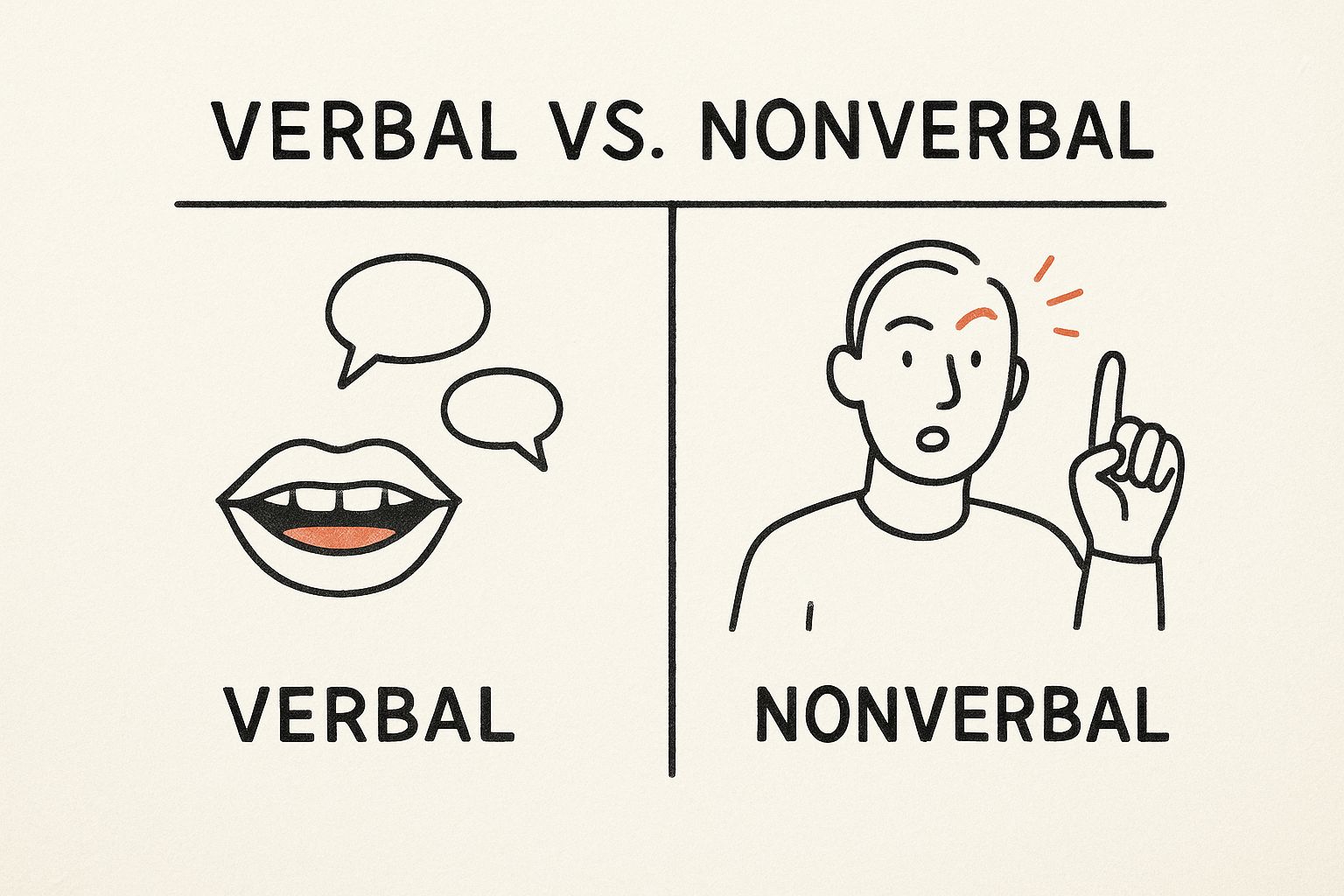
As the image shows, what we say is only one piece of the puzzle. How our bodies express the message is just as, if not more, important.
Non-Verbal Communication and Empathy
Did you know that a huge chunk of our communication—some experts say over 90%—is non-verbal? It’s the welcoming posture of a school tour guide, the warm tone of voice on a phone call, or the steady eye contact during a parent meeting. Empathy, which is simply the ability to understand and share someone else's feelings, is deeply connected to these non-verbal signals.
Training in this area helps your team become more conscious of their own body language and much better at reading the emotional cues of others. When a prospective parent is touring the school, are they leaning in with real interest or crossing their arms with a hint of skepticism? Catching those signals allows the tour guide to shift gears, maybe addressing an unstated concern or highlighting a program that sparks their interest. That empathetic connection can absolutely be the deciding factor for an enrolling family.
Feedback and Conflict Resolution
Let’s be real—no school is immune to difficult conversations. Whether it's managing a negative comment on social media or mediating a dispute between staff members, friction is going to happen. The only thing that matters is how you handle it.
Great communication skills training gives your team a playbook for both giving and receiving feedback constructively and for navigating conflict without burning bridges. It teaches them to:
- Focus on the behavior, not the person.
- Use "I" statements to own their perspective.
- Listen to the other side without jumping to conclusions.
- Work together to find a solution.
A communications pro with these skills can turn a frustrated parent’s complaint into a productive conversation. The parent feels heard and valued, and the school gets useful feedback. This is how you turn potential fires into opportunities that reinforce your school's reputation for being responsive and genuinely caring.
How to Tailor Communication Training for Your School Marketing Team
Off-the-shelf communication advice is a decent starting point, but let’s be honest—your school’s marketing and communications team doesn’t live in a generic world. Their entire job revolves around connecting with very specific people: anxious prospective parents, busy current families, and a diverse local community. Each group has its own unique set of needs and worries.
For training to be truly effective, it has to move beyond theory and plug directly into the team's day-to-day reality. This is how abstract concepts create tangible results. Active listening, for example, isn't just a soft skill; it's the tool that helps your admissions director hear the unspoken hope in a parent's voice during a campus tour. Clarity isn't just about good grammar; it's what makes a snow day announcement a source of comfort instead of chaos.
When you take this targeted approach, the return on investment becomes crystal clear. Every sharpened skill directly helps your team attract, engage, and retain families, powerfully supporting your school's enrollment and community-building goals.
From Listening to Campaigns That Resonate
A school marketing team’s primary mission is to figure out what current and prospective families really value. This is where active listening becomes a strategic weapon. It’s the difference between asking, "What do you want in a school?" and truly hearing the story behind their search—their desire for a safe, nurturing place where their child will be seen and known.
When your team is trained to listen for intent, not just words, the insights they gather are on a completely different level. They can then design open house events, website content, and ad campaigns that speak directly to the core emotional drivers of your audience. This creates messaging that resonates deeply, making families feel understood before they even set foot on campus.
A marketing campaign built on surface-level survey data might talk about small class sizes. A campaign built on active listening will tell a story about a teacher who noticed a shy student’s passion for astronomy and created a special project just for them. The first is a fact; the second is a connection.
This simple shift changes the whole dynamic. You’re no longer just selling a service; you’re building a relationship.
Clarity and Concision in Every Single Channel
In the world of school communications, every word counts. From the subject line of a weekly newsletter to the caption on an Instagram post, clarity is everything. A confusing message erodes trust and creates a ton of unnecessary work for everyone as parents flood the phone lines looking for answers. Targeted communication skills training helps your team master the art of being both clear and concise, no matter the platform.
Think about these real-world applications:
- Website Copy: Training helps writers craft homepage headlines and program descriptions that are instantly understandable, guiding prospective parents straight to the information they need without any friction.
- Social Media Updates: Your team learns to share important news in a way that’s scannable and reassuring—perfect for parents scrolling through a busy feed.
- Email Correspondence: Skills in concision ensure that emails to families are direct and respectful of their time, which boosts open rates and makes sure key information actually gets read.
This isn't just about being a better writer; it's about operational efficiency. When messages are clear the first time, the team spends less time answering repetitive questions and more time on strategic work. This skill set is a core component of any effective marketing plan for schools that aims to build a strong, informed community.
Why This Matters in the Bigger Picture
The demand for these abilities is skyrocketing. North America currently leads the soft skills training market, representing over 32.9% of the global share in 2024. This isn’t a fluke. The trend is driven by a widespread understanding that skills in leadership and communication are crucial for boosting productivity and gaining a competitive edge. Just as corporations invest in advanced training to empower their people, schools must do the same for their teams. If you want to dive deeper into these market dynamics, you can explore the research on workforce development trends.
Empathy as Your Most Powerful Enrollment Tool
Finally, let's talk about empathy. It might just be the most powerful—and most underestimated—tool in a school marketer's kit. A school tour guided by empathy isn't a robotic recitation of features and benefits. It’s a real conversation. The guide tunes into the family's non-verbal cues—their excitement, their hesitation—and adapts the experience on the fly to address their specific hopes and fears.
This skill transforms what could be a transactional encounter into a genuine human connection. When families feel that a school representative truly gets their perspective, it builds a profound sense of trust and belonging. More often than not, that feeling is the tipping point that turns a prospective family into an enrolled one.
Overcoming Common Barriers to Effective Communication

It’s one thing to say, "We need to communicate better." It's another thing entirely to actually break down the stubborn, often invisible, barriers that get in the way. Good intentions aren't enough when you're up against ingrained habits, institutional roadblocks, or just a simple lack of time.
These hurdles are often deeply embedded in an organization's culture, and schools are no exception. They might look like a rigid hierarchy where feedback only travels one way—down. Or it could be a culture so focused on putting out daily fires that professional development always gets shoved to the bottom of the list. Even the best teams can fall into familiar patterns of indirect communication or passive listening, simply because that's the way it's always been done.
This isn't just a local problem; it's a global one. For example, a much-needed communication skills training initiative in Tanzania never got off the ground due to resource shortages and other logistical hurdles. It's a powerful reminder that even the most well-laid plans can get sidetracked by reality.
Dismantling School-Specific Hurdles
In a school environment, communication breakdowns have a unique flavor. They aren't just about hitting targets; they're about building community trust and ensuring student well-being. Pinpointing these specific obstacles is the first real step toward creating a training plan that actually works.
Some of the most common hurdles I see in schools include:
- Time Scarcity: Let's be honest, teachers and staff are stretched incredibly thin. Finding time for training can feel like an impossible ask.
- Siloed Departments: Often, the admissions, academic, and marketing teams operate in their own separate orbits. This leads to mixed messages and a disjointed experience for parents and students.
- Fear of Feedback: In a top-down culture, staff can be reluctant to speak up or offer constructive criticism, which ultimately stifles any chance for meaningful growth.
Tackling these requires a strategic approach, not just a hopeful one. It's helpful to understand the broader landscape of common communication challenges and tips for effective communication in the workplace to see how these issues play out in different settings.
Practical Strategies for Lasting Change
Pushing past these barriers means doing more than just booking a workshop. You need a thoughtful strategy that weaves training into your school's daily rhythm and proves its worth right from the start. The goal isn't a one-time event; it's to make better communication a sustainable, everyday practice.
The most successful communication initiatives don't happen in isolation. They are woven into the fabric of daily operations, supported by leadership, and designed to solve real, immediate problems for the team.
First, you absolutely must get leadership buy-in. This is non-negotiable. You need to build a clear business case that ties communication skills training directly to your school's core goals—things like boosting enrollment, improving parent satisfaction, or increasing staff retention. Don't frame it as a cost. Frame it as an investment in the people who connect with your most important stakeholders. Our guide on stakeholder management strategies explains just how crucial this is.
From there, think small to win big. Launch a pilot program with a motivated group, like your marketing or admissions team. A successful pilot creates internal advocates and gives you concrete results to justify a school-wide rollout.
Finally, embed the practice into existing routines. Instead of a long, disruptive seminar, why not use the first 15 minutes of your weekly team meeting to focus on one skill, like active listening or giving better feedback? This approach makes skill-building a consistent and manageable habit, leading to a slow but powerful shift in your school's culture.
How to Implement Your School's Communication Training Plan
Knowing your school needs to improve its communication and actually making it happen are two very different things. A solid, structured plan is what closes that gap, turning a great idea into a real, lasting practice. This roadmap helps demystify the process so you can launch an initiative that’s custom-fit, measurable, and built to last.
The whole point is to weave this training into the very fabric of your school's culture, not just host a one-off seminar that everyone forgets by Monday. It all starts with getting a clear picture of where you are now and where you truly want to be. Following these phases brings clarity and ensures your investment in communication skills training delivers tangible results for your team and the entire school community.
Phase 1: Figure Out What You Really Need
Before you can pick a solution, you have to diagnose the problem. The first move is always a thorough needs assessment to pinpoint the specific communication gaps on your marketing and communications teams. This is no time for guesswork; you need to gather real data.
Simple, anonymous surveys or even structured group chats can work wonders here. Ask your staff about the hurdles they face every day. Do they find it tough to write clear, concise emails to parents? Do they feel on-the-spot during tough conversations on school tours? Are meetings between departments a source of frustration and inefficiency?
The insights you gain in this phase are gold. They make sure your training budget goes toward solving actual problems, not just what you think the problems are. This targeted approach makes the whole program infinitely more relevant and effective.
Phase 2: Pick the Right Training Format
Once you know which skills need attention, you have to decide how you're going to teach them. There's no single "best" way to do this. Honestly, the most effective approach is often a mix of different methods that keeps your team engaged and works for various learning styles. Each format offers its own unique benefits for communication skills training.
Here are some popular options to consider:
- Online Modules: These are fantastic for laying the groundwork. They offer flexibility and let people learn at their own pace. Your team can absorb core concepts, like active listening or principles of clear writing, whenever it fits their schedule.
- In-Person Workshops: Nothing beats getting in a room together for hands-on practice. Interactive exercises, like role-playing for conflict resolution or getting real-time coaching on presentation skills, are far more powerful when done face-to-face with instant feedback.
- Ongoing Coaching: A good coach provides personalized, long-term support, helping your team members apply their new skills to real-world challenges as they pop up. This is how new habits truly stick.
Phase 3: Set Clear, Measurable Goals
A plan without clear goals is really just a wish. If you want to know if your training is actually working, you have to define what success looks like in concrete, measurable terms. These objectives not only hold the program accountable but also prove its value to school leadership.
Instead of a vague goal like "improve communication," aim for specific targets. For example:
- Reduce parent email complaints about unclear information by 20% within six months.
- Boost positive mentions of staff interactions on parent satisfaction surveys by 15%.
- Decrease the average length of team meetings while improving the quality of follow-up action items.
Setting these benchmarks is a crucial part of building a comprehensive communication plan for schools that directly connects professional development to your school's strategic goals.
Phase 4: Measure Your Impact and Adapt
Finally, remember that implementation isn't a one-and-done event. It’s a continuous cycle of training, measuring, and refining your approach.
Keep a close eye on the metrics you set in the previous phase to see how the program is performing. Use that data not just to prove it’s working, but also to find areas you can improve for the next round of training. Make it a habit to check in with your team. Is the training actually helping them with their daily challenges? This feedback loop is what keeps your communication skills training relevant and allows it to evolve right along with your school’s needs.
Got Questions About Communication Skills Training? We've Got Answers.
When you're thinking about investing in something like communication skills training, it's only natural to have a few questions pop up. School leaders and their teams often wonder about the practical side of things—how long it takes, what format works best, and, of course, what the real payoff is.
Let's tackle some of the most common questions we hear.
How Long Does It Take to See Results?
This is a big one. While you’ll likely notice some quick wins—like a new awareness of different communication styles right after a session—real, lasting change doesn't happen overnight. It's less like a quick fix and more like building a new fitness habit. Consistency is the name of the game.
Generally, you can expect to see significant, lasting improvements over three to six months of focused practice. The initial training gives your team the playbook, but the magic happens when they start using those skills every day—in team huddles, parent emails, and campus tours. Lasting change really hinges on consistent application and strong support from leadership.
Is Online or In-Person Training More Effective?
Honestly, the best answer is often a mix of both. Each approach has its own strengths, and the right fit really depends on what your team needs to achieve.
- In-Person Training: Nothing beats getting everyone in the same room for hands-on, interactive work. It's fantastic for practicing skills like conflict resolution or navigating tough conversations, where reading body language and getting immediate feedback is crucial. It’s also a powerful way to build genuine team chemistry.
- Online Training: The big win here is flexibility. Online modules let your team learn the foundational concepts on their own time and at their own pace. It's a great way to get everyone on the same page with the core ideas before you dive into a more hands-on group session.
Many schools find a blended approach works wonders. Use online learning for the "what" and "why," then bring the team together in person to really nail the "how."
Is communication skills training actually worth the investment? Consider this: poor communication can cost businesses up to 18% of their total annual salaries. For a school, that cost isn't just about lost productivity—it's measured in eroded trust and missed enrollment opportunities.
Can This Training Really Improve Enrollment?
Yes, absolutely—though it works in a way that's both subtle and incredibly powerful. Think about it: better communication sharpens every single interaction a prospective family has with your school. From that very first phone call to the campus tour and every follow-up email, it all gets better.
When your team communicates with empathy, clarity, and confidence, they build trust right out of the gate. They make families feel seen, heard, and genuinely cared for. More often than not, that feeling is what tips the scales and makes your school their final choice.
Ready to build a more connected and effective team? The MarCom Society provides the resources, expert-led sessions, and peer support K-12 marketing professionals need to master communication and drive real results for their schools. Join our community and start transforming your school's communication strategy today.