
Think of a communications strategy template as your organization's playbook. It’s a living document that lays out the game plan for every message you send, both inside and outside the company. This isn't just about making things look pretty; it's about moving your team from a reactive, fire-fighting mode to a proactive, unified force.
A solid template ensures everyone—from marketing and sales to HR and the C-suite—is on the same page. It’s the single source of truth that defines what you say, who you say it to, and why it matters.
Why a Communications Template Is Your Secret Weapon
Let's get practical. Without a clear plan, teams inevitably work in silos. Marketing launches a campaign with one message, customer service handles client questions with another, and leadership communicates a completely different vision internally. The result? Confusion, mixed signals, and a brand that feels disjointed.
A well-crafted template changes the game. It provides the structure needed to shape your brand's narrative proactively. Suddenly, you're not just reacting to events; you're guiding the conversation, whether you're launching a new product or navigating an unexpected crisis.
From Chaos to Clarity
Here’s a real-world example I see all the time. Imagine a school district rolling out a new online portal for students and parents.
- The chaotic approach (no template): The IT department blasts out a technical email filled with jargon. The principal's office includes a tiny blurb in the weekly newsletter. Teachers get a separate, and slightly different, set of instructions. Parents are confused, teachers are frustrated, and the launch is a mess.
- The strategic approach (with a template): The communications team first defines the goal (smooth, widespread adoption). They identify the key audiences (tech-savvy parents, less-technical parents, teachers, students) and craft tailored messages for each. This creates a unified campaign with consistent talking points across emails, social media, and internal meetings, leading to a much better experience for everyone.
This proactive mindset is what separates effective organizations from those that are always playing catch-up. For a deeper dive into building a robust plan, particularly within a community-focused setting, check out this guide on Enhancing Your Church Communications Strategies For Effective Engagement.
To help you get started, here's a quick overview of the essential elements your communications strategy template should include for maximum effectiveness.
Core Components Of A Strategic Communications Template
| Component | Purpose | Key Question to Answer |
|---|---|---|
| Objectives & Goals | To define what success looks like. | What do we want to achieve with this communication? |
| Audience Analysis | To understand who you're talking to. | Who are we trying to reach, and what do they care about? |
| Core Messaging | To establish your key talking points. | What are the 2-3 most important things we need to convey? |
| Channel Selection | To choose the right platforms. | Where does our audience spend their time? |
| Timeline | To create a schedule for execution. | When will each message be delivered? |
| Metrics & KPIs | To measure your impact. | How will we know if we were successful? |
Each of these components works together to create a comprehensive and actionable plan, turning your strategy from a document into a powerful operational tool.
The Strategic Value of Cohesion
This kind of alignment isn't just a "nice-to-have"—it has real strategic value. The global public relations market, which is built on effective communication planning, is expected to hit a staggering $214.9 billion by 2030.
This growth is fueled by the demand for precise, audience-focused messaging. In fact, research shows that 67% of journalists prefer story pitches that are specifically tailored to their audience's interests. This highlights a core principle of any good communications template: know your audience and speak their language.
Ultimately, a communications strategy template is more than just a document. It’s a tool that builds consistency, empowers your team to speak with one voice, and fosters trust with every interaction. This clarity saves time, reduces risk, and builds a rock-solid brand reputation over the long haul.
Setting Goals That Actually Drive Business Results
A communications strategy without clear goals is like a road trip without a destination. Sure, you're busy and creating activity, but you have no real idea if you’re getting anywhere that matters. Vague ambitions like “boost awareness” or “improve engagement” sound good in a meeting, but they don't give your team direction and are impossible to measure in a way that proves your value.
This is why the first, most critical step in using any communications template is to tie every single effort back to a real business result. Your leadership team doesn't just care about how many likes your post got; they care about how that post influenced student enrollment, staff retention, or the district's reputation. It’s a crucial mindset shift from tracking activity to measuring impact.
Moving Beyond Vague Ambitions
Great goal-setting starts when you ditch the fuzzy language. You need sharp, focused targets that leave no room for interpretation, and the SMART framework is genuinely the best tool for this. It forces you to define goals that are:
- Specific: What exactly do you want to accomplish? Who is this for, and why does it matter right now?
- Measurable: How will you prove you succeeded? Think in hard numbers, percentages, or other concrete data points.
- Achievable: Be honest with yourself. Is this goal challenging but realistic given your team, budget, and timeline?
- Relevant: How does this communications goal support the bigger picture? Does it align with the organization's top priorities?
- Time-bound: Give yourself a deadline. It creates a natural sense of urgency and a clear finish line for evaluation.
Applying this framework is how you turn a weak objective into a powerful directive that guides every decision you make from here on out.
A goal without a measurement is just a dream. When you tie your communication efforts to specific, measurable outcomes, you stop being seen as a cost center and start being recognized as a value driver.
Real-World Examples in Action
Let's see what this looks like in practice. It's all about moving from general ideas to laser-focused targets.
Scenario 1: Introducing a New Magnet Program
- The Vague Goal: "Generate buzz for our new STEM program."
- The SMART Goal: "Increase enrollment inquiries for the new STEM magnet program by 30% compared to last year's average inquiry rate, as measured through the website contact form, by the end of the second quarter."
See the difference? This goal is specific (enrollment inquiries for STEM), measurable (30% increase), achievable (benchmarked against past data), relevant (drives enrollment), and time-bound (end of Q2). Now you have a clear target to aim for.
Scenario 2: Improving Internal Staff Morale
- The Vague Goal: "Improve internal communications."
- The SMART Goal: "Reduce staff turnover inquiries related to company direction by 15% over the next fiscal year by implementing a bi-weekly leadership update and monthly Q&A sessions."
Here, the objective is tied directly to a critical HR metric—turnover. Suddenly, your communications plan has a clear, undeniable impact on the business's bottom line.
Connecting Your Goals to the Template
When you get to the "Objectives" section of your communications strategy template, you're not just making a to-do list. You're defining the entire purpose of your plan.
Each goal you document here becomes a North Star for every other decision you'll make. If your goal is to land more positive media mentions, your tactics will naturally focus on media relations and PR. If the goal is to get more parents to use a new app, your channels will be things like email, text alerts, and private social media groups. Your goals dictate your strategy, and writing them down clearly ensures every press release, internal memo, and social media campaign serves a specific, calculated purpose.
Knowing Your Audience Better Than They Know Themselves
If you want your message to land, you have to stop thinking about what you want to say and start focusing on who you're talking to. Blasting a generic message into the ether is a surefire way to get ignored. But a message crafted for a specific group of people? That's how you change minds and get people to act. This is the heart of audience analysis, and it's the bedrock of any solid communications plan.

It’s no longer enough to just list stakeholders like "parents" or "staff." To really connect, you need to dig deeper. We're talking about moving beyond basic demographics and into psychographics—what motivates them, what keeps them up at night, and where they go for information. This is where your message finds its power.
Building Robust Audience Personas
The best way to get a handle on this is by creating audience personas. Think of a persona as a semi-fictional character based on real-world research who represents a key segment of your audience. Doing this turns abstract data into a relatable human story, making it infinitely easier for you and your team to communicate with intention.
A good persona should feel like a real person with real problems. Let’s say you’re a school district. You might create personas like these:
- "Busy Parent Brenda": She’s a working mom with two kids in elementary school, juggling a full-time job. She gets her info on the fly from the district’s mobile app and private parent Facebook groups. Her biggest headache? Feeling out of the loop on important dates and deadlines.
- "Veteran Teacher Tom": A high school teacher with 20+ years of experience, he's skeptical of new tech and just wants clear, concise info delivered to his email inbox. He’s tired of being told to check five different platforms for updates.
See how these profiles immediately clarify your approach? Brenda needs quick, mobile-friendly updates. Tom needs straightforward emails that respect his time. This level of detail is exactly what you need to fill out your communications strategy template effectively. If you want to get even more granular, understanding what audience segmentation is can provide a more structured framework for grouping these stakeholders.
Your audience doesn't care how much you know until they know how much you care. Deep audience analysis is the most tangible way to show you understand and respect their unique perspectives.
Gathering Actionable Insights
So where do you get the information for these detailed personas? You have to ask. It's a mix of good old-fashioned qualitative research and hard quantitative data.
Here are a few proven ways to get inside your audience’s head:
- Surveys: Use simple tools to ask direct questions. A quick five-question survey sent to parents about how they prefer to receive news can give you an incredible amount of clarity.
- Interviews & Focus Groups: Nothing beats sitting down with people. Hearing a teacher explain their daily workflow or a parent describe their chaotic morning routine provides context that numbers on a spreadsheet just can't capture.
- Social Listening: Pay attention to the conversations already happening. Monitor community forums, social media pages, and private groups. This is where you'll find the unfiltered opinions and discover the real pain points people are dealing with.
- Analyze Existing Data: Dive into your website analytics, email open rates, and social media engagement. Which topics get the most clicks? What time of day are people most active? This data tells a story about what your audience truly cares about.
For instance, you might notice that your blog posts about student mental health have 200% higher engagement than posts about fundraising. That insight is gold. It tells you exactly what kind of content your community is hungry for and should immediately shape your messaging priorities.
Applying Insights to Your Strategy
Once you have this deep understanding, the rest of your communications plan starts to click into place. Every insight you gather will directly inform what comes next in your template.
You'll know precisely which channels to prioritize, what tone of voice will resonate, and which messages will hit home. A message about a new security protocol needs a different approach for a tech-savvy early adopter than it does for a cautious, budget-conscious board member. This tailored approach, rooted in genuine audience understanding, is what separates communication that gets ignored from communication that actually works.
Crafting a Message That Sticks
Alright, you’ve nailed down your goals and you know who you’re talking to. Now for the fun part: deciding what you're actually going to say. This isn't just about spitting out a list of features or announcements. It's about crafting a core story—a narrative that actually resonates with people and sticks in their minds long after they've scrolled past.
The key here is to define your foundational messaging pillars. Think of these as the two or three big, unshakeable ideas you want your audience to remember. These pillars become the DNA of every email, social post, presentation, and internal memo you create.
When you get this right, everyone speaking for your organization—from the CEO to a summer intern—is telling the same powerful, consistent story.
Building Your Message House
I've always found the "message house" framework to be one of the most effective ways to organize messaging. It’s a simple but powerful visual that provides incredible clarity and keeps your entire team aligned. It's essentially a blueprint for your communications.
Here’s the basic structure:
- The Roof (The Big Idea): This is your one, overarching message. If someone only remembers one thing about you, what do you want it to be? This is it.
- The Pillars (Core Messages): You need 2-4 strong themes to hold up that roof. These are the supporting arguments that give your big idea substance and credibility.
- The Foundation (Proof Points): This is where you bring the receipts. The foundation is made of the hard facts, stats, customer stories, and specific examples that make your pillars believable.
This infographic gives you a great visual for how these elements work together to build a solid structure.

As you can see, a single, powerful idea is held up by a few distinct pillars, creating a message that's both stable and memorable.
A Message House in Action
Let’s walk through a real-world scenario. Imagine a school district wants to shift its public perception from being traditional and academically rigid to being innovative and focused on future-readiness.
Here's how they could build their message house in the communications strategy template.
The Roof (Big Idea): Our district prepares every student for a successful future, not just the next grade level.
This is sharp, aspirational, and instantly repositions the district. It’s a rallying cry that staff, parents, and the community can easily get behind.
The Pillars (Core Messages):
- We connect learning to real-world careers.
- Our students solve complex problems through hands-on projects.
- We build strong partnerships with local businesses and community leaders.
Notice how each pillar supports the "future-ready" idea from a different angle. They aren’t just rephrasing the same thing; they’re adding unique layers to the story.
The Foundation (Proof Points):
- For Pillar 1: "Our new internship program placed 85 students with local tech companies last semester."
- For Pillar 2: "The middle school robotics team won the state championship by designing a solution for local water conservation."
- For Pillar 3: "We've partnered with the Chamber of Commerce to offer 12 new career-mentoring workshops."
With this structure in place, the communications team has a complete toolkit ready to go for any situation.
Messaging isn't about repeating the same exact words over and over. It's about consistently reinforcing the same core ideas through different stories, data points, and conversations.
Adapting Your Message for Different Audiences
The true magic of the message house is its flexibility. The core ideas—the roof and pillars—are your constants. But the delivery and the proof points you choose should absolutely change depending on who you're talking to. This is a crucial part of filling out your communications strategy template.
Let's stick with our school district example:
- For Journalists: You’d lead with the hard data. The story pitch would highlight the 85 student internships because reporters need concrete, newsworthy facts to build a story around.
- For Loyal Parents: Here, you'd lean into the emotional impact. You might share a heartwarming story about a student from the robotics team who discovered her passion for engineering. This audience connects with student growth and personal success.
- For the Internal Team: You need to focus on the why. You'd explain how this new direction supports the district's long-term vision and makes the work of teachers and staff even more meaningful. They need to feel connected to the mission.
The core message never changes, but by tailoring the proof points and tone, your communication feels authentic and relevant to each group, all while building one cohesive and powerful narrative.
Choosing the Right Channels and Tactics
So you've done the hard work. Your goals are set, you know your audience inside and out, and your message pillars are solid. But even the most brilliant message is useless if it's delivered in an empty room. Now comes the part where we get that message in front of the right people.
It’s tempting to try and be everywhere at once, but that's a surefire way to burn through your budget and your sanity. The real art is in being strategic. It’s about being in the right places at the right time.
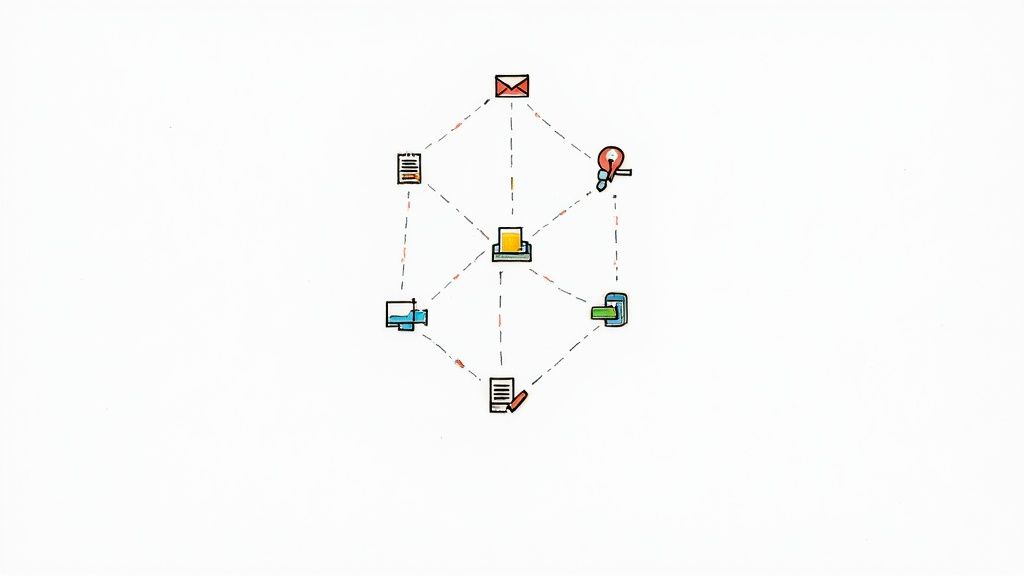
The way people consume information has completely changed. We're not just dealing with a few TV stations and newspapers anymore. By 2025, it's predicted that platforms like YouTube and TikTok will be dominant news sources, especially for younger generations. People aren't actively searching for news as much; it's finding them through algorithms on their feeds.
This means we have to think differently. A one-size-fits-all plan is dead. Our strategies need to be multi-channel, nimble, and built for shorter attention spans.
Matching the Channel to the Goal
Before you jump to picking platforms, ask yourself a simple question: "What am I actually trying to accomplish with this message?" Your answer should guide your entire channel strategy because different platforms are built for different jobs.
Here’s how I think about it:
- Looking for B2B leads? Go deep. Think detailed whitepapers, webinars that showcase your expertise, or a targeted article series on LinkedIn. These are channels where you can trade serious value for a prospect's contact info.
- Building a B2C community? Get personal and interactive. Short, authentic videos on Instagram Reels or TikTok, engaging polls on X (formerly Twitter), or a behind-the-scenes look inside a private Facebook group can work wonders for building trust.
- Want to be seen as a thought leader? You need to get your experts out there. Pitch them for guest spots on industry podcasts, publish op-eds in trade publications, or host a live Q&A on LinkedIn. These platforms build credibility.
- Need to get your internal team on the same page? Consider a dedicated internal podcast, a bi-weekly email from the CEO, or a private Slack channel for important project updates. The goal is to keep your own people informed and motivated.
This is the essence of effective digital communications—every channel has a purpose.
Remember, your channels are more than just buckets for content; they are strategic tools. The medium is part of the message. A formal whitepaper signals deep expertise, while a candid Instagram Story signals authenticity. Choose what you want to signal.
Creating an Integrated Channel Mix
The most powerful strategies I've seen don't just put all their eggs in one basket. They create a connected ecosystem where every channel works together to amplify the core message. I like to think of it as a "hub-and-spoke" model.
Your "hub" is the main, high-value piece of content—maybe it's a big research report or a detailed guide on your website. The "spokes" are all the different channels you use to push people toward that hub.
Here’s a real-world example of what this could look like in action:
- The Hub: You publish a comprehensive guide on your blog called "Navigating the New Financial Aid Process."
- The Spokes:
- Email: You send a newsletter to your database of parents and students with a quick summary of the guide and a strong call-to-action to read the full piece.
- Social Media: You create a handful of shareable graphics for Instagram and Facebook, each pulling out a key statistic or tip from the guide. The link to the full guide goes in your bio.
- Video: Your financial aid director films a quick two-minute video for YouTube breaking down the top three changes, with a link to the full guide right in the video description.
- PR: You pitch a story idea to local education reporters, highlighting the unique data you uncovered in your guide.
See how it all connects? This integrated approach ensures you're meeting different people on their preferred platforms, all while driving them back to your most valuable resource. It turns a single piece of content into a full-blown campaign.
How Do You Know if It’s Working? Measuring Success and Refining Your Strategy
A communications plan isn't a "set it and forget it" document. It’s a living, breathing guide that needs regular check-ups to stay effective. To truly know if your strategy is hitting the mark, you have to move beyond gut feelings and commit to measuring what matters. This is where you prove the value of your work.
The only way to tell a compelling story about your impact is to tie your metrics directly back to the SMART goals you set earlier. If a goal was to increase enrollment inquiries, then your key performance indicators (KPIs) are things like website form submissions and campus tour sign-ups. This direct link turns a spreadsheet of numbers into a clear narrative of progress.
Defining Your Key Metrics
Your communications strategy template should have a specific spot just for KPIs. The trick is to aim for a healthy mix of quantitative and qualitative data—this gives you the full story of your performance.
- Quantitative Metrics: These are the hard numbers. Think website traffic from a specific campaign, email open rates, social media engagement rates, and the number of media mentions. These metrics tell you what happened.
- Qualitative Metrics: This is the data that provides the why behind those numbers. You can get this through sentiment analysis on social media, by running short stakeholder surveys, or by gathering feedback from parent-teacher meetings.
Let’s say you see a 25% spike in traffic to a new program page (that's your quantitative data). But, qualitative feedback from a parent survey reveals they're still confused about the curriculum. That insight is gold. It tells you the channel is working, but your message needs a tune-up.
A dashboard isn’t about tracking every metric under the sun. It’s about tracking the right metrics that tell you whether you’re on track to hit your goals. Keep it simple and focused on the outcomes your leadership team actually cares about.
Reading the Tea Leaves: Interpreting Data and Making Adjustments
Once you start collecting data, the real work begins. I recommend scheduling regular check-ins—monthly is great, quarterly is essential—to sit down with your dashboard and ask some tough questions.
Did that new video series drive incredible engagement? Let's figure out how to do more of that. Is the weekly email newsletter consistently getting low open rates? Maybe it's time to rethink the content, or even the frequency.
This constant cycle of measuring, interpreting, and tweaking is what keeps your strategy agile and powerful. For a deeper dive into this, our guide on how to measure communication effectiveness offers some excellent frameworks.
Beyond your overall strategy, it’s also critical to know how to measure content performance to understand the ROI of individual pieces like a blog post or a case study. This continuous feedback loop ensures your communications strategy evolves from a simple plan into a powerful, results-driven engine for your organization.
Answering Your Toughest Communications Strategy Questions
So, you've got a communications strategy template. That's a great start. But the real work begins when you try to bring that document to life within the whirlwind of your organization. A plan on paper is one thing; making it work day-to-day is a whole different ballgame.
Let’s walk through some of the most common questions and hurdles that pop up when you move from theory to reality. Getting this right is what turns a static document into a living, breathing guide that actually drives results.
How Do I Make This Strategy Work for My Organization’s Size?
Whether you're a tiny startup or a massive global company, the core of a good communications strategy doesn't change. You still need clear goals, a deep understanding of your audience, a compelling message, and the right channels to deliver it. The real difference is in the scope and resources you have to play with.
Think of it this way:
If you’re a small startup: You have to be scrappy. Your focus should be on a couple of high-impact channels where you know your audience spends their time. Maybe your entire plan revolves around a killer company blog and one well-managed social media account. With limited resources, every single action needs to be laser-focused on a core business goal, like generating leads or building an initial customer base.
If you’re a large corporation: The game is more complex. You’re not just managing one plan; you're likely overseeing a whole ecosystem of them—internal comms, PR, investor relations—that all need to connect back to the main strategy. The biggest challenge here is keeping the message consistent across dozens of departments, maybe even multiple countries. This requires rock-solid brand guidelines and clear approval processes to keep everyone singing from the same hymn sheet.
The bottom line is to match your ambition to your capacity. Start with what you can realistically achieve, show its value, and then earn the right to expand.
How Often Should I Be Looking at This Thing?
Your communications plan isn't a "set it and forget it" document. It has to evolve. While I recommend a deep, comprehensive strategic review once a year, you need to check in on it far more frequently.
I always tell people to think of their strategy like a GPS. You’ve plugged in your destination (your annual goal), but you still have to glance at the map to navigate around traffic jams, roadblocks, or even find a surprise shortcut. A quarterly review is the perfect cadence for this.
These quarterly check-ins are your chance to look at the data. Are you hitting your KPIs? Has your audience's behavior changed? Did a new competitor just launch something big? These reviews let you make smart, agile shifts—like moving more budget to a social channel that’s blowing up—without getting sidetracked from your ultimate goals.
How Do I Get My Boss and Other Teams on Board?
A brilliant strategy is worthless if nobody supports it. Getting buy-in from leadership and other departments is all about framing your plan as a solution to their problems, not just another "marketing thing."
When you present your strategy, you have to speak their language. Don't just talk about engagement rates; connect every single tactic back to a bigger business objective they actually care about, like increasing sales, improving employee retention, or carving out a stronger market position. Use the data from your initial research to show them the real risks of not having a unified strategy.
Show them, with numbers, how your plan is going to solve real problems and open up new opportunities for the entire organization. That’s how you get them invested.
At The MarCom Society, we're all about giving you the tools and community you need to build and execute plans that don't just sit on a shelf—they get results. Our resources are specifically built for K-12 communications professionals wrestling with these exact challenges.









