
When a crisis hits, social media becomes the digital town square where the story unfolds, whether you're there to tell it or not. For schools, this isn't about just posting announcements; it's about actively managing the flow of information with speed, accuracy, and empathy when it matters most. It’s your direct line to a worried community, and you need to own it.
Why Social Media Is Your Most Critical Crisis Tool
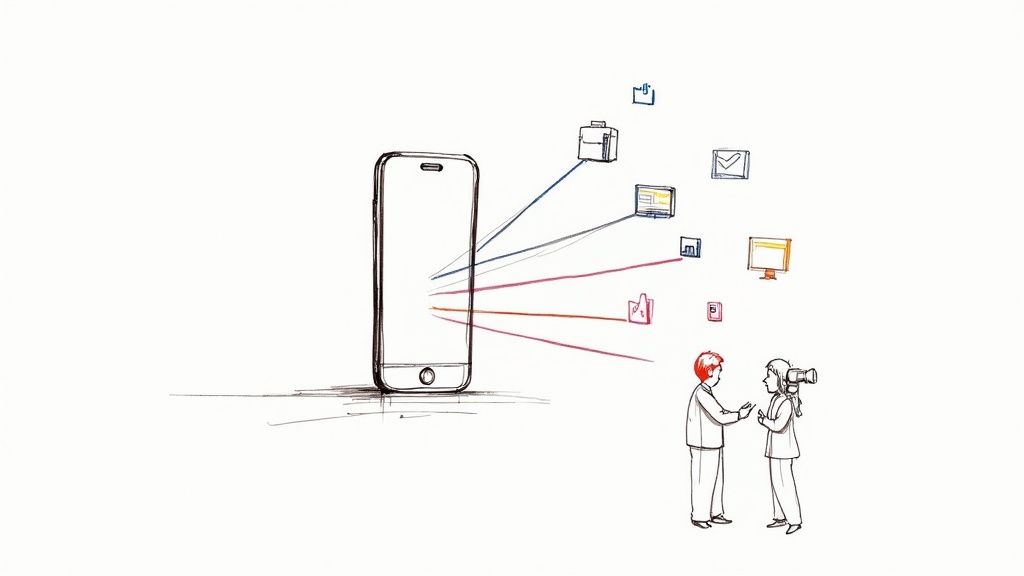
Let's be real. The moment an incident happens—a lockdown, a gas leak, a sudden weather closure—the conversation explodes on social media. Parents in Facebook groups, students on Snapchat… the first version of the story is written in minutes, long before a traditional press release or email can even be drafted.
This isn’t a new trend; it’s the reality of communication now. Ignoring it is like trying to ignore a fire alarm. A proactive social media strategy is no longer a "nice-to-have"; it's the heart of modern crisis communication on social media. It flips your channels from a space where rumors can run wild into your single best tool for controlling the story.
The New Speed of Information
Think of social media during a crisis as an information vacuum. If your official channels don't fill it with facts, it will instantly be filled with fear, speculation, and outright misinformation. A student texts their parent from a classroom, and that parent immediately posts a frantic question in a community group. Suddenly, one unverified comment has reached hundreds of families before your team has even confirmed the initial details.
This is the fundamental shift. Your school’s social media must be the go-to, undisputed source of truth. By building that reputation before a crisis, you’re training your community where to look when they're scared and need answers. This boils down to a few core commitments:
- Speed: Get something out within minutes. Even a simple holding statement like, "We are aware of the situation at XYZ School and will provide more information as it becomes available," is better than silence.
- Accuracy: Every single detail you post must be verified and crystal clear. No jargon, no ambiguity.
- Consistency: The same message needs to go out on Facebook, X, your website, and any other channel you use. A unified front prevents confusion.
The days of crafting the perfect press release while rumors spread like wildfire are over. The table below illustrates just how much the game has changed.
The Shift from Traditional to Social Media Crisis Response
| Crisis Element | Traditional Response (Pre-Social Media) | Modern Response (Social Media-Centric) |
|---|---|---|
| Initial Alert | Phone calls, local news reports, word-of-mouth. | Instant posts on X, Facebook, and Instagram; alerts from students via text. |
| Information Speed | Hours. Controlled by media cycles and official press briefings. | Seconds to minutes. Information flows in real-time from multiple sources. |
| Official Voice | A single spokesperson; formal press releases sent to media outlets. | The school's social media accounts become the primary source of truth. |
| Community Input | Limited to phone calls to the front office or angry letters. | Direct, public comments and DMs on posts; real-time feedback and concerns. |
| Rumor Control | Reactive. A press conference held hours later to "set the record straight." | Proactive. Directly and publicly correcting misinformation as it appears. |
| Tone | Formal, institutional, and often detached. | Empathetic, transparent, and human. Shows leadership and care. |
This evolution from a one-way broadcast to a two-way conversation is the most significant change in crisis management in a generation.
From Liability to Leadership Asset
A well-handled social media response does more than just share facts—it demonstrates compassionate leadership. It tells your families, staff, and students, "We see you, we hear you, and we're on top of this." That builds a level of trust that will last far beyond the current emergency.
A crisis doesn't create your school's reputation; it reveals it. How you communicate in those first few critical hours defines public perception and can either strengthen or shatter community trust for years to come.
The scary part? Many organizations are caught completely flat-footed. A staggering only 49% of U.S. companies have formal crisis communication plans, according to research shared by Sprinklr. This leaves a huge vulnerability in a world where a single viral post can spiral out of control.
The solution is to stop seeing your social media as just a digital bulletin board. It's a two-way street—a place to listen to what people are worried about, correct bad information with grace, and offer genuine reassurance. You can explore the foundational concepts of crisis management on social media to build a more resilient plan.
When you build that foundation of trust before an emergency, you ensure that when every second counts, your voice is the one your community trusts and turns to first.
Building Your School's Crisis Communication Playbook
A crisis is the worst time to wonder who has the social media passwords. When an emergency hits, you don’t have time to invent a plan on the fly. You need a playbook you can open and execute immediately. Think of it as your school's muscle memory for staying in control when everything feels out of control.
A well-built playbook for crisis communication on social media takes the guesswork out of the equation. It cuts down on human error under pressure and ensures your response is swift, accurate, and empathetic. It’s what separates leading the conversation from being swept away by it.
Assemble Your Core Response Team
Before a single tweet is drafted, you need to know who’s on the field. Your social media crisis team isn't your entire communications department. It’s a small, agile group of designated people who have the authority and skills to act fast.
Your team should have clearly defined roles:
- The Lead Communicator: This is often the Director of Communications. They have the final say on messaging and strategy, coordinate the team, and are the main point of contact for school leadership.
- The Social Media Manager: This person is on the front lines, responsible for posting updates, monitoring all channels for comments and rumors, and engaging directly with the community.
- The Fact-Finder/Liaison: Their job is to get verified information from administrators, emergency services, or other official sources. They feed accurate, timely details to the Lead Communicator so every post is truthful.
- The Leadership Representative: Think a principal or superintendent who can quickly approve statements and provide high-level direction, making sure the response aligns with district policy and values.
Getting these roles sorted out ahead of time prevents that chaotic "who's in charge?" moment that can paralyze a response. Building a solid playbook is also a core part of a bigger picture, which is why Your Online Reputation Management Guide is such a valuable resource for protecting your school's brand before, during, and after a crisis.
Establish a Lean Approval Process
Speed is everything. A message that takes two hours to get approved is practically ancient history in a social media crisis. Your playbook has to outline an approval workflow that’s both simple and fast, bypassing the usual red tape.
For example, a crisis workflow might look like this: The Social Media Manager drafts a post based on intel from the Fact-Finder. The Lead Communicator reviews it for tone and accuracy, then sends it to the Leadership Representative for a final, quick thumbs-up. This whole cycle should take minutes, not hours.
In a crisis, your approval process should be a clear highway, not a winding country road. The goal is to get accurate, approved information out to your community before rumors can take root and spread.
The United States might lead the market in social media use, but many organizations are still caught flat-footed. It’s pretty shocking, but only about half of U.S. companies have a formal crisis plan. As you can learn from insights on gminsights.com, this gap is a huge vulnerability. For schools, it’s a critical opportunity to get ahead by formalizing your own response strategy.
Pre-Draft Your Holding Statements
You will never have all the answers in the first ten minutes of an emergency, but silence is not an option. That's where pre-drafted holding statements come in. These are essentially fill-in-the-blank templates that let you acknowledge a situation immediately while your team scrambles to gather the facts.
Your playbook should contain templates for various scenarios. It’s like a first-aid kit for your communications.
This image from Ready.gov shows what goes into a disaster supplies kit. Your communication templates serve the exact same purpose—they are essential supplies you need ready before disaster strikes. You wouldn't want to search for batteries in a blackout, and you don't want to be writing a statement from scratch during a lockdown.
Here are a few examples of what your templates might cover:
- Weather Emergency: "Due to [Weather Event], all schools in [District Name] will be [Action Taken, e.g., closing early]. We are taking this step to ensure the safety of our students and staff. More information will be shared here as it becomes available."
- Security Threat: "We are aware of a situation at [School Name] and are working closely with law enforcement. The campus is currently [Status, e.g., on lockdown]. We will provide updates on this channel as soon as we have verified information. Please do not come to the campus at this time."
- Health Concern: "The health department has notified us of [Health Issue] impacting our community. We are following all recommended protocols and will share specific information with families via email. The safety of our students is our top priority."
These templates aren't your final message, but they are your critical first one. You can get more structured help building out this part of your playbook with our crisis communication plan template.
Navigating the First Hour of a Live Crisis
When an emergency hits, the clock starts ticking—fast. That first hour is a whirlwind of confusion, rumors, and genuine fear. But from a communications standpoint, it’s also your golden hour. This is your chance to get ahead of the narrative, and your crisis playbook is the tool that lets you move with speed, accuracy, and empathy.
You won't have all the answers in those first sixty minutes. And that's okay. The real goal is to immediately establish your school’s official social media channels as the one and only source of truth. You’re cutting through the noise to show your community you're there, you're in control, and their safety is all that matters.
Activate Your Team, Post Your Holding Statement
The second a crisis is confirmed, your first move is to get your comms team online. This isn’t the time for a slow email chain. It should be an instant alert through a dedicated channel, like a secure messaging group, that gets your key people assembled and ready to act. Everyone knows their job.
Almost simultaneously, you need to get your holding statement out. This might be the single most important post you make. The public expects a response, and they expect it now. In fact, research shows 40% of consumers expect brands to respond via social media within one hour of an issue breaking. Silence is deafening; it looks like incompetence or, worse, like you don't care. This is exactly why having pre-written, pre-approved templates is non-negotiable. You can dig deeper into the data on why that first hour is so vital in research from odwyerpr.com.
A solid holding statement accomplishes three things, quickly:
- Acknowledge: "We are aware of the situation."
- Empathize: "Our hearts are with everyone involved."
- Direct: "This page is where we will post all official updates."
For instance, during a sudden campus lockdown, you might post: "We are aware of an active situation at Northwood High School and are working closely with law enforcement. The campus is secure. The safety of our students and staff is our primary focus. We will share all verified updates here as they become available."
That’s it. That simple message buys you critical time and fills the information vacuum where rumors start to grow.
This infographic lays out the core elements of a playbook designed for this kind of rapid response.
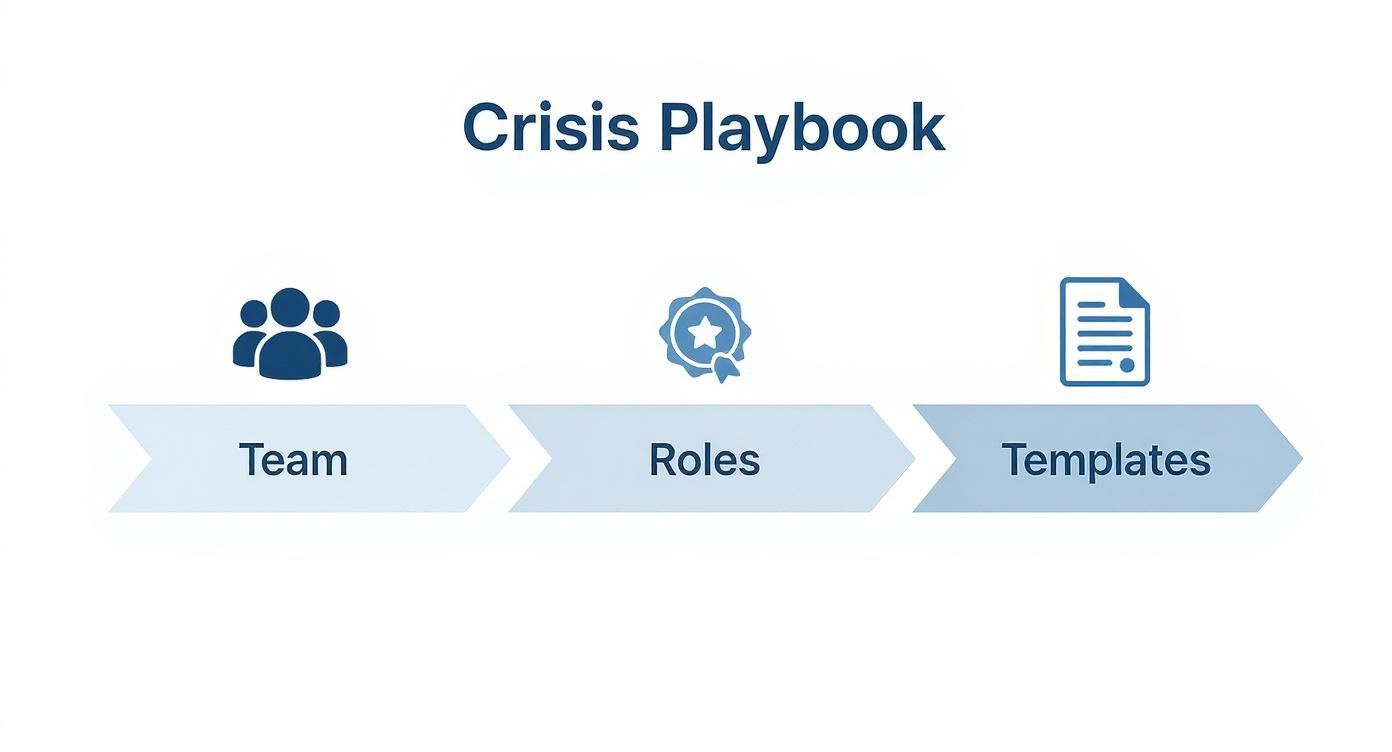
As you can see, a successful response hinges on having your team, roles, and messaging locked down long before you ever need them.
Master the Art of Compassionate Messaging
Once that first message is up, your focus has to shift to the tidal wave of questions and comments coming in. Here, your tone is everything. Every word you type has to project calm, confidence, and compassion.
Ditch the cold, institutional jargon. Instead of, "The district is handling the incident," try something more human: "Our team is on-site, and we are focused on ensuring every student is safe." It’s a subtle shift, but it makes all the difference. You’re a person first, an institution second.
In a crisis, your community isn’t looking for a press release. They’re looking for reassurance from a trusted leader. Your social media voice needs to be that leader—calm, empathetic, and clear.
When you can, give people clear, actionable instructions. If parents need to stay away from campus, tell them plainly and explain why. "For everyone's safety and to allow emergency responders clear access, please do not come to the school. We will let you know the moment it is safe to do so."
Manage Comments and Shut Down Misinformation
Your comment section is about to become a live feed of your community’s worst fears. Don’t ignore it. And whatever you do, don't turn off the comments unless it becomes a legitimate safety issue with direct threats. Shutting them down screams that you’re hiding something and just pushes the entire conversation into private Facebook groups where you have zero control.
Instead, you need a smart, strategic approach.
- Monitor Like a Hawk: Your social media manager should be glued to the feed, looking for common questions and spotting dangerous rumors before they take root.
- Reply to Themes, Not Individuals: You simply can't answer every person. Instead, look for the recurring questions. Is everyone asking about dismissal? Address it in your next official update. For example: "We're seeing many questions about student pickup. We will post a detailed plan for reunification in our next update, which we expect in 30 minutes."
- Correct Gently but Firmly: When you spot something that's flat-out wrong, you have to correct it. But do it without emotion. A simple, "That information is incorrect. Please continue to follow this page for official details. The campus remains secure," is perfect. Don't get dragged into an argument.
By actively and authentically managing the conversation, you continuously reinforce your role as the single source of truth. You hold onto the trust that your community needs from you now more than ever.
Leading the Post-Crisis Recovery and Review

When the immediate danger is gone and the stream of urgent alerts finally stops, it's natural to want to just get back to normal. But this is precisely when some of the most critical work in crisis communication on social media begins. This is your moment to rebuild trust, help your community heal, and prove your leadership is steady long after the storm has passed.
Your social media channels need to make a careful pivot. They’ve been the go-to for emergency updates, and now they must become a hub for recovery and resilience. The tone has to shift from urgent and directive to supportive and reassuring. This next chapter is just as important as the first.
Shifting Your Messaging to Support and Heal
Your community is looking for a path forward, and your social channels can light the way. The focus now is all about providing resources, celebrating the strength of your community, and navigating the emotional aftermath. Your content needs to be thoughtful, empathetic, and consistently helpful.
This means sharing practical information that actually helps in the recovery. Put yourself in the shoes of your families and staff—what do they need to feel safe and supported as things get back on track?
Your messaging in this phase should stand on a few key pillars:
- Sharing Counseling and Support Resources: Post clear, easy-to-find links and contact info for school counselors, district mental health partners, and local support services. Pin these posts or make them highly visible.
- Announcing Return-to-School Plans: Be crystal clear about the logistics of reopening. Detail any changes to schedules, building access, or new procedures designed to keep everyone safe.
- Highlighting Stories of Resilience: This is huge. Share positive stories of students, teachers, and community members stepping up and supporting one another. It helps shift the narrative from fear to strength.
For instance, after a major storm forces a closure, don't just post that school is back in session. Thank the maintenance crews who worked around the clock to clear the campus. It shows gratitude and reinforces that you're all in this together.
Conducting a Post-Crisis Social Media Review
Some of the most valuable lessons you’ll ever learn come from looking back at how you handled a crisis. Once the dust settles, it is absolutely essential to conduct a thorough review—what we often call a "hot wash"—of your social media performance. This isn't about pointing fingers. It’s about being honest about what worked and what didn't so you can tighten up your playbook for next time.
Get your core crisis team in a room and ask the tough questions. An honest, unflinching look at your performance is the only way to get better.
A crisis doesn’t end when the emergency vehicles leave. It ends when you've learned every possible lesson from the experience. A structured review turns a painful event into a powerful catalyst for improvement.
This isn't a casual chat; it should be a structured, documented process. It's a vital step that turns a reactive team into a proactive, prepared one. The data is clear: organizations that formally review their crisis plans are far more effective when the next emergency hits.
Your Social Media Hot Wash Checklist
Use these questions to guide your team’s discussion. The goal is to walk away with actionable insights that will make your crisis communication plan stronger and more realistic.
1. Response Time and Accuracy
- How long did it take us to get that initial holding statement out? Was it fast enough?
- Did we post anything that was factually incorrect? If so, how quickly did we catch and correct it?
2. Message Effectiveness
- Was our language clear, compassionate, and simple to understand, even for someone in a panic?
- Did our posts actually help? Did they direct people to the right places and cut down on the number of frantic calls to the front office?
3. Community Engagement and Rumor Control
- Looking at the comments, what were the most common questions or worries people had?
- What specific rumors or misinformation blindsided us? Where did they come from?
- How well did we shut down false information without getting into arguments or making things worse?
4. Internal Processes and Team Performance
- Where did our approval process get bogged down? Did anyone on the team feel unsure of their role?
- Did our internal communication (our text thread, Slack channel, etc.) work smoothly?
- What’s the one tool, template, or piece of information we desperately wished we had in the moment?
By digging into these areas, you can pinpoint the real gaps—whether it’s a clunky approval chain or a missing pre-approved message—and fix them. This disciplined review ensures your crisis communication on social media doesn't just work, it gets better and more resilient every time.
Putting Your Playbook to the Test in Real-World Scenarios
A crisis playbook is a great start, but it's just a document until it’s tested under fire. When a real crisis hits, the pressure is immense, emotions are running high, and your entire community is looking to you for calm, clear guidance. This is the moment where all that preparation pays off, empowering you to control the flow of information with confidence.
To give you a better feel for how this works, let's walk through three all-too-common scenarios in the K-12 world. For each one, I’ll share some concrete examples of social media posts for every stage of the crisis—from the first alert to the final all-clear. Think of these as adaptable templates you can pull from for your own crisis communication on social media.
Scenario One: Sudden School Lockdown
A lockdown is one of the most frightening situations a school community can endure. It's an information vacuum filled with uncertainty and fear. Your social media response has to be immediate and factual, offering reassurance without giving false hope or unverified details.
Here’s a look at how you might manage the communication:
Initial Alert (Within 5 Minutes): "Lincoln High School is currently in a precautionary lockdown due to a situation in the nearby area. All students and staff are safe inside the building. We are in direct contact with law enforcement and will share verified updates ONLY on this page. Please do not come to the campus at this time."
Ongoing Update (15-20 Minutes Later): "Update: The lockdown at Lincoln High remains in effect as law enforcement manages the external situation. Again, all students are safe and following our established safety protocols. We will provide our next update in 30 minutes or sooner if the situation changes."
Resolution Post: "The lockdown at Lincoln High has been lifted by law enforcement. The situation in the area is resolved and there is no longer a threat. Students will be dismissed at the normal time. We are incredibly proud of our students and staff for their calm and cooperation."
Scenario Two: Widespread Public Health Issue
Picture this: a severe flu or norovirus outbreak sweeps through an elementary school, forcing you to close for a day or two. Your communication needs a different touch—it should be informative, empathetic, and squarely focused on the steps you’re taking to protect everyone’s health.
Here, the tone is less about immediate physical danger and more about proactive safety measures and clear instructions.
In a health-related crisis, your primary role is to be a source of calm, credible information. You must convey the seriousness of the issue while reassuring parents that you have a clear plan to ensure a safe learning environment.
The goal is to stop the spread of two things: the illness itself and any misinformation that might be brewing online. Below are some sample posts you might use.
Sample Social Media Posts for Different Crisis Stages
| Crisis Stage | Platform | Sample Post Content |
|---|---|---|
| Initial Alert | Facebook/Email | "Due to a significant number of reported flu cases at Maplewood Elementary, and in consultation with the Health Department, the school will be closed tomorrow, [Date], for deep cleaning. This proactive step is to ensure the health and safety of our entire school community." |
| Ongoing Update | X/Instagram Story | "Our facilities team is conducting a thorough cleaning of Maplewood Elementary today. We are following all health department guidelines to prepare for a safe reopening. We will confirm reopening plans by 5 PM this evening. Thank you for your understanding." |
| Resolution Post | All Channels | "Maplewood Elementary will reopen on schedule tomorrow, [Date]. The school has been professionally sanitized. Please remember to keep children home if they show any signs of illness. We appreciate our community's partnership in keeping our schools healthy." |
These templates help maintain a consistent, reassuring voice when parents need it most.
Scenario Three: Viral Reputational Crisis
Let’s say a student posts a short video clip from a science class. Taken out of context, it makes a beloved teacher look like they’re endorsing a dangerous idea. The video goes viral in local parent groups, and the online outrage is building fast.
You aren't managing physical safety here, but you are absolutely protecting your school's reputation—and your teacher's. Your response must be swift and transparent, correcting the narrative without getting defensive or violating student privacy.
- Acknowledge and Set the Record Straight: "We are aware of a video circulating online from a science class at Jefferson Middle School. The short clip does not show the full context of the lesson on scientific debate. We have reviewed the full lesson and can confirm the teacher was illustrating a point, not endorsing the view shown. We are speaking with the family involved."
This kind of crisis really shows why you have to move fast to reclaim the story. By providing context and showing you're taking it seriously, you can often de-escalate the situation before it causes any lasting damage.
Common Questions About Social Media in a Crisis
Even with the best plan on paper, when a real crisis hits, the pressure is immense. The speed of social media can feel overwhelming, and tough questions pop up that don't always have an easy answer. Let's walk through some of the most common dilemmas I see school communicators wrestle with when things get tense online.
Thinking through these scenarios before you're in the hot seat is a huge part of effective crisis communication. It helps you move past reacting on instinct and into a strategic, thoughtful response.
Should We Disable Comments on Our Posts During a Crisis?
The temptation to shut down comments is real, especially when they're flooding in with anger or panic. But in almost every situation, the answer is no. Disabling them is a bad look. It sends a message that you're hiding something or can't handle the heat.
Worse, it just pushes the entire conversation off your page and into private parent groups where misinformation can spread completely unchecked.
Your best bet is to leave comments on and monitor them like a hawk. This approach actually gives you more control.
- Spot recurring questions: You can see what everyone is asking and make sure to address those concerns in your next official update.
- Correct misinformation directly: When you see a factual error, a gentle, public correction can steer the conversation back to the truth.
- Show you're listening: Keeping the lines open signals confidence and transparency, building trust when you need it most.
This is where having a clear, pre-existing comment policy is a lifesaver. It gives you the authority to remove comments that are genuinely abusive, threatening, or spam without silencing the entire community.
How Do We Handle Rumors Spreading in Private Parent Groups?
This is a tricky one. You can't moderate what happens in a private Facebook group, but you absolutely can influence it. The best strategy is to make your official channels the undisputed source of truth.
When your school’s social media pages are the fastest and most reliable place to get information, you essentially starve rumors of the oxygen they need to spread.
It also helps to have a trusted staff member or even a well-regarded parent volunteer in those groups. Their job isn't to police the conversation but to act as a helpful guide. They can simply share links back to your official announcements.
A simple message works wonders. Something like, "For the latest official update directly from the district, please see their post here: [link]" can redirect the entire conversation back to facts without picking a fight.
What Is the Single Most Important First Step?
Get an initial holding statement up. Fast. This is the absolute foundation of successful crisis communication on social media, and it needs to happen within minutes, not hours. Even if you have very few details, that first post is critical.
Your first post has three simple but vital jobs:
- Acknowledge: Show you’re aware of the situation.
- Empathize: Recognize the fear and concern in your community.
- Direct: Tell people this is the channel they need to watch for official updates.
A statement posted in 90 seconds that says, "We are aware of the ongoing situation at the high school and will share more confirmed information here as soon as we can," is infinitely better than waiting 20 minutes for a perfectly polished paragraph. That 20-minute gap is a vacuum that rumors will rush to fill.
If you want to dig deeper into the core principles behind this strategy, you can learn more about what crisis management entails.
At The MarCom Society, we provide K-12 communications professionals with the tools, training, and peer support needed to lead with confidence during a crisis. Join our community to access expert-led workshops, practical resources, and a network of colleagues who understand the unique challenges you face. https://marcomsociety.org









