
At its core, a crisis communication plan is a school's playbook for responding with speed, clarity, and confidence during an emergency. It's the strategic guide that details who says what, when, and how, ensuring you manage the flow of information, safeguard the school's reputation, and hold onto the community's trust when the unexpected happens.
Why a Proactive Plan Is No Longer Optional
In any K-12 school, a crisis can blow up in a matter of minutes. A rumor on social media, a sudden weather alert, or a health scare can spiral out of control before the first bell even rings.
The days of taking a "wait-and-see" approach are long gone. When official information is missing, fear and misinformation will always rush in to fill the void. A proactive crisis communication plan is what turns a chaotic reaction into a coordinated, reassuring response.
This isn't just about having a dusty binder on a shelf. Think of it as a living tool that empowers your leadership team to act with conviction. When everyone already knows their role and the core messages are pre-drafted, you can focus on what truly matters: keeping students safe and supporting your staff.
The Real Cost of Unpreparedness
It’s surprising how many organizations operate without this critical safety net. A recent survey showed that only 49% of U.S. companies have a formal crisis communication plan in place. That gap is a major risk for any industry, but for schools—where trust is the absolute bedrock of the community—it's a massive vulnerability.
For schools, the consequences of being unprepared are steep and immediate:
- Erosion of Parent Trust: When parents feel left in the dark or get conflicting messages, their confidence in your ability to protect their children can quickly evaporate.
- Widespread Misinformation: Social media is an accelerant. Inaccuracies can spread like wildfire, creating unnecessary panic and making it much harder to manage the actual situation.
- Staff Confusion and Anxiety: Without clear direction, teachers and staff are left fielding questions they can't answer. This just adds to the stress and prevents a unified, calm response.
A well-structured plan is your school's operational blueprint for maintaining stability during instability. It ensures you control the narrative, provide a single source of truth, and demonstrate competent leadership when it is needed most.
Shifting from Reaction to Readiness
Building a solid plan demands a real shift in mindset—from reactive damage control to proactive readiness. To get this right, it helps to understand the principles of proactive risk management that effective organizations live by. It’s all about anticipating potential scenarios, from a data breach to a power outage, and putting clear protocols in place before they ever happen.
This forward-thinking stance is a key part of what crisis management is all about. For school leaders, that means going beyond just operational checklists and weaving communication into every single stage of your emergency planning. The hard work you put in during times of calm is what guarantees a steady hand during the storm. If you want to dive deeper into the overarching strategy, you can explore the fundamentals of crisis management here: https://blog.marcomsociety.org/what-is-crisis-management/.
Building Your School's Crisis Response Team
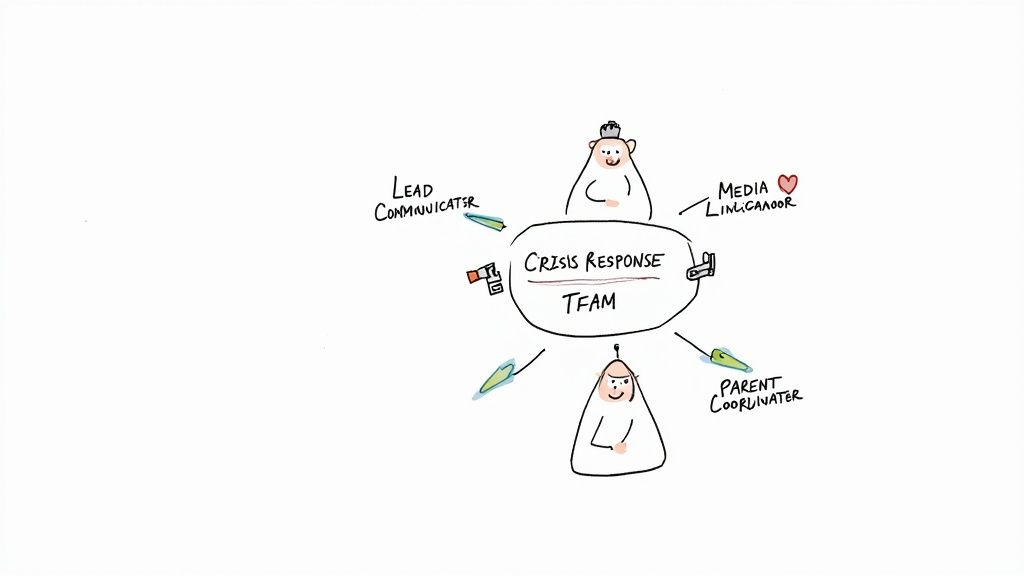
Let's be honest: a crisis communication plan is just paper until you have the right people ready to execute it. When an emergency hits, chaos is the only guarantee. That’s why your dedicated response team isn't just a nice-to-have; it's the engine that will drive your entire strategy when every second is critical.
The goal here is to create a small, agile unit that can move fast without tripping over each other. It’s less about official job titles and more about who can stay level-headed and make smart decisions under immense pressure.
Defining Your Core Communication Roles
Your full-blown crisis response will involve people from operations, safety, and IT, but the communications group has a very specific job: managing the message. This team is laser-focused on controlling the flow of information to parents, staff, the media, and the community.
You need to formally empower these individuals with the authority to act before a crisis happens. Think about the specific skills you need on deck. For example, the person who's a wizard with your social media accounts might be perfect for monitoring online chatter but isn't necessarily the one you want in front of a news camera.
While every school is different, a few roles are absolutely non-negotiable.
Core Roles for Your Crisis Communication Team
To make sure all your bases are covered, you need to assign specific responsibilities. This table breaks down the essential roles, what they do during an emergency, and the skills you should look for when choosing the right person.
| Role | Primary Responsibilities | Essential Skills |
|---|---|---|
| Lead Communicator / Spokesperson | Approves all external messages and serves as the public face of the school. Delivers official statements to the media and community. | Public speaking, gravitas, ability to stay on message under pressure, decision-making authority. |
| Media Liaison | Manages all incoming media requests, organizes press conferences, and distributes official information to journalists. Acts as the primary point of contact for the press. | Media relations experience, organizational skills, strong written communication, assertiveness. |
| Parent & Community Coordinator | Manages mass notification systems (email, SMS, robocalls), updates the school website, and serves as the main conduit for parent inquiries. | Empathy, clear writing, familiarity with school notification platforms, patience. |
| Internal Communications Coordinator | Ensures all staff and teachers receive timely, accurate information so they can manage their classrooms and answer student questions effectively. | Attention to detail, clarity, understanding of internal school dynamics. |
| Social Media Monitor | Actively watches all social media platforms for rumors and misinformation, posts official updates, and reports on community sentiment to the team. | Social media savvy, quick response time, sound judgment, ability to spot emerging issues. |
Having these roles clearly defined prevents confusion and ensures that critical tasks don't fall through the cracks when things get hectic.
Assembling the Right People
When you're picking your team, look past the org chart and focus on temperament. Who on your staff is unflappable? Who can make a quick, smart decision with only half the information? Those are the people you want in the room.
The effectiveness of your crisis response is directly tied to the composure and clarity of the people leading it. A flustered leader creates a panicked community. A calm, prepared leader fosters trust and resilience.
Think about the staff member who always keeps a cool head during a tense parent-teacher conference or the administrative assistant known for their meticulous attention to detail. These are your prime candidates. They know how to filter out the noise and just get the job done.
Once you’ve got your team, you need a crystal-clear chain of command. Everyone needs to know exactly who they report to and who has the final say on sending a message. This simple step eliminates the bottlenecks and indecision that can paralyze a response. A well-defined hierarchy turns a group of talented individuals into a single, coordinated force.
Anticipating Risks and Crafting Key Messages
The best crisis communication plans are built on foresight, not reaction. If you’re waiting for an emergency to figure out what to say, you’re already behind. A proactive approach is what allows your team to communicate with calm control instead of frantic improvisation when the stakes are highest.
This whole process begins with an honest look at the specific risks your school community faces. Every campus is different, so a generic checklist just won't do. The goal here is to shift your mindset from "what if?" to "when this happens, here's what we do."
Conducting a School-Specific Risk Assessment
Your risk assessment has to be a team effort. Bring in your crisis team, campus safety personnel, and even your facilities managers. The idea is to brainstorm every plausible scenario that could throw a wrench in the school day and demand clear, immediate communication.
You need to get specific. "Bad weather" is way too broad. Think about the very different communication challenges posed by a tornado warning versus a sudden blizzard that shuts down the roads and forces an early dismissal.
Here are a few common risk categories for K-12 schools to get you started:
- Natural Disasters: Think hurricanes, tornadoes, floods, or wildfires. Anything that could directly impact your school’s operations or the safety of your campus.
- Health Emergencies: This could be an outbreak of something like norovirus or the flu, a widespread foodborne illness, or a serious medical incident involving a student or staff member.
- Safety and Security Threats: On-campus threats, lockdowns (both real and precautionary), scary but unsubstantiated social media rumors, or a police incident in the neighborhood that affects your safety protocols.
- Facility Failures: The unexpected stuff—a power outage, a burst pipe causing major flooding, or a gas leak that requires an immediate evacuation.
- Reputational Crises: Allegations of staff misconduct, a student fight that goes viral online, or a data breach that exposes sensitive family information.
Once you have your list, it's time to rank these scenarios by likelihood and potential impact. This helps you figure out where to focus your energy first. A winter storm in Minnesota is a near certainty; other events might be less likely but would be absolutely devastating if they occurred.
Developing Pre-Approved Core Messages
With your potential crises identified, you can start drafting core messages for each one. These aren't rigid, word-for-word scripts. They are foundational templates you can grab, adapt, and send out in minutes. The goal is to have 80% of the message written and approved ahead of time, so all you have to do is fill in the specific details during the actual event.
The point of pre-drafted messages is to take creative writing out of the equation when everyone is under immense pressure. Having a clear, empathetic, and legally-vetted starting point is invaluable when your team is stressed.
Remember to craft these messages with your different audiences in mind. The information a parent needs is not the same as what a staff member requires or what you'd share with the media. A big part of planning is figuring out who you need to talk to and how to reach them. You can explore these key strategies for stakeholder communication to make sure your messages connect with everyone from parents and staff to the wider community.
Key Elements of an Effective Crisis Message
No matter the crisis, every message you send should have a few core components. This structure provides clarity and builds confidence, even when you don't have all the answers yet.
- Acknowledge the Situation: Start with a clear, simple statement about what is happening. Use plain language. For example, "This morning, a water pipe burst in the main building, causing significant flooding."
- State the Immediate Action: Tell people what you are doing right now and what they need to do. Example: "For the safety of all students and staff, we are dismissing school early at 11:00 AM."
- Express Empathy and Reassurance: Show you understand people are concerned. A simple sentence like, "We know this is disruptive and our top priority is ensuring every student is safe," goes a long way.
- Provide a Single Source of Truth: This is critical for shutting down misinformation. Direct everyone to one place for official updates. For instance, "All future updates will be posted on the district website and sent via our official SMS alert system."
- Outline the Next Steps: Let people know when they can expect to hear from you again, even if it’s just to say, "We will provide another update by 3:00 PM today." This manages expectations and cuts down on the flood of inbound calls and emails.
By investing time now to anticipate risks and prepare these foundational messages, you're building the essential infrastructure for a successful crisis response. This is the proactive work that separates a school that manages a crisis from one that is managed by it.
Mastering Your Communication Channels
Having a folder of pre-approved messages is a smart first step, but those messages are worthless if you can't get them to the right people, right now. During a crisis, your communication channels are the lifelines connecting you to your community. A scattered, hope-for-the-best approach just won't cut it. You need a layered, multi-channel strategy that ensures your updates actually break through the noise.
Think about your parent community. Not everyone is glued to their email inbox. Some live on Facebook, while others still default to checking the school website for news. If you only use one channel, you’re guaranteed to miss a huge chunk of your audience. Your crisis communication plan has to be crystal clear about which tools to use, in what order, and for what specific purpose.
This isn’t about just blasting the same message everywhere at once. It’s about creating a coordinated flow of information where each channel supports the others, consistently pointing everyone back to a single source of truth.
Choosing the Right Tools for the Job
Every school has a communications toolkit. The real trick is knowing the strengths and weaknesses of each tool and using them with intention. A mass text message is perfect for a sudden, urgent alert, but an email is far better for providing the detailed follow-up information parents will be desperate for.
Let’s break down the primary channels and how to use them when the pressure is on:
- Mass Notification Systems (SMS/Robocalls): These are your emergency sirens. Use them for immediate, high-priority alerts like lockdowns, early dismissals, or evacuations. Keep the message brutally short and to the point, and always direct people to another channel (like the website) for more details.
- Email: This is your workhorse for detailed updates. Email gives you the space to provide context, proactively answer the questions you know are coming, and share links to helpful resources. It’s the ideal channel for follow-up communication once the initial alert is out.
- School Website: Your website must become the definitive source of truth. Before a crisis ever hits, create a dedicated, easy-to-find "Alerts" or "Emergency Updates" section on your homepage. Every single message you send on other channels should point back here for the most current and comprehensive information.
- Social Media Platforms: Use platforms like Facebook or X (formerly Twitter) for quick, scannable updates and to actively shut down misinformation. This is also where you’ll face the most public-facing scrutiny. It’s a non-negotiable part of any modern plan, and it's vital to understand the unique challenges of managing crisis communication on social media.
The shift to digital tools in emergency response is undeniable. A recent global survey found that over 60.3% of organizations now rely on emergency notification tools as a core part of their crisis plans. The heavy use of mobile phones and email in emergencies signals a clear demand for fast, accessible information. You can discover more insights about these communication trends and see how they apply across different fields.
Taming the Social Media Beast
In a crisis, social media can be your greatest ally or your most dangerous foe. On one hand, it’s an incredibly fast way to get information out. On the other, it’s a petri dish for rumors, panic, and angry speculation. You need a specific game plan to manage it effectively.
Your social media monitor should be glued to the screen, tracking mentions, comments, and hashtags related to your school. The key is not to get dragged into online arguments. Instead, focus on correcting dangerously false information calmly and authoritatively.
Never let your official social media accounts go dark during a crisis. If you don't have new information to share, post a simple holding statement. Something like, "We are continuing to manage the situation and will provide our next update by 2:00 PM." Silence creates a vacuum that will immediately be filled by rumors.
When you post an official update, seriously consider turning off the comments for that specific post if the platform allows it. This simple action can prevent the thread from spiraling into a chaotic mess of unverified claims and directs people with questions to your official channels.
Knowing When to Escalate to a Press Briefing
Let's be clear: most school-level incidents will not require a formal press conference. But for a major event with significant community impact or intense media interest, a press briefing may become unavoidable. This move is all about taking control of the narrative and demonstrating transparency.
A press briefing is probably warranted when:
- The incident involves multiple outside agencies, like the police and fire departments.
- You're suddenly dealing with widespread, or even national, media attention.
- You need to correct significant misinformation that has spread far beyond your control.
This is the moment when your designated spokesperson and media liaison become the most important people in the district. They will manage the event, deliver the carefully prepared statement, and field questions from reporters. The goal of a press briefing isn't to have every single answer, but to show you have a process for finding them and are committed to keeping the public informed. By mastering each of these channels, you build a resilient communication system that delivers clarity and confidence when your community needs it most.
Putting Your Plan Into Practice
Having a documented crisis communication plan is a great first step, but a plan gathering dust on a shelf won’t do you any good when an emergency strikes. You have to bring it to life. The real work begins when you turn that document into an active, operational tool through consistent training, drills, and practice. This is how you build the "muscle memory" your team will rely on to perform under pressure.
Without practice, even the most well-thought-out plan can crumble. People forget their roles, messages get garbled, and the chain of command fractures. Regular practice is what bridges the gap between theory and reality, preparing your team to handle the immense stress of a real event with confidence.
Running Realistic Tabletop Exercises
Tabletop exercises are, without a doubt, the best way to pressure-test your plan. These aren't full-blown, high-stress simulations. Think of them as guided discussions where your crisis team walks through a specific scenario, step-by-step, in a low-stakes environment. The goal is simple: talk through the plan to see where it works and, more importantly, where it breaks.
I always recommend starting with one of the high-likelihood risks you identified earlier, like a sudden school closure due to a winter storm or a power outage. Gather your team, lay out the scenario, and then start asking the tough questions.
- The First 5 Minutes: Who gets the first call? What’s the very first message we need to send, and who has to sign off on it? What channels do we hit immediately?
- Who Does What: What's the media liaison's first move? How is the parent coordinator preparing for the inevitable flood of calls? What is our social media person looking for online?
- Getting the Message Right: Let’s actually draft the follow-up email to parents. What information is non-negotiable? How do we sound empathetic without losing our authority?
You’d be amazed at what these exercises uncover. You might find out your designated spokesperson freezes up on camera or that your message approval process is painfully slow. Discovering these things during a drill is a gift; finding them during a real crisis is a catastrophe. If you need a solid framework to get started, our crisis communication plan template is a great resource.
Building Muscle Memory Across the School
Your core crisis team can't do this alone—they can't operate in a silo. True readiness means involving everyone, from teachers and counselors to the front office staff. Every single person needs to understand the basic communication protocols to present a consistent, unified front.
When a crisis hits, parents will call the main office, and students will pepper their teachers with questions. If your staff gives out conflicting information or simply says "I don't know," it completely undermines the official messages your team is working so hard to get out.
Consistent practice isn't about achieving perfection. It's about building familiarity and confidence. The more your team runs through the plays, the more automatic their response will be when the clock is ticking.
This doesn't have to be complicated. A quick 15-minute review during a staff meeting or a simple email reminder can keep the plan top-of-mind. This reinforcement ensures everyone knows to direct questions to official channels, which is critical for maintaining control of the narrative.
The data backs this up. The BCI Emergency & Crisis Communications Report found that 75% of organizations run crisis communication training at least once a year. On top of that, over 80% exercise their crisis plans just as often. There's a clear line connecting practice to preparedness.
This visual shows a typical communication flow we recommend, ensuring information gets to the right people at the right time.
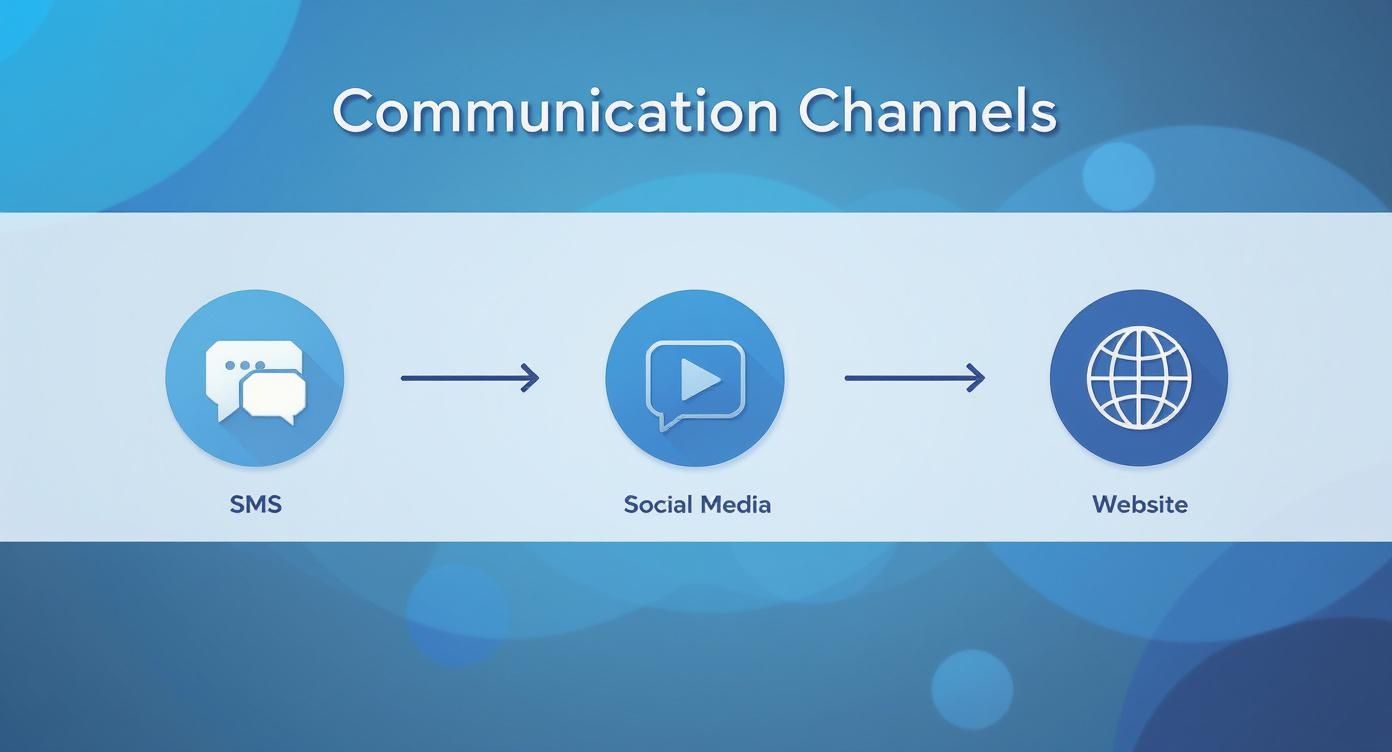
This sequence gets urgent alerts out instantly via text, follows up with broader announcements on social media, and then directs everyone to your website for the detailed, authoritative information they need.
Learning and Refining After a Crisis
When the dust settles after a crisis, the real work begins. The immediate threat might be over, but this is the critical moment to dissect what happened. A post-crisis review is your chance to turn a stressful, real-world test into a stronger, more resilient plan for the future.
This isn’t about pointing fingers or playing the blame game. It’s a frank look in the mirror to see what went right and, just as importantly, what went wrong. The whole point is to make your crisis communication plan smarter and more effective the next time—because there will always be a next time. If you skip this step, you're just setting yourself up to repeat the same mistakes.
Gathering Honest and Actionable Feedback
First things first, you need to hear from everyone involved. Your crisis team was in the thick of it, but their perspective is just one piece of the puzzle. Parents, staff, and community partners all experienced the event differently, and their insights are pure gold.
- Parent and Guardian Surveys: Get a simple, anonymous survey out to your families. Ask them point-blank: Was our information clear? Was it fast enough? Did you know where to go for official updates, or were you left scrambling and anxious?
- Staff Debrief Sessions: Pull all of your staff together for a dedicated debriefing—not just the crisis team. You need to create a space where teachers and support staff feel safe sharing what it was really like. Could they answer their students' questions? Did they get key information from you before it hit the local news?
- Community Partner Check-ins: If you worked with local police, fire, or other emergency services, get on the phone with them. Talk through the communication flow. Were there gaps? Delays? Moments where one hand didn't know what the other was doing?
The moments after a crisis are a rare opportunity for unvarnished truth. Actively seek out criticism and areas for improvement—this is how a good plan evolves into a great one.
Conducting the Internal Review
Once you’ve gathered all that outside feedback, it’s time for your crisis communication team to huddle up for a thorough internal review. Here, the focus is on your team’s performance, your processes, and the tools you used. Walk through the event timeline, step-by-step, and question every decision.
Use these guiding questions to get the conversation started:
- Message Effectiveness: Were our messages clear and reassuring, or did they create more confusion? Did we do enough to shut down rumors and misinformation?
- Channel Performance: Which channels really worked for us? Did our text alerts go through? Did the website crash? Did anyone even see the social media posts?
- Team Response Time: How long did it take us to get that first critical message out the door? Where did we get bogged down?
- Plan Adherence: Did we actually follow our own plan? If we went off-script, why? Was it a smart adjustment on the fly, or did it show a weakness in the plan itself?
This kind of honest self-assessment is what keeps your plan from becoming a dusty binder on a shelf. It ensures it remains a living document that gets better and stronger with every real-world lesson.
Got Questions About Your School's Crisis Plan? We've Got Answers.
Even after you've built out a comprehensive crisis plan, you're bound to have some lingering questions. That’s completely normal. Let’s walk through some of the most common things that come up for school administrators and communicators, so you can feel more confident when you put your plan into practice.
How Often Should We Really Update Our Plan?
A crisis communication plan can't be a "set it and forget it" document. In my experience, a full review needs to happen at least once annually. But let's be honest, the real test is an actual crisis. After any incident, your post-event debrief is the perfect time to immediately refine and update the plan based on what you learned.
You should also treat your plan as a living document that needs to evolve alongside your school. Pull it out for a refresh whenever there are significant changes, like:
- New Faces in Key Roles: A new principal, superintendent, or communications lead comes on board.
- Different Tech in the Toolbox: Your district rolls out a new mass notification system or decides to use a new social media platform.
- Changes to School Routines: You’ve updated safety protocols or how you handle student dismissal.
Keeping it current ensures it’s actually useful when you need it most.
What's the Single Biggest Mistake Schools Make?
Hands down, the most damaging mistake is waiting too long to say something. In today's world, an information vacuum gets filled instantly with rumors, panic, and speculation, especially on social media. I get it—the instinct is to wait until you have all the facts. But that hesitation can be fatal to your credibility.
Your community's trust is on the line within the first 30 minutes. Getting a message out early—even if it's just to say "we're aware and working on it"—shows you're in control and committed to keeping people informed.
It's far better to send a quick, initial message acknowledging the situation and letting parents know where to find official updates. This simple step immediately establishes your school as the go-to source of truth and stops misinformation in its tracks.
How Do We Tame the Social Media Rumor Mill?
You can't just react to social media rumors; you have to get ahead of them. The best defense is a good offense. This means you need to be constantly training your community to look to your official channels—the school website, official social pages, and your notification system—for accurate information.
When a specific rumor starts to catch fire, you need to address it head-on with a calm, factual post. Don't get emotional or get dragged into online arguments. Just state the facts and, once again, point everyone back to your official sources. This is why having a designated social media monitor on your crisis team is non-negotiable. It’s an essential role for protecting your students, staff, and families from the harm that falsehoods can cause.
At The MarCom Society, we get the unique pressures K-12 communicators are under. Our community is a place to find expert advice, connect with peers who understand your challenges, and get the practical resources you need to build a crisis communication plan that works. Join us to connect with professionals who have been there.









