
When it comes to social media, a crisis is the practice of having a plan ready to go before you need it. For schools, this means being prepared to handle everything from a single disgruntled parent's comment to a full-blown safety incident. It’s all about having a system to identify, manage, and resolve brand-threatening issues before they spin out of control and cause lasting damage to your reputation.
Why You Need a Proactive Crisis Response Framework
On social media, a crisis doesn't politely wait for you to get organized. When something happens—a student safety issue, a controversial post from a staff member, or a rumor that catches fire—every single second counts. Trying to react on the fly is a recipe for disaster. You'll end up with mixed messages, painful delays, and a swift erosion of trust within your community.
A proactive crisis response framework is your school's best defense. It turns chaotic, panicked reactions into a measured, strategic, and calm execution.
This framework is far more than just a document sitting in a shared drive; it’s a pre-approved action plan that clearly defines roles, lays out the protocols, and gives your team the confidence to act decisively. It's shocking how many organizations are caught flat-footed. Industry surveys show that only 49% of U.S. companies have a formal crisis communication plan. This leads to an average response time of nearly 19 hours from the first sign of trouble—a massive delay that gives misinformation a huge head start.
Establish Your Social Media Monitoring System
You can't manage a crisis if you don't even know it's happening. The foundation of any good crisis management plan is listening. A solid monitoring system is your early-warning radar, catching the whispers before they turn into a deafening roar. This isn't about obsessing over every mention, but about spotting patterns and potential threats early.
Think of it this way: one negative comment from a parent about a new policy is a customer service issue. But when ten parents comment on the same post about that policy, it’s a developing situation. When that conversation spawns its own hashtag and starts getting picked up by local news personalities, you're officially heading into crisis territory.
Your monitoring system should be set up to track:
- Brand Mentions: Any direct tags of your school’s social media handles.
- Keyword Variations: Your school's name, its mascot, and the names of key administrators and board members.
- Sentiment Shifts: Keep an eye out for sudden spikes in negative comments or a noticeable drop in positive engagement.
- Community Groups: Conversations often start in private parent Facebook groups or neighborhood forums before they hit your public pages.
"The goal of social listening isn't just to hear what's being said, but to understand the sentiment behind it. This context is what separates a minor complaint from a genuine crisis in the making, allowing your team to triage issues effectively."
Define Roles for Your Crisis Response Team
When the pressure is on, ambiguity is your worst enemy. One of the most common mistakes schools make is simply assuming everyone knows what to do. Your framework must spell out, with zero room for interpretation, who is responsible for what. For a closer look at effective team structures, you can explore these proven strategies for effective crisis management in social media.
Everyone on your team needs a clearly defined lane to stay in during a crisis. Below is a breakdown of the core roles you absolutely need to have assigned before an incident occurs.
Crisis Response Team Key Roles and Responsibilities
| Role | Primary Responsibility | Key Tasks |
|---|---|---|
| Team Lead/Coordinator | Overall command and control. | Activates the plan, convenes the team, acts as the central information hub, and ensures the workflow is followed. |
| Social Media Manager | Frontline monitoring and engagement. | Posts approved statements, manages comments, flags emerging issues for the Team Lead, and provides real-time updates. |
| Spokesperson | The official voice of the school. | Delivers all public statements (written or verbal) to ensure a single, consistent, and authoritative message. |
| Legal Counsel Liaison | Risk and compliance oversight. | Serves as the direct link to legal counsel, ensuring all communications comply with privacy laws like FERPA and mitigate legal risks. |
| Stakeholder Comms Lead | Internal communication management. | Adapts messages for staff, board members, and parents, and distributes them via internal channels like email or the parent portal. |
By assigning these roles before a crisis hits, you eliminate the confusion and hesitation that waste precious time. This allows your team to move from identifying an issue to taking action in minutes, not hours.
For a deeper dive into building out your entire strategy, check out our guide on creating a crisis communication plan template built specifically for school marketers. This level of preparation is what separates the schools that successfully navigate challenges from those that are forever defined by them.
Navigating the First Hours of a Crisis
When a crisis hits, the clock starts ticking—loudly. Those first few hours are a blur of frantic DMs, emotional Facebook comments, and misinformation spreading like wildfire. What your communications team does in this initial window is critical. It sets the tone for everything that follows. Speed, accuracy, and empathy aren't just buzzwords; they're your lifeline.
Your very first move? Pause all scheduled social media posts. Immediately. Nothing torpedoes your credibility faster than a cheerful, pre-scheduled post about the school carnival popping up in the middle of a safety incident. It makes the school look completely out of touch. Once the content is paused, it's time to get your crisis team on the same page.
Get Your Response Protocol in Motion
This is where all that planning you did pays off. The team lead needs to pull the trigger and get the core group together—your social media manager, spokesperson, legal counsel, and whoever is handling stakeholder communications. Whether you meet in a physical "war room" or jump into a dedicated Slack or Teams channel, the goal is to connect instantly.
The objective is simple: get everyone aligned, and fast. The social media manager should lead with a quick briefing on what's happening online. How many mentions are we seeing? What’s the sentiment—are people scared, angry, confused? What are the main rumors taking hold? This huddle ensures no one goes rogue and everyone is working from the same script before a single word is posted publicly.
A swift, unified response can completely change the direction of a crisis. You don't have the luxury of waiting for perfect information. The goal is to acknowledge the situation and immediately establish your school as the source of truth.
Assess the Situation and Hunt for Facts
With the team assembled, the next job is to cut through the noise. Your top priority is separating solid, verified facts from the rumors swirling online. The team lead must have a direct line to the principal or other staff on the ground who know what’s actually happening.
While you're confirming facts internally, your social media manager should be using their monitoring tools to get a read on the community's emotional state. Are parents panicked? Is one specific piece of false information causing the most damage? Understanding the feeling of the conversation is just as crucial as knowing the facts. It shapes the tone of your first public message.
This framework shows the basic flow from listening to acting.

You can see that a smart response always starts with careful listening before you jump into making public statements.
This rapid, coordinated approach is powerful. A well-known case study from American Airlines showed how they activated their social crisis plan within just one hour of a major incident. They immediately started pushing real-time updates with a consistent message, which helped them control the story. You can read about their swift crisis management response to see how it played out.
Craft and Approve an Initial Holding Statement
Let's be realistic: you won't have all the answers in the first hour. And that's okay. The point of an initial holding statement isn't to solve the problem; it's to acknowledge it, show you're taking it seriously, and buy your team precious time to get the facts straight. This message needs to be approved quickly—ideally just by the team lead and your legal liaison—to avoid getting stuck in a bottleneck.
A solid holding statement does four things:
- Acknowledges the situation: "We are aware of…"
- Shows you care: Express empathy for anyone affected.
- Says what you're doing: "We are investigating and working with authorities."
- Sets expectations: "We will provide another update here by [Time]."
This simple formula prevents an information vacuum, because if you don't fill it, someone else will—with rumors and speculation. Your goal is to become the one place everyone turns to for reliable updates.
Adaptable Messaging Templates for Common Scenarios
Having pre-written templates ready to go is a game-changer. It allows your team to respond with speed and confidence by adapting a solid starting point to the specific situation.
For a Student Safety Incident (e.g., lockdown, medical emergency):
"We are aware of the ongoing situation at [School Name]. All students and staff are safe. We are working closely with local authorities and will provide an official update on this channel as soon as we have confirmed information. The safety of our community is our highest priority."
For Viral Misinformation (e.g., a false rumor about a policy or staff member):
"We are aware of a rumor circulating on social media regarding [Topic]. We want to assure our community that this information is inaccurate. We are gathering the correct details to share a factual update shortly and urge families to rely on official school channels for information."
For a Facility Issue (e.g., power outage, burst pipe):
"This morning, [School Name] experienced a [Issue, e.g., power outage]. All students are safe, and the school day is proceeding as normally as possible. Our team is working to resolve the issue and we will update parents via [Channel, e.g., email and our website] by [Time]."
Think of these as your starting blocks. Your social media manager should tweak the language to match the tone and context of the moment. By getting these first crucial steps right in the opening hours, you establish control, show strong leadership, and build the foundation for managing the crisis on social media all the way through to its resolution.
Communicate With Empathy and Authority
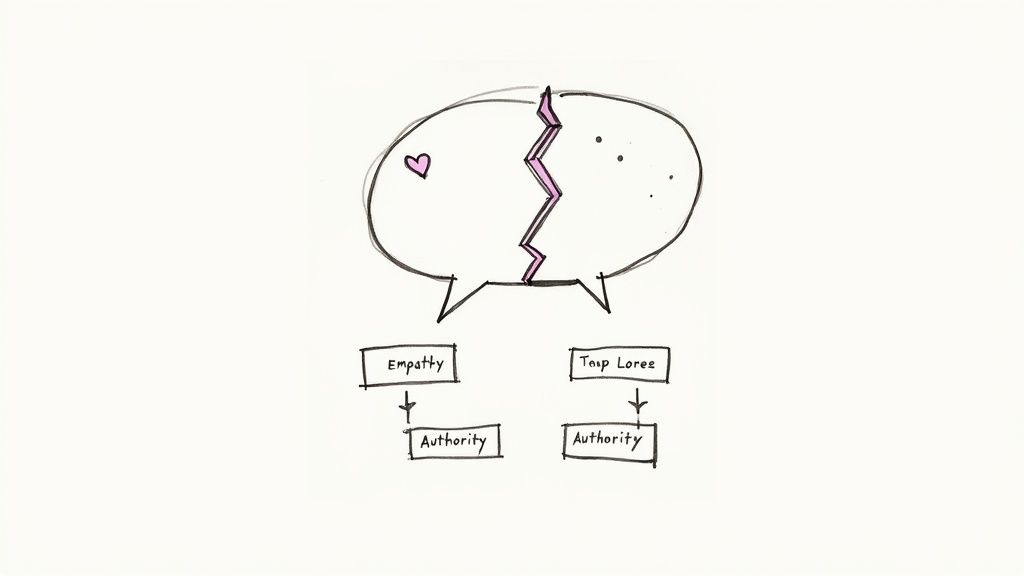
After you've publicly acknowledged a crisis, every single word that follows carries immense weight. The tone you strike can either calm the waters and start rebuilding trust or just pour fuel on the fire. When a crisis hits your social media, you're walking a tightrope between showing genuine human empathy and holding your ground as the authoritative source of information.
Your community doesn’t want to hear corporate jargon or defensive talking points. They're looking for leadership and reassurance. This means speaking with a voice that is calm, clear, and compassionate, especially when parents and students are feeling scared, angry, or confused.
To really nail this, you have to understand the core principles of fostering empathy and compassion. This is what makes your messages actually connect on a human level, and it’s the secret to navigating those tough online conversations.
Taking Ownership When You Are at Fault
Sooner or later, your school is going to make a mistake. It could be a policy misstep, a communication breakdown, or an operational error. The natural instinct is often to deflect or downplay it. Don't do it. That's almost always the wrong move. Real authority is built on accountability.
When your school is clearly in the wrong, a sincere, direct apology is non-negotiable. Ditch vague phrases like "we regret any inconvenience" or the classic "mistakes were made." You need to own it, completely.
A powerful apology really has three parts:
- Acknowledge the specific mistake: Get right to it. Clearly state what went wrong without making excuses.
- Express sincere regret: Show that you truly understand how your mistake impacted your community.
- Outline corrective actions: Tell them exactly what you're doing to fix the problem and make sure it never happens again.
By taking ownership, you shift the narrative from blame to resolution. You demonstrate that your school is responsible and committed to making things right, which is a powerful way to rebuild trust that has been damaged.
Let's say a school bus is an hour late and no one told the parents. A weak response is, "We are aware of transportation delays." A much stronger, more empathetic response would be: "We sincerely apologize to all families affected by the bus delay on Route 7 this afternoon. We failed to communicate this in a timely manner, and we understand the frustration and concern this caused. We are immediately reviewing our notification protocol to ensure this does not happen again."
Shutting Down Rumors Without Amplifying Them
During a crisis, misinformation spreads like wildfire. Your job is to be the single source of truth, but correcting rumors is a delicate art. If you jump on every false claim, you can accidentally give it a bigger platform.
Instead of playing whack-a-mole with every rumor, focus on proactively telling the truth. Post clear, factual updates regularly on your main social channels. This creates a central hub of accurate information that your community will learn to rely on.
When you do have to correct something specific, frame it positively. For example, instead of, "The rumor that school is cancelled tomorrow is false," try a more authoritative approach: "A reminder to all families: School will be open and operating on a normal schedule tomorrow, Friday, October 26th. We look forward to seeing everyone." This kills the rumor without even repeating it.
Remember, everything you post could be picked up by the media, so having a clear strategy is crucial. Make sure your spokesperson is ready by reviewing our guide on how to handle media interviews.
The stakes here are incredibly high. One study found that 43% of shoppers would boycott a brand after a bad social media crisis response. Schools aren't retailers, but the same principle applies to parent trust and your reputation. This just goes to show how quickly an audience will turn on an organization that doesn’t communicate with transparency and sincerity.
Coordinate Your Stakeholder and Legal Response
When a crisis hits your school's social media, the fallout isn't just public. The absolute last place your parents, staff, or board members should get critical information is from a stranger's Facebook comment. That’s a fast track to losing trust.
A truly effective crisis response runs on two parallel tracks: one for the public and one for your internal community. If you forget your people, you’ll find yourself fighting a second, internal crisis of confidence that can do more lasting damage than a thousand angry tweets. The key is simple—get to them first.
Your Internal Comms Strategy: No One-Size-Fits-All Blasts
Sending the same generic email to everyone on your list is a rookie mistake. Each of your stakeholder groups has wildly different concerns and needs to hear from you in a different way. A teacher needs the classroom-level details, a parent needs to know about student safety, and a board member needs the 30,000-foot view.
This isn’t something you figure out on the fly. You need to map it out ahead of time.
- Parents: Go straight to your most immediate, reliable channels. This is what your emergency text alert system, school app push notifications, or a direct email from the principal is for. Keep the message tight, clear, and focused on student well-being.
- Staff: Your team needs to hear the facts from you before they see them online. An all-staff email from leadership is non-negotiable. This equips them to manage student questions and keeps them from contributing to the rumor mill.
- School Board: Board members need a confidential, high-level briefing. A quick call from the superintendent or a concise email summary usually does the trick. They need to understand the situation, your response, and any potential policy fallout.
If you're looking for a structured way to build this out, our guide on creating a stakeholder communication plan walks through the whole process.
Stakeholder Communication Channels Matrix
To get your message to the right people effectively, you have to use the right channel. An urgent safety alert shouldn't get buried in a weekly newsletter, and a routine update doesn't warrant an emergency text. This matrix will help you match the message to the medium.
| Stakeholder Group | High-Urgency Scenario Channel | Low-Urgency Scenario Channel | Key Message Focus |
|---|---|---|---|
| Parents/Guardians | SMS/Text Alert, School App Push Notification | Email, Newsletter, Website Update | Student safety, logistics, pickup/dismissal info. |
| Staff & Faculty | All-Staff Email, Internal PA System | Staff Meeting, Internal Newsletter | Factual summary, their role, student support. |
| School Board | Direct Phone Call, Secure Email/Portal | Board Meeting Briefing, Email Update | Situation overview, response strategy, legal. |
| Students | In-Person Assemblies, Classroom Teachers | School Social Media, Student Emails | Reassurance, safety procedures, available support. |
| Media | Official Press Release, Designated Spokesperson | Website Media Center, Email | Confirmed facts, school's official position. |
Having this planned out before a crisis means you can act with speed and confidence, ensuring every group gets the information they need without causing unnecessary alarm.
Staying Out of the Legal and Compliance Quagmire
In the K-12 world, every word you publish is scrutinized through a lens of legal and compliance regulations. Trying to navigate this during a high-pressure crisis is a recipe for disaster. Student privacy is the big one, and a single mistake can have serious repercussions.
The law you absolutely have to know is the Family Educational Rights and Privacy Act (FERPA). This federal law is a brick wall around student education records. During a crisis, it means you can't release any personally identifiable information about a student involved without explicit, written parental consent.
And I mean any information. Confirming a student’s name, their grade, or even acknowledging their involvement in an incident can be a FERPA violation. Train your entire team on this default phrase: “We cannot comment on matters involving individual students.” No exceptions.
Your best defense is documentation. The moment a crisis begins, start a log. Every social media post, parent email, and media statement gets recorded. This meticulous trail is your proof that you followed a thoughtful, compliant process if your school's actions are ever questioned.
Knowing When to Get the Lawyers Involved
Don't wait until you think you need legal advice. Your crisis plan must have clear, non-negotiable triggers for immediately looping in your school's legal counsel. This shouldn't be a gut call in the heat of the moment.
Here are some scenarios that demand an immediate legal review before you say anything publicly:
- Any incident that involves a serious student injury or a death.
- Any allegation of misconduct against a staff member.
- Credible threats of violence made toward the school community.
- Basically, any situation you could imagine turning into a lawsuit.
In these moments, your legal team isn't a roadblock; they're your guardrails. They’ll help you find the words that are both compassionate and legally sound, preventing your crisis communications from accidentally creating new liabilities down the road.
Review Your Response and Rebuild Trust

The immediate crisis might be over, but the work isn't done. That sigh of relief you just breathed? It’s a sign that the most important phase is about to begin: reviewing your response and rebuilding community trust.
It's tempting to just move on and forget the whole ordeal. Don't. This post-crisis period is a golden opportunity to learn and grow. How you handle the aftermath is what will separate your school from others, turning a negative event into a catalyst for a stronger, more resilient community.
Conduct a Thorough Post-Mortem Analysis
Before you look outward, you have to look inward. A post-mortem—or an "after-action review"—is an absolute must. Get it on the calendar within a week of the crisis de-escalating, while everything is still fresh in everyone's minds.
The goal here isn't to point fingers or assign blame. It's about an honest, candid look at what worked and what didn't. Get the entire crisis response team in a room and walk through the timeline from beginning to end. To keep the discussion productive, focus on a few key areas:
- Timeliness and Speed: How fast were we off the mark? Did we spot the issue quickly? Were there any delays that held up our first message?
- Process and Workflow: Did our team members know exactly what their roles were? Where did we hit snags in the communication or approval chain?
- Messaging and Tone: Did our statements actually connect with our families and staff? Was our tone right—did we sound both empathetic and in control?
- Tools and Resources: Were our social media monitoring tools up to the task? Did we have the right channels to talk to each other internally when things got hectic?
- Plan Effectiveness: Let’s get specific. What part of our crisis plan was a lifesaver? And which sections felt clunky or need a complete overhaul?
This kind of honest assessment turns a tough experience into an invaluable lesson. It’s what makes your crisis management on social media playbook a living, breathing document that actually gets better over time. Use what you learn to update your plan, clarify roles, and pinpoint where you need more training.
Transition Back to Normalcy Thoughtfully
After a serious incident, jumping straight back to posting about the upcoming spirit week or bake sale can feel tone-deaf and jarring. Your community isn't ready for it, and it can make you look like you haven't been listening.
Your transition back to a normal content calendar has to be gradual and intentional. Start by easing back in with content that reinforces your school's core mission. Think helpful, community-focused, and low-key. Share resources for parents, highlight a student's achievement in a humble way, or spotlight a teacher making a difference. This subtly shows that you’re back to doing what you do best: serving students and their families.
Don’t just flip a switch and resume your old content schedule. Keep a close eye on community sentiment as you start posting again. If you're still seeing a lot of anxiety or negative comments, that’s a clear signal to slow down and continue addressing the community's concerns.
Launch Proactive Reputation Recovery Campaigns
Once the dust has truly settled and you've eased back into a routine, it's time to shift from a defensive posture to a proactive one. Actively rebuilding your school's reputation is a long-term game. It's all about strategically reminding your community—parents, staff, and students—why they fell in love with your school in the first place.
This is your chance to reclaim the narrative. Develop a content series built around positive, authentic storytelling. This is where you can really shine.
- Share powerful video testimonials from parents who are passionate advocates for your school.
- Create "day in the life" features that offer a genuine peek into your positive school culture.
- Produce spotlights on innovative programs that showcase academic excellence and unique opportunities.
You’re not trying to pretend the crisis never happened. Instead, you're demonstrating your school’s resilience and unwavering commitment to its students. By consistently sharing these real, positive stories, you slowly but surely rebuild the trust that is the foundation of your entire school community.
Frequently Asked Questions
Even with the best playbook in hand, a real crisis always throws a curveball or two. Your team will inevitably face unique questions and tough judgment calls on the fly. Here are some of the most common questions we see from school communicators, along with some hard-won advice for handling them under pressure.
How Should We Handle Negative Comments from Parents?
It's tempting to hit "delete" on a negative comment, isn't it? The urge to protect your school's image is strong, but I can tell you from experience, deleting comments almost always makes things worse. It looks like you're hiding something and tends to pour fuel on the fire, inviting the original commenter—and their friends—to come back even stronger.
A much better approach is a simple three-step model: Acknowledge, Empathize, and Redirect.
- Acknowledge Publicly: Start with a brief, polite public reply. Something as simple as, "Thank you for sharing your concern with us," shows you're not ignoring them.
- Empathize Sincerely: You don't have to agree with their point, but you do need to show you hear their frustration.
- Redirect Privately: This is the most important part. Get the conversation offline and out of the public square. Try, "To look into this specific situation, could you please send us a direct message?" This protects student privacy and shows everyone else you're responsive.
This tactic de-escalates the public tension while still addressing the parent’s concern directly.
When Is It Better Not to Respond to a Comment?
While you want to be responsive, responding to every single comment is a mistake. Some comments are best left alone. You should feel comfortable ignoring anything that is clearly spam, completely off-topic and nonsensical, or uses obscene language (your policy should tell you whether to hide or delete these).
The biggest trap is engaging with trolls—people who are clearly just trying to pick a fight. Giving them a response is exactly what they want. It feeds the algorithm, gives their comment more visibility, and pulls your focus away from the people you actually need to be communicating with.
The golden rule of engagement: Respond to legitimate concerns to show you're listening, but don't feed the trolls. Wasting energy on bad-faith arguments is a surefire way to burn out and lose control of the narrative.
What Is the Best Way to Manage Staff Social Media Use During a Crisis?
Nothing undermines a crisis response faster than mixed messages. You need one, unified voice, and that means getting ahead of well-meaning staff members who might be tempted to share their own opinions or unverified information on their personal accounts. Your social media policy should cover this, but a crisis warrants a direct, immediate reminder.
As soon as a crisis hits, send out an all-staff email or message with clear, simple instructions:
- Direct All Inquiries: Staff should not engage with questions or comments online. Instead, they need to direct everyone to the school’s official channels for information.
- Avoid Speculation: This is crucial. Remind them not to share personal opinions, what they think happened, or unconfirmed details—not even in a "private" community Facebook group.
- Amplify Official Messages: The one thing they can do is share official posts directly from the school or district’s accounts. This helps spread accurate information from the single source of truth.
Getting this internal communication out the door quickly is a non-negotiable step. It keeps everyone on the same page and reinforces that the school's official channels are the only place for reliable updates.
At The MarCom Society, we help K-12 school communications professionals build the skills and confidence to handle challenges just like these. We offer the resources, expert guidance, and peer support you need to excel. To access exclusive workshops, grab ready-to-use templates, and connect with a network of colleagues who just get it, learn more about our community.









