So, you've heard the term "CRM" thrown around, but what does it actually mean for a school like yours? Let's break it down.
What Is a CRM for Education and Why Does It Matter?
At its core, a Customer Relationship Management (CRM) system is a central hub for managing all your school's relationships and interactions—with prospective families, current students, alumni, and donors.
Think of it as your school's digital memory. It replaces that messy collection of spreadsheets, sticky notes, and siloed email lists with one clean, organized system where every conversation, every tour, and every touchpoint is recorded.
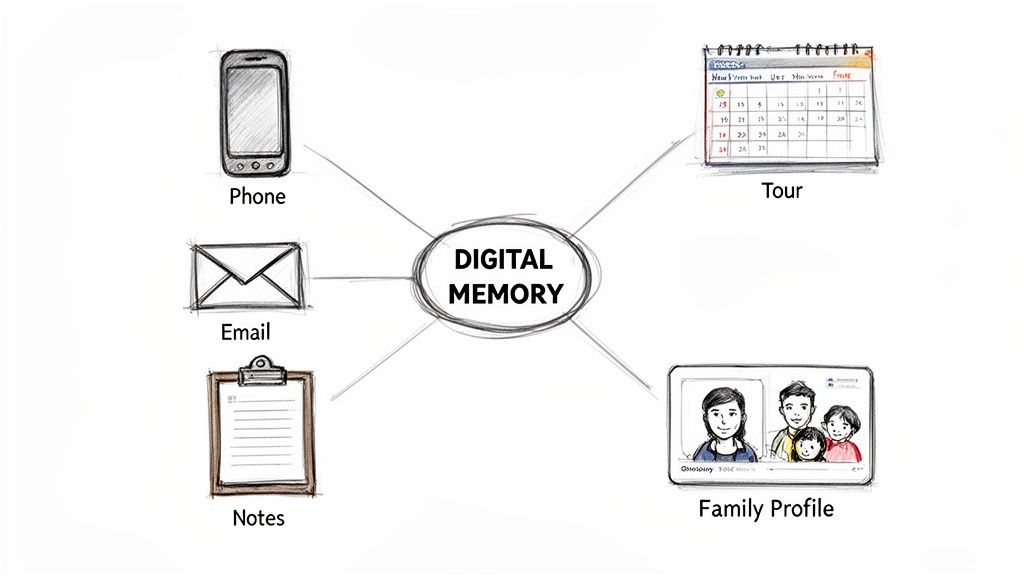
For years, school MarCom teams have done their best to juggle it all. An inquiry lands in one person's inbox, tour sign-ups live in a Google Sheet, and parent event RSVPs are tracked somewhere else entirely. This patchwork approach isn't just inefficient; it's where great families fall through the cracks.
A dedicated education CRM changes all that. It creates a single source of truth, giving you a complete, 360-degree view of every family's journey with your school—from their very first click on your website to their re-enrollment decision years down the line.
Moving Beyond Disconnected Data
When your data is scattered, so is your communication. A quick note about a prospective family's interest in the arts program might live only in an admissions counselor's head. A parent's volunteer interests might be stuck on a forgotten sign-up sheet. This fragmentation makes personalized communication almost impossible and turns reporting into a painful, manual process.
This is where having a CRM really makes a difference. It connects all those disparate pieces of information, letting you answer critical questions in seconds, not hours:
- Which of our open house events brought in the most applications?
- Has the Johnson family received our follow-up email about the scholarship program?
- Who are our most engaged current parents, and how can we get them more involved?
A CRM shifts your communications from reactive and fragmented to proactive and strategic. It allows you to anticipate a family’s needs and personalize your outreach at a scale you just can't achieve manually.
The table below shows a clear "before and after" picture, contrasting the old way of doing things with the new possibilities a CRM opens up.
From Scattered Data to Strategic Relationships
| Challenge Without a CRM | Solution With a CRM | Key Outcome for Your School |
|---|---|---|
| Prospective family details are lost in messy spreadsheets and individual inboxes. | A unified family profile tracks every interaction, from inquiry to enrollment. | No more lost leads. Every prospective student gets a personalized, timely follow-up. |
| Communications are generic "email blasts" that don't resonate with everyone. | Audience segmentation allows you to send targeted messages based on interests and needs. | Higher engagement, as families receive content that's actually relevant to them. |
| It's impossible to know which marketing efforts are actually working. | Built-in analytics and reporting dashboards show you exactly which campaigns drive results. | Make data-driven decisions to invest your time and budget more effectively. |
| Following up with every inquiry is a manual, time-consuming chore for the team. | Automated communication workflows nurture leads and handle routine follow-ups. | Your team is freed up to focus on building meaningful, one-on-one relationships. |
As you can see, the shift is about more than just technology; it's about building a better, more connected school community.
A Tool Built for School Growth
Ultimately, a CRM isn't just a fancy contact list; it's a powerful engine for growth. It directly tackles the biggest headaches for K-12 marketing and communications pros by organizing workflows, automating repetitive tasks, and providing clear insights into what moves the needle. As other technologies like chatbots in education become more common, a strong CRM provides the foundational data needed to make them truly effective.
By bringing your relationship management into the 21st century, you ensure no prospective family is forgotten and every current family feels seen and valued. That's the bedrock of a thriving school community.
How a School CRM Drives Enrollment and Retention
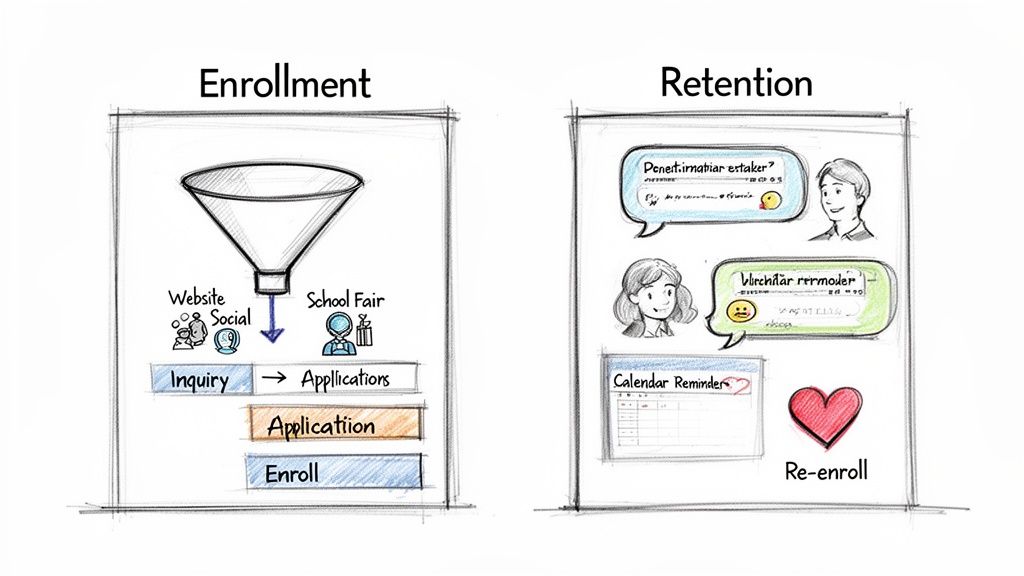
A school CRM is the engine behind your two most important goals: attracting new families and keeping current ones happy. It helps your team shift from being reactive—always scrambling for information—to being proactive. You can start anticipating needs and building real relationships that lead to growth.
By centralizing every conversation and interaction, the CRM ensures no family ever feels like just a number. It gives you a framework to manage the entire family journey, from their first click on your website to their enthusiastic re-enrollment, year after year. Let’s look at how this plays out for both enrollment and retention.
Boosting Enrollment with Smart Automation
Just think of all the ways a prospective family might find you. A form on your website. A social media ad. A sign-up sheet at a local fair. Without a CRM, any of these leads could easily get lost in a crowded inbox or a forgotten spreadsheet. That's a missed opportunity.
A CRM solves this by acting as your central hub, automatically capturing every inquiry and building a profile for each family. The "lost lead" problem is immediately fixed.
But it gets better. You can set up automated communication flows that do the heavy lifting for you. For instance, when a family requests information online, the CRM can instantly trigger a series of actions:
- Send a personalized thank-you email with a link to your viewbook.
- Alert the right admissions counselor to make a personal phone call.
- Schedule a follow-up email for two weeks later to see if they have questions.
Trying to manage this level of consistent, personal follow-up by hand is nearly impossible once you have more than a handful of inquiries. Automation ensures every prospect gets timely attention, making it far more likely they’ll book a tour or start an application. This is a core part of building a solid growth plan, which we cover more in our guide to strategic enrollment management.
Enhancing Retention Through Personalized Engagement
Bringing in new students is essential, but keeping your current families is what builds a stable, thriving school community. A CRM is a powerhouse for retention, too. It gives you the deep, contextual knowledge needed to make current families feel seen, heard, and valued.
Because the CRM tracks the history of every interaction, you can segment your communications with incredible precision.
A CRM helps you move beyond one-size-fits-all newsletters. It empowers you to create targeted, meaningful touchpoints that demonstrate you understand and care about each family's unique experience at your school.
This means sending messages that actually mean something to the people receiving them. For example, you could quickly pull a list of all parents who volunteered at last year's fall festival and send them a special early invitation to help out again. Or you could identify families with students in the arts program and send them specific updates about a new theater production.
This kind of targeted outreach directly impacts re-enrollment. When parents feel connected and informed, their loyalty to the school grows, making the decision to return each year an easy one. You can see similar principles at work in this piece on how a tutoring CRM converts inquiries into enrollments. At the end of the day, a CRM turns retention from a wish into a deliberate, data-driven strategy.
Choosing the Right CRM with Essential Features
Picking a CRM for your school isn't like buying any old piece of software. It’s more like hiring a new team member—one that’s going to be central to your school's communication and growth. With so many options out there, it’s easy to get sidetracked by flashy features that don’t actually solve the day-to-day challenges of a K-12 school.
The right platform should feel less like a clunky corporate tool and more like a purpose-built command center for your admissions, marketing, and communications teams. Let’s cut through the noise and focus on the practical, must-have features that will actually make a difference in your work.
Must-Have Contact Management Features
At its core, a CRM has to manage contacts well. But for schools, that means so much more than just a name and an email. You need a complete, 360-degree view of each family unit.
Imagine pulling up a single, clean profile that connects parents to their children, shows you which open house they attended, and logs every single email, phone call, and meeting. When someone on your team opens that record, they should see the family's entire journey with your school in a single glance.
Key capabilities to look for include:
- Family and Household Grouping: This is non-negotiable. You need to link student profiles with their parents or guardians to see the whole family picture.
- Custom Fields: The ability to add fields that are unique to your school is a game-changer. Think "Varsity Soccer" interest for a student or "Parent Association Volunteer" for a parent.
- Interaction Logging: A clear timeline that automatically—and manually—tracks every touchpoint, from the moment they first filled out a form on your website to the notes from their campus tour.
Visualizing the Admissions Journey
Your admissions process is a journey, not just a spreadsheet. A critical feature for any school CRM is a visual admissions pipeline. Usually, this looks like a Kanban-style board where you can see every prospective family neatly organized by their current stage—from "Inquiry" to "Application Submitted" to "Tour Completed" and, finally, "Enrolled."
This visual approach is incredibly powerful. It instantly shows your team where to focus its energy. You can spot bottlenecks, identify families who might need a little nudge, and celebrate wins as applicants move from one column to the next.
A visual pipeline transforms the chaos of admissions into an organized, manageable process. It makes sure no applicant ever falls through the cracks and gives your leadership a clear, real-time snapshot of your enrollment health.
The Power of Marketing Automation
This is what separates a good CRM from a great one. Marketing automation helps you send the right message to the right person at exactly the right time, all without lifting a finger. It’s how you deliver personalized, consistent follow-up, even when you’re stretched thin.
For instance, you can build an automated email workflow for new inquiries. A parent fills out a form on your website, and the CRM automatically triggers a sequence of messages. The first email might share your viewbook. A week later, another one could invite them to an upcoming open house. A third might feature a video of student testimonials. For a detailed breakdown of different platforms, check out our marketing automation software comparison.
Robust Reporting and Analytics
You can't improve what you don't measure. A quality CRM must have solid reporting and analytics dashboards that turn all your data into insights you can actually use. This is what moves you from guesswork to making truly data-driven decisions.
Your CRM should make it easy to answer the big questions:
- Which of our marketing efforts (social media, local ads, etc.) are bringing in the most qualified inquiries?
- What’s our conversion rate from a campus tour to a submitted application?
- How long does it typically take a family to move from first contact to enrollment?
The broader EdTech world is moving fast, with an 85% boost in adoption across education. We can learn a lot from trends in higher education, where they use these tools to track event RSVPs with 48% higher engagement rates and personalize newsletters to get 28% improved open rates. To see how these trends are shaping the industry, read the full research about the higher education CRM market.
By focusing on these core features, you can find a CRM that doesn't just store your data but becomes a true engine for strategic growth.
Integrating Your CRM for a Unified School System
A standalone CRM is helpful, but an integrated CRM is where the magic really happens. It truly unlocks its potential when it stops being an isolated island of data and starts talking to the other critical systems your school uses every day. Think of it as the central nervous system for your school's entire digital operation.
The CRM becomes the brain, pulling in information from different places and sending out coordinated messages. This connection gets rid of the frustrating, error-prone chore of manually copying data between systems. Instead, you get a single, reliable source of truth that everyone on your team can depend on.
Connecting Your Most Critical Platforms
The goal here is to build a unified system by linking your CRM to the platforms where your most important interactions take place. This creates a seamless flow of information that keeps everyone—from admissions to marketing to the front office—on the same page.
For most schools, there are a few non-negotiable integrations:
- Student Information System (SIS): This is the heart and soul of your school's data. When you connect your CRM to your SIS, an officially enrolled student's data moves over automatically and accurately. This simple handshake between systems eliminates the risk of manual typos and saves your administrative staff a ton of time.
- Website Inquiry Forms: Think about every "Request Information" or "Schedule a Tour" form on your website. That connection should be instant. The moment a family hits submit, a lead should pop up in your CRM, ensuring 100% of new inquiries are captured and follow-up can kick off immediately.
- Email Marketing Platforms: By linking your CRM to your email tool (like Mailchimp or Constant Contact), you can build incredibly targeted mailing lists based on real-time information. You can create dynamic groups like "Applicants with Incomplete Forms" or "Parents Interested in the Arts Program" that update themselves, making sure your messages always hit the mark.
When you integrate these systems, you’re not just shuffling data around. You’re building an intelligent, automated communication machine. The CRM orchestrates the whole journey, making sure the right information gets to the right people exactly when they need it.
The Benefits of a Single Source of Truth
Creating this connected environment delivers real, tangible benefits that are about much more than just convenience. When your CRM is the undisputed hub for all family data, you break down the silos that keep departments from working together. You give your team accurate, up-to-the-minute information, which leads to smarter, faster decisions.
This isn't a new idea; it's a proven strategy across the education sector. CRM adoption in education is already at an impressive 85%, which shows just how central it has become to modern school operations. While cloud-based CRMs are growing fast, the real takeaway is how top-performing teams are using them. For MarCom professionals, this is key: 61% of sales leaders automated their CRM workflows in 2023 to get better campaign reports, and they saw a 28% lift in performance as a result. K-12 teams can borrow this exact playbook for open house promotions or fundraising campaigns to deliver hyper-personalized communication that drives family engagement and boosts retention. You can dive deeper into these CRM trends in higher education on businessresearchinsights.com.
Ultimately, integration turns your CRM from a simple contact list into the strategic core of your school's growth engine, getting every department rowing in the same direction.
A Step-by-Step Plan for CRM Implementation
Bringing a new CRM into your school can feel like a huge undertaking, but it doesn't have to be. The secret is breaking it down into a clear, phased plan. When you tackle the process in manageable steps, you can roll out a powerful new tool smoothly, without overwhelming your team.
Think of it like building a house. You wouldn’t start hanging pictures before the foundation is poured and the walls are up. In the same way, a successful CRM implementation starts with a solid blueprint, making sure every piece is perfectly in place before you move on to the next.
This diagram shows how information should ideally flow from your public-facing tools (like your website) into the CRM, and then sync with your school's core database.

This is the goal: a seamless loop where website inquiries automatically feed the CRM, which then updates your Student Information System (SIS) once a student is enrolled.
Phase 1: Define Your Goals and Build Your Team
Before you even glance at a vendor demo, the first step is to look inward. Why do you need a CRM? The answer can’t just be, "because everyone has one."
Get really specific. Is your main goal to increase new student inquiries by 15%? Or maybe you want to improve retention by automating communications with current families. Write down your top three measurable goals. These will become your North Star, guiding every single decision you make, from choosing a platform to setting it up.
Next, it's time to assemble your implementation team. This is not just an IT project. It’s a communications, admissions, and marketing project all rolled into one. Your team must include key players from:
- Admissions: They are your frontline users and will be living in the CRM every single day.
- Marketing: They need it for running campaigns, segmenting audiences, and tracking results.
- IT: They'll handle the technical side of things, like integration and data security.
Getting this cross-functional group together from the start ensures everyone's needs are met, which helps you avoid major roadblocks down the line.
Phase 2: Evaluate Vendors and Plan Your Data Migration
Okay, with your goals and team in place, you can finally start shopping. Use your list of goals as a checklist. If a CRM can't directly help you achieve your specific objectives, it’s not the right one for you, no matter how many flashy features it has.
Once you've selected a partner, you hit the next critical milestone: data migration. This is easily the most underestimated part of the whole process. You need a rock-solid plan for moving all your existing contacts—from spreadsheets, random email lists, and old systems—into the new CRM without making a mess.
A CRM is only as good as the data inside it. A messy data import guarantees a messy, frustrating CRM that undermines the entire project. Take the time to clean and organize your data before you import it.
A great first step is to create a simple data dictionary. This is just a document that defines what each field means (e.g., "Lead Source" will only include 'Website', 'Social Media', or 'Referral'). This little bit of prep work ensures consistency from day one and makes your future reports infinitely more accurate.
Phase 3: Customize, Train, and Launch
Now for the fun part: making the CRM your own. This is where you’ll set up the stages of your admissions pipeline, create custom fields to track specific family interests, and build out your first automated email sequences.
But the final, and most important, step is training. Your team has to feel confident and capable using this new system. Schedule dedicated, hands-on training sessions that are tailored to their specific roles. Don’t just show them the whole platform at once.
Instead, adopt a "crawl, walk, run" approach.
- Crawl: Start with the absolute basics. Master logging new contacts and tracking communications.
- Walk: Once everyone is comfortable, move on to building simple email campaigns and using the admissions pipeline.
- Run: Finally, you can dive into advanced reporting and more complex automation workflows.
This phased rollout prevents your team from feeling overwhelmed, builds their confidence, and ultimately ensures your new CRM becomes the indispensable tool it’s meant to be.
Measuring Your CRM Success and Proving ROI
Putting a CRM for education in place is a serious commitment, both in time and money. The final—and most crucial—step is proving it was a smart one. To get this right, you have to look past the surface-level vanity metrics and zero in on the key performance indicators (KPIs) that really move the needle for your school's health and growth.
Your whole objective here is to show a clear return on investment (ROI). This means drawing a straight line from your CRM activities to real, tangible results. Think of your CRM as the engine of your admissions and retention machine; these metrics are the gauges on the dashboard telling you how efficiently that engine is running.
Key Performance Indicators to Track
Forget obsessing over email open rates. We need to track the metrics that tell a story about your enrollment pipeline and family satisfaction. Your CRM dashboard should be your mission control, built to shine a spotlight on the data that your head of school and board actually care about.
Here are the essential KPIs you should be watching like a hawk:
- Qualified Inquiry Growth: How many new, good-fit families are reaching out? Track this increase month-over-month and year-over-year.
- Inquiry-to-Application Conversion Rate: This is a big one. What percentage of those qualified inquiries actually follow through and complete an application? It's a direct measure of how effective your follow-up is.
- Application-to-Enrollment Rate: Of all the families that apply, how many officially enroll their child? This number tells you a lot about the strength of your entire admissions experience.
- Cost Per Acquisition (CPA): In simple terms, how much marketing and admissions money does it take to get one new student in the door? Your CRM is brilliant at this because it can track where every lead came from.
- Student Retention Rate: This is the long game. A CRM that helps you communicate better with current parents has a direct impact on their decision to re-enroll year after year.
By focusing on these core metrics, you shift the conversation. Your MarCom and admissions efforts stop looking like a cost center and start being seen as a measurable, data-backed engine for school growth.
Building Your ROI Report
To really sell the value of your CRM, you need to present your data in a way that’s clear and compelling, especially for board meetings or leadership reviews. Don't just dump a spreadsheet of raw numbers on them—tell the story behind the data. Use your CRM’s reporting tools to create simple, visual dashboards that answer the most important questions at a glance.
A powerful ROI story sounds less like a report and more like a victory announcement: "Since we started using the CRM, our automated follow-up sequences have helped us boost our inquiry-to-application conversion rate by 18%. That directly resulted in 25 more applications this year than last." For more tips on how to frame these wins, check out our guide on how to measure marketing ROI.
This isn't just a trend; it's a fundamental shift. Higher education student CRM systems are projected to grow at a 9.1% CAGR through 2030, and the adoption of AI within them is set to jump 97%. This kind of tech allows for deep personalization that can lead to 57% better lead nurturing outcomes. For K-12 leaders, this is a clear signal. Using similar tools for your parent portals can drive 36% engagement boosts with simple automation. You can dig into more of the data on these educational CRM market trends on lucintel.com.
Ultimately, measuring your CRM's success is about connecting the dots. It’s about proving that the daily tasks—the automated emails, the organized family records, the streamlined admissions pipelines—are the very things that build a stronger, more vibrant, and financially stable school.
Answering Your Top Questions About Education CRMs
Bringing a new system like a CRM into your school is a big decision, and it’s natural to have a few questions. School leaders often ask about the price tag, how complicated it is to get started, and—most importantly—how it keeps student and family data safe. Let’s clear up some of those common concerns.
One of the first questions is always about cost, especially for smaller schools working with tight budgets. The great news is you don’t need an enterprise-level budget anymore. Modern CRM providers have options built specifically for K-12 schools, with pricing that can scale to your size and needs.
Think of it as an investment. When you factor in the return—like higher enrollment numbers from a smoother admissions process or the countless staff hours you’ll save on manual tasks—the CRM more than pays for itself.
How Do We Handle Data Privacy and Security?
This one is non-negotiable. Protecting your community's data is paramount, and any reputable CRM vendor in the education space knows this. They build their platforms from the ground up to comply with regulations like the Family Educational Rights and Privacy Act (FERPA).
When you're looking at different options, be sure to dig into the specifics. Ask them directly about:
- Data Encryption: How is our sensitive information protected both when it's stored and when it's being sent?
- User Permissions: Can we give our admissions team access to inquiry data but restrict them from seeing anything else?
- Compliance Certifications: Can they show proof that they meet industry-standard security protocols?
A solid CRM gives you the tools to lock down your data, so you can have complete confidence that your school and your families are protected.
Our Team Is Already Swamped. Can We Really Handle This?
The idea of implementing a whole new software system can feel overwhelming, I get it. The secret is to not try to do everything at once.
Start with your biggest headache. Is it the black hole where website inquiries seem to disappear? Or maybe it’s the chaos of managing event registrations in a spreadsheet. Pick just one of those problems and use the CRM to solve it.
Once your team gets a win, they'll see the value firsthand. That initial success builds momentum. From there, you can start rolling out other features department by department. Plus, most providers offer hands-on support to walk you through the setup, so you’re never going it alone.
Ready to build a more connected school community and drive growth with smarter strategies? The MarCom Society offers exclusive resources, expert-led workshops, and a supportive network of K-12 marketing professionals just like you. Join us to get the tools and insights you need to succeed.