
At its heart, design thinking in education is a way of solving problems that puts people first. Forget rigid formulas and one-size-fits-all solutions. This is a mindset, a creative process for truly understanding the needs of your students, teachers, and parents so you can build better experiences with them, not just for them.
A New Way to Look at Old School Challenges
Imagine an architect tasked with designing a new school library. The old way might be to jump straight to the blueprints based on standard layouts.
But an architect using design thinking would start somewhere completely different. They’d spend time watching how students actually study, talk to librarians about their daily frustrations, and ask parents what they hope their children will discover among the shelves. They build empathy first. Only after they deeply understand the human side of the library do they start sketching ideas, creating small-scale models, and asking for feedback before a single wall is built.
That’s design thinking in action. It’s a powerful approach that helps schools move from just delivering a service to co-creating experiences that truly resonate. It all comes down to a few core ideas:
- Empathy: It’s about more than just sympathy. It's about getting inside the head of a kindergartener who is scared at drop-off or a teacher who feels overwhelmed by a new piece of software.
- Creativity: This is the "no bad ideas" phase. It’s about encouraging wild, out-of-the-box thinking to find solutions no one has considered before.
- Iteration: You don't have to get it perfect the first time. The goal is to build simple, low-cost prototypes—like a new email template or a different traffic flow for the carpool line—to test your ideas, see what works, and make them better based on real feedback.
Shifting from Top-Down to All-In
This approach fundamentally changes how decisions are made. It moves a school's culture away from a top-down, "we know best" model and toward one of collaborative problem-solving. Problems become opportunities for everyone to get creative.
This mindset can improve everything from redesigning the parent-teacher conference experience to launching a marketing campaign that actually speaks to prospective families. At its core, it requires a genuine partnership with your community, which is a cornerstone of any good stakeholder engagement strategy.
Over the last decade, we've seen this idea gain serious traction. Once a popular concept in universities, design thinking is now making its way into K-12 schools worldwide, recognized for its power to build critical 21st-century skills like creativity and critical thinking.
The biggest shift design thinking brings is moving from solving problems for your community to solving them with your community. That collaborative spirit is what builds trust, ownership, and solutions that stick.
To bring these ideas to life, it helps to see them broken down into practical terms. This table connects the core principles of design thinking directly to the school environment.
Core Principles of Design Thinking at a Glance
| Core Principle | What It Means for Your School | Example Application |
|---|---|---|
| Human-Centered | Decisions are made with a deep understanding of the needs, emotions, and contexts of students, parents, and staff. | Redesigning the admissions tour based on feedback from prospective families about what made them feel most welcome (or most anxious). |
| Bias Toward Action | Instead of endless meetings and analysis, the focus is on creating simple prototypes to learn from doing. | Before overhauling the entire school newsletter, the communications team sends two different versions to small parent groups to see which one gets more engagement. |
| Show, Don't Tell | Using visuals, stories, and experiences to communicate ideas, rather than relying on abstract reports or data. | Creating a short video of a "day in the life" of a student to show donors the impact of their contributions, instead of just sending a letter. |
| Radical Collaboration | Bringing diverse voices into the problem-solving process—teachers, administrators, parents, and even students—to generate richer solutions. | Forming a "lunchroom committee" with students, kitchen staff, and teachers to brainstorm ways to reduce food waste and improve the dining experience. |
By internalizing these principles, a school's leadership and marketing teams can start to see every challenge not as a roadblock, but as a chance to innovate and connect more deeply with the community they serve.
The Five Stages of Design Thinking for Schools
To really get your hands dirty with design thinking in education, you need a framework. The process is typically broken down into five key stages. But think of this less as a rigid, step-by-step recipe and more like a flexible cycle. You’ll find yourself moving back and forth between stages as you uncover new insights.
Let's walk through this process by tackling a classic K–12 headache: the dreaded student drop-off line.
Stage 1: Empathize
First, and most importantly, you Empathize. This is all about setting aside your own assumptions and genuinely trying to understand the experience from your community’s point of view. It’s about walking a mile in their shoes to feel what they feel.
For our drop-off line problem, this isn’t about brainstorming solutions from a quiet office. It means you’re out there, clipboard in hand, right in the middle of the morning rush. You’re watching the traffic flow, noting the bottlenecks, and seeing the frustration on people’s faces.
You pull parents aside for quick, informal chats, asking open-ended questions like, "Can you tell me about your morning drop-off routine?" You also connect with the staff on duty, gathering their firsthand accounts of the daily chaos. The goal here is to collect real stories and observations, not just cold data.
Stage 2: Define
Once you’ve gathered all those stories and notes, it’s time to Define the actual problem you're trying to solve. This is where you sift through everything you've learned and distill it into a clear, actionable problem statement. A great problem statement is always human-centered; it gives your team a North Star to guide the work ahead.
After listening to everyone, you realize the problem isn’t simply "the traffic is bad." It's deeper than that. By sorting through parent quotes and staff observations, a much clearer picture emerges. You might define the core problem as: "Busy parents need a clearer, faster, and safer way to drop off their children in the morning because the current process feels chaotic and unpredictable."
This definition is so much more powerful. It frames the challenge around a specific person (the parent) and their very real needs (clarity, speed, and safety).
Stage 3: Ideate
With a focused problem in hand, you can now move into the Ideate stage. This is the fun part—the brainstorming! You want to create a judgment-free zone where every idea is welcome, and the main goal is to generate a massive quantity of potential solutions.
Bring together a diverse group for this: a teacher, an administrator, a parent, and maybe even an older student. For the drop-off line, the ideas might start flying:
- What if we created staggered drop-off times by grade level?
- Could we design a completely new traffic pattern with bold, colorful signage?
- Maybe we could recruit a team of parent volunteers to direct cars and open doors.
- Is there a simple app that could signal a student's arrival to their teacher?
No idea is too wild at this stage.
Stage 4: Prototype
Next up, you Prototype. This doesn’t have to be complicated or expensive. It’s about creating a simple, low-cost, tangible version of your best one or two ideas so you can see how they hold up in the real world. A prototype is just a tool for learning.
Let’s say you want to try the "new traffic pattern" idea. You don't need to call a paving company. A simple prototype could be mapped out with a handful of orange cones, some temporary signs printed on cardstock, and a few volunteers to guide drivers for a single week.

This simple flow—understanding people, generating ideas, and trying them out—is the engine of the whole process.
Stage 5: Test
Finally, you Test your prototype with actual users. You put your new cone-and-sign traffic pattern into action and watch what happens.
You gather feedback directly from parents, measure whether drop-off times have actually improved, and see if stress levels have gone down. This feedback is pure gold. It tells you what’s working, what isn’t, and what needs tweaking. More often than not, the results will send you back to an earlier stage—maybe to ideate a new solution or build a different prototype. And that's not failure; that's the process working exactly as it should.
Mapping Design Thinking Stages to School Challenges
To make this even more concrete, let's see how these five stages can be applied to solve two very different kinds of school challenges: one academic and one focused on marketing. The underlying process remains the same, whether you're trying to boost classroom engagement or increase event attendance.
| Stage | Classroom Challenge (e.g., Low Student Engagement in History) | MarCom Challenge (e.g., Declining Open House Attendance) |
|---|---|---|
| Empathize | Observe classes, interview students about their interests and frustrations, and talk to teachers about what they've tried. | Survey parents who didn't attend, interview families who did, and analyze past event feedback. |
| Define | Frame the problem: "Students need a way to connect historical events to their own lives because they currently see the subject as irrelevant." | Frame the problem: "Prospective families with busy schedules need a more flexible and compelling way to experience our school's community." |
| Ideate | Brainstorm ideas: Project-based learning, historical simulations, guest speakers, a student-run history podcast. | Brainstorm ideas: Virtual open house options, smaller themed tour nights, student-led video tours, a weekend family festival. |
| Prototype | Create a one-week project-based learning module for a single history class. | Host a single, small-group "Athletics & Arts" tour on a Saturday morning. |
| Test | Gather feedback from the students and teacher, measure engagement levels, and assess the quality of the final projects. | Collect feedback from attendees, track application numbers from the test group, and see if the format felt more personal. |
As you can see, this human-centered framework is incredibly versatile. It provides a reliable structure for tackling ambiguous problems and ensures the solutions you create are genuinely responsive to the needs of your community.
How Design Thinking Transforms School Marketing
For far too long, school marketing has been stuck in a cycle of glossy brochures and one-size-fits-all messaging. Design thinking in education gives us a way out. It’s a complete mindset shift—moving from simply promoting our schools to truly understanding and serving the families we hope to attract. It turns our marketing monologue into a meaningful dialogue.
This whole process starts with empathy. Instead of just guessing what families are looking for, we actually go out and listen. We sit down with current and prospective parents for empathy interviews to build out real, authentic personas. These aren't just sterile demographic checklists; they're rich stories that capture a family's genuine hopes, their anxieties, and what really goes into their decision-making. This depth of understanding shapes everything, from the photos on your website to the tone of your social media posts.
Mapping the Family Journey
Once you really get who you're talking to, you can map out their entire enrollment journey from their perspective. Where do they first hear about you? What’s it like when they land on your website? How does the application process actually feel to them? This journey mapping exercise is fantastic for pinpointing those critical points of friction—the moments of confusion, frustration, or dead silence that can cause a family to drop off.
By looking at your admissions process through a family’s eyes, you stop seeing a funnel and start seeing a relationship. The goal isn’t just to convert leads; it’s to build trust and make families feel seen and valued at every single step.
For example, a marketing director I know noticed during a journey mapping session that the gap between a campus tour and the follow-up email was often several days. That’s a long time for an anxious parent to wait. The team was able to define the problem very clearly: "Prospective families need immediate, personalized follow-up after a tour to feel confident and remembered."
Prototyping and Testing for Better Results
This is where small, fast experiments become your secret weapon. You don’t need a huge budget or a grand plan to test out new ideas. Prototyping in marketing can be as simple as an A/B test on an email subject line. Before a major campaign, why not send two versions to a small group of 20 families? See which one gets more opens: "Your Journey Starts Here" or "Next Steps After Your Tour."
This iterative approach takes the guesswork out of communication. By testing and refining constantly, you learn what truly connects with your audience. In that marketing director's case, her team prototyped two follow-up emails: one was a standard, generic message, and the other was highly personalized, even including a photo of the family's tour guide. The personalized version saw a 40% higher response rate, which led to better applications and created fantastic word-of-mouth buzz.
This cycle of empathizing, defining, and testing is the heart of effective, human-centered school marketing. When you're refining your local school marketing strategies with this mindset, don't forget about your digital front door—consider optimizing your Google Business Profile to connect with your community where they are already searching.
Transforming the Classroom with Design Thinking
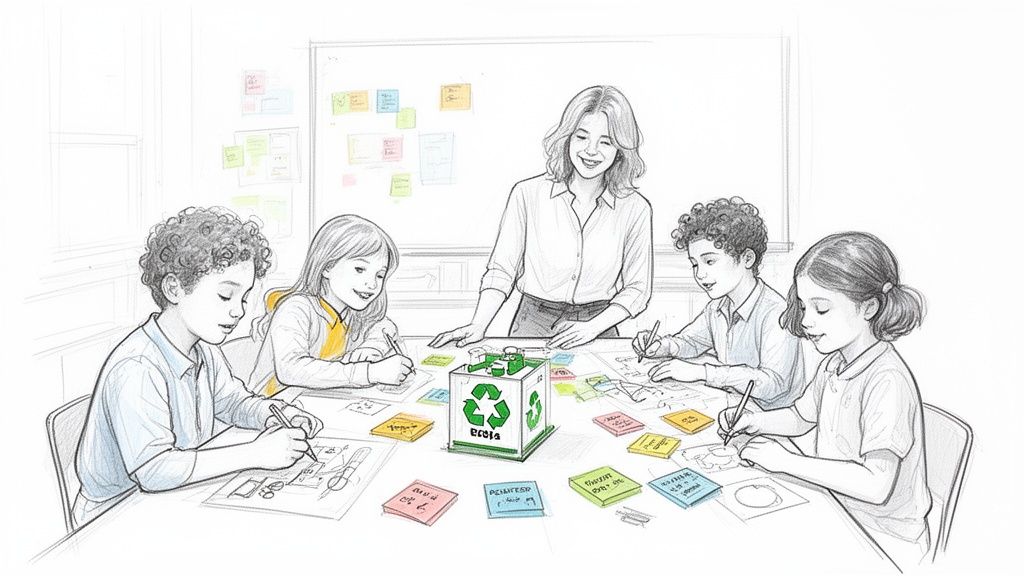
While design thinking is a game-changer for marketing and school operations, its real magic happens inside the classroom. This is where learning shifts from just listening and memorizing to actively solving problems. It empowers teachers and students to build the learning experience together.
This isn't just about teaching subjects; it's about nurturing the skills students actually need to succeed. Instead of just absorbing facts, they learn to approach real challenges with a healthy dose of curiosity and empathy. This process naturally builds resilience, teaching them that failure is just a stepping stone to a better solution. It’s a powerful way to cultivate collaboration, critical thinking, and genuine creativity.
Fostering a More Inclusive Classroom
One of the biggest wins for design thinking in education is its emphasis on empathy. When teachers really lean into this, they start to see their classroom through their students' eyes. They begin asking crucial questions: What is this lesson like for a student with dyslexia? What hurdles does a student who is learning English face with this assignment?
This human-centered view leads directly to more inclusive and flexible teaching. A teacher might prototype a few different ways to share information—maybe through visuals, a group discussion, or a hands-on activity—and see what clicks with different learners. This simple shift helps every student feel seen, understood, and supported. For educators wanting to build on this, exploring effective technology integration in classrooms can unlock even more ways to personalize learning.
Design thinking transforms the classroom into a laboratory for learning. It gives students permission to be curious, to try things, to fail, and to try again, building not just knowledge but also character.
Classroom Projects in Action
So, what does this actually look like day-to-day? Here are a few real-world examples of how students took an idea from a simple thought to a tangible reality:
- The School Garden Redesign: A third-grade class decided to fix up their neglected school garden. They started by interviewing the cafeteria staff to find out what fresh produce they actually needed. From there, they brainstormed new layouts, built small models of their ideas, and presented a final, well-thought-out plan to the principal.
- The History Podcast Project: A high school class wanted to make history more exciting. First, they talked to their classmates to figure out why history felt so boring. Their goal became "make history feel like a compelling story." They experimented with a few different episode styles before launching a podcast series for the whole school.
- The Recycling Program Overhaul: A middle school science class took on their school's confusing recycling program. They watched how students behaved at lunch, defining the problem as "unclear instructions and poorly placed bins." They then designed and tested a new system with color-coded signs and better bin locations, which dramatically boosted recycling rates.
Implementing Design Thinking at Your School
Shifting to a design thinking model can feel like a massive undertaking, but it doesn't mean you have to flip a switch and change everything overnight. The real key is to start small. Pick a winnable battle, build some momentum, and show everyone how valuable this approach can be.
Think of it less as a top-down mandate and more like planting a seed. You’re nurturing a new way of thinking that will eventually grow throughout your school's culture.
The best place to start is with a small, highly visible pilot project. Choose a common frustration point—something everyone knows is a problem but no one has had the time to fix. Maybe it's the chaotic new student orientation, the clunky re-enrollment process, or that weekly newsletter parents never seem to read.
When you nail that first project, it becomes your best case study. People notice. When your colleagues see a real, positive result from this new way of working, you’ll start to get genuine buy-in.

Identify and Empower Your Champions
Every school has them: the early adopters. They're the teachers and staff who are naturally curious, always experimenting, and excited to try something new. These are your future design thinking champions. Your job is to find them, support them, and let them lead the charge.
Give this small group dedicated time and resources to run that first pilot project. When they succeed, they become your internal advocates. They can share their stories and explain the process to their peers far more effectively than any administrator ever could. Their excitement is contagious, helping this problem-solving mindset spread organically. If you're looking for ways to nurture these leaders, check out some frameworks for effective professional development for educators.
A Practical Roadmap for Your First Project
You don't want to overwhelm your new team, so give them a simple, structured path for their first go-around. This keeps everyone focused on solving problems for people, right from the start.
Here’s a starter checklist to guide them:
Frame the Challenge Clearly: Kick things off with a "How Might We…" question. Instead of a blunt goal like "Fix orientation," try reframing it: "How might we help new families feel connected and confident before their first day of school?"
Schedule Empathy Work: Carve out specific time for the team to actually talk to people. They should interview a few new families and observe the current process firsthand. This isn't optional—understanding your community's real needs is the foundation for everything else. Your team can learn how to conduct user interviews effectively to get the most out of these conversations.
Define the Core Problem: Once they’ve gathered insights, have the team boil it all down to a single, human-centered problem statement. This creates a laser focus for brainstorming.
Ideate Without Judgment: Host a short, high-energy brainstorming session. The rule here is no bad ideas. Encourage wild thinking and aim for quantity over quality at this stage.
Build a Low-Fidelity Prototype: Challenge the team to create a simple, cheap version of their best idea. It doesn't have to be perfect. This could be a new welcome email template, a rough sketch of a revised orientation schedule, or even a script for a quick welcome video.
Test and Learn: Get the prototype in front of a small group of new parents and ask for their honest feedback. What worked? What didn't?
The goal of the first project isn't perfection; it's learning. By framing design thinking as a tool for solving existing frustrations, you position it as a welcome support system, not just another initiative. This approach builds trust and paves the way for wider adoption.
Common Questions About Design Thinking in Schools
Even with a clear roadmap, bringing any new way of thinking into a school is going to stir up some questions. When it comes to design thinking in education, I find that school leaders and marketing teams tend to run into the same handful of concerns. Let's walk through them so you can move forward with a bit more clarity.
Is Design Thinking Only for Tech or Designers?
Absolutely not. It's true the framework grew up in the design world, but at its heart, it’s just a structured way to solve problems for people. And what is a school if not an entire community of people? This approach is really just a mindset for deeply understanding what students, teachers, and parents actually need, so you can build better solutions with them, not just for them.
Think of it less as a rigid process and more as a versatile toolkit. You can use it for anything—rethinking a confusing school policy, brainstorming a new marketing campaign, or even figuring out how to make a history lesson stick. It’s all about empathy, creativity, and testing ideas, regardless of the subject matter.
How Can We Possibly Find Time for This?
This is the big one, isn't it? Every school I know is running on a packed schedule. The secret isn't to add design thinking on top of everything else, but to weave it into the work you're already doing.
Start small. Pick one manageable, nagging challenge, like fixing the morning carpool chaos or making the weekly parent newsletter something people actually want to read. You don't need to clear the calendar for a month. Dedicate a single PD day or a few short faculty meetings to working through that one problem. Once your team sees how this structured thinking leads to a real solution, they’ll see it as an investment that saves time down the road by getting things right the first time.
The most common mistake is trying to do everything at once. The best way to start is to pick one nagging problem, solve it using this process, and let that success build the momentum for you.
What Is the Best First Step for Our Marketing Team?
My advice is always to pick a low-stakes, high-impact marketing challenge to start. A perfect example is the inquiry form on your school's website or the automated emails you send to prospective families. These are critical first impressions that often get overlooked.
Frame the project with a simple question: "How can we make this experience more helpful and welcoming for new families?" Then, just focus on the first two stages:
- Empathize: Call 3-4 families who recently inquired and just listen to their story. What was their experience like? What was confusing?
- Define: Get together as a team and summarize what you heard into a clear, simple problem statement.
This kind of small-scale project gives the team a quick win. It lets them feel the power of the process without needing a huge budget or a complicated timeline, which makes it the perfect entry point.
How Do We Measure the Success of a Project?
You need both stories and data. One without the other doesn't give you the full picture. Success in a human-centered project has to be measured by both qualitative and quantitative proof.
For the qualitative side, you need to collect feedback. Are parents saying the admissions process feels clearer and less stressful? Are students more excited about the new library layout? Use short surveys, quick interviews, or small focus groups to gather these anecdotes—they’re gold.
For the quantitative side, track the numbers tied directly to the problem you were trying to solve. If you redesigned the open house experience, did the number of applications from attendees go up? If you improved the website navigation, did the bounce rate on key pages go down? Always tie your metrics back to the specific problem you identified in the beginning.
Ready to transform your school’s marketing with a human-centered approach? At The MarCom Society, we provide the tools, community, and expert guidance K-12 marketing professionals need to innovate and lead. Join our exclusive network to access live workshops, collaborative sessions, and a library of resources designed to help you solve your school's biggest challenges. Learn more and become a member today.









