
So, what are marketing personas, really? At their core, they're detailed, semi-fictional profiles of the ideal families you want to attract. This isn't just about demographics; it's about digging deep into their motivations, daily challenges, and how they prefer to communicate. The whole point is to shift from generic, mass-market messages to creating real, meaningful conversations that resonate and, ultimately, boost enrollment.
Why School Marketing Personas Are a Game-Changer
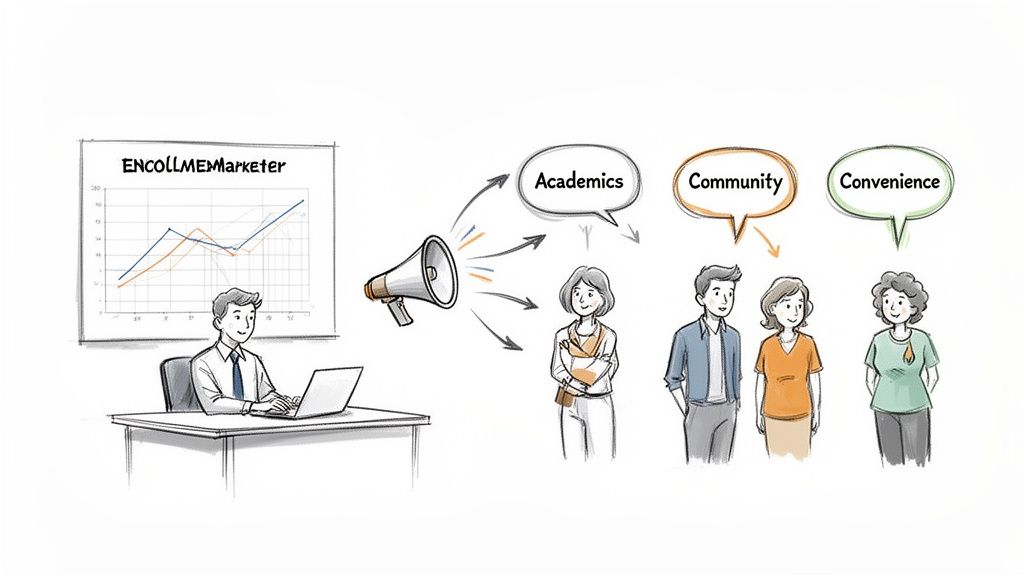
Let's get real for a minute. In the world of K-12 marketing, casting a wide net just doesn’t work anymore. If your enrollment numbers are flat, think about your last open house invitation or tuition email. Did you send the exact same message to every single parent? When you try to speak to everyone, you often end up connecting with no one.
This is exactly where building marketing personas can completely change your approach. They bring the clarity you need to turn a fuzzy goal like "increase enrollment" into a sharp, focused strategy that actually gets results.
From Vague Demographics to Sharp Focus
Instead of targeting "parents aged 35-50 living within a 10-mile radius," you start talking to real people. You can now craft a message for "Achievement-Focused Amelia," who is already thinking about high school readiness for her third-grader, or "Community-Seeking David," who's looking for a place where his child will truly belong. See the difference? It's huge.
This idea isn't new. Back in the mid-1980s, software developer Alan Cooper came up with personas to make technology more user-friendly. Fast forward to today, and 44% of marketers rely on buyer personas. Even more impressive, websites designed with personas in mind can become 2-5 times more effective. Imagine what that could do for your school's enrollment and community pages.
A persona forces you to stop writing for a faceless crowd and start creating content for a real person. It humanizes your marketing, making every email, social media post, and website update more empathetic and effective.
The Real-World Benefits for Your School
Putting in the work to develop these personas pays off in very tangible ways. They become the bedrock of other powerful marketing activities, like audience segmentation. (If you want to go deeper on that, check out this guide on the fundamentals of audience segmentation).
Ultimately, a solid set of personas helps your team:
- Craft Resonant Messaging: You’ll write website copy, emails, and social posts that speak directly to what parents are worried about and what they hope for.
- Improve Channel Strategy: You'll know exactly where to find your ideal families, whether that’s a local parenting Facebook group, a neighborhood event, or even on LinkedIn.
- Guide Content Creation: Your blog posts, videos, and guides will start answering the exact questions your target families are searching for online.
- Align Your Internal Teams: Finally, everyone from admissions and communications to the faculty will share the same clear picture of who they are trying to reach and serve.
Personas replace guesswork with a data-driven strategy. They are the essential bridge connecting your school's unique story to the families who are searching for a place just like yours.
How to Gather Data That Actually Tells a Story
Great school personas aren't built on guesswork from a Monday morning marketing meeting. They’re built on real data from real families. This is where the detective work begins, digging for the authentic stories, motivations, and challenges that drive a family’s school choice.
Think of this process as a two-pronged attack: first, you look inward at the information you already have, and then you look outward to gather fresh perspectives directly from your community. When you blend these two sources, you get a clear, multi-dimensional picture of the people you want to reach.
Start With the Goldmine You Already Have: Your School Data
Before you even draft a survey question, start with the data that’s already sitting in your school’s databases. This internal information gives you a solid, factual baseline of who makes up your community right now.
Get your hands dirty and look for patterns in a few key places:
- Enrollment Forms: Where do your families live? Notice common zip codes, feeder schools, and even parental occupations. These raw demographics form the skeleton of your personas.
- Website Analytics: Dive into your Google Analytics. Are prospective parents flocking to the athletics page, the curriculum guide, or the tuition and financial aid section? Where they click tells you what they care about most.
- Social Media Insights: Check the demographics of your followers on Facebook and Instagram. What kind of content gets the most likes and shares? Is it the feel-good student success stories, photos from the spring musical, or spotlights on your amazing faculty?
This initial dig will help you form some early hunches. Maybe you spot that a big chunk of your new families comes from one specific neighborhood, and you also notice your posts about community service get huge engagement. That might just be the beginning of a "Community-Focused Connector" persona.
Nothing Beats a Real Conversation: Conduct Meaningful Interviews
The numbers tell you what people are doing, but conversations tell you why. There is no substitute for a direct, human-to-human interview to understand the emotional drivers behind a family’s decision. The key is to talk to a variety of people to get a well-rounded view.
Try to line up conversations with a mix of people:
- Newly Enrolled Families: Their memories of the school search are fresh. They can give you the play-by-play of their journey.
- Long-standing, Re-enrolled Families: These are your loyalists. They provide incredible insight into what keeps a family happy and committed year after year.
- Alumni Parents: Their perspective is golden. They can speak to the long-term value and impact of the education their child received.
- Admissions Staff & Faculty: Don't forget your internal experts! They’re on the front lines every day, hearing the raw, unfiltered questions and hopes of families.
The single most powerful tool in an interview is the word "Why?" When a parent says they chose you for your "strong academics," don't stop there. Ask what "strong academics" actually means to them. Their answer will unlock the deeper values that truly guide their decisions.
Ask Questions That Get People Talking
The insights you gather are only as good as the questions you ask. Ditch the simple yes/no queries and focus on open-ended prompts that encourage people to tell you a story.
Here are a few questions I’ve found incredibly effective over the years:
- What was the one thing that really sealed the deal for you when choosing our school?
- Can you describe the moment you thought, "Okay, this is the right place for my child"?
- What was your biggest headache or frustration during the whole school search process?
- When you were researching schools, where did you go for real information? (Think social media, friends, online reviews, school fairs, etc.)
- If you had to describe our school to a friend in just three words, what would they be?
Use Surveys to Validate Your Hunches at Scale
Interviews give you rich, detailed stories, but surveys give you the numbers to back them up. They’re the perfect tool to see if a theme you heard from a few parents is actually a widespread feeling across your community.
To get people to actually finish your survey, keep it focused and reasonably short. I find a mix of multiple-choice questions (for easy data) and a few open-ended text boxes (for personal stories) works best.
For a deeper dive, our guide on creating an effective survey for parents has templates and tips ready to go. It’ll help you collect the exact data you need to build out your marketing personas.
From Raw Data To Real People: Crafting Your K-12 Personas
You've done the hard work. You've conducted the interviews, sent out the surveys, and now you’re staring at a mountain of transcripts, spreadsheets, and analytics. This is where the magic happens. It’s time to transform all those scattered data points into cohesive, actionable profiles that feel like real people you know.
The goal here is to move beyond spreadsheets and into stories. You'll sift through the "what"—the demographics and clicks—to truly understand the "why"—the deep-seated motivations, anxieties, and hopes that drive a family’s school choice. This is the synthesis phase, where clear patterns start to rise above the noise.
This process generally flows from deep, personal conversations to broader, data-backed validation.
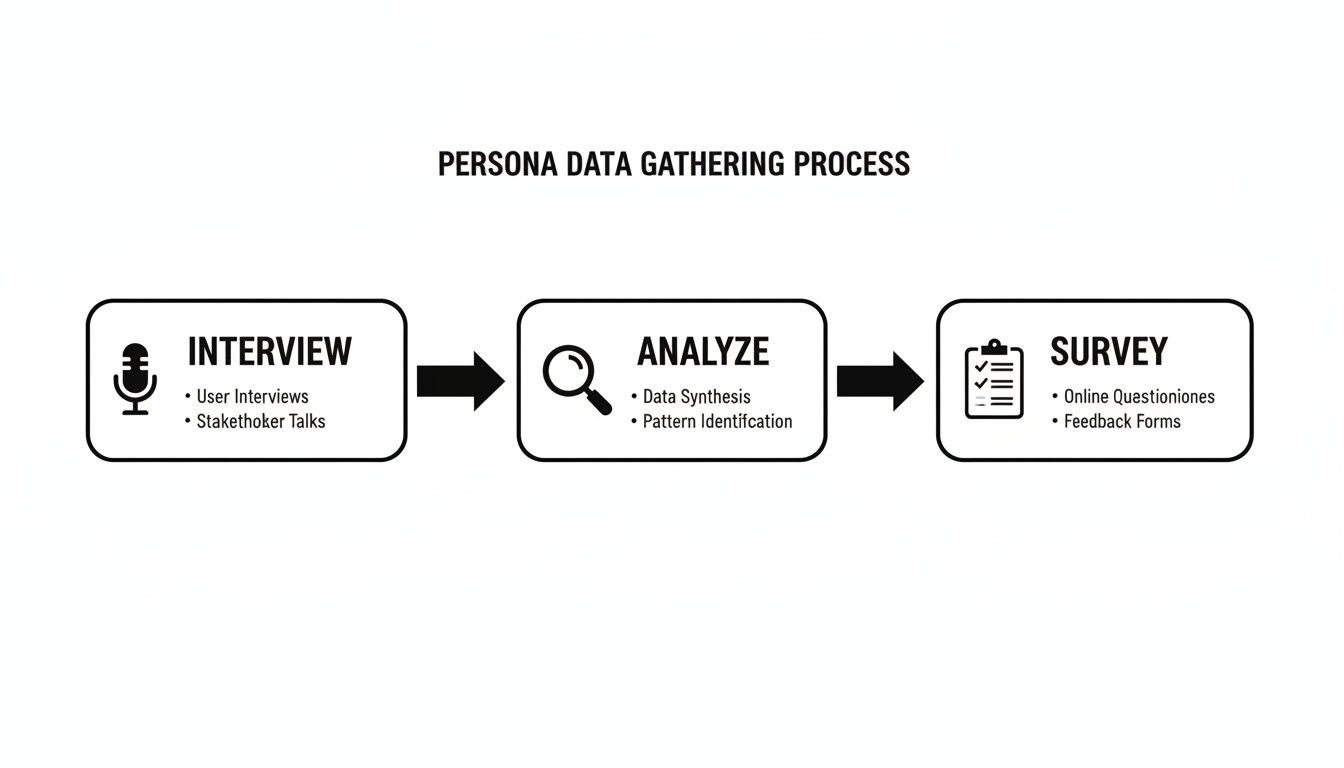
This cycle of qualitative and quantitative research is crucial. It ensures the rich, personal insights from your interviews are genuinely representative of your wider audience, as confirmed by your survey data.
Finding The Patterns In Your Research
Your first move is to organize everything and start combing through it all, looking for recurring themes and common threads. Put on your detective hat. Before you dive too deep, it can be helpful to review some fundamental audience segmentation strategies to give yourself a solid framework for sorting the data.
Start by grouping similar responses and comments. Did 12 different parents mention wanting a "strong sense of community"? Did you hear the phrase "rigorous but supportive academics" over and over? These aren't just buzzwords; they're the seeds of your personas.
Begin creating clusters of information around these core areas:
- Goals & Aspirations: What are parents truly hoping to achieve for their kids? It might be getting into a top-tier university, but it could just as easily be about developing a lifelong love for learning or finally finding a peer group where their child feels like they belong.
- Challenges & Frustrations: What are their biggest headaches in the school search? Common themes often include overly complicated admissions processes, anxiety about social fit, or the struggle to find a school that truly supports a specific learning need.
- Information Sources (Watering Holes): Where do they actually go for information they trust? Note every single mention of local parent Facebook groups, specific school review sites, neighborhood blogs, or advice from friends.
- Decision-Making Factors: What are the ultimate tipping points that seal the deal? Was it the passion of a particular teacher they met on a tour? The school's undeniable commitment to the arts? Or maybe it was something as practical as the convenient after-school care program.
As you start categorizing your notes, you'll see distinct groups begin to form. These are the foundational archetypes of your school's audience.
Segmenting Your Data Into Distinct Archetypes
Once you've identified those core patterns, you can begin the work of segmenting your audience into distinct persona groups. The key is that each group should share a similar set of motivations, challenges, and goals.
I've found it incredibly helpful to use a simple table to organize these criteria before trying to write the full profiles. This forces you to be disciplined and ensures each persona is based on clear, data-backed distinctions, not just vague feelings or assumptions.
Here’s a look at how you might structure that thinking.
Persona Segmentation Criteria For K-12 Schools
| Segmentation Category | Key Questions To Ask | Example Data Points |
|---|---|---|
| Primary Motivation | What is the single biggest driver behind their school search? | "I need a school that will challenge my daughter academically." vs. "We're looking for a warm, inclusive community." |
| Key Frustration | What is their biggest obstacle or fear in this process? | "I'm overwhelmed by the number of options." vs. "I'm worried my quiet son will get lost in a big school." |
| Communication Style | How do they prefer to receive information from a school? | Prefers detailed, data-rich emails and curriculum guides. vs. Prefers visual, story-based social media content. |
| Information Sources | Where do they go for trusted advice and research? | Relies on official school websites and national ranking sites. vs. Trusts word-of-mouth from friends and local online groups. |
Using criteria like these helps you start giving your segments working titles that reflect their core identity, like 'The Achievement-Focused Parent' or 'The Community-Seeking Family.' These archetypes become the skeletons you'll soon flesh out into living, breathing personas.
Personas aren't just demographic checklists; they are tools for building empathy. The goal is to create a profile so vivid that your entire team feels like they genuinely know this person and can anticipate what they need before they even ask.
Bringing Your Personas To Life
Now for the fun part: building the complete persona profile. This should be a one-page snapshot that’s easy to read, share, and reference in your day-to-day work. While there are countless templates out there, a strong K-12 persona always blends demographic data with those crucial psychographic insights.
Your final document should read more like a biography than a data sheet. Give your persona a name and find a stock photo that feels right. This simple step is surprisingly powerful—it makes the persona memorable and helps your team visualize exactly who they’re trying to connect with.
A well-crafted persona includes several key components:
- A Memorable Name and Photo: Think "Supportive-Seeker Sarah" or "High-Achiever Henry."
- A Quick Bio: A short paragraph summarizing their background, family life, and what their typical day looks like.
- Key Demographics: Include age, location (neighborhood or town), occupation, and household income to ground the persona in a tangible reality.
- Goals: List their top 3-4 goals related to their child's education. Use direct, action-oriented language pulled from your research.
- Frustrations: Detail their top 3-4 pain points. What keeps them up at night about this decision? This is where you build real empathy.
- "Watering Holes": Get specific. List the exact social media platforms, websites, and community groups they rely on for information.
- A Quote: Find a single, powerful quote directly from your interviews that perfectly encapsulates their core motivation or biggest worry.
By filling out these fields with the clustered data from your research, you create an incredibly powerful tool. You turn abstract numbers into a relatable human story that can guide every marketing and communications decision you make.
How To Validate Personas And Get Team Buy In
Crafting your school's personas is a huge accomplishment, but don't stop now. A persona gathering digital dust on a shared drive won't do anyone any good. The next steps are all about proving your hard work is on the mark and, just as importantly, getting your entire team to actually use these powerful new profiles.
Think of your draft personas as well-researched hypotheses. Now it's time to test them with the people who live and breathe your school's community every single day. This is your chance to take the personas on a "roadshow" and get critical feedback from the front lines.
Socializing Your Personas For Feedback
Forget sending a mass email with a PDF attachment. To get real, honest feedback, you need to have actual conversations. Start by scheduling short, informal meetings with key stakeholders across different departments. Your goal here isn't a formal presentation; it's to get their gut reaction and see if the personas feel like real people they know.
Bring your draft personas to these essential groups:
- The Admissions Team: These folks are your most valuable reality check. They're on the phone with prospective parents all day. Ask them directly, "Does 'Community-Seeking David' sound like the parents you gave tours to last week? Does this ring true?" Their daily interactions can fill in the nuanced details your research might have missed.
- Division Heads (Lower, Middle, Upper School): These leaders have a deep understanding of what parents are worried about at each stage of their child's journey. They can quickly tell you if the "Frustrations" you've listed for an elementary school parent persona are what they're truly hearing in their offices.
- The Head of School: Getting the Head of School's support is non-negotiable. When you meet with them, frame the personas not as a marketing project, but as a strategic tool that gets the entire institution speaking the same language about the families you serve.
The real "aha!" moment is when a colleague looks at a persona and says, "Oh, I know this person! I just spoke with a parent exactly like this yesterday." That's when you know you've created a genuinely useful tool, not just a fictional character.
This feedback loop is priceless. You might discover a persona's primary goal is slightly different than you initially thought, or uncover a common question that you need to add to their profile. You could even run a small, targeted session with a few staff members to dig deeper; our guide on how to conduct focus groups gives you a great framework for that.
From Marketing Project To Shared Resource
Let's be honest: overcoming skepticism is often the biggest challenge. Some of your colleagues might dismiss personas as "fluffy marketing stuff." The only way to win them over is to show them exactly how this work solves a real problem for their department.
Don't just present the persona; present the solution it enables.
- For Admissions: "By keeping 'Achievement-Focused Amelia' in mind, we can refine our open house talking points to hit on academic rigor and college placement right away."
- For the Web Team: "This shows us 'Supportive-Seeker Sarah' is looking for proof of our community. Let's make those student life stories much more prominent on the homepage."
- For Communications: "We now have a roadmap to create blog posts that directly address the specific anxieties we've listed for 'High-Achiever Henry.'"
When you frame it this way, your persona project transforms from an isolated marketing initiative into a shared school resource that makes everyone's job a little easier and a lot more effective.
You can also add another layer of credibility by connecting your personas to broader demographic trends. Generational cohorts, for example, have a huge impact on everything from communication preferences to core values. Tying your work to this kind of external data builds an undeniable case for its strategic importance. When your personas are grounded in both internal feedback and recognized external data, they become an integral part of your school's culture.
Putting Your School Marketing Personas Into Action
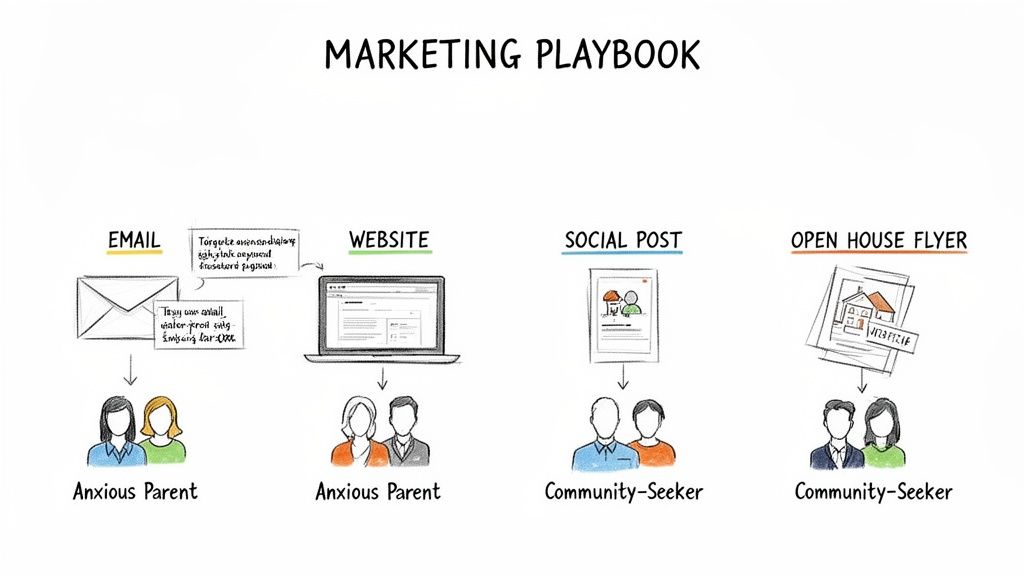
You’ve put in the hard work of researching and building your personas. Now for the exciting part—turning those detailed profiles into real marketing that actually connects with families and drives enrollment.
The biggest pitfall I see is schools treating personas as a one-and-done project that collects dust on a shelf. To be truly effective, they need to become the playbook for every single piece of content you create.
Think of your personas as a new set of glasses. Before you write an email, design a social post, or plan an open house, look at it through the eyes of "Achievement-Focused Amelia" or "Community-Seeking David." This simple shift flips your perspective from "What do we want to say?" to "What do our families need to hear?"
Customizing Your Digital Communication Channels
Your website and email campaigns are usually the first places a prospective family gets a feel for your school. This is where your personas can make a huge, immediate impact. The data doesn't lie—persona-driven marketing works.
Persona-informed websites are 2-5 times more effective for the right audiences. And get this: personalized email campaigns can double your open rates and see a fivefold jump in click-throughs.
So, what does this look like in your daily workflow?
For "High-Achiever Henry" (The parent who lives for academics and outcomes):
- Website: Make sure your homepage has a big, obvious link to "Academics" or "College Placement Stats." Write blog posts like, "How Our STEM Program Sets Students Up for Top Universities."
- Email: A subject line like "An Inside Look at Our Advanced Placement Curriculum" will cut through the noise in his inbox way better than a generic "Spring Newsletter."
For "Supportive-Seeker Sarah" (The parent looking for community and a sense of belonging):
- Website: Your homepage hero image should feature students laughing and working together, not just sitting at desks. Sprinkle in testimonials from parents talking about the "welcoming community."
- Email: Try a subject line like, "You're Invited: Our Annual Family Fall Festival." The email itself should feel warm and focus on connection.
Your personas are your secret weapon for crafting communication that feels personal and relevant. Instead of one generic open house invitation, you can now create two versions—one highlighting academic excellence and another showcasing community spirit.
Tailoring Content and Social Media Strategy
Your content strategy—everything from blog posts to social media—becomes so much clearer with personas. You're no longer just "creating content"; you're solving specific problems and answering the exact questions your ideal families are asking.
Once your personas are set, you can get much smarter with your content, including things like optimizing your social media posting times for maximum engagement to reach them when they're actually online.
Let's say you're planning your social media for the month. Here's how to use your personas:
- Facebook Content for "Community-Seeking David": He wants to see your school's culture in action. Post a quick video interview with a beloved teacher or a photo gallery from the student art show. Your captions should use words like "family," "belonging," and "tradition."
- LinkedIn Content for "High-Achiever Henry": He’s career-minded and respects data. This is the perfect place to share a story about a recent grad who landed a spot in a prestigious university program, or an infographic with your school's impressive college matriculation stats.
This way of thinking goes far beyond your digital channels. Personas should shape the talking points on a school tour and even the theme of your next admissions event. They create a shared language for your entire team, ensuring every interaction a family has with your school reinforces the values they hold most dear.
This is how personas stop being an exercise and become a powerful, everyday strategic tool.
Common Questions About School Personas
As you start digging into persona development, a few practical questions almost always pop up. Let’s tackle the ones I hear most often from school marketing teams so you can move forward with confidence.
How Many Personas Should Our School Create?
There’s no magic number here, but the sweet spot for most schools is 3 to 5 key personas. This is manageable enough to actually use without feeling like you're trying to talk to a dozen different people at once.
If you try to build ten personas right out of the gate, you’ll likely end up with a set of beautiful but useless profiles. None of them will get the attention they deserve.
Start by focusing on your most critical family segments. This usually means profiling prospective parents at your main entry points—think kindergarten, sixth grade, or ninth grade. You can always get more granular and add secondary personas later. Nail the core group first.
How Often Should We Update Our School Personas?
Think of your personas as living documents. They're not a "set it and forget it" project. Family priorities shift, your community evolves, and your school's own goals change. Your personas have to keep up.
A good rule of thumb is to give them a quick review annually. This is just to make sure their goals, challenges, and motivations still ring true. You might only need a major overhaul every two or three years, or if you notice a big shift in enrollment data or parent feedback. The key is simply to prevent them from becoming stale.
The biggest mistake is creating personas based on assumptions rather than real data. When personas are built on what you think your audience is like, they become unhelpful fictional characters. Ground every detail in actual interviews, surveys, and analytics.
What Is The Biggest Mistake To Avoid?
Hands down, the most common pitfall is building personas on internal assumptions instead of real research. When your persona is based on what the admissions team thinks a prospective parent cares about, it's not a strategic tool. It's fiction.
Every single detail—from their primary goals to their biggest frustrations—must be rooted in what your families have actually told you.
The other classic mistake? Creating incredibly detailed personas and then letting them collect digital dust on a shared drive. For these to work, you need a plan to activate them from day one. This means your team should be pulling them up when writing website copy, brainstorming social media campaigns, or even scripting tour guide talking points. Without a clear plan for putting them to work, even the best-researched personas won't move the needle.
Ready to build a strategy that truly connects with your ideal families? The MarCom Society provides K-12 marketing professionals with the expert guidance, resources, and collaborative community you need to master tools like personas and drive real results. Join our community of school marketing leaders today!









