
Digital transformation in marketing isn't just a buzzword. For schools, it's a strategic reinvention of how you connect with families by weaving technology, data, and digital channels into the very fabric of your outreach. It’s a fundamental change that creates personalized, measurable experiences to boost enrollment and build a stronger community.
What Digital Transformation Means for School Marketing
Think of it this way: remember the old, dusty card catalogs in the library? Now picture a dynamic, searchable digital media hub. That’s the leap we’re talking about. It’s far more than just buying new software; it's a complete shift in mindset, strategy, and daily operations to meet the real-world expectations of modern families.
This change means moving away from the "spray and pray" world of static brochures and disconnected spreadsheets. Instead, you're building an integrated system that truly understands and even anticipates the needs of both prospective and current parents. This is the foundation for a marketing engine that doesn't just broadcast messages—it builds genuine relationships.

Beyond Just Going Digital
Let’s be clear: having a website and a Facebook page isn't true digital transformation. The real magic happens when those tools start talking to each other, powered by data, to create a seamless and personalized journey for every family.
Digital transformation is the process of using digital technologies to create new—or modify existing—business processes, culture, and customer experiences to meet changing business and market requirements.
This means every interaction—from a parent's first Google search for "best schools near me" to their experience with your online enrollment portal—is part of a single, cohesive strategy. It’s the difference between sending a generic email blast and sending a perfectly timed follow-up to a family based on the specific STEM program page they visited on your website.
This isn’t just a niche trend. The global digital transformation market is on track to hit $2.8 trillion by 2025. That’s a massive signal that organizations everywhere are investing heavily to adapt. This is no longer a "nice-to-have"; it's a core operational necessity for any school that wants to stay relevant.
A Look at Traditional vs. Transformed Marketing
To really grasp the difference, it helps to see the old and new approaches side-by-side. The table below breaks down how various marketing functions evolve when a school truly embraces digital transformation.
| Marketing Function | Traditional Approach (Pre-Transformation) | Transformed Approach (Post-Transformation) |
|---|---|---|
| Lead Generation | Print ads, local fairs, word-of-mouth | SEO, targeted digital ads, content marketing, virtual tours |
| Parent Communication | Mailed newsletters, phone calls, flyers in backpacks | Automated email workflows, personalized parent portals, SMS alerts |
| Data & Analytics | Manual spreadsheets, anecdotal feedback, basic web hits | Integrated CRM, marketing automation, real-time dashboards |
| Enrollment Process | Paper forms, in-person appointments, manual follow-up | Online applications, digital document submission, automated reminders |
| Brand Storytelling | Static brochures, annual reports | Video testimonials, student-run blogs, interactive social media |
The shift is clear: we’re moving from broad, one-way communication to targeted, two-way conversations that are driven by data and focused on the individual family's experience.
The Core Components of This Shift
So, what does this actually look like inside a K-12 school? The transformation really hinges on four key areas that have to work together.
- Technology Integration: This is about connecting your tools. Think of your Customer Relationship Management (CRM) system, marketing automation software, and analytics platforms working in harmony, not in silos.
- Data-Driven Decision Making: You stop guessing what parents want and start knowing. Decisions are guided by real data on website behavior, email engagement, and social media interactions.
- Enhanced Parent Experience: Every digital touchpoint—from your website to your emails—is designed to be intuitive, helpful, and personal. The goal is to make a family's journey with your school feel smooth and supportive.
- Operational Agility: Your team builds new, flexible processes. This allows you to pivot quickly when parent expectations change or a new digital trend emerges, making your marketing far more effective.
Ultimately, this process builds a robust digital foundation that positions your school to thrive for years to come. To see how these ideas play out in a specific tactic, our guide on content marketing for education is a great next step.
The Forces Driving Digital Change in Education

The big push for digital transformation in marketing for schools isn’t just some trend. It's a real-world reaction to massive shifts that are changing the entire K-12 landscape. For schools wanting to thrive and connect with their communities, sitting on the sidelines is no longer an option.
Three major forces are really pushing this change forward. Getting a handle on them is the first step, not just to see why this is happening, but to build a strategy that tackles the actual problems, not just the surface-level symptoms.
The New Parent Playbook
Let's face it: the parents you’re trying to connect with today are mostly millennials and older Gen Z. These are digital natives. They handle their banking, shopping, and social lives with a few taps on their phones, expecting everything to be slick and easy. So when it's time to look for a school, they bring those exact same expectations to the table.
This isn't about a simple preference for digital; it's a full-blown demand. A clunky website, an application form you can't fill out on a phone, or a day-long wait for an email response can be a deal-breaker. They're looking for an "Amazon-like" experience where information is at their fingertips and the whole process feels personal and smooth.
Today’s parents aren't just comparing your school to the one down the street. They are subconsciously comparing their experience with your school to their last interaction with Netflix, Spotify, or Amazon.
This shift completely changes the game. Old-school marketing tactics just don't hit the same way anymore. A flyer in the mail has a tough time competing with a school's vibrant Instagram feed or an immersive virtual tour. Your school's digital presence has become its new front door, and if that first impression is a bad one, that door might slam shut for good.
The Mandate for Data-Driven Decisions
For a long time, school marketing was run on gut feelings, tradition, and word-of-mouth. "We've always run an ad in the local paper," or "I heard from a parent that they liked our open house." While there's a place for that kind of feedback, it doesn't provide the hard evidence needed to justify budgets and prove your efforts are paying off.
Today, school boards and leadership teams are asking much sharper questions:
- Which campaigns are actually bringing in applications?
- What is our cost to acquire a new student?
- How can we get a real handle on forecasting next year’s enrollment?
Trying to answer these without a solid digital framework is like flying blind. This is where digital tools change everything. By tracking website traffic, seeing who opens your emails, and measuring social media engagement, you can finally collect real data. This allows you to show what’s working, what’s not, and make smarter decisions with a limited budget, proving your team's value every step of the way.
An Increasingly Competitive Environment
The world of K-12 education is more crowded than ever. Public, private, charter, and online schools are all vying for the attention of the same families. In this kind of market, a school's digital savvy is often seen as a direct reflection of its quality and how innovative it is.
A school with a polished, easy-to-use website and an active social media presence sends a message that it's forward-thinking. On the other hand, a school with a digital footprint that looks stuck in 2005 can seem out of touch, no matter how great its academic programs are. Digital transformation in marketing has become a key way to stand out.
Think about two schools. One offers online enrollment, virtual tours, and personalized email updates. The other sticks to paper applications and generic mailings. For a busy, tech-savvy family, the choice becomes pretty clear. The school that makes the journey easier and more engaging is the one that builds trust and, ultimately, gets the enrollment.
The Four Pillars of a Modern Marketing Transformation
Taking the leap into a full-scale marketing transformation can feel like a massive undertaking. It's not just one project; it's a fundamental change in how your school connects with families. The best way to get your arms around it is to break the process down into four interconnected pillars.
Think of them as the foundational columns supporting a brand-new, much stronger structure for your school's outreach and enrollment. These pillars are Technology and Tools, Data and Analytics, People and Processes, and the Parent Experience. Each one is critical, and they only work when they work together, creating a modern marketing engine that truly drives results.
Let's dig into each one and see how it applies in the real world of a K-12 school.
Technology and Tools
This first pillar is usually the most visible one. We're talking about your MarCom technology stack—the software and platforms that will become your new command center. The key here isn't to chase every shiny new gadget. It’s about being strategic and choosing tools that actually work together to help your team work smarter, not just harder.
The whole point is to get information flowing seamlessly. For most K-12 schools, a solid tech stack includes a few core components:
- Customer Relationship Management (CRM): This is the heart of your operation. It’s a central hub for every single family interaction, replacing those scattered spreadsheets for good. A CRM tracks every touchpoint, from the moment a family inquires on your website to their campus tour follow-up.
- Marketing Automation Platforms: These are the workhorses that handle the repetitive but crucial tasks. They let you nurture relationships at scale, sending out automated email sequences that trigger after a family downloads a viewbook or RSVPs for an open house.
- Content Management System (CMS): This is the engine that runs your website. A good CMS means you can easily update pages, post news, and spin up new landing pages without having to call a developer for every little thing.
This simple graphic shows how these core digital marketing tools fit together to support your transformation.
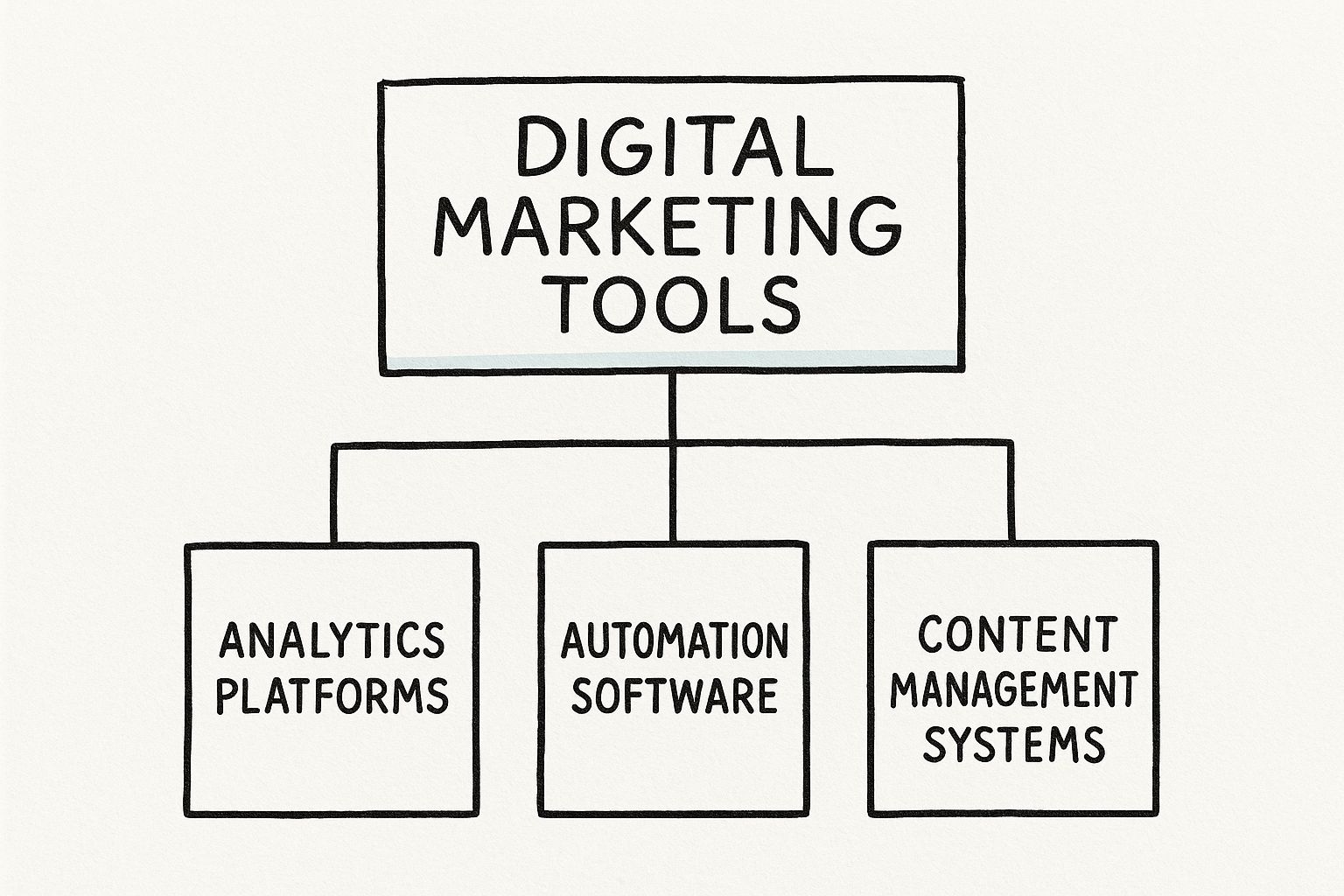
As you can see, these platforms don't work in isolation. They form a connected system to manage, analyze, and automate your school's marketing.
Data and Analytics
If technology is your engine, then data is the fuel that makes it run. This pillar is all about making the shift from guesswork to genuinely informed decisions. Every click, every form submission, and every social media interaction is telling you a story about what prospective families are looking for. Your job is to listen.
This means you need to turn raw numbers into real enrollment insights. Instead of just looking at overall website traffic, you can start analyzing which blog posts are resonating most with families in a key zip code. You can see exactly which email subject lines drove the most open house sign-ups.
Data lets you stop broadcasting one message to everyone and start having personalized conversations with specific groups. It’s the difference between shouting into a crowd and having a meaningful one-on-one chat.
As you build this capability, it’s worth looking into how technology is making data analysis even more powerful. The AI's transformative impact on the marketing landscape is undeniable, especially when it comes to interpreting complex data and personalizing outreach at scale.
People and Processes
Here’s a classic mistake: investing a ton of money in new technology without investing in the people who have to use it. This third pillar is all about giving your team the skills and workflows they need to thrive in this new environment. This kind of change is as much about culture as it is about technology.
This really boils down to three things:
- Upskilling and Training: Your team might need coaching on the new CRM, a crash course in SEO best practices, or guidance on how to read an analytics dashboard.
- Creating Agile Workflows: It’s time to move away from rigid, year-long plans. Shifting to more flexible, sprint-based projects allows your team to adapt quickly when new challenges or opportunities pop up.
- Fostering Collaboration: You have to break down the traditional silos between admissions, marketing, and even IT. When everyone is looking at the same data and working toward the same goals, the entire operation becomes so much more effective.
The Parent Experience
Finally, we get to the pillar that ties it all together. The technology, the data, and the new processes must all serve one ultimate goal: creating a seamless, personal, and positive experience for parents at every single touchpoint.
This is about truly mapping the family's journey—from their first Google search for local schools to their experience after they've enrolled—and finding ways to remove friction at every step.
For example, a family that expressed a strong interest in your arts program shouldn’t just get generic admissions emails. They should be getting invites to student performances, a link to a video about the art department, and maybe even a personal note from the head of the arts faculty. This is where it all comes together, ensuring your efforts lead to stronger relationships and, ultimately, a stronger school community. Weaving these pillars together is the very essence of modern https://blog.marcomsociety.org/marketing-strategies-for-schools/ today.
Your Strategic Roadmap to Digital Transformation
Going from a great idea to actual execution is where most ambitious projects fall apart. When it comes to a digital transformation in marketing, a clear, actionable roadmap is your school’s best defense against a project that gets bogged down in confusion or simply loses steam.
This isn't about etching a rigid, ten-year plan in stone. Instead, think of it as building a flexible framework that guides your decisions, helps you show steady progress, and allows you to adapt along the way.
It’s a lot like planning a cross-country road trip. You wouldn’t just hop in the car and start driving west. You’d map out your key destinations, figure out your daily mileage, and plan for fuel stops. In the same way, a strategic roadmap for your school's marketing needs to break the journey into manageable, logical stages.
Stage 1: Conduct an Honest Audit
Before you can figure out where you’re going, you need a painfully honest assessment of where you are right now. This first stage is all about taking a complete inventory of your school's current marketing tools, workflows, and team skills. Being unflinchingly honest here is the most important part.
Your audit needs to dig into three key areas:
- Technology: What software are you actually using every day? Is a real CRM managing your prospective families, or are you wrestling with a series of complex spreadsheets? Can your team even update the school website without calling in an expert?
- Processes: How do you really handle new inquiries? Map out the step-by-step journey a family takes from their first click on an ad to submitting an application. Find the bottlenecks, the dead ends, and the points of friction.
- Skills: What are the genuine strengths of your team? Do you have a social media whiz or someone who truly gets data? Be real about the gaps, whether that’s a lack of experience with SEO or a team that’s never touched marketing automation.
Stage 2: Define Clear Goals and KPIs
Okay, you know your starting point. Now, let’s define the destination. Vague goals like "improve our digital presence" are completely useless because you can’t measure them. Your objectives have to be specific, measurable, achievable, relevant, and time-bound (SMART).
Instead of a fuzzy goal like "get more leads," a much stronger one would be, "Increase qualified campus tour requests by 20% over the next academic year." Now that’s a clear target. Key Performance Indicators (KPIs) are just the specific numbers you’ll track to see if you’re getting closer to that goal, like website conversion rates, cost per application, and email open rates.
A goal without a number is just a wish. When you attach specific metrics to your objectives, they stop being vague aspirations and become a tangible action plan that your school’s leadership can actually understand and get behind.
Stage 3: Prioritize Your Initiatives
After your audit, you’ll probably have a laundry list of a dozen things you want to fix. Trying to do everything at once is a surefire recipe for burnout and failure. The real skill here is learning to prioritize—focusing on the initiatives that will give you the biggest bang for your buck.
A simple but incredibly powerful tool for this is the impact vs. effort matrix. Just plot every potential project on a four-quadrant graph:
- High-Impact, Low-Effort (Quick Wins): Do these immediately. A perfect example is setting up automated email responses for website inquiries.
- High-Impact, High-Effort (Major Projects): These are your big, game-changing initiatives, like implementing a new school-wide CRM. Plan these out carefully.
- Low-Impact, Low-Effort (Fill-Ins): Tackle these when you have a bit of spare time, but don’t let them sidetrack you from the bigger goals.
- Low-Impact, High-Effort (Time Sinks): Avoid these like the plague.
Stage 4: Develop a Phased Implementation Roadmap
With your priorities straight, you can build a timeline that’s actually realistic. A phased roadmap, usually spanning 12-24 months, breaks your massive projects down into smaller, sequential steps that you can tick off one by one.
For example, rolling out a new CRM might be broken down like this:
- Phase 1 (Months 1-3): Research and select the right CRM vendor; get budget approval.
- Phase 2 (Months 4-6): Handle the technical setup and migrate your existing data.
- Phase 3 (Months 7-9): Train the admissions team and get them using the new system.
- Phase 4 (Months 10-12): Expand CRM access to the marketing team for tracking campaign results.
Stage 5: Secure Buy-In and Budget
Finally, none of this matters if you can't get your school’s leadership on board. This is where all your prep work pays off. Your presentation shouldn’t be a geeky showcase of flashy technology; it needs to be a compelling, data-backed business case for why this change is necessary.
Frame your entire request around the goals that leadership cares about: enrollment growth, student retention, and the school’s financial health. Show them exactly how the current way of doing things is creating inefficiencies or causing you to miss out on prospective families. Use the data from your audit to highlight the problems and your prioritized roadmap to present clear, costed solutions.
By connecting your plan directly to the school's bottom line, you turn your request from a simple marketing "ask" into a strategic investment in the school's future. This kind of investment is happening everywhere. In fact, worldwide spending on digital transformation is projected to jump from $2.5 trillion in 2024 to $3.9 trillion by 2027. You can explore more data on digital transformation investments to see just how massive this global shift really is.
Seeing Digital Transformation in Action at Schools
Theory is one thing, but what does this all actually look like on the ground? It’s one thing to talk about frameworks and strategies, but it's another to see how schools are using new digital approaches to make a real difference.
Let's dive into a few real-world scenarios. These aren't far-fetched stories; they're practical examples of how K-12 schools are connecting with families in smarter, more effective ways.

The Independent School and Personalized Nurturing
Think about a small independent school that just wrapped up a successful virtual open house. The old way? Blast a generic "thank you" email to everyone who registered. It’s a huge missed opportunity because every family showed up for a different reason.
Now, that same school uses a marketing automation platform like HubSpot or Finalsite connected directly to their event registration data. The follow-up is worlds apart.
- Families who logged into the "Meet Our Arts Faculty" session get an email the next day with a link to a student art gallery and a video from a proud theater parent.
- Parents who joined the "Athletics Program Overview" receive a message celebrating recent team wins and a direct link to sign up for a virtual Q&A with the coaches.
- The group that only attended the financial aid webinar gets a clear, no-nonsense guide to the application process, answering their biggest questions upfront.
This kind of personalized follow-up makes families feel like the school was actually listening. It’s a subtle shift, but it turns a one-size-fits-all event into the start of a meaningful conversation.
The Public District and Proactive Reputation Management
Now picture a large public school district trying to keep up with the constant chatter online. Community Facebook groups, Nextdoor, local forums—they're all humming with a mix of praise, questions, and the occasional sharp criticism. In the past, the communications team was always playing defense, only hearing about a problem after it had already blown up.
By bringing in social listening tools like Brand24 or Meltwater, the team can finally get ahead of the conversation. They set up alerts for keywords related to enrollment, school safety, and specific programs.
This simple change moves the communications team from being digital firefighters to proactive community managers. They can now join conversations, correct misinformation, and share positive stories before negativity takes root.
When they see a bunch of questions popping up about new bus routes, for instance, they can quickly publish a clear FAQ on the district website and push it out across all social channels. This builds trust and shows the community that someone is paying attention.
The International School and the Customized Website Experience
Finally, consider an international school recruiting families from across the globe. A family exploring the website from São Paulo has entirely different questions than one browsing from Tokyo. The standard, one-size-fits-all website makes them work way too hard to find what they need.
By connecting their CRM and website analytics, the school can now offer a far more welcoming first impression. Using simple IP-based geolocation, the website can automatically:
- Display key landing pages in the visitor's native language.
- Highlight information about the International Baccalaureate (IB) program for visitors from countries where that curriculum is a top priority.
- Feature video testimonials from families who relocated from the same region as the person browsing the site.
This isn't overly complex tech, but it sends a powerful message: "We see you, we understand your journey, and we're ready to help." It’s a small touch that can have a huge impact on inquiry rates from international families.
To give you a clearer picture of how these initiatives connect to real-world results, this table breaks down a few common projects and the impact you can expect to see.
| Digital Transformation Initiatives and Their K-12 Impact |
| :— | :— | :— | :— |
| Initiative | Technology Involved | Primary Goal | Potential Measurable Impact |
| Virtual Tour Implementation | 360-degree cameras, interactive web platforms (e.g., YouVisit) | Enhance remote accessibility and engagement for out-of-state or international families. | 20-30% increase in inquiries from non-local geographies; higher virtual event attendance. |
| Admissions CRM Overhaul | Slate, Blackbaud, or a school-specific CRM | Create a single source of truth for all prospective family data, from inquiry to enrollment. | Reduce manual data entry by 50%; improve lead-to-application conversion rate by 15%. |
| Paid Social Media Advertising | Facebook Ads, Instagram Ads, LinkedIn Ads | Reach specific parent demographics in target zip codes with tailored program messaging. | Increase in qualified applications from target areas; lower cost-per-inquiry vs. traditional ads. |
| SEO Content Strategy | SEO tools (e.g., Ahrefs, Semrush), CMS (e.g., WordPress) | Capture search traffic from families looking for specific programs ("best private middle schools," "STEM programs near me"). | 40% year-over-year growth in organic website traffic; top-3 rankings for key academic program keywords. |
Each of these projects represents a deliberate step away from "how we've always done it" and toward a more data-informed, family-centric approach that drives tangible growth.
How to Measure Success and Prove Your ROI
So, you've poured time, budget, and a whole lot of effort into your school's digital marketing overhaul. Now comes the moment of truth. Every school leader, from the head of school to the board, is going to ask the same simple question: "Was it worth it?"
To answer that question convincingly, we have to move past "vanity metrics" like social media likes and website clicks. The real task is to draw a straight line from your marketing activities directly to the school's bottom line—enrollment. It's about showing how every dollar you spent brought real value back to the school.
Key Metrics That Matter to Leadership
Your head of school doesn't have time to wade through a massive spreadsheet. To get their attention and prove your worth, you need to zero in on a handful of high-impact Key Performance Indicators (KPIs) that connect what you do in marketing to what happens in admissions.
Here are the metrics that truly tell the story:
- Cost Per Application (CPA): This one is simple and powerful. Just take the total cost of a marketing campaign and divide it by the number of applications you received from it. It directly answers, "How much did we have to spend to get one family to apply?"
- Enrollment Conversion Rate: Of all the students you accepted, what percentage actually enrolled? This is a crucial indicator of the quality of the inquiries and applications your marketing is bringing in.
- Marketing-Sourced Enrollment Value: This is the big one. It's the total tuition revenue that came directly from your marketing channels. You calculate it by multiplying the number of new students from your campaigns by the average tuition.
When you start reporting on metrics like these, you completely change the conversation. Marketing is no longer just a line item in the budget; it's a revenue-generating engine for the school. This shift in perception is absolutely critical for getting buy-in for future initiatives.
Building a Compelling ROI Narrative
Having the right data is only half the battle. You have to present it in a way that’s clear, compelling, and instantly understandable. A well-designed dashboard is your best friend here, visually linking what you spent to the enrollment growth you delivered. It makes the ROI undeniable.
When you present your findings, always bring it back to the school's big-picture goals. Show how that jump in qualified applications supports the school’s mission. Explain how the new enrollment value strengthens the school's financial foundation. This is how you prove that digital transformation isn't just a marketing project—it's a strategic investment in the school's future.
For a deeper dive, check out our guide on how to measure marketing ROI specifically for a school environment. If you're looking for even more ideas, there are plenty of effective ways to improve marketing ROI that you can start using today.
Answering Your Key Questions
Jumping into digital transformation can feel like a huge leap, especially when you're navigating the unique world of K-12 education. To help you get your footing, I've rounded up some of the most common questions I hear from marketing and communications professionals just like you.
Here are some straightforward answers to guide your first steps.
Where Should a Small School Start with a Limited Budget?
When you're working with a tight budget, you have to find the sweet spot between high impact and low cost. The good news? You don't need a massive, expensive new system on day one. Your best bet is to find a "quick win"—a simple fix that solves a real, nagging problem for your admissions or marketing team right now.
Here’s where I’d start:
- Master Your Inquiry Follow-Up: This is where so many schools leak potential families. Grab a free or low-cost email marketing tool and build a simple, automated five-email sequence. This sequence should go out to every single family that requests information, ensuring no one ever falls through the cracks again.
- Get to Know Google Analytics: It's completely free and unbelievably powerful. Block off a weekend to learn the basics. Figure out which pages prospective parents visit the most and where your website traffic is coming from. This data is pure gold and will help you make smarter decisions without spending a dime.
How Can We Get Buy-In from Less Tech-Savvy Colleagues?
Look, resistance to change is human nature, especially when new technology is involved. The trick is to stop talking about it as a “tech project” and start framing it as a solution to the everyday headaches your colleagues are dealing with. Drop the jargon and focus entirely on the "what's in it for them."
The best way to build momentum is to find a small, visible pain point and solve it. Show, don’t just tell. When a skeptical colleague sees a new tool save them hours of manual data entry, they become a champion for the change.
For instance, instead of talking about "CRM integration," show them a dashboard that automatically tracks inquiries. When they see they can finally ditch that complicated spreadsheet they’ve been wrestling with for years, you’ll have a convert. Success is contagious; once one person is on board, others will follow.
What Are the Biggest Mistakes to Avoid with a New CRM?
Bringing in a Customer Relationship Management (CRM) system is a huge step forward, but the path is littered with potential missteps. The single biggest mistake is treating it like an IT project. A CRM is destined to fail when there's no clear strategy for how your admissions and marketing teams will actually use it day-to-day.
To get it right, define your processes first. Map out exactly how you want your team to handle inquiries, tours, and applications. Then, and only then, configure the software to support that workflow—not the other way around.
Ready to build a strategy that works for your school? The MarCom Society provides the expert guidance, peer support, and practical resources K-12 professionals need to lead successful digital initiatives. Join our community today.









