
In the competitive landscape of K-12 education, connecting with prospective and current families requires more than a one-off newsletter. A thoughtful communication strategy is key to nurturing interest, building trust, and ensuring families feel valued from their very first inquiry to re-enrollment day. This is where automated email sequences, or drip campaigns, become a school marketer's most powerful tool.
These campaigns deliver the right message to the right person at the right time, ensuring no family falls through the cracks. They allow you to scale personalized communication, guiding a prospective parent from an initial download to a campus tour or helping a newly enrolled family feel prepared for their first day. The core benefit is efficiency and effectiveness; you build a system once that works for you continuously, saving valuable administrative time while improving the family experience. For a deeper dive into setting up the systems that make these campaigns possible, consider best practices for implementing marketing automation effectively.
This article breaks down eight essential email drip campaign examples tailored specifically for the K-12 environment. We will move beyond theory and provide you with:
- Clear sequence maps for each campaign.
- Sample subject lines and email copy.
- Strategic insights and key performance indicators (KPIs).
- Actionable ideas you can implement immediately.
Our goal is to give you a replicable blueprint to streamline your communications, save time, and ultimately, grow and retain your school community.
1. The Prospective Parent Nurture Campaign
This campaign is your school's digital handshake and first impression. It's an automated email sequence triggered when a prospective parent takes a high-intent action, such as downloading a viewbook, filling out an inquiry form, or requesting information. The primary goal is to guide them from initial curiosity to a high-value action, like scheduling a campus tour or attending an open house.
This isn't a hard sell. It's a carefully paced, 4-6 week journey designed to build trust and tell your school's unique story. By delivering valuable, relevant content over time, you stay top-of-mind and nurture the relationship, making your school a front-runner when they are ready to make a decision. This is one of the most fundamental email drip campaign examples for driving new enrollment.
Strategic Breakdown
The power of this sequence lies in its structure and timing. Sending the first email within five minutes of the initial inquiry is critical to capitalizing on peak interest.
- Trigger: User submits an "Request Information" form.
- Audience: Prospective parents who have shown initial interest in a specific grade level or program.
- Goal: Secure a campus tour booking or an open house registration.
- Key Performance Indicators (KPIs): Open Rate, Click-Through Rate (CTR) on the primary CTA, Tour Bookings/Conversions.
Key Insight: A mix of formats is crucial. Use visually rich HTML emails to showcase your campus and student life, but also include plain-text emails from a real person, like the Director of Admissions. This combination feels both professional and deeply personal.
Example Sequence: "Upper School Inquiry"
Here is a sample 5-email flow for a family interested in 9th grade:
Email 1 (Immediate): Subject: Your Info on [School Name]'s Upper School Is Here!
- Content: Immediate thank you and delivery of the requested asset (e.g., viewbook link). Briefly reinforces the school's core value proposition and presents the primary CTA: "Schedule a Personal Tour."
Email 2 (Day 3): Subject: A Day in the Life of a [School Mascot]
- Content: Features a short, embedded video showcasing student life, athletics, and arts. The focus is on community and engagement.
Email 3 (Day 8): Subject: From [School Name] to College & Beyond
- Content: A plain-text email from the Director of College Counseling. Highlights recent college acceptance stats, unique counseling programs, and a graduate testimonial.
Email 4 (Day 15): Subject: See For Yourself: Upcoming Tour Dates
- Content: A visually driven email with photos of campus and a clear, bold CTA block with available tour dates.
Email 5 (Day 25): Subject: A quick question from [Admissions Director's Name]
- Content: A final, personal check-in. This email acknowledges their interest and asks if they have any questions, offering a low-pressure way to re-engage.
This type of structured follow-up is a core component of modern school marketing. To dig deeper into how this fits into a larger strategy, explore these powerful enrollment marketing strategies.
2. The Educational Content Nurture Campaign
Where the initial inquiry campaign is a handshake, this sequence is the deep, engaging conversation that follows. It's a longer-term drip campaign designed to educate prospective parents who are earlier in their decision-making process. The goal is to build trust and establish your school as a thought leader by providing valuable content, not just promotional material.
This campaign isn't about an immediate tour booking. It’s a 3-5 week journey that guides a family from a state of general awareness to active consideration. By delivering insightful, problem-solving content, you position your school as an invaluable resource, making you the logical choice when they are ready to take the next step. This is one of the more sophisticated email drip campaign examples for building a high-quality pipeline.
Strategic Breakdown
The strength of this sequence is its focus on value-add content over a hard sell. It acknowledges that modern parents do extensive research and empowers them with the information they need.
- Trigger: User downloads a top-of-funnel content piece, like a "Choosing the Right Kindergarten" guide or an "Evaluating Middle School Curricula" checklist.
- Audience: Prospective parents in the research and awareness phase, not yet ready for a sales-oriented conversation.
- Goal: Move the prospect from the "Awareness" stage to the "Consideration" stage by demonstrating expertise and building trust.
- Key Performance Indicators (KPIs): Click-Through Rate (CTR) on content links, Asset Downloads, Lead Score increases, eventual conversion to a tour request.
Key Insight: Segment your audience based on the content they downloaded. A parent interested in kindergarten has vastly different concerns than one exploring high school. Tailor the entire sequence to their specific journey and pain points for maximum relevance.
Example Sequence: "Choosing a Middle School"
Here is a sample 6-email flow for a family who downloaded a guide on middle school transitions:
Email 1 (Immediate): Subject: Your Middle School Guide Is Here!
- Content: Delivers the guide as promised. Briefly introduces the school's philosophy on the middle school years and mentions that you'll be sending a few more helpful resources.
Email 2 (Day 4): Subject: Navigating the Social-Emotional Landscape of Middle School
- Content: Links to a blog post or video featuring your school counselor discussing adolescent development. The CTA is soft: "Read the full article."
Email 3 (Day 9): Subject: What to Look For in a Middle School Curriculum
- Content: Highlights 3-4 key aspects of your school's unique academic program (e.g., project-based learning, advisory programs). This is educational but also showcases your strengths.
Email 4 (Day 15): Subject: A Student's Perspective
- Content: A short, authentic video testimonial from a current 8th grader talking about their experience and growth at your school. This adds social proof and a human element.
Email 5 (Day 21): Subject: Is [School Name] the Right Fit?
- Content: A more direct email that transitions from pure education to consideration. It poses key questions for the parent to consider and introduces the idea of a campus tour as the best way to get answers.
Email 6 (Day 28): Subject: An invitation from our Head of Middle School
- Content: A plain-text email offering a 15-minute call with the division head or an invitation to an upcoming virtual Q&A session. This is a high-value, low-pressure next step.
This educational approach is central to a modern inbound strategy. For a deeper dive, explore how this fits into a broader plan with these insights on content marketing for education.
3. The Cart Abandonment Recovery Campaign
This is the quintessential e-commerce email sequence, designed to reclaim lost revenue. It’s triggered when a user adds items to their online shopping cart but leaves the website without completing the purchase. The primary goal is to re-engage these high-intent shoppers and guide them back to finalize their transaction.
This campaign is a rapid-response, 2-4 day journey that leverages psychological triggers like urgency, scarcity, and social proof. By sending timely, helpful reminders, and sometimes a small incentive, you can recover a significant percentage of otherwise lost sales. It’s a powerful and direct revenue-generating tool, making it one of the most essential email drip campaign examples for any organization selling products or services online.
Strategic Breakdown
Timing and tone are everything. The first email must be sent within hours to catch the user while the purchase is still fresh in their mind. The sequence then escalates its persuasion tactics subtly.
- Trigger: User adds an item to the cart but does not complete the checkout process.
- Audience: Website visitors who have shown clear purchase intent but abandoned the final step.
- Goal: Drive the user back to the checkout page to complete their purchase.
- Key Performance Indicators (KPIs): Open Rate, Click-Through Rate (CTR) on "Complete Your Order" links, Conversion Rate, Revenue Recovered.
Key Insight: Personalization is paramount. Include dynamic content like images of the exact items left in the cart, direct links back to their populated cart, and customer reviews for those specific products. This makes the email feel less like a generic reminder and more like a helpful, personalized service.
Example Sequence: "School Spirit Wear Store"
Here is a sample 3-email flow for a user who abandoned a cart with a school hoodie:
Email 1 (1 Hour Later): Subject: Did you forget something?
- Content: A friendly, low-pressure reminder. "Your items are waiting!" Includes a large, clear image of the hoodie left in the cart and a single, bold CTA: "Return to Your Cart." Reinforces trust with return policy details.
Email 2 (24 Hours Later): Subject: Your [School Mascot] gear is selling fast! + 10% Off
- Content: Introduces urgency and a small incentive. "Complete your order before it's gone!" Features the product images again but adds a customer review or testimonial. Provides a 10% discount code as the primary CTA.
Email 3 (48 Hours Later): Subject: Last Chance: Your 10% discount expires tonight!
- Content: The final push. This email uses strong urgency language. It can include a countdown timer GIF showing the offer expiring. The focus is entirely on scarcity and the expiring incentive to drive immediate action.
This automated sequence is a must-have for any school store or fee-based registration process. For a deeper look at optimizing your user journey, check out these customer journey mapping tools.
4. The New Parent Onboarding Campaign
Once a family enrolls, the journey isn't over; it's just beginning. This campaign is your school's official welcome and integration plan. It's an automated email sequence triggered after a new family submits their enrollment deposit, designed to transition them smoothly from an admitted family to a fully integrated community member. The goal is to build confidence, reduce anxiety, and ensure they are prepared for the first day of school.
This isn't just an information dump. It’s a staggered, 8-10 week sequence leading up to the start of school that makes families feel seen, supported, and excited. By providing timely information, key dates, and introductions to school culture, you prevent overwhelm and foster a strong, early connection. This is one of the most critical email drip campaign examples for improving new family retention.
Strategic Breakdown
The sequence's success hinges on a "just-in-time" delivery model, providing information exactly when parents need it. Sending the first welcome email within 24 hours of enrollment confirmation is crucial for validating their decision.
- Trigger: New family enrollment deposit is confirmed.
- Audience: Newly enrolled parents for the upcoming school year.
- Goal: Successfully onboard new families by providing key information, fostering a sense of community, and preparing them for the first day of school.
- Key Performance Indicators (KPIs): Open Rate, Click-Through Rate (CTR) on portal links, Form Completion Rate (for required paperwork), and new parent survey feedback.
Key Insight: Segment your audience by division (Lower, Middle, Upper School). Onboarding needs for a Kindergarten parent are vastly different from those of a 9th-grade parent. Personalization shows you understand their specific journey.
Example Sequence: "New Middle School Family Onboarding"
Here is a sample 5-email flow for a family with a student starting 6th grade:
Email 1 (Within 24 Hours): Subject: Welcome to the [School Name] Family! Your Next Steps.
- Content: A warm, celebratory welcome from the Head of School. Provides immediate next steps, like setting up their parent portal account, and offers a clear point of contact for any questions.
Email 2 (2 Weeks Later): Subject: Key Dates & Getting Prepared for [School Year]
- Content: Outlines the academic calendar, deadlines for health forms, and information on purchasing uniforms or textbooks. The focus is on logistical preparation. Includes a link to the "New Parent Checklist" on your website.
Email 3 (4 Weeks Later): Subject: Meet Your Middle School Team at [School Name]
- Content: Introduces key figures like the Middle School Division Head, Dean of Students, and school counselor. A short video message adds a powerful, personal touch.
Email 4 (6 Weeks Later): Subject: Tech, Schedules, and Life as a [School Mascot]
- Content: Details on student device requirements, an explanation of the bell schedule, and an overview of extracurricular and athletic sign-ups. This helps demystify the daily student experience.
Email 5 (2 Weeks Before School): Subject: You're Almost There! New Student Orientation Details
- Content: A final, enthusiastic email providing all the necessary details for new student orientation and the first day of school, including drop-off procedures and event schedules.
5. The Reactivation Campaign – Win-Back Sequence
This campaign is your school’s effort to re-engage families who have gone silent. It’s an automated email sequence triggered when a family in your database, perhaps from a past inquiry or event, hasn't opened an email or engaged with your school in a set period (e.g., 90-180 days). The primary goal is to reignite their interest and bring them back into an active communication channel, or alternatively, to clean your list of genuinely disengaged contacts.
This isn't just about sending a "we miss you" email. It's a strategic, 2-3 week sequence designed to remind them of your school's value and showcase what's new and exciting. By providing a compelling reason to look again, you can win back a valuable segment of your audience that already knows who you are, making this one of the most cost-effective email drip campaign examples for reviving a cold lead pipeline.
Strategic Breakdown
The effectiveness of this sequence hinges on segmentation and value. You must first identify why they might be inactive and then provide a compelling reason for them to pay attention again.
- Trigger: A contact has not opened an email in 120 days.
- Audience: Families who previously inquired or attended an event but have since stopped engaging with communications.
- Goal: Elicit an email open or click-through, prompting them to re-engage with new content or an event invitation.
- Key Performance Indicators (KPIs): Re-engagement Rate (opens/clicks from the inactive segment), Unsubscribe Rate, New Inquiries from the reactivated list.
Key Insight: Frame the sequence around what they've missed, not just that you miss them. Highlight new programs, recent student achievements, or campus upgrades. This shifts the focus from a plea for attention to a valuable update, increasing the likelihood of a positive response.
Example Sequence: "Past Inquiry Reactivation"
Here is a sample 3-email flow for a family who inquired last year but never moved forward:
Email 1 (Immediate): Subject: A lot has changed at [School Name]!
- Content: A friendly, light-hearted check-in. Acknowledge it's been a while and briefly highlight 2-3 major positive updates since they last connected (e.g., "We launched a new STEM lab!"). The CTA is soft: "See What's New."
Email 2 (Day 7): Subject: Is [School Name] still on your mind?
- Content: This email provides social proof. Feature a powerful new parent or student testimonial. Connect their story to a core school value. The goal is to remind the recipient of the community and outcomes your school delivers.
Email 3 (Day 14): Subject: A final check-in & an invitation
- Content: A more direct email offering a clear path back. Invite them to a low-commitment virtual event, like a "Program Spotlight Webinar," or offer a direct line to an admissions counselor. Include a clear, no-fault option to unsubscribe to help clean your list.
This structured attempt to win back attention is crucial for maintaining a healthy and engaged contact list.
6. The Product Launch Announcement Campaign
While K-12 schools don't launch "products" in the traditional sense, this campaign structure is perfect for unveiling significant new initiatives. Think of a new academic program, a state-of-the-art facility, or a major curriculum overhaul. The goal is to build anticipation and drive engagement, turning a simple announcement into an exciting, can't-miss event.
This sequence moves beyond a single "We're excited to announce…" email. It's a strategic, multi-week build-up designed to generate buzz among current families, prospective parents, and even alumni. By teasing information and escalating the reveal, you create a sense of momentum and importance around the launch. This is one of the more advanced email drip campaign examples that can dramatically increase the impact of a new school offering.
Strategic Breakdown
The effectiveness of this campaign comes from its phased rollout, which transforms a simple update into a compelling story. It manufactures excitement and ensures your big news lands with maximum impact.
- Trigger: Manual launch for a planned school initiative.
- Audience: Segmented lists such as current parents, high-interest prospects, or alumni, depending on the nature of the launch.
- Goal: Drive attendance to a launch event, secure early sign-ups for a new program, or generate positive community buzz.
- Key Performance Indicators (KPIs): Open Rate, Click-Through Rate (CTR) on "Learn More" links, RSVP/Registration conversions, social media shares.
Key Insight: Create an information gap. Don't reveal everything in the first email. Tease the "what" and "why" first to build curiosity, then follow up with the specific details and the call-to-action in subsequent emails. This narrative arc keeps your audience engaged and wanting more.
Example Sequence: "New STEM Innovation Lab Launch"
Here is a sample 4-email flow to announce a new state-of-the-art STEM facility:
Email 1 (14 Days Before Launch): Subject: Something BIG is coming to [School Name]'s campus…
- Content: A "teaser" email. Uses intriguing language and visuals (e.g., architectural rendering snippet, blueprint graphic) without revealing the full project. Hints at a major step forward for student learning and ends with "Details coming soon."
Email 2 (7 Days Before Launch): Subject: The future of learning is here.
- Content: The big reveal. Announces the new STEM Innovation Lab with a powerful video featuring the Head of School and a student. Highlights key features and connects them to student outcomes. Includes a primary CTA: "RSVP for the Ribbon-Cutting Ceremony."
Email 3 (2 Days Before Launch): Subject: A look inside the new [School Name] Innovation Lab
- Content: Features a photo gallery or a "virtual tour" video. Showcases specific equipment and learning spaces. Includes testimonials from the STEM department head. Reinforces the RSVP call-to-action.
Email 4 (Launch Day): Subject: It's here! Join us today to celebrate
- Content: A final, energetic reminder for the launch event. Includes a simple "Join the Live Stream" link for those who can't attend in person and a "See the Highlights" link for post-event engagement.
7. Webinar or Event Registration Follow-up Campaign
Hosting a virtual open house, a financial aid webinar, or a "Meet the Faculty" event is a powerful enrollment marketing tool. However, getting registrations is only half the battle. This campaign ensures that those registrants actually attend and that you engage them effectively, whether they show up or not. It's an automated sequence that handles everything from pre-event reminders to post-event nurturing.
The goal is twofold: maximize live attendance and convert interest into action. By providing timely reminders, valuable content, and a clear follow-up path, you transform a one-off event into a meaningful touchpoint in the enrollment journey. This is one of the most practical email drip campaign examples for turning digital engagement into tangible results like campus tour bookings.
Strategic Breakdown
This sequence is all about momentum. It starts the moment a parent registers and extends beyond the event itself, ensuring no lead goes cold. The key is to segment your post-event follow-up based on attendance.
- Trigger: User registers for a school webinar or virtual event.
- Audience: Prospective parents who have signed up for a specific online event.
- Goal: Maximize live attendance and drive post-event applications or tour bookings.
- Key Performance Indicators (KPIs): Attendance Rate, Post-Event CTA Click-Through Rate (CTR), Conversion Rate (from attendee to applicant/tour booking).
Key Insight: The "Add to Calendar" function is your best friend. Including an
.icscalendar file in the confirmation and reminder emails dramatically increases the likelihood of attendance by making it effortless for busy parents to remember.
Example Sequence: "Virtual Open House"
Here is a sample 6-email flow for a family who registered for a virtual open house:
Email 1 (Immediate): Subject: You're Registered! [School Name] Virtual Open House
- Content: A confirmation email with all the key details: date, time, and a unique join link. Crucially, include an "Add to Calendar" link (.ics file).
Email 2 (3 Days Before): Subject: Get Ready for Our Virtual Open House!
- Content: Build anticipation by sharing the agenda, introducing the speakers (e.g., Head of School, Director of Admissions), and highlighting a key session.
Email 3 (1 Day Before): Subject: Reminder: Our Virtual Open House is Tomorrow!
- Content: A brief, friendly reminder with the event details and join link prominently displayed.
Email 4 (2 Hours Before): Subject: See you soon! The [School Name] event starts at 11 AM
- Content: The final nudge. A very short email with just the essential "Join Now" link.
Email 5 (24 Hours After – Segmented):
- For Attendees: Subject: Thanks for joining us! Here's the recording.
- Content: Thank them for their time, provide a link to the event recording and presentation slides, and present a clear next step, like "Book Your Personal Tour."
- For No-Shows: Subject: We missed you! Here's what you missed.
- Content: A "sorry we missed you" note with a link to the recording, encouraging them to watch and then take the next step.
- For Attendees: Subject: Thanks for joining us! Here's the recording.
Email 6 (3 Days After): Subject: Any questions about [School Name]?
- Content: A simple, plain-text check-in from an admissions counselor to open a personal dialogue and answer any lingering questions.
Executing this type of campaign flawlessly is essential. For more ideas on planning your next virtual event, check out these webinar best practices.
8. The Referral & Affiliate Incentive Campaign
This campaign leverages your most powerful marketing asset: your happy current parents. It's an automated sequence designed to encourage and equip existing families to refer new families to your school. The goal is to transform word-of-mouth from a passive occurrence into an active, measurable enrollment channel by incentivizing advocacy.
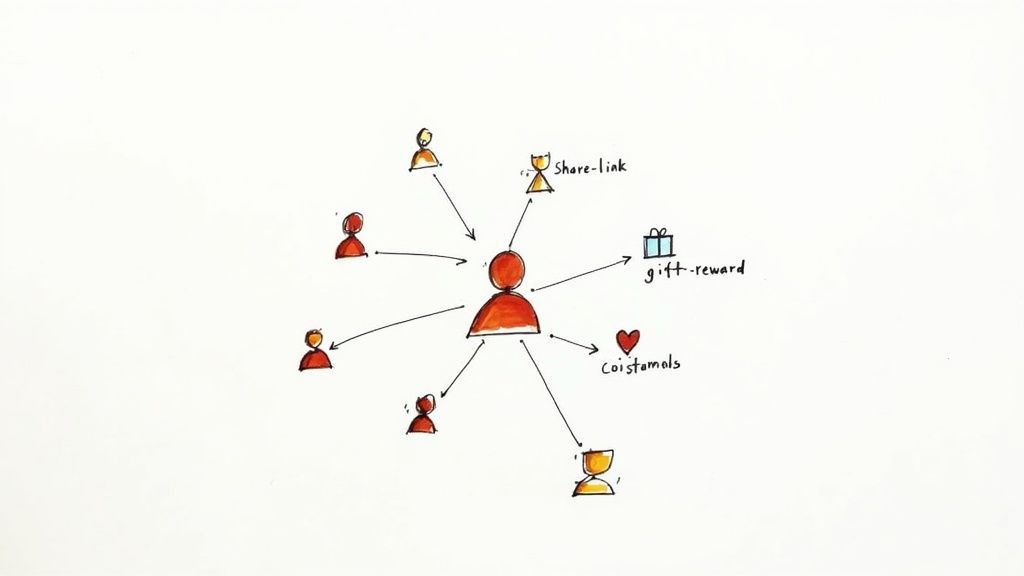
This isn't just about asking for a favor. It’s a structured, 2-4 week campaign that clearly explains the "what's in it for them" (e.g., tuition credit, gift cards) and makes sharing incredibly easy. By providing parents with the tools and motivation they need, you empower them to become your best ambassadors, making this one of the most cost-effective email drip campaign examples for sustainable growth.
Strategic Breakdown
The success of this campaign hinges on clarity, ease of use, and a compelling incentive. The messaging must feel less like a marketing blast and more like an exclusive opportunity for valued members of your community.
- Trigger: Manual send to a segmented list of currently enrolled families.
- Audience: Engaged and satisfied current parents who have a high Net Promoter Score (NPS) or have been enrolled for 2+ years.
- Goal: Generate qualified inquiries from new families referred by current families.
- Key Performance Indicators (KPIs): Referral link clicks, number of unique referrals submitted, and conversion rate from referral to application.
Key Insight: Gamification can significantly boost participation. Highlighting "top referrers" in a follow-up email or offering tiered rewards (e.g., a bigger prize for three successful referrals) creates a sense of friendly competition and encourages sustained effort.
Example Sequence: "Share Our School"
Here is a sample 4-email flow to launch a referral program:
Email 1 (Day 1): Subject: Love [School Name]? Share It and Earn!
- Content: Announce the new referral program. Clearly and concisely explain the benefits for both the referrer (e.g., a $250 tuition credit) and the new family (e.g., waived application fee). The CTA is to "Learn More & Get Your Link."
Email 2 (Day 5): Subject: Your Personal Referral Link is Ready
- Content: This email provides the parent with their unique, trackable referral link and code. It includes simple, ready-to-use text they can copy and paste into an email or text message to a friend.
Email 3 (Day 12): Subject: An Easy Way to Share [School Name] on Social
- Content: Provides pre-written social media posts and branded images perfectly sized for Facebook or Instagram. Includes direct "Share on Facebook" and "Share on Twitter" buttons to make the process frictionless.
Email 4 (Day 20): Subject: Reminder: Our Referral Bonus Ends Soon!
- Content: A friendly reminder email that creates a sense of urgency. It might highlight a testimonial from a family who recently joined through a referral and reiterate the program benefits. This email is a final nudge to participate.
8-Point Email Drip Campaign Comparison
| Campaign | Implementation complexity | Resource requirements | Expected outcomes | Ideal use cases | Key advantages |
|---|---|---|---|---|---|
| Welcome Series – New Subscriber Onboarding | Low–Medium (signup triggers, simple sequences) | 3–5 template emails, personalization tokens, basic segmentation | High open/click rates; improved deliverability and initial engagement | New subscribers; list warming | Captures peak interest; builds trust and sets expectations |
| Lead Nurture Campaign – Educational Sequence | Medium–High (multi-step journeys, advanced segmentation) | Substantial content (case studies, webinars), persona mapping, automation | Better-qualified leads; higher conversion over time; thought leadership | B2B or complex purchase journeys; mid-funnel prospects | Establishes expertise; shortens sales cycle; creates qualified pipeline |
| Cart Abandonment Recovery Campaign | Medium (real-time triggers, e‑commerce integration) | Product feed/images, checkout links, discount logic, fast send cadence | High ROI; recovers ~10–30% of abandoned carts | E‑commerce stores with frequent cart drop-offs | Recovers lost sales quickly; highly measurable and personal |
| Post-Purchase Onboarding & Customer Success Campaign | Medium–High (product-specific flows, behavioral triggers) | Setup guides, videos, support workflows, usage tracking | Higher activation (60–75% target); reduced churn (15–25%) | SaaS and products requiring activation/adoption | Improves adoption and LTV; identifies at‑risk customers early |
| Reactivation Campaign – Win-Back Sequence | Low–Medium (time-based triggers, re‑engagement offers) | Segmentation by inactivity, targeted offers, preference center | Low-to-moderate reactivation (≈2–5%); list hygiene improvements | Lapsed subscribers/customers (30–90+ days inactive) | Cost-effective re-engagement; cleans list and recovers past customers |
| Product Launch Announcement Campaign | High (timing, multi-phase sequence, cross‑channel) | Rich creative (video, demos), teaser content, VIP segmentation | Strong launch momentum; early adopters and pre-orders | New product/feature launches to warm audiences | Generates buzz and drives early adoption; converts warm leads |
| Webinar or Event Registration Follow-up Campaign | Medium (event-platform integration, timed reminders) | Confirmation, calendar invites, reminder cadence, replay assets | Increases attendance by ~15–30%; extends post-event engagement | Webinars, virtual events, conferences | Boosts live attendance; captures attendee data and repurposes content |
| Referral & Affiliate Incentive Campaign | Medium–High (tracking, rewards, dashboards) | Referral links, creative share assets, reward fulfillment, fraud controls | Higher-quality, lower-CAC leads; participation varies (10–20%) | Customer advocacy and partner-driven acquisition | Leverages trusted recommendations; scalable viral potential |
From Automation to Advocacy: Your Next Steps
We've explored a comprehensive suite of K-12-specific email drip campaign examples, from the foundational new inquiry nurture sequence to the critical re-enrollment push. Each example serves as more than just a template; it's a strategic blueprint for building stronger, more meaningful relationships with your prospective and current families at scale. The power of these automated sequences lies in their ability to deliver the right message to the right person at the right time, consistently and without manual intervention.
This frees up your team from repetitive tasks, allowing you to focus on high-impact initiatives like personal outreach, community building, and strategic planning. By automating key touchpoints, you ensure no family falls through the cracks and every interaction reinforces your school's unique value proposition.
Key Strategic Takeaways
The most effective drip campaigns are not "set it and forget it" tools. They are dynamic, living communication channels that require a strategic foundation. As you move forward, keep these core principles at the forefront:
- Segmentation is Non-Negotiable: The difference between a generic blast and a compelling nurture sequence is relevance. Segmenting your audience by grade level of interest, entry point (e.g., campus tour vs. info packet download), or engagement level is the first step toward personalization that resonates.
- The Journey is the Goal: Every email in a sequence should logically connect to the next, guiding the recipient on a purposeful journey. Map out the entire flow before writing a single word to ensure a cohesive and persuasive narrative.
- Value Precedes the Ask: Whether your goal is to secure an application, a donation, or a re-enrollment contract, your primary focus must be on providing value. Share helpful resources, offer authentic insights into your school's culture, and answer questions before they are even asked.
By internalizing these concepts, you shift your mindset from simply sending emails to architecting communication experiences. You're not just providing information; you're building trust and fostering a sense of belonging.
Your Actionable Roadmap to Implementation
Seeing these powerful email drip campaign examples is one thing; implementing them is another. The key is to avoid overwhelm and start with a single, high-impact campaign. Don't try to build all eight sequences at once.
- Identify Your Biggest Bottleneck: Where are you losing the most momentum? Is it nurturing new leads from your website? Reducing "summer melt" after enrollment? Or boosting parent participation in the annual fund?
- Choose One Campaign: Select the drip campaign from our list that directly addresses that bottleneck. The Lead Nurture or Parent Onboarding campaigns are often excellent starting points.
- Map, Write, and Build: Outline your sequence flow, draft authentic, mission-aligned copy for each email, and build the automation in your email marketing platform.
- Launch and Learn: Activate the campaign and closely monitor your KPIs. Pay attention to open rates, click-through rates, and, most importantly, the ultimate conversion goal. Use A/B testing on subject lines or calls to action to continuously optimize performance.
As you plan your next steps from automation to advocacy, consider exploring more inspiration. Reviewing a wide variety of the top email drip campaign examples can spark new ideas for segmenting audiences and crafting compelling narratives that are perfectly suited for your school's unique community and goals. By starting small and building incrementally, you will create a powerful, automated communication engine that works for you 24/7, turning initial interest into enrollment and enrollment into lifelong advocacy.
Ready to move from theory to practice with expert guidance? The MarCom Society is a professional community designed exclusively for K-12 marketing and communications leaders like you. We provide the masterclasses, resources, and peer support you need to implement sophisticated strategies like these and drive real results for your school. Join The MarCom Society to connect with peers and access the tools to elevate your impact.









