The secret to a knockout school fundraiser isn't the flashy theme or the grand prize—it’s the quiet, careful planning that happens long before anyone asks for a dime. A solid blueprint is what separates a wildly successful campaign from one that just fizzles out. This early work turns a simple request for money into a mission the whole community can get behind.
Building Your School Fundraising Blueprint

Before you even dream of fun runs or bake sales, you need to lay the groundwork. The real magic happens when you get everyone on the same page, from the principal to the most energetic parent volunteers. It’s all about creating a unified vision that makes people want to contribute.
This is more important than ever. With school budgets stretched thin, fundraising is no longer a "nice-to-have"—it's often a critical bridge between tuition and the actual cost of running the school. A thoughtful plan ensures every ounce of effort goes toward what matters most.
Pinpoint Your Exact Needs
First things first: what do you actually need the money for? "More money" isn't a goal; it's a wish. You have to get specific.
Are you trying to fund:
- A new set of tablets for the third-grade classrooms?
- Updated microscopes for the high school science lab?
- A scholarship fund to help more families afford tuition?
- A complete overhaul of the worn-out playground?
A tangible target is infinitely more motivating. Think about it. “Help us raise $15,000 for new library books” has a much bigger impact than a vague “fundraiser for the library.” Donors want to picture exactly where their money is going.
Set Achievable Financial Goals
Once you know what you're funding, you can figure out how much you need. The trick is to set a goal that's ambitious but still feels within reach. Aiming for the moon can be exciting, but an intimidating number can scare people off before you even begin.
A great tactic is to break it down. If the big number is $10,000, what does that mean per student? Or per family? Suddenly, the goal feels much more personal and manageable. It shows everyone that their contribution, no matter the size, is a crucial piece of the puzzle.
I've seen it time and again: it’s far better to smash a $5,000 goal and build incredible momentum than it is to fall short of an overly ambitious $20,000 target. Morale is your most valuable currency here.
Align Your Key Stakeholders
A school fundraiser is a team sport, period. You need to get your key players—the school administration, the PTA/PTO board, teacher reps, and those well-connected parent volunteers—in the same room and on the same team.
Host a kickoff meeting to walk them through your needs and the proposed financial goal. This is where you build your core committee and start handing out roles. When the leadership is genuinely excited, that energy is contagious. Fostering these collaborative efforts is essential, and you can learn more about how to strengthen these connections by exploring effective partnerships in schools. Getting everyone aligned ensures you're all telling the same powerful story to the entire school community.
Choosing the Right Fundraiser for Your Community
With your goals locked in and your team on the same page, it's time to tackle the fun part: picking the actual fundraiser. This is where the magic happens, but it’s also where many schools stumble. What works wonders for one community might completely flop in another.
The secret isn’t about chasing the flashiest trend. It's about finding the right fit for your families, their capacity, and their interests. A high-energy carnival might be a home run for an elementary school with a huge campus and an army of parent volunteers. But for a high school full of busy, dual-income families, a streamlined online giving day could be a much smarter play.
Get a Real Feel for Your Community’s Capacity
Before you even think about themes or product catalogs, you have to get honest about what your community can realistically handle. This means taking a hard look at volunteer availability, family schedules, and financial comfort levels. I’ve seen countless well-intentioned fundraisers fall flat because this crucial step was skipped, leading to burnt-out volunteers and disappointing results.
Ask yourself these questions:
- Time: Do your parents have the bandwidth for a multi-day event, or is a simple, one-time donation far more likely to get traction?
- Money: Will your community respond better to a product sale where they get something in return, or are they ready for a direct donation campaign?
- Talent: Do you have parents who are event planning whizzes, graphic design pros, or social media gurus? Tap into the skills you already have in your community.
Answering these helps you immediately filter out ideas that sound amazing in a brainstorming session but just aren't practical for your school. For a little inspiration, check out these creative https://blog.marcomsociety.org/school-fundraising-ideas/ that can help you find a perfect match for your school's unique vibe.
Product Sales vs. Event-Based Fundraisers
It’s the classic school fundraising dilemma: sell stuff or host an event? Both have their pros and cons, and there’s no single right answer. Product sales—think wrapping paper, cookie dough, or popcorn—give people a tangible item for their money. The downside? They often come with lower profit margins and a ton of logistical work, from chasing down order forms to coordinating distribution days.
On the other hand, event-based fundraisers are fantastic for building school spirit and can bring in some serious cash. Think fun runs, auctions, or carnivals. The catch is they require a much bigger commitment from your volunteer team. If you're leaning toward a larger event, looking at top fundraising gala ideas can spark some great ways to make a big impression.
The sweet spot is always at the intersection of effort and return. A simple Read-a-Thon, for example, requires way less volunteer muscle than a full-blown auction but can bring in a shocking amount of money by empowering students to tap into their own family and friend networks.
This chart breaks down a few common school fundraising activities, showing how the complexity and effort can lead to very different outcomes.
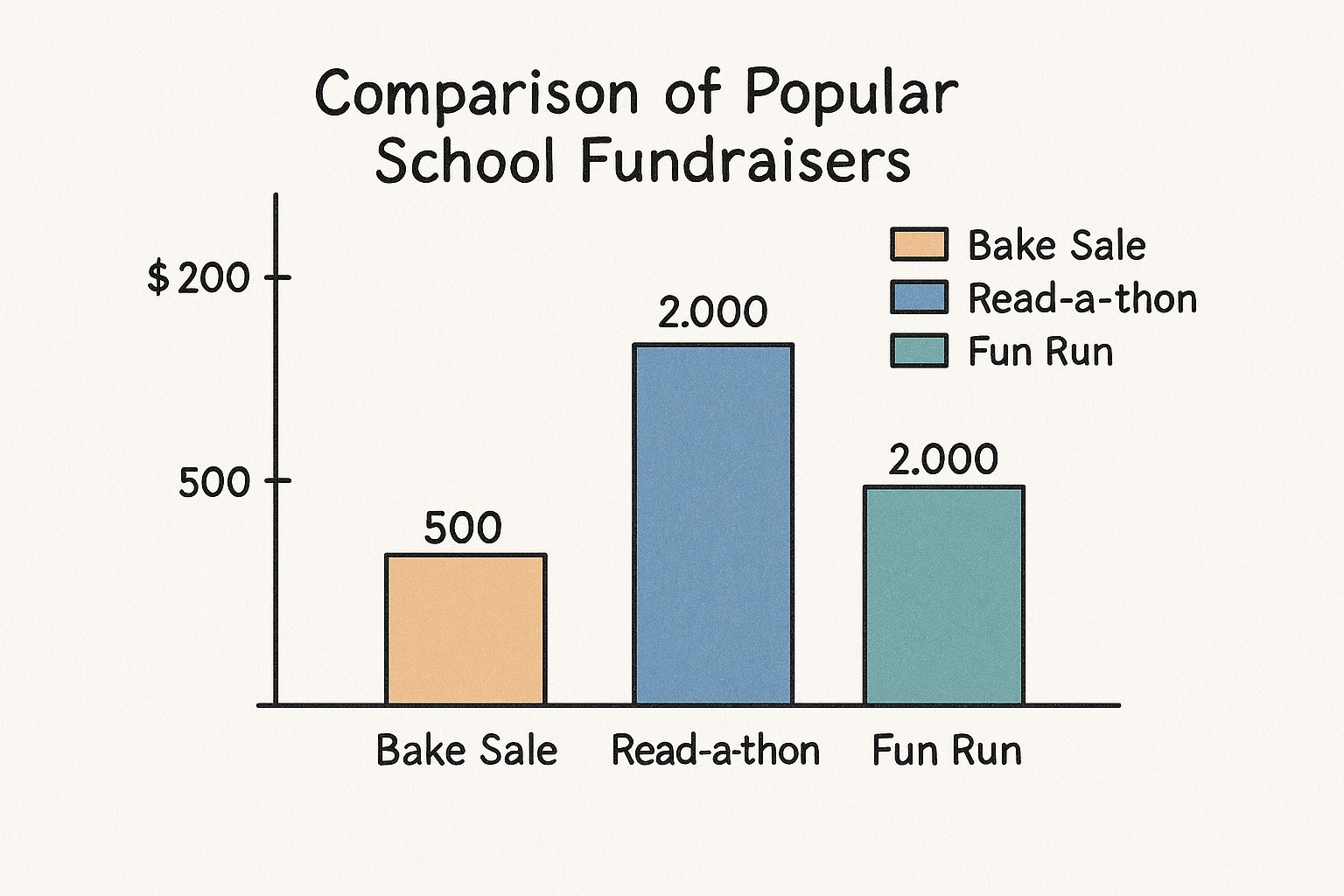
As you can see, while everyone loves a bake sale, fundraisers that can easily scale participation, like a school-wide fun run, almost always deliver a much bigger financial punch.
To help you weigh your options, here’s a quick comparison of some popular campaign models.
Comparing School Fundraising Campaign Types
This table breaks down the most common types of school fundraisers, evaluating them on key factors like potential return, volunteer lift, and upfront costs. Use it to find a campaign that aligns with your school's resources and goals.
| Campaign Type | Potential ROI | Volunteer Effort | Upfront Cost | Best For |
|---|---|---|---|---|
| Product Sales (Cookie Dough, etc.) | Low-Medium | Medium | Low | Schools wanting a tangible "give-get" exchange. |
| A-Thons (Read-a-Thon, Fun Run) | High | Medium | Low-Medium | Engaging students directly and building school spirit. |
| Online Auction | Medium-High | Medium | Low | Communities comfortable with digital platforms. |
| Giving Day/Crowdfunding | High | Low | Very Low | Schools with a specific, compelling project to fund. |
| Gala/Large Event | Very High | Very High | High | Schools with a strong volunteer base and donor network. |
Ultimately, the best choice depends on your specific context. An "a-thon" offers fantastic returns with manageable effort, while a direct crowdfunding campaign is hard to beat for its efficiency and low upfront cost.
Don't Overlook Digital and Hybrid Models
These days, you're no longer stuck with just flyers and in-person events. Digital fundraising tools have changed the game, offering a more efficient and less labor-intensive way to raise money. These campaigns are especially great for reaching beyond your immediate parent community to connect with grandparents, alumni, and friends who live out of town.
Here are a few modern approaches to consider:
- Online Auctions: Bidding platforms make it simple to auction off donated items without needing a big venue or a fancy dinner. This makes it super easy for busy families to participate from their couch.
- Crowdfunding Campaigns: This is basically a direct donation drive with better storytelling. You create a dedicated webpage to share your goal—like new playground equipment—and collect funds directly.
- Giving Days: This is a high-energy, 24-hour fundraising blitz. By creating a sense of urgency, schools can rally incredible support and often secure matching gifts from local businesses to double their impact.
The most successful campaigns I see now often use a hybrid model. Imagine hosting an in-person fun run but using an online platform to collect all the pledges. This approach gives you the best of both worlds: the community-building excitement of a live event combined with the sheer convenience of digital tools. It's a win-win for everyone involved.
Getting the Word Out: Your Communication and Marketing Plan

So, you've got a fantastic fundraiser with a crystal-clear goal. That's a powerful engine, but it won’t go anywhere without fuel. Your communication plan is that fuel. It’s what transforms a simple announcement into genuine excitement and a shared sense of purpose across your entire school community.
Let's move past the old "flyer-in-the-backpack" method that we all know gets lost. Today, successful fundraising at schools relies on a smart, multi-channel approach that tells a story people want to be a part of. This isn’t just about asking for money; it’s about inviting every family to join a success story.
Your job is to make a number—say, $15,000—feel real and tangible. It’s the difference between saying "we need money" and painting a picture of "students discovering a love for science with brand new lab equipment." That’s the kind of story that gets people to act.
Find Your "Why" and Tell a Great Story
Before you type a single word for an email or social media post, you need to find the heart of your campaign. What’s the story you're telling? It’s not about the event itself; it’s about the students who will benefit, the teachers who will feel more supported, and the community that will become stronger because of it.
A really powerful story has three parts:
- The Problem: Get straight to the point. "Our library's book collection hasn't been updated in over a decade, leaving our kids with worn-out, outdated resources."
- The Solution: Position your fundraiser as the answer. "This read-a-thon will raise enough money to purchase 500 brand-new books, filling our shelves with exciting modern stories and up-to-date nonfiction."
- The Impact: Show donors exactly what their support achieves. "Your donation means a kindergartener can discover a new favorite character, and a fifth-grader can find the research they need for their history project."
This simple story becomes your guidepost for everything—from newsletters to Facebook posts. It keeps your message consistent, memorable, and full of heart.
Here's a classic mistake I see all the time: focusing on the 'what' (a fun run) instead of the 'why' (funding a new, safer playground). People don't donate to events; they donate to causes. They give to make a difference. Make your 'why' impossible for them to ignore.
Use the Channels You Already Have
You don't need a huge marketing budget to get the word out. The most effective campaigns I've been a part of lean heavily on the communication channels the school already has. The secret is making them all work together.
The idea is to create a "surround-sound" effect where families hear about the fundraiser from several different places. This constant, gentle exposure builds familiarity and underscores how important the campaign is to the school.
Your School's Communication Toolkit
| Channel | Best For | Pro Tip |
|---|---|---|
| School Newsletter | Going into detail, sharing the full story, and providing important links. | Don't bury it! Give your fundraiser a dedicated, high-visibility spot in every issue leading up to and during the campaign. |
| Social Media | Quick updates, behind-the-scenes photos, student videos, and progress bars. | Visuals are everything here. A short video of students talking about why they're excited is a thousand times better than a block of text. |
| School Website | Creating a central "fundraising hub" with all the info, FAQs, and a direct donation link. | Make it ridiculously easy to find. Put a banner on the homepage that links right to your campaign page. |
| Email Blasts | Sending targeted reminders, celebrating when you hit a milestone, and making urgent calls to action. | Segment your email lists. You can send a slightly different message to families who've already donated versus those who haven't. |
When you use these tools in harmony, you create a professional, cohesive strategy that keeps your fundraiser top-of-mind without feeling overwhelming.
Build Momentum with a Simple Timeline
Your communication shouldn't be a one-time event. Think of it as a steady drumbeat that starts soft and builds to a powerful crescendo. A simple timeline keeps you organized and ensures you're sending the right message at the right time.
Here's a basic playbook for a month-long fundraiser:
- Two Weeks Before Launch: Start dropping hints in the newsletter and on social media. Build a little mystery with posts like, "Something exciting is coming to help our arts program!"
- Launch Week: This is when you go big. Announce the fundraiser everywhere with your full story, clear goals, and easy-to-find links. A kick-off video from the principal or a beloved teacher works wonders.
- During the Campaign: Post weekly progress updates. Celebrate milestones—"We're halfway to our goal!"—and share photos or quotes from students. This keeps the energy and motivation high.
- The Final Push: In the last week, create a sense of urgency. Use countdowns ("Only 3 days left to contribute!") and remind everyone what reaching the goal will mean for the students.
- After the Campaign: Don't stop when the money is in! Immediately send a huge, school-wide "thank you" message celebrating the community's success. A few weeks later, follow up with a report showing exactly how the funds are being used. This last step is critical—it builds trust and makes people eager to help again next time.
Getting It Done: Running Your Campaign and Rallying Your Team
Alright, you’ve got your story, your goal is set, and your communication plan is ready to go. Now for the fun part: making it all happen. This is where all that careful planning gets put into action. Whether you're running a week-long online giving campaign or a massive in-person bake sale, how you execute the event is what separates a good fundraiser from a great one.
And let’s be honest, the real engine behind any successful school fundraiser is your people. Your volunteers—the parents, teachers, and community members who show up—are your single greatest asset. Managing them effectively isn't just about handing out a to-do list; it's about creating a team that feels connected to the cause and proud of their work.
Finding and Firing Up Your Volunteers
First things first, you need to build your crew. Think beyond just sending a generic email asking for "help." Get specific. People are much more likely to volunteer when they know exactly what you need from them.
Instead of a vague plea, try outlining the different jobs you need filled. Not everyone is comfortable asking for money, but you might have a parent who’s a graphic design whiz, another who can organize a spreadsheet in their sleep, or someone who just loves to greet people with a warm smile.
Break the big job down into smaller, bite-sized roles. This makes it far less intimidating. For example, instead of "we need help with the silent auction," try this:
- Donation Crew: A small team to reach out to local businesses for auction items.
- Setup Team: The hands-on folks who can set up tables and decorations the morning of the event.
- Welcome Committee: A few friendly faces to manage check-in and greet guests as they arrive.
- Clean-Up Squad: The absolute heroes who stick around to make sure the space is left better than you found it.
When someone can sign up for a specific task with a clear time commitment, they feel respected and are more likely to jump in. It lets them play to their strengths and contribute in a meaningful way.
The Art of Delegation (Without the Stress)
Once you have your team, the real magic is in letting them do their jobs. I’ve seen it a hundred times: one or two dedicated committee chairs try to do everything themselves and end up completely burned out. Don't fall into that trap. The key to good delegation is trust and clear communication.
A simple shared document, like a Google Sheet, can be a game-changer. Create one with all the major tasks, who’s in charge of what, and when it’s due. This creates a central source of truth, so everyone knows their role and how it fits into the bigger picture. Then, schedule short, regular check-ins—a quick 15-minute Zoom call once a week is often plenty—to tackle any issues and keep everyone motivated.
A well-managed volunteer team is a happy team. When people feel their time is being used effectively and their contribution is valued, they not only do a better job but are also eager to sign up again for the next fundraiser.
Simple Tools for a Smooth-Running Campaign
You don't need a high-tech, expensive command center to run a successful fundraiser. In fact, sometimes the simplest tools are the best because they're easy for everyone to pick up and use. The goal is to make things easy for your team and your donors.
Here are a few essentials I wouldn't run a campaign without:
- An Online Payment System: This is non-negotiable. Making it easy for people to donate with a credit card will dramatically boost your results. There are tons of platforms out there built just for schools that can handle everything from selling event tickets to accepting straight donations.
- Shared Calendars: Use a shared digital calendar to coordinate volunteer shifts, meeting times, and important deadlines. It’s a simple way to avoid any "oops, I forgot" moments.
- A Group Chat App: Something like WhatsApp or GroupMe is perfect for sending quick updates, last-minute reminders, and words of encouragement to your volunteer team on the go.
By keeping your operational toolkit straightforward, you cut down on chaos and create a more organized, positive experience for everyone. This lets you keep all that amazing campaign energy focused on hitting your goal, not on putting out logistical fires.
Celebrating Success and Nurturing Donors for Life

The last donation has been tallied and the volunteers have all gone home. It’s tempting to breathe a sigh of relief and consider the job done, but what you do next is what separates a good fundraiser from a great one. This is your chance to turn one-time donors into a community of lifelong supporters who feel a real connection to your school.
Think of this phase less as a wrap-up and more as the beginning of your next campaign. It’s all about cementing trust and proving to your community that their contribution made a real difference. Get this right, and everything that comes next gets easier.
Define What Success Really Means
Before you fire off a single "thank you," take a step back and look at the bigger picture. Hitting your financial target is obviously a huge win, but it's not the only story to tell.
A much clearer picture of your success emerges when you track a few other key numbers:
- Donor Participation: How many different families or individuals chipped in? An increase in the number of donors is a fantastic sign of growing community engagement, even if the total amount raised is the same as last year.
- New Donor Acquisition: What percentage of your donors were first-timers? This is a vital sign that your message is reaching new people and your base of support is expanding.
- Average Gift Size: Did the average donation go up? This can be a great indicator of growing confidence and belief in what your school is doing.
Looking at your campaign through this lens gives you a richer, more powerful story. It's a story about a community rallying together, not just a number on a spreadsheet.
The Art of a Meaningful Thank You
Let’s be clear: a generic, automated email receipt is not a thank you. A real thank you makes your donors feel seen, valued, and absolutely essential to the school’s mission. So many schools miss this crucial opportunity to build a connection.
You don't have to overcomplicate it. A few thoughtful touches go a long way:
- Segment Your Thank Yous: Don't send the same message to everyone. A first-time donor should get a different note than a major contributor or a parent who volunteered for 20 hours. Acknowledging their specific role makes the gratitude feel personal.
- Get Students Involved: Nothing hits home like a short thank-you video from the kids. Seeing them talk about the new library books or playground equipment directly connects the donation to the impact in a way words alone can't.
- Shout It from the Rooftops: Post a huge public thank you on social media, feature it in the school newsletter, and maybe even hang a banner out front. Gratitude should be loud and proud.
The goal of a thank you is to make a donor feel so good about their decision that they can’t wait to support your school again. It's the first step in building a long-term relationship, not the end of a transaction.
Digging deeper into how to thank donors and build lasting relationships is time well spent for any fundraising team.
Show Them the Impact
This part is non-negotiable. A few weeks or months after the campaign, you absolutely must report back to your community and show them exactly how their money was put to work. This transparency is what turns a skeptical parent into your most passionate advocate.
You don't need a glossy annual report. A simple one-page PDF or a section in the newsletter works perfectly. Create a quick "Impact Report" with photos of the new equipment in use, a quote from a grateful teacher, and a final, simple breakdown of the funds. You're showing your donors you did exactly what you promised. This is also a fantastic way of connecting with alumni and reminding them of the tangible good their support does.
The reality is that school fundraising results are all over the map. One recent survey showed that 35% of schools raise between $0 and $5,000 annually, while another 27.1% pull in over $75,000. Clear, consistent impact reporting is one of the best ways to build the donor confidence needed to grow your campaigns. When people see their money at work, they become far more invested in your school's future.
Your School Fundraising Questions Answered
Even the most buttoned-up plan hits a few bumps. It’s just the nature of school fundraising. Questions pop up, unexpected challenges arise, and that’s perfectly normal. This is where we tackle the common hurdles I see school leaders and parent volunteers face year after year.
Think of this as your practical guide for navigating the tricky spots. Getting clear on these issues helps you stay focused on what really matters—your students and your school. After all, successful fundraising is often about solving small problems before they become big ones.
How Can We Boost Parent and Student Involvement?
Getting more people to participate is the age-old question, isn't it? The secret is to stop thinking about it as just asking for money and start treating it like a community mission.
First, you have to be relentless in communicating the "why." Don't just say you need funds for the library. Show them. Post pictures of the worn-out books and empty shelves. Share a quick video of students talking about what a new reading corner or updated tech would mean to them. Make the need real and personal.
Next, inject some fun and friendly competition into the mix. A little rivalry goes a long way.
- Friendly Class Competitions: Offer a pizza party or the chance for the winning class to have a silly string fight with the principal. It’s amazing what kids (and teachers!) will do for bragging rights.
- Let Students Lead: Give students ownership. A "Read-a-Thon" where they collect pledges makes them active participants, not just messengers carrying a flyer home. They get to see their own effort translate into results.
- Make It Insanely Easy: Your online donation platform has to be simple. Parents are juggling a million things. If giving takes more than three clicks, you’ve already lost most of them.
And finally, celebrate everyone. Publicly thank the volunteers who folded flyers and the families who shared the campaign on Facebook, not just the top donors. An inclusive approach makes every single person feel like they were a crucial part of the success.
What Are the Best Low-Cost, High-Profit Ideas?
Ah, the holy grail of fundraising: maximizing your return while keeping costs near zero. This is all about picking campaigns that run on community spirit and creativity, not expensive products or fancy events.
The most profitable ideas almost always involve direct giving or sponsored activities.
- A "Giving Day" Drive: This is pure, nearly 100% profit. You set up a simple campaign page on a low-cost platform and promote a 24-hour giving blitz. The urgency pushes people to act right away.
- Sponsored "A-Thons": A walk-a-thon, read-a-thon, or even a dance-a-thon gets students directly involved. They gather pledges from family and friends for doing something fun and healthy. The school’s cost to organize it? Practically nothing.
- Print-on-Demand Spirit Wear: Worried about getting stuck with boxes of unsold t-shirts? Partner with a print-on-demand service. You create the designs, and items are only printed after an order is placed. This completely eliminates inventory risk and upfront costs.
These models are so effective because they sidestep the logistical nightmares and razor-thin margins of traditional product sales.
I see so many schools get stuck in the product sales trap because it feels "easy." But once you factor in the volunteer hours spent sorting order forms and distributing frozen cookie dough, the real profit is often tiny. A well-run online giving day can raise more in 24 hours with a fraction of the human effort.
What Legal and Tax Rules Should We Know?
Navigating the legal stuff is non-negotiable. It protects your organization's good standing and, just as importantly, your donors' trust. While rules can vary by state, a few key principles apply to almost every school fundraiser in the U.S.
First, know your status. If your PTO/PTA is a registered 501(c)(3) nonprofit, donations are generally tax-deductible for the donor. That’s a huge incentive. You are responsible for providing a receipt for all contributions, and the IRS requires one for any single donation over $250.
But it gets a little murky when a donor gets something in return. This is what’s known as a quid pro quo contribution.
- The Dinner Ticket Test: If a ticket to your gala costs $100, but the actual meal is worth $40, only the remaining $60 is tax-deductible. You have to make that clear on the receipt.
- Be Careful with Raffles: This is a big one. Many states consider raffles a form of gambling and have strict regulations or licensing requirements. Always check your state and local laws before even thinking about planning a raffle.
Meticulous record-keeping isn't just a good idea; it's a must. If you have any doubt, especially with larger campaigns, spending a little money to consult an accountant or lawyer who specializes in nonprofits is one of the smartest investments you can make.
At The MarCom Society, we help K-12 marketing and communications professionals tackle challenges just like these every day. We provide the expert guidance, practical resources, and supportive community you need to build incredible fundraising and communication strategies. Learn more and become a member of our network.