
Building an email list isn't just a marketing task; it's about forging a direct, dependable connection with your community. The whole process hinges on offering something genuinely valuable in return for an email address, then consistently nurturing that relationship. The biggest difference from social media? You own this audience, and you don't have to battle algorithms to reach them.
Why Your Email List Is Your Most Valuable Asset
Before we get into the nitty-gritty of how to build your list, we have to talk about why it's so critical. We all spend time on social media, and it’s a great tool, but think of it as rented land. A sudden algorithm shift or a platform fading in popularity can wipe out the connection you’ve worked so hard to build.
Your email list, on the other hand, is an asset you completely control. It’s a stable, reliable foundation for your school’s entire marketing strategy.
This gives you a direct line to prospective parents, current families, and alumni—allowing for a level of personal connection that social media just can't replicate. It's not just for blasting announcements; it's for building real, lasting relationships.
The Power of a Direct Connection
Think of your email list as a predictable engine for enrollment and community engagement. When you need to promote a new summer camp, get the word out about an open house, or launch a fundraising drive, this is the group that will be most receptive.
It really comes down to a few key advantages:
- Insulation from Volatility: You're no longer at the mercy of social media platforms that can slash your organic reach overnight.
- Deeper Personalization: You can easily segment your audience—think prospective parents, current families, alumni—and send them content that actually matters to them.
- Higher Engagement Rates: Email almost always drives more action than a social media post. People are simply in a more focused mindset when they're in their inbox versus endlessly scrolling a feed.
- Reliable ROI: Email marketing consistently delivers one of the highest returns on investment. When you manage this asset well, you can clearly see what’s working, a topic we cover in our guide on how to measure marketing ROI.
Let's quickly compare where your energy is best spent.
Email List Growth vs Social Media Followers
| Attribute | Email List | Social Media Followers |
|---|---|---|
| Ownership | You own the list directly. | You're "renting" access from the platform. |
| Reach | High deliverability to your entire list. | Reach is limited by unpredictable algorithms. |
| Personalization | Easy to segment and send tailored messages. | Limited personalization options. |
| Engagement | Higher click-through and conversion rates. | Lower, often passive "likes" and shares. |
| Relationship | Fosters a direct, one-to-one connection. | Creates a broad, one-to-many broadcast. |
Building an email list puts you in the driver's seat, allowing you to nurture relationships on your own terms.
Audience Ownership in a Crowded Digital Space
The digital world is incredibly noisy. By 2025, the number of email users worldwide is expected to hit 4.6 billion, with more than 347 billion emails flying around every single day. Just having an email list isn't enough; you have to earn your place in the inbox.
This is where smart tactics like segmentation come in. It’s been shown that segmented campaigns can generate 30% more opens and 50% more click-throughs simply because they deliver relevant, targeted value. If you're interested in the data behind this, MailMunch has a great breakdown on email list growth statistics.
Owning your email list means you're building a community, not just collecting followers. It’s a dedicated group of people who have explicitly raised their hand and said, "Yes, I want to hear from you." That's a powerful position to be in.
Ultimately, learning how to build an email list is a direct investment in your school's long-term stability and growth. It’s the most dependable way to guide prospective families, foster loyalty, and ensure your message lands with the people who matter most, every single time.
Choosing Your Email Marketing Platform
Picking your email service provider (ESP) is one of those foundational decisions that sets the stage for everything else. This isn't just a piece of software; it's the engine behind every email you send, every subscriber you welcome, and every bit of data you analyze. Get this right from the start, and you'll save yourself from logistical headaches down the road, like painful platform migrations or hitting unexpected feature walls.
Think of it less like buying a subscription and more like hiring a critical team member. You need a reliable partner that fits your school's budget, your team's tech-savviness, and your long-term goals. A small independent school with a one-person marketing team has completely different needs than a large district with a dedicated communications department.
Core Features That Actually Matter
When you start looking at different platforms, it's easy to get lost in a sea of features. A lot of them are just noise. Let's cut through the clutter and focus on the non-negotiables that will actually make a difference for your school.
Here’s what you should be looking for:
- Ease of Use: How intuitive is this thing, really? You shouldn't need a computer science degree to build a newsletter or set up a sign-up form. A good drag-and-drop editor and a clean interface are your best friends here.
- Segmentation and Tagging: This is where the magic happens. The ability to "tag" subscribers based on their interests (like “Interested in Lower School” or “Alumni Donor”) or segment them by actions (like clicking an open house link) is what lets you send content that truly connects.
- Automation Capabilities: This is your time-saver. A solid ESP lets you create automated "welcome" sequences for new families or trigger specific emails based on what people do. It ensures every new contact gets a consistent, warm welcome without you lifting a finger.
- Reliable Analytics: You have to know what's working. Your platform must give you clear, easy-to-read reports on key metrics like open rates, click-through rates, and unsubscribe rates. This data is your roadmap for getting better.
Your email platform isn't just a mail-merge tool; it's a strategic asset for understanding your audience. The right analytics will show you exactly what content resonates with prospective parents versus what engages your current community, helping you sharpen your message for maximum impact.
Matching the Platform to Your School's Needs
There is no single "best" platform. The right choice is all about your specific context. A tool celebrated for its complex e-commerce features is probably overkill—and needlessly expensive—for a school focused on community newsletters.
For instance, a solo marketer at a small private school might find a platform like MailerLite or FloDesk to be a perfect fit. They offer beautiful interfaces, solid automation basics, and budget-friendly pricing, making it easy to get up and running quickly.
On the other hand, a larger school district juggling communications across multiple campuses will likely need the more muscular features of a platform like ActiveCampaign or HubSpot. These tools offer advanced CRM functions, sophisticated automation workflows, and the kind of deep analytics needed to manage a more complex strategy.
This comparison from Wikipedia gives you a sense of the vast differences in features and pricing across popular services.

As you can see, things like automation, landing pages, and A/B testing vary wildly, which directly affects what you can accomplish and how much you'll end up paying.
Scalability and Budget Considerations
Finally, think about where you want your school to be in two or three years. Your immediate goal might be getting your first 1,000 subscribers, but what happens when you hit 5,000? A platform that seems like a bargain today can become a major budget-buster as your list grows.
Before you commit, dig into the pricing tiers. Most platforms charge based on subscriber count or the number of emails you send each month. Make sure the plan you choose not only meets your needs now but also offers a clear, affordable path forward. Trust me, switching your ESP is a massive hassle—a thoughtful, forward-looking decision today will save you countless hours down the line.
Creating Lead Magnets People Actually Want

Let's be honest, people guard their inboxes. An email address has become personal currency, and a vague promise of "school updates" just isn't going to convince someone to hand it over. To get people to join your list, you need to offer a clear, immediate, and valuable exchange.
This is where your lead magnet comes in. It’s a fantastic, free resource you give away in return for that coveted email address. The real goal isn't just collecting contacts; it's about giving a genuine solution to a problem your ideal parent or family is wrestling with right now. When you get this right, signing up feels like a no-brainer.
Moving Beyond the Generic PDF
We've all seen them—the uninspired, five-page PDF that just rehashes information anyone could find with a quick Google search. That’s not going to cut it anymore. Your lead magnet has to be so genuinely useful that your audience would have considered paying for it.
It needs to solve a real-world problem for a specific group of people. Think about it: a family looking at your elementary school has a completely different set of questions than an alumnus you hope will donate. Your lead magnet has to show you understand that difference.
Focus on giving them a quick, tangible win. What can you provide that will make their life easier today?
High-Impact Lead Magnet Ideas for Schools
Let’s get practical. Here are some ideas designed specifically for the K-12 world that address real-life pain points for parents and prospective families.
Checklists: People love checklists. They’re simple, scannable, and help bring order to a chaotic process.
- Example: "The Ultimate School Visit Checklist: 25 Must-Ask Questions for Your Tour." This is a lifesaver for prospective parents trying to make an informed choice.
Templates: A good template saves people time and mental energy by providing a ready-made framework.
- Example: "Printable After-School Activity Planner for Busy Parents." This offers instant value to your current families and shows you understand their daily juggle.
Resource Guides: You can become an invaluable resource by curating overwhelming information into one neat, convenient package.
- Example: "A Parent's Guide to Local Tutors & Academic Support Services." This positions your school as a helpful, connected hub of the community.
Your best lead magnet is born from your audience's biggest question. If you constantly get asked about the application process, create a "Step-by-Step Application Timeline" guide. If parents worry about the transition to middle school, offer an "Expert Tips for a Smooth Transition" e-book.
Tying Value Directly to Your Goals
Creating a killer lead magnet isn't just about giving away free stuff—it’s a powerful strategic move. The numbers back this up. In 2025, email marketing is projected to deliver an average ROI of $42 for every $1 spent. It's an incredibly efficient way to drive real results, and it all starts with a compelling offer that gets the right people on your list. You can dig into more of these powerful email marketing statistics on Inboxally.
The trick is to create lead magnets that attract your ideal subscriber. A guide to your school’s championship-winning athletics program will naturally draw in families who care about sports. You can then tag them in your system and send them much more relevant, personalized communication down the road.
How to Pinpoint the Perfect Lead Magnet Topic
So, where do these irresistible ideas come from? You listen. The best topics are usually hiding in plain sight, embedded in the questions you’re already answering every day.
Here's a simple process to find your next great idea:
- Talk to Your Admissions Team: Ask them for the top three questions they hear on every single tour and phone call. Those recurring questions are pure gold.
- Dig Into Your Website Analytics: Which blog posts or pages get the most traffic? That's your audience telling you exactly what they want to know more about. Create a lead magnet that takes a deeper dive into that popular topic.
- Survey Your Current Parents: Send a quick poll asking what they wish they had known before they enrolled their child. Their hindsight is your marketing foresight.
Once you have a great resource, like a comprehensive guide, don't just let it live on one page. Think about all the ways you can repackage that value. Exploring different content repurposing strategies can turn a single great idea into several lead magnets—that guide can become a checklist, a short video series, or an infographic.
When you focus on providing genuine value, your lead magnet becomes more than a bribe for an email. It becomes the very first helpful, positive interaction someone has with your school, setting the perfect stage for a strong relationship.
Designing Opt-In Forms That Convert
So, you've created a fantastic lead magnet. That's a huge win, but even the most valuable resource is worthless if prospective parents never see it. This brings us to the gateways that capture those leads: your opt-in forms.
Think of these forms as the digital handshakes that invite families into your school's community. They need to be welcoming, clear, and incredibly easy to use. A clunky or poorly placed form can do more harm than good—it can frustrate visitors and make your school look out of touch. Our goal is to make signing up feel like the most natural next step for anyone interested in your school.
Where to Place Your Forms for Maximum Impact
Strategic placement is everything. You need to put your forms where people are most engaged, right at the moment they're thinking, "This is great information." It's not about randomly plastering them everywhere; it's about being thoughtful.
Here are the spots that consistently work best for schools:
- Within Relevant Blog Posts: If you have an article on "5 Ways to Prepare Your Child for Middle School," embedding a form that offers your "Middle School Transition Checklist" is a no-brainer. The offer is perfectly matched to their immediate interest.
- The Website Header or Navigation Bar: A slim, sticky bar at the top of your site is a great way to keep your general newsletter offer front and center. It follows the user from page to page without being obnoxious.
- Pop-up Forms (When Used Wisely): I know, I know—pop-ups can be annoying. But exit-intent pop-ups are a different beast. They only appear when a user's cursor moves toward the "back" or "close" button, giving you one last chance to connect. This tactic is surprisingly effective because it doesn't interrupt their browsing.
- Your "About Us" Page: Don't overlook this one. The parents landing on your mission or history page are often your most invested prospects. A well-placed form here is a smart move.
Don't just pick one spot and call it a day. A multi-form strategy is key. I've found that a combination of an embedded form in blog posts, a simple footer sign-up, and a tasteful exit-intent pop-up creates multiple, non-intrusive opportunities for connection.
The Anatomy of a High-Converting Form
When it comes to form design, simplicity always wins. Every single element—the headline, the text, the button—should serve one purpose: convincing the visitor to sign up. Anything else is just noise that will tank your conversion rate.
Here are the only ingredients you really need:
- A Compelling Headline: Ditch "Subscribe to Our Newsletter." It’s boring. Focus on the benefit. Something like, "Get Expert Tips for Your Child's Academic Success" is far more motivating.
- Benefit-Driven Copy: Use a quick sentence or a few bullet points to spell out exactly what's in it for them. For example, "Join our list for weekly college-prep resources and key application deadline reminders." They instantly know the value.
- A Crystal-Clear Call-to-Action (CTA): The button text matters more than you think. Instead of the generic "Submit," use active language that reinforces what they're getting. Try "Download My Free Guide" or "Send Me the Checklist!"
The Psychology of Asking for Less
One of the biggest mistakes I see schools make is asking for a mountain of information upfront. Every extra field you add to a form creates friction. It gives a busy parent another reason to abandon the process. Ask yourself: Do you really need their phone number, child's current grade, and zip code right this second?
Probably not.
For that initial sign-up, stick to the absolute essentials: a first name and an email address. That's it. This one small change can dramatically boost your conversion rates. You can always gather more details later on as you build a relationship with them.
The logic here is backed by user behavior. With 92% of online adults using email and 61% checking it daily, the inbox is a trusted space. In fact, many people check their email constantly throughout the day. You can dig into more of these email engagement statistics from OptinMonster. By making your form as frictionless as possible, you respect their time and make it incredibly easy for them to say "yes."
Driving Traffic to Your Opt-In Offers
You’ve created a fantastic lead magnet and a polished opt-in form. That’s a huge win. But if you stop there, it's like setting up a beautiful storefront on a deserted street. To build your email list, you need to become a skilled traffic director, guiding prospective families right to your sign-up offers.
This isn't a one-and-done task. You have to actively and consistently steer qualified traffic toward your forms. The great news? This doesn't require a massive budget. The real goal is to create reliable streams of interested families, leading to steady, organic list growth over time.
Attract Parents with SEO-Optimized Content
One of the most effective, long-term ways to get eyes on your offers is through search engine optimization (SEO). Put yourself in your ideal parents' shoes. What are they typing into Google? They're searching for things like "best private schools in [your city]" or "how to prepare a child for kindergarten."
Your job is to build a library of blog posts that answer those exact questions. When a parent discovers your helpful article through a search, you've instantly built trust. This is the perfect moment to present your lead magnet. For instance, a post about kindergarten readiness is the ideal place to offer your "Kindergarten Readiness Checklist." It feels like a natural, helpful next step, not a jarring sales pitch.
Supercharge Your Best Content with Upgrades
Dive into your website analytics and pinpoint your top five most popular blog posts. These pages are already proven traffic magnets. You can send your sign-up rate through the roof by adding a content upgrade to each one.
A content upgrade is simply a bonus resource created specifically for one piece of content. It helps the reader take action on what they've just learned.
- For a blog post on "Our School's STEM Program," the upgrade could be a "Downloadable Guide to At-Home STEM Activities."
- For an article about "Navigating the Financial Aid Process," an upgrade might be a "Financial Aid Application Worksheet."
I’ve seen this single tactic boost opt-in rates on a specific page from 1% to over 10%. It's so effective because the offer is hyper-relevant to what the reader is already engaged with, making the decision to subscribe a no-brainer.
Promote Your List on Social Media Without Being Spammy
Your social media channels are fantastic for promotion, but only if you lead with value. Nobody wants to see endless posts that just say, "Sign up for our newsletter!" That’s a fast track to getting unfollowed.
Instead, pull a genuinely helpful tip from your lead magnet and share it. Then, invite your followers to download the full resource. You could post a short video with one key tip from your "School Visit Checklist" and write a caption like, "That's just one of 25 must-ask questions on our free checklist. Grab the full guide at the link in our bio!" This gives immediate value and creates a compelling reason to click.
Tap Into Online Communities
Think about where your ideal parents already hang out online. They’re probably in local Facebook groups, on parenting forums, or following community pages. Your goal is to become a helpful member of these communities, not a spammer.
Jump into discussions, answer questions, and offer genuine advice. When it feels right and adds to the conversation, you can mention a free resource you've created that could help. This builds real credibility and directs highly motivated people back to your website.
Using Paid Ads to Accelerate Growth
Organic methods are the foundation of sustainable growth, but sometimes you just need a boost. Targeted advertising on platforms like Facebook or Instagram can place your lead magnet directly in front of your ideal demographic. You can target parents in specific zip codes with children in a certain age range.
This is a powerful way to get immediate results and quickly test which offers resonate most with your audience. You don't need a massive budget, either. Even a small, focused campaign can drive a significant number of sign-ups. If you're considering this route, learning the fundamentals of creating effective ads for schools is a crucial first step to ensure you get a positive return on your investment.
To give you a clearer picture, here’s a breakdown of how these different channels stack up for building your school's email list.
List Building Promotion Channel Breakdown
This table outlines the primary channels for promoting your opt-in offers, what they're best suited for, and the key metric you should watch to gauge success.
| Channel | Best For | Primary KPI |
|---|---|---|
| SEO Content | Building long-term, organic traffic and authority. | Organic Traffic Growth |
| Content Upgrades | Maximizing conversions on your most popular pages. | Opt-in Conversion Rate |
| Social Media | Engaging your current audience and driving warm traffic. | Click-Through Rate (CTR) |
| Online Communities | Reaching highly-targeted, niche parent groups. | Referral Traffic |
| Paid Ads | Accelerating growth and reaching new, specific demographics. | Cost Per Lead (CPL) |
By combining these strategies, you create a powerful system that consistently brings new, interested families to your school, ready and willing to join your community.
Common Questions About Building an Email List
Even with the best-laid plans, questions are bound to come up as you get started with email list building. I've heard these a lot over the years, so let's walk through some of the most common ones to get you moving forward.
How Long Does It Take to Build a Substantial List?
This is the big one, and the honest answer is, it really depends. If your school’s website is brand new and doesn't have much traffic yet, hitting your first 1,000 subscribers could realistically take 6-12 months of consistent effort. You’re building from scratch, after all.
On the other hand, if you're a school with an established website and a steady stream of visitors, a great lead magnet and some well-placed forms could get you there in just a few months. The secret isn't a magic timeline; it's consistency. Focus on adding a few qualified families to your list every single day, rather than fixating on a big number by a specific date.
What Is a Good Opt-In Form Conversion Rate?
A solid benchmark to aim for with your opt-in forms is a conversion rate between 1% and 5%. Frankly, most schools land in the 1-2% range, and that’s perfectly fine. If you’re seeing numbers between 3-5%, you’re doing great work. Anything higher than that is exceptional.
But remember, context is king. Your conversion rate is directly tied to the quality of your traffic, how compelling your offer is, and where you've placed the form. A highly targeted content upgrade on a popular blog post might easily convert at 10% or more. Meanwhile, a generic newsletter sign-up tucked away in your website footer might only pull in 0.5%.
The best approach is to stop comparing your numbers to some universal average and start benchmarking your own forms against each other. The goal is continuous improvement. Keep testing small changes—a new headline, a different button color—and see what actually resonates with your audience.
Should I Buy an Email List to Get Started?
Let me be blunt: absolutely not. Buying an email list feels like a tempting shortcut, but it’s a mistake that almost always ends in disaster. These lists are packed with people who have no idea who you are and never gave you permission to contact them.
Sending emails to a purchased list guarantees terrible open rates and a flood of spam complaints. Worse, it can get your school's domain blacklisted by email providers. This tanks your sender reputation, making it incredibly difficult for your legitimate emails to ever reach the families who genuinely want to hear from you. Always, always build your list organically.
How Often Should I Email My List?
The right email frequency comes down to what your audience expects and what you can deliver consistently. A good starting point for a school newsletter is often weekly or bi-weekly during the admissions season, and perhaps monthly during quieter periods.
The key is to set expectations right from the start. A simple line on your sign-up form like, "Join our weekly newsletter for campus news and admissions updates!" does the trick. From there, keep an eye on your open rates and unsubscribes to see how your audience is responding.
This visual gives you a simple way to think about segmenting your communication based on how engaged your subscribers are.
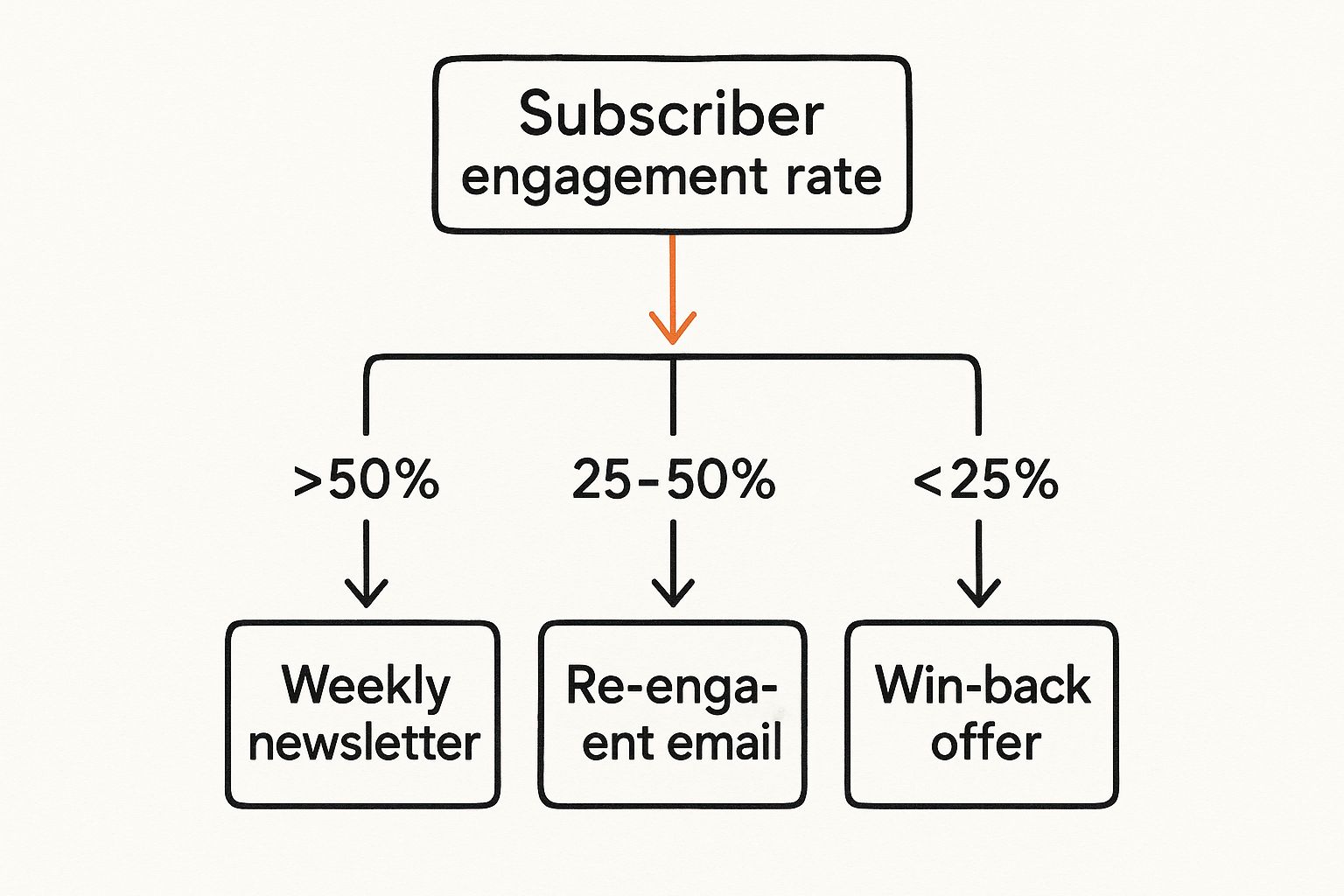
The big takeaway here is that you don't have to email everyone at the same frequency. Tailoring your approach keeps your subscribers happy and your email list healthy.
At The MarCom Society, we know that building an email list is just one piece of a successful school marketing strategy. Our community provides the ongoing support, expert guidance, and practical resources you need to master not only this skill but every aspect of K-12 communications. Join us to connect with peers, learn from industry leaders, and find the tools to help your school thrive. https://marcomsociety.org









