You can't expect to get rich, meaningful insights from a focus group if you just wing it. The truth is, the success of your session is locked in long before anyone even walks through the door—or logs into the video call. It all comes down to smart, thorough planning. This is where you take a fuzzy idea and sharpen it into a strategic, actionable plan.
Building the Foundation for a Successful Focus Group
Every truly great focus group I've ever been a part of started with crystal-clear objectives. If your goal is something vague like "understanding what parents think," you're setting yourself up for failure. You need to get much more specific.
What are you really trying to learn? Are you trying to get a gut check on a proposed 1-to-1 technology initiative? Or maybe you need to test the messaging for a big capital campaign before you roll it out. The more precise your goal, the sharper your questions will be and the more useful your findings will become.
This is also the stage where you have to get real about the budget. It's an easy and common mistake to overlook costs, but that can completely derail the entire project. You need to think through every potential expense, not just the obvious ones.
Make sure your budget accounts for:
- Participant Incentives: You're asking people for their valuable time. A gift card, a donation to a school program in their name, or even a simple piece of school merchandise is a must for showing appreciation and boosting recruitment.
- Facility Rental: If you’re holding the session in person and need a neutral space off-campus.
- Moderator Fees: A major consideration if you're bringing in an experienced external moderator.
- Technology and Software: This could be a subscription to a platform like Zoom for virtual groups or costs for high-quality recording equipment.
- Transcription Services: Getting your audio or video recording transcribed makes analysis infinitely easier.
- Catering: Never underestimate the power of coffee and cookies. Simple refreshments create a welcoming, relaxed atmosphere.
Taking the time for this detailed prep work is absolutely essential. It’s what separates professional research from a casual chat. This level of rigor is a key reason the global market research industry's revenue skyrocketed by over 95% between 2016 and 2024, ballooning from $71.5 billion to $140 billion. That massive growth shows just how much organizations rely on this kind of structured insight to make sound decisions. You can explore more of these market research statistics to see the full picture.
Crafting Your Moderator's Guide
Once you’ve nailed down your objectives and budget, your next job is to build the moderator’s guide. Think of this document as your roadmap for the conversation. It’s absolutely not a rigid script you read word-for-word. Instead, it's a flexible playbook that keeps the discussion on track while leaving room for spontaneous, valuable insights to emerge.
A great moderator’s guide balances structure with flexibility. It provides a clear path for the conversation but leaves room to explore unexpected insights that arise organically from the group's dynamic.
Your guide should outline your key questions, have a rough time estimate for each section, and—this is important—include some pre-planned probing questions. For example, instead of a flat question like, "Do you like the new report card format?" you can dig deeper.
Your guide might have prompts like:
- "Walk me through your experience of reading this new report card for the first time."
- "What information really stood out as useful? On the flip side, what felt confusing or maybe just unnecessary?"
- "If you had a magic wand and could change one thing about this format, what would it be and why?"
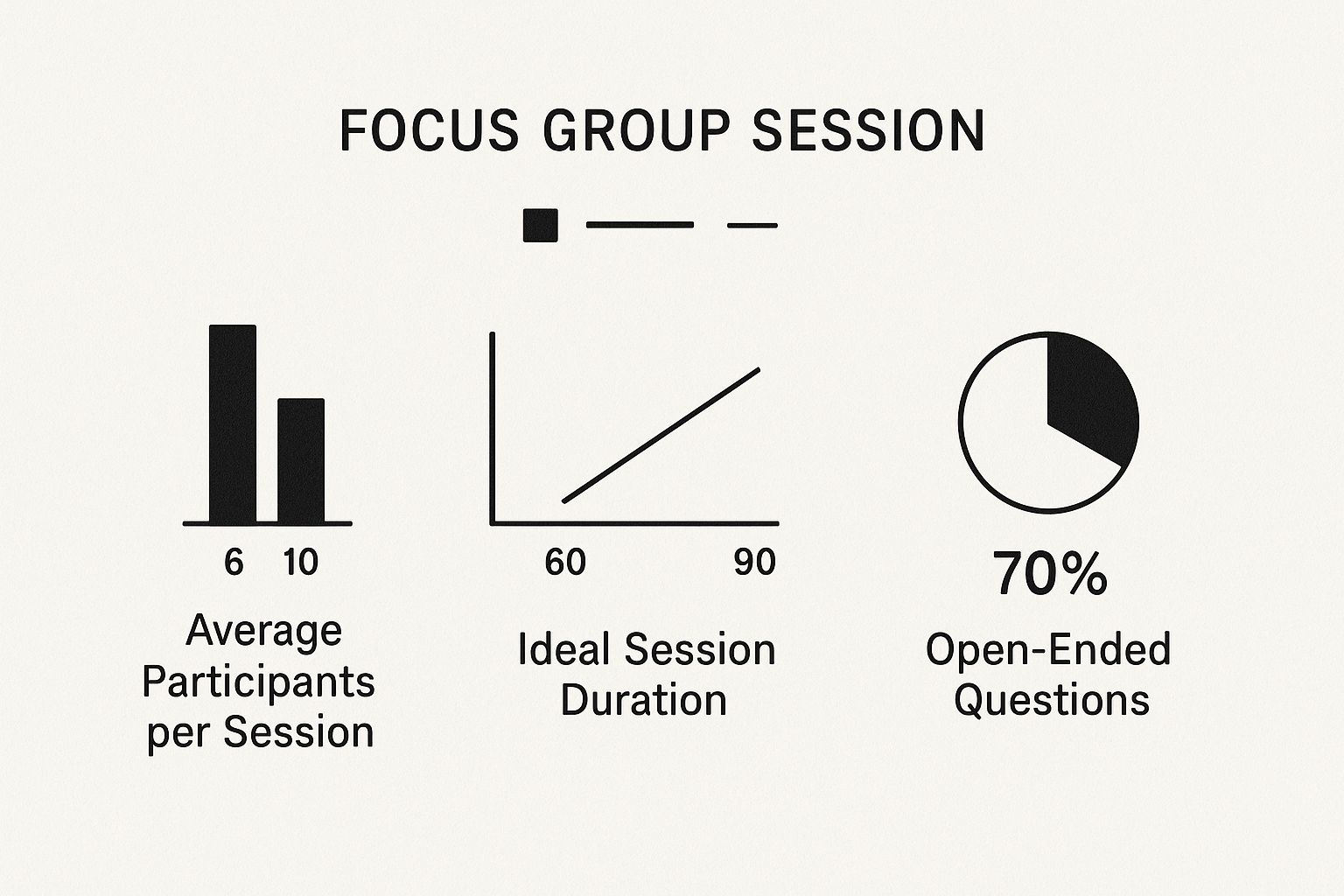
See the difference? These kinds of open-ended questions encourage people to tell stories and give you rich, detailed feedback, not just a simple "yes" or "no."
Finalizing Your Strategic Plan
Okay, before you even think about recruiting participants, it's time for one final, crucial check to make sure all these foundational pieces fit together. This is your last chance to catch small misalignments that could become big problems later. Using a checklist is a simple but powerful way to ensure you haven't missed anything. This is how you ensure the process of how to conduct focus groups is professional and effective.
Here is a simple checklist I use to make sure every project is on solid ground before moving forward.
Essential Focus Group Planning Checklist
This checklist helps ensure all your strategic components are in place before you start reaching out to parents, students, or staff.
| Planning Component | Key Considerations | Status (To Do / In Progress / Complete) |
|---|---|---|
| Clear Objectives | Are goals specific, measurable, and tied to a larger school initiative? | |
| Target Audience | Who do you need to hear from (e.g., parents of 5th graders, high school juniors)? | |
| Budget Approval | Have all potential costs been identified and the final budget approved? | |
| Incentive Plan | Is the incentive appropriate and appealing for your target audience? | |
| Venue/Platform | Has an in-person location been booked or an online platform been selected? | |
| Moderator Guide | Is the guide complete with open-ended questions, probes, and timing? | |
| Recruitment Screener | Are the questions ready to identify and qualify the right participants? | |
| Project Timeline | Are key dates for planning, recruitment, moderation, and analysis set? |
Running through a checklist like this is a quick and effective way to confirm that your planning is complete and your project is set up for success. It’s a final quality-control step that prevents headaches down the road.
Recruiting the Right People for Your Study
Let's be honest: your focus group is only as good as the people you get in the room. This isn't just about filling seats. It's about strategically finding the exact voices who can answer your most pressing questions. If you get recruitment wrong, you risk ending up with off-topic chatter and unreliable feedback, which pretty much torpedoes the whole effort.
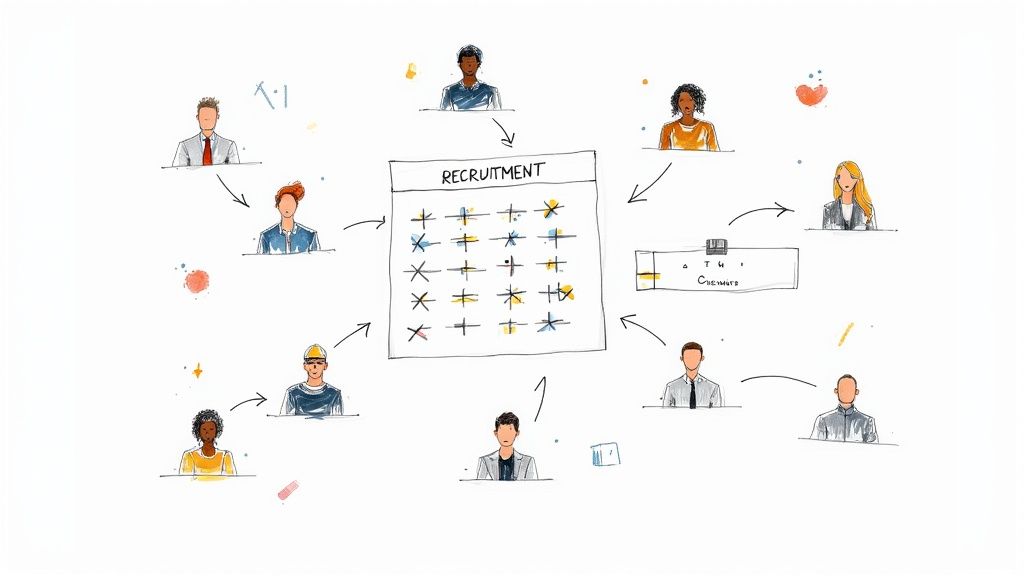
The first thing you need is a crystal-clear picture of who you're looking for. This profile should be directly tied to your research goals. "Parents" is way too broad. Think more along the lines of, "Parents of K-3 students who have used our after-school enrichment programs at least twice in the last school year." That level of precision is what gets you people with direct, relevant experience.
This kind of targeted approach is really the foundation when you conduct market research. You have to be incredibly specific about whose opinion actually matters for the topic at hand.
Building Your Screener Questionnaire
Once you know who you're after, you need to build a screener questionnaire. This is a short, sharp survey that weeds out people who don't fit your criteria. The trick, though, is to do it without tipping your hand about the study's true purpose.
Let's say you're exploring a new school communication app. A bad screener would ask, "What do you think of our new app?" That just primes people to tell you what they think you want to hear. A much better approach is to hide your key questions among more general ones.
Here are a few examples of smarter screening questions:
- How do you typically receive information from your child's school? (Select all that apply)
- Which of the following communication methods have you used in the past six months?
- On a scale of 1 to 5, how satisfied are you with the overall communication from the school?
These questions let you quietly identify parents who are deeply engaged with school communications—and even single out users of your new app—without ever mentioning it. This keeps bias out of the equation and ensures people aren't just trying to "pass the test" to get selected.
A well-designed screener is your silent gatekeeper. It finds the perfect candidates and politely shows the wrong ones the door, all while protecting the integrity of your research by keeping the topic under wraps.
Choosing Your Recruitment Channels
So, where do you find these people? You've got a few options, and each has its pros and cons. The right choice really comes down to your budget, timeline, and the specific group you need to reach.
| Recruitment Method | Pros | Cons |
|---|---|---|
| School Databases | You have direct access to your target audience (parents, staff). It's very cost-effective. | Segmenting lists and outreach can be time-consuming. You might run into privacy restrictions. |
| Social Media | You can reach a massive audience and target specific demographics. Great for finding community voices. | You risk attracting "professional" participants who do this for a living. It might require an ad budget. |
| Professional Recruiters | They are experts at finding niche or hard-to-reach people. Show-up rates are usually high. | This is often the most expensive option. The connection to your school community can feel less personal. |
Ultimately, the quality of your participants is everything. For high-stakes research, you can't afford to cut corners here. Taking the time to verify participants ensures the feedback you get is reliable and prevents your data from being muddied by people who aren't qualified or genuinely invested.
Managing Logistics and Confirmations
Okay, you've found your people. Now comes the nitty-gritty of making sure they actually show up. Consistent, clear communication is your best defense against no-shows.
Here’s a simple, battle-tested process I always follow:
- The Initial Confirmation: The moment someone is selected, they should get an email with all the essentials: date, time, location (or virtual link), session length, and the incentive details. I always ask for a reply to confirm their spot.
- The Reminder Call: A quick, personal phone call a day or two before the session works wonders. It's a chance to go over the details again, answer any last-minute questions, and just build a little rapport.
- The Final Nudge: On the morning of the focus group, send a short text or email. It’s a simple, friendly reminder that keeps the session top of mind.
This might seem like a lot of follow-up, but it makes a huge difference in your attendance rate. I also make it a rule to over-recruit by about 20%. If you need eight participants, find and confirm ten. That little bit of a buffer is your insurance policy against the inevitable last-minute dropouts, ensuring you still have enough people for a dynamic conversation.
Mastering the Art of Focus Group Moderation
You’ve done the hard work of planning and recruiting. Now, the success of your entire project comes down to one person: the moderator. A great moderator is so much more than a question-asker. They’re part facilitator, part neutral observer, and part conversational artist, all rolled into one. Your job is to guide the discussion, make sure every voice feels valued, and dig for those deeper insights—all without leading the group to a specific conclusion.
It’s a real balancing act. You have to follow your moderator's guide but also know when it’s okay to go off-script if a promising, unexpected topic pops up. The key is to remain an impartial guide, creating a safe, welcoming space where people feel comfortable sharing their honest thoughts, even if their opinions aren't popular.
Setting the Stage for Success
The first five minutes are everything. This is your window to set the tone, build rapport, and establish the ground rules for a productive chat. I always start with a warm, genuine welcome and a quick, friendly icebreaker. This isn't just filler; it’s a strategic move to break the tension and get people comfortable with the sound of their own voices in the room.
Right after the welcome, clearly lay out what to expect. Reassure everyone that there are no right or wrong answers and that you genuinely want to hear all perspectives, especially conflicting ones. Giving this explicit permission to disagree is crucial for preventing groupthink, that classic pitfall where a few dominant opinions silence everyone else.
The Art of Probing for Deeper Insights
Getting past surface-level answers is where a skilled moderator truly earns their keep. People will often start with simple, generic responses. Your job is to gently push for the "why" behind their statements. Instead of just accepting "I like it," you need to use probing techniques to uncover the specific feelings and experiences that led to that opinion.
Here are a few powerful techniques I’ve relied on for years:
- Ask for Stories: Don't just ask for opinions; ask for experiences. "Tell me about the last time you used the school's website. What were you trying to do?" This simple shift moves the conversation from abstract ideas to concrete, detailed memories.
- The 'What If' Scenario: Use hypotheticals to open up new possibilities. "If you had a magic wand and could change one thing about parent-teacher conferences, what would it be?"
- Request Specifics: When you hear a general statement like "It was confusing," follow up with, "What part, specifically, did you find confusing?" Get them to pinpoint the exact issue.
- The Power of Silence: This one takes practice. After you ask a question, resist the urge to immediately fill the quiet. Let a moment of silence hang in the air. More often than not, someone will jump in with a more thoughtful, less rehearsed answer.
Your goal as a moderator isn't just to get answers; it's to understand perspectives. Probing questions are your most valuable tool for turning a simple comment into a rich, detailed insight.
Navigating Common Moderation Challenges
Every focus group has its own personality, and you can bet that challenges will pop up. Being prepared for the common bumps in the road is what keeps a conversation on track and ensures you get good, balanced feedback.
How to Handle Common Scenarios
| Challenge | Effective Solution |
|---|---|
| The Dominant Talker | Try non-verbal cues first—break eye contact and turn your body toward others. If that doesn't work, politely interject with, "That's a fantastic point, thank you. Now I'd love to hear what others think about that." |
| The Quiet Participant | Create a low-pressure opening for them. Ask directly but gently, "Javier, what's your take on this?" or open it up with, "Does anyone have a different perspective they'd like to share?" |
| Off-Topic Conversations | Acknowledge their point so they feel heard, then gently guide them back. "That's an interesting tangent. For the sake of our time, let's get back to discussing the new grading policy." |
| Groupthink Sets In | Actively hunt for dissenting opinions. Ask directly, "Does everyone feel that way, or does someone see it differently?" This tells the group it's safe to disagree. |
Knowing how to conduct a focus group effectively means being ready for these moments. The best moderators I know can manage these group dynamics with a mix of grace and firm kindness. That adaptability is what ensures the data you collect represents the full spectrum of opinions in the room, and it's the true mark of a master facilitator.
In-Person or Online? Choosing the Right Setting for Your Focus Group
One of the biggest decisions you'll make is where to host your focus group. Will you gather everyone in a physical room, or will you connect them in a virtual space? This isn't just about logistics; the venue you choose fundamentally shapes the conversation, influences how comfortable people feel, and directly impacts the quality of your findings.
It's a classic choice between the rich, observable dynamics of a face-to-face meeting and the sheer convenience and reach of an online format. Think of it as choosing the right tool for the right job.
The Case for In-Person Focus Groups
There's a certain magic to getting people in the same room. You can feel the energy. In-person focus groups are fantastic for picking up on the subtle, non-verbal cues that often get lost on a screen—a shared glance between parents, a collective nod of agreement, or the hesitant body language that tells you there's more to a story. These nuances are gold.
This is especially true if you’re discussing sensitive topics or want feedback on physical items, like a draft of a new school prospectus or some student-designed artwork.
If you go the in-person route, your priorities should be neutrality, comfort, and accessibility. A conference room at a local library or a neutral community center is often a much better bet than using a room on campus. Your own school building can feel intimidating or bring up preconceived notions for some participants.
Here are a few practical tips I've learned over the years:
- Mind the Layout: Arrange chairs in a circle or a U-shape. This encourages a feeling of equality and makes it easier for people to talk to each other, not just the moderator. Avoid a classroom-style setup at all costs.
- Small Comforts Matter: Have coffee, water, and maybe some light snacks available. It’s a small gesture, but it makes people feel welcomed and valued, which helps them relax and open up.
- Test Your Tech: Do a full sound and video check in the room before the day of the focus group. There’s nothing worse than realizing your microphone isn't picking up the quiet talker in the corner.
A shared physical space builds rapport fast. That sense of community can encourage participants to be more forthcoming and build on each other's ideas, leading to richer, more collaborative insights.
Embracing the Power of Online Focus Groups
Let’s be honest: online focus groups offer unmatched convenience. They eliminate travel and childcare hurdles for your participants and cut down on costs and logistical headaches for your team. This is a massive win for schools trying to engage busy parents or staff members who simply couldn’t squeeze a two-hour in-person session into their day.
But the real power of going online is its ability to erase geography. You can bring together parents from different feeder districts, alumni scattered across the country, or teachers from various campuses—all in one virtual room.
Online focus groups aren’t just a Plan B for in-person meetings; they are a distinct method with their own powerful advantages. The flexibility and reach they offer can be a game-changer for school communicators.
To help you weigh your options, here’s a quick comparison of the two formats.
In-Person vs Online Focus Groups A Comparative Analysis
This table breaks down the key differences to help you decide which approach is the best fit for your specific research goals and your community.
| Feature | In-Person Focus Groups | Online Focus Groups |
|---|---|---|
| Atmosphere | High-energy, immediate group rapport. | Convenient and relaxed (participants are in their own space). |
| Non-Verbal Cues | Excellent. Easy to observe body language and group dynamics. | Limited. Relies on facial expressions; full body language is lost. |
| Geographic Reach | Limited to a specific local area. | Virtually unlimited. Can include participants from anywhere. |
| Participant Pool | Can be harder to recruit; requires travel commitment. | Easier to recruit a diverse group, including those with busy schedules. |
| Cost | Higher. Includes venue rental, refreshments, and potential travel stipends. | Lower. Eliminates most venue-related costs. |
| Technology | Minimal tech needed for participants. Requires recording equipment. | Requires all participants to have a stable internet connection and device. |
| Logistics | More complex. Involves booking a space, setup, and cleanup. | Simpler. Involves sending a link and managing a virtual meeting room. |
Ultimately, both in-person and online formats can deliver incredible value. The best choice depends entirely on what you want to learn and who you need to hear from.
Many of the video conferencing platforms you already use are perfect for this. Tools like Zoom, Microsoft Teams, or Google Meet have built-in features that are surprisingly effective for research. Things like virtual whiteboards, live polls, and breakout rooms let you replicate many of the interactive elements of an in-person session.
Because so many people are already familiar with these platforms, the technology isn't a major barrier. For K-12 schools, ensuring this kind of easy access is a crucial part of an effective communication plan for schools because it means you can equitably reach your entire community.
From Conversation to Insightful Action
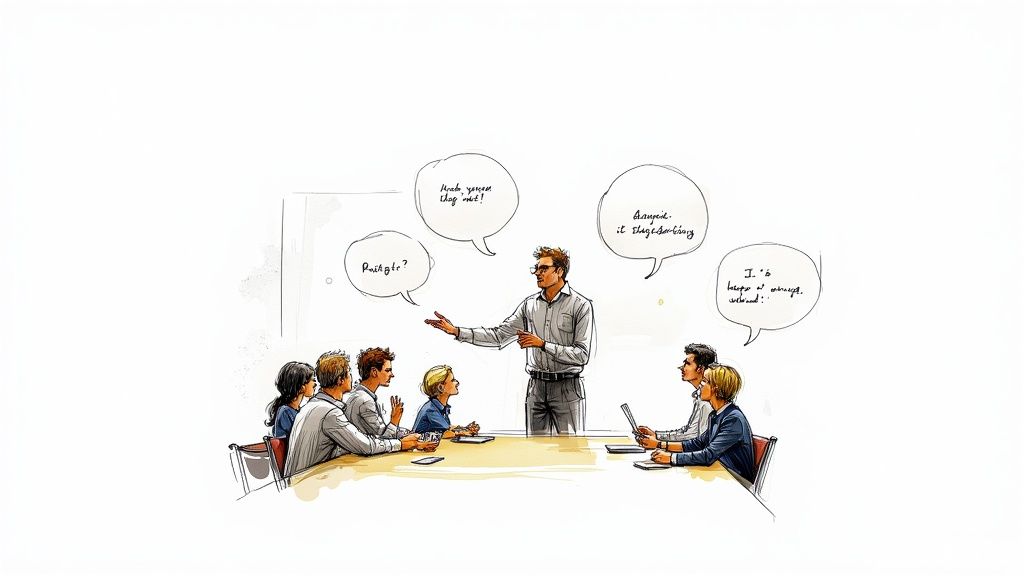
The recorders are off, the participants have gone home, and you’re left with a goldmine: hours of rich, lively discussion. But simply gathering the data isn't the endgame. The real magic happens when you transform those raw conversations into clear, actionable insights that can confidently guide your school's next move.
This is where you shift from just hearing what people said to truly understanding what it all means. It's a structured process of finding the signal in the noise.
Starting with a Clean Slate: Transcription
Before you can spot any patterns, you need a written record. Trying to analyze hours of audio from memory or by constantly re-watching video is a recipe for frustration and missed details. You need a transcript.
You’ve got a few ways to tackle this, each with its own pros and cons:
- Manual Transcription: This is you or a team member typing it all out. It’s the cheapest route in terms of cash, but it will cost you dearly in time.
- AI Transcription Services: Tools like Otter.ai or Rev can spit out a transcript in minutes for a pretty reasonable price. They're fast, but they aren't flawless. You'll absolutely need a human to review the text to fix names, school-specific jargon, and the occasional misheard word.
- Professional Transcriptionists: This is your most accurate—and most expensive—option. A human expert delivers a polished document, which is perfect when the stakes are high.
For most school projects, I've found that using an AI service followed by a careful human proofread hits the sweet spot between speed, cost, and accuracy. The bottom line is to start your analysis with a clean document.
Uncovering Themes and Patterns
With your transcript ready, the real detective work begins. Your goal here is to conduct a thematic analysis—a methodical process for identifying the core ideas, recurring patterns, and even surprising contradictions that bubbled up in your groups. This isn't just about counting keywords; it's about digging into the meaning behind the words.
Start by reading the transcript a few times. Your first pass is just to get a feel for the conversation's general flow. On your next reads, you'll start coding the data.
Coding is simply the act of highlighting key quotes or ideas and giving them a short label, like a tag. For instance, if a parent says, "I could never find the link for the parent-teacher conference sign-ups on the website," you might code that phrase with a tag like "website navigation issue" or "conference logistics."
Your analysis needs to go beyond a simple summary of what was said. The real value is in interpreting why it was said and what it means for your school's strategy and daily operations.
As you work your way through the transcript, you'll see your codes start to cluster. Maybe you notice a bunch of codes about website navigation, confusing emails, and missed newsletters. Together, these might point to a bigger theme you can label "Communication Channel Confusion." This is how you build from individual comments to big-picture findings.
From Findings to Actionable Insights
Identifying themes is a huge step, but it’s not the finish line. An insight is what connects a finding (the "what") to its implication (the "so what?"). It's the bridge between data and meaningful action. A good insight doesn't just point out a problem; it illuminates the path to a solution.
Here’s how to tell them apart:
| Element | Description | Example |
|---|---|---|
| Finding | A factual summary of what you observed or heard. | "Parents in all three focus groups mentioned they were unsure which communication tool to check for urgent updates." |
| Insight | The interpretation of that finding, explaining the "why" and its impact. | "The lack of a single, designated channel for urgent news is causing anxiety and confusion among parents, who fear they are missing critical information." |
| Recommendation | A specific, actionable step your school can take based on the insight. | "Designate the school's mobile app as the sole platform for all time-sensitive alerts and clearly communicate this new policy to all parents." |
This structured thinking is the heart of making smart, evidence-based choices. For a deeper look at this process, our guide on data-driven decision-making provides some great frameworks for turning focus group findings into real-world strategy.
Crafting a Compelling Report
Finally, you need to share your results with stakeholders—the people who can actually make changes. A dry, academic report will just gather dust. You need to tell a story.
Start with a punchy executive summary highlighting the most critical themes and your top recommendations. Then, for each theme, walk your reader through the finding, the insight, and your proposed action.
But the most powerful tool in your arsenal is the voice of your participants. Weave direct quotes throughout your report. A statement like, "I felt like I was failing my child because I missed the deadline I never even knew about," has a gut-punch quality that's far more persuasive than simply stating, "Parents reported frustration."
These quotes bring the data to life, making the issues human and creating a powerful sense of urgency for your stakeholders.
Got Questions About Your Focus Group? We’ve Got Answers.
Even the most meticulously planned focus group can throw you a curveball. Over the years, I've seen it all, and a few key questions pop up time and time again. Getting ahead of these common hurdles is the key to keeping your research on track and making sure you walk away with insights you can actually use.
Let's dive into some of the questions I hear most often.
How Many People Should I Invite?
The magic number for a focus group is somewhere between 6 to 10 participants. This range hits the sweet spot—it’s big enough to spark a lively, diverse conversation but small enough that you, as the moderator, can keep things under control and give everyone a chance to speak.
If you have fewer than six people, you risk the conversation stalling out. Too much dead air. But with more than ten, it can quickly devolve into chaos. Side conversations start, quieter voices get lost, and you lose control of the room.
Here's a tip from the trenches: Always, always over-recruit. I build in a 20% buffer for every group. If I need eight people to show up, I'll confirm ten. Life happens—kids get sick, meetings run late—and this simple step saves you from the stress of a last-minute scramble.
What’s a Fair Incentive to Pay Participants?
There's no one-size-fits-all answer here; it really depends on who you're asking and how much of their time you need. For a standard 90-minute session with parents, offering between $75 and $150 is a pretty standard and respectful amount.
Now, if you're trying to get a busy superintendent or a specialized curriculum director in the room, the game changes. Their time is incredibly valuable. For an hour with a professional at that level, you might need to offer $250 or more. Sometimes, offering a donation to their school or a program they care about can be an even more powerful incentive.
The goal is to show you genuinely value their expertise and time. The incentive should be enough to make it worth their while, but not so high that it becomes their only motivation for participating—that can sometimes lead to less-than-honest feedback.
How Do I Deal With Someone Who Won't Stop Talking?
Ah, the "conversation dominator." This is probably the most common moderation challenge, and handling it gracefully is an art form. It requires being firm but kind.
Your first move should be non-verbal. Gently break eye contact with the person who's talking too much and physically turn your body and your gaze toward another part of the group. It’s a subtle but often effective cue.
If that doesn't work, you'll need to step in verbally. Try a polite redirect:
- "That's a fantastic point, thank you. I'd love to see what some others think about that idea."
- Or, you can call on someone specific: "Maria, we haven't heard from you yet. What's your take on this?"
The key is to acknowledge their contribution while steering the ship back on course, making sure everyone's voice is heard.
How Many Focus Groups Do I Actually Need to Run?
There’s no hard-and-fast rule, but the gold standard in research is to keep conducting groups until you hit "saturation." That’s the point where you’re not really hearing anything new. The same themes, opinions, and ideas are coming up again and again.
For most projects, you’ll likely hit this point after running 3 to 5 groups for each specific audience. For example, you might run 3-5 groups with parents, and another set for high school students.
Resist the temptation to run just one focus group. A single group can be an anomaly; its dynamic might be completely unique. Running multiple groups is how you spot real patterns, validate your findings, and gain the confidence that your insights are solid.
At The MarCom Society, we believe that truly understanding your community is the foundation of building stronger schools. Our professional community gives K-12 marketing leaders the tools, expert guidance, and peer network to master essential skills like this. Join us to collaborate with peers, learn from experts, and turn insights into communication strategies that make a real impact.