A proper SWOT analysis gets you to look inward at your school's Strengths and Weaknesses, then outward at the Opportunities and Threats shaping your environment. It's a simple, four-part framework that gives you the clarity to build a strategy that actually works—connecting where you are today with where you need to be tomorrow.
Building a Foundation for School Marketing Strategy
Before you can even think about mapping out a marketing plan, you have to know exactly where your school stands. A SWOT analysis delivers that crucial perspective, acting as the bedrock for your entire strategy. This isn't just some corporate busywork; for school marketers, it's an indispensable tool for building smarter, more effective plans.

We're going to move beyond the textbook definitions and dig into what each of these four quadrants really means in a school setting. Consider this the essential first step before you launch an enrollment campaign, rethink your brand message, or decide where to put your limited budget.
Why Every School Needs This Framework
A good SWOT analysis is so much more than a list. It’s the starting point for meaningful action. It forces an honest, often overdue, conversation about what’s truly working and what isn’t, giving you a 360-degree view of your school.
Here’s why it’s so critical in the world of K-12 education:
- It Clarifies Your Priorities. You can focus your team and your budget on the initiatives that will actually move the needle, instead of spreading resources too thin.
- It Reveals Your Blind Spots. The process has a funny way of bringing hidden weaknesses or looming threats to the surface before they become full-blown crises.
- It Builds Real Consensus. When you bring key people into the room—from admissions and academics to the front office—you create shared ownership of the path forward.
- It Sharpens Your Messaging. Truly understanding your unique strengths is how you craft marketing messages that connect with prospective families on an authentic level.
The real power of a SWOT analysis isn't in filling out the boxes—it's in the strategic conversations it sparks and the focused action it inspires.
From Simple Grid to Strategic Tool
The SWOT analysis has been around since the 1960s, starting as a simple brainstorming method. Back then, teams would just list out factors on a four-quadrant grid. Today, we can bring in enrollment data, parent surveys, and market research to make the process far more precise and insightful.
This evolution highlights just how vital a data-informed SWOT has become in modern school leadership. It’s a cornerstone of any real strategic plan, helping to get your entire team aligned and pushing in the same direction. For a deeper dive, our guide on https://blog.marcomsociety.org/strategic-planning-for-schools/ shows how this analysis fits into the bigger picture.
To put it simply, this framework is the launchpad for making smarter decisions that drive enrollment and build a stronger school brand. While our focus here is on schools, you can get a great overview of the general process in a comprehensive guide on how to conduct a general SWOT analysis.
SWOT Analysis Quadrants at a Glance
To get started, it helps to have a quick reference for what belongs in each quadrant. Here’s a simple breakdown with some school-specific examples to get you thinking.
| Component | Focus | School Marketing Example |
|---|---|---|
| Strengths | Internal positives. What do you do well? What unique advantages do you have? | A renowned STEM program with high college placement rates. |
| Weaknesses | Internal negatives. Where do you need to improve? What resources do you lack? | An outdated website that is difficult for parents to navigate. |
| Opportunities | External factors you can use to your advantage. What market trends can you capitalize on? | A new housing development is being built nearby, bringing in young families. |
| Threats | External factors that could harm your school. What is your competition doing? | A competing school just launched a 1:1 laptop program and is marketing it heavily. |
Think of this table as a starting point. The real value comes from the specific, honest, and detailed items your team generates for each category.
Assembling Your Team and Gathering Intelligence
A SWOT analysis is only as good as the people in the room and the information you give them. It’s not about guessing or just sharing opinions from the top; it’s about building a strategy on a solid foundation of diverse perspectives and real data. This is where you set the stage for success.
All too often, I see schools treat this as a quick meeting between the head of school and the admissions director. While their input is vital, that narrow approach is a recipe for strategic blind spots. To get a real, 360-degree view of your school, you need to widen the circle.
Who Should Be in the Room?
Your mission here is to build a cross-functional team that truly represents the day-to-day life of your school. Think beyond the usual suspects. A great SWOT session thrives on healthy debate and fresh insights from people who see the school from different angles.
Your core team should absolutely include leaders from:
- Admissions and Marketing: They’re on the front lines, hearing directly from prospective families and seeing market trends play out.
- Academics: Pull in division heads or department chairs who can speak honestly about curriculum, faculty, and student life.
- Athletics and Arts: These programs are often huge differentiators and enrollment drivers, with their own unique strengths and challenges.
- Administration and Finance: They bring the essential context of what's possible, grounding the conversation in budget realities and operational capacity.
I also recommend bringing in a trusted board member or a parent association leader. Their outside perspective can be invaluable, spotting opportunities or threats the internal team is too close to see. The sweet spot is usually around 8-12 people—big enough for a rich discussion, but small enough to keep it focused.
The most insightful SWOT sessions I've facilitated were the ones where a department chair pointed out a weakness the admissions team never knew existed, or when the finance director revealed an opportunity hidden in the budget. Diversity of roles is your strategic advantage.
Gathering Your Pre-Session Intelligence
Before anyone sets foot in the meeting room, you need to equip them with data. This is what separates a productive strategy session from a simple brainstorming free-for-all. Your job as a marketer is to be the intelligence officer, pulling together the facts that will ground the conversation in reality.
A few days before the meeting, send out a concise pre-read packet. It doesn’t need to be a novel, but it should give everyone a common factual starting point. This saves a ton of time during the session and ensures the discussion is based on what’s actually happening, not just what people think is happening.
The Essential Data Checklist
Your intelligence gathering should paint a picture of both what's going on inside your school and what's happening in the world outside. To really nail the external factors, you'll want to know how to conduct market research thoroughly.
Here’s a checklist to get you started:
Internal Data Points
- Enrollment Funnel Metrics: Look at application numbers, yield rates, and summer melt stats for the last three years. Where are the leaks in your pipeline?
- Parent and Student Satisfaction Surveys: What are the big themes—good and bad? What do your families rave about, and what are their most common frustrations?
- Website and Social Media Analytics: What content is resonating? What are people searching for when they land on your site?
- Exit Interview Summaries: If you survey families who leave, what are the top reasons they give for their decision?
External Intelligence
- Competitor Analysis: A quick rundown of what your key competitors are up to. Have they launched new programs, changed tuition, or rolled out a splashy ad campaign?
- Local Demographic Trends: Are new neighborhoods being built? Is the school-aged population in your key zip codes growing or shrinking?
- Economic Outlook: Keep an eye on local employment rates and real estate trends. These can be leading indicators for your future applicant pool.
Providing this information beforehand completely changes the tone of the meeting. Suddenly, your team isn't just guessing—they're making informed contributions based on tangible evidence. This single prep step is one of the most critical for ensuring your SWOT analysis leads to a strategy that actually works.
Running a SWOT Session That Actually Works
You've got the right people in the room and everyone has done their homework. Now for the hard part: getting them to talk openly. The success of your SWOT analysis lives or dies in this session. It’s not about just filling four boxes on a whiteboard; it’s about creating a space where people feel safe enough to share the good, the bad, and the sometimes-uncomfortable truths about the school.
As the facilitator, you're the guide, not the hero. Your job is to steer the conversation, keep the energy up, and make sure everyone's voice is heard. Without a firm hand on the tiller, these sessions can get bogged down in one pet topic or dominated by the most senior person at the table.
Setting the Stage for Real Talk
Kick things off by laying down some ground rules. Make it crystal clear that this is about honest assessment, not assigning blame. What's said in this room is for the sole purpose of making the school stronger, and every single perspective is critical. This one small step is a game-changer for getting people to talk about weaknesses and threats without fear.
This simple flow chart shows how all the prep work leads to a productive session.

As you can see, getting a good outcome is a logical process. It starts with the right team, grounded in solid data, and flows into a structured, well-managed conversation.
A great tactic to get things moving is to hand out sticky notes and have everyone silently brainstorm ideas for each quadrant first. This is a fantastic way to avoid "groupthink" and gives your more introverted team members an equal shot at getting their ideas on the board before the open discussion begins.
Diving Into the Four Quadrants With Better Questions
Vague questions get you vague answers. If you want real insights, you have to push your team to get specific.
Strengths: Go Deeper Than "Great Community."
Challenge the group to pinpoint why that strength exists.
- "Which of our programs—academic or extracurricular—drives the most word-of-mouth referrals?"
- "What's the one moment on our campus tour that consistently gets a 'wow' from prospective families?"
- "Which teachers have the strongest reputations in the community, and what makes them stand out?"
Weaknesses: Face the Music.
This is often the trickiest part. Frame it as a puzzle to be solved, not a gripe session.
- "Where in our admissions funnel are we losing the most qualified applicants?"
- "What’s the number one complaint we get from new families in their first 90 days?"
- "If we had a blank check to fix one thing on campus, what would make the biggest impact on the student experience?"
Opportunities: Look Outside Your Gates.
Opportunities are all about external factors you can turn to your advantage. Get the team thinking about the world around your school.
- "Are there any big local companies expanding or moving here that could bring in new families?"
- "What new education trends, like specialized micro-schools, could we pilot to serve a niche market?"
- "Which local events or organizations could we partner with to get in front of the right people?"
Threats: Name the Elephants in the Room.
These are the external challenges that could trip you up. Be brutally honest.
- "How are high-quality online programs changing how families perceive our value?"
- "Are demographic shifts in our key zip codes shrinking our traditional applicant pool?"
- "What is our scrappiest competitor doing right now that we aren't ready for?"
Keeping the Train on the Tracks
A great discussion is fantastic, but it's easy to go off on a tangent. Your job is to be the friendly timekeeper. Set a timer for each quadrant—maybe 25-30 minutes—and stick to it. This ensures every area gets the focus it needs.
I’ve found that structure actually sparks creativity. When you give people clear prompts and time limits, they can stop worrying about the process and focus their brainpower on generating great ideas.
One of the best things you can do is make the workshop fun and interactive. For more on this, check out our guide on how to make workshops interactive.
Remember, the goal here is to capture ideas, not solve every problem on the spot. I always use a "parking lot" on a whiteboard for important ideas that are outside the scope of the SWOT. It’s a simple way to validate someone's point without derailing the whole conversation.
When done right, a SWOT analysis is a powerful tool. A 2025 survey found that over 70% of businesses that use SWOT analysis reported clearer decision-making and more effective strategic pivots. It’s a testament to how valuable a structured, honest conversation can be.
Turning Your Insights Into a Winning Strategy
The SWOT session is over, the whiteboards are full, and you're staring at a completed matrix. It's a fantastic snapshot of your school’s reality, but let's be honest—on its own, it’s just a collection of ideas. The real work, and the real magic, happens when you connect those dots and turn your analysis into an actionable marketing strategy.
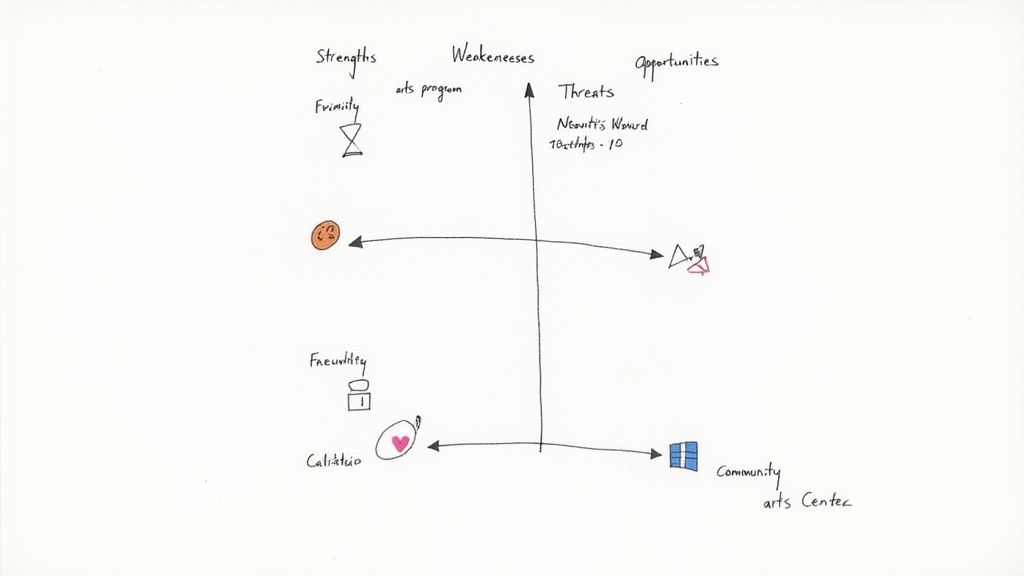
The best way I've found to do this is by systematically pairing your internal factors (Strengths and Weaknesses) with your external ones (Opportunities and Threats). Some people call this a TOWS analysis, but whatever the name, this is where raw insights become real marketing initiatives. This process helps you answer the big questions that actually drive growth.
Pairing Strengths with Opportunities for Maximum Impact
This is the fun part. You get to figure out how to use what you’re already great at to grab the opportunities right in front of you. Think of it as pouring gasoline on a fire.
- SO Strategy (Maxi-Maxi): This is all about playing offense. How can you use your strengths to make the most of emerging opportunities?
Let's say your analysis flagged your renowned arts program as a major Strength. At the same time, you identified an Opportunity—a new community arts center is opening downtown. The strategic play here is a no-brainer: forge a partnership. You could host a joint student art show at the new center, creating a fantastic marketing campaign that cements your school's reputation as the go-to place for arts education.
This kind of pairing lights a clear path forward. Once you have these insights, a good guide to strategic planning can help you build out the practical next steps.
Using Strengths to Neutralize Threats
Your school’s strengths are your best defense against what’s coming at you from the outside. It's about being proactive, not just reacting to problems as they arise. You're essentially building a shield out of what you do best.
- ST Strategy (Maxi-Mini): How can your strengths help you minimize or even dodge potential threats?
Imagine a school's biggest Strength is its incredibly tight-knit and engaged parent community. They see a Threat on the horizon: a competitor is launching a massive digital ad campaign. Instead of trying to outspend them—a losing battle for most schools—they can lean into their strength. Why not launch a "refer a friend" campaign that mobilizes current parents as brand ambassadors? Authentic word-of-mouth from happy families is far more powerful than any glossy ad.
Your strongest marketing assets are often the things your competitors can't just buy or copy. A loyal community, a stellar academic reputation, or a unique school culture are powerful defenses against market threats.
Fixing Weaknesses by Seizing Opportunities
Opportunities aren't just for amplifying your strengths; they can be the perfect nudge to finally fix those internal weaknesses. This is where you look for a little help from the outside world to level up your game.
- WO Strategy (Mini-Maxi): How can you grab an opportunity to overcome an internal weakness?
Picture this: a school's Weakness is an outdated science lab, a sore spot that comes up on nearly every tour. Then, an Opportunity appears—a local tech firm announces a new grant program for STEM education. The strategy writes itself: dedicate serious effort to crafting a killer grant proposal. If you get the funding, you not only fix the weakness but also get a fantastic, positive marketing story to tell.
The trick is to stop seeing weaknesses as dead ends. They're just problems waiting for the right solution to pop up.
Addressing Weaknesses to Mitigate Threats
This is your most defensive—and arguably most critical—set of strategies. Here, you’re shoring up the internal vulnerabilities that external threats could easily exploit.
- WT Strategy (Mini-Mini): What do we absolutely have to do to minimize our weaknesses and avoid these threats?
Let's say a school has a known Weakness of clunky, inconsistent parent communication. At the same time, they face a Threat from rising interest in charter schools that are famous for their slick, data-driven parent portals. The defensive strategy is clear: it’s time to invest in a modern communication platform. This move directly patches the hole in their armor, making them far less vulnerable to the competition.
Prioritizing Your Strategic Initiatives
Okay, after this pairing exercise, you’re going to have a long list of potential projects. You can't do it all at once. The next step is to prioritize.
A simple but incredibly effective method is to score each idea on two scales from 1 to 5:
- Impact: How much will this actually move the needle on enrollment or brand perception?
- Effort: How much time, money, and staff will this take?
Zero in on the high-impact, low-effort ideas first. These are your quick wins that build momentum. After that, you can start planning for the high-impact, high-effort projects. This simple scoring matrix transforms a messy brainstorming list into a clear, actionable roadmap, ensuring your budget and energy are spent where they'll make the biggest difference.
Common SWOT Analysis Mistakes to Avoid
Even with the best intentions, a SWOT session can easily go off the rails. I’ve seen it happen many times. The team walks out with a document that’s practically useless, feeling like they've just wasted a precious afternoon.
But with a little foresight, you can sidestep the common traps that snag most schools. The whole point is to create a powerful strategic tool, not just another list of bullet points that gets filed away and forgotten. Let's walk through the most frequent mistakes I see and how to keep your session on track.
Letting a Few Voices Dominate the Room
We’ve all been in that meeting. The Head of School or the most senior person at the table shares an opinion, and just like that, all other discussion grinds to a halt. When a couple of dominant personalities steer the entire conversation, you lose out on the rich, diverse perspectives that make a SWOT so valuable in the first place.
This is especially risky when you get to weaknesses and threats. A junior admissions coordinator or a new teacher might see a critical issue that leadership is completely blind to, but they’re not going to speak up if they don't feel it's safe to do so.
This is where a neutral facilitator is your best friend. Their only job is to manage the conversation, draw out the quieter folks, and make sure every voice is heard. A great technique is to start each quadrant with silent brainstorming on sticky notes. This levels the playing field, ensuring every single idea gets on the board before the discussion even begins.
Creating Vague and Endless Lists
One of the fastest ways to make your SWOT totally useless is by filling it with generic, fluffy statements. A strength listed as "good community" is meaningless. A weakness like "needs marketing improvement" is far too broad to be actionable. This happens when the group skims the surface instead of digging for the real details.
Your analysis needs specifics. Instead of "good community," a much better strength is, "Our parent association has a 90% participation rate in volunteer events, which drives strong word-of-mouth referrals." Now that's something you can work with.
The goal of a SWOT isn't to create the longest list possible. It’s to identify the handful of critical factors that will genuinely shape your school's future, forcing you to prioritize what truly matters.
To keep this from happening, challenge every point that goes on the board. When someone offers a vague idea, ask probing questions like, "What does that actually look like day-to-day?" or "Can you give me a specific example of that?" This pushes the team to provide the concrete details you need to build a real strategy.
Confusing Weaknesses with Threats
This is probably the single most common mistake people make. It’s so easy to mix up internal weaknesses with external threats, but getting this right is non-negotiable. Why? Because the way you respond to each is completely different.
Here’s the simple way to keep them straight:
- Weaknesses are internal things you can control. An outdated website, a clunky admissions process, or deferred campus maintenance are all weaknesses. You have the power to fix them.
- Threats are external factors you can’t control. A new charter school opening down the street, a shrinking school-age population in your zip code, or a competitor launching an aggressive ad campaign are all threats you have to react to.
For instance, if enrollment is down because your follow-up with inquiries is slow, that's a Weakness. But if it’s down because a major local employer just laid off 500 people, that's a Threat. You fix the first with better internal processes; you mitigate the second with a different marketing approach. Keeping them separate ensures you're applying the right solutions to the right problems.
Getting Stuck in Analysis Paralysis
The final pitfall is doing all this great work, admiring your beautiful SWOT chart… and then doing absolutely nothing with it. A good session can generate so many ideas that the team feels overwhelmed and slips into "analysis paralysis." You’ve identified all these complex issues but can't decide where to even start, so the momentum fizzles out and the document gathers digital dust.
A SWOT analysis is a starting line, not a finish line.
To avoid this trap, you have to shift from analysis to action before everyone leaves the room. Block out the last 30 minutes of your meeting specifically for prioritization. A simple dot-voting exercise works wonders—give everyone three sticky dots to place on what they see as the most critical items. This will quickly reveal the top two or three priorities in each quadrant.
From there, assign a clear owner to each prioritized point and set a deadline for them to come back with proposed next steps. This simple act of assigning responsibility is what turns a passive document into an active work plan, ensuring your hard work actually leads to meaningful progress.
Still Have Questions About Your School's SWOT Analysis?
Even with a step-by-step guide, it's totally normal to have a few questions pop up when you're planning your school's SWOT analysis. While the framework itself is simple, getting the details right is what separates a truly insightful session from a box-ticking exercise.
Let's tackle some of the most common questions I hear from school leaders. Getting these cleared up beforehand will make your actual workshop run a whole lot smoother.
How Often Should We Be Doing This?
For most schools, conducting a full SWOT analysis once a year is the sweet spot. This cadence lines up perfectly with the annual strategic planning and budgeting cycle. It gives you a fresh, clear-eyed look at where you stand right before you start making big decisions and allocating funds for the upcoming year.
But please, don't just create the document and let it gather dust until the following year. Your SWOT should be a living, breathing guide. A major shake-up in your market should always be a cue to pull it out and reassess.
You'll want to revisit your analysis if things like this happen:
- A new competitor school pops up in your backyard (or an existing one closes).
- A major local employer announces a big expansion or, conversely, significant layoffs.
- New state or federal policies are introduced that directly impact your school's operations or funding.
When you treat your SWOT as an agile tool, your marketing strategy can adapt and respond to what’s actually happening, instead of being stuck on a plan that's already out of date.
Who Absolutely Needs to Be in the Room?
If you want a complete picture, you have to invite people with different vantage points. A SWOT analysis run by just the marketing and admissions folks will inevitably have huge blind spots. You need input from people who live and breathe every part of the school experience.
Your non-negotiable, core team should include:
- The Head of School
- Director of Admission
- Director of Marketing
- Director of Finance or Business Manager
But don't stop there. The real magic happens when you broaden the circle. I strongly recommend pulling in academic leaders like your division heads, the athletic director, and maybe even a trusted board member or the head of your parent association. This mix of perspectives is your best bet for avoiding a strategy built on incomplete or biased information.
I’ve seen the most powerful insights come from the most unexpected corners of the room. An academic head might point out a curriculum gap that the admissions team can then proactively message, turning a potential negative into a story of continuous improvement.
What's the Real Difference Between a Weakness and a Threat?
This is, without a doubt, the most common point of confusion. Getting it wrong can send your entire strategy off course, so let's make it crystal clear. The dividing line is internal vs. external.
Weaknesses are internal factors. These are challenges that your school has direct control over—the problems you can actually choose to fix.
- Think of things like an outdated website that’s a nightmare for prospective parents to use.
- Or maybe inconsistent communication with newly enrolled families.
- Even deferred maintenance on a prominent campus building counts.
Threats, on the other hand, are external forces completely outside your control. You can’t change them; you can only prepare for and react to them.
- This could be a declining school-age population in your key zip codes.
- New state legislation that cuts funding for private schools.
- A rival school launching an aggressive, high-budget marketing blitz.
Nailing this distinction is everything. You fix a weakness by dedicating people, time, and money to it. You counter a threat by building a defensive strategy that plays to your strengths. If you mix them up, you’ll end up wasting a ton of energy on the wrong things.
Ready to move from analysis to action? The MarCom Society provides the tools, expert guidance, and peer support K-12 marketing professionals need to build and execute winning strategies. Join our community to access exclusive workshops, resources, and a network of leaders just like you. Learn more and become a member at https://marcomsociety.org.