A good SWOT analysis starts with a clear goal. You'll bring together a diverse team to brainstorm your school's internal Strengths and Weaknesses, then dig into the external Opportunities and Threats. This simple framework is the first step to organizing your thinking and building a marketing plan that actually works.
Setting the Stage for an Effective SWOT Analysis
The real work of a SWOT analysis happens long before you gather everyone around a whiteboard with a pack of sticky notes. Solid prep work is what turns this from a simple list-making exercise into a powerful strategic tool.
It’s the difference between creating a document that collects dust and building a blueprint for meaningful change in your school's marketing and communications. This pre-planning phase is all about laying a solid foundation with two key ingredients: a razor-sharp objective and the right people in the room.
Define a Crystal-Clear Objective
First things first: why are you doing this? You need to answer the question, "What problem are we trying to solve or what goal are we trying to achieve?" A generic objective like "improve our school" is far too broad and won't get you anywhere.
You need a focused statement that will guide the entire conversation. Think about what’s really pressing for your school right now. For example:
- Enrollment: To figure out how to reverse a two-year decline in middle school applications.
- Brand Perception: To understand what families in that new suburban development north of town really think of us.
- Program Evaluation: To decide if launching a new STEM magnet program next year is a viable idea.
Just like you would create a complete blueprint for event success, a structured approach ensures every step is purposeful. Having a single, clear goal keeps the discussion on track and guarantees your final output is relevant and actionable.
To give you a quick reference for your meeting, here's a simple breakdown of the four key components you'll be discussing.
SWOT Analysis Key Components at a Glance
| Element | Focus | Example Questions for a K-12 School |
|---|---|---|
| Strengths | Internal, Positive | What do we do better than anyone else? What unique programs or resources do we have? Why do families choose us? |
| Weaknesses | Internal, Negative | Where do we fall short? What resources are we lacking? What do competitor schools do better than us? |
| Opportunities | External, Positive | Are there new neighborhoods we can market to? Can we partner with local businesses? What new educational trends can we adopt? |
| Threats | External, Negative | Is a new charter school opening nearby? Are there demographic shifts affecting our applicant pool? How do economic changes impact our families? |
This table serves as a great starting point for brainstorming and ensures your team stays focused on the right questions for each category.
Assemble a Diverse and Insightful Team
A SWOT analysis done only by the marketing department is guaranteed to have blind spots. For a true 360-degree view, you need to bring a diverse group of people to the table—stakeholders who see the school through different lenses.
Your goal is to capture a wide range of experiences and viewpoints. Think about inviting:
- Administrators who know the operational realities and the big-picture vision.
- Teachers from different grades and subjects who are on the front lines every day.
- Parents who can give you candid feedback on everything from communication to curriculum.
- Admissions and communications staff who live and breathe the market and know what prospective families are thinking.
- Students or recent alumni (when it makes sense) for that invaluable ground-level truth.
A diverse team challenges assumptions and uncovers insights that a homogenous group would miss. The more varied the perspectives in the room, the richer and more accurate your analysis will be.
Once you’ve chosen your team, send out a clear invitation that explains the objective and what to expect. A short pre-session survey can be a game-changer here. Ask a few open-ended questions about what they see as the school's greatest strengths or biggest challenges. This gets people thinking ahead of time and gives you valuable material to kickstart the workshop. If you want to dive deeper, our guide on how to conduct market research provides a more structured approach to gathering this kind of information.
Even by 2025, the SWOT analysis remains a foundational tool for strategic planning. The reason is simple: it works. But remember, statistics show that about 83% of corporate strategies fail because they’re built on bad assumptions. A well-run SWOT is your best defense against that, ensuring your strategy is grounded in reality.
Leading a Productive SWOT Workshop

Let's be honest: a great SWOT session has very little to do with the whiteboard and everything to do with the person leading the room. You've already done the hard work of setting a clear goal and assembling a diverse team. Now, it's all about running a workshop that pulls out honest, insightful, and genuinely actionable ideas.
Your job is to create an environment where everyone feels safe enough to be candid about the school's future. Think of yourself as the guide—your role is to steer the conversation, manage the different personalities in the room, and keep the energy high. This is your playbook for turning what could be a chaotic brainstorm into a focused, strategic exercise.
Kicking Off the Session with Purpose
The first five minutes set the tone for the entire workshop. Start by immediately restating the session's objective—that specific goal you landed on during your prep work. This simple act gets everyone on the same page and reminds them why their presence is so valuable.
Next, do a quick and dirty explanation of the SWOT framework. You can't assume everyone lives and breathes this stuff. A 60-second refresher on internal factors (Strengths, Weaknesses) versus external ones (Opportunities, Threats) prevents confusion later on.
Finally, lay down some ground rules. These aren't meant to stifle creativity but to build a foundation of respect and psychological safety.
- No bad ideas in a brainstorm. We can filter later; for now, let's get it all out.
- One person, one mic. We can only follow one conversation at a time.
- Listen to understand, not just to respond. Let's really hear each other out.
- Get specific. Vague statements aren't helpful; real-world examples are golden.
This structured start builds momentum and signals to the group that this is going to be a productive use of their time.
Drawing Out Insightful Feedback
The quality of your SWOT analysis comes down to the quality of your questions. You need to push past the obvious, surface-level answers. Instead of a generic prompt like, "What are our strengths?" dig deeper with more targeted questions for each quadrant.
For Strengths, you could ask:
- "What are the top three things our enrolled families rave about?"
- "Which of our programs gives us a unique edge over the school down the street?"
For Weaknesses, try probing with:
- "What's the single biggest frustration we hear from parents during the admissions process?"
- "If you had a magic wand to fix one internal bottleneck, what would it be?"
This approach forces people to think in terms of real scenarios and hard evidence, which leads to much richer contributions. It’s all about guiding the team to honestly identify everything from your stellar brand reputation to those nagging operational inefficiencies.
A facilitator's best tool is the follow-up question. When someone offers a generic point like "our communication is a weakness," gently probe further with "Can you give me a specific example of when our communication fell short?" This turns a vague comment into a tangible problem to solve.
Managing Group Dynamics Effectively
In any group, you'll have dominant voices and quieter observers. Your job as facilitator is to balance the scales and make sure every perspective gets heard. If you notice one or two people are doing all the talking, it's time to politely interject.
A great way to do this is to say, "That's a fantastic point. I'd love to hear from someone who hasn't had a chance to speak yet—what are your thoughts on this?" This acknowledges the contributor while opening the floor to others. If someone seems hesitant, you can gently invite them in by asking their opinion on a specific topic.
You can also use a few simple tools to democratize the conversation:
- Silent Brainstorming: Hand out sticky notes and give everyone five minutes of quiet time to jot down their ideas for a quadrant. This is a game-changer for preventing groupthink and giving introverts a comfortable way to contribute.
- Round Robin: Simply go around the table and ask each person to share one idea. This structured approach guarantees that every single person participates.
- Digital Collaboration Tools: If you're running a remote or hybrid session, platforms like Miro or Mural are fantastic. These digital whiteboards allow for anonymous contributions and real-time collaboration, leveling the playing field for everyone.
By actively managing the flow of conversation, you ensure the final output is a true reflection of the entire group's wisdom. For more tips on this, our guide on how to make workshops interactive has some great strategies to keep the energy up.
Real-World K-12 School SWOT Scenarios
Theory is one thing, but seeing a SWOT analysis in action is what makes it all click. Let’s get out of the clouds and look at some concrete examples that school leaders like you are grappling with right now.
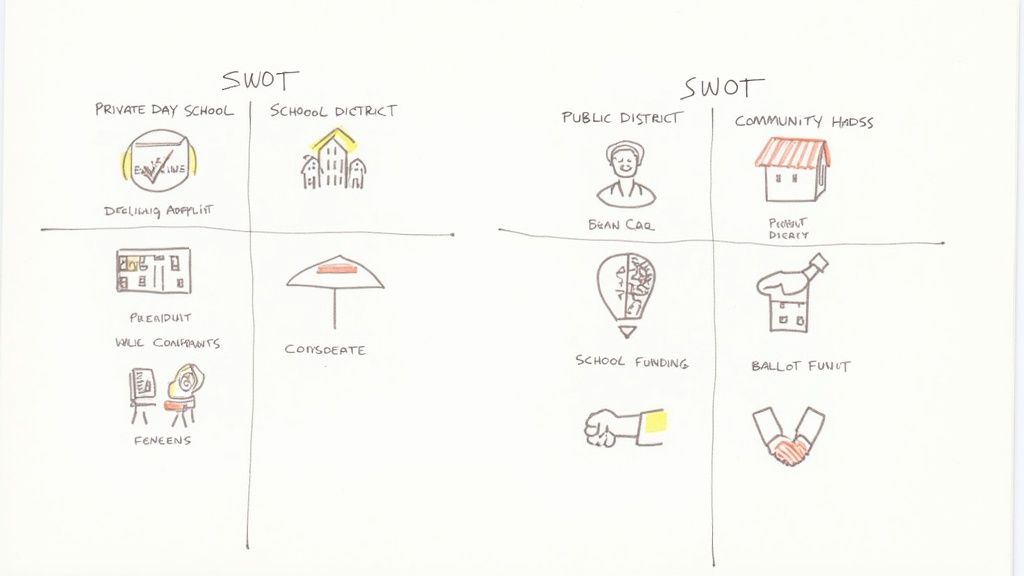
We'll walk through two very different, but very common, situations. First, we'll dive into the world of a private day school struggling with a drop in applications. Then, we’ll shift gears to a public school district that needs to rally community support to pass a make-or-break funding initiative. You'll see just how flexible this framework is.
Scenario 1: Reversing an Enrollment Dip at a Private School
The Goal: Get to the bottom of a 15% drop in new student applications over the last two years and map out a plan to turn things around.
Imagine a private school in a crowded suburban market. They're seeing a worrying decline in applications, especially for their middle school. To figure out what's going on, the leadership team pulls together a group: the admissions director, a couple of veteran teachers who've seen it all, and two current parents who can offer an on-the-ground perspective.
Here’s a snapshot of what their SWOT grid might look like after their session.
| Strengths (Internal, Positive) | Weaknesses (Internal, Negative) |
|---|---|
| • Stellar academic reputation, particularly in humanities. | • Our science labs and tech are embarrassingly outdated. |
| • Parents love us—we have a powerful word-of-mouth culture. | • The application process is a paper-based nightmare. |
| • Our experienced faculty is beloved and they don't leave. | • Our financial aid budget is tiny compared to our rivals. |
| Opportunities (External, Positive) | Threats (External, Negative) |
|---|---|
| • A huge tech company is moving in nearby, bringing new families. | • That new charter school with the flashy STEM lab just opened. |
| • More local families are searching for specialized learning support. | • Rising property taxes are making families feel the pinch. |
| • The local public middle school is bursting at the seams. | • The national conversation about the "value of private school" is negative. |
Let's unpack this. The Strengths are the aces up their sleeve—things they own and control, like their rock-solid reputation. The Weaknesses, on the other hand, are the internal hurdles they've created for themselves, like the ancient labs and clunky application system.
The Opportunities are gifts from the outside world, like the influx of new families they can attract. And the Threats are the external storms they have no choice but to weather, from the shiny new charter school down the street to the economic anxieties of local families.
Scenario 2: Rallying Support for a Public District's Funding Initiative
The Goal: Figure out what the community really thinks so we can build a communications plan that gets our bond measure passed.
Now, let's picture a public school district that desperately needs to pass a bond to fix crumbling buildings and launch new programs. The superintendent gets the right people in a room: a few principals, some school board members, and the leaders of the local PTO.
Their analysis is all about public perception, trust, and communication.
Building a strategy without first understanding the community's perspective is like trying to navigate a new city without a map. A SWOT analysis provides that essential guide, highlighting the roads to take and the roadblocks to avoid.
Here’s what their SWOT might reveal:
Strengths:
- Our high graduation rates consistently beat the state average.
- This town loves its high school sports, and we dominate.
- We have a very active and well-respected parent-teacher organization.
Weaknesses:
- We've done a poor job explaining how district money is spent.
- There's a feeling that the district office isn't transparent.
- You can literally see the disrepair at some of our older schools.
Opportunities:
- Local business leaders are on our side and have said so publicly.
- The local paper just ran a great story on our students' achievements.
- The city's economy is looking up, and people are feeling more optimistic.
Threats:
- A vocal anti-tax group is already organizing against the bond.
- Bad information about the true cost to homeowners is all over social media.
- We're worried about low voter turnout for a special election.
For this district, the internal Strengths are their proven track record and key community assets like the PTO. But their internal Weaknesses are just as significant—a history of poor communication has created a trust deficit.
The Opportunities are the tailwinds they can catch, like endorsements from influential business leaders. And the Threats are the headwinds they're sailing into, from organized opposition to the viral spread of misinformation online.
As you can see, the SWOT framework isn't just a business school exercise. It’s a practical tool for organizing a complex reality into a clear, actionable picture.
From Analysis to Actionable Strategy
A completed SWOT matrix pinned to a bulletin board might feel like a victory, but it's not the finish line. Honestly, it's just the starting block. The real magic of a SWOT analysis isn't in the neat lists you create; it’s in the strategic connections you make and the focused actions you take afterward. This is where raw data becomes a real roadmap for your school's marketing and communications.
Without a clear next step, all that hard work risks becoming what I call "analysis paralysis"—a detailed chart that looks impressive but never leads to meaningful change. The key is to shift from simply identifying your school's situation to actively shaping its future.
Introducing the TOWS Matrix
To bridge that gap between analysis and action, we're going to use a simple but powerful framework called a TOWS Matrix. Think of it as SWOT 2.0. It forces you to deliberately pair your internal realities (Strengths and Weaknesses) with what’s happening externally (Opportunities and Threats).
This matching exercise is where the strategic breakthroughs happen. Instead of staring at four separate lists, you start asking questions that naturally generate tangible strategies. It’s how you move beyond just observing and start building a deliberate plan.
The TOWS framework creates four distinct types of strategies:
- SO Strategies (Strengths-Opportunities): How can we use our core strengths to really capitalize on emerging opportunities?
- ST Strategies (Strengths-Threats): How can our strengths help us defend against or minimize external threats?
- WO Strategies (Weaknesses-Opportunities): How can we use external opportunities to fix or improve our internal weaknesses?
- WT Strategies (Weaknesses-Threats): What defensive moves do we absolutely have to make to keep our weaknesses from being exploited by threats?
This structured approach makes you think critically about every single item on your SWOT chart, ensuring no insight goes to waste.
Building Your Strategic Connections
Let's jump back to our private school example—the one struggling with an enrollment dip. Their SWOT analysis was just the beginning. Now, by applying the TOWS framework, they can generate concrete action items.
SO Strategy (Maxi-Maxi):
- Connection: Their stellar academic reputation (Strength) meets the influx of new families from a nearby tech company (Opportunity).
- Action Plan: Launch a targeted digital marketing campaign aimed at new movers in specific zip codes. The ads will highlight their advanced humanities programs and showcase alumni success stories at top universities.
ST Strategy (Maxi-Mini):
- Connection: Their powerful word-of-mouth culture (Strength) confronts the new charter school with its flashy STEM lab (Threat).
- Action Plan: Create a formal parent ambassador program. This initiative empowers current families with shareable content and talking points, emphasizing the unique value of a well-rounded education over trendy, specialized programs.
This method turns abstract points into focused initiatives. Each quadrant of the TOWS matrix gives you a different strategic angle, resulting in a balanced and comprehensive action plan. You can find some additional insights on conducting SWOT analysis for business leverage that might spark more ideas.
A SWOT analysis tells you where you are. A TOWS analysis tells you where to go. It's the essential link that turns a diagnostic tool into a strategic compass for your school's future.
The table below gives you a clear visual of how these connections work.
From SWOT to Strategy: The TOWS Matrix
This framework is all about matching your internal factors with external ones to build proactive, well-rounded strategies.
| Opportunities (External) | Threats (External) | |
|---|---|---|
| Strengths (Internal) | SO Strategies: Use strengths to maximize opportunities. (e.g., Promote your strong arts program to new families moving into the area.) | ST Strategies: Use strengths to minimize threats. (e.g., Leverage your strong community to counter a competitor's big marketing budget.) |
| Weaknesses (Internal) | WO Strategies: Use opportunities to overcome weaknesses. (e.g., Take advantage of a local business grant to upgrade your outdated tech.) | WT Strategies: Minimize weaknesses and avoid threats. (e.g., Acknowledge your small campus size and focus enrollment efforts on younger grades.) |
By working through each box, you ensure you're not just playing defense but also actively seeking out ways to grow and improve.
Prioritizing and Assigning Ownership
Okay, so you’ve brainstormed a great list of potential strategies. You can't do everything at once. The next critical step is prioritization.
A simple but surprisingly effective method is to use a dot-voting system with your team. Give each person a handful of sticky dots or votes and have them place them on the strategies they believe will deliver the biggest impact for the least amount of effort. It’s a quick way to build consensus.
Once you’ve identified your top 3-5 priorities, the final piece of the puzzle is accountability. Every single action item must have two things attached to it:
- A Single Owner: One person needs to be ultimately responsible for seeing the initiative through. This creates clarity and prevents things from falling through the cracks.
- A Clear Metric: Define what success actually looks like. Instead of "launch a campaign," make it "generate 25 new middle school inquiries from the target zip codes by the end of the quarter."
This process directly connects your SWOT findings to your school's broader goals. These actionable steps can become a core part of your school's growth plan and should absolutely inform your strategic enrollment planning.
This whole process has become so central to modern planning that a dedicated software market has sprung up around it. In fact, the global market for SWOT analysis creators is projected to hit $600 million in 2025. Cloud-based tools are leading the charge, holding over 75% of the market share thanks to their collaborative features. It just goes to show that organizations are investing in tools to make this process more efficient and actionable. By following a structured approach, you ensure your school's efforts are just as focused.
Common SWOT Analysis Mistakes to Avoid
Even a SWOT analysis with the best of intentions can go sideways, turning what should be a powerful strategic tool into a frustrating waste of time. I’ve seen it happen. The good news is that knowing the common pitfalls ahead of time is your best defense.
Over the years, I've noticed schools fall into the same traps. They create long, generic lists that have no real focus, let personal biases color the results, or lose steam because the initial goal was just too fuzzy.
But the biggest mistake of all? Analysis paralysis. This is where a team creates a beautiful, detailed matrix… and then it gets filed away, never to be seen again. Not a single action comes from it.
Losing Focus with Vague Objectives
The most frequent error happens before you even pick up a pen. Kicking off a SWOT session with a goal like "Let's improve our marketing" is a surefire way to have a rambling, unproductive conversation. When you don't have a specific problem to solve, your team's ideas will be all over the map.
A vague objective inevitably leads to a laundry list of disconnected points. You end up with minor operational gripes sitting right next to major strategic threats, and there's no clear way to sort through the noise.
The quality of your SWOT analysis is directly tied to the clarity of your initial question. A sharp objective acts as a filter, ensuring every point discussed is relevant and moves you closer to a specific solution.
To fix this, you have to anchor your session to a single, measurable goal. Instead of a broad topic, get specific: "How can we increase open house attendance from our feeder middle schools by 20%?" This simple shift immediately sharpens everyone's thinking and makes the entire exercise more effective.
Creating Generic and Unprioritized Lists
Another common pitfall is letting the brainstorming session run wild, producing long, generic lists for each quadrant. When "good communication" is listed as a strength and "budget limitations" as a weakness, what can you actually do with that? The terms are just too broad to be actionable.
This usually leads to a second problem: no prioritization. With 15 items listed under "Weaknesses," it’s impossible to know where to begin. The team gets overwhelmed, and the truly critical issues get lost among the less important ones.
Here’s how to avoid this trap: demand specifics.
- Instead of "Good Communication": Try "Our weekly parent e-newsletter has an average open rate of 65%, well above the industry average."
- Instead of "Budget Limitations": Get specific with "Our current digital ad budget is too small to effectively target the new suburban developments to the west."
Once you have a list of specific points, use a simple dot-voting system to prioritize. Give each person three or four votes (dots) to place on the items they believe are most critical. This is a quick, visual way to build consensus and create a short list of what truly matters.

As this flowchart shows, the SWOT matrix is just the starting line. It's the raw material. The real magic happens when you translate those findings into a concrete plan, which is how you avoid the trap of inaction.
Forgetting to Plan the Follow-Up
This might be the most damaging mistake of all: finishing the SWOT session with no clear plan for what comes next. All the energy and brilliant insights generated in the room vanish if there isn't an immediate, scheduled follow-up. This is the very definition of analysis paralysis.
The solution is simple, but it requires planning. Before your SWOT workshop even starts, schedule the follow-up strategy meeting. Put it on everyone's calendar.
Then, at the beginning of your SWOT session, announce that the goal isn't just to fill out a chart. The goal is to identify priorities that will be assigned owners and timelines at the next meeting. This small framing trick changes the entire dynamic. The analysis becomes the first step of a real process, not just a one-off event.
Your Top SWOT Analysis Questions, Answered
When you're gearing up to run a SWOT analysis for your school, a few questions always seem to pop up. School leaders I talk with are often curious about the timing, who should be in the room, and the nitty-gritty details of the framework itself. Let's get those sorted out so you can move forward with confidence.
I’ve pulled together the most common questions I hear from marketing and communications pros in the K-12 world to give you some quick clarity.
How Often Should We Really Be Doing This?
Ideally, you should plan on a full-blown SWOT analysis once a year. Think of it as a core part of your annual strategic planning cycle. This keeps your marketing strategy grounded in reality, not based on last year's assumptions.
But don't let that annual calendar box you in. A more focused SWOT is a powerful tool to pull out before any big strategic move.
For instance, you'll want to run one when you're:
- Kicking off a capital campaign for a new science wing.
- Reacting to a new competitor school opening just down the road.
- Facing a major demographic shift in your community.
Using the SWOT framework in these moments helps you stay nimble and make smart, responsive decisions.
Who Needs to Be in the Room?
This is a big one. To get the richest, most honest insights, you absolutely have to bring a diverse group to the table. A SWOT analysis done in a silo with just the admin team or the marketing department is guaranteed to have massive blind spots. You're aiming for a 360-degree view of your school.
Your invitation list should be a true cross-section of your community:
- School administrators who hold the big-picture operational knowledge.
- Admissions and marketing staff—they’re on the front lines with prospective families every single day.
- Faculty from different departments and grade levels.
- Current parents and board members for that crucial external perspective.
- Students or recent alumni (when appropriate) can offer some of the most candid, ground-level truths you'll hear.
It all comes down to control. Weaknesses are internal factors you can change over time. Threats are external forces you can only react to.
What’s the Real Difference Between a Weakness and a Threat?
This is, without a doubt, the most common point of confusion when people are new to the SWOT framework, but getting it right is critical. The whole distinction boils down to one word: control.
Weaknesses are internal. These are the challenges and shortcomings that are within your school's power to fix. Think of things like an outdated website, a clunky carpool line, or a limited selection of AP courses. You own these, and with time and resources, you can improve them.
Threats are external. These are factors completely outside of your direct control. A new charter school opening a mile away, declining birth rates in your county, or a wave of negative press about private education are all threats. You can't stop them from happening, but you can build a strategy to defend against their impact.
At The MarCom Society, we're all about giving K-12 marketing professionals the tools and community you need to lead these critical strategic conversations. Join us to get access to expert workshops, tons of downloadable resources, and the peer support that will help take your school's marketing to the next level.