When you break it down, a SWOT analysis is really a four-part conversation.It starts with thoughtful preparation, moves into a collaborative brainstorm covering Strengths, Weaknesses, Opportunities, and Threats, and then funnels into deep analysis and finally, a concrete action plan. This simple framework is incredibly effective for helping schools figure out where they stand and how to move forward.
Why a SWOT Analysis Matters for Your School
In the increasingly competitive world of K-12 education, a SWOT analysis is much more than just a business school exercise. Think of it as a powerful diagnostic tool—one that turns fuzzy goals into a real-world action plan for boosting enrollment and strengthening your school's community. When you get this right, you stop operating on assumptions and start building your strategy on solid ground.
It’s all about getting that 30,000-foot view of your school's marketing and communications landscape. You clearly see what’s working, what isn't, and what potential changes are just over the horizon. That kind of clarity is priceless.
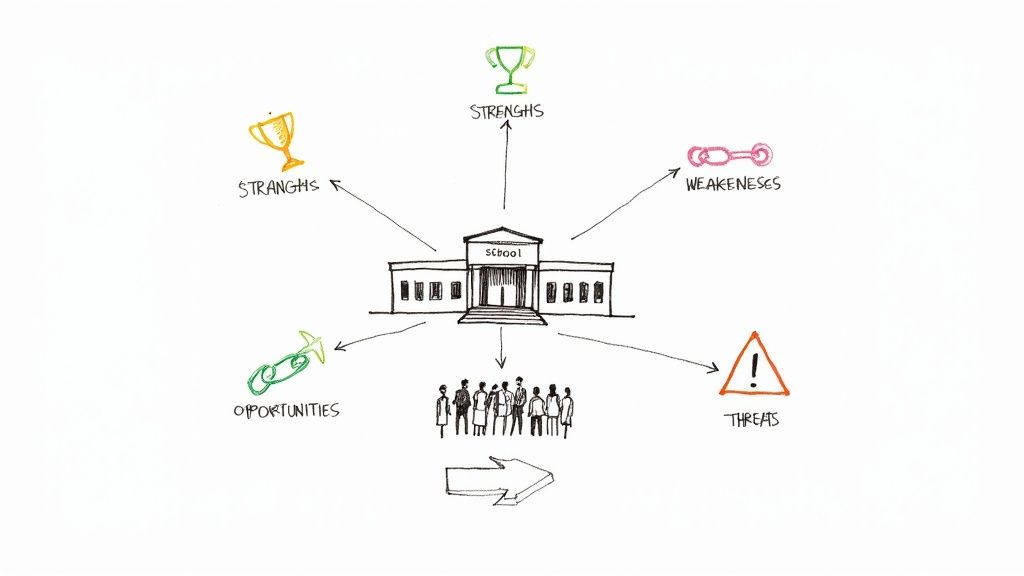
Before diving into the "how," let's quickly review the four pillars that make up the SWOT framework. Each component asks you to look at your school from a different angle, giving you a complete picture.
The Four Pillars of a School SWOT Analysis
| Component | Focus | Example Question for a School |
|---|---|---|
| Strengths | Internal positives—what you do well. | "What unique programs or faculty expertise makes families choose us?" |
| Weaknesses | Internal negatives—areas for improvement. | "Where are we consistently losing prospective students to competitor schools?" |
| Opportunities | External factors you can leverage. | "Is there a growing local industry we could partner with for a new STEM track?" |
| Threats | External factors that could cause trouble. | "How will the new charter school opening downtown impact our enrollment?" |
Understanding these distinct categories is the key to a focused and productive session. It keeps the conversation organized and ensures you're not just listing random ideas but categorizing them for strategic use later on.
Aligning Your Team Around a Shared Vision
One of the biggest, and often overlooked, benefits of running a SWOT session is how it pulls your team together. When you get administrators, admissions staff, and teachers in the same room, you're tapping into a wealth of different perspectives that make the entire process richer. Suddenly, everyone is on the same page, working from a shared understanding of the school's reality.
This collaborative approach always uncovers insights that would have otherwise stayed siloed in different departments. For instance:
- The admissions team might flag a major weakness in the campus tour experience that leadership is unaware of.
- A group of teachers could highlight the strength of a niche academic program that marketing has never promoted.
- A parent representative might spot a fantastic opportunity for a new community partnership.
Tapping into this collective intelligence makes your final strategy far more robust and, frankly, more realistic.
From Vague Goals to a Tangible Strategy
The SWOT framework gives your strategic conversations a much-needed structure, keeping them from spiraling into unproductive complaint sessions. It organizes a mountain of complex information into four simple quadrants, making it infinitely easier to spot connections and decide what to tackle first. It’s a foundational step that fits perfectly within the larger context of strategic planning for nonprofit organizations.
By identifying your school's unique strengths and matching them to external opportunities, you uncover the most direct pathways to growth. This process turns your "what if" ideas into a "how-to" roadmap.
This method has been around for a long time for a reason: it works. Originating back in 1965, SWOT analysis is a time-tested technique. In fact, it’s projected that by 2025, about 72% of executives will continue to prioritize it in their strategic planning. This simple but powerful exercise delivers the clarity you need to make smart decisions that will shape your school’s success for years to come.
Laying the Groundwork for a Productive Session
The success of your SWOT analysis is decided long before anyone ever walks into the meeting room. I’ve seen it firsthand: a well-prepared session produces focused, actionable insights. A poorly prepared one? It almost always devolves into a disorganized complaint-fest.
If you want a SWOT that actually moves the needle for your school, getting the prep work right is non-negotiable.

Define a Crystal-Clear Objective
First things first: you need a single, specific goal for the analysis. Without a clear objective, your conversation will wander, and you'll end up with a laundry list of points that are impossible to prioritize.
Think of your objective as the lens through which you’ll view every strength, weakness, opportunity, and threat. Vague goals like "improve marketing" just won't cut it. You need to get sharp and measurable.
Instead of: "We want to grow our school."
Try: "Increase middle school enrollment by 10% for the next academic year."
Instead of: "We need better parent communication."
Try: "Improve our parent satisfaction score on communications from 75% to 90% by the end of the school year."
This level of specificity gets everyone in the room solving the same problem. It makes it so much easier to filter ideas and zero in on what’s truly relevant to your goal.
Assemble Your SWOT Dream Team
The quality of your analysis is directly tied to the diversity of perspectives you bring to the table. If you only invite the leadership team, you’re guaranteed to get a narrow, top-down view. For a complete picture, you need a cross-functional group that represents a real slice of your school community.
Consider pulling in people from these key groups:
- School Leadership: The Head of School and division principals who own the strategic vision.
- Admissions & Marketing: Your team on the front lines of recruitment and communication.
- Faculty Members: A mix of teachers from different grades or departments who live the student experience daily.
- Parent Association Leaders: Influential parents who can provide that critical, authentic external perspective.
- Board Members: Trustees who bring a governance and long-term oversight lens to the conversation.
When you bring these different voices together, you’ll uncover insights that would otherwise stay siloed in individual departments. A teacher might highlight a curriculum strength that marketing never knew about, while a parent could point out a weakness in the carpool line that administrators overlook.
Gather Your Data Before the Meeting
A truly effective SWOT analysis is fueled by data, not just opinions. To ground the conversation in reality, you have to gather relevant information beforehand and share it with the team. This homework helps participants come prepared with informed ideas, not just gut feelings.
Your data-gathering checklist should include a mix of internal and external sources. For a more detailed guide on this process, check out our article on how to conduct market research.
Pro Tip: I always send a concise summary of key data points to all participants at least two days before the session. This "pre-read" packet ensures everyone starts with the same baseline understanding and saves a ton of valuable meeting time.
Here's some of the essential information I recommend collecting:
- Enrollment & Admissions Data: Look at application numbers, yield rates, and attrition trends over the last 3-5 years. Are there patterns?
- Parent & Student Surveys: Pull the key takeaways and common themes from your most recent satisfaction or feedback surveys.
- Competitor Analysis: Do a quick scan of what nearby competitor schools are promoting. What are their core marketing messages?
- Website & Social Media Analytics: Note your most popular content, engagement rates, and any direct feedback you're seeing on social channels.
Having this information on hand allows the team to validate their points with evidence. For example, instead of someone just feeling like the website is a weakness, you can point to a high bounce rate as concrete proof. This data-driven approach is what elevates the entire exercise from a simple brainstorm to a powerful strategic planning tool.
Guiding the SWOT Brainstorming Session
Alright, you’ve got your objective locked in and your team assembled. Now it's time to roll up your sleeves and get to the heart of the SWOT analysis. This is where the real insights are uncovered through a structured, collaborative brainstorm. As the facilitator, your job is to steer the conversation, keep the energy up, and make sure everyone gets a chance to contribute.
I’ve found that the best way to kick things off is with a stack of sticky notes for each person. Give everyone five to ten minutes of quiet, individual time for each of the four quadrants (Strengths, Weaknesses, Opportunities, Threats). This little trick is a game-changer—it helps prevent groupthink and gives the more introverted folks on your team the space to get their ideas down without being talked over.
Once the time’s up for a section, have everyone walk up and stick their notes on the corresponding part of the whiteboard or flip chart. Then, you can start clustering similar ideas and discussing them as a group.
Uncovering Your Authentic Strengths
Strengths are the positive things happening inside your school—the assets and attributes you have direct control over. The goal here isn't just to list nice things about your school; it’s to pinpoint the specific, evidence-backed advantages that make you stand out.
Most schools will immediately jump to broad claims like "great teachers" or a "strong community." While probably true, these statements are too vague to build a strategy around. You need to gently push your team to find the proof.
- Instead of “great teachers,” probe for the details. Does that mean "Our faculty includes five teachers with Ph.D.s in their subjects, giving us unparalleled academic depth in the upper school"?
- Instead of a “strong community,” ask for the data. Does that mean "We have an 85% parent volunteer rate for school events, which is double the regional average"?
Get the group thinking about what really tips the scale for prospective families. Is it your state-of-the-art STEM lab? Your signature project-based learning curriculum? These are the strengths that become the pillars of your marketing messages.
Confronting Your Weaknesses Honestly
This part of the conversation can feel a bit awkward. It requires real honesty and a touch of vulnerability. Weaknesses are the internal factors holding you back, and it’s critical to create a safe space where people can point out what’s not working without anyone getting defensive.
Frame this exercise as an opportunity for growth, not a complaint session. And just like with strengths, press for specifics. "Our website is outdated" is a classic entry, but it doesn't tell you anything actionable. What does "outdated" actually mean?
- Does it have a bounce rate over 60% on the main admissions page?
- Is it not mobile-responsive, frustrating the 70% of parents who are looking you up on their phones?
- Does your inquiry form have a painfully low completion rate because it's too long or clunky?
Other common school weaknesses might be the lack of a formal parent ambassador program, inconsistent branding across divisions, or a re-enrollment process that feels like filing taxes. Naming the specific problem is the only way you can start building a plan to fix it.
Tackling weaknesses isn't about placing blame; it's about taking ownership. Acknowledging a flaw is the only way to build a strategy that effectively addresses it.
Identifying External Opportunities
Now we shift our focus from inside the school walls to the world outside. Opportunities are external factors you can use to your advantage. This requires your team to look up from their daily tasks and scan the horizon for trends in education, your local community, and technology.
Get the conversation started with some prompts:
- Demographic Shifts: Is a new housing development full of young families being built a few miles away?
- Industry Growth: Is a major tech company opening a new campus in town, bringing in families who will value your STEM program?
- Educational Trends: Is there a growing public interest in social-emotional learning that perfectly aligns with your school's long-standing philosophy?
This is also the perfect time to look at your marketing channels. Maybe a local parenting blog has exploded in popularity, creating a new partnership opportunity. Or perhaps you’ve noticed none of your competitors are using video tours effectively. These insights are gold. To get an even clearer picture of what your stakeholders are thinking, consider running focus groups. Our guide on how to conduct focus groups can walk you through that process.
Recognizing External Threats
Last but not least, it’s time to talk about threats. These are the external factors that could cause problems for your school. Just like opportunities, they are largely outside your control, but identifying them is the first step in creating a plan to protect yourself.
Threats often come from your competition, but they can also be wider economic or societal shifts.
- Direct Competitors: A new charter school with a slick marketing budget is opening two miles down the road.
- Economic Factors: A major local employer just announced layoffs, which could impact re-enrollment next year.
- Changing Perceptions: You’re noticing a growing national conversation that questions the value of independent school tuition.
The idea here is to be realistic, not to create a panic. By identifying potential threats before they’re at your doorstep, you can build strategies to mitigate their impact. That foresight is what separates schools that are always reacting from those that are proactively shaping their own future.
Example SWOT Analysis for a K-8 Independent School
To make this all a bit more concrete, here’s a sample SWOT matrix for a fictional independent school. Notice how each point is specific and provides a clear starting point for strategic planning.
| Strengths | Weaknesses | Opportunities | Threats |
|---|---|---|---|
| STEM program with 3 dedicated labs and a 1:1 device ratio for grades 5-8. | Admissions inquiry form has a 50% abandonment rate due to its length and outdated design. | A new 300-home subdivision is under construction within a 3-mile radius, targeting young families. | A new, well-funded public charter school with a STEM focus is opening next fall. |
| 92% student retention rate from K-7, indicating high family satisfaction. | Inconsistent branding and messaging between the lower and middle school divisions. | The local newspaper and two influential parent blogs have expressed interest in featuring our project-based learning curriculum. | A major local corporation announced layoffs, which could affect 15% of our current families. |
| Award-winning debate team that has won the state championship for the last 3 years. | The school's social media presence is minimal and managed by a parent volunteer with limited time. | None of our direct competitors are actively using video testimonials on their websites or social media. | Rising operational costs (insurance, utilities) are putting pressure on the upcoming tuition increase. |
| A highly engaged Parent Association that raised over $150K last year for facility upgrades. | Lack of a formal alumni relations program, resulting in missed fundraising and networking opportunities. | Local businesses have expressed interest in sponsoring school events or programs. | Public sentiment in our region is shifting, with more families questioning the ROI of private school tuition. |
Looking at a completed matrix like this one, you can start to see how the different quadrants connect. For instance, the school could leverage its award-winning debate team (Strength) and the media's interest (Opportunity) to create a PR campaign that directly counteracts the threat from the new charter school. This is where your analysis starts turning into a real, actionable strategy.
Turning Your SWOT Analysis Into Action
Finishing your SWOT matrix feels like a huge win. You’ve just created a powerful snapshot of your school's reality, packed with honest insights from your team. But let's be real—the analysis itself doesn't change a thing. Its true value is unlocked only when you translate those lists into a clear, actionable strategy.
Without a deliberate next step, even the most brilliant SWOT can end up collecting digital dust in a forgotten folder. It's time to move from analysis to synthesis, connecting the dots between those four quadrants to build a plan that actually drives progress for your school's marketing and communications.
This framework shows the classic flow, starting with your internal reality before looking outward.
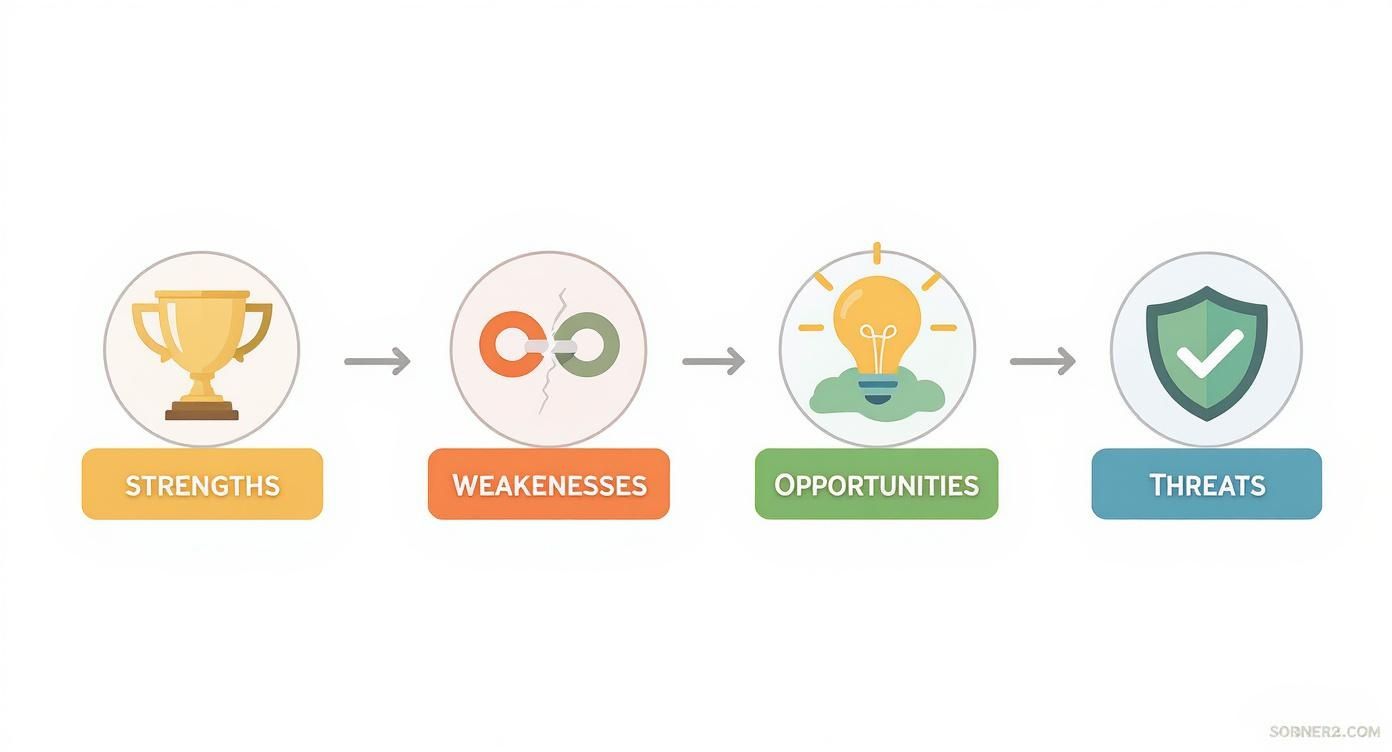
Each box gives you a different lens to view your school, ensuring you have the full picture before you start plotting your next moves.
The Bridge from Insight to Action: The TOWS Matrix
To build that action plan, we’re going to use a simple but incredibly effective framework called a TOWS analysis. I know, another acronym. But this one is a game-changer because it strategically flips SWOT on its head and forces you to make direct connections between the quadrants. It’s all about asking four specific questions:
- Strengths-Opportunities (S-O): How can we use our internal strengths to jump on external opportunities?
- Strengths-Threats (S-T): How can our strengths shield us from these external threats?
- Weaknesses-Opportunities (W-O): Can we leverage an opportunity to fix one of our weaknesses?
- Weaknesses-Threats (W-T): How do we minimize our weaknesses to avoid being vulnerable to threats?
This approach is the bridge between knowing your situation and knowing what to do about it. It pushes you beyond simple lists and into building real, tangible strategies.
Connecting the Quadrants: Real-World School Examples
Let’s look at how this plays out in a typical school setting. By pairing items from different parts of your SWOT, you can brainstorm specific initiatives that make sense for you.
1. Using Strengths to Seize Opportunities (S-O)
This is your "growth" quadrant, where the magic happens. You’re pairing what you already do well with a favorable wind at your back.
- Example: Your Strength is an award-winning arts program. The Opportunity is a new creative-industry corporate HQ opening nearby. Your strategy? Develop a corporate partnership program offering arts scholarships or sponsor a student art gallery in their new lobby.
2. Using Strengths to Mitigate Threats (S-T)
Think of this as your "defensive" playbook. You're using your core advantages to build a moat around your school and protect it from risk.
- Example: A local Threat is a new charter school opening with a massive marketing budget. But your Strength is a 95% parent satisfaction rate. The move is clear: Launch a "Why We Stay" campaign featuring powerful video testimonials from your most loyal families.
A well-crafted strategy isn't just about chasing new ideas; it's about strategically leveraging what you already have to protect your position and build resilience against future challenges.
Shoring Up Your Defenses and Planning for the Future
The next two pairings are all about addressing your vulnerabilities so you don't get left behind. These often become critical internal projects for your team to tackle.
3. Using Opportunities to Overcome Weaknesses (W-O)
Here, you're looking outside for a solution to an internal problem. This is your "improvement" strategy.
- Example: Your Weakness is an outdated, clunky website. You notice an Opportunity—none of your competitors are using virtual tours effectively. The strategy writes itself: Invest in a new, user-friendly website with a high-quality virtual tour as its centerpiece to leapfrog the competition.
4. Minimizing Weaknesses to Avoid Threats (W-T)
This is your "precautionary" work. It’s about patching the holes in your ship before you sail into a storm.
- Example: A known Weakness is inconsistent communication with current parents. A serious Threat is declining enrollment across your region. The strategy is to implement a new parent communication platform to improve retention and stop families from even thinking about looking elsewhere.
Prioritize, Assign, and Measure
You’ll likely come out of the TOWS exercise with a long list of great ideas. You can’t do everything at once. The final, critical step is to prioritize.
A simple impact/effort matrix works wonders here. Just rank each idea by its potential impact (high, medium, low) and the effort it would take (high, medium, low). Go after the high-impact, low-effort "quick wins" first to build momentum.
For every strategy you decide to pursue, assign:
- An Owner: Who is accountable for this?
- A Timeline: By when?
- A Metric: What does success look like in numbers?
This turns a brainstorming session into a concrete work plan. To see how these action items fit into a larger plan, check out our guide on strategic planning for schools. Of course, once the plan is set, you need to sell it internally, so understanding what makes a good presentation is key to getting stakeholder buy-in.
Common Mistakes That Can Derail Your SWOT Process
Even the most well-intentioned SWOT analysis can fall flat. You end up with a whiteboard full of ideas, but nothing ever comes of it. Knowing the steps is one thing, but sidestepping the common pitfalls is what makes the whole exercise worthwhile.
Let's be honest, the most frequent mistake is just creating a giant laundry list. When you have dozens of unweighted items stuffed into each quadrant, the result is pure overwhelm. The goal isn't to capture every single thought, but to pinpoint the most significant factors that will genuinely shape your school's marketing strategy.
Ditch the Vague Statements for Cold, Hard Facts
Vagueness is the absolute enemy of a useful SWOT. I’ve seen it a hundred times—phrases like "good community" or "strong teachers" get thrown around. They sound nice, but they're strategically useless because they don't point to any clear action.
This is why I have one non-negotiable ground rule for any SWOT session I facilitate: the "Prove It" rule. If someone wants to add a point to the board, they have to back it up with a specific example or a piece of data.
- Instead of just saying you have a "good community," what does that actually mean? Maybe it's "85% parent participation in annual fundraising efforts." Now that's something we can work with.
- "Strong teachers" is a great sentiment, but how do we prove it? It's much more powerful to say, "70% of our faculty hold advanced degrees in their subject area."
This simple change forces everyone to move past fuzzy, feel-good statements and root the entire conversation in reality. It gives your analysis credibility and creates a much stronger foundation for building an actual plan.
Your SWOT analysis is only as strong as the evidence supporting it. Vague assertions lead to vague strategies. Specific, data-backed points lead to targeted, effective actions.
Make Sure Every Voice in the Room Is Heard
It happens in every meeting. A few dominant personalities naturally take over, and before you know it, the SWOT reflects what two or three people think, not the collective insight of the entire room.
That’s why I always start each quadrant with a few minutes of silent, individual brainstorming. Hand everyone a stack of sticky notes and just give them time to think. This simple act empowers the introverts and junior team members to get their thoughts down without being interrupted or influenced.
When you finally go around the room or have people post their notes, you'll be amazed at the richer, more diverse set of ideas you get right from the jump.
The Biggest Mistake of All
Here it is: The single biggest mistake a school can make is to run a fantastic, engaging SWOT session… and then do absolutely nothing with the results. That filled-out matrix isn't the final product. Think of it as the raw material for your strategy.
Your SWOT is a diagnostic tool, not a historical document meant for a filing cabinet. If it isn't immediately used to build out a TOWS matrix, prioritize actions, assign ownership, and set deadlines, then you've just wasted a lot of smart people's valuable time. The analysis has to be the starting pistol for action, not the finish line.
Don't Let Your SWOT Analysis Collect Dust
You’ve finished the SWOT analysis. Great. Now, what do you do with it? Too often, these insightful documents end up filed away, never to be seen again. The key is to treat it as a living, breathing guide for your school's marketing and communications, not a trophy for the shelf.
The next step is to translate those big-picture insights into your annual marketing plan. This is where the magic happens, turning what you’ve learned into real initiatives with clear, measurable goals.
A SWOT analysis without follow-through is just a meeting. The real value comes from turning those carefully identified points into a concrete, measurable, and time-bound action plan that steers your school toward its goals.
Each strategic initiative needs to be connected to specific key performance indicators (KPIs). Think of KPIs as the yardstick for your success. They turn vague hopes into concrete targets, letting you track your progress and prove the value of your efforts. Without them, you're just guessing.
Let's say your SWOT analysis flagged your school's outdated website as a major Weakness. The strategy isn't just "fix the website." It's a full-blown project, and its success can't be based on a feeling—it needs to be measured with hard data.
From Insight to Impact with KPIs
Let's make this real. How do you attach a metric to that website example? Instead of a fuzzy goal, you set a specific KPI that leaves no room for doubt.
- Strategy: Redesign the school’s admissions section to improve the user experience for prospective families.
- KPI: Reduce the website bounce rate by 15% within six months of the new site launch.
- KPI: Increase inquiry form completions by 20% in the first year.
See the difference? This approach creates accountability and gives you concrete evidence of how your marketing efforts directly support the school's enrollment goals.
Finally, remember that the world of education is constantly changing. A SWOT from last year might already be missing new trends or challenges. To keep your strategy sharp and relevant, plan on a full review and refresh of your analysis annually. This rhythm keeps your school agile and ready to adapt, ensuring you’re always prepared to tackle what's next.
Got Questions? We’ve Got Answers.
Even with the best game plan, a few questions always pop up when you're getting ready to run your own SWOT session. Let's tackle some of the most common ones we hear from school marketing and communications pros in the field.
How Often Should We Really Be Doing This?
A full-blown SWOT analysis is something you should put on the calendar annually. Think of it as your school's yearly marketing health check-up, perfectly timed with your strategic planning cycle.
That said, don't just file it away for 365 days. You'll want to dust it off and revisit it any time a major change happens. Did you just hire a new Head of School? Is a new charter school opening a mile away? Did the demographics of your town shift unexpectedly? These are all perfect triggers for a SWOT refresh.
Who Needs to Be in the Room?
Getting the right people together is half the battle. If you only have the marketing team in the room, you’re going to get a very one-sided view. The magic happens when you bring together a diverse group that can see the school from different angles.
Your invite list should be a true cross-section of your community:
- Leadership Team: Your Head of School and Principals are non-negotiable.
- Admissions & MarCom: This is your core team.
- Faculty: Make sure you have teachers from different divisions (lower, middle, upper school).
- Parents: The head of your parent association is a fantastic resource.
- Board Members: A trustee or two can provide that high-level, strategic perspective.
Getting this mix of voices ensures you're getting the full picture, not just the one seen from the main office.
Here's a pro-tip we always share: Weaknesses are internal problems you can fix. Threats are external forces you have to navigate. Nail this distinction, and your entire analysis will be more focused and useful.
What’s the Real Difference Between a Weakness and a Threat?
This is the one that trips up almost everyone, so let's clear it up. It’s a simple but crucial difference.
Weaknesses are internal issues your school has direct control over. Think of things like your clunky re-enrollment process, an outdated science lab, or even low faculty morale. These are problems you can roll up your sleeves and work on.
Threats, on the other hand, are external forces happening to you. You can't control them, only react. This could be a declining school-age population in your zip code, a new state voucher program, or that competitor across town launching a massive ad campaign.
Ready to elevate your school's marketing strategy with insights from leading experts? Join The MarCom Society to access exclusive resources, expert-led workshops, and a supportive community of K-12 professionals just like you. Learn more and become a member.