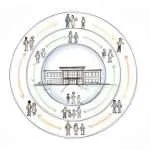
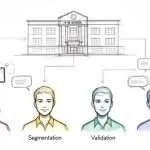
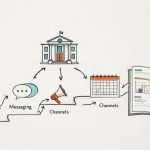
If you want to build truly effective buyer personas, you need a solid framework. It boils down to four key stages: defining your goals, doing the deep research, building out detailed profiles, and finally, putting them to work across all your marketing. This approach is what takes you from shouting into the void with generic messaging to having meaningful conversations with the specific families you want to see walking through your doors.
When you really get to know what drives their decisions, you can craft communication that actually connects, which ultimately leads to better inquiries and stronger enrollment numbers.
Why Your Generic Marketing Fails to Attract the Right Families
Let's be real. The goal isn't just to attract any family—it's to attract the right family. In the crowded and competitive world of K-12 education, a one-size-fits-all message is a recipe for getting ignored. When you try to speak to everyone, you end up connecting with no one, because you're not hitting on the specific hopes, fears, and priorities that guide a parent’s school choice.
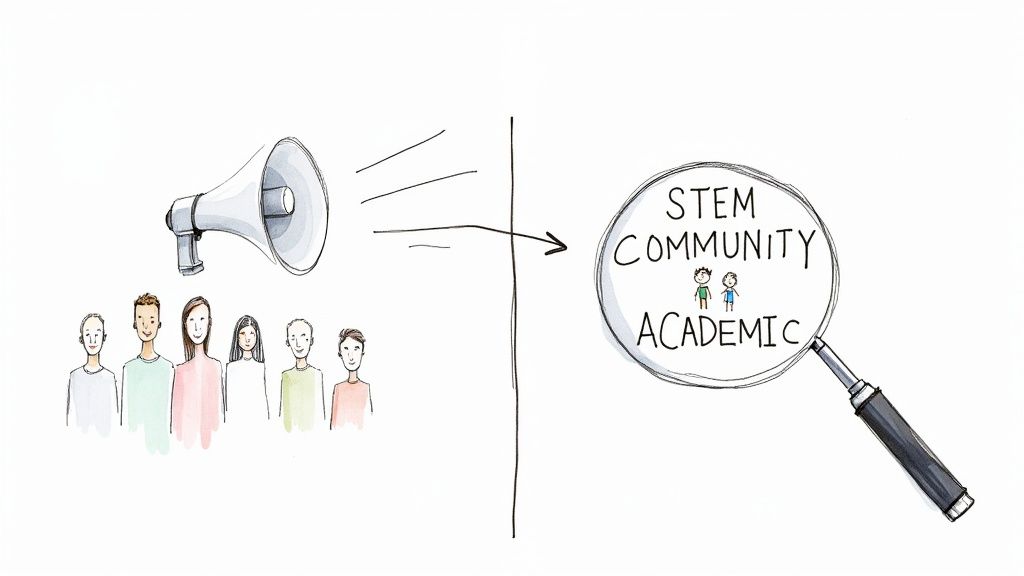
When your marketing casts too wide a net, you get a flood of broad interest. That often means a lot of unqualified leads and a ton of time wasted for your admissions team. Buyer personas are the strategic fix for this. They aren't just a fluffy marketing exercise; they are your roadmap to understanding the real-world motivations of modern parents.
Shifting from Assumptions to Insights
At its heart, creating buyer personas is about one thing: replacing gut-feel assumptions with hard, data-driven insights. Instead of guessing what parents might care about, you build a crystal-clear picture based on what you know from your research. This whole process is the bedrock of good audience segmentation, which is just a structured way of grouping families who share similar needs and goals. For more on that, you can check out this resource: https://blog.marcomsociety.org/what-is-audience-segmentation/
This shift from guessing to knowing lets you do a few critical things:
- Speak directly to their pain points: You can finally address the specific things keeping them up at night, whether it’s a lack of STEM opportunities at their current school or a deep desire for a more nurturing classroom environment.
- Highlight what actually matters to them: Instead of listing every feature of your school, you can showcase the specific programs and outcomes that will make a particular type of family sit up and take notice.
- Show up in the right places: You'll know exactly where to find them, whether it’s a hyper-local parenting group on Facebook or a professional network like LinkedIn.
Think of it this way: you wouldn't use the same pitch for your advanced robotics club to a parent laser-focused on arts integration as you would for a parent whose kid is a coding whiz. Personas give you the playbook to nail that conversation every single time.
To give this process some structure, we'll follow a simple four-stage framework that provides a clear roadmap from start to finish. This will keep your efforts focused and effective. If you want to go even deeper on the basics, there's a complete guide on how to create buyer personas that provides excellent background.
We've put together a table that lays out this roadmap, giving you a clear, step-by-step process for creating and using personas that genuinely reflect your ideal K-12 families.
A Four-Stage Framework for Building School Personas
| Stage | Core Objective | Essential Activities |
|---|---|---|
| 1. Define Goals | Align persona work with your school's strategic enrollment objectives. | Set clear goals, identify who needs to be involved, and define what success looks like. |
| 2. Conduct Research | Gather both quantitative and qualitative data on your families. | Dig into your CRM data, survey current parents, and conduct interviews with prospective families. |
| 3. Build Profiles | Turn all that research into detailed, usable persona profiles. | Create semi-fictional profiles with names, goals, challenges, and communication preferences. |
| 4. Apply & Measure | Weave your new personas into all marketing and communications. | Tailor your messaging, select the right channels, and track performance against your goals. |
Following these four stages ensures you're not just creating documents that will sit on a shelf. You're building a strategic tool that will fundamentally improve how you connect with families.
Defining Your School's Strategic Enrollment Goals
Before you jump into surveys and interviews, we need to lay some groundwork. The whole process of creating parent personas has to start with one simple question: What are we actually trying to achieve here?
Without a clear answer, your personas will end up as interesting but ultimately useless profiles that just gather digital dust. To make this work, your persona project must be directly wired into your school's most critical institutional goals. This alignment is what turns a marketing exercise into a real tool for strategic growth.
Connect Personas to Enrollment Objectives
Take a minute to think about your school's most pressing priorities. Are you about to cut the ribbon on a new state-of-the-art STEM wing? If so, you need to attract families who are genuinely passionate about science and technology.
Or maybe you’ve noticed a troubling dip in enrollment from a key neighboring county and need to figure out how to reverse that trend. Your main goal might even be boosting retention by getting a better handle on what makes your current families tick, ensuring they stay with you for the long haul.
Defining these objectives right from the start gives your research a clear purpose. It frames everything.
Goal: Increase middle school applications by 15%.
Persona Focus: Pinpoint the specific anxieties and aspirations of parents with 5th and 6th graders in your main feeder districts. What keeps them up at night?
Goal: Fill the seats in your new arts conservatory program.
Persona Focus: Find the families who truly value creative expression and are actively looking for specialized arts education. Where do they hang out online? What do they search for?
When you start with a clear 'why,' every piece of data you gather becomes relevant and actionable. You’re not just learning about families; you’re learning what you need to know to move the needle on specific, measurable outcomes.
This first step is the bedrock of any solid enrollment strategy. For a more detailed look at how this fits into the bigger picture, check out our guide on strategic enrollment planning.
Identify Key Stakeholders and Their Questions
Once you’ve nailed down your goals, it’s time to figure out who inside your school will actually use these personas. This isn’t just a job for the marketing office; it’s a team effort. To be effective, your personas have to be valuable to everyone involved in bringing families in and keeping them here.
Get your key players around a table early in the process. This group should probably include:
- The Head of School
- Your Director of Admissions
- Division Heads
- A few key faculty members
- Parent ambassadors
Each of these people sees the school through a different lens and has different questions they need answered to do their job well.
Your admissions director is probably wondering, "What are the biggest objections we need to be ready for during a school tour?" A parent ambassador, on the other hand, might need to know, "What kind of success stories really connect with prospective parents like me?"
Gathering these questions from the get-go ensures your research is designed to deliver practical, real-world answers. You’re not just building a vague profile of "Achievement-Focused Amelia." You’re discovering her top three deal-breakers for choosing a high school, the blogs she reads every morning, and the tough questions she’s afraid to ask on a tour.
This is the kind of detail that empowers your entire team to communicate with real empathy and precision, which directly supports your school's mission and its financial health.
Gathering the Insights You Need on K-12 Families
If you want to create parent personas that actually work, you have to get out of the conference room and stop making assumptions. It’s time to put on your detective hat and dig into real data.
This whole process really boils down to two types of research, and they work best when you use them together. One gives you the "what," and the other gives you the "why."
First, you've got the quantitative stuff—the hard numbers. This is the goldmine you're likely already sitting on: your CRM, enrollment database, and website analytics. This data shows you what people are doing on a large scale.
But numbers don't tell the whole story. To understand the why behind a parent's choice, you need qualitative research. This is where you'll find the stories, the emotions, and the real-world context that make your personas come alive.
Finding Trends in Your Existing Data
Your school has a treasure trove of quantitative information just waiting to be analyzed. This is the perfect place to start because it’s based on the actual behavior of your families, not just theories. It gives you a solid, factual foundation to build on.
Start by digging into a few key places:
- Your CRM or Enrollment Database: Look for the patterns. Where do most of your families live? Which zip codes or feeder schools pop up over and over? Are there common threads in family size or what parents do for a living? This gives you a quick sketch of who’s already part of your community.
- Google Analytics: Your website traffic tells a fascinating story. Which program pages are people spending the most time on? What search terms are leading them to your site? Seeing how people move through your site highlights what they truly care about.
- Social Media Insights: Don’t forget to check the analytics on your main social channels. On Facebook and Instagram, you can see the basic demographics of your followers—age, gender, location. Pay close attention to the posts that get the most comments and shares. That’s a direct signal of what your community is passionate about.
When you pull all this data together, you'll start to see some high-level segments take shape. You might discover that 35% of your new middle school inquiries are clustered in just three nearby zip codes. Or maybe you'll notice that your blog posts on social-emotional learning get twice the engagement of posts about academic scores. These are the first threads you'll pull to unravel the bigger story.
The Power of Real Conversations
While data shows you what families are doing, talking to them is how you learn why they’re doing it. This is where you uncover the motivations, the anxieties, and all the little decision-making moments that you’ll never find in a spreadsheet.
The goal here is simple: understand what a 'day in the life' is like for your target families. This means reaching out to real people through surveys and, most importantly, one-on-one interviews. You'll want to chat with a mix of people to get the full picture.
Your interview list should include:
- Current Parents: Especially those who just went through the admissions process. Their memory is fresh, and they can tell you exactly what worked and what didn't.
- Prospective Families: Talk to parents who are currently touring or have just inquired. Their questions and concerns are happening in real-time.
- Faculty and Staff: Your admissions team, division heads, and even veteran teachers have incredible front-line perspectives on what parents are struggling with and what they truly value.
If you want to get more technical on the methodology, we have a complete guide on how to conduct market research that breaks down more structured approaches.
Asking Questions That Get Real Answers
The quality of your personas hinges entirely on the quality of your interviews. You have to get past simple "yes" or "no" questions. The magic is in the open-ended prompts that encourage people to tell you a story.
Here are a few examples to get you thinking beyond the surface level:
For a Current Parent
- "Walk me through the moment you knew our school was the right fit. What was happening, and what did that feel like?"
- "Think back to your school search. What was the most stressful or frustrating part of that whole process?"
- "If you were telling a close friend about our school, what's the one story you'd share that really captures what this place is all about?"
For a Prospective Parent
- "When you think about the ideal school for your child, what are the top three non-negotiables?"
- "As you've been researching schools in the area, what information has been the hardest to find?"
- "Picture your child a year from now, absolutely thriving in their new school. What does that look like?"
These kinds of questions are designed to get you emotional responses and detailed anecdotes. That's the raw material for building a persona that feels like a real person.
You’re not just collecting facts; you're gathering stories. This deep understanding is what helps you create marketing that truly connects. In fact, a MarketingSherpa study found that websites redesigned around personas saw a 100% increase in pages visited. You can find more stats on the impact of personas over at Salesgenie.com.
Turning Raw Data into Actionable Persona Profiles
So you've done the hard work. After weeks of interviews, surveys, and digging through your CRM, you're probably looking at a mountain of information. It’s an exciting moment, but let's be honest, it can also feel a little overwhelming. This is where the real magic happens—transforming those scattered notes and spreadsheets into living, breathing profiles that your team can actually connect with and use.
The goal here isn't just to neatly organize your research; it's to find the human story buried in the data. This part of the process is less about statistics and more about empathy. You’re looking for the common threads, the shared motivations, anxieties, and dreams that drive a family’s school choice.
Spotting Patterns and Segmenting Your Audience
Your first job is to sift through everything you've gathered and start looking for meaningful patterns. It’s easy to get lost in the weeds, so try to zoom out. Look for the recurring themes that let you group families into distinct segments.
This is where you marry the "what" from your quantitative data with the "why" from your qualitative interviews. For instance, your CRM data might show a cluster of new inquiries from a specific zip code (the what). But your interview notes might reveal that these families are all new to the area, feeling disconnected, and desperately seeking a strong school community (the why). Boom. That's a segment.
As you sort through your research, keep an eye out for:
- Shared Goals: Are multiple parents bringing up the need for a top-tier athletics program or hands-on STEM opportunities?
- Common Challenges: Are you hearing the same frustrations about poor communication at their current school? Or maybe a shared anxiety about the middle school transition?
- Similar Habits: Where do these families get their information? Are they all in the same local Facebook parenting groups, or do they rely on word-of-mouth from a few trusted friends in the neighborhood?
This is where the lightbulbs start going off. You might realize that the families who prioritize STEM also happen to value clear, data-driven communication about student progress. That single insight is the seed of a powerful persona.
Building Your K-12 Persona Template
Once you've identified a few key segments, it's time to give them a face and a story. A good persona template is your guide, making sure you capture the essential details that make each profile realistic, memorable, and—most importantly—useful. Think of it as creating a character sheet for your ideal families.
A solid K-12 persona template should always include these core pieces:
- A Relatable Name and Photo: Don't skip this! Giving your persona a name like "Achievement-Focused Amelia" and finding a stock photo makes them instantly more real and memorable for your whole team.
- Demographics: Nail down the key details like age, location (get specific—neighborhood or county), occupation, family income, and the number and ages of their children.
- Core Goals: What is this parent ultimately trying to achieve for their child? This should be a high-level aspiration, like "Ensure my child gets into a top-tier university" or "Find a place where my creative child can finally thrive."
- Real-World Challenges: What’s standing in their way? This could be anything from, "My child's current school has zero AP courses" to "I'm worried my quiet daughter will get lost in the shuffle at a huge school."
- A Narrative Summary: This is the heart of the persona. Write a short paragraph that tells their story. What’s a day in their life like? What keeps them up at night? Capture their personality and what truly motivates them.
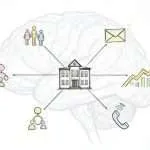
This diagram shows how the numbers and the stories work together to create a complete picture.
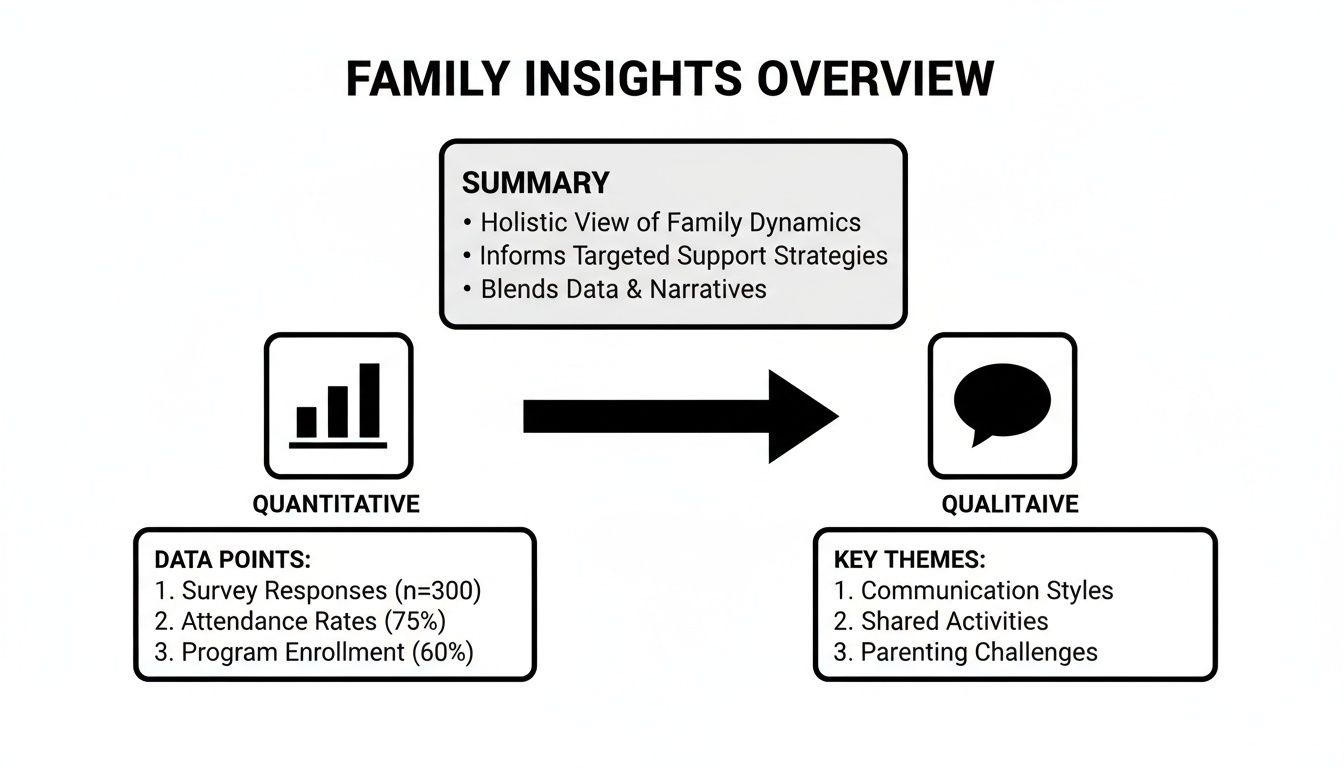
You need both. The numbers tell you what is happening, but the stories explain why it matters so much to your families.
Bringing K-12 Personas to Life with Examples
To show you how this all comes together, let's build out two common personas you've likely met in the K-12 world. Use these as a blueprint for turning your own research into a powerful, story-driven tool.
Persona Example 1: Achievement-Focused Amelia
- Name & Photo: A professional-looking woman in her early 40s.
- Demographics: 42-year-old corporate lawyer living in an affluent suburb. Two children, ages 11 and 14. Household income of $250,000+.
- Goals: To secure a top-tier education that guarantees her children a pathway to an Ivy League university. She views school as a critical, long-term investment in their future.
- Challenges: She is incredibly busy and short on time. She’s worried her child's current public school isn’t academically rigorous enough and lacks the personalized college counseling they’ll need to be competitive.
- Narrative: Amelia's days are a blur of meetings and deadlines. She does her school research late at night after the kids are in bed, digging through websites for college acceptance rates and AP score distributions. She values clear, concise information and is immediately turned off by marketing fluff. A direct quote from her interview: "Just show me the data. I need to see proof that your school delivers results."
Persona Example 2: Community-Minded Chris
- Name & Photo: A friendly-looking man in his late 30s, maybe volunteering at a community event.
- Demographics: 38-year-old graphic designer living in a family-focused urban neighborhood. One child, age 8. Household income of $120,000.
- Goals: To find a nurturing and inclusive school where his child can develop strong social-emotional skills and feel a true sense of belonging.
- Challenges: His son is a bit of an introvert, and he's concerned about him getting lost or even bullied in a larger school system. He finds it hard to gauge a school's real culture from a glossy brochure.
- Narrative: Chris is all about authentic connections. He spends his weekends at the local farmers' market and coaches his son's soccer team. He’s looking for a school that feels like an extension of his own tight-knit community. During our chat, he said, "I can find test scores anywhere. What I really want to know is, will my child be happy here? Will he be known and valued for who he is?"
See the difference? These detailed profiles are the direct result of good research. They transform abstract data into tangible, relatable people, giving your team the power to create marketing that truly speaks to them.
Putting Your K-12 Personas into Action
You’ve done the hard work of creating detailed persona profiles. That’s a huge milestone, but it's not the finish line. A persona that just sits in a shared drive is nothing more than a well-researched story. The real value is unlocked when you start weaving these insights into the very fabric of your school's daily marketing and communications.
This is where your research turns into real connections and, ultimately, drives enrollment.
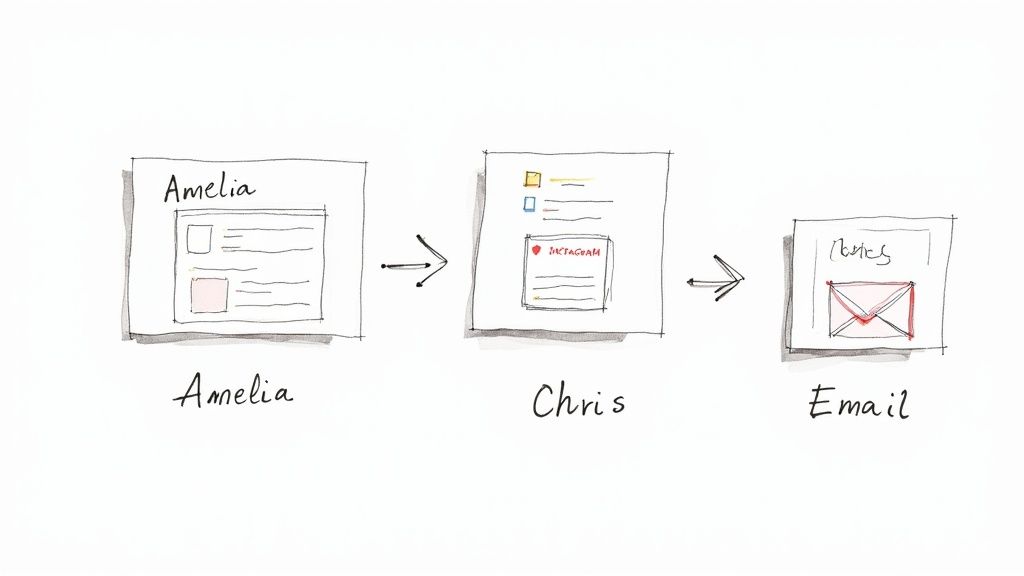
Think of this next phase as operationalizing empathy. Instead of guessing what a prospective family wants to hear, you can now consult your personas. They become your go-to guide for crafting messages that resonate, choosing the right channels, and developing content that genuinely addresses their deepest needs and anxieties.
Tailoring Your Website and Digital Content
Your website is often the very first "tour" a prospective family takes of your school. It’s your digital front door. Personas help you make sure every visitor feels seen and understood from the moment they land on your homepage.
Instead of plastering your site with generic copy, you can now speak directly to the unique goals and challenges of each parent group.
For instance, your homepage could be strategically designed to appeal to your primary personas:
- For Achievement-Focused Amelia: You’ll want to feature a prominent section with hard numbers—college acceptance rates, AP course offerings, and impressive alumni success stories. Use direct, data-driven language that proves your academic value proposition.
- For Community-Minded Chris: Lead with an authentic video that showcases student collaboration, teacher-student mentorship, and heartfelt parent testimonials. Emphasize your social-emotional learning programs and the extracurriculars that truly foster a sense of belonging.
This isn't just for the homepage, either. Your admissions landing pages, program descriptions, and blog posts should all be written with a specific persona in mind. When you address their distinct pain points, your website transforms from a simple brochure into a powerful conversion tool.
When your content answers a parent's unspoken questions, you build immediate trust. It shows them you don't just understand students—you understand their student.
Sharpening Your Email and Social Media Strategy
Generic email blasts and one-size-fits-all social posts are enrollment killers. It’s that simple. Personas give you the power to segment your audience and deliver the right message on the right platform, which will dramatically improve your engagement rates.
Understanding the practical applications of personas can help optimize your marketing efforts, especially in evolving digital landscapes. You can find more on how personas can strengthen AI search and drive better results.
For email marketing, this is a total game-changer. A study by THM Agency showed that persona-based email strategies can boost open rates by two to five times compared to generic campaigns.
Your channel selection also becomes crystal clear. Rather than trying to be everywhere at once, you can focus your energy and budget where your families actually spend their time online.
Social Channel Strategy by Persona:
| Persona | Primary Social Channel | Content Focus |
|---|---|---|
| Achievement-Focused Amelia | Highlighting notable alumni achievements, faculty thought leadership articles, and partnerships with local universities or tech companies. | |
| Community-Minded Chris | Instagram & Facebook | Sharing behind-the-scenes classroom moments, student-led service projects, and authentic video testimonials from current parents and students. |
Empowering Your Admissions and Tour Guides
The impact of personas goes way beyond your digital marketing. They are invaluable tools for your admissions team and anyone who interacts with prospective families face-to-face.
When you share these profiles, you equip your team to have more empathetic and effective conversations.
Imagine a tour guide who knows they're speaking with a "Community-Minded Chris." They can instantly tailor their talking points. They'll know to spend a little extra time highlighting the buddy system for new students, the collaborative nature of classroom projects, and the active parent association. This simple shift turns a generic tour into a personalized experience that speaks directly to that family's core desires, making them feel truly at home before they've even applied.
Keeping Your Personas Accurate and Effective
Getting your school's personas defined and documented is a huge win. Seriously, pop the sparkling cider. But that's the starting line, not the finish. The families you’re trying to connect with are constantly changing—their priorities shift, new anxieties crop up, and the ways they communicate evolve.
That’s why your personas can't be a "set it and forget it" project. They need to be living, breathing documents. An outdated persona is actually worse than having none at all, because it can point your marketing efforts in the completely wrong direction based on faulty assumptions. The real key to making this work long-term is building a simple, repeatable process to check in on them and keep them fresh.
How to Tell if Your Personas Are Actually Working
So, how do you know if all this effort is paying off? You look at the data. By tracking a few key metrics, you can draw a pretty clear line between your persona-driven marketing and real-world results.
The trick is to track performance by persona segment. Don't just look at your overall email open rate; compare the engagement for a campaign you sent to "Achievement-Focused Amelia" with one designed for "Community-Minded Chris."
Look for these kinds of signals in your analytics:
- Landing Page Conversions: Are the inquiry pages you built for specific personas converting better than your old, generic pages? They should be.
- Email Engagement: Check the open rates and, more importantly, the click-through rates. When you see higher numbers for your segmented emails, it's a fantastic sign that your messaging is hitting home.
- Time on Page: Are parents sticking around longer on the blog posts or program pages you've tailored to their persona's specific questions and interests?
When you see a lift in these metrics for a specific persona, you have concrete proof that your insights are on the money. And if a persona-targeted campaign falls flat? That's not a failure. It's just a signal that it's time to revisit your assumptions and tweak your approach.
A Realistic Timeline for Keeping Personas Fresh
To stop your hard work from gathering digital dust, get a recurring review on the calendar. For most schools, a quick check-in every quarter and a more serious deep dive once a year is a manageable and effective rhythm.
- Quarterly Check-In (1-2 hours): This is a quick huddle with your admissions and communications teams. What are they hearing on tours? Are new questions or concerns popping up in conversations with parents? Share those fresh observations.
- Annual Review (1 day): Set aside a full day for a proper audit. This is when you'll dig back into the analytics, maybe conduct a few new parent interviews, and update your persona profiles with any significant changes you've uncovered.
This kind of regular maintenance turns your understanding of how to create buyer personas from a one-off task into a real, ongoing strategic advantage for your school.
Common Mistakes to Sidestep
As you put your personas to work, watch out for a few common traps that can completely derail their usefulness.
- Creating Too Many Personas: It’s so tempting to make a unique profile for every little variation of a family you can think of. Don't do it. You'll spread your efforts too thin. Stick to 3-5 core personas that truly represent the bulk of your ideal families.
- Relying on Stereotypes: Your personas have to be built on real data from your research and interviews, not gut feelings or clichés about what you think parents want. If you can't back up an assumption with actual evidence, leave it out.
- Forgetting Team Buy-In: A persona is pointless if it lives in a folder on your desktop. Everyone—from the admissions team greeting families at the door to the faculty members being interviewed for a blog post—needs to know who these personas are and how their work connects with them.
Steering clear of these pitfalls is what will make your persona project deliver real, sustained value for years to come.
At The MarCom Society, we provide K-12 marketing professionals with the tools, expert insights, and collaborative community needed to master challenges like these. Elevate your school's marketing strategy by joining our network of forward-thinking leaders. Learn more about the MarCom Society.