Before you write a single word for your next blog post or schedule a social media update, you need a plan. So many school marketing efforts fall flat because they jump straight to creation without first building a solid foundation. This is where your content strategy comes in—it’s the "why" behind every article, video, and email you send.
Think of it as the architectural blueprint for a house. You wouldn't start laying bricks without knowing the layout, the number of rooms, or who you're building it for. In the same way, creating content without a strategy is like throwing materials at a construction site and just hoping a school building appears. It’s chaotic, inefficient, and rarely gets you the results you need.
Building Your Foundational Content Strategy
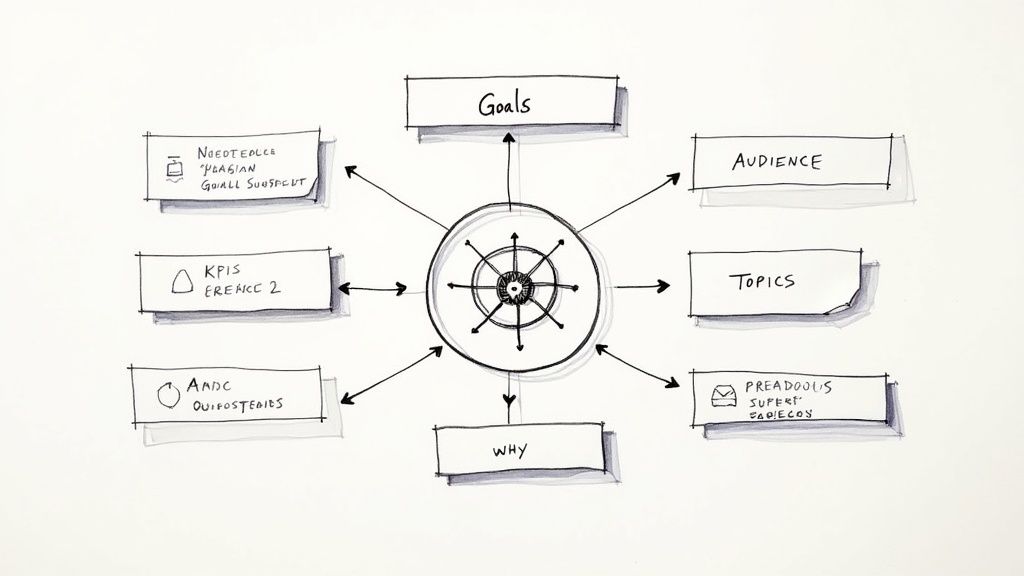
Set Clear Business-Oriented Goals
Your content doesn't exist in a bubble. It has a job to do, and that job is to support your school's most important goals. What are you actually trying to achieve? The answer to that question will shape every piece of content you develop. Without it, you're just adding to the noise online.
For a K-12 school, your primary goals probably look something like this:
- Increasing Brand Awareness: Getting your school's name out there, making it the first one that comes to mind for families in your community.
- Generating Qualified Leads: Attracting prospective families who are a great fit and encouraging them to take the next step, like booking a tour.
- Boosting Enrollment: Guiding interested families through the admissions funnel with helpful, reassuring content that answers their questions.
- Improving Community Engagement: Keeping current families connected and happy, turning them into your biggest advocates.
Each of these goals demands a different approach. Content for lead generation might be a detailed guide on your STEM curriculum, while brand awareness could be a fun "day in the life" video series on Instagram. If you're looking for a structured way to outline these objectives, a good communications strategy template can be incredibly helpful for aligning your content with the school's overall mission.
Define Your Key Performance Indicators
Once you know where you're going, you need a way to track your progress. That's where Key Performance Indicators (KPIs) come into play. These are the specific, measurable data points that tell you whether your strategy is actually working. Guesswork is expensive; data is not.
A content strategy without KPIs is like a road trip without a map. You're moving, but you have no idea if you're getting closer to your destination. Tracking the right metrics provides direction and confirms your efforts are paying off.
To give you a clear picture of what a solid framework looks like, here’s a breakdown of the core components you'll be building.
Key Components of a Content Strategy Framework
A quick overview of the essential pillars that support a successful content strategy, providing a clear structure for your planning process.
| Component | Description | Example Metric |
|---|---|---|
| Business Goals | The high-level objectives the content is meant to achieve for the school. | Increase new student applications by 15%. |
| Target Audience | A detailed profile of the specific parent/family persona you are trying to reach. | Website bounce rate on key pages. |
| KPIs | Specific, measurable metrics used to track progress against your goals. | Number of "Request a Tour" form submissions. |
| Content Pillars | The core topics or themes your content will consistently focus on. | Social media engagement rate on pillar posts. |
| Distribution Channels | The platforms where you will share your content to reach your audience. | Click-through rate from the parent e-newsletter. |
By aligning your goals directly with your KPIs, you create a powerful feedback loop. It's the difference between hoping for results and engineering them.
This foundational work is what transforms your content from a simple expense into a predictable, growth-driving asset. When you set clear goals and define exactly how you'll measure them, you create a powerful framework for every decision that follows. That clarity is what ensures every piece of content has a purpose and contributes directly to the success of your school.
Defining Your Audience and Brand Voice
If you don't know who you're talking to, you might as well be shouting into the wind. A brilliant message delivered to the wrong audience is just noise. This is where so many school marketing efforts fall flat, and it's the first real hurdle in creating a content strategy that actually connects with families.
Before you write a single word, you need to go deeper than basic demographics like zip codes and income levels. For K-12 schools, the real magic happens when you understand the psychographics—the deep-seated motivations, anxieties, and aspirations of the parents you’re trying to reach.
Who Are You Really Talking To?
Your goal here is to paint a crystal-clear picture of your ideal family. This isn’t about guesswork; it's a research-backed process that will ground your entire strategy in reality. Start by asking questions that get to the heart of their needs.
What are their biggest fears about their child's education? Are they worried about academic rigor, social-emotional development, or simply finding a community where their family fits in? Knowing these pain points is everything. It allows you to create content that provides genuine solutions and reassurance, not just marketing fluff.
Here are a few tried-and-true ways to gather this crucial intel:
- Talk to Your People: Sit down with current, happy families. Ask them point-blank why they chose your school, what their journey was like, and what pieces of content actually helped them make that decision.
- Lean on Your Admissions Team: Your admissions staff is on the front lines every single day. They hear the unfiltered questions and concerns from prospective parents. Treat their insights like gold.
- Send a Quick Survey: Use simple tools to poll your email list or new inquiries. Ask about their top priorities when choosing a school. Keep it short and sweet.
- Become a Social Lurker: Monitor local parent groups on Facebook or other platforms. What are they talking about? What questions pop up over and over again about local education options?
This research helps you build out your buyer personas—essentially, character sketches of your ideal parents. You might identify "First-Time Kindergartener Parent Paula," who is anxious about the transition to formal schooling and needs to see content that highlights your nurturing environment. Or maybe "STEM-Focused Dad David," who wants to see hard data on college placements and advanced science programs.
Understanding the nuances between these different groups is key. That’s why it’s so helpful to learn more about what is audience segmentation and how to apply it.
Finding Your School’s Voice
Once you know exactly who you’re talking to, you have to figure out how you’re going to talk to them. This is your brand voice—the distinct personality your school projects in all its communications. It’s what makes a social media post, an email, and a website page all feel like they came from the same place.
Your brand voice isn't just about what you say; it's about how you make people feel. It should be a direct reflection of your school's core values and connect on an emotional level with the families you want to attract.
A strong brand voice is never generic. It's authentic and, above all, consistent. For example, a school focused on innovative, project-based learning might adopt an energetic, curious, and forward-thinking voice. On the other hand, a traditional preparatory school might use a voice that feels more formal, reassuring, and distinguished.
To make sure your content truly connects, it's vital to know how to define and project your school's unique personality, as covered in these strategies for building a strong online presence and personal brand.
To nail down your voice, think about these three things:
- Character/Persona: If your school were a person, who would it be? A wise mentor? An enthusiastic guide? A caring friend?
- Tone: What’s the general vibe of your content? Is it inspiring, professional, warm, or playful? The tone might shift a bit—more casual on Instagram, more formal in an official announcement—but it should always feel true to your core persona.
- Language: What specific words and phrases do you use? Or, just as importantly, which ones do you avoid? Do you steer clear of educational jargon? Do you keep sentences simple and direct?
Document all of this in a simple style guide. This little document is a lifesaver, ensuring that anyone creating content for your school—from the marketing director to a teacher writing a blog post—maintains a consistent and powerful voice that builds trust with every single interaction.
Mapping Content to the Parent Journey
Throwing content out there without a plan is like handing a prospective family a campus map with no labels. Sure, they can see the buildings, but they have no clue which one to visit first or where to go next. A smart content strategy, on the other hand, guides them step-by-step, from their first flicker of curiosity about your school to the final decision to enroll.
This whole process is called mapping content to the customer journey—or in our case, the parent journey. It's all about delivering the right message, in the right format, at the exact moment a family needs it. Instead of a random jumble of blog posts and social media updates, you build a logical path that nurtures families and builds trust along the way.
A strong strategy doesn't just happen. It's built on a foundation of solid research and a clear understanding of your school's unique voice. Let's look at how that comes together.
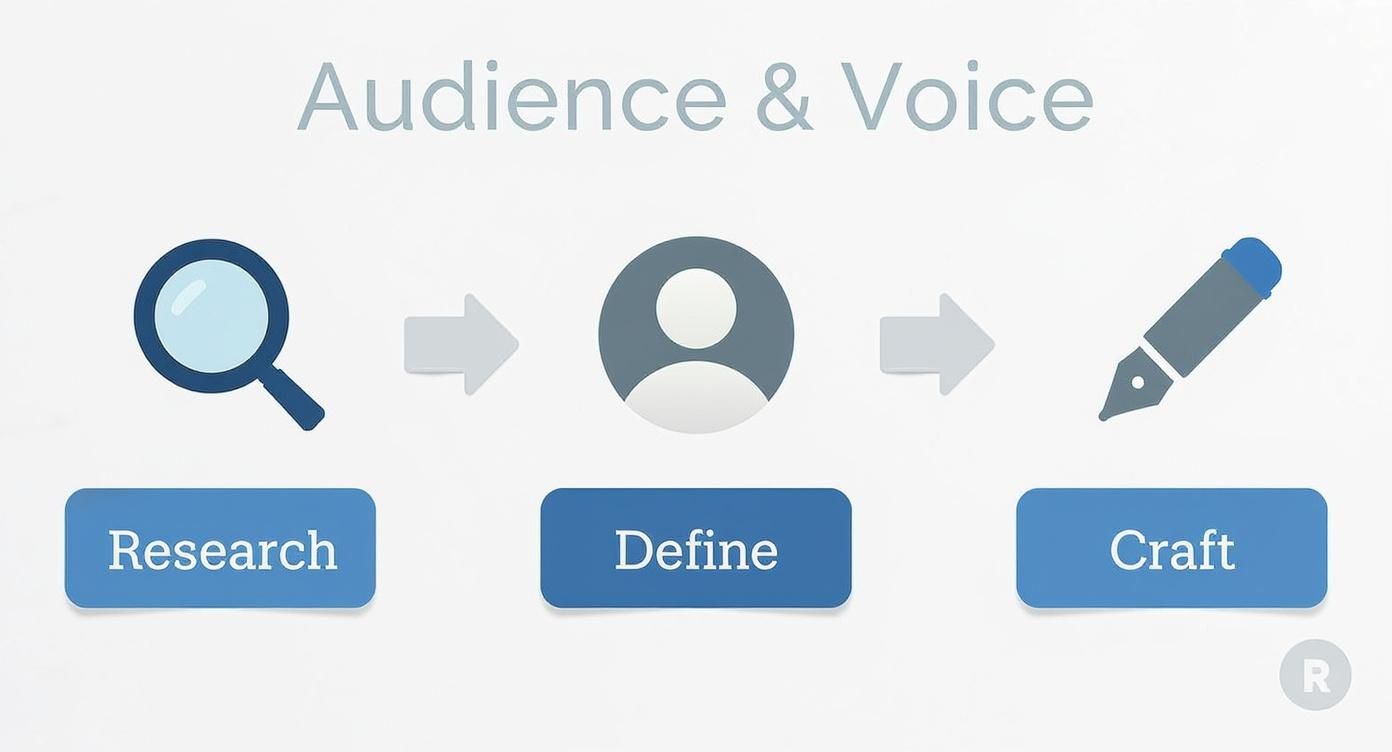
This visual makes it clear: a powerful brand voice isn't an accident. It's the direct result of knowing your audience inside and out and defining who you are as a school. The journey map is simply how you apply that voice to the different phases of a parent's decision.
Engaging Parents in the Awareness Stage
At the very top of the funnel, parents aren't looking for a hard sell. They're just starting to realize they have a problem or a need. For a K-12 school, this "problem" might be the dawning realization that their current school isn't the right fit, or maybe they're planning a move into the area.
Their searches are broad and informational. Think "best preschools near me" or "signs my child is bored at school." Your content here needs to be genuinely helpful, not promotional.
- Helpful Blog Posts: Write articles that answer their most urgent questions. A post like "5 Things to Look for on a Kindergarten Tour" provides instant value without pushing your own school.
- Engaging Social Media: Share quick, useful tips for parents on your Instagram or Facebook. Think short videos on "How to Foster a Love of Reading at Home" or an infographic about the benefits of learning a second language.
- Community Guides: Create something like "A Guide to Family-Friendly Activities in [Your Town]." This positions you as a helpful local resource, not just another school.
The goal is simple: be the first helpful answer they find. That's how you establish your school as a trusted authority right from the start.
Nurturing Families Through the Consideration Stage
Once a family knows your school exists, they shift into the consideration stage. Now, they're actively weighing their options. Their searches get more specific, like "[Your School Name] vs. [Competitor School Name]" or "benefits of a project-based learning curriculum."
Your content needs to pivot from general advice to specific solutions that show off what makes your school different.
At this stage, you're not just providing information; you're building a case. Your content needs to clearly demonstrate why your school’s approach is the best solution for their child’s specific needs and their family’s values.
This is the perfect time to roll out more in-depth content:
- Detailed Program Guides: Offer downloadable guides that dive deep into your signature programs, like your STEM lab, arts curriculum, or athletics.
- Comparison Articles: Create an honest, helpful blog post comparing different educational philosophies (e.g., "Montessori vs. Reggio Emilia: Which is Right for Your Child?"). This showcases your expertise and helps parents clarify their own thinking.
- Virtual Open Houses & Webinars: Host live or pre-recorded events where department heads or the head of school can speak directly to prospective families and answer their questions in real-time.
Having a documented strategy here is non-negotiable. It's a key differentiator. Recent research found that 97% of B2B marketers now have a defined content strategy, and the 52% who classify themselves as 'pacesetters' have effective frameworks driving superior results. You can read the full research on B2B content marketing trends to see just how much a clear plan separates the leaders from the laggards.
Sealing the Deal in the Decision Stage
Finally, at the bottom of the funnel, families are ready to make a choice. What they need now is that last bit of reassurance that your school is the one. Your content should focus entirely on validation and building their confidence in the decision.
At this point, it's all about proof. This is where you let your happy, current families do the talking for you.
- Compelling Case Studies: Share success stories of students who truly thrived after enrolling.
- Video Testimonials: There's nothing more powerful than featuring parents and students talking authentically about their positive experiences.
- Live Q&A Sessions: Host a live chat with your admissions director or a panel of current parents to tackle any last-minute questions and hesitations.
When you thoughtfully map your content this way, you create a seamless and supportive journey. You meet families where they are, answer their questions before they even have to ask, and confidently guide them toward becoming a part of your school community.
Weaving in the Right Tools and Tech
To bring a modern content strategy to life, your team needs more than just good ideas—it needs a solid toolkit. The right technology doesn't just make your job a little easier; it unlocks new levels of efficiency and insight. It’s all about working smarter, scaling your impact without having to scale your workload.
This has never been more true than with the rise of AI. For school marketers, AI isn't some far-off concept. It's a practical assistant that can give a serious boost to everything from brainstorming content to analyzing how it performs. It helps you spot the content gaps your competitors are missing and can even whip up first drafts for blog posts or social media updates.
This shift is already well underway. Over 80% of marketers globally are using AI in some capacity, and nearly 20% are dedicating over 40% of their marketing budgets to AI-powered tools. The reason is simple: it works. In fact, 53% of marketing leaders are already rethinking team roles to build around AI-driven workflows. You can dig into more of these trends and see how AI is shaping marketing budgets on typeface.ai.
Giving Your Workflow an AI Assist
Think of AI tools as a force multiplier for small marketing teams. They can take on the repetitive, time-sucking tasks, freeing you up to focus on the distinctly human side of marketing—building real relationships and telling your school's unique story.
Here’s how you can put AI to work right away:
- Keyword Research and Gap Analysis: Let AI analyze what your competitors are ranking for to uncover high-opportunity keywords you may have overlooked. This data-driven approach takes the guesswork out of your SEO.
- Content Ideation: Feeling stuck for blog ideas? AI can brainstorm dozens of relevant topics based on your audience’s questions and what’s currently trending in search.
- Drafting and Outlining: While you should never let AI write your final content, it’s fantastic at creating structured outlines and rough first drafts. This alone can save you hours of writing time.
There are countless platforms out there, and finding the right one depends on your team’s specific needs. A great place to start is by checking out a list of the top AI tools for content marketing.
Choosing Your Core Marketing Stack
Beyond just AI, every school needs a reliable set of core marketing technologies. These are the platforms that form the backbone of how you create, publish, and share your content, making sure everything runs smoothly behind the scenes.
A great content strategy is powered by a great tech stack. The goal isn't to collect shiny new tools, but to build an integrated system where each piece works together to simplify your workflow and amplify your results.
For instance, take a look at a typical dashboard from a comprehensive tool like Semrush. It's perfect for tracking how your keywords are performing and keeping an eye on competitor activity.
This kind of snapshot gives you a clear picture of your SEO health, showing your site's authority, organic traffic, and keyword rankings. Insights like these are absolutely vital for making smart, informed tweaks to your strategy.
So, what are the must-haves for a K-12 marketing team? It really boils down to three essentials:
- A Content Management System (CMS): This is the foundation of your website. A user-friendly CMS like WordPress or Squarespace makes it simple for anyone on your team to publish blog posts, update pages, and manage your school's digital front door.
- A Marketing Automation Platform: Tools like HubSpot or Mailchimp help you nurture prospective families with automated email sequences, manage your contacts, and see how people are engaging with your content over time.
- Analytics and Reporting Tools: Google Analytics is non-negotiable. It tells you where your website visitors come from, which pages they love the most, and how they’re moving through your site.
Adopting these tools isn’t about replacing marketers; it’s about empowering them. By weaving the right technologies into your day-to-day, you can execute a much more sophisticated, data-backed content strategy that drives enrollment and builds a stronger school community.
From Big Ideas to Published Content: Building Your Plan
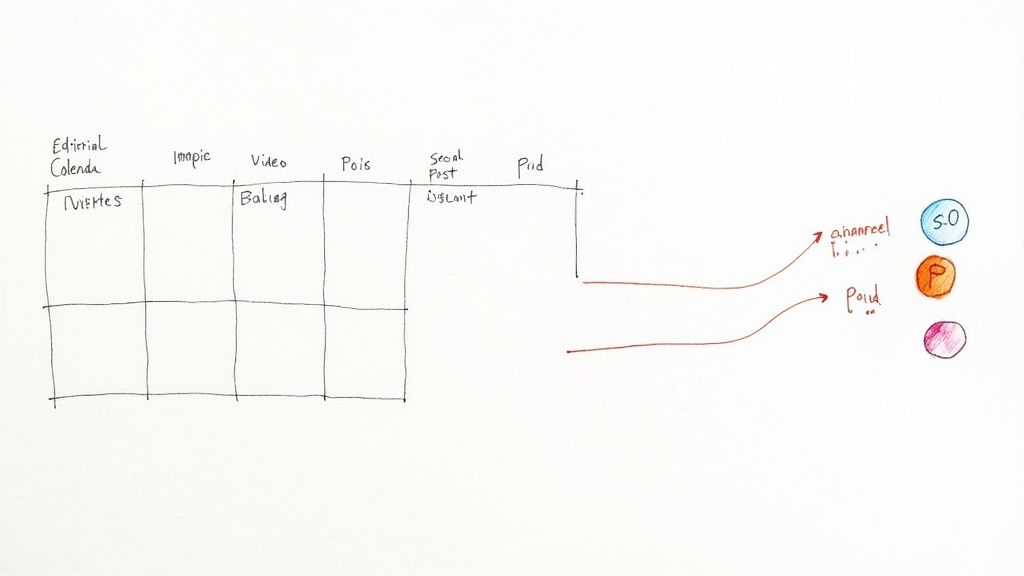
Even the most brilliant strategy is just a document until you put it into action. This is where your research and planning become real—where you start creating tangible content that actually reaches and connects with prospective families. It's time to fire up your content engine.
At the heart of that engine is a realistic editorial calendar. This is more than just a spreadsheet with dates; it's your command center. It's the single source of truth for what gets created, who is responsible, and when it goes live. A well-oiled calendar puts an end to the last-minute scramble for content and ensures you're consistently delivering value.
If you're starting from scratch, we have a guide that walks you through what is a content calendar and how to build one. It’s a great starting point for building a structure that keeps your team on track.
Finding Topics That Actually Resonate
Your calendar needs to be filled with topics that speak directly to the questions and concerns you found during your audience research. Brainstorming shouldn't be a random, "what should we post today?" exercise. It needs to be a focused process, tied directly to your content pillars and the journey a parent takes when choosing a school.
For a K-12 school, your ideas will likely fall into a few key buckets:
- Curriculum Spotlights: Go beyond the course catalog with posts like, "A Look Inside Our Project-Based Middle School Science Lab."
- Student Life & Culture: Show, don't just tell. Think about content like, "How We Build Character and Leadership Outside the Classroom."
- Parent Resources: Offer genuinely helpful advice that builds trust. A great example is, "A Checklist for a Stress-Free First Day of Kindergarten."
- Admissions Guidance: Make a complex process feel simple with content such as, "Navigating Financial Aid: A Step-by-Step Guide for Families."
Get your team involved! Pull in people from admissions, faculty, and even current parents for regular brainstorming sessions. Their on-the-ground perspectives are gold for generating authentic ideas that connect with your ideal families.
Thinking Beyond the Blog Post
While blog posts are fantastic for SEO and providing deep-dive information, stopping there is a huge missed opportunity. Today's families are consuming content in a dozen different ways on a dozen different platforms. To really grab their attention, you have to diversify your approach.
Video, in particular, has changed everything. It's incredibly engaging. YouTube saw a massive 79% growth in the past year, largely fueled by the explosion of short-form video on TikTok and Instagram Reels. It's no wonder that 93% of marketers agree that interactive content is a powerful way to capture attention. You can find more details in these compelling content marketing stats from inmotionmktg.com.
The best content strategies meet families where they are. That means creating a mix of content types that fit different platforms and preferences—from a quick, informative video on Instagram to a detailed, downloadable guide on your website.
Start thinking about how you can package your core messages into different formats:
- Short-Form Video: "Day in the life" clips of students, quick interviews with beloved teachers, or a mini virtual tour of a new facility.
- Podcasts: A monthly podcast with alumni interviews, discussions on education trends with your Head of School, or tips for parents.
- Interactive Quizzes: A fun, simple quiz like "What Type of Learner is Your Child?" that offers value while capturing lead information.
- Infographics: A visual and easy-to-share graphic of your college acceptance stats or the impact of your arts program.
By using multiple formats, you give your message the best possible chance of cutting through the digital noise and connecting with busy parents.
Making Sure Your Content Gets Seen
Creating great content is only half the job. You can produce the most insightful article or the most beautiful video, but if no one sees it, it doesn't matter. Your distribution plan is every bit as critical as your creation plan.
This means you have to move beyond the "publish and pray" method. Every single piece of content deserves its own mini-promotion plan. That plan should tap into a mix of owned, earned, and paid channels to maximize its reach.
| Distribution Channel | Tactic for a K-12 School |
|---|---|
| SEO (Owned) | Optimize every blog post with keywords families are actually searching for, like "private school STEM programs." |
| Email Marketing (Owned) | Feature your latest blog post or a student success story in your weekly parent newsletter. |
| Social Media (Owned) | Share your content on Facebook and Instagram, but create custom captions and visuals tailored for each platform. |
| Paid Amplification (Paid) | Put a small budget behind your best-performing Facebook posts to reach a targeted lookalike audience of local parents. |
The key to doing this efficiently is repurposing. One big piece of content—say, a detailed guide on "The Benefits of a Bilingual Education"—can be broken down into dozens of smaller assets. That one guide can become an infographic, a series of social media graphics with key stats, a short video interview with your Spanish teacher, and a segment in your school's podcast. This strategy stretches your efforts and ensures your core message reaches the widest possible audience.
Still Have Questions? Let's Talk Strategy.
Even with the best roadmap, a few questions always come up when you're in the trenches building a content strategy. Let's tackle some of the most common ones I hear from K-12 marketers.
How Often Should I Actually Update My Content Strategy?
Your content strategy shouldn't be a dusty binder on a shelf. It’s a living document. I always tell my clients to plan for one major overhaul at least once a year. This is your chance to zoom out, look at the big picture, and realign the strategy with your school's latest enrollment goals.
But that doesn't mean you ignore it for the other 11 months. You need to keep a finger on the pulse.
- Quarterly Reviews: I find that quarterly check-ins are perfect for making meaningful tweaks. You can see which campaigns really connected with parents and which fell flat, then adjust your upcoming content accordingly.
- Monthly Glances: A quick peek at your analytics each month is non-negotiable. This is how you spot a blog post that’s suddenly taking off or a social media campaign that needs a little boost.
Think of it this way: the annual review is for changing direction, but the regular check-ins are for steering.
What If I Have a Tiny Team and an Even Tighter Budget?
Welcome to the club! This is the reality for almost every school marketer I know. A tight budget is exactly why you need a sharp strategy. It forces you to be smart and stops you from wasting precious time and money.
A small, focused team with a brilliant strategy will run circles around a huge team with no plan. It’s never about doing everything; it’s about doing the right things incredibly well.
Here’s how you punch above your weight with limited resources:
- Go deep, not wide. Don't try to master TikTok, Facebook, Instagram, and LinkedIn all at once. Find out where your prospective parents actually spend their time—say, a local Facebook parents group—and own that space.
- Become a master of repurposing. That one beautifully written blog post about your project-based learning approach isn’t just a blog post. It's 5-10 social media updates, a script for a short video, an infographic for Pinterest, and a key feature in your next email newsletter. Squeeze every drop of value from your work.
- Embrace your community. Your best marketing assets are already walking your halls. Encourage students and families to share their stories and photos (with permission, of course!). This kind of user-generated content (UGC) is pure gold—it's authentic, trustworthy, and costs you nothing.
Seriously, How Long Until This Starts Working?
I get it. You need to show results. But a content strategy is a marathon, not a sprint. You're building relationships and earning trust, and that takes time. Paid ads give you a quick hit of traffic, but content marketing builds an asset that pays dividends for years.
From my experience, here’s a realistic timeline:
- First 3 Months: You’ll see sparks of life. A jump in likes and comments on social media, or people spending more time reading your new blog posts. These are the early signs that you're on the right track.
- Months 3-6: This is when the engine really starts to warm up. Your SEO efforts begin to pay off, and you'll see a real, noticeable increase in families finding your website through Google searches.
- Months 6-12: Now you’re cooking. You should have a steady stream of organic traffic, see new inquiries coming in through your website, and be able to draw a clear line between your content and your enrollment numbers.
The absolute key to all of this is consistency. Don’t give up. Keep creating, keep sharing, and keep serving your audience. The journey of learning how to create a content strategy is all about refining as you go.
At The MarCom Society, we help K-12 marketing pros move from overwhelmed to strategic. We offer the expert guidance, practical tools, and a community of peers you need to build marketing plans that truly move the needle on enrollment. See how you can elevate your work by learning more at The MarCom Society website.