
Before you can even think about asking for a donation, you need a plan. A real plan. This goes way beyond just having a mission statement; it's about crafting a powerful story that showcases your school's impact and paints a clear, inspiring picture of its future. When you have this solid foundation in place, every fundraising email, event, and conversation becomes more focused, measurable, and effective.
Laying the Groundwork for Donor Acquisition
Figuring out how to get donors isn't just about sending out a few appeals or hosting a gala. It all starts with a deliberate, strategic foundation. Without one, fundraising can feel like you're just throwing things at the wall and hoping something sticks—a surefire way to burn out your team and your donors. A well-defined strategy is your roadmap, guiding every single decision you make.
Putting in this work upfront is non-negotiable. It’s what transforms your fundraising from a series of disjointed asks into a structured program designed for long-term success. The goal here is to build a system that not only brings in new supporters but also sets the stage for sustainable financial growth for your school.
Craft a Compelling Case for Support
Your Case for Support is the absolute heart of your fundraising message. It’s not just a mission statement—it’s the powerful narrative that answers the one question every potential donor is asking: "Why should I give to your school, right now?" To hit home, it needs to connect on an emotional level, make a logical argument, and create a sense of urgency.
To be truly effective, this document must tell your school's unique story, pinpoint the specific challenges you're trying to solve, and show the tangible impact a donation will have on your students. If you want to dig deeper, we have a whole guide on how to build a powerful Case for Support. A strong case directly links a donor’s gift to a student’s success story.
A great Case for Support doesn’t just state facts; it tells a story that makes potential donors the heroes. It frames their contribution not as a donation, but as a critical investment in the future of their community's children.
This process is about turning a big-picture vision into real, measurable outcomes.
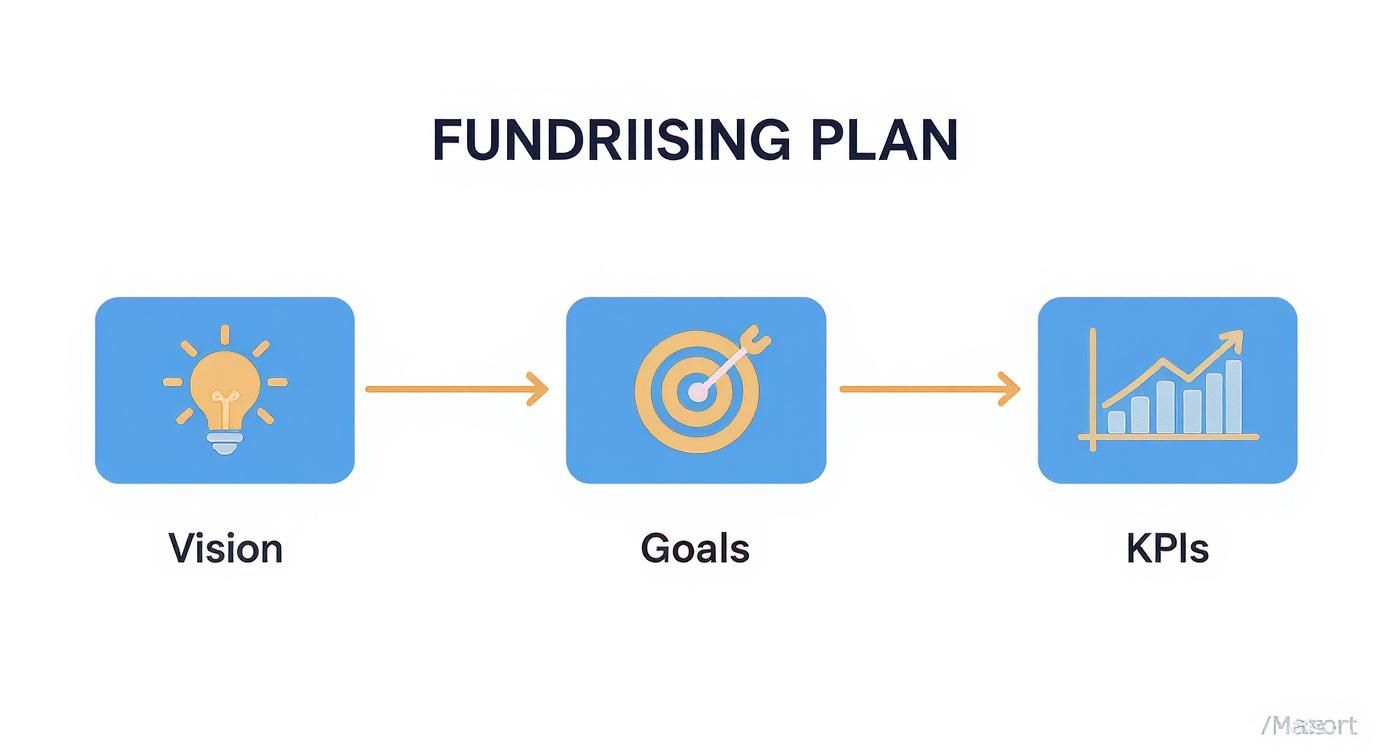
As you can see, a compelling vision is just the start. You have to translate it into concrete goals and track your progress with specific KPIs to actually make it happen.
Define Your Fundraising Goals and KPIs
Once your story is locked in, it's time to set realistic, data-driven fundraising goals. Please, don't just pick a number out of thin air. Ground your goals in reality by looking at your school’s actual needs, your past fundraising performance, and the giving capacity within your community.
This is where Key Performance Indicators (KPIs) come into play. They help you measure what actually matters. Instead of obsessing over just the total dollars raised, focus on the metrics that signal the long-term health of your program.
Think about tracking things like:
- Donor Acquisition Cost (DAC): How much are you spending to bring in a new donor?
- Donor Retention Rate: What percentage of your donors give year after year? This is a huge one.
- Average Gift Size: What's the typical donation amount, and how can you nudge it upward over time?
- Donor Lifetime Value (LTV): How much is a donor projected to give over their entire relationship with your school?
Tracking these KPIs gives you a much clearer picture of what’s working and what isn’t, helping you make smarter decisions. In many ways, it's similar to building a sales pipeline that converts; the core principles of tracking, nurturing, and converting leads are directly transferable to the world of fundraising.
To give you some context, the philanthropic landscape is always shifting. Charitable giving in the United States, for instance, was estimated to reach $592.50 billion in 2024. That’s a 6.3% increase, largely driven by a strong economy. Understanding these broader trends is vital for setting goals that are both ambitious and achievable.
Finding and Researching Potential School Donors
So, you've crafted a powerful story and set clear goals. Now for the big question: who do you share it with? Finding the right potential donors is so much more than just pulling a list of current parents. It's a blend of smart detective work and a real desire to connect with people who are already on your team—they just might not know it yet.
This whole phase is about discovery. We’re going to move beyond the usual suspects and really dig into your existing data, explore some powerful research tools, and map out your community to find those hidden gems. The goal isn't just to find people with money; it's to find people who genuinely care about what you do.
Start With Your Inner Circle
Your best prospective donors are almost always hiding in plain sight. Before you even think about looking outward, you need to do a deep dive into your own community. These are the folks who already have a real, tangible connection to your school, which makes them far more likely to pick up the phone when you call.
Who makes up this "inner circle"?
- Current Parents and Grandparents: They see the magic happen every single day.
- Alumni: Their own journey at your school creates a powerful, lifelong bond.
- Past Parents: Even after their kids have graduated, many still feel a strong connection to the place that shaped them.
- Faculty and Staff (Past and Present): Their investment is more than a paycheck; they are true believers in the mission.
Start by combing through your database for clues of deeper engagement. Who’s always volunteering? Who shows up to every single event, from the school play to the championship game? These actions are a huge signal of commitment and often go hand-in-hand with philanthropic interest.
Building a strong donor base starts from the inside out. Your most passionate advocates and future major donors are likely already part of your school community. Your first job is to identify them.
This internal audit gives you a fantastic "warm list" of prospects to start with, creating a solid foundation for everything that comes next.
Use Data to Uncover Hidden Prospects
Once you have your list of engaged community members, the next move is to layer in data to better understand their capacity and likelihood to give. This is where prospect research becomes your secret weapon, helping you prioritize your outreach and tailor your conversations.
Wealth screening services are a great place to start. These platforms analyze public data—things like real estate holdings, stock ownership, and political contributions—to give you an estimate of an individual's financial capacity. Think of it like a more strategic way of prospecting. For anyone curious, many of the same principles in sales prospecting best practices apply here; it's all about finding the right fit.
Here’s a look at the dashboard for a popular tool in this space, DonorSearch.
Tools like this pull together philanthropic history and wealth data, helping you spot the top prospects already in your database. But remember, a big bank account is only half the story.
Just as important are the philanthropic indicators. Has this person given to other schools or universities? Do they sit on the board of a local nonprofit? This kind of information tells you they are already active givers and are familiar with how philanthropy works.
Expand Your Reach Into the Community
After you've got a solid handle on your internal prospects, it's time to look beyond your campus gates. Your school is a cornerstone of the local community, and plenty of businesses and individuals have a vested interest in your success, even if they don’t have a child enrolled.
Start thinking about these key groups:
- Local Businesses: Companies often want to support local schools as part of their community engagement and social responsibility efforts.
- Community Foundations: These organizations exist specifically to funnel money to local causes, and education is almost always at the top of their list.
- High-Net-Worth Individuals: Research consistently shows that education is a top philanthropic priority for many affluent donors in your area.
The potential is massive. The global population of ultra-high-net-worth (UHNW) individuals was around 510,810, with North America home to 41% of that group. These individuals often have powerful peer networks that can open doors you never thought possible.
By mapping these community connections, you can start building authentic relationships with key leaders and organizations. The idea is to build a diverse portfolio of potential supporters, making your fundraising program more resilient and sustainable for the long haul.
Building Relationships Through Donor Cultivation
Once you’ve identified a promising group of potential supporters, the real work begins. Let's be honest: effective fundraising is built on genuine relationships, not one-off transactions. This next phase, donor cultivation, is where you thoughtfully and strategically turn a name on a list into a passionate, long-term partner for your school.
The whole point is to make potential donors feel like valued insiders long before you ever ask for a gift. It's all about building trust, showing them the real impact of their future support, and creating a meaningful connection that feels bigger than just a financial exchange.
Start by Segmenting Your Audience
A one-size-fits-all email blast is the fastest way to get ignored. To successfully cultivate these relationships, you have to make each person feel seen and understood. The first step is breaking down your prospect list into smaller, more manageable groups based on their connection to your school and their potential to give.
Think about it: the way you talk to a recent alum is going to be worlds apart from how you approach a local business owner or the grandparent of a third-grader.
Consider creating a few key segments like these:
- Major Gift Prospects: These are the folks you've researched and identified as having the capacity to make a significant gift. Their cultivation track needs to be highly personalized and high-touch.
- Alumni by Decade: Grouping alumni by their graduation era is a fantastic way to tailor your messaging around shared memories, inside jokes, and relevant school history.
- Current Parent Leaders: Think of your PTA president or those dedicated event volunteers who are always the first to sign up. They are already deeply engaged and are prime candidates to become cornerstone donors.
- Local Community Partners: This segment includes local business owners and community leaders who have a vested interest in seeing their community's school thrive.
When you segment your audience, you can finally move away from generic communication and start sending the right message to the right person at the right time.
Design a Multi-Channel Cultivation Playbook
With your segments defined, it's time to map out how you’ll actually engage with them over time. This isn’t about bombarding people with information. It’s about creating a series of meaningful "touchpoints" that build the relationship organically. Your playbook should be a mix of different communication channels and experiences.
Donor cultivation is a marathon, not a sprint. Every email, every event, and every conversation is a chance to deepen the connection and bring a prospect closer to your school's mission.
Not every touchpoint needs to be a grand gesture. In my experience, it's often the small, personal interactions that are the most powerful. A handwritten note from a student whose science project was funded by a small grant can have a much bigger impact than a glossy brochure ever could.
Here are a few real-world examples you can adapt:
| Touchpoint Type | For Major Gift Prospects | For Engaged Parents |
|---|---|---|
| Exclusive Invitation | A private, behind-the-scenes tour of the new arts wing with the principal. | An invitation-only "State of the School" coffee and Q&A. |
| Personal Outreach | A phone call from a board member who shares a similar industry background. | A handwritten thank-you note from a teacher for their volunteer hours. |
| Impact Reporting | A custom one-page report on a program they've shown interest in. | A short, unpolished video of students using the new library resources. |
| Volunteer Opportunity | An invitation to serve on a strategic advisory council for a new initiative. | A call for volunteers for a beloved school tradition, like the fall festival. |
This multi-channel approach ensures you're reaching people in ways that feel authentic and relevant to them, not just like another fundraising appeal.
Master the Art of Storytelling
Facts and figures can justify a donation, but stories are what inspire one. The single most critical piece of your cultivation strategy is storytelling. You have to bring your school’s impact to life by turning abstract goals into tangible, emotional student successes.
Instead of saying, "We need to raise money for our new STEM lab," tell the story of Sarah, a 7th grader who discovered a passion for coding in an after-school program and now dreams of becoming an engineer. Show a picture or a quick video of her working on a robotics project. Make it real.
This narrative-driven approach has never been more important. Recent fundraising trends show a concerning paradox: while total charitable dollars are going up, the actual number of donors is going down. The smallest donors, those giving between $1 and $100, saw their numbers drop by a staggering 11.1% year-over-year. This means larger gifts from wealthier donors are making up for a shrinking base, putting immense pressure on schools like yours to get really good at cultivation. You can explore the full data on donor trends to see the bigger picture.
These statistics drive home a crucial point: in a world with fewer donors, building deep, lasting relationships isn't just a nice idea—it's an absolute necessity for survival and growth. By consistently sharing powerful stories, you move your school from being just another organization asking for money to a vital cause that people feel proud to be a part of.
Making a Confident and Compelling Ask

After months of research and relationship-building, the moment arrives to actually ask for a gift. For many, this is the most nerve-wracking part of fundraising. But if you’ve laid the groundwork correctly, the ask isn't a confrontation; it’s just the next logical step in a great conversation.
A successful ask is never a surprise. It’s the natural outcome of a relationship where the donor feels like a genuine partner in your school's vision. The goal is to make the entire experience feel collaborative, not transactional.
Setting the Stage for Success
So, how do you create the perfect moment? It starts with patience and preparation. You ask for a gift only when a donor has been fully brought into the fold and has a rock-solid understanding of your school’s needs and the incredible impact their support will make.
Who does the asking is just as critical. The best person is almost always the one with the strongest, most authentic relationship with the prospect. This could be your Head of School, a passionate board member, or even a fellow parent. A peer-to-peer ask can be incredibly powerful.
The most effective solicitations are dialogues, not monologues. Your job is to co-create a solution with the donor, making them the hero of the story by showing how their gift solves a real-world problem for your students.
Before you ever walk into that meeting, practice. Role-playing the conversation with your team is a game-changer. It helps everyone build confidence, anticipate tough questions, and nail down the core message. Go in knowing exactly what you're asking for and why it matters.
Structuring a Proposal They Can't Refuse
For any significant gift, your face-to-face conversation should be backed by a clear, written proposal. This document is far more than just a request for money. It's a personalized plan that directly connects the donor’s passions to a specific school initiative.
A proposal that gets results usually includes these four elements:
- The Problem: Start with a brief, compelling story about the challenge or opportunity. (e.g., "Our current library was built for a different era and is too small to support how students learn today.")
- The Solution: Clearly outline the project that will solve that problem. (e.g., "We envision a brand-new Learning Commons with collaborative spaces, a media lab, and updated digital resources.")
- The Impact: Show them the tangible outcomes. (e.g., "This new space will give 350 students daily access to technology and resources they currently lack.")
- The Investment: State the specific amount you are requesting and provide a simple budget breakdown.
This framework turns an abstract need into a concrete, investable project. These same principles are also the bedrock of institutional funding. In fact, mastering a donor proposal gives you a huge head start in learning about grant writing for schools, as both require a persuasive, data-backed case for support.
Navigating the Conversation with Grace
During the meeting itself, your most important job is to listen. After you’ve made your case and stated the specific ask, stop talking. Give the donor the space to process and respond. Their questions are gold—they offer a direct window into their thought process.
But what if they say "no," or "not right now"? That’s not a failure; it’s an opportunity to learn. Ask gentle, clarifying questions to understand their hesitation. Maybe the timing is wrong, or perhaps they’re more excited about a different aspect of your school's work.
Here’s how you can handle common hesitations:
- "I need some time to think about it."
- Your Response: "Of course, this is a significant decision. Is there any additional information I can provide to help you with your review?"
- "That's more than we can consider right now."
- Your Response: "I completely understand. Would you be open to discussing a different gift amount, or perhaps a multi-year pledge that might feel more comfortable?"
- "We are committed to other organizations at the moment."
- Your Response: "We sincerely appreciate your philanthropic leadership in our community. We'd love to keep you updated on our progress and perhaps explore ways we might partner in the future."
No matter the outcome, every conversation should end with a sincere thank you and a clear plan for the next steps. This professional, respectful approach keeps the relationship strong and leaves the door wide open for future support.
Turning Donors into Lifelong Partners with Stewardship
Getting that first donation isn’t the finish line. It’s the starting gun. What you do after the gift comes in is what separates a one-time transaction from a lifelong partnership, and it’s the engine that powers a truly sustainable fundraising program.
Let's be honest, this is the part that often gets overlooked in the rush to meet goals. But without a real plan to thank, inform, and recognize your supporters, you're stuck on a fundraising hamster wheel, starting from scratch every single year. A thoughtful stewardship plan makes every donor, no matter the size of their gift, feel like a hero in your school's story. That’s how you keep them coming back.
The Power of a Prompt and Personal "Thank You"
The very first thing you do after a gift arrives can make or break the future of that relationship. A quick, personal thank you has an absolutely massive impact on whether someone gives again. Speed and sincerity are everything here. That generic, automated email receipt? It just doesn’t cut it.
Your goal is to make the donor feel seen and immediately valued.
- The 48-Hour Rule: I always tell my team to get a personal acknowledgment out the door within 48 hours of receiving a gift. It shows you’re on top of things and that their support is a genuine priority.
- Go Beyond Email: For a first-time donor or a particularly meaningful gift, a handwritten note is pure gold. Have the Head of School, a student, or a board member write a few sentences. It leaves an impression that lasts for years.
- Pick Up the Phone: This is my secret weapon. A quick, personal phone call from a volunteer or board member—with absolutely no other ask—is one of the most powerful stewardship tools you have. It’s so unexpected, and it works wonders.
Think of that first thank you as the beginning of a conversation, not the end of a transaction. You're setting the tone for everything that comes next.
Show Them Their Gift in Action
Donors are asking one simple question: "Did my money actually make a difference?" Your job is to answer that question with compelling stories, not dense financial reports. You have to connect their dollar to a real student's success.
This means creating content that brings their investment to life. It doesn't have to be a polished, high-budget production. A short, candid video of students using new science lab equipment, a simple one-page impact report with great photos, or a feature story in your newsletter can be incredibly effective.
The golden rule of stewardship is simple: Show, don't just tell. Instead of saying a gift supported the arts program, show a photo of the packed auditorium on opening night of the school play. Let donors see the joy and success they helped create.
When you consistently close the loop and show them what their generosity built, you build deep, lasting trust. This is a crucial part of guiding supporters through the complete donor life cycle and keeping them engaged for the long haul.
Create Meaningful Ways to Say "Thanks" Publicly
While some donors prefer to stay in the background, many truly appreciate being recognized for their generosity. A thoughtful recognition program makes supporters feel like they're part of an important community. The key is to make it feel special, not just a quid pro quo.
I’ve found that a tiered approach based on giving levels works best:
- Annual Report Listing: This is the baseline. A simple, public acknowledgment in your school's annual report is a standard and expected form of recognition.
- Giving Societies: Get creative here! Create societies with unique names that connect to your school's history (e.g., The Founder's Circle, The 1965 Society) for donors who hit certain giving thresholds. Offer members exclusive perks, like an invitation to a special reception with the Head of School.
- Physical Recognition: For those major gifts that fund big projects, things like naming a classroom, a bench in the courtyard, or a wing of the library can be a powerful motivator and create a beautiful legacy for a family.
Just remember to always ask a major donor how they would like to be acknowledged before you make any public announcements. It’s their gift, so it should be their choice.
A well-planned stewardship program relies on using a mix of communication methods to keep donors informed and feeling appreciated. The right touchpoint depends on the message and the donor.
Here's a quick comparison of common strategies:
Donor Touchpoint Strategy Comparison
| Touchpoint Type | Primary Goal | Best For | Frequency |
|---|---|---|---|
| Personal Phone Call | Building deep, personal connection; expressing gratitude. | Major donors, first-time donors, loyal supporters. | Once or twice per year. |
| Handwritten Note | Showing sincere, personal appreciation. | Any gift size, but especially for new or upgraded gifts. | As needed, after a gift. |
| Impact Report/Update | Demonstrating the tangible results of their donation. | All donors. | 1-2 times per year. |
| Exclusive Event Invite | Providing a sense of community and insider access. | Mid-level and major donors; giving society members. | Annually or biannually. |
| School Newsletter Feature | Public recognition and storytelling. | Donors who have given permission to be featured. | Periodically. |
Ultimately, the goal is to make communication feel personal and relevant. A donor who feels like an insider is far more likely to stay involved.
Paving the Way for Bigger and More Frequent Gifts
Here’s the best part: great stewardship naturally leads to more giving. When your donors feel genuinely appreciated and see the impact they're making, they are far more likely to give again. And very often, they give more.
This is the perfect moment to strategically invite them to become a recurring donor.
After someone has given for a second or third year in a row, reach out and invite them to join your monthly giving program. Frame it as a simple, powerful way to provide predictable support for the school. Show them how a modest monthly gift of $25 adds up to $300 over the year—enough to buy a whole new set of books for a classroom.
This isn’t just about retaining donors; it’s about building a pipeline for the future. Today’s loyal annual fund donor who feels truly connected to your mission is tomorrow’s capital campaign leader. And it all starts with a simple, sincere thank you.
Answering Your Top Donor Questions
Even the most well-thought-out fundraising plan runs into practical hurdles. When you're in the trenches, it’s the specific, "how-do-I-actually-do-this" questions that can stop you in your tracks.
Let's tackle some of the most common questions that come up for school marcom pros. We'll get straight to the point with answers you can put to use right away.
How Much Should We Spend on Fundraising?
There’s no magic number here, but a solid industry benchmark is a 3:1 return on investment. In simple terms, for every dollar you spend, you should be aiming to bring in at least three dollars. When you're just starting out, expect your cost-per-dollar-raised to be a bit higher as you get the right systems and people in place.
The trick is to stop thinking of fundraising as just an expense and start seeing it as an investment. Keep a close eye on your donor acquisition cost—that's your total fundraising spend divided by the number of new donors you brought in. Your goal is to see that number go down over time as your relationships strengthen and your process gets smarter.
A big mistake I see schools make is underfunding their fundraising efforts. You have to spend a little to make a lot. A smart, strategic budget for the right tools and outreach is what builds a program that pays dividends for years to come.
How Do We Get Our Board Members Involved?
Getting your board fired up about fundraising is a game-changer, but you can't just tell them to "go fundraise." They need clear direction, and you have to play to their strengths. Let's be honest, not everyone is comfortable asking for money.
Break it down for them with specific, manageable tasks:
- The Connectors: These are your networkers. Ask them to review a list of potential donors and see who they know. A simple introduction is often all it takes.
- The Hosts: Have a board member with a great home or office? Ask them to host a small, casual get-together to introduce new families to your school's vision.
- The Advocates: Not everyone has to ask. Task some board members with making thank-you calls to recent donors. It's a powerful stewardship touch that they're usually happy to do.
Give them talking points. Give them a short list of prospects to research. Make it easy for them to say yes, and you’ll turn a passive board into a group of genuine fundraising champions.
How Do We Balance Asks with All Our Other Communications?
Your fundraising messages should never feel like they come out of left field. The key is to integrate, don't isolate. If you’re only talking to people when you want money, you’re doing it wrong.
Weave stories of impact and gratitude into the communications you're already sending. A short feature in a newsletter or a "thank you" post on social media goes a long way.
Map everything out on one master communications calendar. You'll quickly see if you're overwhelming your audience with appeals.
A great rule of thumb is the 3:1 ratio: for every single fundraising ask, your community should see at least three other non-ask messages from you. Think student success stories, event highlights, and notes of appreciation. This builds a relationship based on value, not just transactions.
Ready to stop guessing and start building a powerful, data-driven fundraising program? The MarCom Society provides K-12 marketing and communications professionals with the expert guidance, practical resources, and supportive community you need to excel. Join us to access exclusive workshops, expert sessions, and a network of peers who understand your challenges. Elevate your school's fundraising strategy by visiting us at https://marcomsociety.org.









