
When you're dealing with a difficult parent, the most important work happens before you even say a word. It starts with a mental shift—seeing them not as an adversary, but as a passionate advocate for their child who is likely acting out of fear or frustration.
The secret is to listen with empathy, validate their feelings without necessarily agreeing with their point, and then gently steer the conversation toward finding a solution together. This simple reframe can transform a tense showdown into a productive partnership focused squarely on the student's well-being.
Shifting Your Mindset From Conflict to Connection

The first real step in handling a tough conversation isn't memorizing a script; it’s about recalibrating your perspective. We’ve all been there: an email with an urgent, all-caps subject line hits your inbox, and your shoulders tense up. It’s natural to brace for a fight.
But what if you changed the frame? Instead of thinking of them as “difficult parents,” try thinking of them as “parents in a difficult situation.”
This small adjustment is powerful. It acknowledges that their behavior is almost always driven by a fierce, protective love for their child. Their frustration is a symptom of a deeper problem, not a personal attack on you or the school. Grasping this helps you stay centered and approach the situation as a problem-solver, not a defender.
Getting to the Root of Parent Frustration
A parent's frustration might look like anger or accusation on the surface, but it rarely comes from a place of malice. It’s usually fueled by a much deeper fear or concern.
Think about the common triggers you see every day:
- Academic Anxiety: A bad grade isn't just a letter on a report card; to them, it might feel like a sign of their child falling behind or even failing in the future.
- Feeling Unheard: Sometimes, the anger you're facing is the result of a parent feeling like their previous concerns were dismissed. You might just be the one who gets the full force of that built-up frustration.
- Stress at Home: Life is complicated. The parent you're talking to could be dealing with job loss, family illness, or other pressures that have nothing to do with school but are spilling over.
Research has shown that nearly 40% of U.S. children lack a strong emotional bond with their parents. This context is critical. A parent’s intense focus at school might be their way of trying to get something right when other things feel unstable.
The most powerful tool you have is empathy. By looking past the initial anger and seeking the underlying concern, you disarm the conflict and open the door to genuine dialogue.
This proactive approach of building trust is a central pillar of effective communication for school leaders. Small, consistent efforts—like sharing positive news or sending clear updates—prevent minor issues from snowballing. It shows families you care about their child’s entire journey, not just the problems.
Mindset Shifts for Proactive Parent Communication
To truly master de-escalation, you need to embed a few key principles into your daily practice. This isn't just about what you do in the heat of the moment, but about creating a foundation of trust long before a conflict ever arises. The table below outlines the core mindset shifts that turn reactive defense into proactive partnership.
| Principle | Actionable Strategy |
|---|---|
| Assume Positive Intent | Start from the belief that every parent wants what's best for their child, even if they express it poorly. This prevents you from becoming defensive. |
| Listen to Understand, Not to Reply | Instead of formulating your response while they're talking, focus completely on what they are saying and the emotion behind their words. |
| Separate the Person from the Problem | Address the issue at hand without making it a personal conflict. Frame it as "us vs. the problem," not "me vs. you." |
| Validate, Don't Agree | You can acknowledge their feelings ("I can hear how frustrating this must be") without agreeing with their accusations. This lowers their defenses. |
| Focus on the Future | After acknowledging the past, steer the conversation toward future-focused solutions. Ask, "What can we do to move forward?" |
By internalizing these principles, you're not just learning a technique; you're fundamentally changing the dynamic. You're moving from a position of authority to one of alliance, which is where real, lasting solutions are found.
Reading Between the Lines of Parent Concerns
When you're dealing with a difficult parent, you have to be part detective. What they say is often just the tip of the iceberg. The real problem—the one you actually need to solve—is almost always hidden beneath the surface.
An angry email about a C- on a math test is rarely just about the grade. It’s usually about a much deeper fear: Is my child falling behind? Are they losing confidence? Will they have the same shot at success as everyone else?
Your first job is to listen past the words and hear the worry. This means getting beyond the surface-level complaint to understand what’s really driving their behavior. A parent's communication style is often a direct reflection of their core anxiety, and learning to spot these patterns is your key to crafting a response that actually helps.
Decoding Common Parent Anxieties
While every family is different, you’ll start to see familiar patterns driven by specific fears. When you can identify the underlying motivation, you can cut through the noise and get to the heart of the matter much faster.
- The Anxious Advocate: This parent is deeply involved, sometimes to the point of seeming demanding or overbearing. Their core fear is that their child will be overlooked or won't get the specific support they need to thrive. Every email and phone call is really a plea for reassurance.
- The Frustrated Fixer: The moment this parent spots a problem, their instinct is to solve it—immediately. They often come to you with a pre-made solution, telling you exactly what needs to be done. Their behavior is driven by a fear of losing control; they believe if they don't step in, things will only get worse.
- The Overwhelmed Observer: This parent can seem distant or disengaged, often waiting until a small issue has snowballed into a crisis. They're not apathetic; they're typically overwhelmed by the school system, personal circumstances, or both. Their silence stems from a fear that they simply don't know how to help their child.
Understanding these dynamics is critical, especially as kids get older and family relationships shift. It's telling that less than 50% of parents in the U.S. report having an excellent relationship with their teenage children. As research from Gallup on family dynamics shows, factors like income and a child's gender add even more layers of stress on families.
Asking Questions That Get to the Real Issue
Active listening isn’t about just sitting there quietly; it’s an investigation. Your most powerful tool is the clarifying question—a specific, empathetic question that acknowledges the emotion while digging for the root cause.
This technique validates their feelings and gently guides them toward articulating the real problem.
A parent is upset about the amount of homework. Instead of debating the workload, try naming the emotion you're hearing. You could say, "It sounds like you're worried about their confidence in this subject. Is that what’s most concerning you?"
That one sentence changes the entire conversation.
Suddenly, you're not debating school policy. You're showing them you hear their real concern and are shifting the focus to collaborative problem-solving. You’ve moved from arguing about homework to discussing how to build the child's confidence—which was the actual barrier all along.
Here are a few more ways to reframe your questions:
Instead of: "Why are you so upset about the grade?"
Try: "It seems like that grade was really unexpected. Are you concerned it doesn't reflect how hard they're working?"
Instead of: "That's just the school policy."
Try: "I can hear your frustration with the policy. Can you help me understand how it's specifically impacting your child?"
When you learn to read between the lines, you’re not just managing a difficult situation; you’re building a partnership. You're showing parents that you see them, you hear them, and you’re an ally in their child's success. This approach doesn't just resolve issues faster—it builds a foundation of trust that can prevent future conflicts before they even start.
A Proven Framework for De-escalating Tense Conversations
When a parent conversation starts to heat up, it's natural to feel your defenses go up. But reacting emotionally is a surefire way to make a bad situation worse. What you need is a game plan—a reliable framework that keeps you in control and steers the interaction back toward productive ground.
I’ve found that one of the most effective models for these tough moments is AVIS: Acknowledge, Validate, Inquire, and Solve. This simple four-step process works because it addresses the core of most parent frustrations: the feeling of not being heard. It systematically moves the conversation from conflict to collaboration.
Acknowledge and Validate Their Feelings
The first two steps—Acknowledge and Validate—are everything. You can't solve a problem when emotions are running high, so your initial goal is to lower the temperature. This starts by verbally recognizing the parent’s concern and validating the emotion behind it.
And let's be clear: validation is not agreement. You don’t have to agree that the school messed up to acknowledge how a parent feels. A little empathy goes a long way.
Try phrases like these:
- "I can hear how upsetting this situation is for you."
- "Thank you for bringing this to my attention. It sounds incredibly frustrating."
- "I understand why you're concerned about that. Let's talk through it."
These simple statements signal that you're an ally, not an adversary. They show the parent you’re listening to understand, which immediately dials back their need to fight to be heard.
Inquire for Clarity and Solve Collaboratively
Once you feel the parent's defensiveness begin to soften, it’s time to shift into the Inquire phase. This is where you dig deeper to find the root of the problem, which often lies beneath the surface-level complaint.
Use open-ended questions to get them talking. Instead of just hearing a complaint about a grade, you might ask, “Can you help me understand what about this grade is most concerning to you?” This simple shift turns the focus from blame to genuine understanding.
This visual gives a great overview of processing parent concerns, highlighting how important it is to listen and clarify before jumping to solutions.
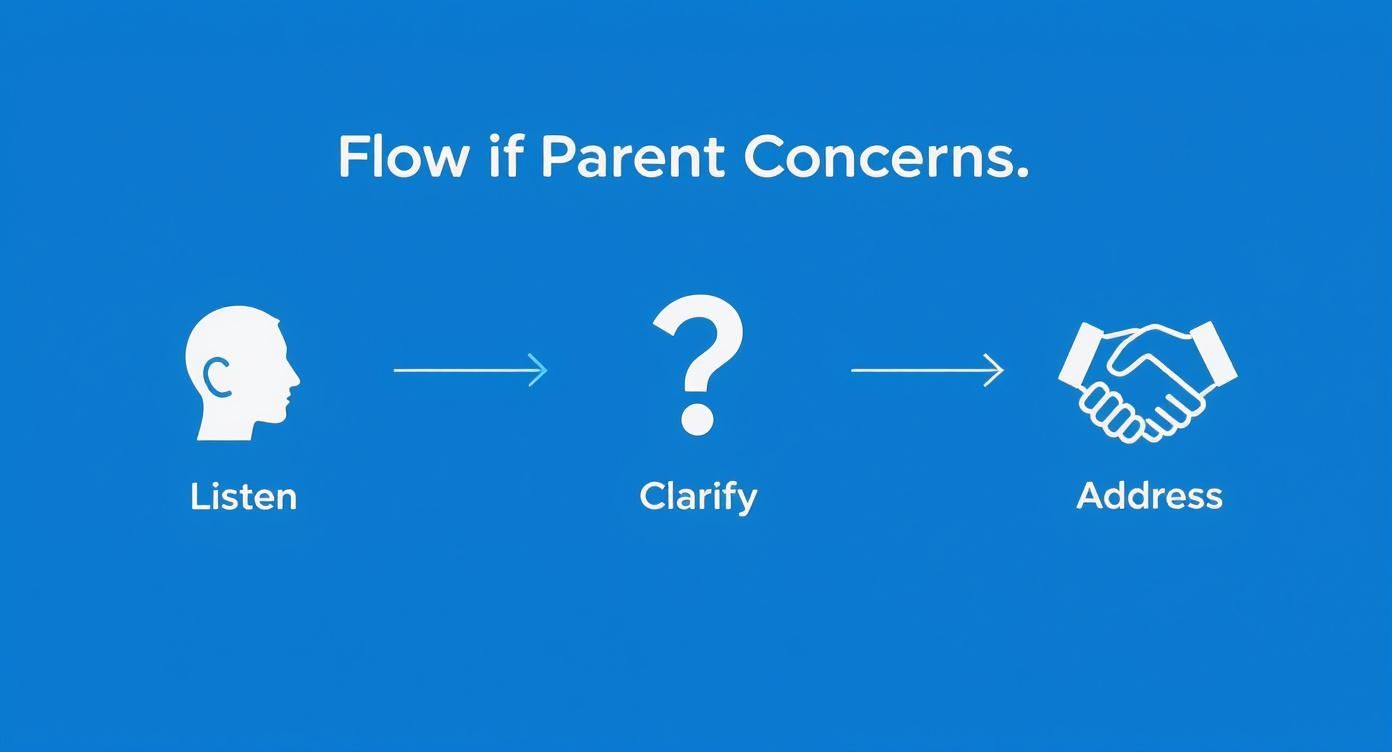
As the infographic shows, you can only reach a real resolution after you’ve built that foundation of listening.
Finally, you can move to the Solve stage. The key here is to frame it as a partnership. Use "we" and "us" to reinforce that you're on the same team, working toward a shared goal: the student’s success.
By focusing on collaborative problem-solving, you transform the dynamic from a parent-versus-school standoff into a united front dedicated to helping the child. This is the cornerstone of effective conflict resolution in schools.
Whether you're face-to-face or on the phone, your tone and body language matter just as much as your words. A calm voice and open posture can work wonders. Remember, your composure is contagious; it can single-handedly guide a difficult conversation back to a respectful and productive place.
Communication Techniques for Different Parent Archetypes
Of course, not all parents are the same. Recognizing who you're talking to can help you tailor your approach. The table below outlines some common "archetypes" and the subtle shifts in communication that can make a huge difference.
| Parent Archetype | Ineffective Response | Effective Response |
|---|---|---|
| The "Helicopter" Parent | "We have this under control." (Dismissive) | "I appreciate how involved you are. Let's look at the next steps together so we're on the same page." |
| The "Bulldozer" Parent | "That's just our policy." (Stonewalling) | "I hear your frustration with the policy. Help me understand how it's impacting your child specifically." |
| The "Ghost" Parent | "We need you to be more involved." (Accusatory) | "We've noticed a few things and would love to partner with you to support your student. What's the best way to keep you in the loop?" |
| The "Know-It-All" Parent | "I'm the expert here." (Defensive) | "You've shared some really insightful points. Your perspective is valuable. Let's combine that with what we're seeing at school." |
Applying the AVIS framework while being mindful of these parent dynamics gives you a powerful toolkit for navigating almost any difficult conversation that comes your way. It’s about being firm but fair, empathetic but professional, and always focused on the student.
Setting Professional Boundaries and Documenting Everything
https://www.youtube.com/embed/NAJ5RU-V8NA
While empathy is your superpower in this job, it has its limits. Without clear professional boundaries, it's easy to burn out. Your time, energy, and emotional well-being are not infinite, and protecting them is essential to serving all your families effectively.
Think of boundaries not as walls to keep people out, but as clear guidelines that teach people how to interact with you respectfully. This is never more important than when you're dealing with parents who fire off endless emails, make unreasonable demands, or cross the line into disrespect. Without these lines in the sand, you're just inviting chaos and exhaustion.
Establish Clear Communication Protocols
The best boundaries are the ones you set before you need them. You can head off so many problems just by clearly communicating your expectations for response times and preferred contact methods right from the get-go.
For example, we've all had that parent who emails at 10 PM and expects an immediate reply. If you answer, you've just taught them you're on call 24/7. The better move? Wait and reply first thing during your normal work hours.
It's not about ignoring them; it’s about training them on a professional rhythm of communication.
Protecting your time isn't selfish—it's a professional necessity. When you preserve your own energy, you guarantee you’ll have the patience and clarity needed to handle the truly tough situations when they arise.
Setting firm boundaries is especially critical when you suspect you're dealing with manipulative behaviors. For a deeper dive into some of those personality dynamics, you might find resources on navigating relationships with narcissistic individuals helpful for understanding what could be at play.
Scripts for Redirecting a Conversation Gone Wrong
When a conversation starts going in circles or gets heated, you need an exit ramp. Having a few phrases in your back pocket can keep you from getting flustered and help you regain control of the situation.
When a phone call is escalating:
- “I can hear we’re both getting frustrated. I think we’d make more progress if we scheduled a time to talk about this with a clear head. I’ll send an email to find a time that works.”
For a parent making unreasonable email demands:
- “Thanks for laying this all out. To give this the attention it deserves, the right next step is to meet with [Teacher/Principal's Name]. Let me know what your availability looks like next week.”
These scripts are polite but firm. They acknowledge the parent's feelings but shift the conversation from an emotional, unproductive space to a structured, solution-focused one.
If It’s Not Written Down, It Didn’t Happen
This brings me to my most important piece of advice: document everything. Meticulously. This isn't about building a case against a parent. It's about creating a factual, objective record that protects you, the student, and the school.
After every single important call or meeting, send a quick follow-up email.
- Keep it short, factual, and neutral.
- Note the date and time of your conversation.
- Summarize the key issues and any agreed-upon next steps.
This simple act creates a paper trail, ensures everyone is on the same page, and holds all parties accountable. If things ever do escalate, you’ll have a clear, unemotional record of every interaction.
Turning Conflict Into a Collaborative Partnership

The real goal of a tough parent conversation isn't just to survive it. The real prize is turning a moment of high tension into a stronger, more collaborative relationship that ultimately benefits the student. It’s what you do after the meeting that makes all the difference and proves you're an ally for the long haul.
Your first move should be a carefully crafted follow-up email. Think of it as more than a simple recap; it’s a tool for cementing your shared commitment. Summarize the solutions you landed on and clearly outline the next steps for everyone involved—both you and the parent. This simple act builds clarity and mutual accountability.
This is a cornerstone of effective school communication with parents, which you can read more about here: https://blog.marcomsociety.org/school-communication-with-parents/. It creates a documented history of your partnership and shifts the dynamic from just putting out fires to proactively working as a team.
From a Tense Meeting to a True Partnership
Once you’ve sent that initial follow-up, the real work of rebuilding trust begins. Your actions in the coming days and weeks are what will truly define the relationship. The key is to be intentional and consistent.
Try scheduling a brief, low-stakes check-in. A quick email or even a two-minute phone call a week later can work wonders.
- Keep it simple: "I just wanted to touch base and see how things have been going since we last spoke."
- Share a quick positive: "I wanted to let you know that we started that new reading strategy today, and it went really well."
These small gestures show you’re thinking about their child even when there isn’t a problem. It proves you’re invested in their success, not just reacting to issues as they come up.
The most powerful tool for resetting a difficult parent dynamic is "positive contact." Instead of only reaching out when there's a problem, make a point to share good news—no matter how small.
A short email celebrating a small win—a moment of kindness in the classroom, a great effort on an assignment, or a positive interaction with friends—can completely reframe a parent’s perception of the school. It shows you see their child as a whole person, not just a list of challenges. This builds an incredible amount of goodwill and makes any future difficult conversations infinitely more productive.
Understanding Long-Term Family Dynamics
It’s also crucial to remember that you're only seeing a small slice of a long-standing family dynamic. The stress you witness in a meeting might be rooted in years of history that you’ll never be privy to. Research even shows that tensions between parents and their adult children often intensify over time, which gives you a sense of the complex dynamics that can spill over into school life.
In cases where you suspect broader family communication is the core issue, your efforts alone may not be enough. For families dealing with specific challenges, suggesting resources like family therapy for ADHD can be a constructive way to help them develop better communication strategies as a unit.
Navigating the Toughest Parent Conversations
Even with a solid plan, you’re going to run into specific, high-stakes situations that test your patience and professionalism. Let's be honest, knowing how to handle difficult parents is less about having a perfect script and more about being ready for the inevitable curveballs. Here are some of the most common challenges I've seen pop up and how to get through them.
What If a Parent Becomes Verbally Aggressive?
First and foremost, your safety—both physical and psychological—is non-negotiable. When a parent starts yelling, using threatening language, or getting in your space, your only job is to de-escalate and create distance. This is not the time to solve the problem or win the argument.
Stay calm. It’s hard, but your measured response is your best tool. Use a clear, neutral tone to set a firm boundary.
Something as simple as, "I understand you're upset, but I can't continue this conversation while I'm being yelled at. We can reschedule for a time when we can speak more calmly," can work wonders.
If you’re face-to-face, physically step back to create more space. Don't hesitate to walk away and find an administrator or colleague. Every school has a protocol for this, so make sure you know it. And never, ever feel bad about calling security if you feel unsafe.
After the immediate situation is over, document everything. Write down the time, location, what was said, and who was present. Report it to your supervisor right away.
How Do I Manage a Parent Who Constantly Emails or Calls?
This one is a classic path to burnout. When you respond to every single message instantly, you're unintentionally training parents to expect 24/7 access to you. That’s just not sustainable. The key here is to proactively and professionally set boundaries.
You need to manage expectations by setting a clear communication rhythm.
A simple but effective tactic is to dedicate a specific block of time each day to respond to non-urgent parent emails. More importantly, you need to communicate this system.
You could add a quick note to your email signature: "I am committed to giving your message my full attention and typically respond to emails between 3:00 and 4:00 PM daily. For urgent matters, please contact the main office."
This isn't about ignoring parents. It’s about managing your time so you can actually focus on your work without constant dings and interruptions. It subtly tells parents that you value their message enough to give it dedicated, focused time instead of a rushed reply between meetings.
What’s the Best Way to Respond When a Parent Blames the School?
It’s a classic opening line: "It's the school's fault that my child is…" When a parent comes in hot with blame, our natural instinct is to get defensive. Don't fall into that trap. Arguing about who’s at fault is a dead-end street that only escalates the conflict.
Your job is to pivot the conversation from blame to collaboration.
Start by acknowledging their frustration. This shows you're actually listening. Then, immediately shift the focus to a shared goal—their child's success.
Try language like this:
"It sounds like you're really worried about how things are going for Alex in math class. I share that concern. I'd love to work with you to figure out a plan to help him get back on track."
This completely reframes the interaction. It moves the dynamic from "us vs. them" to a collaborative team focused on a solution. You’ve successfully steered the conversation away from finger-pointing and toward productive, future-focused action. That’s where the real solutions always are.
At The MarCom Society, we help K-12 communications professionals tackle tough challenges like these every day. We offer the resources, expert advice, and peer support you need to turn difficult interactions into positive partnerships. Join our community to build your skills and confidence.









