When we talk about improving internal communications, we're really talking about creating a system that delivers clear, consistent messages to every single employee. It's time to move away from scattered updates and information overload. The goal is a unified strategy that keeps everyone—from teachers in the classroom to the folks in the maintenance shed—on the same page and feeling like part of the team.
Why School Internal Communication Matters More Than Ever
A great school isn’t just about student achievement; it’s built on a foundation of aligned and engaged staff. But let's be honest, many K-12 teams are drowning in communication chaos. Critical updates get buried in an avalanche of emails, and non-desk staff like cafeteria workers or bus drivers often feel completely left out of the loop.
This isn't just an inconvenience. It creates real, tangible problems.
When communication fails, the fallout is predictable:
- Morale takes a nosedive. Staff who feel uninformed start to feel undervalued, and their engagement plummets.
- Operational chaos ensues. A missed update about a schedule change, a new safety protocol, or a policy tweak can throw a wrench in the entire day.
- Rumors and misinformation spread like wildfire. When official channels are silent or unclear, the grapevine fills the void, often with the wrong information.

The Growing Challenge of Engagement
Keeping your team aligned has never been more crucial—or more difficult. We're seeing rising employee disengagement everywhere, largely fueled by the constant barrage of information. A recent survey of over 200 communication pros highlighted a key challenge: juggling too many platforms while trying to keep messages clear.
To get a sense of what's on the horizon, check out these internal communication trends heading into 2025. They really drive home the need for a smarter approach.
A disconnected staff can't fully support a connected student body. When your internal house is in order, the positive effects ripple outward into every classroom, hallway, and administrative office.
A modern internal communications plan for a school has to be thoughtful and tailored. It’s about being intentional with every message and, just as importantly, respecting your staff’s time. For a deeper dive, our guide on internal communications best practices is a great place to start building your strategy.
Building a solid foundation for your internal communications strategy is essential for success. The table below outlines the core pillars that every school should focus on to create a more connected and informed staff.
Key Pillars of Effective School Internal Communications
| Pillar | Objective | Primary Audience |
|---|---|---|
| Transparency & Trust | Build a culture of honesty and openness. | All Staff (Admin, Faculty, Support) |
| Clarity & Consistency | Ensure messages are easy to understand and uniform across all channels. | All Staff |
| Inclusivity & Accessibility | Reach every employee, regardless of their role or access to technology. | All Staff, especially non-desk workers |
| Feedback & Dialogue | Create two-way communication channels where staff feel heard. | All Staff |
| Alignment & Purpose | Connect daily work to the school's overarching mission and goals. | All Staff |
By focusing on these five pillars, you can move from simply broadcasting information to fostering genuine engagement and a shared sense of purpose across your entire school community.
Once you’ve grasped why this is so important, the next step is implementation. For some great, actionable advice, take a look at these 7 expert tips for improving workplace communication. By prioritizing clarity, consistency, and inclusivity, you can make sure every member of your team feels informed, valued, and ready to help students succeed.
Uniting Leadership and Staff with Clear Messaging
Ever feel like there’s a massive gap between what school leaders say and what teachers and staff actually hear? It’s a common problem. That disconnect can quietly sabotage district-wide initiatives, creating a culture of confusion instead of a cohesive team moving in the same direction. Learning how to improve internal communications starts by bridging this exact gap.
Great leadership messaging is so much more than just sending another email. It's about building trust and creating clarity. When leaders share updates on district goals, policy changes, or new strategic plans, the message has to be consistent, clear, and repeated across different channels. Only then does it actually sink in and resonate with everyone. Think of that consistency as the foundation for a well-informed and engaged staff.
From Broadcast to Dialogue
Relying on one-way, top-down communication is a surefire recipe for disengagement. If you want to build a truly united culture, leaders need to create simple and accessible ways for staff to give feedback. This small shift makes people feel heard and valued, transforming them from passive recipients of information into active partners in the school's mission.
Here are a few practical ways to get a real two-way conversation going:
- "Ask Me Anything" Sessions: Imagine a principal or superintendent hosting regular, informal Q&As. These can be in-person in the staff lounge or virtual, but the goal is to address concerns head-on.
- Simple Pulse Surveys: After a big announcement, send out a short, anonymous survey using a tool like Google Forms. This gives you a quick read on how the message landed and what questions people have.
- Suggestion Boxes (Digital or Physical): It’s a classic for a reason. Suggestion boxes offer a low-pressure way for staff to share great ideas or flag potential issues without feeling put on the spot.
The point isn't just to talk, but to show you're actively listening. This approach builds psychological safety and empowers your staff to share the invaluable perspectives they have from being on the front lines every day.
The Power of Visible Leadership
For building trust, leadership visibility is completely non-negotiable. When your team sees and hears from their leaders regularly and authentically, it demystifies the decision-making process and reinforces your shared purpose. An impersonal memo about a new curriculum adoption feels distant and cold. But a short video from the superintendent explaining the why behind the change? That feels personal and motivating.
The data backs this up. Research consistently shows a direct link between the quality of leadership communication and how aligned employees feel. Here’s a startling reality check: while 27% of leaders think their teams are fully aligned with the organization's goals, a tiny 9% of employees agree. And it gets worse—79% of employees say that the quality of communication from their leaders directly impacts their understanding of those goals. You can dig into more of this data in the full 2025 Internal Communications Report.
Think about it this way: A principal who maintains a genuine open-door policy does more for staff morale and alignment than a dozen perfectly crafted emails ever could. Presence and authenticity matter.
At the end of the day, uniting leadership and staff boils down to being intentional. It requires leaders to be visible, messages to be clear and consistent, and feedback channels to be open and actively encouraged. When you shift from simply broadcasting information to fostering genuine dialogue, you build a foundation of trust that empowers every single person on your staff to do their best work for students.
Choosing Communication Channels That Actually Work
Let's be honest. Tacking a flyer to the staff room bulletin board or sending yet another all-staff email blast just doesn’t cut it anymore. If you want important messages to land, not get lost, you need a smart mix of channels that reaches everyone—from the principal buried in spreadsheets to the bus driver on their morning route.
The trick is to stop thinking in terms of one-size-fits-all. A district-wide policy update needs a different home than a quick reminder for the science department. Building a strategy that actually works means taking a hard look at your school's real-world needs, your budget, and, most importantly, the daily habits of your staff.
Matching the Channel to the Message
Before you jump on board with the latest shiny app, take a step back and ask a few simple questions. How urgent is this message? Who really needs to see it? Do I need a response? Answering these questions first is the secret to choosing the right tool for the job.
This simple framework can help you visualize how to pick the best channel.
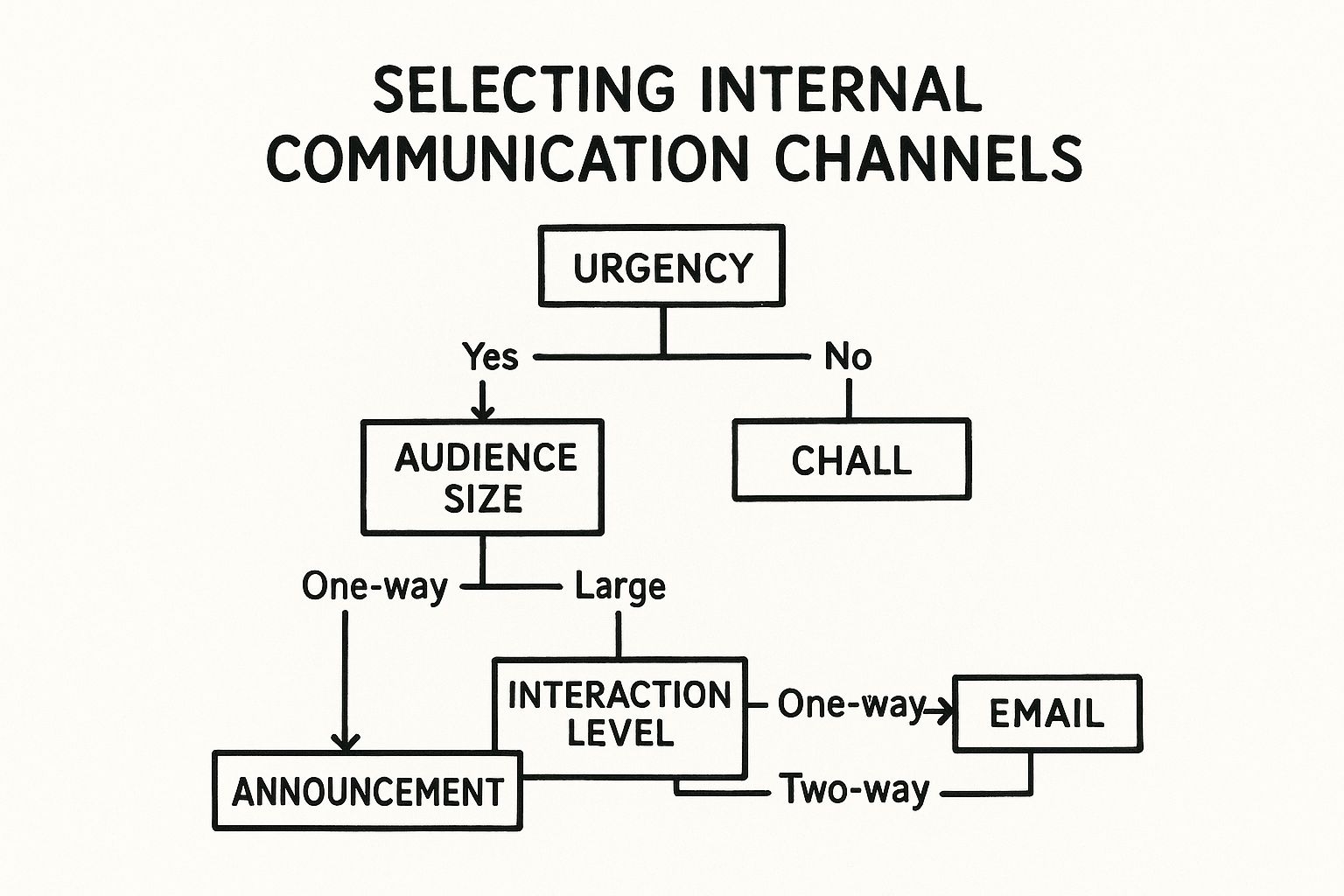
As you can see, a high-urgency message for a big group practically screams for an SMS alert. On the other hand, a non-urgent, two-way conversation is probably better suited for a staff portal or a team chat platform.
For deeper collaboration, tools like Microsoft Teams for internal communication can create a central space for everything from instant messaging to file sharing. It’s also worth noting that a strong internal communication plan often shares DNA with your external strategy. Many of the same principles apply to how you approach social media in schools to connect with parents and the wider community.
The most powerful tool isn't the one with the most features—it's the one your staff will actually use consistently. Simplicity and accessibility should always guide your decision-making process.
Your ultimate goal is to build a reliable communication ecosystem. Thinking about what to include in your mix? Here are a few options I've seen work well in schools:
- Dedicated Mobile App: A game-changer for reaching non-desk employees like maintenance or cafeteria staff. Push notifications are perfect for urgent news.
- Revitalized Email Newsletter: Great for a weekly roundup of important, but not urgent, info. The key is scannable formatting and clear, compelling headlines.
- Targeted SMS System: Use this one sparingly! It's for true emergencies like a snow day or last-minute schedule changes that everyone needs to see now.
- Staff Intranet or Portal: This becomes your single source of truth—a central hub for documents, calendars, HR forms, and other resources staff need to access on their own time.
School Communication Channel Comparison
To make the decision a bit easier, here’s a quick breakdown of common channels, their best uses, and what to watch out for.
| Channel | Best For | Potential Pitfalls | Key Audience |
|---|---|---|---|
| Mobile App | Urgent push notifications, reaching non-desk staff, quick polls, and two-way feedback. | Can be costly to develop; requires staff to download and enable notifications. | All staff, especially mobile-first employees. |
| Email Newsletter | Weekly summaries, "nice-to-know" updates, celebrating successes, and sharing resources. | Easily ignored if too long or poorly formatted; low open rates are a constant battle. | All staff, particularly those who are desk-based. |
| Staff Portal/Intranet | Centralizing static resources like handbooks, forms, calendars, and official documents. | Can become a "document graveyard" if not actively managed and updated. | All staff, for self-service information. |
| SMS/Text Alerts | True emergencies (school closures, safety alerts) and critical, time-sensitive reminders. | Overuse leads to staff ignoring messages; character limits restrict detailed information. | All staff and parents (for emergencies). |
Choosing the right channel isn't about finding a single magic bullet. It’s about building a flexible system where each tool has a clear purpose.
By being intentional about your channels, you cut through the noise and build trust. You ensure every single employee gets the right information, at the right time, through the right medium.
Connecting with Your Hard-to-Reach Employees
Let's talk about the people who are the absolute backbone of your district: the custodians, bus drivers, and cafeteria staff. They keep things running, yet they're often the last to get the memo. An email blast about a new safety protocol or a message celebrating a district-wide win? It probably never even reaches their screen.
This leaves a huge chunk of your team completely in the dark.
This isn't just a feeling; the numbers back it up. There's a major difference in how desk-based and non-desk employees see internal comms. A staggering 29% of non-desk workers say they're satisfied with the information they get, compared to 47% of their colleagues sitting at computers. That gap is a real problem for schools. The 2025 Employee Communication Impact Study really digs into this issue if you want to see the full picture.
Think Mobile-First and Low-Tech
To close this gap, you have to meet these employees right where they are. That means getting away from tools that chain you to a desktop. Think simple, direct, and incredibly easy to access.
- SMS for Urgent News: When it’s a snow day or an emergency update, nothing beats a text message. It cuts through the noise and gets the alert straight into their hands, instantly.
- Simple Apps Without Logins: Look for platforms that offer a streamlined mobile app where a school email isn't required. These are perfect for sending push notifications for news that's important but not a five-alarm fire.
- Old-School Communication Hubs: Don't sleep on the power of a physical space. A clean, updated bulletin board in a breakroom or maintenance office can be a go-to spot for information. Just make sure it stays current and isn't covered in month-old flyers.
These tactics are a great start, but they fit into a bigger strategy of overcoming communication barriers that every school district faces in one way or another.
The Untapped Power of Supervisor Huddles
Tech is great, but it’s not the only solution. Honestly, one of the most powerful tools you have is the direct supervisor. A quick, five-minute "huddle" at the start of a shift can do more than a dozen unread emails ever could.
These quick stand-up meetings are the perfect time for supervisors to:
- Pass along the one or two most important updates for the day.
- Answer questions on the spot and clear up any confusion.
- Get feedback from the team to share up the chain of command.
Suddenly, communication isn't just a top-down broadcast. It becomes a real conversation, making sure the message is not just delivered, but actually understood.
I saw this work wonders in a rural Texas district. They started daily pre-route huddles for the transportation department, and the change was incredible. Morale went through the roof, and operational efficiency improved because drivers felt connected and knew exactly what to expect for the day. It cut down on so many on-the-road headaches.
Making Every Employee Feel Like Part of the Team
At the end of the day, this is about more than just passing along information. It’s about showing every single person on your staff that they are a crucial part of the school community.
When a bus driver gets that timely text alert, they feel respected. When a custodian sees their team's hard work celebrated on a poster in the breakroom, they feel seen.
By mixing smart mobile tools with simple, human-to-human connection, you can finally make sure no one is left out of the loop. That’s how you build a team where every employee feels informed, connected, and ready to help your students succeed.
Measuring What Matters in Your Communication Strategy
So, how do you actually prove your internal communication efforts are paying off? The real way to show your value to school leadership is to move beyond guesswork and into data. When you have the numbers to back you up, you transform your role from someone who just sends messages to a strategist who actively shapes staff engagement.
This whole shift starts with focusing on metrics that tell a clear story. While every school has its own unique quirks, there are a few key performance indicators (KPIs) that give you a solid baseline for measuring how effective your communications really are. This is a critical piece of the puzzle for learning how to improve internal communications—after all, what gets measured gets managed.

Key Metrics for School Communications
You don't need a fancy, complicated analytics platform to get started. Honestly, the best approach is to begin by tracking a few simple but powerful numbers that show how your messages are actually landing with staff.
- Email Open and Click-Through Rates: Think of this as your starting point. If you see a consistently low open rate on your weekly staff newsletter, that’s a flashing red light. It's a clear signal to rethink your subject lines, the time you send it, or the content itself.
- Intranet or Staff Portal Engagement: Take a look at the data. Are people logging in? Are they viewing key announcements and downloading important documents? You need to know if staff are actively using this "single source of truth" or if it's just collecting digital dust.
- Feedback from Pulse Surveys: Short, frequent surveys can give you incredibly valuable qualitative data. Ask direct questions like, "On a scale of 1-5, how clear was the information about the new grading policy?"
These numbers give you a real-time snapshot of what’s connecting and what’s falling flat. Let's say you see a 30% click-through rate on a video message from the superintendent but only 5% on a lengthy policy document. That’s a powerful insight right there—it tells you exactly what kind of content your staff prefers.
Gathering Actionable Feedback
The hard numbers tell you what is happening, but it's the qualitative feedback that tells you why. For any kind of real, continuous improvement, you have to set up simple, consistent channels for staff to share their thoughts. This is non-negotiable.
Your most valuable insights won't come from a dashboard. They'll come from a teacher who tells you they finally feel in the loop, or from a bus driver who suggests a better way to communicate route changes.
Try setting up a digital suggestion box using a simple tool like Google Forms. Another great tactic is to embed a feedback form at the bottom of every major email you send out. A simple question like, "Was this update helpful? Let us know why or why not," can create an amazing, always-on feedback loop.
When you combine hard numbers with real human feedback, you can build a truly compelling case for your strategy. This data gives you the power to show leadership the tangible impact of your work, justify budget requests for new tools, and—most importantly—fine-tune your approach to better serve every single employee in your district.
Answering Your School Communication Questions
Even with the best plan in place, overhauling your communication strategy can feel like a monumental task. If you're feeling a bit overwhelmed, you're in good company. Let’s walk through some of the most common questions and sticking points that K-12 comms pros run into when trying to improve how their schools and districts talk to each other.
How Can We Improve Internal Communications on a Tight Budget?
This is the big one, isn't it? The good news is that improving communication doesn't have to mean a big new line item in your budget. Some of the most effective strategies are low-cost or even free—they’re about changing habits, not buying new platforms.
First, take a hard look at what you’re already using. That weekly email newsletter? It can be a powerhouse if you just make it more scannable, mobile-friendly, and visually interesting. You could also introduce regular "stand-up" meetings for different departments. They cost nothing but a few minutes of time and can do wonders for team alignment.
Free tools can also pack a surprising punch.
- Pulse Surveys: A simple Google Form is perfect for creating quick surveys to get a read on staff morale or gather feedback.
- Communication Champions: Find those enthusiastic teachers and staff members who are natural connectors and empower them to help spread important information within their teams.
- Centralized Resource Hub: Don't underestimate a well-organized shared folder in Google Drive. It can serve as a simple, no-cost "single source of truth" for essential documents and templates.
The real key is consistency and clarity, not expensive tech. I've seen schools make incredible progress just by committing to a predictable, well-formatted weekly email. It becomes a trusted ritual that cuts through the noise without costing a dime.
I've seen schools achieve remarkable turnarounds by simply committing to a well-formatted, reliable weekly email digest. It becomes a trusted ritual that staff can depend on, cutting through the daily noise without costing the district a dime.
What Is the Most Important Change We Can Make?
If you can only do one thing, do this: establish a single source of truth.
Staff burnout is fueled by information chaos. When critical updates come from every direction—random emails, a note in a mailbox, a mention in a staff meeting, a dusty intranet page—people get overwhelmed and confused. This fragmentation is the single biggest enemy of clear communication.
Your mission is to pick one place and make it the official home for everything important. It could be a dedicated section on the staff portal, a weekly email digest, or a specific channel in your district's mobile app. The tool doesn't matter as much as the rule.
Once you’ve chosen it, you have to train everyone to understand that if a piece of information is truly important, it will always be in that one spot. This simple discipline solves multiple problems at once:
- It cuts the noise. Staff know exactly where to look and can tune out the rest.
- It builds trust. Everyone is working from the same playbook.
- It boosts efficiency. No more wasted time hunting for that one memo someone vaguely remembers seeing.
How Do We Get Busy Teachers and Principals to Actually Read Our Communications?
The secret here is to relentlessly respect their time. Every message you send is competing for attention with lesson plans, parent emails, bus duty, and a hundred other things. To win that battle, your communication has to be incredibly concise, relevant, and easy to act on.
Start with your subject lines. Make them direct and action-oriented. "Action Required: Submit Grades by Friday" works. "Weekly Update" does not.
Inside the message, use formatting to your advantage. Bold text, bullet points, and short paragraphs are your best friends. Assume everything will be read on a phone while walking down a hallway. Can someone get the gist in 15 seconds? If not, it’s too long.
But the most important thing you can do is segment your audience. The transportation department doesn't need curriculum updates, and elementary school teachers don't care about the high school prom. Sending the right information to the right people is the ultimate sign of respect, and it’s what will keep them opening your messages in the future.
At The MarCom Society, we provide K-12 communications professionals with the resources, expert guidance, and peer support needed to tackle these challenges head-on. Join our community to access workshops, courses, and a network of colleagues who understand your unique world.