
To get better at telling stories, you really have to zero in on three things: who you're talking to, what you absolutely need them to know, and which narrative framework will get that point across best. It's a blend of emotional connection and clear logic, where you practice turning dry facts into something people actually remember.
Why Mastering Storytelling Is a Modern Superpower

Ever walk out of a presentation and instantly forget the statistics, but you can't shake that one short, personal anecdote the speaker shared? That’s the magic of storytelling. It’s not just a skill for novelists and screenwriters; it’s a powerful tool for anyone who needs to connect and persuade.
Let's be honest, our brains aren’t wired to retain spreadsheets and bullet points. We're wired for narrative. A good story gives information context, sparks emotion, and builds a mental scaffold that makes complex ideas easy to grasp and hard to forget. It’s the difference between saying "a new school initiative needs funding" and sharing the story of one student whose entire future could change because of it.
The Science Behind Why Stories Stick
Your brain processes stories and facts in completely different ways. When you hear raw data, only the language centers of your brain light up. But when you listen to a story, your sensory cortex kicks in—you start to feel, see, and live the narrative as if it were your own. This deep, neurological connection is what makes stories so incredibly persuasive.
The data backs this up. Stories are remembered up to 22 times more than facts alone. Think about that. Studies have shown that people retain a mere 5% to 10% of information when it's presented as just stats. But wrap those same stats in a compelling story, and retention soars to 65% to 70%. You can find even more data storytelling insights that prove how potent this is. This isn't just a slight edge; it's a massive advantage for any communicator.
A great story is a data point with a soul. It transforms abstract numbers into a human experience, making your message not just heard, but felt.
Storytelling in Action
In today's world, being a great storyteller is like having a superpower. It delivers tangible results.
This is the skill that helps:
- A principal secure a game-changing grant by painting a vivid picture of student potential.
- A teacher bring a dry historical event to life by framing it as a gripping human drama.
- A communications director galvanize community support by sharing authentic testimonials from parents and students.
Forget the outdated notion that storytelling is a "soft skill." It's a strategic asset that drives action, builds trust, and forges real connections. Before we get into the nuts and bolts of how to build your narrative skills, it’s essential to buy into the why. Once you truly grasp its importance, you're on your way to becoming a far more effective communicator.
Building Your Storytelling Foundation
Before you can tell a story that truly connects, you have to pour the foundation. A great narrative isn't just a happy accident; it's a carefully built experience. This whole process starts with two deceptively simple questions: Who are you talking to, and what do you want them to walk away with?
It’s tempting to jump right into the exciting parts—the big event, the cool new program. We get caught up in what we want to say before ever considering who we're saying it to. This is where most stories go wrong. The best ones are always, without exception, built with the audience in mind.
Start with Your Audience in Mind
Think of your story as a journey. To guide someone effectively, you have to know their starting point. What do they already believe? What keeps them up at night? What problems are they facing that your story could help them navigate? Taking the time to understand your audience isn't about telling people what they want to hear; it’s about building a bridge from your world to theirs.
A critical first step is figuring out how to develop story ideas that will actually resonate, moving from a random thought to a concept that clicks with the people you’re trying to reach.
For those of us in schools, this means getting much more specific than just "parents" or "staff."
- For current parents: Are they juggling work and family, needing quick, scannable updates on their kid’s progress? Or are they the type who loves a deep-dive newsletter that celebrates school culture?
- For prospective families: What are their biggest fears about picking a school? Are they hunting for top-tier academics, a sense of community, or a standout arts program?
- For your staff: Are they feeling burnt out and need a story that reminds them of their incredible impact? Or do they just need the straight facts about an upcoming change?
Creating simple "audience personas" can be a game-changer. A persona is just a quick sketch of your ideal listener. Give them a name, a role, and a primary goal. Then, when you write, talk directly to that person.
Imagine you're telling a story to "Anna," a working mom who scans school emails on her phone during her commute. Suddenly, those long, dense paragraphs and vague subject lines look like huge roadblocks. You’d instinctively adapt, making your story easy to scan, mobile-friendly, and immediately relevant.
Clarify Your Core Message
Once you know who you're talking to, you have to figure out your one big takeaway. If your audience only remembers one thing, what should it be? This core message is your story’s north star. It guides every single word, image, and detail you choose.
A fuzzy message always leads to a rambling, forgettable story. A crystal-clear message, on the other hand, creates a focused and powerful narrative.
For instance, instead of a generic theme like "our new science program," a sharp core message would be: "Our new hands-on science program gives every student the confidence to experiment, fail, and discover their inner innovator." See the difference? It's specific, it's emotional, and it gives you a clear direction. Of course, your school's unique personality is a huge part of this, which you can learn more about in our guide on what is a brand voice.
Use the ABT Framework to Find Your Focus
One of the simplest and most powerful tools for finding your story's focus is the And, But, Therefore (ABT) framework. It’s a brilliant little trick that forces you to build a narrative arc with tension and resolution, turning a boring list of facts into a real story.
Here’s the breakdown:
- AND: You state the situation or a few related facts. This sets the scene.
- BUT: You introduce a problem or a conflict. This is the hook that creates tension.
- THEREFORE: You present the solution or the outcome. This is the payoff that reinforces your core message.
Let’s see it in a school setting:
Example ABT:
- Our school has always prided itself on strong academics AND our students have consistently performed well on standardized tests.
- BUT we noticed a decline in student engagement and a growing fear of making mistakes in creative subjects.
- THEREFORE, we launched a project-based learning initiative that celebrates experimentation, turning our classrooms into hubs of curiosity and resilient problem-solving.
That simple structure instantly gives your story a beginning, a middle, and a satisfying end. It’s the perfect blueprint to get you started.
You've figured out who you're talking to and what you need to say. Now, how do you actually put it all together? This is where a narrative framework comes in—it’s the skeleton that holds your story upright and gives it momentum.
Without a solid structure, even the most important message can fall flat. Think of it as the difference between a random pile of bricks and a well-designed house. You need a blueprint to turn raw materials into something meaningful and lasting.
The video below offers a great overview of how to build a compelling narrative arc.
As you plan, remember that your story's foundation is built in a specific order: knowing your listener, clarifying your message, and then picking the structure that best serves both. This little decision tree visualizes that flow perfectly.

The framework is that final, crucial piece of the foundation. It ensures your story is perfectly suited to your audience and lands with the intended impact. Let's dig into a few of my go-to frameworks for school communications.
Choosing The Right Storytelling Framework
Not all stories are built the same way. The structure you choose depends entirely on your goal. Are you trying to inspire personal growth, make a persuasive case for a new program, or rally support for a big vision? The right framework makes all the difference.
This table breaks down a few popular structures and when I've found them to be most effective.
| Framework | Core Concept | Best Used For | Example Scenario |
|---|---|---|---|
| The Hero's Journey | A relatable character overcomes a challenge with the help of a guide, returning transformed. | Alumni spotlights, student testimonials, and stories of personal growth. | A shy student joins the debate team (the challenge), finds their voice with a coach's help (the mentor), and wins a major competition (the return). |
| Problem → Solution → Impact | A straightforward structure that identifies a challenge, presents a fix, and shows the positive results. | Grant proposals, fundraising emails, and presentations for new initiatives. | Problem: After-school programs are oversubscribed. Solution: We're launching a new STEM club. Impact: 25 more students get hands-on learning each week. |
| Sparkline (What Is vs. What Could Be) | Contrasting the current reality with a more desirable future to create tension and inspire change. | Vision-casting speeches, capital campaign kickoffs, and community town halls. | What Is: Our playground is old and unsafe. What Could Be: Imagine a modern, accessible space where all our kids can play and learn together. |
Think of these as recipes—you can follow them exactly or add your own flavor. The key is to pick the one that best matches your ingredients (your audience and message) and what you're trying to cook up (your goal).
The Classic Hero’s Journey
There’s a reason The Hero’s Journey has been around for centuries, from ancient myths to blockbuster movies. It’s a deeply human pattern that resonates with everyone. The magic of this framework is that it casts your audience—or someone they can relate to—as the hero.
The basic arc looks like this:
- The Call to Adventure: The story starts with a challenge. In a school setting, this could be a student struggling with a tough subject or a teacher trying a new classroom technique.
- Meeting the Mentor: Our hero doesn’t go it alone. They meet a guide—a tutor, a supportive principal, a new program—that gives them the tools they need.
- Overcoming the Obstacle: Armed with new skills or support, the hero faces their challenge head-on and succeeds. They nail the presentation or master the tough concept.
- The Return: The hero comes back changed, with new confidence and skills that can inspire others in the community.
This structure is a natural fit for donor appeals, student success stories, and any time you want to showcase profound, personal transformation.
Problem → Solution → Impact
When you need to be direct, clear, and persuasive, the Problem → Solution → Impact model is your best friend. It’s logical, easy to follow, and incredibly effective for getting people on board with an idea. I lean on this one heavily for board presentations and emails asking for specific action.
First, you clearly define a problem that your audience already knows and cares about. This creates an immediate connection. Then, you introduce your program or initiative as the obvious answer.
But the most critical part is the end: the impact. Don't just list what your solution does. Show the real, human results. Paint a picture of the positive change it will create. This is what turns intellectual agreement into passionate support.
A common mistake I see is people spending all their time explaining the solution. The truth is, your audience won't care about your solution until they feel the weight of the problem and the promise of the impact.
Sparkline: The Contrast Between What Is And What Could Be
Developed by presentation guru Nancy Duarte, the Sparkline structure is all about building energy and momentum. It works by constantly shifting between "what is" (the current, less-than-ideal reality) and "what could be" (the inspiring future you're working toward).
This back-and-forth creates a powerful rhythm that keeps your audience captivated. It builds tension around the problem and offers release with the vision of a better way.
Here’s how that might sound in a speech for a library fundraiser:
- What Is: "Right now, our library is a place of quiet, dusty shelves with books that haven't kept pace with our curriculum."
- What Could Be: "But imagine a vibrant learning hub, buzzing with students collaborating on projects, using 3D printers and green screens."
- What Is: "We know that vision seems far off, especially with our current budget constraints."
- What Could Be: "But with your support, we can take the first step. We can fund the innovation lab that becomes the heart of this new space."
This framework is perfect for inspiring a community to embrace change. When you back this kind of narrative up with data, it becomes nearly unstoppable. Good storytelling has been shown to increase engagement by 300% and even boost sales by 30% in business contexts. The same principle applies here: blend a compelling vision with hard facts, and you'll build a case that's impossible to ignore.
Picking the right structure is a huge part of learning how to improve storytelling skills. It’s what gives your message direction and power. For even more ideas, check out these fantastic brand storytelling examples and see how others are putting these frameworks to work.
Bringing Your Story to Life With Detail and Emotion

If your story's structure is the skeleton, then vivid details and genuine emotion are its heart and soul. This is the magic that transforms a simple report into a memorable experience. It’s what makes your audience feel something, not just understand something.
Getting good at this means moving beyond just listing facts. Your goal is to paint a picture so clear that your audience feels like they were right there with you.
Show, Don’t Just Tell
This is probably the single most powerful piece of advice for any storyteller. Instead of just stating a fact, give your audience the details and let them arrive at the conclusion themselves. It’s far more impactful.
Let's look at a real-world school example:
- Telling: "Our after-school robotics club was a huge success, and the students were very engaged."
- Showing: "Every Tuesday afternoon, the science lab buzzed with a different kind of energy. Students were huddled together, debating designs, their faces lit by the glow of laptops as they programmed a robot arm to finally pick up a block. You could feel the whole room hold its breath… then erupt in cheers when it worked."
See the difference? The second version doesn't just claim success; it lets you feel the excitement and see the teamwork. That’s how you make a story stick.
A story that tells you everything leaves you with nothing to feel. A story that shows you the details invites you to live inside the moment, making the emotional impact your own.
Engage the Senses and Use Analogies
To pull your audience into the story, appeal to their senses. What did the moment look, sound, or even smell like? Describing the scent of old books in the library or the squeak of sneakers on the gym floor makes a scene instantly more real.
Analogies are another fantastic tool. They're like mental shortcuts, connecting a new or complex idea to something your audience already understands.
Trying to explain a new curriculum change can be incredibly dry. But what if you frame it as "upgrading our school’s operating system"? Immediately, parents and staff get it—it's a fundamental improvement designed for better performance.
Amplify Emotion with Visuals
In our visual-first world, your words are only half the story. The right photo, graphic, or short video can amplify the emotional core of your narrative in a heartbeat.
Here’s how to get it right:
- Impactful Photography: Ditch the posed group shots. Instead, look for candid photos that capture genuine emotion—students deep in concentration, a teacher having a breakthrough moment with a child. Action and authenticity are key.
- Simple Graphics: You don't need to be a graphic designer. Use a free tool like Canva to pull a single powerful quote or statistic and place it on a clean background. This makes key takeaways memorable and easy to share.
- Short Video Clips: A 15-second video of a student proudly explaining their science fair project can be far more compelling than a whole paragraph describing it. Remember, authenticity beats high production value every time.
Visuals aren't just decoration; they're powerful narrative tools. For a masterclass in this, look at how creators are telling a story with intention through cinematic videos.
If you’d like to explore this further, our guide on https://blog.marcomsociety.org/visual-storytelling-techniques/ offers more practical tips. Blending compelling writing with smart visuals is how you create stories that don't just inform, but truly connect.
Practice Exercises to Hone Your Narrative Skills
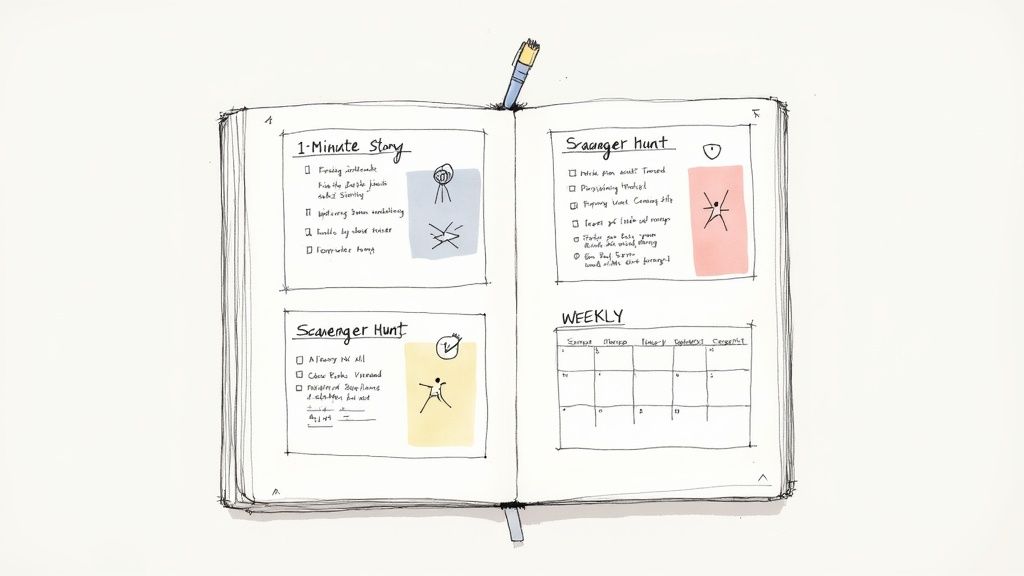
Knowing the theory of great storytelling is one thing. Actually doing it, making it an instinct, takes practice. Just like a musician runs scales or an athlete runs drills, we need exercises to build that narrative muscle.
This section is your workshop. It’s full of hands-on exercises you can weave into your routines. The goal isn't to add another huge task to your plate but to start seeing storytelling opportunities in the work you’re already doing.
Daily Micro-Exercises for Story Spotting
Great stories are happening all around you, usually hidden in plain sight. The first step to becoming a better storyteller is becoming a better story spotter. These quick, five-minute exercises train your brain to see the narrative potential in everything.
- The Story Scavenger Hunt: As you scroll through your inbox, pick one email—a district update, a parent question, a vendor message. Challenge yourself to find the hidden story. What's the sender's problem? What solution are they pitching? What’s the unspoken emotion driving the message?
- The Statistic Flip: Grab a single data point from a report, like "85% of students participated in extracurriculars." Now, give yourself 60 seconds to turn that number into a micro-story. Who is one of those students? What club did she join, and how did it change her week? This exercise forces you to humanize data on the fly.
Learning how to improve storytelling skills is less about grand invention and more about consistent observation. When you start seeing the narrative arcs in your daily life, crafting your own becomes second nature.
Weekly Challenges to Build Your Craft
When you have a bit more time, go for a slightly deeper dive. These weekly challenges are designed to stretch your creative muscles and help you apply storytelling frameworks in a low-stakes way.
- The 'Three Sentences' Challenge: Think about a recent school event—a field trip, an assembly, a guest speaker. Your mission is to tell the entire story using only the And, But, Therefore (ABT) framework. This forces you to slice through the noise and find the core conflict and resolution, the true heartbeat of the story.
- The 'Perspective Shift' Prompt: Write a short paragraph (50-75 words) about a school policy from three different viewpoints: a brand-new teacher, a senior student, and a parent who works two jobs. This is a powerful exercise in empathy, helping you see an issue from all sides before you communicate it.
- The 'Show, Don't Tell' Rewrite: Find a sentence in a recent email or post where you "told" something. For example, "The students were excited for the science fair." Now, rewrite it to "show" the excitement: "The gym buzzed with energy as students rushed to put the final touches on their volcanoes, their voices echoing off the bleachers."
Reusable Templates for Common Scenarios
Practice works best when it prepares you for the real world. Think of these templates as a launchpad, not a rigid script, for crafting messages for common school communications.
Template 1: The Persuasive Social Media Post
- Hook: Start with a relatable problem or an emotional question. (e.g., "Ever wonder what pure curiosity looks like?")
- The Moment: Share a powerful photo or a short video clip showing a student or teacher in action.
- The Insight: In one or two sentences, connect that moment to a bigger school value. (e.g., "This is what happens when we give students the tools to build their own ideas.")
- Call to Action: Tell your audience what to do next. (e.g., "See more from our innovation lab at the link in our bio!")
Template 2: A Story-Driven Weekly Update Email
- Subject Line: Make it intriguing. Instead of "Weekly Update," try "A Story of Teamwork from the Third Grade."
- Opening Anecdote: Begin with a brief story about one student or class that illustrates the week's main theme.
- The 'Zoom Out': Connect that small story to the bigger picture. How does this reflect a school-wide goal?
- Key Information: Place your logistical updates (dates, deadlines) after you've made an emotional connection.
- Closing Thought: End with an inspiring sentence that ties back to your opening story.
These aren't just one-and-done exercises. They're about building a repeatable process. Bookmark this page and come back to it. Pick one challenge a week. The more you practice these small acts of storytelling, the more natural and powerful your voice will become.
Common Questions About Storytelling
Even with the best frameworks in your back pocket, real-world questions always pop up. It’s one thing to understand the theory of great storytelling; it’s another thing entirely to pull it off when you're on a tight deadline.
Let’s get into some of the most common hurdles I see school communicators face. Answering these will help you bridge that gap between knowing what to do and actually doing it, giving you the confidence to tell stories that truly stick.
How Do I Find Stories in Data-Heavy Reports?
It’s so easy to get lost in a sea of spreadsheets, from enrollment numbers to assessment results. The secret is to stop looking for a story in the data and start looking for the human story behind the data. After all, numbers are just a record of what people did.
First, hunt for the outliers. Did the 3rd-grade team see a 20% jump in reading scores this year? That's not just a statistic; that’s a story about a group of teachers trying something new that paid off. Go find those teachers and ask them what they did differently.
Then, look for trends over time. Has volunteer participation crept up steadily over the past three years? That’s a powerful story about growing community trust and engagement. Your job is to find a parent or two who represents that trend and share their "why."
Don’t just present the data and hope your audience finds it interesting. Find the person who makes the data interesting and tell their story. Data provides the proof; the human element gives it a soul.
Any Tips for Overcoming a Fear of Public Speaking?
Putting a personal or heartfelt story out there can feel incredibly vulnerable, especially when you're standing in front of a room full of people. That fear is completely normal, but you can absolutely manage it. The goal isn't to eliminate your nerves—it's to channel them.
Here are a few practical strategies that have worked for me and countless others:
- Practice with a friendly face. Run through your story with a colleague you trust. Getting comfortable with the narrative when the stakes are low makes the real deal feel far less intimidating.
- Don't memorize, internalize. Instead of trying to get every word perfect, just know the key emotional beats of your story. This frees you up to speak more naturally and actually connect with your audience, rather than just reciting a script from memory.
- Lead with your best stuff. If you're nervous, open your presentation with your most practiced and compelling story. A strong, confident start builds momentum and helps you settle into a natural rhythm for the rest of your talk.
How Can I Tell If My Stories Are Working?
Measuring a story's impact can feel a bit fuzzy, but you can absolutely track its effectiveness with a mix of qualitative and quantitative feedback. You need to know if your message is actually landing the way you intended.
Here are a few simple ways to gauge your story's impact:
- Direct Feedback: After a presentation or board meeting, pull a few people aside and ask them what their main takeaway was. Their answers are the fastest way to know if your core message hit the mark.
- Engagement Metrics: On social media, look beyond the likes. Are people leaving comments with their own related experiences? Are they sharing the post with their networks? That deeper level of engagement is a sign that your story truly resonated.
- Observed Behavior: Did your story have a clear call to action, like signing up for the e-newsletter or RSVPing for an event? Tracking that response rate is the most direct measure of whether your story successfully inspired people to act.
Ultimately, a great story doesn't just get heard—it gets remembered and retold. When you start hearing parents or staff reference one of your stories in a later conversation, that's when you know you've truly succeeded.
At The MarCom Society, we provide the tools, expert guidance, and peer support K-12 professionals need to turn everyday school communications into compelling, impactful stories. Join our community to master these skills and more. https://marcomsociety.org









