When people talk about using AI in marketing, what they really mean is using smart tools to automate tedious jobs, make customer experiences more personal, and actually understand the data we’re collecting. It all boils down to spotting your biggest headaches, picking the right software to fix them, and then checking if it’s actually helping you hit your numbers.
So, What Does AI Actually Do in Marketing Today?
Let's cut through the hype. AI in marketing isn't some far-off sci-fi concept anymore; it's a practical, day-to-day tool that teams are using to get ahead. Forget the buzzwords for a second and think about what's happening on the ground.
Marketers who are already on board are using AI to create incredibly specific customer journeys, put routine campaign tasks on autopilot, and pull out insights from data that would have been impossible to find manually. Instead of getting lost in spreadsheets for hours, they’re letting AI spot the patterns and predict what’s likely to happen next.
Why Is Everyone Jumping on the AI Bandwagon?
This shift isn't just a fleeting trend. It's a genuine change in how marketing gets done. The real magic of AI is its ability to chew through enormous amounts of information and get things done at a speed and scale no human team ever could. This frees up your people to think bigger and get more creative.
Here are a few places where AI is already making a real difference:
- Whipping up content: AI can generate solid first drafts for blog posts, social media captions, and email newsletters in just a few minutes.
- Making sense of data: It can quickly pinpoint your most valuable audience segments or tell you why one campaign is outperforming another.
- Personalizing everything: Imagine showing a unique homepage or different course recommendations to thousands of prospective students at the same time. AI makes that possible.
- Automating the grunt work: It can handle routine jobs like scheduling social posts or sorting email lists, letting your team focus on strategy.
The market growth tells the same story. The AI marketing space is expected to hit a staggering $107.5 billion by 2028. That number alone shows why getting a handle on how to use AI in marketing is no longer optional.
AI isn't here to replace marketers. It's here to make them better. The real winners will be the ones who figure out how to work with AI, using it as a partner to boost their own creativity and strategic chops.
To get a feel for what’s out there, digging into a guide on AI marketing automation can be a great starting point.
While the tools might seem geared toward e-commerce, the core ideas apply almost anywhere. For example, the same AI tactics used to recommend products can be tweaked to improve student recruitment and alumni communication, a topic we dive into in our article on AI in education. This just goes to show how flexible and powerful these tools really are.
Finding Where AI Can Make the Biggest Impact

Jumping into AI without a clear plan is like buying expensive camera gear without knowing what you want to shoot. It’s tempting to grab the newest, shiniest tool, but to really understand how to use AI in marketing, you first need to know which problems you're trying to solve. This is about being strategic, not just adding more tech to your plate.
The best place to start is with a simple, honest look at your team's day-to-day workflow. Where are the bottlenecks? What tasks are eating up the most time? The idea isn't to replace your talented people, but to give them superpowers by offloading the repetitive work that drains their creative energy.
Pinpointing Your Marketing Pain Points
Every school marketing team has its own unique grind. A quick self-audit is often all it takes to see where AI could provide immediate relief and deliver the biggest bang for your buck.
Think about these common areas where marketing teams often feel the strain:
- Content Creation Speed: Is your team constantly playing catch-up, struggling to produce enough blog posts, social updates, and newsletters? AI can be a brilliant co-pilot, helping generate drafts and brainstorm ideas in a fraction of the time.
- Manual Data Analysis: Do you lose hours staring at spreadsheets, trying to connect the dots between campaign performance and enrollment data? AI is fantastic at spotting trends and patterns that are easy for the human eye to miss.
- Personalization at Scale: Are your emails to prospective families or alumni feeling a bit generic? AI can help you segment audiences and tailor messaging with a level of detail that's nearly impossible to achieve manually.
- The Admin Grind: How much time gets sucked into scheduling social media posts, cleaning up contact lists, or drafting standard email replies? These are perfect candidates for AI-powered automation.
The smartest AI integrations don't start with a flashy tool. They start with a well-defined problem. If you focus on a specific pain point first, you can guarantee your initial foray into AI delivers a real, measurable win for your team.
Once you’ve done this audit, you'll have a "hit list" of opportunities. Instead of getting overwhelmed by every new AI app that hits the market, you’ll have a clear guide for what to look for. If content creation is your number one headache, you know to focus your search on generative AI writing assistants.
Prioritizing for Maximum ROI
With your list of pain points in hand, the next step is to prioritize. Not all AI solutions are created equal, and some will give you a much faster and more significant return on your investment of time and money.
Ask yourself: which of these problems, if solved, would make the biggest difference to our school's marketing goals? Is it about driving more qualified leads for the admissions team? Or is it about saving your team 10 hours per week on admin, freeing them up for bigger-picture strategy?
Here's a simple way to think through your priorities:
- Assess the Impact: How much would fixing this problem move the needle on key metrics like enrollment inquiries, campus tour sign-ups, or overall brand visibility?
- Evaluate the Effort: How complex would it be to implement an AI tool for this? I always recommend starting with the "low-hanging fruit"—the low-effort, high-impact tasks—to build momentum and confidence.
- Align with Goals: Does this opportunity directly support a major marketing objective for this semester or school year?
This deliberate approach helps you avoid chasing shiny objects. You're strategically applying AI to solve real-world challenges, which sets you up for measurable success and makes it much easier to justify future investments in your marketing tech stack.
Choosing the Right AI Marketing Tools
Now that you've pinpointed the specific marketing challenges you want to solve, it’s time to navigate the crowded world of AI marketing software. The trick here is to sidestep the flashy features and zero in on what truly matters: a tool that fits your school's unique needs, budget, and existing tech stack.
You'll quickly find there are two main camps: broad, all-in-one platforms and specialized, niche solutions. A big platform might bundle tools for content creation, social media scheduling, and email automation all in one place. On the other hand, a niche tool might only do one thing—like writing fantastic, SEO-friendly blog posts—but do it exceptionally well. Neither is better than the other; it all comes down to your school's priorities.
Evaluating Your Options
It's so easy to get mesmerized by a long list of features when you're comparing tools. I've been there. My advice? Cut through the noise and focus on three things: usability, integration, and the actual quality of the AI output. A tool can have all the bells and whistles, but it’s worthless if your team finds it too clunky for daily use.
Always look for a clean, intuitive interface. When you’re in a demo, really notice the workflow. Does it make sense? Could someone on your team who isn't a "tech person" get the hang of it without a huge learning curve? For school marketing teams, where everyone is already wearing multiple hats, simplicity is a must. You can see how new tools fit into the bigger picture in our guide on modern marketing techniques for schools.
My Two Cents: The best AI tool isn't the one with the most features. It's the one your team will actually use. Prioritize a friendly interface and smooth integration to make sure it gets adopted and you see a real return on your investment.
To give you a better sense of what these tools can do, here’s a quick breakdown of the main categories you'll encounter.
Comparing Key AI Marketing Tool Categories
This table breaks down the primary functions, common use cases, and popular examples for different types of AI marketing tools to help you identify what you need.
| Tool Category | Primary Function | Example Use Cases | Example Platforms |
|---|---|---|---|
| Content Generation | Creating written or visual content | Drafting blog posts, social media captions, email newsletters, generating images | Jasper, Copy.ai, Midjourney |
| SEO & Content Optimization | Analyzing and improving content for search engines | Keyword research, on-page SEO suggestions, content briefs, topic clustering | Surfer SEO, MarketMuse |
| Social Media Management | Automating scheduling, analytics, and engagement | Finding optimal posting times, analyzing post performance, generating content ideas | Lately, Buffer (with AI features) |
| Email Marketing & Automation | Personalizing and automating email campaigns | Writing subject lines, personalizing email copy, segmenting audiences, A/B testing | Mailchimp (with AI features), Klaviyo |
Hopefully, seeing it laid out like this helps clarify which type of tool aligns best with the problems you identified earlier.
For instance, an AI-powered data tool can dramatically cut down the time and mistakes involved in getting your admissions data ready for a new campaign.
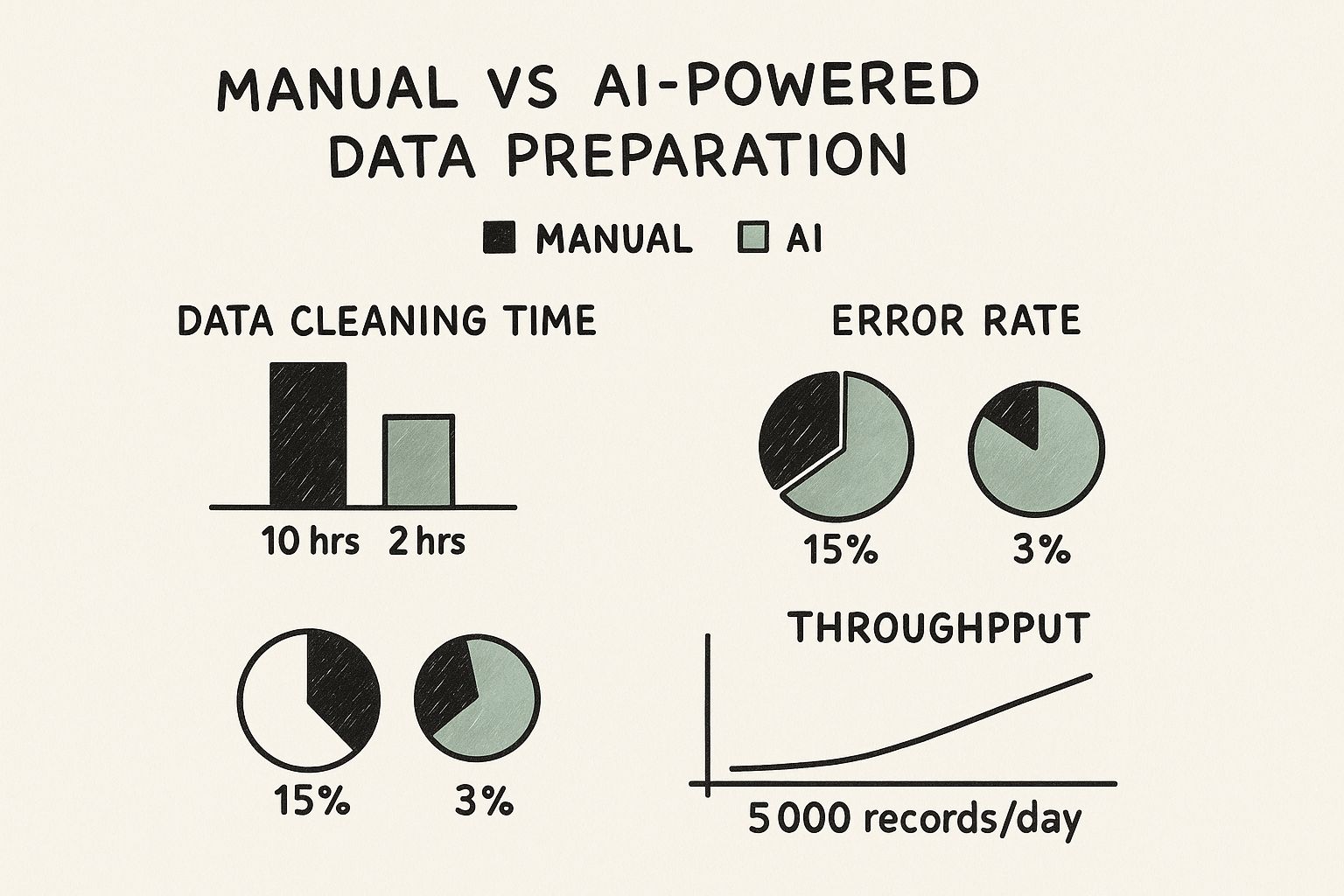
As you can see, AI can slash data prep and cleaning time by a staggering 80%. That’s a huge win for any busy marketing team, freeing you up for more strategic work.
Run a Pilot Program First
Before you commit to a year-long contract, please, please run a small-scale pilot program. Pick one or two people on your team and have them test the tool on a real, live project for a couple of weeks. This is your chance to see how the software performs in your actual work environment, not just in a polished sales demo.
During the trial, try to answer these questions:
- Is it a real time-saver? Track the hours spent on a task before and after bringing the tool into the mix.
- Does it actually improve quality? Put the AI-assisted output (like an email or a blog post) side-by-side with your previous work. Is it better?
- What's the support like? If you hit a snag, is their customer support team quick to respond and genuinely helpful?
This testing period gives you hard evidence to make a confident decision. And it's a decision more and more of us are making. In 2025, a whopping 88% of marketers report using AI in their day-to-day roles. A big chunk of them—51%, to be exact—use it for content optimization, which shows just how essential these tools are becoming. This hands-on approach is the only way to ensure you pick a tool that truly helps your team succeed.
Putting AI into Action in Your Campaigns

You’ve got your strategy and a shortlist of AI tools. Now comes the exciting part: actually putting them to work. The secret to learning how to use AI in marketing without getting overwhelmed is to start small. Don’t try to overhaul your entire marketing department overnight—that’s a surefire way to frustrate your team and burn your budget.
Instead, think like a scientist and run a pilot project. A focused pilot minimizes risk and gives your team a safe space to learn the ropes. More importantly, when it works, you’ll have hard data and a success story to show leadership, making it much easier to get their buy-in for bigger initiatives. The name of the game is to score a quick, measurable win that proves AI's value.
Launching Your First AI-Powered Content Workflow
For most school marketing teams, the content hamster wheel never stops spinning. This makes an AI-powered content workflow an ideal pilot project. It’s a common pain point, and the results are both visible and fast.
Let’s say you need to create a few blog posts to attract families looking into your middle school science program. Here’s a look at how that process changes with AI in the mix:
- Ideation and Research: Forget spending hours digging through keyword tools. An AI platform can analyze the top articles for "middle school STEM programs" in minutes. It will spit out a list of relevant subtopics, common questions parents are searching for, and related keywords you need to include.
- Drafting the Outline: Take the most promising topic and feed it to a generative AI writer. Ask it to create a detailed blog post outline. Right away, your writer has a solid structure to work with, completely sidestepping that dreaded "blank page" paralysis.
- Content Generation and Refinement: Next, the AI can generate a first draft from that outline. This is where your team’s expertise is critical. A marketing pro must step in to refine the text, weaving in your school's unique voice, adding real-life examples of student projects, and fact-checking everything.
- SEO and Readability Checks: Before you hit publish, run the final draft through an AI optimization tool. It will score your content against your target keywords and check its readability, flagging clunky sentences or complex jargon that might confuse parents.
This hybrid approach—using AI for grunt work and human experts for strategy and authenticity—can slash your content creation time while actually improving its search engine performance.
Scaling Up to Email and Ad Campaigns
Once you’ve seen success with your content pilot, you can start applying these same ideas to other parts of your marketing. Email is a perfect next step. We've all been there, manually segmenting lists and trying to A/B test a couple of subject lines. AI completely transforms this.
You can now use AI to personalize email content on the fly for different parent personas or alumni groups. An AI tool can also run hundreds of tiny A/B tests at once on subject lines, send times, and calls-to-action—something a human team could never manage. The result is consistently higher open rates and more clicks.
The real power of AI in marketing isn't just automation; it's about achieving a level of precision and personalization that was previously unattainable. It allows a small team to create tailored experiences for thousands of individuals.
The same holds true for your digital ads. AI-driven ad platforms can optimize your campaigns in real time, automatically shifting your budget to the ads and audiences that are actually driving inquiries. This frees your team from the tedious work of adjusting bids and lets them focus on what matters: strategy and creative.
By starting with a small, manageable project and building on each success, you can methodically construct a powerful AI marketing engine for your school.
Proving Your AI Efforts Are Paying Off
Bringing new AI tools into the mix is always exciting, but the big question from leadership will always be: "Is it actually working?" Answering that question is how you justify the budget and show everyone that your marketing efforts are making a real difference. When you're figuring out how to use AI in marketing, learning to measure its return on investment (ROI) is what turns a cool experiment into an essential part of your strategy.
It's tempting to get caught up in vanity metrics like social media likes or impressions, but we need to look deeper. The real proof is in the Key Performance Indicators (KPIs) that connect directly to your school's most important goals. Are your AI-driven campaigns sending more qualified inquiries to the admissions team? Is that new automated email workflow actually getting more people to sign up for campus events?
First, Know Your Numbers
Before you go all-in with a new AI tool, you have to establish a clear baseline. You need to know exactly where you stand before you start. This is the only way to create a clean "before and after" picture that leaves no doubt about the tool's impact.
Here are a few of the most important metrics I always recommend tracking:
- Lead Quality Score: AI is fantastic at scoring leads by analyzing behavior and figuring out which prospective families are most likely to enroll. If your average lead score starts climbing, that's a huge win.
- Conversion Rates: Keep a close eye on the percentage of website visitors who take a specific action, like scheduling a tour or downloading an admissions packet. You'll want to compare this rate before and after your AI goes live.
- Customer Lifetime Value (CLV): In the school world, this often translates to student retention and even alumni engagement down the road. AI-powered personalization builds stronger relationships, which keeps families around longer.
- Content Engagement: How are people interacting with your AI-assisted content? Look at metrics like time on page for AI-generated blog posts or the click-through rates on emails you've optimized with AI.
This data-first mindset is quickly becoming the norm. Globally, around 83% of companies now consider AI a top business priority because they see the value it brings. Just look at giants like Netflix, which pulls in an estimated $1 billion every year just from its AI recommendation engine. The potential for a solid return is massive.
Calculating the Actual Return
Once you've got your data, the ROI calculation itself is pretty straightforward. You're essentially looking at two things: how much money you saved and how much new revenue you brought in. A lot of the foundational strategies for measuring social media ROI can be a great starting point for thinking about this.
Here’s a simple way to break it down:
- Efficiency Gains (Cost Savings): Tally up the hours your team gets back from automating repetitive tasks. Multiply those hours by their average hourly rate, and you've got a hard number for the value of that saved time.
- Performance Gains (Revenue Growth): This is where you connect the dots between new enrollments or donations and your AI-powered campaigns. This shows a direct impact on the bottom line.
Your goal is to build a rock-solid case for your AI investment. Imagine walking into a board meeting and being able to say, "This tool saved us 40 hours last month and directly generated 15 new qualified leads." That’s how you prove AI is a strategic asset, not just a shiny new toy.
For a more detailed look at the formulas and frameworks you can use, be sure to check out our complete guide on how to measure marketing ROI. Taking this methodical approach will help you celebrate your successes and get the buy-in you need for whatever comes next.
Common Questions About Using AI in Marketing

It’s only natural to have a few questions when you start bringing AI into the mix. We hear them all the time. From data security to managing a totally new workflow, it’s smart to get a handle on the practical side of things before you jump in with both feet.
One of the first things people ask is about data privacy. When you’re inputting your school's information into an AI tool, where is that data actually going? It's a great question. While reputable platforms have pretty strict data policies, you absolutely have to read the fine print. Dig into their terms of service to see exactly how they handle your information and always stick with tools that make security a top priority.
Then there’s the accuracy question. What if an AI writer gets a key fact about your school wrong? Or what if the content it spits out just doesn't sound right? This is exactly why a human touch is completely non-negotiable.
Handling Potential AI Errors
My best advice? Treat anything an AI gives you as a first draft. It’s a starting point, never the finished product.
Your team’s real-world expertise is what makes the content shine. They’re the ones who will catch inaccuracies, tweak the tone to match your school's voice, and weave in those authentic stories and details that an algorithm could never invent. It’s a partnership between human and machine.
Your job won't be taken by AI. It will be taken by a person who knows how to use AI. This mindset is key—viewing AI as an assistant that speeds up your process allows you to maintain quality control while boosting efficiency.
This hybrid approach gives you the best of both worlds: the speed of AI without sacrificing the quality and unique personality of your school’s brand.
Will AI Replace Marketing Jobs?
This is the big one, isn't it? The fear is real, but the reality is more about evolution than replacement. Sure, AI can automate repetitive stuff like crunching analytics data or drafting simple social media posts. But what it really does is create a demand for new skills.
The marketers who thrive will be the ones who learn to direct the AI, interpret its output, and build strategy around it. They're the ones who become more valuable, not less.
Your team's focus can shift from hours of tedious manual work to high-level strategy and creative oversight. You're no longer just doing the tasks; you're guiding the technology and making smarter decisions because of it. Knowing how to use AI in marketing is quickly becoming one of the most powerful skills you can have.
At The MarCom Society, we help school marketers get comfortable and confident with these new skills through practical training and a supportive community. Join our network of pros and learn how to make AI work for you. Find out more at https://marcomsociety.org.