
Think of a press release as a ready-made story you're handing to a journalist. The whole process really boils down to a few key parts: you need a newsworthy event to start, then you frame it with a killer headline and a punchy opening paragraph. From there, you build out the body with good quotes and solid facts, and you wrap it all up with your school's standard "boilerplate" info and contact details.
Why Press Releases Still Matter for Schools
With all the noise from social media and overflowing email inboxes, it's fair to ask if the old-school press release still has a place. For K-12 communicators, the answer is a resounding yes. It’s still one of the most effective tools in your kit for telling your school's story with authority and reaching an audience far beyond your campus.
Sure, a quick tweet about the new robotics club is great for keeping your current families in the loop. But a well-written press release can transform that same announcement into a feature story in the local paper or a segment on the evening news. This is how you go from just sharing updates to actually building your school's public reputation.
Building Authority and Trust
There’s a level of credibility that comes with a formal press release that a social media post just can't replicate. When a reporter or media outlet covers your story, it provides powerful third-party validation. That kind of endorsement builds serious trust with prospective families and the community at large, signaling that what's happening at your school is genuinely newsworthy.
This format also gives you complete control of the narrative right from the start. You get to ensure your key messages—whether about student achievements, innovative teaching, or community partnerships—are communicated clearly and accurately. It's a cornerstone of any solid communications plan. To dive deeper, take a look at our guide on public relations in schools.
A well-crafted press release does more than announce news; it builds a public archive of your school's accomplishments, creating a lasting record of excellence that supports everything from enrollment marketing to fundraising efforts.
Transforming School News into Compelling Stories
The real magic happens when you stop thinking about announcements and start thinking about stories. The goal isn't to write a dry, corporate-style memo; it's to find the human-interest angle in the day-to-day happenings at your school.
Let’s look at a few examples:
- Got a new robotics club? Frame it as: “Local Students Build Robots to Solve Real-World Problems.”
- Finished a fundraiser? The story is: “Community Rallies to Raise $25,000 for New School Playground.”
- A teacher won an award? Announce it with: “Veteran Teacher Honored for 20 Years of Inspiring Future Scientists.”
Telling these stories effectively is a huge part of your school's growth. When you can clearly communicate your school's value, you're better positioned to attract more customers—in your case, new families and community partners. Mastering the press release gives you a vital skill for showcasing the incredible things happening within your school walls every single day.
Laying the Foundation: How to Structure Your Press Release

Imagine a journalist's inbox. It's a relentless flood of pitches, and your press release has maybe three seconds to make an impression before it's deleted. A confusing, messy structure is the fastest ticket to the trash folder.
Proper formatting isn't just about looking professional; it’s about respecting a reporter's time. A clean, predictable layout guides them straight to the information they need, making their job easier. When you make it simple for them to pull out key facts and quotes, your school's story is far more likely to get covered.
The Anatomy of a Perfect Press Release
Every effective press release follows a time-tested formula. This isn't the place for creative formatting—reporters expect a standard structure because it allows them to quickly scan for the essentials.
Here’s the framework every school communicator needs to know by heart:
- FOR IMMEDIATE RELEASE: This goes in the top-left corner, always in all caps. It tells the reporter the news is ready to go public now.
- Headline and Subheadline: Your headline grabs their attention, and the subheadline adds that crucial bit of context. They sit right at the top. We'll get into the art of writing these next.
- Dateline: This kicks off your first paragraph. It includes your city and state, plus the date. For example: OAKWOOD, IL – October 26, 2024 –
- The Lead (Introduction): This is your opening paragraph, and it has one job: to deliver the who, what, when, where, and why of your story.
- Body Paragraphs: Here, you'll flesh out the story, adding more detail, background information, and supporting facts.
- Quotes: Sprinkled throughout the body, quotes from your principal, a student, or a teacher add a much-needed human touch and credibility.
- Boilerplate: Think of this as your school’s "About Us" section. It's a short, standardized paragraph at the end that describes your mission and key details.
- Media Contact: Make it easy for them. Include the name, title, email, and phone number of the person they should reach out to.
- The End Mark (###): Three pound symbols, centered at the very bottom, signal the end of the release. It's a small but professional touch.
Expert Tip: Always write using the "inverted pyramid" model. Put the most critical, must-know information right at the top. A journalist should grasp the entire story just from your headline and first paragraph.
Keep It Tight, Keep It Credible
Journalists are drowning in information. Brevity is your best ally. The industry gold standard for a press release is somewhere between 300 and 500 words. That’s enough space to tell your story without overwhelming a busy reporter.
Sticking close to that 400-word sweet spot is a great way to keep them engaged. While some stories might need a little more room, a concise and clearly presented announcement will always have a better shot at getting noticed.
Just as important is your writing style. Adhering to Associated Press (AP) style is non-negotiable. Using AP format for dates, numbers, and job titles signals that you understand their world and respect their craft. It builds instant credibility and means a reporter can copy and paste sections of your release directly into their story with minimal editing.
What’s the Deal with the Boilerplate?
Your boilerplate is much more than just the last paragraph—it's your school's official signature. It should be the exact same on every press release you send out, providing a consistent snapshot of who you are. To make sure your school has a consistent tone and personality, it's worth spending some time on developing your brand's voice.
A strong school boilerplate should include:
- Your school's full name and location
- A brief, punchy mission statement
- Key facts like student enrollment or grade levels served
- A recent major award or notable achievement
- A link to your school’s website
This small block of text reinforces your brand and identity with every single piece of news you share, ensuring that reporters and their audiences know exactly who you are.
Writing Headlines and Leads That Grab Attention
Let's be honest. A journalist will give your press release about five seconds before deciding its fate. And that decision hinges almost entirely on one thing: your headline.
Think of it as the ultimate first impression. A weak, boring headline guarantees your news ends up in the digital trash bin. A great one? It earns that crucial click in a reporter's overflowing inbox and puts your school's story on their radar.
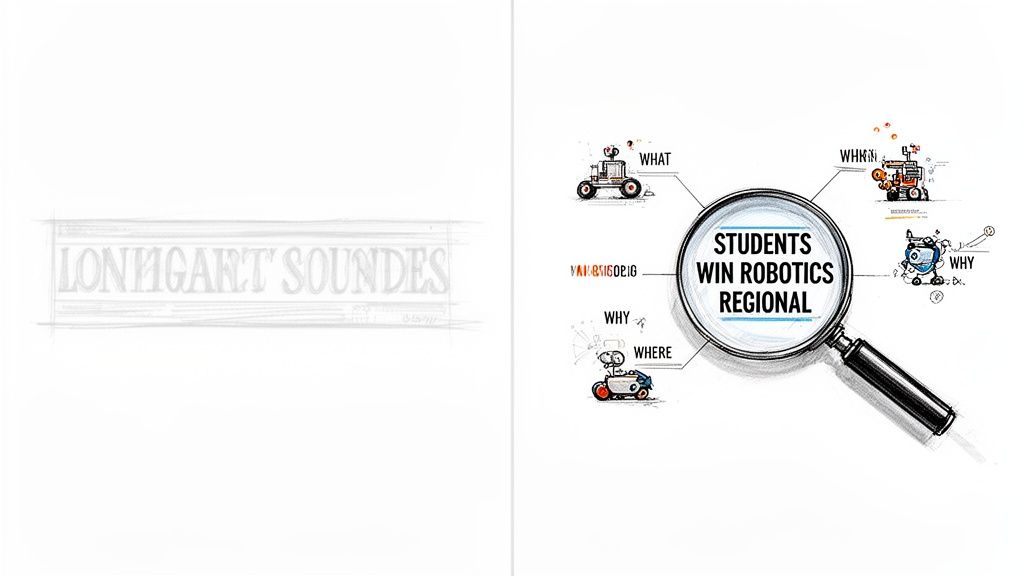
Your entire announcement needs to be distilled into a single, compelling sentence. No pressure, right? The trick is to be direct, use strong action verbs, and answer the "so what?" question right away.
Crafting the Perfect Headline
A truly effective headline is punchy and specific, usually landing under 10-12 words. This isn't just for reporters; it's also great for search engines. When a parent Googles local school news, a clear headline helps your story show up.
Cut the fluff and marketing jargon. Instead, zoom in on the most newsworthy part of your announcement.
Here’s a look at what separates a headline that gets ignored from one that gets clicks:
| Vague & Weak Headline | Strong & Specific Headline |
|---|---|
| Northwood High Announces Fall Play | Northwood High Students Reimagine Shakespeare in Modern Fall Production |
| Lincoln Elementary Hires New Principal | Veteran Educator Dr. Maria Flores Named New Principal of Lincoln Elementary |
| Oakdale Middle School Robotics Team Does Well | Oakdale Middle School Robotics Team Wins State Championship, Heads to Nationals |
The strong headlines tell you why you should care. They have energy and provide immediate context.
The secret to a powerful headline is identifying your hook—the single most compelling aspect of your announcement—and placing it front and center. Is it a prestigious award? A surprising statistic? A unique community partnership? Lead with that.
Data can be a powerful hook. In fact, thirty-nine percent of journalists want to see exclusive research or data in the pitches they get. If you have a compelling number, flaunt it. "Maplewood Elementary Fundraiser Collects 5,000 Canned Goods for Local Food Bank" has a much greater impact than just saying the school held a successful fundraiser.
Mastering the Lead Paragraph
Okay, your killer headline worked! The reporter opened your release. Now, the lead paragraph has to deliver on that promise—fast.
The lead (or "lede," in journalism speak) is your first paragraph. Its sole mission is to summarize the entire story in one or two sentences. This is where you quickly lay out the classic "Five Ws":
- Who: Who is this about? (e.g., Jefferson High School's debate team)
- What: What happened? (e.g., they won the national tournament)
- When: When did it happen? (e.g., on Saturday, October 22, 2024)
- Where: Where did it take place? (e.g., in Washington, D.C.)
- Why: Why is this important? (e.g., it's the first national title in the school's history)
A reporter should be able to grasp the whole story from this paragraph alone. Everything that follows—quotes, background, additional details—is just the supporting cast.
Here’s what a solid lead looks like in practice:
"RIVERBEND, CA – October 26, 2024 – The Riverbend High School senior debate team won the National Forensics League Championship in Washington D.C. this past weekend, securing the first national title in the school’s 50-year history and earning four students full academic scholarships."
Boom. In one sentence, we know the who (debate team), what (won the championship), where (Washington D.C.), when (last weekend), and why it's a big deal (a school first plus scholarships). By getting straight to the point, you're not just making the journalist's job easier; you're dramatically increasing your odds of getting coverage.
Bringing Your Story to Life with Quotes and Multimedia
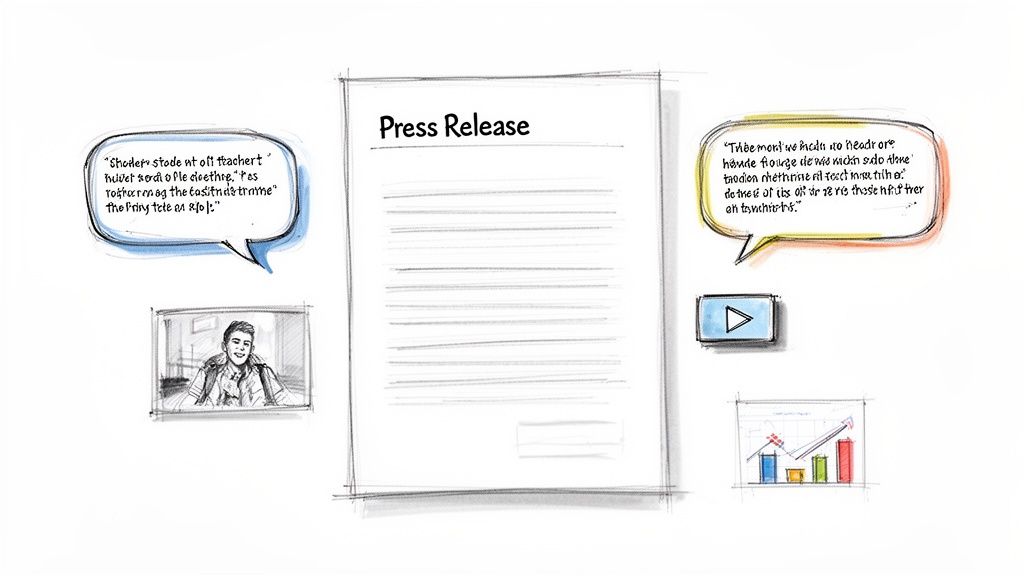
Facts and figures are the skeleton of your story, but quotes and visuals are what give it a heartbeat. A press release about a new STEM lab is fine on its own. But a quote from a student whose eyes light up describing the experiments she can now run? That’s what creates a real connection.
Stiff, formal statements from administrators have their place, but it's the authentic voices of your school community that add genuine emotion and credibility. This is how your announcement goes from just text on a page to a vivid story that a journalist can easily see and feel.
Finding Quotes That Actually Sound Human
Let's be honest: the best quotes don't sound like they were written by a committee. They capture real enthusiasm and perspective, adding a human element that reporters and their audiences crave. It’s time to move beyond the principal’s office to find the voices that truly matter for the story you’re telling.
To get quotes that really resonate, think about who is closest to the news:
- Launching a new program? Go talk to the teacher leading the charge. Ask them what they’re most excited about or what impact they hope to see.
- Celebrating a student win? Get the story straight from the student. A quote like, "Building this robot taught me I could actually solve problems I read about in textbooks," is far more compelling than just a summary of the award.
- Recapping a community event? Find a parent volunteer for a quick soundbite. Their take on a successful fundraiser adds a valuable layer of community buy-in.
When you ask for a quote, give them some context and guide them with open-ended questions. Instead of the generic, "Can you give me a quote?", try asking something more specific, like, "What was the most memorable moment from the science fair for you?" This simple shift helps draw out a much more natural and heartfelt response.
Pro Tip: Keep quotes tight and impactful. The best ones are usually just a sentence or two. You can edit for clarity, but always make sure to preserve the speaker's original voice and intent. A student's or teacher's voice is often more powerful than an executive's.
Why You Can't Skip the Multimedia
In today's visual world, a wall of text just won't cut it. Journalists, especially those working online, are always on the hunt for high-quality visuals to make their stories pop. When you provide them with ready-to-use assets, you make their job easier and dramatically increase your chances of getting featured.
In fact, one in three journalists says providing multimedia is one of the best things a PR pro can do to add value. It shows you understand what they need to build a compelling story.
Think about which assets best support your announcement:
- High-Resolution Photos: Get candid shots of students deep in a project, teachers interacting with their class, or the final seconds of a big game. Skip the stiff, posed group photos whenever possible.
- Short Video Clips: A 30-second clip of the school choir's final performance or a time-lapse of a new mural being painted can be incredibly effective.
- Simple Infographics: If you're sharing news about rising test scores or a successful fundraising campaign, a clean infographic can make the data much easier to understand and share.
When you send your press release, make it incredibly easy for journalists to get these files. Please, don't attach large files directly to your email—they clog up inboxes. Instead, include a simple link to a cloud folder (like Google Drive or Dropbox) where they can download everything they need in one click.
For a deeper dive into making your visuals compelling, check out these visual storytelling techniques. By pairing strong quotes with great visuals, you give your school’s story the depth and life it truly deserves.
Getting Your News into the Right Hands
You've done the hard work. You’ve written a fantastic press release—the headline is sharp, the quotes are genuine, and the story is compelling. But a brilliant announcement is useless if it’s just sitting on your desktop. Now comes the most important part: getting it to the people who can turn it into a real story.
Effective distribution isn’t about blasting your news to a massive, generic list of contacts. For a school communicator, success is all about precision. It's about building real relationships and getting your news in front of the specific reporters, bloggers, and editors who are genuinely interested in what’s happening in your hallways. This targeted approach is the bedrock of any successful media outreach.
Building Your School's Media List
Think of your media list as your playbook. It should be a curated, living document, not some dusty spreadsheet you update once a year. The goal here is absolutely quality over quantity. An email to one highly relevant local education reporter is worth more than a blast to one hundred random journalists who will just hit delete.
Start by identifying the key players who actually cover your community. Your list should definitely include:
- Local Newspaper Education Reporters: These are your primary targets. Find the journalist who specifically covers K–12 education or community news in your city's main paper.
- Community Bloggers and Hyperlocal News Sites: Don't forget the popular neighborhood blogs or online-only news outlets that parents in your district actually read. They are often hungry for feel-good local stories.
- TV and Radio News Assignment Editors: For bigger news, like a major award or a significant event, find the assignment desk emails for your local TV and radio stations.
- Alumni Magazine Editors: If your school has an active alumni association, their publication is a perfect, and often overlooked, outlet for stories about student success and campus growth.
As you build this list, go beyond just a name and an email. Make a note of what topics they typically cover. Does one reporter love stories about student innovation? Does another focus on school board policies? This is the kind of insight that will help you personalize your pitch and make it stand out.
A targeted media list transforms your outreach from a shot in the dark into a strategic conversation. When you know who you're talking to and what they care about, you're not just sending a press release; you're offering them a story that fits their beat.
The Great Debate: Distribution Service vs. Direct Pitch
Once your list is ready, you have two main ways to get your press release out there: using a wire service or pitching directly to journalists yourself. Each has its place.
Wire services (like PR Newswire or Business Wire) can get your release in front of hundreds or thousands of outlets at once. This is great for maximizing reach, especially for huge announcements like a major grant or a new school opening. The downside? It’s an impersonal—and often expensive—approach.
Direct pitching, on the other hand, is all about sending your press release directly to the contacts on your curated media list. This method is built on personalization and relationship-building. It takes more time, sure, but a direct pitch is far more likely to get a personal response from a local reporter who recognizes your name. This is a core part of building strong media relations.
For most K–12 schools, a hybrid approach works best. Use a wire service for your biggest, most impactful news, but lean on direct pitching for the majority of your day-to-day announcements.
Timing Your Pitch for Maximum Impact
When you send your email matters almost as much as what’s in it. Journalists are slammed on Mondays trying to catch up and on Fridays trying to wrap up. My experience, and the data, consistently shows that mid-morning from Tuesday to Thursday is the sweet spot for outreach.
Want to get really specific? Emails sent between 10:00 AM and 2:00 PM achieve a staggering 45% click-through rate (CTR), as this is when journalists are most active at their desks. Plus, remember that 74% of journalists prefer receiving news via press releases, which trumps direct emails or social media pitches. It's a proven format they trust.
The Art of the Follow-Up
You’ve sent your pitch. Now what? It’s perfectly okay to follow up, but there’s a fine line between being persistent and being a pest.
Wait at least a day or two before sending a gentle reminder. Your follow-up email should be brief and helpful, not demanding. A simple, "Just wanted to make sure this came across your desk" is often enough. To add a little more value, you could also offer a new piece of information, like an extra photo or a contact for a student interview.
And a pro tip: never follow up more than once. If you don't hear back, it's time to let it go and move on to your next great story.
Your Top School Press Release Questions, Answered
Even when you feel like you've got the basics down, certain situations will always make you pause. As a school communicator, you're constantly juggling different roles, and knowing the right move for each scenario is half the battle. This section tackles some of the most common questions I hear from pros in the field, with straightforward answers to help you navigate your next communication challenge.
Think of this as your go-to guide for those tricky "what if" moments. The goal is to give you the confidence to make smart, strategic decisions every time you have a story to share.
How Often Should We Be Sending Press Releases?
This is the classic question, isn't it? The answer isn't a magic number—it's all about newsworthiness. I've seen schools make the mistake of sending a release for every tiny update, and it quickly leads to "pitch fatigue" with their media contacts. If a journalist sees your school's name in their inbox every other day for non-events, they'll start hitting delete without even opening them.
You have to aim for quality over quantity. A good rule of thumb is to send a press release only when you have a story with a genuine impact on your students, staff, or the community.
Try to find a rhythm that works for you, something like this:
- Major Announcements (1-2 per semester): These are your big-ticket items. Think groundbreakings for new buildings, a massive grant award, or the launch of a new flagship academic program.
- Notable Achievements (2-4 per semester): This bucket includes state championship wins, a list of National Merit Scholars, or a professor receiving a prestigious national award.
- Community Events (as needed): A large-scale fundraiser that engages the whole town, a community service day with hundreds of student volunteers, or a new partnership with a major local business are all perfect press release topics.
The key is to become a reliable source of actual news. When a reporter sees an email from you, you want their first thought to be, "This is probably something my audience will care about," not, "Oh, here's another minor update from Northwood High."
How Do You Announce News That Isn't Tied to a Specific Event?
Not all news comes with a convenient ribbon-cutting ceremony. Sometimes, the most important stories are about gradual progress or significant changes that don't happen on a single day. This is where your storytelling skills really come into play.
Let's say your district just finished rolling out a new project-based learning curriculum across all elementary schools. That's huge news! But it happened over months, not in a single afternoon.
To make it newsworthy now, you have to create a focal point.
- Find your human angle. A press release about a curriculum change is dry. A story about a specific teacher and student is compelling. Find someone who can bring it to life with a quote like, "I used to just memorize facts for a test, but now I'm building a real-world business plan. It completely changed how I see school."
- Use data as your hook. Can you share any early data points? A headline like, "Westwood Elementary Sees 15% Jump in Student Engagement After Curriculum Overhaul" is far more interesting than "Westwood Elementary Announces New Curriculum."
- Create your own event. Invite a few key reporters for a 30-minute classroom walk-through to see the new curriculum in action. This gives them a tangible, visual "event" to cover.
When Should I Use a Media Advisory Instead of a Press Release?
Knowing the difference between a media advisory and a press release is critical. They are both essential tools in your kit, but they serve completely different functions. Sending the wrong one is a quick way to frustrate a reporter on a deadline.
Here’s the simple breakdown:
| Media Advisory | Press Release |
|---|---|
| It's an Invitation: Tells the media where to be and when to be there for a live event. | It's the Full Story: Provides all the details about news that has already happened or is happening now. |
| Format: Super brief, just the facts in bullet points: Who, What, When, Where, Why. | Format: A complete narrative (300-500 words) written in AP style. |
| Use It For: Inviting the press to cover your annual student robotics competition this coming Saturday. | Use It For: Announcing the winners and outcomes of the robotics competition after it has concluded. |
An advisory is your best bet for getting cameras and reporters on-site for something visual and time-sensitive. The full press release is for telling the complete story afterward or for announcements that don't have a live component. And don't forget how much journalists still rely on this format; recent research shows that 72% of journalists still prefer to receive press releases from communications pros. You can dig into more PR insights and stats in PRLab's latest report.
Ready to connect with a community of peers who are navigating the same challenges you are? The MarCom Society offers exclusive workshops, expert-led sessions, and a supportive network to help K-12 communicators like you master their craft. Become a member today and elevate your school's story.









