
Getting your school's emails opened is a constant battle. It’s not just about what you send, but how and when you send it. To really move the needle on your open rates, you need to think less like a broadcaster and more like a trusted communicator. It all boils down to building a genuine connection with your families, which starts with understanding why they might be tuning you out in the first place.
The Reality of the Unopened Email
Let's face it: the modern inbox is an absolute warzone for attention. If your emails are consistently being ignored, it's probably not just one thing you're doing wrong. It's usually a mix of small missteps that add up, pushing your message straight to the digital "ignore" pile.
One of the biggest silent killers of open rates is a simple lack of trust. Every single email you send is either strengthening your relationship with your community or weakening it. If your subscriber list was cobbled together from old forms or, worse, purchased, you're starting from a massive disadvantage. Those parents and students never actually asked to hear from you, so why would they open your email?
A healthy, engaged audience starts with a clean, permission-based list. If you're struggling with this foundational step, it’s worth revisiting the basics of how to build an email list the right way from the ground up.
Beyond that initial trust, relevance is everything. Generic, one-size-fits-all email blasts are a thing of the past. Your community expects messages that speak directly to them—a parent of a high school senior has vastly different needs than a parent of a first-grader. When a message feels impersonal, it gets deleted.
Breaking Down the Barriers to Better Open Rates
Timing can make or break your campaign. Sending a critical update at 10 PM on a Friday night is like shouting into an empty auditorium. You need to get a feel for your audience's daily rhythm. Sending emails when parents are most likely to be checking their inboxes—say, during their lunch break or after dinner—can make a world of difference.
And then there's the subject line. It's the first thing anyone sees, and often, it's the only thing they see. If it’s vague ("School Update") or boring ("Weekly Newsletter"), you’ve given them zero reason to click. It’s an instant pass.
The competition is fierce. In 2025, the average email open rate across all industries is sitting around 24%. This stat really drives home the challenge we're all up against every single time we hit "send." For a deeper dive, check out the latest email marketing statistics on Inboxally.com.
Finally, don't overlook the technical gremlins that can sabotage your efforts behind the scenes. Your sender reputation is a huge deal. It’s what tells email providers like Gmail and Outlook whether you're a legitimate sender or a potential spammer. Several things can wreck this reputation:
- High bounce rates: Too many invalid email addresses signal that your list is stale or poorly managed.
- Spam complaints: Every time someone marks your email as spam, it's a major red flag for email providers.
- Lack of authentication: Forgetting to set up email authentication like SPF and DKIM makes your domain look suspicious to spam filters.
Each of these issues erodes your credibility, making it all too easy for your messages to be ignored or, worse, sent straight to the spam folder. The first step to boosting your open rates is taking an honest look at these problems and tackling them head-on.
Top Factors Hurting Your Open Rates and How to Fix Them
Often, the path to a better open rate is about diagnosing the right problem. I've put together this quick-reference table to help you pinpoint common issues and find a practical solution you can implement right away.
| Problem Area | Impact on Open Rates | Actionable Solution |
|---|---|---|
| Weak Subject Lines | Your email gets lost in the inbox shuffle. It fails to create urgency or spark curiosity, leading to it being ignored or deleted. | Write compelling, concise subject lines (under 50 characters). Use personalization (like a student's name) and ask engaging questions. |
| Poor List Quality | High bounce rates and spam complaints damage your sender reputation, causing your emails to land in the spam folder instead of the inbox. | Regularly clean your email list to remove inactive subscribers and invalid addresses. Implement a double opt-in process for new sign-ups. |
| Bad Timing | You're sending messages when your audience is busy, asleep, or offline, meaning they never even see your email when it's at the top of their inbox. | Use your email platform's analytics to identify peak engagement times for your specific audience. Test sending on different days and at different times. |
| Generic Content | The message feels irrelevant and impersonal. One-size-fits-all content doesn't resonate, giving subscribers no reason to open. | Segment your audience by grade level, interest, or parent vs. student. Tailor content to meet the specific needs and interests of each group. |
| Technical Issues | A lack of proper email authentication (SPF/DKIM) makes your domain look untrustworthy to spam filters, hurting deliverability. | Work with your IT department to ensure your email authentication protocols are correctly configured and verified for your sending domain. |
Fixing these core issues isn't just about small tweaks; it's about fundamentally shifting your approach to email communication. By focusing on quality, relevance, and trust, you'll start earning the opens you're looking for.
Crafting Subject Lines That Demand to Be Opened

Think of your subject line as the gatekeeper. It’s the first—and often only—thing your audience sees. No matter how incredible the email content is, a bland or generic subject line is a surefire way to get ignored. It's your one shot to stand out in a sea of other messages, so making it count is absolutely critical.
The real goal isn’t just to be clever. It's to be compelling. A great subject line strikes a chord with the reader, sparking curiosity, highlighting urgency, or making a personal connection. It makes a promise of value and creates a tiny bit of mystery that people feel an itch to solve by clicking "open."
The Psychology Behind a Great Subject Line
Your subject line is essentially a micro-headline. It has a huge job to do in just a few words. To make it work, I've always found it helpful to lean on one of three powerful psychological triggers.
Curiosity: This is all about piquing interest without spilling all the details. Instead of a flat "Recap of the Robotics Club Project," try something like, "You won't believe what our students built this week." The second version makes them wonder, and that wonder gets you the click.
Urgency: Nothing gets people moving like a deadline. "Parent-Teacher Conference Information" is easily ignored. But "Last call for Parent-Teacher Conference sign-ups!" creates a sense of immediacy that pushes parents to act now.
Personalization: Make your families feel like you're talking directly to them, not just blasting a message to a list. "Important Update for 8th Grade Parents" is infinitely more effective than a generic "School News" because it screams relevance.
Focusing on these triggers helps you move past generic templates and start building a real connection. For a more detailed look at these techniques, you can explore some great resources on email subject line best practices.
Don't Forget the Technical Details
Writing a psychologically compelling message is only part of the equation. You also have to play by the technical rules of the inbox.
Length is a huge one. With so many people reading emails on their phones, you have to keep it brief. I always aim for 70 characters or fewer. Anything longer gets cut off, and your brilliant message is lost.
Personalizing your subject lines can give your open rates a serious lift—we're talking an increase of up to 20%. But it’s a balancing act. You have to build trust, especially when 36% of people say they ignore emails because they don't trust the sender.
Here are a few other technical pointers that can make a big difference:
- Use Emojis, but Wisely: A single, relevant emoji (like 📅 for an event or 📣 for an announcement) can make your email pop visually. But go overboard, and you risk looking unprofessional or, worse, like spam.
- Steer Clear of Spam Trigger Words: Be careful with words like "free," "winner," or "act now." Especially when you pair them with a bunch of exclamation points (!!!), they can send your email straight to the spam folder.
- Always Be Testing: The only way to truly know what resonates with your audience is to test it. This is non-negotiable. Send two different subject lines to small segments of your list (this is called A/B testing) and see which one performs better. Let the data guide your strategy, and you'll see your open rates climb over time.
Make Your Emails Feel Personal, Not Mass-Produced

If you're sending the exact same email to every single person on your list, you're training them to ignore you. It's a subtle signal that you don't really know who they are or what they care about. The real secret to improving email open rates is making each person feel like you’re speaking directly to them. That all starts with smart segmentation.
Segmentation is just a fancy word for dividing your big email list into smaller, more focused groups based on what they have in common. Instead of shouting into a crowded auditorium, you're having a more meaningful conversation with a handful of people. This simple shift makes your content feel immediately relevant, which is what earns that click.
Starting with Smart Segmentation
The magic of this strategy lies in how you divide your audience. A school community is a mix of so many different people, so a one-size-fits-all message is doomed to fall flat. Your goal is to create groups that let you tailor what you say for the biggest impact.
Here are a few practical ways to start segmenting your school's list:
- By Role: This is the absolute starting point. At a bare minimum, you need separate lists for parents, students, faculty, and alumni. Their priorities and information needs couldn't be more different.
- By Grade Level: What matters to a kindergarten parent is a world away from the concerns of a high school senior's parent. Segmenting by grade helps you deliver targeted info about specific events, deadlines, and academic milestones that actually apply to them.
- By Engagement Level: Your email platform is already tracking who opens your emails and who doesn't. Why not use that data? Create a group of your most engaged readers—say, people who opened your last five emails—and give them early access to event registration. On the flip side, you can run a special re-engagement campaign for subscribers who have gone quiet.
This doesn't have to be some massive, complicated project. Honestly, just starting with one or two basic segments can make a night-and-day difference. If you want to dive deeper into the strategy, this guide on what is audience segmentation is a fantastic resource.
Think about it: a generic weekly newsletter might get a 15% open rate. But a targeted email sent only to 8th-grade parents about the upcoming high school transition night? That could easily hit open rates of 40% or more. That’s the power of being relevant.
Putting Personalization into Practice
Once you have your segments, you can add another layer of detail: personalization. And I’m talking about more than just sticking someone's first name in the subject line. Real personalization uses the data you have to swap in dynamic, highly relevant content.
Let's walk through a real-world scenario from a private school's admissions office. Instead of blasting out a generic "Open House Reminder," they get specific.
- Segment: They pull a list of families who checked "arts program" on their initial inquiry form.
- Personalized Subject Line: "See our art studio in action this Saturday, [Parent's Name]!"
- Dynamic Content: The body of the email is now completely tailored. It features photos of the art studio, includes a quote from a current art student, and even links directly to a video about the fine arts curriculum.
This approach feels less like a marketing email and more like a genuinely helpful, personal invitation. It proves you were paying attention to their interests, which makes them far more likely to open that email and show up for the event. That level of detail is a true game-changer for improving email open rates.
Nail the Technicals: Sender Reputation and Deliverability
You could write the most compelling email in the world, but if it gets flagged as spam, it might as well not exist. This is where we get a little technical, but stick with me—it's the bedrock of everything else we've discussed. Getting this right is how you build trust with gatekeepers like Gmail and Outlook.
Your sender reputation is essentially your school's credit score in the email world. Internet service providers (ISPs) use it to decide if you're a trustworthy sender. A great score gets you a direct flight to the primary inbox. A poor score? You’re heading straight to the junk folder, a place where important announcements go unseen.
What tanks this score? Things like people marking your emails as spam, a high number of bounced (undeliverable) emails, and a lack of proper authentication.
What is Email Authentication, Really?
Think of email authentication as your official ID badge. It’s how you prove to ISPs that your school is who it says it is, which is the best defense against spammers trying to impersonate you. There are three key pieces to this puzzle.
- SPF (Sender Policy Framework): This is basically a public list of the specific mail servers you’ve approved to send emails from your domain. If an email comes from a server not on the list, it's immediately suspicious.
- DKIM (DomainKeys Identified Mail): This adds a tamper-proof digital seal to your messages. It’s a behind-the-scenes signature that confirms the email content wasn't messed with after it left your server.
- DMARC (Domain-based Message Authentication, Reporting & Conformance): DMARC is the enforcer. It builds on SPF and DKIM and tells receiving email servers exactly what to do with an email that fails those checks—like quarantine it or reject it flat-out.
These aren't just "nice-to-haves" anymore. Major providers now expect them. You'll likely need to work with your IT team to get these records set up correctly, but it's a non-negotiable step for solid email deliverability.
Keep Your Email List Squeaky Clean
Beyond the server-side setup, the health of your actual email list has a massive impact on your sender score. Blasting emails to a list cluttered with old, inactive, or incorrect addresses sends a clear signal to ISPs: you're not a very careful sender. This is why list hygiene is so crucial.
An unengaged subscriber isn't just a missed connection. They're actively hurting your ability to reach the parents and students who do want to hear from you. Pruning them from your list is one of the fastest ways to improve your sender reputation.
A clean, engaged list means fewer bounces and spam complaints. That boosts your reputation, which in turn improves your inbox placement. It’s a win-win. With the total number of global email users set to top 4.8 billion by 2027, standing out is more important than ever. The good news is that education emails already see a healthy 39.5% open rate on average. You can dive deeper into these email marketing statistics from OptinMonster to see how your school stacks up.
Tailoring Your Timing and Content by Industry
Sending a beautifully written email at the wrong time is a bit like holding a parent-teacher conference on a snow day—your attendance is going to be dismal. A huge part of getting more people to open your school's emails is understanding that there's no magic "best time" to send. What works for a clothing brand will almost certainly fall flat for a nonprofit or, in our case, a school.
The real key is to get in sync with the daily rhythm of your specific audience. Think about your parents and staff. A teacher is most likely clearing their inbox first thing in the morning, while a working parent might not catch up until their lunch break or after the kids are in bed. Nailing this timing keeps your important message from getting lost in the digital shuffle.
Of course, timing is only half the battle. The email itself has to feel right for your audience and their expectations. A sense of urgency works wonders for an online store, but for a school community, you’ll find that data-driven insights and clear, helpful information are far more effective.
Content That Connects With Different Audiences
Every industry has its own "language," and email is no exception. A retail email often uses bright colors and flashy calls to action, but a nonprofit's message usually lands better with a softer, story-driven approach.
The look, feel, and tone of your email should feel native to your school's environment. This visual guide breaks down how different design choices can affect open rates in various fields.
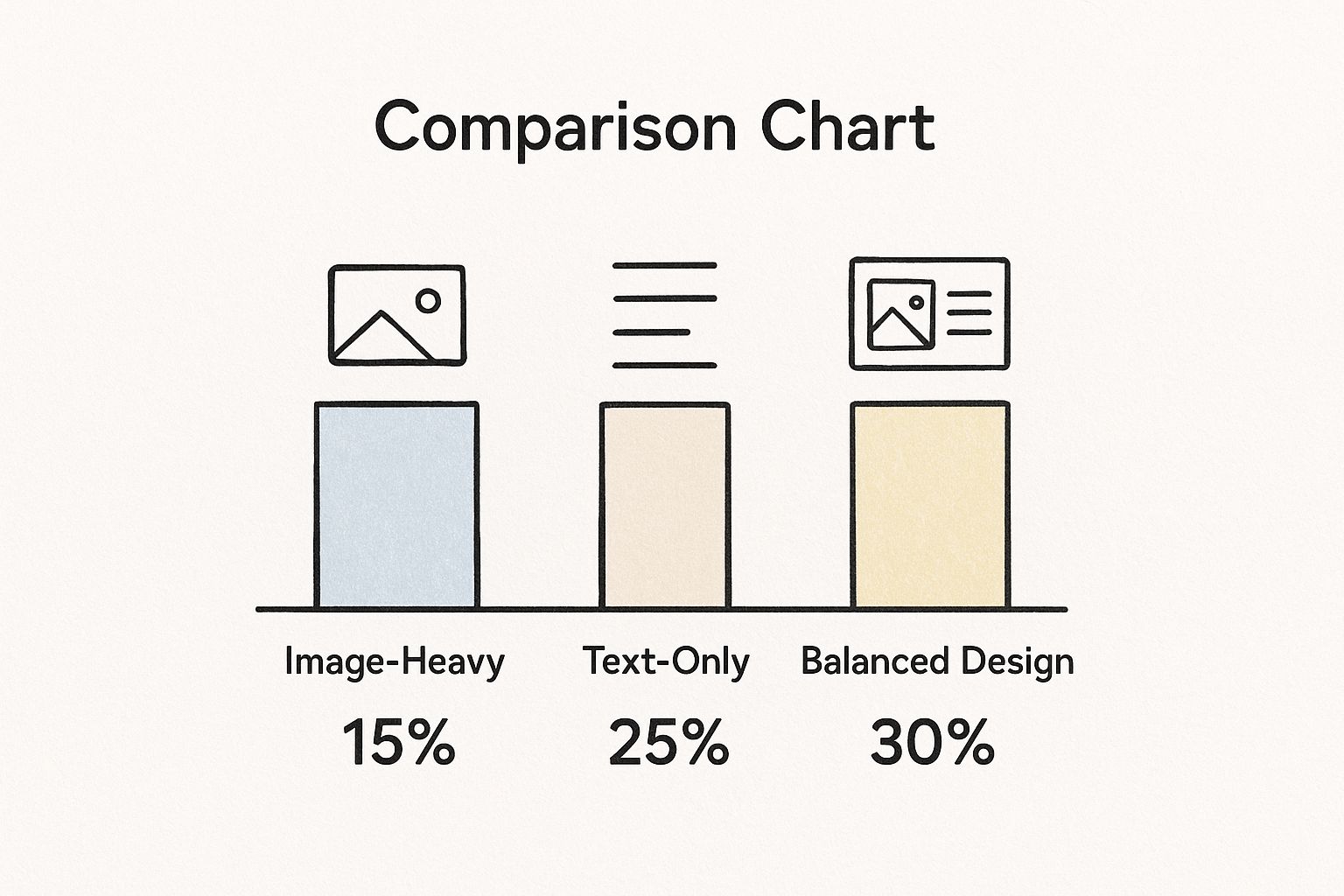
As you can see, a balanced design—one that mixes short, scannable text with great visuals—tends to be the sweet spot. It avoids overwhelming the reader with too many graphics while also steering clear of a dry, text-only format that can feel intimidating.
For a school's weekly newsletter, this might mean pairing a brief, heartfelt note from the principal with a few high-quality photos from the science fair. That combination is infinitely more engaging than a long block of text.
Data-Backed Strategies For Key Sectors
When you look at the data, you can really see how much these strategies diverge. Industry benchmarks show some pretty stark contrasts that can help you fine-tune your own email game. To get a better feel for this, here's a quick look at how email strategies differ across a few major sectors.
Email Strategy Comparison by Industry
| Industry | Average Open Rate | Best Sending Time | Effective Content Tactic |
|---|---|---|---|
| Retail | 38.58% | Evenings (6 PM – 9 PM) | Urgency & Scarcity ("Last chance!") |
| B2B | 30.35% | Weekday Mornings (9 AM – 11 AM) | Data, Case Studies & ROI |
| Nonprofit | 46.49% | Mid-week Afternoons (1 PM – 3 PM) | Emotional Storytelling & Questions |
This comparison highlights why a one-size-fits-all approach just doesn't work. The emotional, story-driven content that helps nonprofits achieve an incredible 46.49% average open rate wouldn't resonate the same way in a B2B context. You can dig deeper into these numbers with this fantastic breakdown of industry benchmarks from HubSpot.
For a nonprofit, a subject line like, "Can you help Sarah find a home?" is far more powerful than a generic "Donation Update." That emotional hook is their greatest tool for grabbing attention.
To really move the needle on your school's email open rates, you have to stop thinking in generalities and start focusing on your unique community. Test different send times, play with your content formats, and always, always pay attention to what your own data is telling you. This kind of focused, iterative approach is what separates a good email strategy from a truly great one.
Got Questions? Let's Talk Email Open Rates
Even with a great plan in place, you're bound to run into questions. Getting people to open your emails is a constant cycle of trying new things, seeing what works, and adjusting your approach. Here are some straight answers to the hurdles I see school communicators grappling with all the time.
Think of this as a quick reference guide to help you get unstuck and refine your email strategy.
How Often Should I Actually Clean My Email List?
There isn't a single, perfect answer here, but I always recommend a deep clean of your entire list at least twice a year. That said, your day-to-day maintenance should be automated. Your email platform, for instance, should be set up to instantly remove any hard bounces after a single failed attempt.
But what about the people who just stop opening your emails? For subscribers who've been inactive for around six months, it’s a good idea to run a re-engagement campaign. If they don't bite, it's time to let them go. Keeping them on your list just drags down your sender reputation and messes with your metrics.
This isn't just a school problem. I was reading some recent nonprofit email statistics on OptinMonster and saw that a whopping 35% of nonprofits admit they don't regularly remove unengaged subscribers. That’s a recipe for high bounce rates and a disengaged audience.
Is Optimizing for Mobile Still a Big Deal?
Yes, and honestly, it’s more important than ever. The first place most of your families will see your email is on their phone. If it looks jumbled or is hard to read on that small screen, it’s getting deleted. We're past just having a "responsive" design; this is about the whole experience.
Here are a few things to keep top of mind for your mobile readers:
- Shorten those subject lines. Try to stay under 40 characters so they don't get cut off in the inbox preview.
- Stick to one column. It’s the easiest layout for someone to scroll through on a phone without having to pinch and zoom.
- Make your buttons tap-friendly. There's nothing more frustrating than trying to hit a tiny link with your thumb. Make them big and obvious.
- Give your content room to breathe. Use plenty of white space so the email doesn't feel like a wall of text.
Skipping mobile optimization is like putting a padlock on the front door of your school. You're just making it harder for your community to get the information they're looking for.
How Do New Privacy Rules Change How I Track Open Rates?
This is a big one. Privacy features like Apple's Mail Privacy Protection (MPP) have definitely made the old-school "open rate" a less reliable number. MPP can pre-load email images—including the tiny tracking pixel that registers an open—so you might see an "open" that never actually happened.
So, are open rates totally useless now? No, but you can't treat them as the ultimate measure of success anymore. It’s time to shift your focus to what people do after they open the email.
Instead of getting hung up on open rates, start digging into more meaningful metrics:
- Click-Through Rate (CTR): This tells you how many people found your content compelling enough to click a link. That’s real engagement.
- Conversion Rate: Did they actually do the thing you asked them to? Did they sign up for the parent-teacher conferences or RSVP for the fundraiser?
- Reply Rate: Sometimes, asking a simple question and encouraging a reply is the best way to see who’s really listening.
At the end of the day, these privacy changes are pushing all of us to do better work. They force us to create content that’s so valuable people can't help but act on it, rather than just passively opening it.
Ready to connect with a network of peers who are tackling these same challenges? The MarCom Society provides K-12 school marketers with the expert insights, practical workshops, and supportive community you need to master your email strategy and more. Join The MarCom Society to elevate your school's communications.









