
In the world of K-12 education, strong leadership isn't just a nice-to-have; it's the very foundation of a successful school. When we talk about leadership training for educators, we're not just talking about professional development. We're talking about a direct investment in the people who shape our schools—the principals, department heads, and teacher-leaders who create environments where students and staff can truly flourish.
This kind of training is the engine for better faculty retention, higher instructional quality, and the kind of positive school culture you can feel the moment you walk through the doors.
Why Great Leadership Training is a Game-Changer for Today's Schools

Let's be honest: the job of a school leader has gotten incredibly complex. The days of simply being an administrator focused on schedules and budgets are long gone. Today's leaders are expected to be instructional coaches, data gurus, community advocates, and champions for change—all at once.
They're on the front lines, navigating teacher burnout, integrating new technologies, and responding to the ever-changing needs of their students. Old-school, top-down management just doesn't cut it anymore. That approach often leads to stifled creativity and plummeting morale. What schools need now is leadership that's adaptive, empathetic, and built on collaboration.
Seeing the Real Return on Investment
Investing in leadership training isn't just about ticking a box on the professional development budget. It's a strategic decision that strengthens the entire school community in measurable ways.
- Keeping Great Teachers: It’s simple. Effective leaders build supportive workplaces where teachers feel respected and empowered. When teachers feel valued, they stay. Research has consistently shown that schools with strong leadership and a positive climate have far lower teacher turnover.
- Boosting Classroom Instruction: A well-trained leader knows how to give meaningful, constructive feedback. They can guide professional learning communities (PLCs) effectively and promote teaching strategies that actually work. This has a direct, positive impact on the quality of teaching in every single classroom.
- Building a Resilient Culture: Leaders set the tone for the entire building. When they're trained to build trust, encourage open communication, and rally everyone around a shared vision, the result is a culture of belonging and resilience.
"The quality of an education system cannot exceed the quality of its teachers, and the quality of its teachers cannot exceed the quality of the leaders who hire, develop, and retain them."
This reality makes one thing crystal clear: deliberate, high-quality training is essential for any educator looking to improve leadership skills and build a school where people thrive.
Closing a Critical Global Gap
Despite how crucial this is, there’s a major disconnect between the demand for skilled school leaders and the training they actually receive. Many are thrown into the deep end, unprepared for the strategic parts of the job.
A truly eye-opening report found that just 30% of school principals worldwide receive specific leadership training before starting their roles. Worse, fewer than 20% of those programs properly cover essential areas like strategic planning or instructional leadership. It's no wonder so many new leaders fall into a reactive, "fire-fighting" mode instead of being the proactive visionaries their schools need. You can read more about this in the 2025 GEM Report.
This gap isn't a problem; it's an opportunity. By investing in thoughtfully designed leadership programs, districts can empower their leaders to become the architects of resilient, forward-thinking schools. The goal is to shift from just solving daily problems to truly building a community.
Core Competencies for Modern Educational Leaders
To be effective, any leadership program must focus on the skills that matter most in today's schools. We're moving beyond basic management to cultivate a new kind of leader.
Here’s a look at the core competencies that should be at the heart of any training initiative.
| Leadership Competency | Why It Matters in Today's Schools | Example Application |
|---|---|---|
| Instructional Leadership | Leaders must be the "lead learners" and guide teachers in improving classroom practice. | Facilitating a PLC where teachers analyze student data to refine a reading intervention strategy. |
| Strategic Vision & Planning | Schools need a clear, shared direction to navigate change and achieve long-term goals. | Developing a three-year school improvement plan with input from staff, students, and parents. |
| Data-Informed Decision-Making | Gut feelings aren't enough. Leaders need to use data to identify needs and measure progress. | Using attendance and assessment data to identify at-risk students and design targeted support systems. |
| Emotional Intelligence (EQ) | Building trust and strong relationships requires empathy, self-awareness, and resilience. | De-escalating a difficult conversation with an upset parent by actively listening and validating their concerns. |
| Community Engagement | Schools don't exist in a vacuum. Strong leaders build partnerships with families and the community. | Hosting regular "coffee with the principal" events to foster open dialogue with parents. |
By building programs around these key areas, we can ensure we are developing leaders who are not only prepared for the challenges of today but are also equipped to shape the schools of tomorrow.
Building Your Foundational Leadership Curriculum
Any seasoned educator knows that an impactful leadership program isn't something you can just pull off a shelf. The most effective leadership training for educators grows directly from the real, day-to-day needs of your own school or district. To create a curriculum that actually drives change, you have to start with a deep dive into your unique context, moving past abstract theories to build practical, immediately useful skills.
This isn't about finding a one-size-fits-all program. It's about crafting one that fits your community perfectly. The goal is to design learning experiences that equip your emerging leaders with strategies they can turn around and use the very next day. That’s the true difference between a binder that sits on a shelf collecting dust and a new set of tools a leader instinctively reaches for.
Identifying Your Core Leadership Needs
Before you build anything, you need a solid blueprint. For curriculum design, that blueprint comes from understanding the most pressing leadership challenges and skill gaps in your buildings. Whatever you do, don't make assumptions. Your first move should be to gather direct, honest feedback.
- Anonymous Staff Surveys: This is a great way to get a candid look at what teachers and staff need from their leaders. Ask specific questions about communication, instructional support, and the overall school culture.
- Focus Groups with Teacher-Leaders: Get your department heads, grade-level leads, and other informal leaders in a room. Ask them frankly: where do you feel unprepared? What skills would make the biggest difference in leading your teams?
- One-on-One Interviews: There's no substitute for a real conversation. Sit down with your current principals and assistant principals. What challenges are keeping them up at night? What skills do they wish they had developed much earlier in their careers?
The data you pull from these conversations is pure gold. It gives you the high-priority themes that must become the pillars of your curriculum, ensuring the training is relevant from the get-go.
Structuring Modules Around High-Impact Themes
With a clear picture of your school's needs, you can start framing the curriculum. A pro tip is to move away from broad, generic topics like "communication." Instead, structure your modules around tangible leadership actions. This simple shift makes the learning feel concrete and goal-oriented.
Think of these high-impact themes as potential pillars for your program:
Leading Instructional Coaching Cycles: This is so much more than a simple classroom walkthrough. A module like this would train leaders to conduct meaningful pre-observation conferences, give targeted, non-evaluative feedback, and guide teachers through reflective practice. It transforms observation from a compliance checkbox into a powerful engine for growth.
Using Data for School Improvement: It’s one thing to have data; it’s another to know what to do with it. This module should focus on helping leaders analyze multiple data points—from attendance and behavior to formative assessments—to spot systemic issues and guide the work of their professional learning communities (PLCs).
Cultivating a Culture of Psychological Safety: A positive school culture is built on a foundation of trust. This theme would equip leaders with specific strategies for building relational trust, navigating difficult conversations, and creating an environment where staff feel safe enough to take risks and offer candid feedback.
A truly effective curriculum doesn't just teach leaders what to do; it creates a space for them to practice how to do it. Role-playing a tough conversation with a parent or workshopping a data presentation for staff is where real learning happens.
As you build out your modules, incorporating solid instructional design best practices is key to making sure the learning sticks. These principles will help you create training that is engaging, memorable, and ultimately, effective.
Bridging Theory and Everyday Practice
The final, and most critical, layer of your curriculum is the one that connects the concepts to reality. Every single module must be grounded in the authentic scenarios your leaders will actually face. This is a non-negotiable element of high-quality https://blog.marcomsociety.org/professional-development-for-school-leaders/ because it’s what makes the training stick.
Here’s how you can weave practical application directly into your curriculum design:
- Scenario-Based Problem-Solving: Present small groups with a real-world dilemma. For example, give them a case study about a team of veteran teachers who are resistant to a new district initiative. Their task is to collaborate on a strategic plan to address it.
- Action-Research Projects: Challenge participants to identify a problem within their own sphere of influence (a grade level, a department, etc.). Have them research potential solutions, implement a small change, and then measure the results over several months.
- Peer Feedback Protocols: Leaders need to know how to both give and receive constructive feedback. Dedicate session time to this. Have them present their action-research plans and get feedback from their peers using a structured, supportive protocol.
When you design your leadership training with this level of intention, you create a powerful cycle of learning and application. Your leaders won't just walk away with a notebook full of ideas; they'll leave with genuine confidence, new skills, and a clear plan to make a meaningful difference in their schools.
Weaving Modern Challenges into Your Training
A solid curriculum is your starting point, but let’s be honest: great leadership training for educators has to go further. It must tackle the real, high-stakes issues that are hitting our schools right now. If your program isn't addressing the massive changes in technology and well-being, you're not fully preparing your leaders.
Today’s school leaders wear more hats than ever. They aren’t just managing staff anymore; they're also navigating the complexities of digital tools and safeguarding everyone's mental health. A truly relevant program dives headfirst into these modern realities, giving leaders the confidence and compassion to guide their teams.
This isn't about running another "how-to" session on the latest app. It's about fostering strategic thinking and building a supportive culture that can handle what's next.
Moving Beyond Gadgets: Training for Strategic Tech Integration
The constant stream of new educational technology, especially AI tools, isn't just one more thing on a leader's to-do list. It calls for a different kind of leadership—one that champions thoughtful, ethical, and instructionally sound adoption. The real goal is to get past simply having the tech and start using it to genuinely improve learning.
Your training should coach leaders to ask the tough, important questions:
- Does this new tool actually solve a problem we have in our classrooms?
- How are we going to support our teachers so they feel confident using it, not just overwhelmed by it?
- What are the ethical lines we need to draw, especially around student data privacy?
- Could this technology accidentally widen equity gaps instead of closing them?
To build these skills, I recommend a dedicated module on Strategic EdTech Leadership. Don't just give them a high-level overview. Throw them into real-world scenarios. For instance, have your cohort evaluate two competing AI-powered writing assistants. They'd have to dig into the features, sure, but also analyze the pedagogical impact, draft a plan for a pilot program, and even prepare a pitch to get staff on board.
This hands-on approach shifts the dynamic from passively receiving information to actively solving problems. It’s how you prepare leaders to make smart, strategic tech decisions for their schools.
"The most important conversation about technology is not about the technology itself, but about the pedagogy it enables. Great leaders facilitate that conversation."
Becoming a Champion for Mental Health and Well-being
The mental health crisis is not a distant problem; it’s inside our school buildings every day. A staggering 73% of teachers report feeling frequent job-related stress. This means effective school leaders have to do more than pay lip service to well-being—they must build a culture where it's a genuine, lived priority for staff and students alike.
This isn't an "extra," it's a core function of modern educational leadership. We’re seeing a rapid evolution in what the role demands, and by 2025, digital change and mental health will be central to the job. Leaders are expected to guide tech integration while simultaneously building robust support systems for well-being. You can explore more about the future of leadership in education on park.edu.
To get them ready, your training needs to provide concrete, actionable strategies.
Here’s what a practical module on Leading a Culture of Well-being should cover:
Making it Okay to Talk About It: Train leaders how to open up conversations about mental health. Give them sentence starters and simple protocols for checking in with staff in a way that feels supportive, not intrusive. Role-play tough scenarios, like addressing team-wide burnout or supporting a teacher who is clearly struggling.
Modeling a Healthy Balance: Leaders set the tone for the whole building. This part of the training should be about practical ways they can model boundaries, like not sending emails at 10 PM and encouraging people to actually take their breaks. Brainstorm ways to protect precious teacher planning time and cut down on meetings that could have been an email.
Building Real Support Systems: It’s time to move beyond "self-care" platitudes. Explore tangible supports leaders can put in place, from a quiet room for staff to decompress to optional wellness activities or a peer-support network. Critically, make sure they know exactly who to call and what the process is for connecting a staff member with the district’s official mental health resources.
By weaving these two critical challenges—strategic technology and mental health advocacy—into the fabric of your program, you ensure your training is not just relevant but absolutely essential. You’re preparing leaders for the schools we have today, and the ones we'll have tomorrow.
Bringing Your Leadership Program to Life
A brilliant curriculum is only as good as its delivery. I’ve seen some incredible, well-designed content fall completely flat because the learning experience itself was passive and uninspired. This is where the art of facilitation comes in—it's how you transform your program from a series of presentations into a dynamic space where real growth actually happens.
The trick is to build an environment where your emerging leaders feel safe enough to be vulnerable, to practice new skills, and, most importantly, to learn from each other. This section is all about the practical strategies that breathe life into your leadership training for educators, making sure it’s a genuine catalyst for change, not just another meeting on the calendar.
Choosing Your Delivery Model
The way you structure the learning journey has a massive impact on its effectiveness. A one-off workshop can be a great introduction, but if you're aiming for sustained growth, you need a more thoughtful approach. There's no single "best" model here. The right choice really hinges on your goals, your resources, and what your participants truly need.
Let’s walk through a few powerful options I've seen work incredibly well:
The Cohort Model: This is a classic for a reason. Keeping a consistent group of educators together for a semester or a full school year builds a powerful peer network. When participants develop deep trust, you get more honest conversations and truly collaborative problem-solving. This is the gold standard for fostering a district-wide leadership culture.
Mentorship Pairings: There's immense value in pairing an aspiring leader with a seasoned, effective principal or administrator. This isn't about formal instruction; it’s about personalized guidance. It creates a safe space to ask the "dumb" questions and get real-world advice on very specific, in-the-moment challenges.
Action-Research Teams: You can form small groups to tackle a specific, authentic problem happening within the district right now. For example, a team might work on developing better family engagement strategies for your middle school. This approach grounds the learning in immediate, practical application.
These models aren't mutually exclusive. In fact, some of the most powerful programs I've helped build blend these elements—imagine a cohort model that incorporates mentorship pairings and culminates in a final action-research project.
Creating a Psychologically Safe Learning Space
For leaders to truly grow, they have to feel comfortable taking risks. They need to be able to practice a difficult conversation, admit they don’t know something, or share a past failure without fearing judgment. Facilitators are the architects of this psychological safety.
Creating this atmosphere requires deliberate action. It starts with establishing clear group norms in the very first session—things like “assume positive intent” and “what’s shared in the room stays in the room.” It also means the facilitator has to model that vulnerability themselves by sharing their own leadership stumbles and learning moments.
The goal is to build a professional learning community, not an audience. When educators feel seen, heard, and respected, they are far more willing to stretch themselves and engage deeply with the material and each other.
This feeling of safety is the bedrock. Without it, even the most cleverly designed activities will fail to hit the mark.
Making Learning Active, Not Passive
The fastest way to lose a room full of educators is to lecture at them. They spend all day creating engaging experiences for their students; they absolutely expect and deserve the same from their own professional development. The focus must always be on active participation, not just passively consuming information.
Here’s how to make your sessions come alive:
| Active Learning Strategy | How to Implement It Effectively |
|---|---|
| Case Study Analysis | Give them a detailed, realistic scenario. Think managing a budget shortfall or mediating a conflict between two veteran teachers. Then, have small groups diagnose the core issues and present a step-by-step action plan to their peers. |
| Structured Peer Feedback | Don't just say "give feedback." Use specific protocols. For instance, a "consultancy protocol" allows participants to ask clarifying questions and offer structured "warm" and "cool" feedback when a colleague shares a leadership challenge. This keeps the advice constructive. |
| Role-Playing | It's time to move beyond just talking about difficult conversations. Have participants actually practice them. One person can play an angry parent while the other practices active listening and de-escalation in a low-stakes setting. |
Finally, selecting the right facilitator is critical. You need a "guide on the side," not a "sage on the stage." Look for someone skilled at asking probing questions, managing group dynamics, and knowing when to step back and let participant voices lead the conversation. By prioritizing active engagement and a safe environment, you ensure your leadership program is an experience that truly sticks.
Measuring the Real-World Impact of Your Training
So, you've designed and launched a fantastic program. But how do you know if your investment in leadership training for educators is truly paying off? The real test isn't whether people enjoyed the sessions—it's whether anything actually changes back at their schools.
Proving your program's value goes way beyond justifying a budget. It's about gathering the right kind of information so you can keep refining your training, ensuring it creates a lasting, positive impact on school culture, teacher practice, and, ultimately, student learning.
Looking Beyond Smile Sheets
The easiest metric to capture is always participant satisfaction—the "smile sheet." But honestly, it's also the least meaningful. To measure real effectiveness, we need to dig much deeper. Are the new skills and mindsets from your training actually showing up in the hallways and classrooms?
This is where you need a mix of data points. You're looking for observable shifts in behavior and culture.
- Teacher Retention Data: This is one of the most powerful lagging indicators. Take a hard look at teacher turnover rates before and after your leadership program has been running for a year or two. Great leaders build supportive environments where teachers want to stay. A noticeable drop in voluntary turnover is a huge win.
- School Climate Surveys: Use anonymous surveys to get a real pulse on staff morale, trust in leadership, and the overall school culture. When you compare year-over-year data, you can see if the needle is moving on critical areas like collaboration and psychological safety.
- Student Growth and Engagement: While it's harder to draw a direct line, improved leadership almost always correlates with better student outcomes. Watch metrics like attendance rates, disciplinary incidents, and academic growth data to spot positive trends.
Gathering Qualitative and Observational Data
Numbers alone don't tell the whole story. To truly understand the impact, you have to capture the nuanced, human evidence of change. This is about seeing new behaviors in action and hearing the stories of how leadership is evolving on the ground.
A fantastic tool for this is the 360-degree feedback assessment. A leader gets anonymous feedback not just from their boss, but also from their peers and the people they lead. When you do these assessments before the training and again a year later, you get powerful, specific evidence of growth.
Here’s a great visual of the kind of growth you can expect from a successful program.
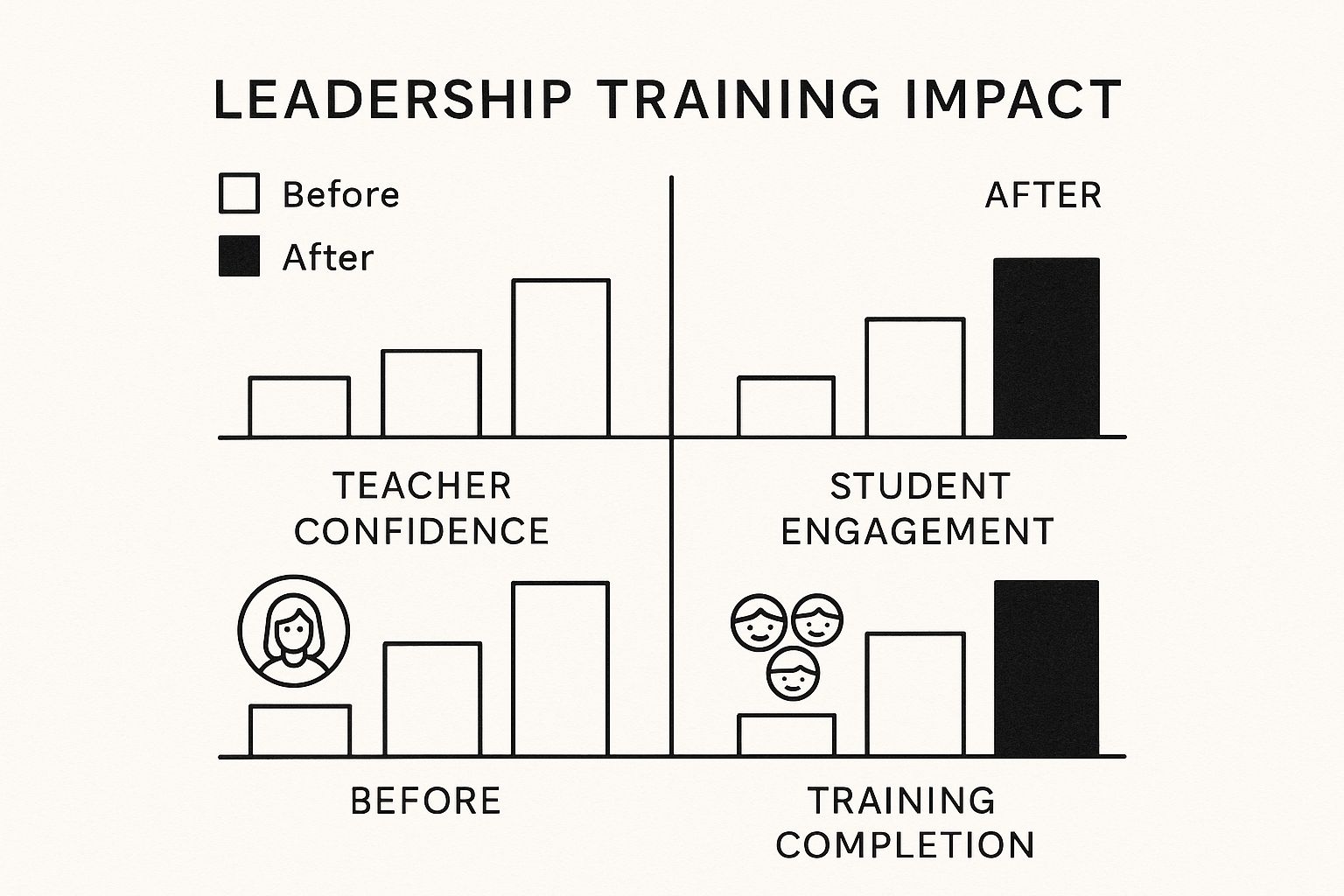
As you can see, targeted training can dramatically boost a leader’s confidence, which has a direct ripple effect on student engagement and making sure new initiatives are actually completed.
To get a full picture of your program's success, it's helpful to blend different measurement techniques. Some give you hard data, while others provide the rich context you need to understand what's really happening.
Impact Measurement Methods for Leadership Training
| Measurement Method | What It Measures | Implementation Tip |
|---|---|---|
| 360-Degree Feedback | Individual growth in specific leadership competencies (e.g., communication, empathy). | Administer pre-training and 9-12 months post-training to show clear, individual growth over time. |
| School Climate Surveys | Staff morale, trust in leadership, and perceived school culture. | Use a consistent, anonymous survey annually to track trends and identify school-wide shifts. |
| Teacher Retention Rates | The stability of the teaching staff and the attractiveness of the work environment. | Compare year-over-year voluntary turnover rates. A decline is a strong indicator of improved leadership. |
| Classroom Observations | The application of new instructional leadership skills in a real-world setting. | Focus on coaching, not evaluation. Look for evidence of leaders modeling strategies from the training. |
By combining these methods, you build a compelling case that connects your training directly to positive changes within the schools you serve.
The ultimate goal is to connect the dots between the training sessions and the daily life of the school. When you hear a teacher say, "My team lead is so much better at giving feedback now," you know the program is working.
Classroom observation rubrics, when used for coaching instead of evaluation, can also offer incredible insight. Are leaders running more effective PLCs? Are they modeling the instructional strategies you taught them? These observations provide concrete proof that links right back to your curriculum.
When leaders build stronger relationships, they also tend to see a positive ripple effect on family involvement. For more on this, check out our guide on how to get parents involved in school activities.
This focus on skilled leadership is part of a much larger trend. The global market for leadership development is projected to surge from USD 89.5 billion in 2025 to USD 238.5 billion by 2035. This incredible growth shows a worldwide recognition that effective leadership is essential. By measuring your impact, you're not just proving your program's worth—you're contributing to this vital movement.
Answering Your Top Questions About Educator Leadership Training
Even the most carefully planned professional development programs will have a few question marks. When you're launching or refining a program for leadership training for educators, you're likely to run into the same hurdles and uncertainties that other administrators have faced.
Let's get ahead of the curve. By tackling these common questions head-on, you can save time, build momentum, and make sure your program truly hits the mark.
How Do We Pick the Right People for Leadership Training?
The easy answer is to look at titles or years of service, but that's often a mistake. Your most promising future leaders aren't always the ones who have been around the longest.
Real leadership potential shows up long before a formal title does. Look for the people who consistently take initiative, the ones who naturally build collaborative teams, and those who have an unshakeable commitment to student success.
To find them, you need a more intentional application process. Go beyond the resume and ask questions that reveal their mindset:
- Ask them to share their personal leadership philosophy. What do they believe makes a great leader?
- Have them pinpoint a specific problem in the school that they're passionate about solving.
- Ask for an example of how they’ve helped create a positive team culture.
Make a point to encourage educators from all different backgrounds and roles to apply. This isn't just an equity issue; it's a strategic advantage. A teacher-leader from the arts department can bring a perspective that's completely different—and just as valuable—as a math department head. A diverse leadership cohort is a powerful asset.
What's the Single Biggest Mistake to Avoid in Program Design?
The most common trap is creating a generic, one-size-fits-all program. It's easy to buy an off-the-shelf curriculum and push it out to everyone, but that approach almost never creates lasting change because it’s disconnected from the reality of your schools.
Effective training is always built on the specific, authentic challenges your educators face every single day. A program that’s a home run in a huge urban high school will likely strike out in a small, rural elementary district.
Before you design a single PowerPoint slide, you absolutely must conduct a needs assessment. This part is non-negotiable. Use a mix of surveys, confidential focus groups, and one-on-one chats with your current and aspiring leaders. This is how you'll uncover the most urgent leadership gaps and priorities, giving you a blueprint for a program that will actually work.
How Can We Pull This Off With a Tight PD Budget?
High impact doesn't have to mean high cost. Many districts are working with lean budgets, but that shouldn’t stop you from developing fantastic leaders. A little creativity and smart planning can help you build a powerful program without a hefty price tag.
Here are a few budget-friendly ideas that work:
- Tap Into Your In-House Talent: You almost certainly have amazing leaders already on your payroll. Why not create a "train-the-trainer" model where your most effective principals and instructional coaches facilitate the program? This saves a ton of money, builds internal capacity, and gives the training instant credibility.
- Go Hybrid: Not every session needs to be face-to-face. Use online modules for foundational concepts and pre-reading. That way, you can save your precious in-person time for the activities that matter most, like group problem-solving, role-playing, and peer coaching.
- Focus on High-Leverage Activities: If your budget is squeezed, put your money where it will have the biggest impact. Mentorship programs, for example, are incredibly effective but cost very little to run.
- Look for Grants: Plenty of educational foundations and organizations offer grants specifically for leadership development. A bit of research can uncover funding sources to help you bring your vision to life.
How Do We Make Sure the Training Actually Sticks?
Training day is just the spark, not the whole fire. For new skills and mindsets to really take hold, you need to build a support system for ongoing growth that lasts long after the final session ends.
The key is creating structures that support leaders over the long haul. You could set up professional learning communities (PLCs) exclusively for program graduates, giving them a regular space to troubleshoot problems and keep each other accountable. Pairing new leaders with veteran mentors is another fantastic, low-cost way to provide a critical lifeline.
Another powerful approach is to have graduates lead their own action-research projects, applying what they've learned to solve a real school-based problem. It's also vital to model strong leadership from the district level by improving communication and embracing effective community engagement best practices that your emerging leaders can then replicate.
Lasting change comes from building a true culture of leadership, not just checking a box on a training course.
Ready to build a stronger school community through effective leadership? At The MarCom Society, we provide marketing and communications leaders with the tools, expert guidance, and peer network needed to elevate their school's message and support key initiatives like leadership development. Join our professional community today to collaborate with peers and access resources that drive real results.









