
In the competitive landscape of K-12 education, connecting with prospective and current families effectively is more critical than ever. While many school marketers understand the what of communication, the how often becomes a bottleneck, consuming valuable time that could be spent on high-level strategy. This is where marketing automation transforms the game. It's not about sending generic, robotic messages; it’s about creating timely, personalized, and meaningful interactions at scale.
Adopting proven marketing automation best practices allows your school to nurture prospective families from their first inquiry to enrollment, keep current parents informed and engaged, and build a stronger, more connected community. By automating the right tasks, you can deliver a consistent, high-touch experience without overwhelming your team. The principles behind these practices are powerful across various sectors; to understand the broader impact and implementation strategies of automation, explore insights on how marketing automation streamlining processes for marketing agencies can serve as a model for efficiency.
This article moves beyond theory to provide actionable steps tailored for the unique needs of school communications. We will explore eight essential practices that will help you move beyond manual tasks and elevate your communication strategy, ensuring your school’s message resonates with the right audience at the right time. Let's dive into the proven methods that will streamline your outreach and drive meaningful engagement.
1. Customer Segmentation and Personalization
The cornerstone of any successful marketing automation strategy is the ability to treat your audience not as a monolith, but as a collection of distinct groups with unique needs. This is the essence of segmentation and personalization. Instead of sending a generic "Welcome to Our School District" email to every new family, you divide your audience into smaller, more manageable segments. This practice allows you to deliver highly relevant and timely messages that resonate on a personal level, making it one of the most critical marketing automation best practices for building strong community relationships.

This approach moves beyond one-size-fits-all communication. By tailoring your outreach, you demonstrate a genuine understanding of each family's unique situation, fostering trust and increasing engagement from the very first interaction.
Why It's a Foundational Practice
Effective segmentation is the difference between communication that gets ignored and communication that gets results. When a prospective family receives information specifically about the kindergarten program their child is eligible for, or a current high school parent gets a reminder about upcoming college prep workshops, the message is immediately more valuable. This targeted approach significantly boosts open rates, click-through rates, and ultimately, enrollment and retention.
How to Implement Segmentation in K-12
Getting started with segmentation doesn't have to be complex. The key is to build a strategy that evolves with your capabilities and data.
- Start with Lifecycle Stages: Begin by creating simple segments. For example: Prospective Families, Newly Enrolled Families, Current Elementary School Parents, and Current High School Parents.
- Layer in Behavioral Data: As you gather more information, refine your segments. Create a group for families who attended a virtual open house or downloaded the curriculum guide. This allows you to send targeted follow-ups that acknowledge their specific interests.
- Utilize Dynamic Content: Implement dynamic content blocks in your emails. This allows a single email template to display different information based on the recipient's segment. For instance, a district-wide newsletter can feature a prominent section about an upcoming middle school event only for parents of 5th to 8th graders.
2. Lead Scoring and Nurturing Workflows
Once you've segmented your audience, the next step is to understand which families are most interested and guide them effectively through their decision-making process. This is where lead scoring and nurturing workflows come into play. This systematic approach involves assigning points to prospective families based on their actions and attributes, then using automated communication sequences to provide them with the right information at the right time. This is one of the most powerful marketing automation best practices for prioritizing your efforts and ensuring no potential student falls through the cracks.
This dual-pronged strategy allows your admissions and marketing teams to focus on the most engaged prospects while automatically building relationships with those who are still in the early stages of consideration. It transforms your follow-up from reactive to proactive, creating a seamless journey for prospective families.
Why It's a Foundational Practice
Without a scoring system, every inquiry is treated with the same level of urgency, which is inefficient and overwhelming. Lead scoring helps you identify a "hot" lead (a parent who has attended a tour and downloaded the application) versus a "cold" one (a parent who only subscribed to a newsletter). Nurturing workflows then ensure that every prospect, regardless of their score, receives consistent and relevant communication that moves them closer to enrollment. This combination maximizes your team’s efficiency and boosts conversion rates.
How to Implement Lead Scoring and Nurturing in K-12
Implementing this system requires a thoughtful approach to defining what an engaged prospect looks like for your district.
- Define Your Scoring Criteria: Assign points for both demographic data (e.g., lives within the district, has a child in the target age range) and behavioral actions (e.g., visiting the tuition page, attending a virtual open house, opening an email). To effectively prioritize and manage your leads, consider implementing advanced tools like lead scoring software to streamline this process.
- Build Targeted Nurture Workflows: Create automated email sequences based on a prospect's score or specific actions. For example, a family who downloads a kindergarten guide could trigger a three-part email series introducing the kindergarten teachers, a "day in the life" video, and an invitation to a kindergarten-specific information session.
- Establish a Lead Handoff Process: Define a specific score threshold that qualifies a prospect as a "Marketing Qualified Lead" (MQL) ready for personalized follow-up. Automate a notification to your admissions team when a lead reaches this score, providing them with the full history of the prospect’s engagement.
3. Behavioral Trigger-Based Campaigns
Beyond segmenting your audience, the next level of sophisticated marketing automation involves reacting to their actions in real time. Behavioral trigger-based campaigns are automated sequences activated by specific actions a family or community member takes. Instead of communicating on your schedule, you engage them the moment they show interest, such as when they download an enrollment packet or click a link to learn about the athletics program. This real-time responsiveness is one of the most powerful marketing automation best practices for capitalizing on peak interest and intent.

This strategy allows you to deliver the right message at the exact moment it's most relevant. It transforms your communication from a monologue into a dynamic conversation, demonstrating that you are listening and responding to the needs of your community.
Why It's a Foundational Practice
Trigger-based campaigns generate significantly higher engagement because they are inherently timely and relevant. When a prospective parent fills out an inquiry form for your magnet program, an immediate, automated email confirming their interest and providing next steps is far more effective than a manual follow-up days later. These automated touchpoints keep your school district top-of-mind during a family's decision-making process, nurturing their interest and guiding them seamlessly toward enrollment. This proactive approach ensures no interested family falls through the cracks.
How to Implement Triggers in K-12
You can start with simple triggers and build more complex workflows as you become more comfortable. The key is to map out the critical touchpoints in a family's journey with your district.
- Identify Key Actions: Begin by listing high-intent behaviors. Examples include: downloading a curriculum guide, RSVPing for an open house, starting but not completing an application form, or clicking on a specific program link in a newsletter.
- Build Multi-Step Workflows: Don't stop at a single message. If a parent downloads the kindergarten readiness guide, trigger a short series of emails: one with a video tour of a kindergarten classroom, another introducing the teaching team, and a final one with a direct link to the enrollment portal.
- Implement "Application Abandonment" Sequences: A family that starts an online enrollment form but doesn't finish is a high-value lead. Set up an automated reminder email that sends 24 hours later, offering help or providing a direct link to resume their application.
- Use A/B Testing: Experiment with the timing and content of your triggered messages. Test whether a follow-up email sent one hour after an action performs better than one sent 24 hours later to optimize your campaign effectiveness.
4. Multi-Channel Campaign Orchestration
Today's families interact with your school district across a wide array of platforms, from email and social media to your website and SMS alerts. Multi-channel campaign orchestration involves strategically coordinating your messages across these touchpoints to create a single, unified experience. Instead of sending isolated communications, this approach ensures a consistent and seamless journey, reinforcing your message and meeting families where they are most active. This is one of the most impactful marketing automation best practices for creating a modern, cohesive communication strategy.
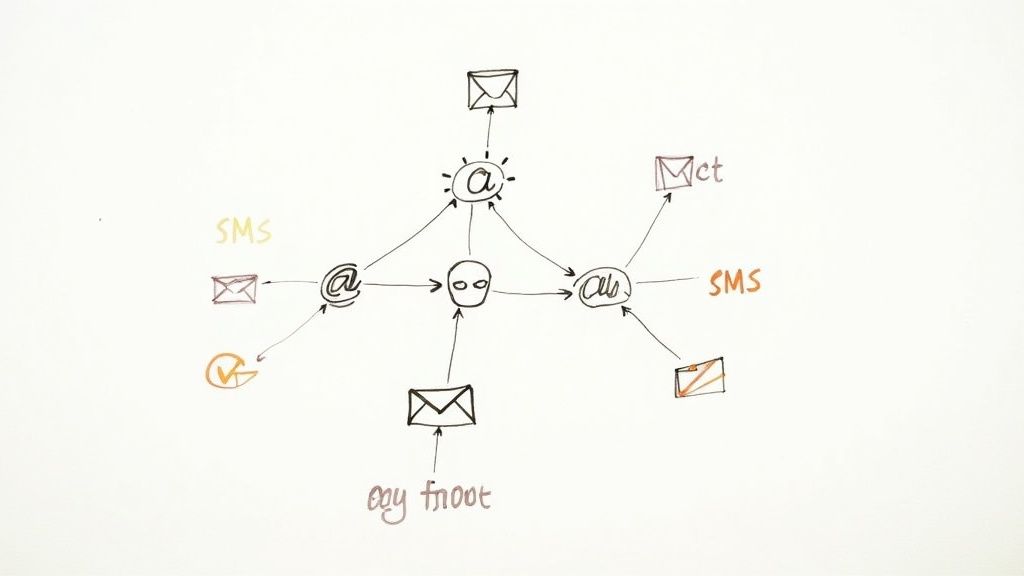
This practice moves beyond simply being present on multiple channels. It’s about making them work together, so a parent might see a Facebook ad for an open house, receive an email reminder after registering, and get an SMS text with a map link the day of the event.
Why It's a Foundational Practice
A multi-channel strategy recognizes that different audiences prefer different communication methods. By orchestrating campaigns, you ensure your key messages aren't missed just because a parent doesn't check their email daily but is highly active on social media. This comprehensive approach maximizes reach and engagement, showing families that your district is accessible and technologically adept. It builds a stronger narrative and prevents the disjointed experience that can arise from siloed communication efforts.
How to Implement Multi-Channel Orchestration in K-12
Coordinating across channels requires a clear plan and the right tools. The goal is to create a fluid conversation that adapts to how your community engages.
- Establish a Central Data Hub: Use a CRM or marketing automation platform that integrates data from all channels. This gives you a 360-degree view of each family's interactions, allowing you to trigger the right message on the right platform at the right time.
- Map the Communication Journey: For a key event like enrollment season, map out the entire communication sequence. Define which channel is best for each stage: awareness (social media ads), consideration (detailed emails), and action (SMS reminders).
- Maintain a Consistent Message: While the format may change, the core message, branding, and tone must be consistent across all channels. A family should instantly recognize your district's communications, whether it's an email newsletter or a post on Instagram.
5. Data Quality Management and Hygiene
The power of your marketing automation platform is directly tied to the quality of the data it contains. Data quality management is the ongoing process of ensuring your contact information is clean, accurate, and complete. Without it, even the most brilliantly designed campaigns will fail, leading to bounced emails, misaddressed communications, and wasted resources. This practice is one of the most fundamental marketing automation best practices for maintaining a credible and effective communications program.
Think of it as the foundation upon which all other automation efforts are built. Clean data ensures your carefully segmented messages reach the right families, personalization tokens pull the correct names, and your analytics reflect reality, not errors.
Why It's a Foundational Practice
Inaccurate or incomplete data can cripple your marketing efforts. Sending an email about middle school registration to a family with only a high school student erodes trust and makes your district look disorganized. Furthermore, poor data hygiene leads to deliverability issues, potentially getting your domain flagged as spam. Consistent data management ensures high deliverability, accurate personalization, and reliable reporting, which are essential for making informed strategic decisions. To explore this topic further, you can learn more about data-driven decision-making for marketing.
How to Implement Data Hygiene in K-12
Maintaining a clean database is an ongoing commitment, not a one-time project. Integrate these practices into your regular operational workflow.
- Implement Validation at Entry Points: Use form field validation to ensure information like email addresses and phone numbers are entered in the correct format from the start. This is your first line of defense against bad data.
- Schedule Regular Data Audits: Dedicate time quarterly or semi-annually to run reports on your database. Look for duplicate contacts, incomplete records, and formatting inconsistencies. Use your platform’s built-in tools, like HubSpot’s duplicate management, to merge and clean these records.
- Maintain Suppression Lists: Keep active suppression lists for families who have opted out, emails that have hard-bounced, or contacts who have requested not to be contacted. This is critical for both efficiency and compliance with regulations like CAN-SPAM.
6. A/B Testing and Continuous Optimization
Launching a marketing automation campaign without testing is like guessing the right answer on a final exam. The practice of A/B testing, or split testing, removes the guesswork by systematically comparing different versions of your communications to see which one performs better. This data-driven approach is a cornerstone of marketing automation best practices, ensuring that every email, landing page, and workflow is continuously refined for maximum impact.
This method empowers you to make small, iterative changes that yield significant improvements over time. By understanding what truly resonates with your parent and student community, you can optimize your efforts, improve engagement, and achieve your communication goals more efficiently.
Why It's a Foundational Practice
A/B testing transforms your marketing strategy from one based on assumptions to one based on evidence. By testing variables like email subject lines, send times, or call-to-action buttons, you can definitively identify what drives higher open rates, more event registrations, and greater engagement. For a school district, this could mean discovering that a subject line with an emoji gets 20% more opens or that sending newsletters on Sunday evening is more effective than on Monday morning. These insights are invaluable for refining future campaigns.
How to Implement A/B Testing in K-12
Integrating A/B testing into your workflow is straightforward with most marketing automation platforms, and it provides clear, actionable data to guide your strategy.
- Start with High-Impact Elements: Begin by testing the variables that are most likely to influence results. Focus on email subject lines, call-to-action (CTA) button text and color, and the main image or hero graphic in your emails.
- Test One Variable at a Time: To get clear, reliable results, isolate a single variable for each test. If you change both the subject line and the send time simultaneously, you won’t know which change caused the difference in performance.
- Ensure a Sufficient Sample Size: For your test results to be statistically significant, you need to send each version to a large enough segment of your audience. Most platforms will guide you on this, but a good rule of thumb is to have at least 1,000 recipients per version.
- Document and Apply Learnings: Keep a record of your test results and the insights you gain. Apply these findings to future campaigns to build on your successes and avoid repeating mistakes. This is a critical step in understanding and improving your marketing return on investment. You can learn how to better measure marketing ROI to connect your testing efforts to tangible outcomes.
7. Customer Lifecycle Journey Mapping
Understanding where a family is in their relationship with your district is crucial for effective communication. Customer lifecycle journey mapping involves planning automated touchpoints across the entire family lifecycle, from their first inquiry (awareness) to becoming passionate advocates for your schools. This strategic approach ensures every family receives relevant, timely information at each stage, guiding them smoothly from one phase to the next.
This infographic visualizes the five core stages of a typical family's journey with a school district, highlighting key outcomes of effective mapping.
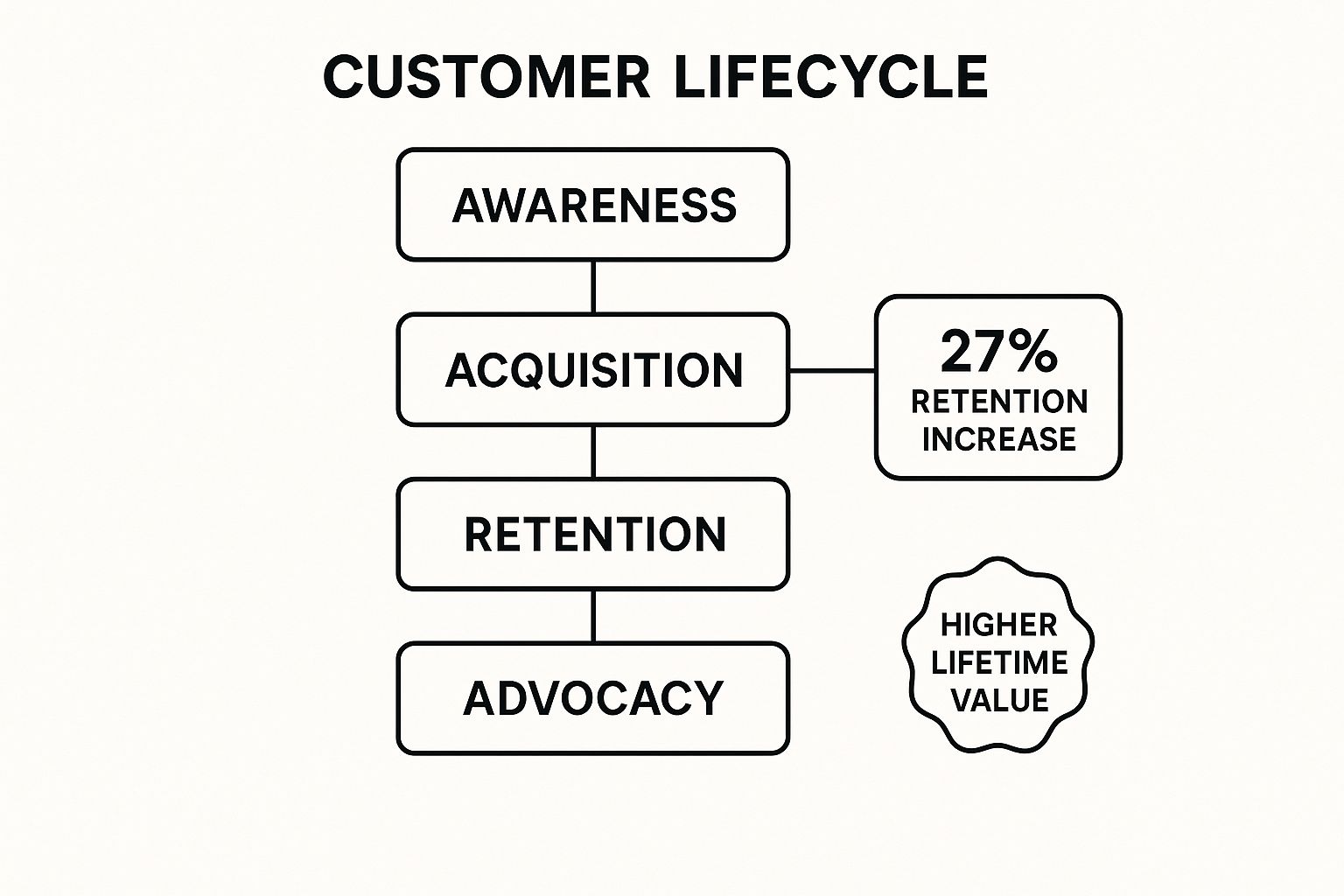
By focusing on a structured journey, you can significantly boost outcomes, such as increasing retention rates and fostering long-term community support.
Why It's a Foundational Practice
Journey mapping transforms your communication from a series of disconnected messages into a cohesive, supportive experience. When you anticipate a family's needs at each stage, you build trust and reduce friction, whether they are a prospective family deciding on enrollment or a current family navigating middle school. This proactive approach is one of the most powerful marketing automation best practices for nurturing relationships and ensuring long-term loyalty.
How to Implement Journey Mapping in K-12
Building a complete journey map takes time, but you can start with a clear, linear path and add complexity later.
- Define Your Stages: Map out the key phases for your families: Awareness (learning about the district), Consideration (attending open houses), Enrollment (completing registration), Retention (engagement during the school year), and Advocacy (recommending the district).
- Identify Key Touchpoints: For each stage, list the critical communications. For the Consideration stage, this might include automated reminders for school tours or follow-ups after an information session.
- Build "Exit Ramps": Create automated pathways for families who are not ready to advance. For instance, if a family misses an enrollment deadline, an automated workflow could move them to a "nurture" sequence for the following year instead of stopping communication entirely.
8. Marketing and Sales Alignment (Smarketing)
In the K-12 world, "sales" translates to admissions and enrollment. Aligning your marketing communications with the admissions team's processes, often called "Smarketing," is crucial. This practice uses automation to create a seamless handoff from a general inquiry (marketing) to a specific application or tour (admissions), ensuring no prospective family falls through the cracks. This integration is one of the most impactful marketing automation best practices because it transforms disparate efforts into a unified enrollment machine.
This approach ensures that marketing-generated leads are nurtured effectively and that the admissions team receives well-qualified, engaged families. By coordinating strategies, you create a consistent and positive experience for prospective parents from their first website visit to their child's first day of school.
Why It's a Foundational Practice
A lack of alignment between marketing and admissions is a primary cause of lost enrollment opportunities. When marketing generates interest but the admissions team isn't equipped to follow up effectively, the investment is wasted. Smarketing uses automation to bridge this gap, ensuring that every lead is tracked, scored, and routed to the right person at the perfect time. This creates a powerful feedback loop where marketing can see which campaigns lead to actual enrollments, allowing for continuous optimization.
How to Implement Smarketing in K-12
Building a bridge between your communications and admissions teams is a strategic process facilitated by technology and clear internal communication.
- Establish a Service Level Agreement (SLA): Create a formal agreement that defines what constitutes a "qualified lead" (e.g., a family who downloaded the viewbook and attended a webinar). The SLA should also outline the admissions team's required follow-up time, such as contacting a high-scoring lead within 24 hours.
- Implement Automated Lead Routing: Use your automation platform to automatically assign new inquiries to specific admissions counselors based on criteria like grade level of interest, campus preference, or geographic location. This eliminates manual work and ensures prompt follow-up.
- Create Shared Dashboards: Build a centralized dashboard that both teams can access. It should display key metrics like new inquiries, lead scores, tours scheduled, and applications submitted. This transparency keeps everyone focused on the same enrollment goals and fosters better collaboration. Learn more about how to foster this collaboration with effective internal communications best practices.
Best Practices Comparison of 8 Marketing Automation Strategies
| Item | Implementation Complexity | Resource Requirements | Expected Outcomes | Ideal Use Cases | Key Advantages |
|---|---|---|---|---|---|
| Customer Segmentation and Personalization | Moderate to high | Significant data collection and management | Higher engagement and conversion rates | Targeted marketing via personalized messages | Improves customer lifetime value, reduces unsubscribes |
| Lead Scoring and Nurturing Workflows | Moderate | Continuous calibration and alignment needed | Increased sales productivity and higher conversions | Prioritizing leads and sales enablement | Reduces sales cycle length; ensures leads aren’t missed |
| Behavioral Trigger-Based Campaigns | High | Robust tracking infrastructure required | Significantly higher click-through and lead generation | Real-time, behavior-driven communications | Timely relevant messaging; reduces manual management |
| Multi-Channel Campaign Orchestration | High | Extensive coordination and platform costs | Improved campaign effectiveness and brand recognition | Coordinated messaging across several channels | Multiple engagement touchpoints; channel-specific optimizations |
| Data Quality Management and Hygiene | Moderate | Ongoing resource investment | Improved deliverability, reduced waste, compliance | Maintaining accurate, clean customer data | Enhances personalization accuracy; regulatory compliance |
| A/B Testing and Continuous Optimization | Moderate | Requires sufficient data volume | Increased conversion rates and data-driven insights | Campaign performance improvement and testing | Reduces guesswork; optimizes ROI incrementally |
| Customer Lifecycle Journey Mapping | High | Complex design; deep behavioral insight | Higher retention and lifetime value | Managing complete customer lifecycle | Clear visibility of progression; proactive success efforts |
| Marketing and Sales Alignment (Smarketing) | High | Complex integration and cultural changes | Greater sales productivity and lead conversion | Synchronizing marketing and sales teams | Better customer experience; closed-loop revenue tracking |
Turn Your Insights into Action
Embarking on the path of marketing automation can feel like assembling a complex puzzle, but the picture it reveals is one of stronger relationships, streamlined processes, and sustained enrollment growth. Throughout this guide, we've navigated the essential pieces, from the foundational importance of precise segmentation and personalization to the strategic necessity of aligning your marketing and admissions teams. By implementing these marketing automation best practices, your school can transition from broadcasting messages to building meaningful, one-to-one conversations at scale.
The journey doesn't end with setting up a few workflows. True mastery lies in the continuous cycle of action, measurement, and refinement. Remember, the most successful strategies are living, breathing systems that adapt to the evolving needs and behaviors of your prospective and current families.
From Blueprint to Reality: Your Next Steps
The difference between reading about a strategy and achieving results is execution. To help you bridge that gap, here are the immediate, actionable steps you can take to put these insights into practice:
- Conduct a Systems Audit: Start by evaluating your current technology stack and data. Before you can implement advanced behavioral triggers or lead scoring, you must ensure your data is clean and your platforms are integrated. This is the cornerstone of effective automation.
- Map One Critical Journey: Don't try to automate everything at once. Choose one high-impact journey, such as the inquiry-to-application process for new families, and map it out. Identify key touchpoints, communication gaps, and opportunities for personalized, automated follow-up.
- Launch a Pilot A/B Test: Select a recurring, high-volume email, like your initial inquiry response or an event reminder. Create a simple A/B test on the subject line or call-to-action button. This small step builds the crucial habit of data-driven optimization.
The True Power of Automation: Building Relationships
Ultimately, the goal of adopting these marketing automation best practices isn't just about efficiency; it's about empathy. It's about delivering the right information to a nervous prospective parent at the exact moment they need it, celebrating milestones with current families, and creating a seamless experience that reflects the care and quality of your school's community. When technology is used to enhance human connection, it becomes an invaluable asset for building trust and fostering loyalty.
This framework provides the blueprint for building a sophisticated communications engine. The real work begins now, in applying these principles, learning from your data, and consistently iterating. By committing to this process, you will not only improve your marketing metrics but also deepen the relationships that form the heart of your school community.
Ready to move from theory to mastery with the support of a dedicated community? Join The MarCom Society to access exclusive workshops, expert resources, and peer-to-peer collaboration focused solely on the challenges and opportunities in K-12 school marketing. Elevate your strategy and connect with leaders like you today.









