The marketing of schools has changed. It’s no longer just about glossy brochures and a once-a-year open house. Today, it’s a constant, thoughtful effort to build a real community by telling your school's story in a way that connects with the right families, faculty, and supporters.
What Is Modern School Marketing Really About?
Stop thinking of your school’s marketing as a megaphone. It’s not about shouting announcements into the void. Instead, picture it as a well-tended garden. Every website update, social media post, and email newsletter is a seed you plant to grow enrollment, strengthen your reputation, and deepen community engagement.
This isn't just about filling seats to meet a quota. It’s about putting your school’s unique culture, academic rigor, and real student success stories on full display. When you do that, you create a natural pull for families who see the world the way you do and want that same environment for their children.
The Primary Goals of School Marketing
A solid school marketing plan is built on clear, measurable goals. While every school has its own priorities, most successful strategies focus on four areas that feed into one another, creating a cycle of growth and stability.
- Boosting Student Enrollment: This is the bottom line. The goal is to attract and engage prospective families, guiding them from their first inquiry to a completed enrollment. It's all about finding students who will truly thrive in your environment.
- Enhancing Institutional Reputation: A great reputation is your most valuable asset. It makes everything else easier. Strategic marketing builds that credibility, positioning your school as a trusted educational leader in the community.
- Attracting Top-Tier Staff: The best educators want to work at the best schools. When you consistently showcase your vibrant culture, professional development pathways, and student achievements, you become an employer of choice for talented faculty and staff.
- Building Community and Donor Support: An active, engaged community of parents, alumni, and local partners is a powerful thing. Good marketing nurtures these relationships, which leads directly to stronger fundraising, more volunteers, and priceless word-of-mouth recommendations.
At its heart, modern school marketing is a comprehensive communication practice. It aligns every message, from the admissions office to the principal's newsletter, to tell one consistent and compelling story about your school's impact.
These goals are all connected. A strong reputation helps you attract mission-fit students. A thriving student body helps you recruit passionate teachers. This positive cycle is powered by smart, story-driven outreach.
To get a better handle on how all these pieces fit together, you can explore the fundamentals of what marketing communications involves in our detailed guide. Every single touchpoint is a chance to prove why your school is the best place for a child’s education. That holistic view is what separates the schools that just survive from the ones that truly thrive.
Identifying the Families You Want to Reach
If you try to speak to everyone, you’ll end up connecting with no one. This is the golden rule of school marketing. Your first step isn’t deciding what to say, but rather, who you need to say it to. To make a real impact, you have to segment your audience and speak directly to their specific hopes, worries, and dreams.
Think of it like a librarian helping a student find a book. They wouldn't just hand the same novel to a first-grader and a high school senior. They ask questions, get to know the reader's interests, and then find the perfect match. Your marketing needs to do the exact same thing—match the right story with the right family at exactly the right time.
Going Beyond Prospective Parents
While bringing new families through the door is obviously a huge priority, a truly effective marketing strategy looks at the bigger picture. Your school's community is made up of several distinct groups, and each one plays a vital role in its success. They all need to hear from you, but not in the same way.
Your audience isn't a single entity; it's a network of different people with different motivations. The diagram below illustrates how a strong, centralized storytelling effort can ripple outward to boost enrollment, build your reputation, and attract top-tier staff.
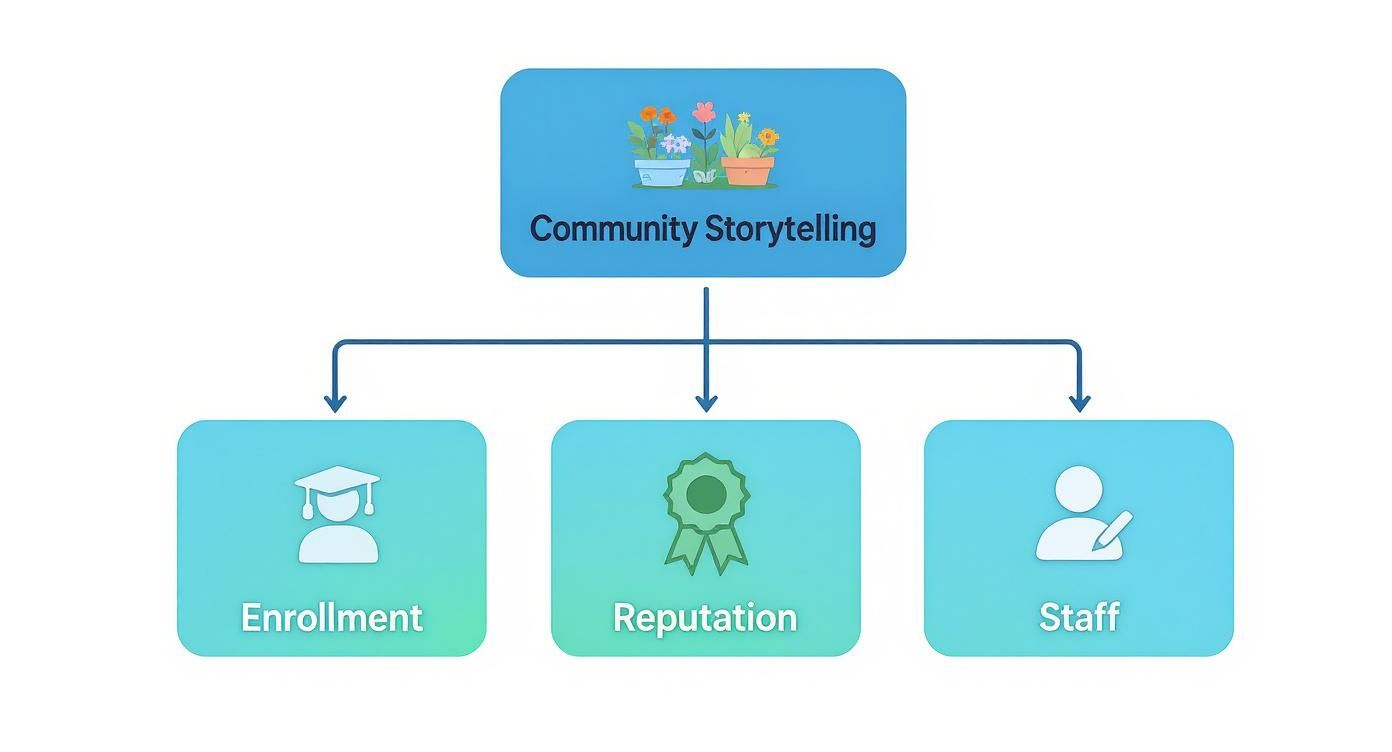
This shows how one powerful, authentic narrative can fuel growth across the board. To get this right, your school needs to get really good at audience segmentation.
These groups all influence one another. A happy current family is your most powerful ambassador to a prospective one. A renowned teacher elevates your reputation in the community, which in turn attracts both new students and other talented educators. To dig deeper into this core marketing concept, check out our guide on what is audience segmentation: https://blog.marcomsociety.org/what-is-audience-segmentation/
To help you get started, here is a quick breakdown of the primary audiences for most K-12 schools, what they care about most, and where you can reach them.
School Marketing Audience Segmentation
| Audience Segment | Primary Interest | Key Marketing Channels |
|---|---|---|
| Prospective Families | Finding the right academic, social, and cultural fit for their child. | School website, social media, open houses, digital ads, community events. |
| Current Families | Staying informed, feeling connected to the community, and seeing their child thrive. | Email newsletters, parent portal, school app, private social media groups. |
| Faculty & Staff | Professional growth, supportive culture, and resources to succeed. | Internal communications, professional development emails, staff meetings. |
| Alumni | Staying connected to the school's legacy, networking, and giving back. | Alumni newsletters, social media (LinkedIn), fundraising campaigns, events. |
| Donors & Partners | Seeing the impact of their contributions and aligning with the school's mission. | Annual reports, targeted fundraising appeals, recognition events, personal outreach. |
| Wider Community | Understanding the school's value and contributions to the local area. | Local press releases, community partnerships, public events, social media. |
Thinking through these different groups is the first step toward creating communication that actually hits the mark.
Developing Personas for Deeper Connection
Demographic data—like age, income, and zip code—is a useful starting point, but it won’t tell you how to connect with someone on an emotional level. That’s where personas come in. Personas are detailed, semi-fictional profiles of your ideal audience members that breathe life into all that data.
By giving a segment a name, a face, and a story, you make them real. Your team stops thinking about "parents aged 35-45" and starts thinking about "Anxious Amy," a mom whose biggest worry is whether her shy five-year-old will find a kind teacher and make new friends in kindergarten.
A well-crafted persona is your marketing compass. It ensures every email, social media post, and website update is written for a real person, answering their questions and easing their specific concerns.
Here are a few common personas you might develop for your school:
- Anxious Amy (First-Time Kindergarten Parent): Her top priorities are safety, a nurturing environment, and a gentle transition into "big school." She needs tons of reassurance, clear communication, and stories that showcase your school’s warm and caring culture.
- Data-Driven David (High School Parent): He’s all about the outcomes—college acceptance rates, AP course selection, and the strength of the STEM program. He responds to hard data, clear academic pathways, and proof of student success after graduation.
- Community-Minded Carla (Current Parent): She’s already a part of your school and is your best potential advocate. She wants to feel looped in on school events, know about volunteer opportunities, and see student achievements she can proudly share with her own network.
Never forget that choosing a school is an incredibly emotional decision. Recent studies show just how invested families are, with 62% of parents saying their kids influence back-to-school purchases and 57% willing to splurge on a special first-day outfit. The whole experience matters deeply.
It's this emotional investment that your segmented marketing needs to connect with. When you build out detailed personas, you can craft messages that make families feel seen, understood, and truly confident that your school is the perfect place for their child.
Crafting Your School's Unforgettable Story
In a sea of schools all vying for attention, what makes your institution the one a family chooses? It isn't just about your list of AP courses or the size of your gym. It’s about your story. This is the heart and soul of marketing of schools—figuring out what makes you genuinely special and then telling that story in a way that connects with the right families.
The starting point for that story is your Unique Value Proposition (UVP). Think of it as your school's core promise. It’s the single, compelling answer to a parent's most critical question: "Why is this the best place for my child over all the others?"
Without a clear UVP, all your marketing efforts risk becoming just more noise. But with a strong one, every website page, social media post, and campus tour works in harmony to build a memorable and powerful identity.

Pinpointing Your Core Differentiators
Your UVP isn't something you invent in a marketing meeting. It's something you uncover by looking closely at what you already do better than anyone else. What are the authentic, bedrock strengths that truly set your school apart?
A great way to start is by simply asking your community. Talk to parents, students, teachers, and staff about what they love most about the school. You might be surprised to find your biggest differentiators are things you take for granted.
Look for your unique story in these areas:
- Academic Philosophy: Do you champion project-based learning that ignites creativity? Or perhaps you offer a rigorous STEM curriculum that truly prepares kids for the future.
- Nurturing Culture: Maybe your superpower is an incredible sense of community where every single student feels seen and known, thanks to a robust advisory program.
- Specialized Programs: Are you known for a one-of-a-kind arts program, a powerhouse athletics department, or a nationally recognized language immersion track?
- Student Outcomes: Can you point to impressive college acceptances, high scholarship numbers, or alumni who are making a real impact in their communities?
Your unique value proposition lives at the intersection of what your school excels at and what your ideal families are desperately seeking. It’s that perfect match between your strengths and their needs.
Once you’ve identified these core differentiators, you can start weaving them into a cohesive story. To really get this right, you'll need a solid grasp of the concept—this guide explains in detail what a value proposition is and how to build one. Honestly, it's a foundational piece for any school's marketing plan.
From UVP to Compelling Key Messages
Once you've nailed down your UVP, the next job is to translate it into a handful of consistent key messages. Think of these as the essential talking points that everyone—from the Head of School to the admissions team—can use to tell your story.
These messages need to be clear, easy to remember, and grounded in what actually happens on your campus every day. They become the building blocks for every piece of marketing you create.
For instance, if your UVP is "Fostering compassionate innovators through hands-on problem-solving," your key messages might sound something like this:
- "Learning by Doing": Our students don't just read about problems; they solve them in our state-of-the-art innovation lab, turning natural curiosity into real-world capability.
- "Character First": We build empathy right alongside intellect by integrating service learning and ethical leadership into the curriculum at every grade level.
- "Future-Ready Skills": Graduates leave with more than just knowledge. They leave with the skills that matter for tomorrow: collaboration, resilience, and creative thinking.
This kind of framework ensures that whether a prospective parent is browsing your website, attending an open house, or just chatting with a current student, they're hearing the same authentic and powerful story. That consistency is what builds trust and ultimately makes your school unforgettable.
Choosing the Right Marketing Channels and Tactics
You’ve defined your school’s unique story and figured out which families you want to reach. Now comes the fun part: bringing that strategy to life. This is where you pick the right mix of marketing channels and tactics—the actual vehicles that will carry your message out into the world.
The goal isn't to be everywhere at once. That's a recipe for burnout. The key is to be in the right places with a consistent, compelling narrative that connects with people.
Think of your marketing channels like a well-stocked tool belt. You wouldn't use a hammer to saw a board. In the same way, the tool you use to announce an open house (like an email blast) is totally different from how you’d showcase your vibrant student culture (hello, Instagram). Smart marketing of schools is all about choosing the right tool for the right job to keep that enrollment pipeline full.
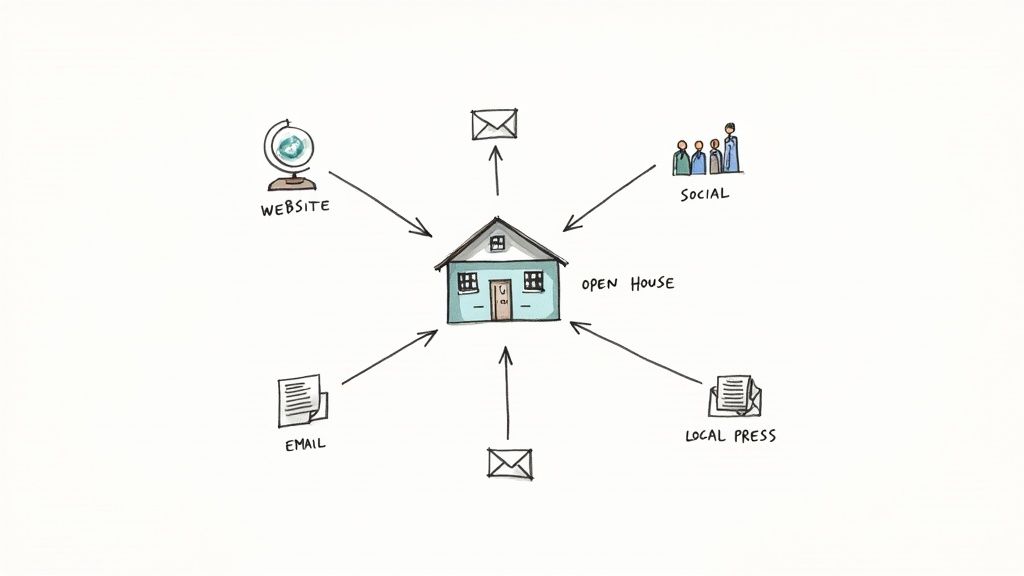
Building Your Digital Foundation
Let’s be honest: a family’s search for a new school almost always starts online. Your digital presence is your virtual front door. It needs to be welcoming, easy to navigate, and full of the answers parents are looking for. If they can’t find you with a quick search, you might as well be invisible.
Your school's website is the hub of it all. It absolutely must be mobile-friendly and simple to use. But a great digital strategy is more than just a pretty website; it's a few key pieces working together.
- Search Engine Optimization (SEO): This is just a fancy way of saying you’re making it easier for search engines to find and recommend you. When a parent types "best private elementary school in [Your City]" into Google, good SEO is what gets your school to show up near the top of the list.
- Local SEO: This is a non-negotiable for schools. It starts with your Google Business Profile. This free listing puts you on the map, shows off your reviews, and gives families your contact info at a glance. It's how local families will find you, period.
- Content Marketing: This is where you stop "selling" and start helping. Think blog posts about navigating middle school, downloadable guides on the application process, or video testimonials from happy parents. By providing real value, you build trust and position your school as an educational leader.
Engaging Families on Social Media
Social media is no longer optional—it’s where your community hangs out online. Just having an account isn’t enough, though. The real goal is to share authentic content that shows off your school's unique personality.
Don't just take our word for it. Research shows that 74% of students use platforms like Instagram and TikTok as primary sources of information, which heavily shapes their preferences.
Here’s a quick rundown of the major platforms:
- Facebook: Still king for reaching parents and the broader community. It’s perfect for sharing event details, celebrating student wins, and posting photo albums that give a feel for campus life.
- Instagram: This is your visual playground. Use Reels and Stories to share behind-the-scenes moments, student takeovers, and teacher spotlights. It’s all about capturing the energy of your school.
- LinkedIn: Often overlooked, but invaluable for building your professional reputation. This is where you attract top-tier faculty and connect with alumni and potential community partners.
- TikTok & YouTube Shorts: Want to show your school's fun side? These short-form video platforms are your ticket. Think quick campus tours, student-led project showcases, or fun facts about your unique programs.
The best school social media accounts focus on authenticity, not polish. Families want to see the real, messy, vibrant life of your school, not a perfectly manicured advertisement. Let your students and teachers be the stars.
The Power of In-Person Connection
As important as digital is, nothing replaces the impact of a real-life connection. Events are your chance to let families feel your school's culture. They turn your mission statement into a living, breathing experience, and a great event can be the single biggest factor in a family's decision.
- Open Houses: A classic for a reason. But don't just give a boring tour. Create an experience. Have student ambassadors share their stories, let teachers run mini-interactive lessons, and make parents feel comfortable enough to ask the tough questions.
- Community Fairs and Events: Set up a booth at the local farmers' market or town festival. This is a low-pressure way to meet families where they already are and get your name out there.
- "Shadow Days" or "Experience Days": This is your secret weapon. Letting a prospective student spend a day on campus, sitting in on classes and eating lunch with their peers, is an incredibly powerful way to help them picture themselves at your school.
While visitors are on campus for these events, thoughtful touches like modern digital signage solutions for schools can make a huge difference in welcoming them and guiding their experience.
Leveraging Public Relations and Earned Media
Earned media is any positive press you don't pay for—like a story in the local paper or a feature on a parenting blog. It's incredibly powerful because it acts as a third-party endorsement, which families often find more credible than a paid ad.
The key is building real relationships with local journalists and community leaders. You can do this by:
- Sending Out Press Releases: Got a big story? A major student award, a cool new program, or a community service project? Share it!
- Positioning Leaders as Experts: Offer your Head of School or lead teachers as sources for local news stories on education trends.
- Celebrating Student Success: Pitch stories about unique student accomplishments in academics, arts, or athletics. People love to read about local kids doing great things.
By mixing a strong digital game with unforgettable in-person events and a smart PR strategy, you create a marketing plan that works from every angle. You meet families wherever they are on their journey, building awareness and trust until it's clear that your school is the right choice for them.
Measuring What Matters in Your School Marketing
Great school marketing isn't about guesswork or crossing your fingers. It’s about drawing a clear line from your daily efforts to the results that actually matter: inquiries, applications, and enrollments.
To do that, you have to look past the "vanity metrics"—things like social media likes that feel good but don't fill seats. Think of it like a coach reviewing game film. The final score is crucial, but they’re also tracking assists, turnovers, and free-throw percentages to understand how the game was won or lost. Your marketing data tells the full story behind your enrollment numbers.
Focusing on Actionable Digital Metrics
For most prospective families, your school’s digital presence is their first handshake with your community. A hard truth in the marketing of schools today is that a strong digital footprint isn't just nice to have; it's essential. In fact, studies show that over 70% of initial student engagement now happens online. Your website and social media profiles are doing the heavy lifting 24/7. Discover more insights about these key education marketing strategies.
To see what’s working, you have to track specific actions that signal real interest.
- Website Conversions: This is your north star. How many visitors are taking the next step? Track every inquiry form submission, tour request, and application start.
- Email Engagement: Look beyond the "sent" number. Your open rate tells you who's actually reading your messages, and the click-through rate shows who’s interested enough to act on what you've shared.
- Social Media Inquiries: Likes are nice, but conversations are better. Are prospective parents sending you direct messages or leaving comments with real questions about your programs? That's a lead.
The most important question to ask of any marketing metric is: "Does this number get us closer to a new student?" If the answer is no, it's a distraction, not a key performance indicator.
Tracking Success Beyond the Screen
Not every marketing win happens behind a screen. Your open house events, community partnerships, and good old-fashioned word-of-mouth are incredibly powerful. You just need a simple way to measure their impact.
These offline metrics connect your community-building efforts directly to your admissions pipeline. Here are the essential Key Performance Indicators (KPIs) to start monitoring:
- Open House Attendance: The number of families walking through your doors is a direct measure of community interest and the reach of your event promotions.
- Inquiry-to-Tour Ratio: Of all the people who first reached out, what percentage actually came for a visit? This number tells you how well your initial follow-up is working.
- Tour-to-Application Ratio: This is a huge one. How many families who experience your campus firsthand are convinced to apply? A high ratio here means your school tour is a powerful closing tool.
- Application-to-Enrollment Ratio: The final step. What percentage of accepted students officially say "yes" and enroll? This is the ultimate report card for your entire admissions process.
By combining both online and offline data, you get a 360-degree view of your marketing performance. You’ll clearly see which channels are bringing in qualified families, where you might be losing people along the way, and exactly where to invest your time and budget for the biggest impact on enrollment.
Ethical Marketing for Building Family Trust
When it comes to school marketing, trust is everything. It's the single most valuable currency you have. While clever campaigns and beautiful viewbooks have their place, they're built on a foundation of ethical conduct. If that foundation cracks, everything else comes tumbling down.
Think about it: every photo you post, every email you send, and every bit of data you collect sends a message about your school's character. Families aren't just shopping for a curriculum or a nice campus; they're entrusting you with their children. That's a profound responsibility, and it demands a marketing approach grounded in complete honesty and respect.
A single misleading claim or a careless attitude toward privacy can undo years of hard work. The damage to your school's reputation can be immediate and incredibly difficult to repair.
Navigating Privacy and Consent
We all know that authentic photos and student stories are marketing gold. They bring your school's community to life in a way nothing else can. But using them comes with serious ethical and legal strings attached.
Before you feature any student in any marketing material, you absolutely must have explicit, informed consent from their parents or guardians.
This can't be a throwaway line buried in a 20-page enrollment packet. Best practice is to use a separate, easy-to-understand consent form that clearly explains how and where a student's image, name, or work might be used—whether it's on your website, in a social media post, or in a printed brochure. This process not only protects your students but also shows families that you put their well-being first.
A family's trust is earned in drops and lost in buckets. Ethical marketing isn't a limitation; it's the framework that ensures your school's reputation remains its greatest asset.
An Ethical Marketing Checklist
To make sure your marketing efforts are building trust, not breaking it, it's a good idea to audit your practices regularly. This simple checklist can help keep you on the right track.
- Honesty in All Claims: Do your marketing materials truly reflect the student experience? Steer clear of exaggerating program outcomes, class sizes, or campus facilities. Be real.
- Airtight Photo and Video Consent: Do you have a clear, documented system for getting—and tracking—parental consent before using a student's image?
- Data Privacy Compliance: Are your data collection practices compliant with regulations like FERPA (in the U.S.)? Make sure all family data is stored securely and only used for its intended purpose.
- Transparent Testimonials: Are the testimonials you feature genuine and used with permission? Never invent quotes or twist someone's words to create a misleading narrative.
Sticking to these principles isn't just about following the rules. It's about building a brand that families genuinely believe in. That kind of trust is the bedrock of long-term enrollment success.
Your Top School Marketing Questions, Answered
Let's be honest, school marketing comes with its own unique set of questions. Below, I've tackled some of the most common ones that come up when I'm working with marketing and admissions teams on the ground.
How Much Should a School Budget for Marketing?
There’s no magic number here, but a reliable rule of thumb for K–12 schools is to set aside anywhere from 1% to 5% of the total operating budget for marketing.
Where you fall in that range really depends on your situation. A brand-new school that needs to build awareness from scratch might push closer to that 5% mark. On the other hand, a well-established school with a great reputation and steady enrollment can often thrive on just 1% or 2%.
The best approach is to tie your budget directly to your enrollment goals. Figure out your cost to acquire a new student, then work backward from your targets. This makes your budget a strategic tool, not just a number you have to hit.
What Is the Best Tactic for a Small School on a Tight Budget?
If your resources are tight, your most powerful and cost-effective tool is good old-fashioned word-of-mouth marketing. Your absolute best bet is to focus on the families you already have.
The most credible and persuasive marketing message doesn't come from a brochure; it comes from one happy parent talking to another. Your primary job is to give them a great story to tell.
Pour your limited energy into small, high-impact community events. Send out a simple but consistent email newsletter celebrating student successes. Make it incredibly easy for your current parents to leave positive online reviews. These efforts turn your families into authentic ambassadors who will sing your praises for free.
How Can We Get Current Parents Involved in Our Marketing?
Getting current families involved means turning them from a passive audience into your most active marketing channel. It takes a little organization, but the payoff is huge.
Here are a few proven ideas:
- Launch a Parent Ambassador Program: Give the role a name and a purpose. Ask your most enthusiastic parents to speak at open houses, call newly enrolled families to welcome them, or share specific posts on social media.
- Make Sharing a Cinch: Don't just hope they'll share your good news. When you post something great on social media, email parents a direct link and even a pre-written caption they can copy, paste, or tweak. The easier you make it, the more they'll do it.
- Systematically Gather Testimonials: Don't wait for them to come to you. Actively collect quotes and stories. A "Family Spotlight" feature in your newsletter or on your website is a fantastic way to celebrate your community and generate authentic marketing content at the same time.
How Long Does It Take to See Results from School SEO?
This is a big one. Search Engine Optimization (SEO) is a long-term play, not an overnight fix.
You can definitely see some quick wins within a few months, especially with local SEO tasks like optimizing your Google Business Profile. But for more significant, lasting results—like ranking for competitive keywords—you need to be patient. It often takes a solid 6 to 12 months of consistent work. Think of it as a marathon, not a sprint.
At The MarCom Society, we specialize in providing K-12 marketing professionals with the resources, expert guidance, and peer support needed to tackle these challenges head-on. Join our community to access workshops, expert sessions, and a network of colleagues who understand your unique role.