A modern school marketing strategy isn't just a plan; it's the lifeline that connects your school's unique value to the right families. It's about moving beyond open houses and glossy brochures to build genuine relationships in a crowded, competitive market.
Think of this guide as your roadmap to doing just that.
Why Old-School Marketing Doesn't Make the Grade Anymore

The old "if you build it, they will come" philosophy is a relic. With charter schools, private academies, and online learning options popping up everywhere, families have more choices than ever. They’ve become savvy consumers.
Today’s parents research schools the same way they shop for anything else—they go online, compare experiences, and look for a perfect fit for their child’s needs and their family's values. Relying on word-of-mouth alone is a recipe for stagnant growth.
Here's the new reality: parents are subconsciously comparing your school's website not just to the one down the street, but to the seamless digital experiences they get from brands like Amazon and Netflix. The bar is higher now.
From Institution to Community
To really connect, you have to shift your thinking. Your school isn't just an institution; it’s a living, breathing community with a story to tell. An effective marketing strategy is the megaphone that broadcasts that story, cutting through the noise to reach the families you're meant to serve.
This isn’t a one-and-done campaign you run during enrollment season. It's a continuous, year-round effort focused on:
- Building real relationships with prospective and current families.
- Showing what makes you different and why it matters.
- Securing your school's future with strong, predictable enrollment.
A great marketing strategy makes a family feel like they belong to your community long before their child’s first day. It turns their decision from a simple choice into a confident investment.
Your Roadmap to a Full Roster
This guide gives you a clear, step-by-step framework to build a marketing plan that actually works. The principles here mirror the larger digital transformation in marketing that has changed how all organizations connect with people.
We'll dig into how to find your ideal families, craft a brand story that resonates, and master the digital channels where parents are spending their time. Most importantly, you'll learn how to measure what matters, so every ounce of effort contributes directly to building a vibrant, thriving school.
Discovering Your Ideal Families and Unique Brand Story

A generic message doesn't just fall flat—it often fails to attract anyone at all. Before you can build an effective marketing strategy of schools, you have to get back to basics and answer two critical questions: Who are we trying to reach, and what makes our school the right choice for them?
Think of this as the foundation of your entire marketing house. Get it right, and everything else you build will be solid.
Creating Your Parent Personas
The first step is to stop thinking in broad strokes like "parents in our area." It’s time to get specific by creating detailed parent personas. These aren't just demographic checklists; they're rich, semi-fictional profiles of the ideal families you want to attract. They give a human face to your audience.
Building a powerful persona means digging into the real-world motivations and anxieties that drive a family's school search. What keeps them up at night? What are their deepest aspirations for their child’s education and future?
Try to answer questions like these:
- What are their top educational priorities? Are they looking for a top-tier STEM program, a vibrant arts department, or a school that prioritizes character and leadership?
- What are their biggest worries? They might be concerned about large class sizes, campus safety, or whether their child will truly feel like they belong.
- Where do they hang out online (and offline)? Do they scroll through local parent groups on Facebook, read reviews on niche school websites, or trust word-of-mouth from friends at the park?
You don't have to guess. Start by talking to your current families. Send out a simple survey asking why they chose your school and what they value most. Look at your website analytics—which pages get the most traffic? That’s a huge clue about what people care about. This process of grouping families by their needs is a cornerstone of smart marketing. To go deeper, you can learn more about https://blog.marcomsociety.org/what-is-audience-segmentation/ and how to apply it.
A well-crafted parent persona is your marketing compass. Every blog post, social media update, and email campaign should be written as if you're speaking directly to that person.
Defining Your Unique Brand Story
Once you truly understand who you're talking to, you can figure out what to say. This is where you define your school's unique brand story—the authentic, consistent message that captures your identity. It's more than a slogan; it's the heart of what makes you special.
Your story needs to be genuine and highlight what actually sets you apart from the school down the street. For a masterclass on this, exploring proven strategies to build your brand can offer some fantastic direction.
Are you the innovation-focused school preparing kids for jobs that don't exist yet? Are you the nurturing, close-knit community where every teacher knows every child's name? Or are you the legacy institution with a century-long track record of academic excellence? Be honest and own it.
Connecting Your Story to Your Audience
This is where the magic happens. You take your brand story and align it directly with the hopes and fears of your parent personas. This connection is what transforms your marketing from a simple broadcast into a meaningful conversation.
For example, if one of your personas is a parent worried their shy child will get lost in the crowd, your story shouldn't just talk about "academic rigor." Instead, it should highlight your small class sizes, your mentorship programs, and the supportive, family-like atmosphere on campus.
If another persona is a parent who values hands-on experience, your story needs to be full of examples of your project-based curriculum, robotics club victories, and student-led initiatives. This alignment ensures your message doesn't just get heard—it truly resonates.
Building Your School's Digital Campus
Long before a family ever sets foot on your grounds for a tour, they've already visited your campus—your digital one. Your school’s website isn't just a brochure anymore. It’s the central hub of your entire marketing world, the first impression, and often, the deciding factor.
Today’s parents are savvy consumers. They’re used to the seamless, intuitive experiences offered by brands like Amazon and Netflix, and they bring those same expectations to their school search. If your website is clunky, slow, or a headache to use on a phone, they’re gone. It’s that simple. In fact, research shows a staggering 52% of users are less likely to engage with a brand after a single bad mobile experience.
Your Website is Your Digital Front Door
Think of your homepage as the main entrance to your school. Is it welcoming? Does it give visitors a clear sense of where to go next? A modern, well-designed website is the foundation that holds up everything else you do. Without it, your brilliant social media campaigns or carefully crafted newsletters simply won't have a place to land effectively.
A great website is non-negotiable. It has to deliver an exceptional user experience that builds trust from the very first click. This is a make-or-break piece of any serious marketing strategy of schools.
To make sure your digital campus leaves a lasting positive impression, you have to nail these fundamentals:
- Effortless Navigation: A prospective parent shouldn't have to go on a scavenger hunt to find tuition info or admissions deadlines. A clean menu and a logical site structure are absolute must-haves.
- Compelling Visuals: High-quality photos and videos are your best tools for storytelling. Use them to show off your vibrant community and the unique spirit of your school. Show, don't just tell.
- Clear Calls-to-Action (CTAs): Make it painfully obvious what you want families to do next. Big, friendly buttons like "Schedule a Tour," "Inquire Now," or "Download Our Viewbook" should be impossible to miss.
- A Flawless Mobile Experience: Most parents are doing their research on their phones, often in between other tasks. Your site must be built for mobile-first. If they have to pinch and zoom, you've already lost them. For a deeper look, our guide on effective school website design has you covered.
Your website isn’t just a tool; it's the digital embodiment of your school's brand and promise. It needs to reflect the same quality and care that you put into your educational programs.
Helping Parents Find You with SEO
Of course, a beautiful website is useless if no one ever finds it. That's where Search Engine Optimization (SEO) comes in. SEO is simply the art and science of helping your website show up higher in Google results when parents search for schools like yours.
When a family moves to town and types "best private school in [Your City]" into Google, you want your school to be right there at the top. A smart SEO strategy makes that happen. It’s not about gaming the system; it’s about making your site genuinely useful for search engines and, more importantly, for the people using them.
It starts with understanding the exact words and phrases your ideal parents are using. From there, you can weave those keywords naturally into your website's pages, headlines, and blog posts.
Positioning Your School as a Trusted Resource
Beyond the technical side of SEO, one of the most powerful things you can do is create genuinely helpful content through a school blog. This shifts your role from just being an option to becoming a trusted expert in education. It's a long game, but one that builds incredible goodwill and authority.
Instead of only writing about your school’s latest award, try answering the real-world questions that keep parents up at night.
Think about blog posts that tackle topics like:
- "5 Ways to Ease Kindergarten Anxiety for Your Child"
- "How to Foster a Love of Reading at Home"
- "Is a STEM-Focused Education Right for My Middle Schooler?"
By offering valuable advice with no strings attached, you start building a relationship with families long before they're even thinking about enrollment. When it’s finally time to choose a school, your name is already one they know and trust. This approach turns your website from a marketing pitch into a true community resource, attracting families who are the perfect fit for your mission.
Engaging Modern Families with Authentic Content

If your marketing strategy is the engine, then compelling content is the high-octane fuel that makes it run. Once you’ve built your digital campus, the next job is to fill it with stories that create a real, human connection with prospective families. This isn't about glossy ads; it's about being genuine.
Today's parents can spot generic marketing from a mile away. They want to see the real, unpolished magic that happens in your hallways and classrooms every single day. The most effective marketing strategy of schools now is built on a simple principle: "show, don't tell."
So, instead of just listing your school's values, show them in action with photos of students working together on a science project. Rather than just talking about your dedicated faculty, feature a short video of a teacher explaining what gets them excited to come to work. This is how you turn abstract ideas into tangible proof.
The Power of Visual Storytelling
We communicate with our eyes first. Families aren't just reading about your school; they're trying to picture their child thriving there. Your job is to paint that picture for them with authentic, high-quality photos and videos.
This doesn’t mean you need a Hollywood-level budget. In fact, content that's too polished can sometimes feel less trustworthy. The real goal is to capture the true spirit of your school.
Try mapping out a content calendar that shines a light on different parts of student life:
- Classroom Collaborations: Snaps of students deeply engaged in hands-on learning.
- Campus Events: Photos from spirit week, the school play, or a bustling science fair.
- Athletic Triumphs: Action shots from the court or field that capture teamwork and grit.
- Artistic Expression: Students proudly showcasing their work in the art studio or on stage.
A steady stream of this kind of visual proof makes your school feel vibrant, active, and, most importantly, real. It lets parents see the daily experiences that truly shape your community.
The most powerful stories aren't found in mission statements. They're revealed in the everyday moments of learning, discovery, and connection that define your school's culture.
Mastering Short-Form Video
One of the biggest shifts in school marketing has been the explosion of short-form video. It's no secret that a modern marketing strategy of schools leans heavily on these quick, engaging clips to grab and hold attention. Platforms like Instagram Reels and TikTok have become essential tools, with video campaigns often crushing traditional ads in both reach and conversions. You can dig into more of this trend and other school marketing statistics on Amra & Elma.
Short-form video is practically tailor-made for showing off a school's personality. These energetic, bite-sized clips give families a dynamic window into your unique culture.
Here are a few ideas to get you started:
- "A Day in the Life" Glimpses: Quick cuts showing different moments from a typical school day—from the morning bell to afternoon clubs.
- Teacher Takeovers: Let a fun, charismatic teacher share a quick teaching tip or a behind-the-scenes look at their classroom.
- Student Soundbites: Short clips of students sharing what they love most about their school, in their own words.
The key is to keep it brief, energetic, and authentic. These videos build a powerful sense of community and give prospective families a genuine feel for your school’s atmosphere long before they step on campus.
Building Trust with Human Stories
Beyond the visuals, the most persuasive content you have comes directly from the people who know your school best. Their personal stories provide social proof and build a layer of trust that no marketing copy can ever hope to replicate.
Start weaving these voices into your content strategy:
- Parent Testimonials: Feature quotes or short video interviews with current parents. Ask them why they chose your school and what positive impact it's had on their child.
- Student Success Stories: Highlight students who have found their passion, whether in academics, the arts, or community service. Tell their story and show their journey.
- Faculty Spotlights: Introduce the incredible people who make up your staff. A blog post or video about a passionate educator helps parents connect with the mentors who will be guiding their children.
When you weave these authentic voices together, you create a rich, multi-dimensional story. You're no longer just selling an education; you're inviting families to become part of a thriving, supportive community. It’s an approach that makes your school feel less like an institution and more like a home.
Nurturing Leads Through Strategic Community Outreach
Getting a family to visit your website or follow you on social media is a great start, but it's not the finish line. That first flicker of interest is just that—a beginning. The real magic happens when you thoughtfully nurture that initial curiosity, turning it into a genuine connection that guides a family all the way to enrollment.
This is where marketing stops being about one-off announcements and becomes an ongoing, supportive conversation. It's about making every family feel seen, heard, and connected to your school at every single touchpoint. By doing this, you stay at the front of their minds and build the kind of trust that makes their final decision a whole lot easier.
Building Your Communication Lifeline
One of the most direct and powerful tools you have is a well-tended email list. When a family hands over their email address—whether to download your viewbook or ask about a tour—they’re essentially inviting you into their digital home. Don't take that invitation for granted.
Use that direct line to share things that genuinely help them make their decision.
- Timely Reminders: Keep them in the loop with friendly nudges about application deadlines, upcoming open houses, and other important dates.
- School News & Highlights: Did your robotics team just win a competition? Share it! These stories bring your school's culture to life.
- Exclusive Content: Give them something they can’t get anywhere else, like a "day-in-the-life" video from a current student or a personal message from the Head of School.
By consistently offering real value, you shift from being just another option to becoming a trusted partner in their search. Every email you send builds familiarity and reinforces what makes your community special.
Fostering Two-Way Conversations on Social Media
Think of your social media channels as a town square, not a megaphone. It’s the perfect place to move beyond static posts and dive into real, back-and-forth conversations. When a parent drops a question in the comments, a prompt and thoughtful answer shows you're listening and you care.
Celebrate your community's wins out loud. Tagging a local business you partnered with or giving a shout-out to a student's achievement fosters a vibrant, interactive atmosphere. This kind of active engagement makes your school feel less like an institution and more like a living, breathing community that families can actually picture themselves joining. Of course, beyond direct outreach, using the right digital tools can make all the difference in guiding families through this journey. Exploring effective marketing funnel builder tools can help you map out and automate this process seamlessly.
Maximizing High-Impact Events and Partnerships
Open houses—whether you're holding them on campus or online—are still a huge deal in school marketing. This is your chance to make your school’s story jump off the page. To really make an impact, go beyond the standard campus tour. Create experiences where families can chat with teachers, ask questions of current students, and connect with other parents. A great open house isn't about seeing buildings; it's about feeling the energy and warmth of your community.
Finally, never underestimate the power of local relationships. Strong connections with feeder schools, neighborhood real estate agents, and community organizations can become an incredible referral engine. When you take the time to build these partnerships, you get your school recommended by trusted voices in the community—and that's a layer of credibility no ad campaign can ever buy.
Real-World School Marketing Success Stories
It's one thing to talk about strategy in theory, but it’s another thing entirely to see it work in the real world. Let's look at how two very different schools took these principles and turned them into tangible enrollment growth, moving from a tough spot to a clear victory.
These stories really drive home the point that there’s no single magic bullet. The best strategies are the ones that are deeply connected to a school's unique identity, its community, and its specific goals.
The Small School That Became a Local Titan
Imagine a fantastic independent school, but one that’s practically invisible. It was getting lost in a sea of bigger, louder competitors. Their problem wasn't the quality of their education; it was simply that prospective families had no idea they even existed.
Their game plan was brilliant in its simplicity: a laser-focused local SEO and community partnership campaign. First, they went to work on their website, making sure it popped up for searches like "best private elementary school in [their town]." They also started a blog that directly answered the burning questions local parents were typing into Google every day.
At the same time, they weren't just sitting behind their computers. They hit the pavement, building genuine relationships with local businesses and nearby preschools. This created a powerful word-of-mouth referral engine. The outcome? A stunning 35% increase in enrollment in just two years, proving that even a small school can dominate its local market with a smart digital strategy.
The infographic below really paints a picture of what's possible when schools get their marketing right.
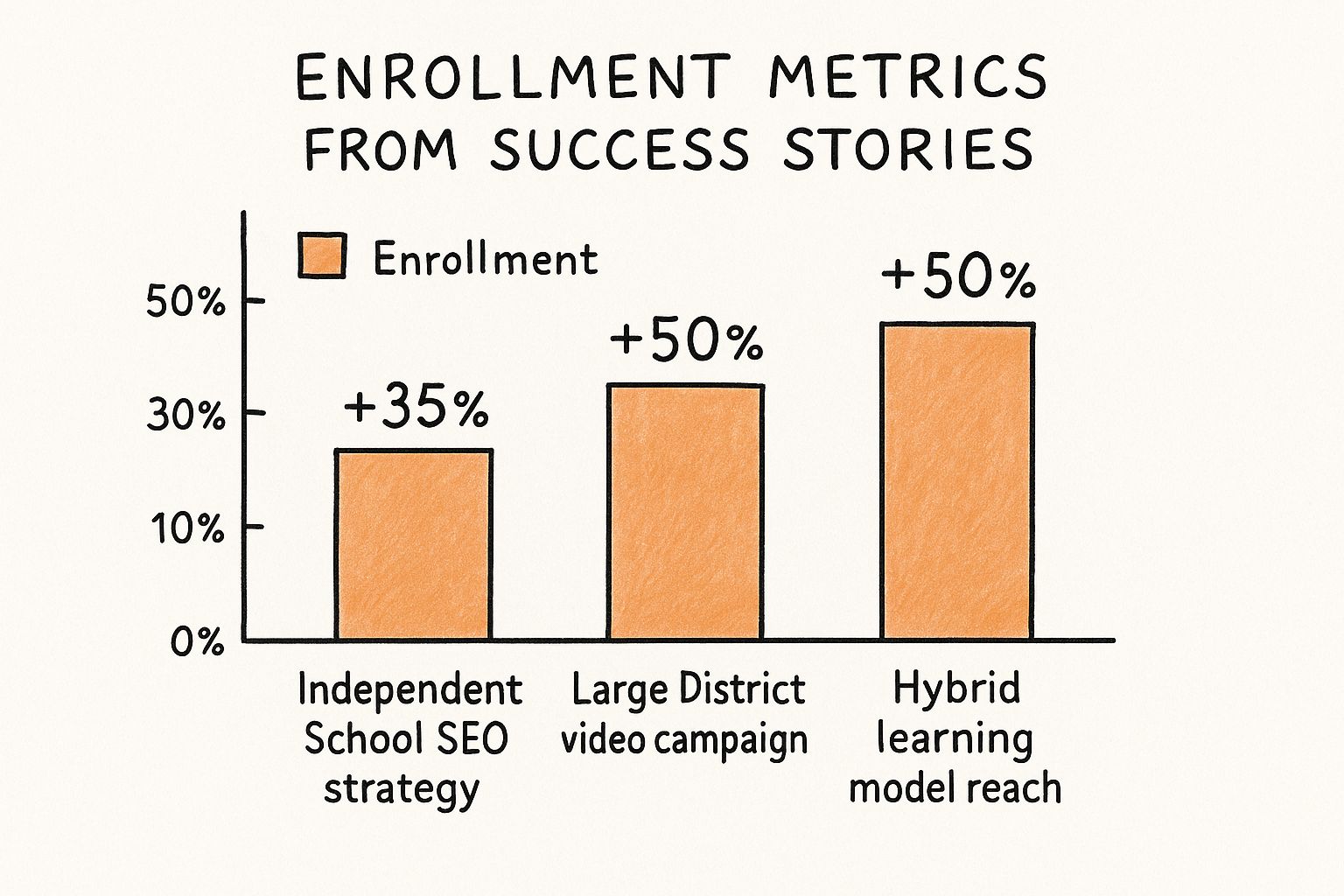
As you can see, strategic, well-executed marketing isn't just about feeling good—it delivers serious, measurable results.
The District That Flipped the Script on Its Reputation
Now for a different kind of challenge. A large public school district was battling a stale, outdated reputation. This perception problem was causing families to flock to neighboring districts or opt for private schools. They had to change the conversation and show everyone the incredible things happening inside their classrooms.
Their strategy was all about authentic storytelling. Instead of corporate-sounding announcements, they launched a dynamic, student-led video campaign. They handed the cameras to high schoolers who created short, high-energy videos perfect for social media. They also created a parent ambassador program, empowering their happiest families to become their most passionate advocates.
This shift from institutional messaging to community-driven stories rebuilt trust and created an undeniable buzz. The district saw a 50% uplift in new family inquiries and successfully attracted families from competing areas.
On a related note, we're seeing schools innovate on accessibility to attract more families. One of the biggest shifts involves hybrid learning models. By blending online and in-person instruction, some schools are cutting tuition costs by as much as 40%. This approach opens the door to a quality education for a much broader audience. You can dive deeper into these and other trends redefining international schools on gsineducation.com.
To better illustrate how these different approaches work, let's compare them side-by-side.
School Marketing Strategy Comparison
The two case studies show that "effective" marketing looks very different depending on the school's unique situation. The following table breaks down their distinct strategies.
| Strategy Element | Case Study 1: Local Independent School | Case Study 2: Large Public District |
|---|---|---|
| Target Audience | Geographically-close families actively searching for private education options. | Families within the district boundaries, including those considering leaving for other districts or private schools. |
| Key Tactics | Hyper-local SEO, content marketing answering parent questions, and building a community referral network with local businesses. | Authentic storytelling through student-led social media videos and a parent ambassador program to build trust and social proof. |
| Expected Outcome | Increased visibility in local search results, higher-quality inquiries, and a significant boost in enrollment numbers. | A revitalized public image, increased community trust, and a measurable rise in new family inquiries and transfers into the district. |
Ultimately, both schools succeeded because they didn't copy a generic template. They identified their core challenge, understood their audience, and built a creative, authentic strategy to connect with them.
Answering Your Top School Marketing Questions
Getting started with a modern marketing strategy for your school can feel like a huge undertaking. It's completely normal to have questions, and from my experience, most school leaders are wrestling with the same practical concerns about budgets, metrics, and getting their team on board.
Let's clear up a few of the most common questions. Think of these answers as a launchpad—the practical foundation you need to turn your school's vision into measurable enrollment growth.
How Much Should We Budget for Marketing?
Everyone wants that one magic number, but the truth is, it doesn't exist. A solid rule of thumb for most private and independent schools is to set aside anywhere from 1% to 5% of your total operating budget for marketing.
Where you fall in that range depends on your situation. If you're a newer school trying to make a name for yourself or you're facing an enrollment dip, you'll want to aim for the higher end of that spectrum to build momentum. The most important thing is to connect your budget directly to tangible goals, like increasing campus tour requests by 20%. That way, every dollar you spend has a purpose.
The best budget isn't a fixed number; it's a flexible investment tied directly to your enrollment goals. Track spending against results, and you'll quickly learn what works and where to double down.
What Are the Most Important Metrics to Track?
It's easy to drown in data. The key is to ignore the noise and focus on the numbers that directly impact new student enrollment. These are your Key Performance Indicators, or KPIs.
Specifically, you should be laser-focused on tracking:
- Website Traffic: Are prospective families finding your digital front door?
- Lead Generation: This is all about action. Think form fills, tour sign-ups, and viewbook downloads.
- Lead-to-Application Rate: Of the families who show interest, what percentage actually take the leap and apply?
- New Student Enrollment: This is it. The ultimate measure of success.
Sure, social media likes and shares are nice to see, but they're vanity metrics. The numbers that truly matter are the ones that show a family is moving closer to becoming part of your school community.
How Can We Get Teachers Involved in Marketing?
Your teachers are, without a doubt, your most authentic and powerful storytellers. The secret to getting them involved isn't adding more to their already-full plates; it's about making it incredibly easy and rewarding for them to participate.
Set up a simple system—maybe a shared folder or a dedicated email—where teachers can drop photos and quick stories about exciting classroom moments. You can feature them in "Faculty Spotlight" blog posts or create short video interviews where their passion for their subject just shines through.
When you empower your teachers to share their own stories, that genuine enthusiasm does more to build trust with prospective parents than any glossy brochure ever could.
At The MarCom Society, we provide the tools, expert guidance, and supportive community K-12 marketing professionals need to answer these questions and more. Join our community to connect with peers and access resources that will help you build a marketing strategy that drives real results.