
A good messaging framework template is more than just a document; it's your school's communications compass. Think of it as the single source of truth that ensures every piece of communication—from an admissions brochure to a quick social media update—tells the same core story about who you are and what you stand for. It’s the tool that creates clarity and builds deep, lasting trust with every single person you talk to.
Why Consistent Messaging Is a Game-Changer for Schools
It's easy for school communications to feel scattered. One department sends an urgent email about a fundraiser, while another posts on Instagram about a big win for the science olympiad team. Individually, these messages are fine, but together they can create a confusing jumble for parents. This isn't just a small hiccup; it creates real problems that can affect everything from enrollment numbers to donor support.
When prospective families get mixed signals, their confidence wobbles. Imagine they hear about your nurturing, student-first culture during a school tour, but then visit a website that’s cold and packed with impersonal data. That disconnect creates friction right when you need to build trust. The same goes for your internal team—faculty and staff can feel adrift from the school's mission if they keep getting conflicting messages.

Unifying Your School's Voice
This is where a messaging framework saves the day. It establishes one clear, unified voice for your school. The goal isn't to give everyone a script to read from. It’s about building a strategic foundation so that everyone is telling the same core story, just in a way that makes sense for their specific audience.
Your framework becomes the official playbook. It gets everyone, from the head of school to a part-time soccer coach, on the same page about the right words, the best proof points, and the key emotional chords to strike. The result? A story that feels authentic, seamless, and trustworthy.
A strong messaging framework transforms communication from a series of disjointed activities into a cohesive strategy. It empowers everyone in your organization to become a confident and effective brand ambassador.
The Real Cost of Inconsistent Communication
Without a shared messaging guide, schools inevitably run into the same old problems. They might seem minor at first, but they add up over time, chipping away at your school's reputation and causing a lot of wasted effort.
- Audience Confusion: Prospective parents get conflicting information from the website, a campus tour, and an open house event. They leave unsure of what your school actually stands for.
- Wasted Resources: Your comms team spends way too much time rewriting copy, arguing over word choices, and fixing off-brand materials that other departments created on the fly.
- Diluted Brand Identity: Your school’s unique magic gets lost in a sea of generic "education-speak" because no one has clear guidance on how to talk about what truly makes you different.
- Crisis Mismanagement: When a crisis hits, the lack of pre-approved, foundational messaging can lead to panicked, contradictory statements that do serious damage to your school's credibility.
How a Framework Drives Alignment and Efficiency
Putting a solid messaging framework in place is a massive step toward running a smarter, more effective operation. The benefits ripple out far beyond the marketing team, shaping your internal culture and how the outside world sees you.
To give you a clearer picture, let's break down the key pieces of the framework.
Core Components of a K–12 Messaging Framework
This table provides a quick look at the essential elements in the template and how they solve specific communication challenges within a school environment.
| Framework Component | Purpose in a K–12 Context | Example Application |
|---|---|---|
| Mission & Vision | The "North Star" that guides all communication, reminding everyone of the school's ultimate purpose. | An admissions officer uses it to open their presentation, grounding everything in the school's core educational philosophy. |
| Brand Voice/Tone | Defines the personality of your school's communication (e.g., "warm," "authoritative," "innovative"). | Social media posts are consistently encouraging and celebratory, avoiding overly corporate or cold language. |
| Audience Personas | Detailed profiles of key groups (e.g., Prospective Parents, Current Students, Alumni, Donors). | A fundraising appeal to alumni uses nostalgic language and focuses on legacy, while a message to current parents is practical and forward-looking. |
| Core Value Proposition | The single most important promise you make to your families. What unique value do you deliver? | "We provide a rigorous academic environment where compassionate, curious leaders are born." This appears on the website homepage and in brochures. |
| Messaging Pillars | 3-4 key themes or story areas that support your value proposition (e.g., Academic Excellence, Character Development). | A blog post highlights a service-learning project under the "Character Development" pillar, reinforcing a core school value. |
| Proof Points | Specific, tangible evidence (data, stats, awards, testimonials) that backs up your claims for each pillar. | Instead of just saying "strong academics," you cite: "98% of graduates are accepted to their first-choice university." |
| Boilerplate/Elevator Pitch | A concise, pre-approved summary of the school that can be used consistently in press releases, grant applications, etc. | The head of school uses it at a community event to quickly and effectively introduce the school to a new potential partner. |
Each of these components works together to create a powerful, unified narrative that everyone can rally behind.
While the K–12 world has its own unique challenges, the power of message alignment is universal. In the B2B tech space, for example, frameworks have become essential for getting marketing and sales teams to speak the same language. It's not just about consistency; it's about efficiency and impact.
Of course, great external messaging starts with great internal communication. To make any of this work, you have to know how to improve team communication so that your entire staff feels informed and aligned. When your team is a united front, your message becomes unstoppable.
Defining Your School's Core Messaging Foundation
Your messaging framework is just an empty shell until you fill it with your school's unique identity. This first step is all about translating that spirit—the feeling you get walking through the halls—into clear, powerful language that your whole team can actually use. It’s how you move from vague ideas about your community to concrete statements that fuel every email, social media post, and viewbook.
To get there, you have to look inward first. Forget the educational buzzwords and marketing jargon for a minute. Let's get back to the basics: your mission, vision, and core values. These aren't just feel-good phrases for the lobby wall; they're the strategic anchors for everything you're about to build.
From Mission to Message
Your mission is your "why." It’s the reason your school exists. Your vision, on the other hand, is your "where"—the future you're working to create for your students and the community. To make these powerful, you need to break them down into usable parts.
- Mission: Hunt for the action words and the promises you make. If your mission is "to cultivate courageous, compassionate leaders," then "leadership" and "compassion" are your starting points for messaging themes.
- Vision: What’s the ultimate outcome you're aiming for? If you envision a community of "lifelong learners who shape a better world," then "impact" and "curiosity" become central ideas.
- Values: These are your non-negotiables. If "Integrity" is a core value, how does that actually show up in daily life at your school? Maybe it's in your honor code or the way you handle conflicts. These become your proof points—the real stories you can tell.
The goal here is to find the golden thread weaving through your mission, vision, and values. This thread becomes the authentic, resonant story that only your school can tell. It’s the difference between saying "we offer a great education" and showing how you build compassionate leaders.
Crafting a Clear Positioning Statement
Once you're clear on who you are on the inside, it’s time to define your place in the world. A positioning statement is a short, sharp description of your school's unique spot in the educational landscape. It answers the most critical question a prospective family has: "Why should I choose this school over all the others?"
This isn't a public-facing tagline. Think of it as an internal compass that keeps all your marketing and communications pointed in the right direction. It declares who you serve, what you provide that no one else does, and why it matters.
For instance, a small, project-based elementary school might develop a positioning statement like this:
"For inquisitive K-5 learners in the downtown core, our school is the only independent program that uses the city as a classroom, fostering real-world problem-solving and a deep sense of civic engagement."
See how specific that is? It nails the target audience (inquisitive K-5 learners), the unique offering (city-as-classroom), and the key differentiator (civic engagement). It gives your team a focused lens for every messaging decision they make.
Identifying Your Core Messaging Pillars
With your positioning set, the final foundational step is to build your core messaging pillars. These are the three or four big themes that will show up again and again in all your communications. They're the main storylines that support your school's overall value proposition. If you want to dig deeper, you can explore crafting a powerful value proposition with our detailed guide.
Think of these pillars as the thematic buckets you'll use to organize all your stories and proof points. They need to be broad enough to be flexible but specific enough to mean something.
Common K-12 messaging pillars often include:
- Future-Ready Academics: Highlighting your innovative curriculum, how you integrate technology, and prepare students for what's next.
- Whole-Child Development: Focusing on social-emotional learning, character education, and student wellness.
- A Thriving, Inclusive Community: Showcasing diversity, strong parent partnerships, and that powerful sense of belonging.
- Excellence in the Arts and Athletics: Emphasizing the well-rounded experiences that happen beyond the core classroom.
The real trick is choosing pillars that are both authentic to who you are and relevant to what your audiences truly care about. These pillars become the backbone of your messaging framework, giving you a solid structure for everything from website copy to your next capital campaign.
This structured approach isn't new; it mirrors successful strategies in other fields. For instance, product marketing teams often build their messaging frameworks in shared documents to keep everyone on the same page. This organized method, centered on a core proposition, is proven to boost engagement—a principle that applies just as well to school admissions and fundraising. To effectively define your school's core messaging and ensure a consistent brand voice across all platforms, consider leveraging a comprehensive social media marketing strategy template.
How to Speak Directly to Your Key School Audiences
A powerful core message is your North Star, but it’s not a script you read to everyone. The real connection happens when you translate that core story to speak directly to the unique hopes, worries, and motivations of each audience. A single pillar, like 'Future-Ready Academics,' means something completely different to a parent anxious about college admissions than it does to a donor excited about funding new technology.
This isn’t about changing who you are. It’s about changing the lens. You’re simply adjusting the focus to highlight what matters most to each group. This subtle shift is what turns a generic broadcast into a meaningful conversation—the kind that builds trust and inspires action.
Think of it this way: your school's mission, vision, and pillars are the central hub. Every piece of communication should start there and branch out, tailored for the person on the receiving end.

As you can see, the mission is fixed, but the pillars give you the flexibility to shape messages that truly connect with what your different audiences need to hear.
Get to the Heart of What Your Audiences Care About
Before you can tailor a single word, you have to get inside the heads of the people you’re talking to. This is about more than just demographics. You need to understand their mindset, what keeps them up at night, and what they hope to gain from their relationship with your school. This is exactly why creating detailed audience personas is so crucial.
Take a prospective parent, for example. Their decision-making is often driven by a mix of high aspirations and deep-seated anxiety. They aren't just buying an education; they're investing in their child's future. Their biggest fear is making the wrong choice.
Now, contrast that with a teacher. Their core driver is more about professional fulfillment and making a difference. They want to be part of a supportive, mission-driven community where they can do their best work. Their biggest fear might be burnout or feeling like they're just a cog in the wheel. If you want to go deeper on this, our guide on how to create buyer personas offers a great, step-by-step process.
Putting a Pillar into Practice: Prospective Families
Let's make this real. Imagine one of your core messaging pillars is "A Community of Belonging." For a family thinking about enrolling, especially if they're new to the area, this idea speaks directly to a fundamental need for connection and security.
Your messaging should bring that promise to life.
- Headline: Find Your People. From Day One.
- Supporting Message: We know that a great education starts with feeling like you belong. Our buddy programs, active parent association, and inclusive school-wide events are designed to make sure every new student and family feels welcomed, connected, and supported from the moment they arrive.
- Proof Point: Feature a quote from a family that recently moved: "We were so worried about our daughter fitting in, but the welcome committee connected us with three other families before school even started. We felt like part of the community instantly."
See how the language is reassuring? It addresses the specific anxieties of a new family head-on.
The key is to translate your pillar from an abstract concept ('community') into a tangible solution for a specific audience's problem ('I'm worried my child won't have friends'). This is what makes your message stick.
Pivoting That Same Pillar for Donors
Now, let's talk to a major donor. Their motivation isn't about their own child fitting in; it's about legacy, impact, and seeing their contribution create something lasting. They are investing in a vision.
For this group, the "A Community of Belonging" pillar needs a completely different frame.
- Headline: Invest in the Power of Connection.
- Supporting Message: A strong, inclusive community is the bedrock of lifelong success. Your support for our Community Endowment Fund directly finances the programs—from mentorship initiatives to our financial aid expansion—that ensure every student, regardless of background, has the network they need to thrive.
- Proof Point: Share a powerful data point: "Last year, donor support for community programs led to a 30% increase in student participation in extracurricular leadership roles."
Here, the message is about investment and measurable impact. The language is aspirational. We're still talking about the same pillar, but we've shifted the angle entirely.
Audience-Specific Messaging Matrix
See how a single core message is adapted across different stakeholder groups to maximize relevance and impact.
| Audience | Primary Concern | Adapted Message (Pillar: Innovative Learning) | Supporting Proof Point |
|---|---|---|---|
| Prospective Families | "Will my child be prepared for the future?" | "Our curriculum goes beyond textbooks to equip students with critical thinking and problem-solving skills for a changing world." | "95% of our graduates report feeling 'very prepared' for the academic rigor of college." |
| Current Parents | "Is my child being challenged and engaged right now?" | "This semester, your child is engaging with our new project-based learning modules, designed to make complex concepts tangible and exciting." | "See photos from the 7th-grade robotics challenge in this week's newsletter!" |
| Faculty & Staff | "Do I have the resources to teach effectively?" | "We are committed to providing you with cutting-edge tools and professional development to bring your most creative lessons to life." | "Register for the upcoming SmartBoard integration workshop, funded by the annual tech grant." |
| Donors | "Is my investment creating a lasting impact?" | "Your gift will directly fund the new STEM innovation lab, a space that will inspire the next generation of engineers and scientists for years to come." | "Naming opportunities are available for key areas within the lab. Let's schedule a hard-hat tour." |
As you can see, the core idea—"Innovative Learning"—is the constant thread. But the focus, the language, and the proof points are all carefully chosen to resonate with what each audience truly values. This level of focus is what elevates your communication from just sending information to actually building relationships.
Putting Your Messaging Framework into Action
A perfectly crafted messaging framework is just a document. Its real power is unlocked when people actually use it. Moving from a PDF on your server to a living, breathing part of your school's culture requires a smart and intentional rollout plan. This is where your strategy gets real, turning carefully chosen words into the daily language of your school.
The goal isn’t just to email the final version and hope for the best. True implementation is about earning genuine buy-in from every corner of your community—from the Head of School’s office to the coaching staff on the field. Done right, this process transforms your faculty and staff from employees into authentic, confident ambassadors who can share your school’s story with passion and consistency.
Securing Enthusiastic Buy-In
Before any new messaging ever hits your website or social media, it absolutely has to be embraced internally. Without the support of your own team, even the most brilliant framework will fall flat. I've learned that people support what they help create, so your rollout should feel less like a mandate and more like a shared victory.
Start at the top by presenting the framework to your school’s leadership team. Don't frame it as just a marketing document; position it as a strategic tool for achieving major institutional goals, whether that's boosting admissions inquiries or increasing annual fund participation. Show them exactly how this unified voice makes everyone’s job easier and more effective.
Next, it's time to bring your faculty and staff into the fold with engaging training sessions. Ditch the top-down lecture. Instead, facilitate a hands-on workshop that shows them how the framework’s pillars connect directly to the incredible work they already do in their classrooms every single day.
- Provide Practical Scenarios: Walk through real-world examples. How can a teacher use a messaging pillar in a parent-teacher conference? How can a coach weave it into their team talks?
- Create Simple Talking Points: Give them a one-page guide—a cheat sheet, really—with key messages and proof points they can reference easily. Don’t make them hunt for the right words.
- Celebrate Their Role: Make it clear that they are the most credible and powerful storytellers your school has. The framework is just a tool to help them shine.
This approach builds a powerful sense of ownership and ensures the messaging feels authentic, not forced.
Establishing a Clear and Simple Approval Process
One of the biggest killers of consistent messaging is a convoluted or painfully slow approval process. If getting a simple flyer approved requires navigating a bureaucratic maze, people will inevitably go rogue. They'll create their own off-brand materials out of sheer frustration, and you can't really blame them.
Your goal is to create a process that ensures quality without creating bottlenecks.
For most day-to-day materials, a simple, two-step review is all you need: a content check followed by a brand check. The content expert (like the athletics director for a sports announcement) confirms all the facts are right. Then, the communications office gives a quick look to ensure the messaging, tone, and visuals are on-brand. Fast and simple.
A great approval process shouldn't feel like a gatekeeper stopping traffic. It should be more like a helpful GPS, quickly guiding every communication to its destination while keeping it on the right path. It’s about empowerment, not control.
Of course, for larger projects like a new viewbook or a full website redesign, a more formal kickoff meeting is essential. This gets everyone aligned from the very start, saving countless hours of painful revisions down the road.
Translating Your Framework into Compelling Content
With your team on board and a clear process in place, you can finally start activating your messaging across all your channels. Your framework is the blueprint; now it’s time to build. Remember, each channel requires a slightly different application of your core messages.
- Website: Your homepage should immediately lead with your core value proposition. From there, each program page should be structured around your messaging pillars, backed up by specific proof points like powerful statistics, glowing testimonials, and student success stories.
- Social Media: Think of your pillars as content categories. If "Whole-Child Development" is a pillar, you could plan a whole month of posts showcasing your wellness programs, advisory system, and service-learning projects.
- Email Newsletters: Frame your newsletter sections around the pillars. This gives your content a familiar, predictable structure and constantly reinforces your school’s key themes in a subtle, natural way.
- Admissions Materials: Every brochure, email sequence, and tour script should be a direct reflection of your audience-specific messaging. A script for an open house should hit the key points that matter most to prospective families, using the exact language from your messaging framework template.
By systematically weaving your framework into every single touchpoint, you create a cohesive and powerful narrative. This operational approach empowers everyone to speak with one, unified voice, ensuring your school's story is told clearly and consistently, no matter who is telling it.
Measuring and Refining Your Messaging Over Time
Building your messaging framework is a huge win, but the work isn’t over. It's a common mistake to treat it as a "set it and forget it" project. In reality, the best communication strategies are alive—they have to be. Your school's priorities will shift, you'll launch new programs, and what matters to your community will evolve.
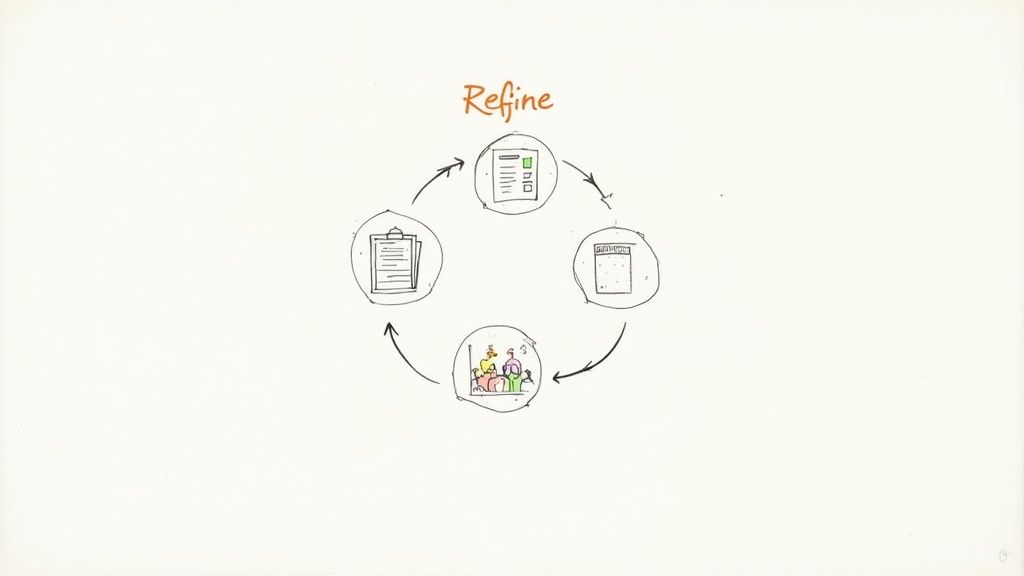
To keep your messaging from going stale, you need a simple, repeatable process for listening and adjusting. This is what turns your framework from a document that gathers dust into a powerful tool that consistently delivers results.
Tuning In: How to Gather Actionable Feedback
First things first, you need to create ways to hear what people really think. The trick is to blend qualitative and quantitative feedback. The numbers tell you what's happening, but the conversations and stories tell you why.
Here’s where to start:
- Parent and Staff Surveys: Once a year, send out a short, focused survey to see if your core messages are actually sticking. You could ask something direct like, "Which of these three statements best describes our school's approach to learning?" The answers are a fantastic reality check.
- Focus Groups: For a much deeper understanding, get small groups together. Chat with new parents, long-time teachers, or even alumni. Ask open-ended questions about their perceptions of the school. I guarantee you’ll uncover some surprising truths about which messages truly connect and which ones are completely missing the mark.
- Admissions Funnel: Your admissions team has its finger on the pulse. Ask them to track which messaging points spark the most questions or get families excited on tours. This is pure gold—real-time feedback on what's working.
Making Sense of It All: Analyzing Communication Performance
Once you have this feedback, it’s time to connect the dots. Look for patterns. Are parents consistently asking the same questions about your technology curriculum? Are donors lighting up when they hear stories about your new service-learning initiative?
You can also dig into the hard data from your digital channels for more clues.
- Website Analytics: Dive into your website traffic. Which pages are people spending the most time on? If your "Our Community" page is a top performer, that’s a clear signal that this messaging pillar is resonating deeply.
- Email Performance: Look at your open and click-through rates. Which subject lines get the most opens? What kind of language inspires people to click? This tells you exactly what words motivate your audience. For a more detailed guide on this, check out this great resource on how to measure marketing ROI.
For example, when your messaging is crisp and clear, channels like SMS can be incredibly effective. SMS marketing, when supported by a solid messaging framework template, can see 98% open rates. That blows email out of the water. Even better, with a 45% average response rate, it’s a direct line for immediate engagement. You can learn more about how SMS is transforming marketing strategies on notifyre.com.
Making Smart, Data-Driven Tweaks
Finally, you need to turn all these insights into action. I recommend scheduling a formal review of your messaging framework at least once a year, maybe as part of your annual strategic planning. This is where you make intentional, informed adjustments.
Your messaging framework should be a living document, not a historical artifact. The goal of this review process is to ensure your communication remains a powerful, effective tool that reflects who your school is today—and where it's headed tomorrow.
This doesn't mean you have to start from scratch every year. More often than not, it’s about making small but strategic adjustments. You might sharpen the wording of a key message, swap out an old proof point for a newer, more compelling one, or tweak the tone just slightly to better match the current school climate.
This cycle of listening, analyzing, and refining is what ensures your messaging never loses its punch.
Common Questions About Messaging Frameworks
As you start pulling together your school's messaging, a few questions always seem to come up. Building a framework can feel like a massive project, but a little clarity on the practical side of things can make all the difference. I've answered a few of the most common ones I hear to help you sidestep any roadblocks and put your framework to work.
Getting these details right is what turns your messaging framework template from a document that collects dust into a tool your team actually uses every day.
How Often Should We Update Our School's Messaging Framework?
Your framework should be a living document, not something carved in stone. Plan on doing a full, top-to-bottom review once a year. The best time to do this is right before your big strategic planning cycle for the year ahead. That way, your communications goals are locked in step with the school's wider institutional goals.
But that doesn't mean you should ignore it for the other 11 months. You have to be ready to make smaller, more tactical updates on the fly.
For example, you might need to make a tweak when:
- You're launching a new signature program that changes how you talk about your school's value.
- You keep hearing the same feedback from parents or staff, signaling a gap in how you're communicating.
- There's a major shift in the local educational scene that forces you to reposition your school.
The real goal here is to stay relevant and sharp, not to blindly follow a plan that's out of date.
What Is the Biggest Mistake to Avoid When Creating This?
The single most destructive mistake I see schools make is creating the framework in a silo. It happens all the time: a small team or even a single department builds the whole thing without ever talking to admissions, faculty, the development office, or the head of school. It looks perfect on paper, but it’s doomed from the start because it doesn't reflect the school's real DNA. And because of that, no one will ever use it.
True authenticity comes from collaboration. When you bring your key people into the process from day one, you’re not just collecting soundbites—you’re building buy-in.
The most effective messaging frameworks are co-created, not dictated. They capture the collective voice of the institution, ensuring the final language is not only accurate but also embraced and used by everyone.
This collaborative process is what transforms the framework from just another "marketing document" into "our school's story."
Is a Messaging Framework Really Necessary for a Small School?
Yes, absolutely. In fact, for a small school with a tiny team and an even smaller budget, a messaging framework is your secret weapon for efficiency. It’s a huge misconception that these are only for big, complicated districts. For a small school, the payoff is immediate.
Think about it: a solid framework gives you clear, pre-approved language that anyone can use confidently, whether it’s the head of school, the office manager, or a parent volunteer. This instantly stops the endless cycle of rewriting every email, social post, or open house flyer from scratch. It takes the communications pressure off of one person's shoulders.
It also guarantees that every single interaction, no matter how small, sounds consistent and professional. This is how you punch above your weight, making your small-but-mighty team look just as polished as your larger competitors. Your messaging framework template becomes your best friend for getting more done with less.
Ready to build a messaging strategy that aligns your entire school and drives real results? The MarCom Society provides K-12 marketing professionals with the expert-led workshops, downloadable resources, and peer support needed to master their craft. Join our community and gain the tools and confidence to elevate your school's voice. Learn more about The MarCom Society.









