Forging real partnerships in schools isn't just a feel-good community project; it's one of the most powerful strategies you can have for growth. When you build genuine collaborations with local businesses, non-profits, and community leaders, the results can directly boost enrollment, elevate your reputation, and deepen your roots in the community.
Why School Partnerships Are Such a Big Deal

Let's cut through the jargon. Meaningful partnerships deliver real returns that go way beyond a quick photo op or a logo on a sponsorship banner. If you're in school marketing or communications, these relationships are your secret weapon for hitting ambitious goals in what's become a very competitive field.
They help shift the perception of your school from an isolated campus to the vibrant, beating heart of the community.
This kind of transformation doesn't just happen on its own, though. It's born from a deliberate strategy built on what both sides stand to gain. Imagine a local tech company that’s desperate to find great talent for the future. At the same time, you need to beef up your STEM programs. A partnership here is a no-brainer—it creates a direct path for students to get hands-on experience while helping the company cultivate its next generation of employees.
The Real Payoff of Working Together
I've seen firsthand how the right partnerships unlock resources and opportunities that a school could never create by itself. When you connect with organizations that share your vision, you strengthen your entire institution from the inside out.
The biggest wins usually fall into these areas:
- Richer Student Experiences: Partners can bring in guest lecturers, offer internships, and provide mentorship that gives students a real taste of their future careers. This is the kind of practical, real-world experience that truly sets them up for success.
- A Magnet for Enrollment: A school with deep community ties is incredibly attractive to prospective families. These relationships are like a powerful, third-party endorsement that says, "This school is an essential part of our community."
- Stronger Community Buy-In: When you build strong partnerships, you create a whole network of champions for your school. You can dive deeper into this concept by reading our guide on the fundamentals of stakeholder engagement: https://blog.marcomsociety.org/what-is-stakeholder-engagement/
Think of a well-run partnership program not as an expense, but as one of the smartest investments you can make in your school's future. It proves you're doing more than just teaching kids within four walls—you're building a stronger community around them.
To truly make a difference, it's vital to understand the pressures schools are under today. You can explore the crucial role of schools in nurturing student well-being to see just how much these partnerships can contribute to that core mission.
Finding and Vetting the Right Partners
The success of your partnership program really comes down to one thing: finding organizations that truly get what your school is all about. A strong partnership is built on shared goals and values, not just because a business is down the street or well-known. It can be tempting to go after the big names, but the real magic happens when you find the right fit.
Before you even start your outreach, take some time to map out what your "ideal partner" looks like. Think of it like a persona you'd create for marketing, but for collaborations. This simple profile will become your North Star, guiding you toward partners who will be a natural extension of your school.
What Makes a Partner a Perfect Fit?
A great partner offers more than just a check or some free supplies. They bring real strategic value that elevates your school's brand and what you can offer students.
For example, a science-focused academy would gain far more credibility and hands-on learning opportunities by partnering with a local engineering firm on a new robotics club. That’s a much deeper connection than a generic sponsorship from a bank. It’s authentic.
As you build your ideal partner profile, ask yourself these questions:
- Who are they talking to? Do they serve the same families and community members you want to connect with?
- What do they stand for? Do their company values genuinely mirror your school's educational philosophy?
- How are they seen in the community? A positive, respected local reputation is non-negotiable.
- What's in it for them? You need to have a clear, compelling answer to this. A one-sided relationship won't last.
Doing this homework upfront saves you from chasing dead ends. It focuses your energy on organizations that are already primed to see the value in working with you. For a deeper dive into managing these relationships once they're established, our guide on vendor management best practices has some great tips.
The whole process, from setting goals to measuring the results, follows a pretty logical flow.
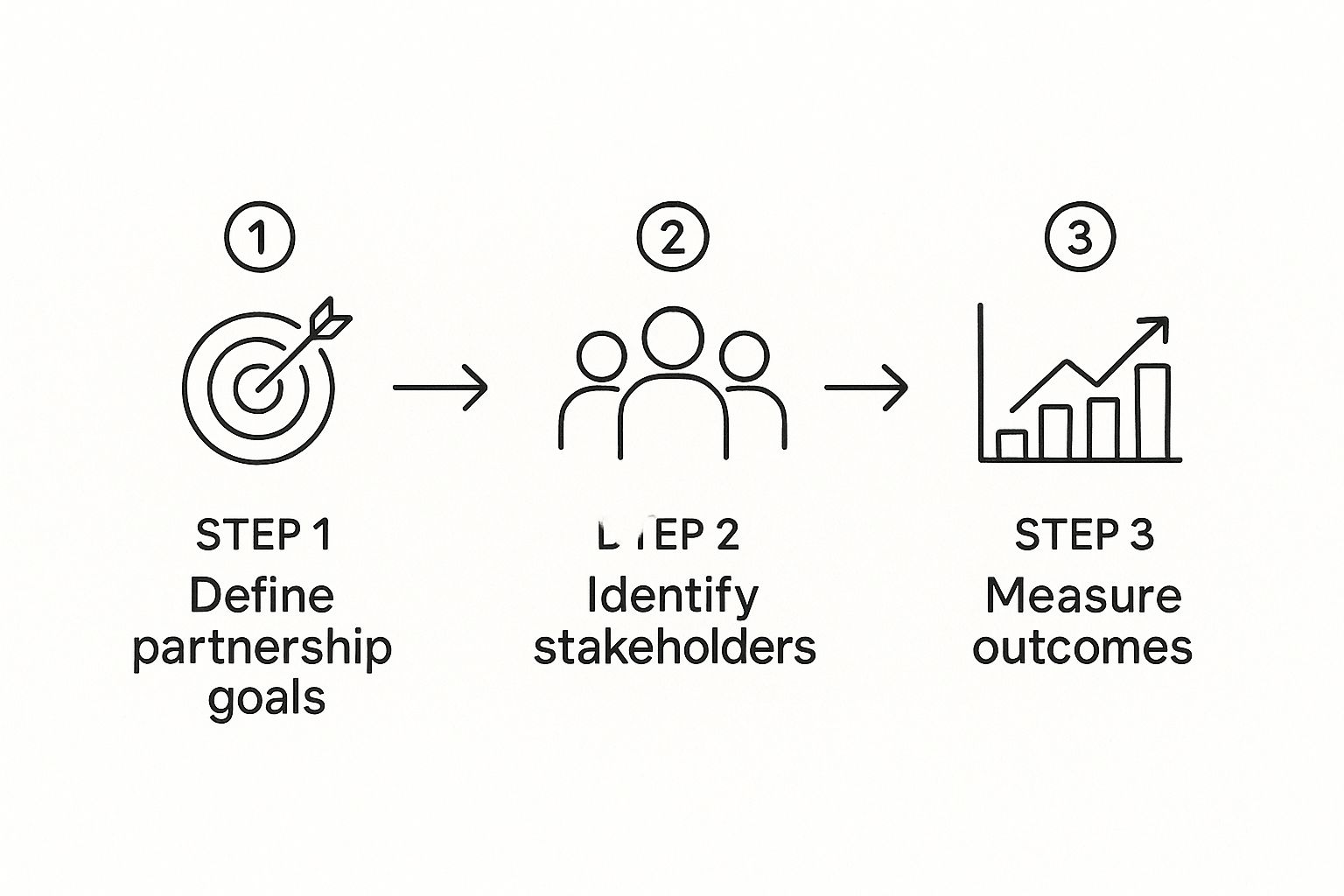
When you’re crystal clear on your own goals from the very beginning, you’ll find it’s much easier to spot the right stakeholders and figure out what success actually looks like.
A partnership should feel like a natural extension of your school’s mission. If you have to force the connection, it’s probably not the right fit for a long-term, sustainable relationship.
This strategic approach is more important than ever. The international school market, for instance, has exploded to over 14,800 K-12 schools around the globe, with a huge concentration in Asia. This growth is often supercharged by government policies that encourage these exact kinds of educational collaborations.
The Vetting Checklist
Once you've identified a few potential partners, it's time for due diligence. Don't skip this step! A quick check can save you a world of headaches down the road. This checklist can help you structure your evaluation and spot any potential issues before they become real problems.
Potential Partner Vetting Checklist
| Vetting Criteria | What to Look For | Red Flags |
|---|---|---|
| Public Reputation | Positive news coverage, strong online reviews, community awards. | Recent scandals, negative press, unresolved customer complaints. |
| Financial Stability | Established business history, signs of growth, financially sound. | Recent layoffs, public financial struggles, high staff turnover. |
| Mission & Values | Clearly stated mission that aligns with education, diversity, and community. | Values that conflict with your school's ethos, purely profit-driven messaging. |
| Past Partnerships | History of successful, long-term collaborations with other non-profits or schools. | A pattern of short, failed partnerships or no history of community engagement. |
| Communication Style | Responsive, transparent, and genuinely interested in a mutual partnership. | Slow to respond, vague answers, focuses only on what they can get from you. |
Vetting isn't about being cynical; it's about being strategic. Taking the time to properly evaluate a potential partner ensures you're building a relationship on a solid, trustworthy foundation.
How to Craft a Compelling Partnership Proposal

So, you've found the perfect potential partner. Now comes the critical part: crafting a proposal that actually gets read and, more importantly, gets a "yes." Forget everything you know about standard fundraising letters. This is a business proposition, plain and simple.
Your pitch needs to immediately communicate mutual benefit. Think less like a school asking for a handout and more like a savvy marketer presenting an unmissable opportunity. You're offering direct access to a highly engaged community of families, and that’s a golden ticket for most businesses.
The Anatomy of a Winning Proposal
Your proposal has one job: to stand out. A generic, copy-and-paste document will end up in the bin. To make a real impact, your pitch needs to be sharp, professional, and feel like it was written specifically for them—because it was. You have to show you've done your homework on their business and their goals.
A truly effective proposal for a school partnership will always contain these key elements:
- A Punchy Summary: Lead with a brief, powerful overview. Who are you, what are you proposing, and—most importantly—what’s in it for them? Get right to the point.
- Clear, Shared Goals: Vague objectives signal a lack of a real plan. Spell out exactly what you hope to achieve together.
- Concrete Collaboration Ideas: Don't just ask for "support." Propose tangible activities. Maybe it’s co-hosting a career-focused webinar for parents or offering an exclusive sponsorship for a student project that perfectly aligns with their industry.
This specific approach completely changes the dynamic. For instance, instead of a weak "We need a sponsor for our science fair," you frame it as a strategic investment.
Try this: "We propose an exclusive sponsorship of our annual STEM Showcase, giving your company direct engagement with over 200 families and positioning your brand as our official Innovation Partner." See the difference? One is a request; the other is a can't-miss opportunity.
A great proposal anticipates the question, “What’s in it for us?” and answers it before it’s even asked. It’s a compelling business case that makes saying “yes” an easy decision.
When you lead with shared value, you transform your proposal from a simple ask into a blueprint for a powerful, win-win collaboration.
Building Partnerships That Actually Last
The handshake is easy. It’s what comes next that determines whether a partnership will flourish or fizzle out. The real work isn't just in finding a willing partner; it's in building a structure that can stand the test of time, navigate inevitable bumps in the road, and actually deliver results.
So many promising collaborations lose steam because nobody took the time to hash out the details upfront. This is where a formal agreement or a Memorandum of Understanding (MOU) becomes your best friend. Forget the intimidating legal jargon—think of it as a shared roadmap. This document is your chance to get everything on paper: who is doing what, when it needs to be done, and what a "win" looks like for everyone involved.
Defining the Collaboration Model
There's no one-size-fits-all approach here. The way you structure your partnership should be a direct reflection of your goals. Are you looking for a quick burst of visibility, or are you in it for the long haul?
A one-off event sponsorship, for example, is fantastic for getting your name out there immediately. But if you’re aiming for deeper, more sustained impact, something like a curriculum partnership will offer far more value over time.
Think about which model fits your needs:
- Event Sponsorship: A classic for a reason. A local business puts its name on your school's fun run or science fair and gets great community exposure in return.
- In-Kind Donations: This is where a partner provides valuable resources instead of cash. Picture a tech company donating laptops for a new coding club or a local nursery providing plants for a school garden.
- Curriculum Integration: This is a deeper, more involved partnership. An engineering firm might help co-teach a robotics class, or a local author could run a series of writing workshops for your students.
When you think big, the results can be staggering. Look at the Global Partnership for Education (GPE). It started by working with just 7 developing countries back in 2002. By 2017, that number had jumped to 65, all by bringing together governments, private companies, and non-profits. Together, they've directed nearly US$3.8 billion toward strengthening education systems around the world. It’s a powerful example of what happens when everyone pools their resources.
A partnership without a clear structure and communication plan is just a good intention. To make it last, you need a blueprint that everyone agrees on and is committed to following.
To keep the momentum going, you absolutely must have clear lines of communication. One of the simplest but most effective things you can do is designate a single point of contact on each side. This one move can eliminate so much confusion and back-and-forth.
From there, schedule regular check-ins. They don't have to be long—a brief monthly call can be enough to keep projects on track, celebrate small wins, and tackle any issues before they become major problems. This kind of proactive management is what turns a temporary handshake into a partnership with real staying power.
Measuring the True Impact of Your Partnerships
Great partnerships feel good, but the best ones deliver real, measurable results. To keep these initiatives going and justify the resources you're putting in, you need to go beyond warm feelings and back up your success stories with cold, hard data.
It all starts with defining what success actually looks like. Before you even launch, you have to decide which Key Performance Indicators (KPIs) matter most. Your goals will point you to the right metrics. For instance, if you're partnering with a local business to drive enrollment, a critical KPI is the referral traffic from their website straight to your admissions page.
Key Metrics to Monitor
You don't need to track every single data point. In my experience, it's far more effective to focus on a handful of metrics that truly tell the story. I often recommend creating a simple partnership dashboard to keep everyone on the same page and make reporting to leadership a breeze.
Here are a few metrics that consistently provide valuable insights:
- Website Referral Traffic: How many people are clicking through to your site directly from a partner's link? This is a direct line showing their influence.
- Social Media Engagement: Look at the likes, shares, and comments on posts where you’ve tagged a partner or run a joint campaign. Is their audience responding?
- Event Attendance Lift: Did you see a spike in attendance at your open house after a partner promoted it? Compare the numbers to past events.
- Lead Generation: When new families inquire, ask them how they heard about you. Keep a tally of how many mention a specific partnership.
The most powerful partnerships are those where success is a shared responsibility. When both you and your partner are invested in tracking outcomes, the relationship becomes stronger and more strategic, ensuring it delivers real value.
Having these numbers on hand gives you the proof you need to not only continue the partnership but also to make a case for expanding it.
If you want to dig deeper into the numbers side of things, our guide on how to measure marketing ROI offers some great frameworks you can easily adapt for your partnership program.
Common Questions About School Partnerships

Even the most experienced school leaders have questions when kicking off something new. Building a solid partnership program means navigating fresh relationships and different expectations. Let's get straight to some of the questions I hear most often.
What If We Have No Budget to Start?
Starting with a zero-dollar budget is more common than you think. The key is to focus on “in-kind” partnerships where you’re trading value, not dollars. Don't underestimate what you have to offer—your audience, your communication channels, and your influence in the community are valuable assets.
Think creatively. You could approach a local print shop about producing banners for your next big event in exchange for being named an official sponsor. Or, offer a local tech company a prominent feature in your parent newsletter if they agree to host a coding workshop for your students. It's all about the give-and-take.
How Do We Handle a Partnership That's Failing?
This is a tough one, but ignoring it is the worst thing you can do. If a partnership is going south, you need to address it head-on and early. Pull out that initial agreement you both signed—it’s your guide for getting things back on track.
Schedule a frank, face-to-face conversation to talk through the problems and see if there’s a solution. If you can’t find a way forward together, it’s far better to end the relationship professionally than to let it drag on and potentially damage your school’s reputation. A well-written exit clause in your initial agreement can make this a much smoother process for everyone.
The need for collaboration in education has never been more urgent. Globally, access to quality learning is a massive challenge. In 2021, an estimated 250 million children were out of school, and the pandemic only made things worse. These numbers show just how critical effective partnerships are. You can discover more insights about the global push for educational access and collaboration.
How Much Time Does This Actually Take?
When it comes to managing these relationships, consistency beats sheer hours every time. If you're just starting out with two or three key partners, you should plan for a single point person to dedicate about three to five hours per week.
That time is for all the essential stuff: ongoing communication, co-planning activities, and tracking your shared goals. Sporadic effort just won't cut it. The most successful programs I've seen assign clear ownership to one person or a small committee to give these partnerships the steady attention they need to thrive.
At The MarCom Society, we give school marketing leaders the tools, expert insights, and peer support needed to build impactful programs like these. Join our community to connect with professionals who are turning great ideas into measurable results.