
A solid professional development plan for teachers is more than just a document; it's a roadmap for continuous growth. It’s what bridges the gap between a teacher's personal career goals and the school’s bigger mission, ultimately elevating the quality of instruction for every student. This isn't about simple compliance. It’s about transforming professional learning from a dreaded requirement into a powerful engine for teacher retention and student success.
Why Your School Needs a Better Professional Development Plan
Let's be honest—most professional development feels like a chore. The classic one-size-fits-all workshop is a big reason so many educators just check out. A truly thoughtful professional development plan flips that script. It directly addresses the real crisis in education—teacher burnout and attrition—by treating educators like the professionals they are. It becomes a powerful retention tool, not just another box to tick on an evaluation form.
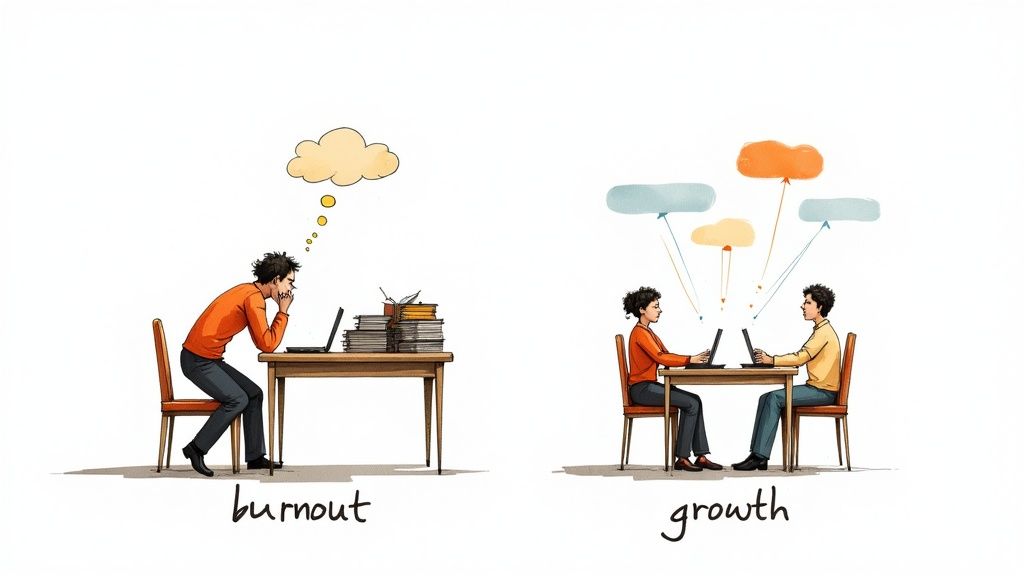
When a school genuinely invests in its teachers' careers, the entire culture can shift. Giving educators relevant, practical skills is a direct antidote to the feelings of stagnation and being undervalued that so often lead to burnout. It helps build a supportive environment where learning isn't an extra burden but a core part of the job.
Moving from Compliance to Career Growth
The numbers tell a sobering story. The Teaching and Learning International Survey (TALIS) found that one in five teachers under 30 plans to leave the profession within five years. Worse, we're facing a projected global teacher shortage of 44 million by 2030.
And while 73% of teachers do participate in training, only about half find it truly makes a difference. That’s a huge disconnect, and it's exactly what a better professional development plan is designed to fix.
A plan that actually works is built on a few key, teacher-focused ideas:
- Authentic Needs Assessment: Finding out what your teachers actually need to thrive in their classrooms, instead of just guessing.
- Personalized Goals: Working together to set specific, measurable goals that align with each teacher's individual career path.
- Flexible Learning Paths: Offering a mix of options like coaching, peer collaboration, and self-directed learning, not just a single mandatory workshop for everyone.
- Meaningful Evaluation: Looking at the real impact on teaching and student learning, not just tracking who showed up.
The real goal of a professional development plan is to build a culture where teachers feel supported, valued, and ready to meet the demands of modern education. It’s a strategic investment in your school's most valuable asset: your people.
Making this shift from compliance to career growth isn't just a nice idea—it's essential for creating a resilient, effective, and motivated faculty. By focusing on these principles, you’re creating a program that teachers won’t just participate in, but will genuinely champion. To see how this approach directly impacts your school’s ability to keep great educators, check out our guide on teacher retention strategies.
Building Your Foundation with a Needs Assessment and SMART Goals
A truly effective professional development plan doesn't start with a catalog of workshops or a list of required readings. It starts with a simple, yet powerful, question: What do our educators actually need to thrive? Forget generic surveys. To build a solid foundation, we have to dig into the real, day-to-day challenges and triumphs of classroom life.
The whole point is to create a plan that feels less like a top-down mandate and more like a genuine partnership. That journey begins with a thoughtful needs assessment, which gives you the insights needed to set meaningful goals that actually resonate with each teacher.
Uncovering Real Growth Opportunities
A great needs assessment is all about connecting the dots. It combines different sources of information to paint a clear picture of both individual and school-wide strengths and areas for growth. It’s about getting a holistic view that respects the complexity of teaching.
To get the ball rolling, focus on gathering insights from a few key places:
- Classroom Observation Data: Look for patterns in non-evaluative walkthroughs. Are teachers consistently running into roadblocks with student engagement during certain lessons? Is there a common need for fresh classroom management strategies?
- Student Performance Metrics: Dive into assessment data to spot curriculum gaps. If you notice that math scores are lagging in fractions across several classrooms, that’s a clear signal for some targeted, content-specific PD.
- Structured Teacher Reflections: Go beyond the simple "What do you want to learn?" question. Use guided reflection prompts that encourage teachers to pinpoint the specific challenges they're facing and what kind of support they believe would actually help.
This multi-pronged approach ensures your professional development plan is directly tied to the real-world needs of your teachers and students. If you want a structured way to think about these internal factors, our guide on how to conduct a SWOT analysis can be a big help.
Translating Needs into SMART Goals
Once you have a handle on the needs, the next move is to turn those broad areas for improvement into sharp, actionable goals. This is where the SMART framework—Specific, Measurable, Achievable, Relevant, and Time-bound—is an absolute game-changer. It transforms vague wishes into a concrete action plan.
An objective like "improve technology use" is too fuzzy; it gives no one anything to aim for. A SMART goal, on the other hand, provides a clear roadmap. It reframes the idea into something tangible you can work toward and actually measure.
The real power of a SMART goal is its clarity. It cuts through the fog, giving every teacher a precise target, a way to track their progress, and a deadline to work toward.
This kind of clarity is more critical than ever. In some parts of the world, the percentage of trained teachers is actually falling. Northern Africa and Western Asia, for instance, saw a drop from 93% to 81% in qualified primary teachers. This just underscores the urgent need for PD plans that reinforce core skills while also building new ones. You can find more on these trends in this fact sheet on global teacher trends from the Teacher Task Force.
From Vague Objectives to SMART Goals for Teachers
Let's look at how this plays out in a school marketing and communications context. More and more, educators are being asked to contribute to school storytelling, but they often haven't been trained in the specific skills needed to do it well. Transforming a vague objective into a SMART goal makes all the difference.
| Generic Objective | SMART Goal Example | How It's Measured |
|---|---|---|
| Get better at social media. | By the end of the third quarter, I will create and post three high-quality classroom stories per month to the school's Instagram channel, resulting in a 10% increase in post engagement. | Number of posts, Instagram analytics (likes, comments, shares), and a simple post quality rubric. |
| Use more video in class. | I will produce one 2-minute "Week in Review" video for my class page each Friday for the next six weeks, using Adobe Express templates and featuring student work. | Six videos completed, adherence to length and content guidelines, and informal student feedback. |
| Improve parent communication. | For the second semester, I will write one detailed, story-driven update for the weekly parent newsletter each month, highlighting a specific project or learning milestone in my classroom. | Four newsletter submissions and positive mentions in parent feedback surveys. |
Ultimately, this process of setting collaborative, well-defined goals is the bedrock of any successful professional development plan for teachers. It guarantees that every activity has a purpose, every outcome can be measured, and every teacher feels a sense of ownership over their own growth.
Designing Personalized Learning Pathways for Teachers
We’ve all sat through them: the one-size-fits-all workshops that are the reason so many teachers dread professional development. After you've done the hard work of assessing needs and setting clear goals, the next move is to build out a professional development plan for teachers that offers diverse, personalized learning pathways. This is about respecting where people are in their careers, how they learn best, and the real challenges they face in their classrooms every day.
Think about it. A 20-year veteran teacher working to perfect their Socratic seminar technique needs something completely different from a first-year teacher who's just trying to master the basics of classroom management. A single, mandatory training session will inevitably miss the mark for both of them. Offering a menu of options, on the other hand, empowers your staff to choose what feels most relevant and immediately useful for their students.
Moving Beyond the Mandatory Workshop
The real goal here is to build a culture of professional learning that’s baked into the daily work of your school, not just something that happens on designated "PD days." Research consistently shows that sustained, content-focused professional development—we're talking 20 or more hours on a single topic—has a much greater impact than one-off events. This means shifting away from the old "sit-and-get" model toward something more dynamic and collaborative.
Here are a few powerful models that can form the backbone of your personalized pathways:
- Instructional Coaching Cycles: This isn't about evaluation. It's a supportive partnership where a coach works with a teacher to hit a specific, teacher-identified goal. They'll observe, offer feedback, and co-plan, focusing on anything from improving questioning techniques to integrating a new tech tool.
- Peer Observation and Collaboration: Some of the best learning happens when teachers watch each other in action. Setting up structured, non-evaluative peer observations allows educators to see new strategies firsthand, followed by a reflective chat. It’s a fantastic way to build trust and spread great ideas organically.
- Professional Learning Communities (PLCs): Get small groups of teachers from the same subject or grade level together regularly, and watch them solve real problems. They can dig into student work, plan lessons together, or tackle a shared instructional challenge. It turns continuous improvement into a team sport.
These approaches move learning from passive to active, making professional growth a shared mission instead of a solo journey.
Instructional Coaching in Action
Let’s look at a real-world example. Mr. Harrison, a high school English teacher, wants to get more students involved in literary discussions. His SMART goal is to have 80% of students contribute meaningfully during fishbowl debates by the end of the semester.
Instead of being sent to a generic workshop on "student engagement," he starts an instructional coaching cycle. His coach comes in to observe, but only collects data on student talk time and the kinds of questions Mr. Harrison is asking. Afterward, they sit down, look at the data together, and map out a new lesson using strategies like "think-pair-share." Mr. Harrison tries it out, they meet again to see how it went, and they plan the next step. This is targeted, iterative support that actually works.
The secret to effective professional development is its direct line to the classroom. When a teacher can try a new strategy tomorrow and see it make a difference with their kids, their motivation to keep learning goes through the roof.
Fostering Collaboration Through PLCs
At the same time, the school’s three new fifth-grade teachers are all having a tough time with their math learning centers. It feels chaotic. They decide to form a PLC with one clear focus: "Develop and implement a consistent system for math center rotations that maximizes student time-on-task."
Their pathway looks completely different from Mr. Harrison's:
- Shared Learning: They start by reading and discussing a short article on managing math centers effectively.
- Collaborative Planning: They use their next meeting to create a shared set of rotation schedules, anchor charts, and student expectation guides.
- Implementation and Observation: Each teacher tries the new system while the others pop in to observe, noting what’s working and what isn’t.
- Refinement: They regroup to share their findings, look at student work produced in the centers, and tweak the system based on what they saw.
This kind of collaboration builds an incredible support system and creates consistency for students across the entire grade level. As you explore different models, you might even find that cohort-based learning models for leadership development offer useful frameworks that can be adapted for teacher teams. The principle is the same: learning together toward a common goal is a powerful catalyst for growth.
The Power of Educator Choice
Ultimately, designing effective learning pathways comes down to offering genuine choice and autonomy. A truly great professional development plan for teachers lets them, in partnership with their supervisors, pick the model that best fits their goals right now. A teacher might opt for an individual inquiry project one year, join a PLC the next, and then jump into a coaching cycle when they’re ready to tackle a major change in their practice.
When you offer a variety of high-quality, job-embedded learning opportunities, professional development stops feeling like a chore and starts becoming an empowering and valued part of your school's culture. This personalization is what unlocks meaningful, lasting growth that makes a real difference for every single student.
Creating Your Professional Development Plan and Calendar
Alright, you've done the groundwork: you know what your team needs, you've set some meaningful goals, and you’ve explored different ways to get there. Now it's time to pull it all together. This is the moment where theory becomes action, turning those great ideas into a concrete plan and a strategic calendar that actually works.
A solid plan isn't just paperwork; it’s about creating clarity and accountability. It ensures every workshop, coaching session, and PLC meeting is a deliberate step toward your bigger goals.
Structuring Your Individual Plan
The individual professional development plan is your personal roadmap. It’s a living document that spells out exactly what you want to achieve, how you plan to get there, and what success will look like. Think of it less as bureaucracy and more as a clear, actionable guide for your own professional journey.
An effective plan doesn’t need to be long or complicated—it just needs to be clear. I’ve found that the best plans cover four essential sections that build a complete picture of your goals for the year.
- Your SMART Goal: This is your North Star. Write down the specific, measurable, achievable, relevant, and time-bound goal you already set.
- Learning Activities & Pathways: Get specific about the how. Will you join a Professional Learning Community? Dive into a coaching cycle? Attend a specific workshop series? List them out here.
- Timeline & Milestones: This is crucial for avoiding overwhelm. Break down your big goal into smaller, manageable steps and give them deadlines. This helps you see your progress along the way.
- Success Metrics & Evidence: How will you know you’ve succeeded? Define it upfront. It could be improved student assessment data, feedback from classroom observations, or powerful examples of student work.
To make this even easier, you can grab our straightforward professional development planning template to get started immediately. And if you're looking for more inspiration, checking out some of the best professional development plan templates can offer some great structural ideas.
From Individual Plans to a School-Wide Calendar
Individual plans are the foundation, but they become truly powerful when they’re part of a cohesive, school-wide calendar. A well-designed calendar moves you away from those disconnected, one-off training days and instead maps out a full year of sustained, embedded professional learning.
It's your school's strategic map for growth. It weaves different PD activities into the natural rhythm of the school year, building momentum without burning out your teachers.
A great PD calendar isn't just a list of dates. It's a thoughtfully sequenced narrative of professional growth, with each activity building on the last to create a powerful, cumulative impact on teaching and learning.
This timeline illustrates perfectly how different personalized activities—like coaching, peer observation, and PLCs—can be layered together throughout the year.
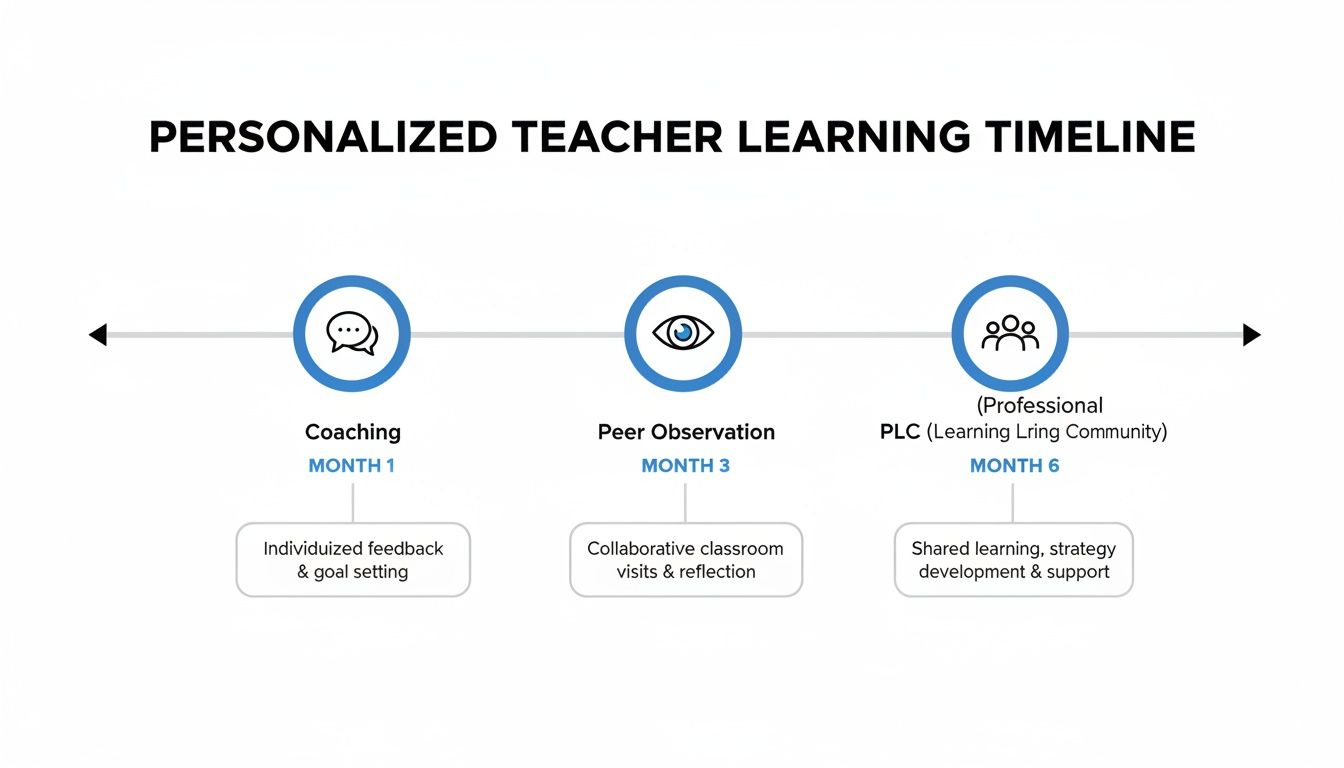
You can see how a teacher’s journey might start with coaching, then move to applying new skills while being observed by a peer, and finally, sharing what they’ve learned in a collaborative PLC. It’s a cycle of support and growth.
Sample Annual Professional Development Calendar
A thoughtful calendar gives professional learning a predictable rhythm, making it a normal and expected part of your school culture. It sequences activities so that new learning has time to take root before the next big thing is introduced. Here’s a sample framework to show what a year of continuous improvement could look like.
Sample Annual Professional Development Calendar
| Quarter | Focus Area | Key Activities | Check-in/Evaluation Point |
|---|---|---|---|
| Q1 (Aug-Oct) | Foundation Setting & Goal Alignment | School-wide kickoff for PD focus areas. Teachers finalize individual SMART goals. First round of peer observations scheduled. | Mid-quarter check-in on goal progress with instructional coaches or mentors. |
| Q2 (Nov-Dec) | Deepening Practice & Collaboration | PLC meetings focused on analyzing student work from Q1. Optional workshops on high-need topics (e.g., tech integration). | Pre-holiday reflection on PLC effectiveness and individual goal progress. |
| Q3 (Jan-Mar) | Implementation & Refinement | Instructional coaching cycles begin for targeted support. Second round of peer observations to see growth. | Mid-semester review of student data to measure the impact of new strategies. |
| Q4 (Apr-May) | Reflection & Celebration | Teachers share successes and key learnings in a "share fair." Final PLC meetings to reflect on the year. End-of-year goal review. | Formal end-of-year evaluation of the PD plan's impact on teaching and student achievement. |
This kind of structure shifts professional development from being an isolated event to a continuous, supportive cycle. By building both a personal plan and a school-wide calendar, you create a powerful framework that supports every teacher's journey to becoming more effective and fulfilled.
Measuring Real Impact and Sustaining Teacher Growth
A beautifully designed professional development plan for teachers is just a document until you can prove it's actually working. The real test isn't just checking off boxes on a to-do list. It's seeing genuine, tangible growth in the classroom.
Frankly, if you can't measure it, you can't improve it. This final stage is all about moving past attendance sheets and digging into what truly changed for teachers and their students.
It's also where you shift from a one-and-done project to building a culture of continuous learning. The goal is to create an energizing cycle where the plan itself evolves based on real results, keeping the momentum going year after year.
Looking Beyond Attendance Sheets
For far too long, the measure of "successful" PD was a sign-in sheet. We have to do better. We need to focus on metrics that connect a teacher's learning directly to what happens in their classroom. This means pulling together both hard numbers and personal stories to get the full picture.
Think of it like an athlete’s training. Their success isn’t measured by hours logged in the gym, but by their performance on game day. For teachers, game day is every day in the classroom.
So, what should you actually be tracking?
- Instructional Practice Shifts: Are teachers actually using the new strategies they learned? Non-evaluative classroom walkthroughs are perfect for this. You're not there to judge; you're looking for specific evidence, like a teacher using a new questioning technique they picked up in a coaching session.
- Student Achievement Data: This is the bottom line. Dig into assessment scores, project rubrics, and other examples of student work. Are you seeing a lift in the areas your PD plan targeted? A 5% bump in reading fluency scores after a literacy-focused PLC cycle is a powerful signal that something is working.
- Qualitative Teacher Feedback: Numbers only tell part of the story. You need to understand the experience of the teachers.
Gathering Rich, Qualitative Insights
To really grasp the impact of your plan, you have to talk to the people on the ground. Teachers' insights are gold for refining your approach and keeping it relevant. A single end-of-year survey just won't cut it.
The most powerful feedback often comes from structured conversations and reflections that capture the nuances of a teacher's growth journey. It’s in these stories that you find the real evidence of impact and the inspiration to keep going.
Try these methods to get deeper, more meaningful feedback:
- Teacher Focus Groups: Get small groups of teachers together to talk honestly about what worked, what fell flat, and why. A good facilitator can uncover the crucial details—like whether they had enough time, the right resources, or the support they needed to make a new strategy stick.
- Reflective Journals: Ask teachers to keep brief, periodic journals about their experiences. Simple prompts can yield incredible feedback. For example, "Describe a moment this week where you tried something new and how it went."
Keeping the Momentum Going
When the school year ends, professional growth shouldn't just stop. The whole point of a professional development plan for teachers is to build a self-sustaining culture of continuous improvement. This doesn't happen by accident.
Sustaining that energy is about making learning a visible, celebrated part of your school's DNA. It means creating systems that encourage teachers to keep collaborating and reflecting, turning PD into something that’s just part of how you operate.
Here are a few high-impact ways to keep the momentum strong:
- Celebrate Small Wins: When a teacher nails a new tech tool or has a breakthrough with a student, shout it from the rooftops! Share that story in a staff meeting or a weekly email. Public recognition validates their effort and inspires everyone else.
- Provide Consistent Feedback: Growth dies in a vacuum. Make sure instructional coaches, mentors, and administrators are giving ongoing, helpful feedback that’s tied directly to each teacher's goals.
- Create Sharing Forums: Set up regular, low-pressure opportunities for teachers to share what they're learning. This could be a "lunch and learn," a dedicated Slack channel, or even the first 10 minutes of a staff meeting. When teachers become the experts, their sense of ownership and engagement skyrockets.
By focusing on real impact and intentionally building momentum, your professional development plan stops being a static document. It becomes a living, breathing engine for school-wide improvement and the catalyst for ensuring every teacher—and every student—is always growing.
Got Questions About Your PD Plan? We've Got Answers.
Even the most meticulously crafted professional development plan for teachers is going to bump up against real-world questions and roadblocks. The secret isn’t avoiding them—it’s anticipating them. Let's dig into some of the most common questions I hear from school leaders.
Probably the first thing on everyone's mind is money. School leaders are constantly asking how they can possibly build a meaningful plan without a massive budget. The good news? A tight budget can actually be a blessing in disguise, forcing you to focus on high-impact, low-cost strategies that often work better anyway.
How Can We Create a Meaningful Plan on a Limited Budget?
A tight budget is an invitation to get creative. It’s a chance to tap into the most valuable resource you already have: the expertise walking your hallways every single day. The real shift is moving away from pricey, one-off workshops and toward building a sustainable, in-house culture of learning.
Here are a few powerful, budget-friendly ideas:
- Launch Peer Coaching Pairs: This is a game-changer. Simply pair up teachers to observe each other and offer feedback on goals they’ve set for themselves. It costs nothing but time and builds an incredible amount of trust and skill.
- Lean into Your PLCs: Make your Professional Learning Communities (PLCs) the engine of your PD. Carve out dedicated time for teams to dig into student work together and co-plan lessons. This is job-embedded learning at its best.
- Curate Free Resources: The internet is overflowing with amazing, free content from universities, non-profits, and other educational groups. Your job is to be the curator. Create a go-to list of high-quality webinars, articles, and podcasts for your staff.
How Do We Get Buy-In from Resistant Teachers?
Let’s be honest: resistance to professional development is almost never about a teacher's unwillingness to learn. It’s a direct result of being subjected to years of irrelevant, top-down mandates that felt like a complete waste of their time. The only way to break that cycle is to build a new system based on autonomy and respect.
True buy-in doesn't come from a mandate; it comes from ownership. When teachers see that the plan directly addresses their classroom challenges and respects their professional judgment, resistance transforms into engagement.
You have to bring teachers into the process from the very beginning. Let them drive the needs assessment. Give them a real voice in setting their own goals. Let them choose the learning path that fits them best. When the plan feels like a partnership, not a prescription, engagement just happens. And don't forget to shine a spotlight on teachers who are trying new things and seeing success—that positive momentum is contagious.
How Often Should a Plan Be Reviewed?
A professional development plan should be a living, breathing document, not something you create in August and file away. For it to stay relevant and actually make an impact, you have to check in on it regularly.
I recommend formal reviews at least twice a year. A mid-year check is perfect for assessing progress and making any necessary tweaks, and an end-of-year review is great for reflecting on overall growth.
But the informal check-ins are just as important. These should happen much more often—think quarterly or even quick monthly conversations. These quick touchpoints keep goals top-of-mind and let you solve problems in real-time. It’s this constant, iterative approach that allows the plan to adapt to the ever-changing reality of a school year.
At The MarCom Society, we're dedicated to giving school leaders the community and tools they need to succeed. Our resources and expert-led sessions are built to help you create effective, engaging professional development programs that truly move the needle. Join our community to connect with peers and get exclusive content to help your school thrive. Learn more and become a member at marcomsociety.org.









