A professional development planning template is more than just a document; it's a structured way to lay out your career goals and, more importantly, the exact steps you need to take to get there. Think of it as your personal roadmap, turning those big, sometimes fuzzy ambitions into a concrete strategy for growth.
Why You Need a Real Career Roadmap
Let's be honest—simply having vague career goals isn't enough anymore. In today's competitive world, a well-defined plan is what separates people who are intentionally building a career from those who are just reacting to whatever opportunity comes their way. A plan puts you in the driver's seat.
I like to think of it like this: without a map, you might stumble into some interesting places, but you're not likely to reach a specific destination on time. Your professional development planning template is that map. It forces you to get crystal clear on what success actually looks like for you and then chart the most effective route to get there.
The Power of a Structured Approach
A good plan isn't just bureaucratic paperwork. It's a living, breathing document that fuels real progress. It gives you a solid framework for tracking your development, holds you accountable, and makes sure every ounce of effort is pointed directly at your biggest goals.
Taking a structured approach gives you a few major advantages:
- Clarity and Focus: It forces you to pinpoint the specific skills you need to learn and the exact milestones you need to hit.
- Motivation and Accountability: Writing down your goals makes them feel real and gives you a reason to stick with them when things get tough.
- Strategic Decision-Making: It becomes your filter for deciding which courses to take, projects to volunteer for, or new roles to pursue.
A plan transforms your career from a series of random events into a deliberate journey. It ensures every action you take is a calculated step toward your long-term vision.
From a company-wide perspective, these templates are also great for creating consistency and fairness. In fact, businesses that use standardized templates often see up to a 30% increase in the accuracy of their performance reviews because the common structure helps remove unconscious bias.
To ensure your plan is truly effective, it needs to have the right components. A solid template should always guide you through a logical process, from self-assessment to action.
Core Components of an Effective PDP
| Component | What It Achieves |
|---|---|
| Self-Assessment | Establishes a clear baseline of your current skills, strengths, and areas for improvement. |
| Long-Term Career Goals | Defines your "North Star"—what you are ultimately working toward in 3-5 years. |
| Short-Term Objectives | Breaks down big goals into manageable, quarterly, or yearly milestones. |
| Action Steps & Resources | Outlines the specific actions (courses, projects, etc.) and resources needed. |
| Timelines & Deadlines | Creates a sense of urgency and provides a schedule for accountability. |
| Success Metrics | Defines what "done" looks like so you can measure your progress objectively. |
As you can see, each piece builds on the last, creating a comprehensive and actionable strategy. For more great insights on this, the team at Asana has written about how templates can support a fair work environment.
Ultimately, using a professional development planning template is about choosing to be the architect of your career, not just a passenger along for the ride. For anyone serious about reaching their full professional potential, it's an indispensable tool.
Conducting an Honest Self-Assessment
Before you can even think about filling out a professional development template, you have to get real with yourself. Where are you really at in your career? This means taking a candid look at your skills, motivations, and blind spots, moving beyond just your current job description.
This isn't about beating yourself up; it's about getting an accurate baseline. A solid plan can only be built on a foundation of genuine self-awareness. Without it, you're just guessing—setting goals that don't truly excite you or that aren't even achievable from where you stand today.
Identifying Strengths and Gaps
A great place to start is with a Skills Gap Analysis. It sounds formal, but it's simple. First, list the essential skills for a role you're aiming for. Next, honestly rate yourself on each one. This gives you a clear, visual map of your natural talents and the specific areas that need your attention.
Another practical technique I've found incredibly useful is Job Crafting. Just take a few minutes to reflect on the last few months of your work. Ask yourself:
- What tasks gave me energy? Think about the work that made you feel totally in the zone and engaged.
- Which activities drained me? What left you feeling bored, frustrated, or depleted?
- When did I feel proudest? Pinpoint those accomplishments and the specific skills you used to make them happen.
This simple reflection connects your plan to what actually motivates you, making your goals feel less like a chore and more like a calling. Of course, you can't rely only on your own perspective. To get the full picture, you need to learn how to master performance reviews and use that formal feedback to uncover valuable insights.
The goal of a self-assessment isn't judgment—it's clarity. An honest look at your current reality is the first step toward building the future you want.
This process is absolutely critical for anyone stepping into a leadership position. For those in the education sector, this kind of self-awareness is the bedrock of professional growth. We dive deeper into this in our guide on effective leadership training for educators, where this exact step is often the starting point. When you truly understand yourself, you're ready to build a plan that creates real, lasting change.
How to Set Goals That Actually Drive Progress
This is where your self-assessment turns into a real, actionable plan. After honestly looking at where you are now, the next move is to map out your destination with clear, powerful goals. Without this step, your professional development plan is just a wish list.
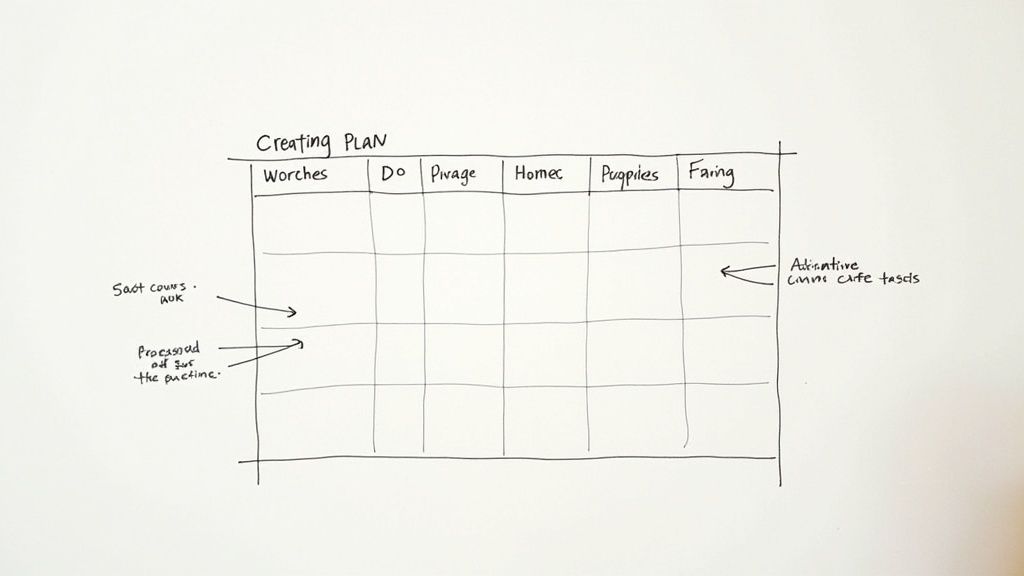
Most of us have heard of SMART goals, but their magic lies in how you apply them. It's about taking a vague idea like "get better at data analysis" and turning it into an objective with some real teeth.
Crafting Goals With Real Impact
Let’s get specific. Instead of that fuzzy goal, a truly effective one sounds more like this: "To improve my data analysis skills (Relevant), I will complete the Google Data Analytics Certificate (Specific, Measurable) within the next 6 months (Time-bound) to qualify for a data-focused project in Q3 (Achievable)."
See the difference? This level of detail connects your day-to-day efforts directly to your long-term career vision. It makes sure every task you add to your template is a deliberate step forward. When you're trying to set goals that truly move the needle, using effective goal planning templates can really help you stay organized and on track.
The best goals aren't just ambitious; they're deeply personal and relevant to the future you're trying to build. That connection is what keeps you going when things get tough.
When organizations put clear PDPs in place, the results speak for themselves. They can see up to a 15% improvement in employee productivity and a 12% jump in retention rates. This shows how individual growth and company success are tied together.
The trick is to make every goal a specific commitment. For instance, an educator might focus on mastering new classroom engagement strategies or developing leadership skills. For a closer look at this, you might find these 8 professional development goals for educators helpful for concrete examples.
Turn Your Goals Into Action with the 70-20-10 Model
Okay, you’ve set your goals. Now for the fun part: building an action plan that actually works. Let’s be honest, real growth doesn’t happen just by sitting through a few workshops. It happens when learning is woven into the fabric of your everyday work.
To do this right, you need a balanced approach. A fantastic framework I’ve relied on for years is the 70-20-10 model. It’s a tried-and-true principle that gives you a realistic structure for how people actually build skills on the job. It breaks down learning into a specific mix of activities, which we'll use to fill out your action plan.
Think of it as a continuous cycle of doing, sharing, and learning—not a one-and-done checklist.
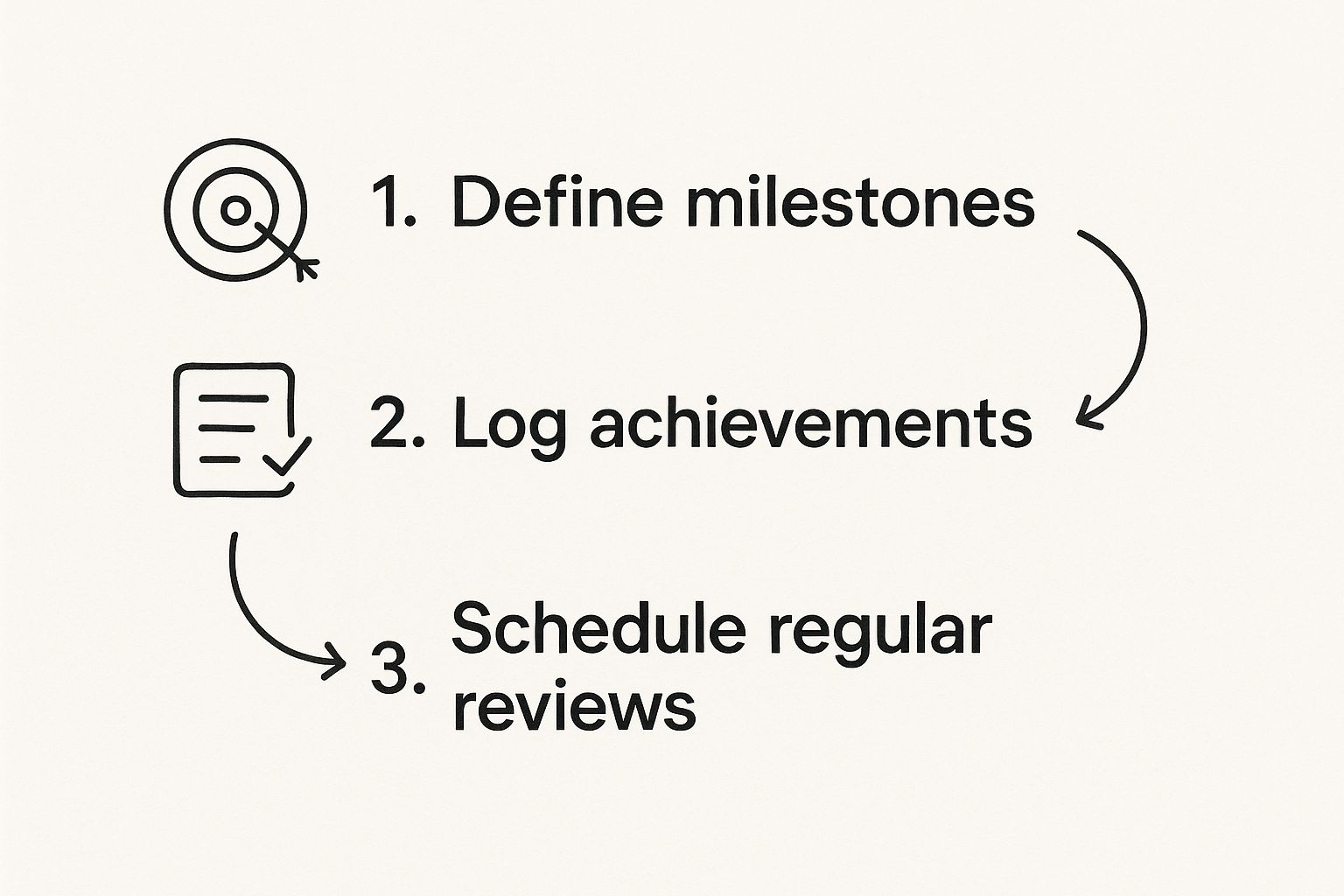
This process of defining milestones, tracking what you've done, and reviewing your progress is what makes a plan stick. Let's dig into how the 70-20-10 rule makes that happen.
Breaking Down the 70-20-10 Rule
This isn't some new-age fad; it’s a cornerstone of modern professional development. The idea is simple: 70% of your growth comes from hands-on experience, 20% from learning with and from others, and just 10% from formal training courses. If you're curious to see it in action, this sample career development plan on VerifyEd.io shows how it all connects.
By building your plan around this ratio, you ensure your development is practical and effective.
Here’s how you can fill out your template using this framework:
The 70%: Learning by Doing (Experiential)
This is where the real magic happens. Think about concrete tasks you can take on right now. Could you ask to lead a small, low-risk project to build your leadership skills? Or maybe volunteer for a "stretch" assignment that pushes you slightly out of your comfort zone? This is your biggest bucket, so fill it with hands-on activities.The 20%: Learning from Others (Social)
Growth is rarely a solo journey. This piece is all about learning from the people around you. Find a mentor whose career you admire and ask for a 30-minute chat once a month. Or you could start a small accountability group with a few peers to share wins, swap stories, and keep each other on track.The 10%: Learning Through Study (Formal)
This is your structured education. Be picky here. Don't just sign up for the first course you see. Pinpoint a specific certification or an online class that gives you the best bang for your buck and directly addresses a skill gap you identified earlier.
By intentionally balancing your plan across these three areas, you're not just adding more tasks to your to-do list. You're embedding your professional growth directly into your workflow, making improvement a natural part of how you work.
Making the Professional Development Template Your Own
Alright, let's get down to the practical part—actually putting your plan on paper. We’ve designed a straightforward professional development planning template to get you started.
I've seen too many plans that are overly complicated and end up collecting dust. The best plan is one you actually use, so we've kept this one simple and focused. Think of it less as a rigid form and more as your personal roadmap for the next chapter of your career.
How to Adapt the Template for Your Career Stage
A one-size-fits-all approach just doesn't work for career planning. A new graduate's priorities are worlds away from a seasoned director's. The real value of this template comes from how you personalize it.
Here are a few scenarios to get you thinking:
- If you're a recent graduate: Your plan should be all about building a solid foundation. Use the "Action Steps" section to list essential software you need to learn, entry-level certifications that will make your resume pop, and key industry events for networking.
- If you're changing careers: The "Skills Gap Analysis" will be your best friend. This is where you get honest about what you know versus what you need to know. Map out a concrete learning path, whether it's online courses, workshops, or a formal degree program.
- If you're an established leader: Your focus shifts from acquiring skills to strategic growth. You might use the template to plan how you'll mentor the next generation of leaders or gain expertise in a new branch of the business. For school administrators, this is critical, and we have more insights on professional development for educators in another guide.
Your professional development plan isn't meant to be set in stone. It's a living, breathing document. Revisit it, tweak it, and let it grow with you as your ambitions and circumstances evolve.
Sometimes, the best way to get started is to see what others have done. Looking at some practical career development plan examples can spark ideas for your own goals and action items. See how others structure their objectives—it can make all the difference.
Navigating Your Professional Development Plan: A Few Common Questions
Once you start putting your professional development plan into action, you'll inevitably run into some real-world questions. That's a good thing! It means you're actively using it. Think of this plan not as a static document, but as a living guide that evolves with you. Let’s walk through some of the most common issues people encounter.
How Often Should I Revisit My Plan?
Your plan is more like a GPS than a roadmap etched in stone—it needs to adapt as the landscape changes. A quarterly check-in with yourself or your manager is a fantastic rhythm to get into. It’s frequent enough to keep you accountable but not so often that it becomes just another box to tick.
Of course, certain moments will demand an immediate review outside of that schedule. You'll want to pull up your plan and make adjustments after events like:
- Wrapping up a major project or mastering a new skill.
- Getting feedback from your annual performance review.
- When your long-term career goals or even personal priorities shift.
This keeps your plan sharp, relevant, and genuinely aligned with where you want to go.
What If I Fall Behind or Get Off Track?
First, breathe. It happens to literally everyone. Life gets busy, priorities at work get shuffled, and sometimes a goal just doesn't spark the same excitement it once did. The trick is to see this not as a failure, but as feedback.
Getting off track isn't a failure; it's a data point. Use it as an opportunity to reassess and adjust your professional development plan to better fit your current reality. Don't be afraid to recalibrate your goals.
So, if a certification course is proving to be more of a beast than you anticipated, don't scrap it—just adjust the timeline. If a larger goal feels overwhelming, break it down into smaller, more bite-sized steps.
This flexibility is crucial for staying motivated. Research from organizations like Great Place to Work highlights that a sense of growth is a powerful motivator. In fact, one study found that 63% of employees pointed to a lack of development opportunities as their main reason for leaving a job. A plan that can bend without breaking ensures those opportunities always feel within reach. Remember, the aim is progress, not perfection.
Are you a K-12 marketing or communications professional looking to accelerate your growth? The MarCom Society provides the expert guidance, peer support, and practical resources you need to thrive. Join our community today and start building your most effective career roadmap yet.