
Finding a great sample of a newsletter from schools can feel like striking gold. The right format not only informs but also engages, builds community, and reinforces your school's brand and mission. Yet, many K-12 marketing and communications professionals struggle to move beyond basic announcements and dated templates. The core challenge is clear: how do you create newsletters that parents, staff, and students actually want to read and interact with?
This guide moves beyond generic advice. We have curated eight distinct and powerful newsletter models, each serving a specific strategic purpose. You'll find everything from a hyper-focused Weekly Classroom Digest that boosts teacher-parent communication to a dynamic Student-Led Newsletter that gives learners a voice. We even break down specialized formats like a Parent Engagement/PTO Newsletter and a timely Social-Emotional Learning (SEL) & Wellness update.
Each example is deconstructed into a strategic analysis, providing you with actionable takeaways, editable template snippets, and proven subject line formulas. To ensure your school newsletter effectively fosters a strong sense of community and keeps parents informed and involved, explore these community engagement best practices.
This resource is your new playbook for transforming school communications from a simple, routine task into a powerful strategic tool. Our goal is to help you save time by providing replicable frameworks while maximizing the impact of every send. Let's dive into the examples that will elevate your communication strategy and deepen your connection with the entire school community.
1. Weekly Classroom Digest Newsletter
The Weekly Classroom Digest is a high-impact, low-effort communication tool that provides parents with a consistent, scannable summary of their child's classroom experience. This format trades broad school-wide news for a focused, intimate look into a single classroom's activities, academic focus, and social dynamics. Its primary goal is to bridge the gap between school and home, empowering parents to have more meaningful conversations with their children about their day.
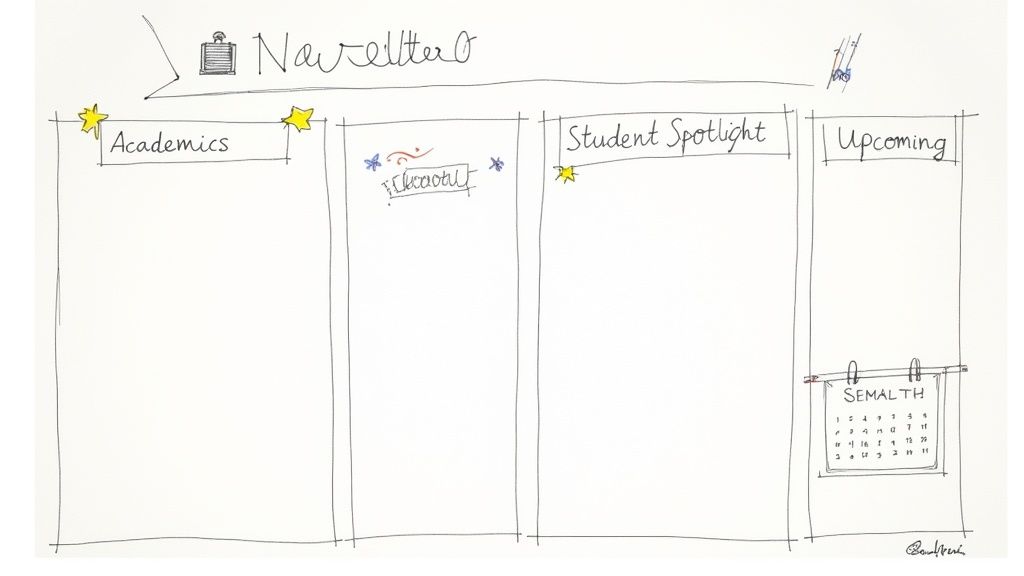
This sample of a newsletter from schools is especially effective at the elementary and middle school levels, where parents are highly engaged with daily learning. Many teachers leverage free tools like Canva or Smore to create visually appealing, single-page newsletters that can be sent as a PDF or a link via email every Friday afternoon.
Strategic Breakdown
- Audience: Primarily parents of a specific classroom. The hyper-targeted nature makes the content immediately relevant and valuable.
- Cadence: Weekly, typically on Friday. This timing allows parents to review the week's events over the weekend and prepare for the upcoming week.
- Format: Digital, single-page, and visually driven. The key is scannability. Heavy use of bullet points, section headers, and photos is crucial for engagement.
- Content Pillars: The most effective digests stick to a consistent structure, such as "Our Learning Focus," "Key Vocabulary," "Upcoming Dates," and a "Student Spotlight."
Actionable Takeaways & Quick-Edit Checklist
To implement this model, focus on consistency and ease of creation. A well-designed template is your greatest asset.
- Create a Reusable Template: Build a template in your preferred platform (Canva, Google Docs, etc.) with pre-defined sections. Each week, you only need to drop in new text and photos.
- Batch Your Content: Take photos throughout the week with the newsletter in mind. Jot down key learning moments or funny quotes as they happen to make Friday's writing process faster.
- Keep Language Accessible: Avoid educational jargon. Instead of "We began our unit on phonological awareness," try "We practiced identifying the starting sounds in words like 'ball' and 'dog'!"
- Feature a Variety of Students: Make a checklist of students to ensure everyone gets a chance to be in a photo or featured in a "Student Spotlight" section over the course of a semester. This fosters a sense of community and value.
2. Monthly School-Wide Newsletter
The Monthly School-Wide Newsletter is a comprehensive communication staple, serving as the official record and primary information hub for the entire school community. Unlike a weekly classroom digest, this format consolidates major announcements, administrative updates, event recaps, and calendar highlights into a single, authoritative publication. Its primary goal is to keep all stakeholders, from parents to staff and community partners, aligned and informed on a macro level.
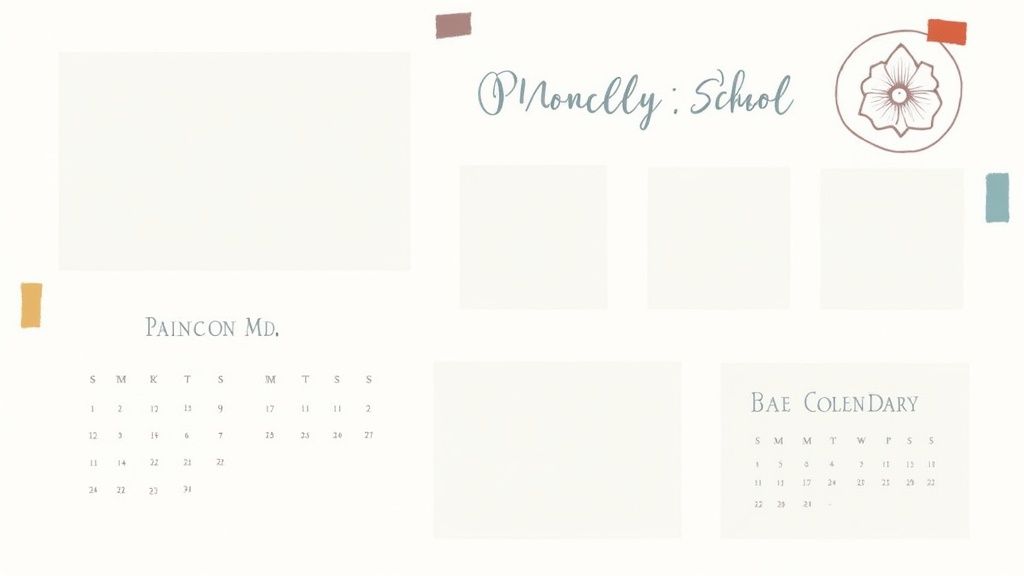
This sample of a newsletter from schools is a cornerstone for school-wide and district-level communications, often curated by an administrative team or communications director. Platforms like Mailchimp, Constant Contact, or ParentSquare are ideal for distributing these more robust, multi-section newsletters, ensuring they are branded, professional, and trackable.
Strategic Breakdown
- Audience: The entire school community, including parents, students, staff, and often district officials or board members. The content must be broad enough to be relevant to all groups.
- Cadence: Monthly, usually sent at the beginning of the month. This rhythm sets expectations and provides a predictable flow of essential information for planning purposes.
- Format: Digital and often multi-page or scrollable. It balances detailed text with strong visual organization, including a table of contents, clear sections, and consistent branding.
- Content Pillars: Key sections typically include a "Message from the Principal," "Important Dates/Calendar," "Student Achievements," "Department News," and "PTA/Community Corner."
Actionable Takeaways & Quick-Edit Checklist
Success with a monthly newsletter hinges on editorial planning and streamlined content collection. A centralized process is non-negotiable.
- Establish an Editorial Calendar: Plan your themes and major content sections for the entire semester. Create content submission deadlines for department heads and teachers at least one week before your send date.
- Create a Central Content Hub: Use a shared Google Doc or Microsoft Form where staff can easily submit their news, photos, and updates. This prevents last-minute scrambling for information.
- Anchor with a Principal's Message: Start every newsletter with a warm, insightful message from the principal. This personal touch sets the tone and provides a consistent, authoritative voice.
- Prioritize the Calendar: Make the "Upcoming Dates" section highly visible and easy to scan. Many parents print this section or use it to populate their family calendar, making it one of the most valuable components.
3. Digital Email Newsletter Template
The Digital Email Newsletter is a modern, responsive communication channel designed specifically for delivery and consumption on digital devices. Unlike a static PDF, this format is dynamic, allowing for clickable links, embedded videos, and interactive elements. Its primary strength lies in its ability to deliver timely information directly to parents' inboxes in a format that is easy to scan on a phone, tablet, or desktop.
This sample of a newsletter from schools is the standard for district-wide communications, independent schools, and any institution aiming for a professional, branded look. Platforms like Constant Contact, Mailchimp, or dedicated school communication tools are used to build and distribute these newsletters, providing valuable analytics on open rates and engagement.
Strategic Breakdown
- Audience: Broad school community, including parents, staff, and sometimes students. The content is often a mix of high-level news, event promotion, and administrative updates.
- Cadence: Bi-weekly or monthly. The less frequent cadence suits the broader, less time-sensitive nature of the content compared to a weekly classroom update.
- Format: HTML email, designed to be responsive. The layout is crucial, typically a single-column structure with a width around 600px for optimal viewing on all email clients.
- Content Pillars: Key content includes a principal's message, upcoming school-wide events, links to important resources (lunch menus, calendars), student achievements, and clear calls to action (e.g., "RSVP for Parent Night").
Actionable Takeaways & Quick-Edit Checklist
Success with this format depends on a mobile-first design and compelling, scannable content. For a deeper dive into platform-specific strategies, you can learn more about email newsletter best practices.
- Prioritize the Subject Line: Your subject line determines if the email gets opened. Use a clear, concise format like "[School Name] News: April 15, 2024" and add a teaser for the main story.
- Place Key Info "Above the Fold": The most critical announcement or call to action should be visible without scrolling. Assume you have three seconds to capture a reader's attention.
- Use Clear Call-to-Action (CTA) Buttons: Instead of a simple hyperlink, use visually distinct buttons for important actions like "Register Now" or "View the Full Calendar." This dramatically increases click-through rates.
- Test Before Sending: Send a test version of the newsletter to yourself and view it on different devices (iPhone, Android phone, desktop) and in different email clients (Gmail, Outlook) to check for formatting issues.
4. Grade-Level or Department Newsletter
The Grade-Level or Department Newsletter narrows its focus from the entire school to a specific academic cohort, such as all third-grade students or the high school science department. This approach provides targeted, curriculum-specific information that a general school-wide message cannot. Its primary purpose is to keep parents informed about learning standards, upcoming projects, and subject-specific resources, fostering a stronger partnership in the educational journey.
This sample of a newsletter from schools is particularly powerful in middle and high schools, where students have multiple teachers. A consolidated "8th Grade Update" or "Fine Arts Department News" prevents parents from being overwhelmed by separate emails from each teacher. It centralizes key information, ensuring clarity and consistency.
Strategic Breakdown
- Audience: Parents of students in a particular grade level (e.g., all Kindergarten parents) or enrolled in a specific department's courses (e.g., high school math).
- Cadence: Monthly or bi-monthly. This frequency is sufficient to cover curriculum units and major projects without creating communication fatigue.
- Format: Typically a multi-section digital newsletter sent via email. It balances text with visuals, often linking to external resources like curriculum guides or homework help videos.
- Content Pillars: Effective examples include "Our Current Unit of Study," "Key Learning Standards Explained," "Tips for Supporting Your Student," "Project Spotlights," and "Department-Specific Events."
Actionable Takeaways & Quick-Edit Checklist
Success with this model relies on collaboration among the teachers in the grade level or department. Designating a point person to collate information is key.
- Use a Collaborative Platform: Create a shared Google Doc or Microsoft Word document where all relevant teachers can add their updates under predefined headings by a certain deadline each month.
- Translate Academic Standards: Don't just list the standard code (e.g., CCSS.MATH.CONTENT.5.NF.A.1). Explain what it means in plain language: "This month, we are learning how to add and subtract fractions with different denominators."
- Provide Actionable Resources: Go beyond just stating what students are learning. Include links to relevant Khan Academy videos, recommend library books that support the curriculum, or suggest family activities that reinforce concepts.
- Showcase Student Work: Feature photos of student projects, lab experiments, or artwork. This not only celebrates student achievement but also gives parents a concrete visual of what’s happening in the classroom.
5. Student-Created/Student-Led Newsletter
The Student-Created/Student-Led Newsletter transforms the school communication channel from a top-down announcement tool into a dynamic platform for student voice and agency. This format shifts the role of content creation from staff to students, who take on responsibilities as writers, editors, photographers, and designers. The primary goal is to foster real-world skills like journalism, collaboration, and digital literacy while providing the community with a unique and authentic perspective on school life.

This sample of a newsletter from schools is highly effective in middle and high school settings, often run as part of a journalism class or an extracurricular club. However, even elementary schools can implement a simplified version with student "reporters" contributing sections. The final product offers a vibrant look into campus culture that resonates deeply with both parents and the student body itself.
Strategic Breakdown
- Audience: Broad school community (students, parents, staff), but with a strong appeal to student readers who see their peers and interests represented.
- Cadence: Monthly or quarterly. The longer production cycle accommodates student schedules, editorial reviews, and the learning process involved.
- Format: Typically digital, such as a multi-page PDF, a dedicated blog, or a section within the main school newsletter. The format often mimics a real magazine or newspaper.
- Content Pillars: Content is driven by student interests and includes school news, event recaps, sports summaries, opinion pieces, interviews with staff or students, and creative works like poetry or photography.
Actionable Takeaways & Quick-Edit Checklist
Implementing a student-led newsletter requires structure and mentorship. The focus is on empowering students while maintaining quality and oversight.
- Establish a Clear Editorial Framework: Create a guide that outlines roles (editor, writer, photographer), ethical standards, content guidelines, and deadlines. This structure helps manage the process.
- Teach Core Journalism Skills: Dedicate time to teaching the basics: how to write a lead, conduct an interview, attribute sources, and write effective headlines.
- Implement a Peer Review Process: Before faculty review, have students peer-edit each other's work. This builds collaborative skills and improves the quality of submissions.
- Leverage Student-Generated Content: This model is a powerful form of user-generated content. You can learn more about these user-generated content strategies on blog.marcomsociety.org to maximize engagement.
- Celebrate and Archive Student Work: Proudly showcase the final newsletter on the school website and social media. Maintain a digital archive that students can use for their portfolios.
6. Parent Engagement/PTO Newsletter
The Parent Engagement/PTO Newsletter is a dedicated communication channel designed to mobilize parent participation and foster a vibrant school community. Unlike broader school-wide updates, this newsletter's sole purpose is to inform, engage, and activate the parent and guardian community, focusing on volunteer opportunities, PTA/PTO initiatives, fundraising efforts, and family-oriented events. Its success hinges on making involvement accessible and showcasing the direct impact of parent contributions.
This sample of a newsletter from schools acts as the central hub for the parent organization. It transforms abstract needs into concrete, manageable tasks, helping parents see exactly where and how they can contribute, whether they have one hour a month or can chair a committee. It is a powerful tool for building social capital and strengthening the home-school partnership.
Strategic Breakdown
- Audience: All parents and guardians within the school community, with a special focus on those looking for ways to get involved.
- Cadence: Bi-weekly or monthly. This frequency is often enough to keep parents informed without overwhelming them, aligning with the typical meeting and event schedule of a PTO or PTA.
- Format: Digital, often created in Mailchimp or a similar platform. It should be mobile-friendly with highly visible buttons and links for RSVPs, sign-ups, and donations.
- Content Pillars: Key sections include a "President's Message," a "Volunteer Corner" with specific needs, fundraising progress updates, event recaps with photos, and a clear calendar of "Upcoming Opportunities."
Actionable Takeaways & Quick-Edit Checklist
To maximize engagement, this newsletter must be welcoming, clear, and action-oriented. The goal is to remove barriers to participation.
- Offer Diverse Opportunities: Feature a mix of volunteer roles, including one-time event help, at-home tasks (like cutting out materials), and ongoing committee positions to suit different schedules and abilities.
- Include Clear Calls-to-Action (CTAs): Every request should have a direct link. Use prominent buttons like "Sign Up to Volunteer Here" or "RSVP for the Family Fun Night" that link directly to a Google Form or Sign-Up Genius page.
- Celebrate and Recognize: Dedicate a section to thank specific volunteers by name or share a brief story about the impact of a recent fundraiser. Seeing their efforts acknowledged encourages repeat involvement.
- Translate Content: To ensure inclusivity, provide the newsletter in the primary languages spoken by your school community. Many email platforms offer simple translation features to facilitate this. To find more parent-focused communication ideas, you can learn more about newsletter ideas for schools on blog.marcomsociety.org.
7. Social-Emotional Learning (SEL) & Wellness Newsletter
The Social-Emotional Learning (SEL) & Wellness Newsletter is a specialized communication focused on student mental health, emotional development, and overall wellbeing. This format moves beyond academics and extracurriculars to provide parents and the community with resources, insights, and updates on the school's efforts to support the whole child. Its primary goal is to partner with families, creating a consistent support system that reinforces healthy emotional habits at school and at home.
.
- Cadence: Monthly or bi-monthly. A less frequent schedule allows for more thoughtful, well-researched content and prevents overwhelming families with sensitive information.
- Format: Digital, often multi-page or blog-style. The format should feel supportive and professional, using calming colors and clean layouts. Links to external resources are a key feature.
- Content Pillars: Core content includes a message from the school counselor, a breakdown of an SEL skill (e.g., self-awareness, responsible decision-making), practical wellness tips for families, and a directory of school and community mental health resources.
Actionable Takeaways & Quick-Edit Checklist
To launch an effective SEL newsletter, focus on building trust and providing genuine, evidence-based support.
- Collaborate with Experts: Partner directly with your school's counselors, psychologists, and social workers to create and vet all content. Their expertise ensures information is accurate, safe, and appropriate.
- Normalize Help-Seeking: Frame mental health support as a normal and healthy part of student development. Use language that reduces stigma, like "Every student benefits from learning how to manage big feelings."
- Provide Practical Tools: Don't just define concepts; give parents actionable strategies. For example, instead of just saying "Practice mindfulness," offer a link to a 3-minute guided breathing exercise for kids.
- Always Include Crisis Information: Every single newsletter must prominently feature contact information for local and national crisis hotlines (like the 988 Suicide & Crisis Lifeline). This is a non-negotiable safety measure.
- Incorporate Student Voice: When appropriate, feature student-created content, such as quotes about kindness or art about managing stress. This makes the topics more relatable and impactful for their peers and parents.
8. Event-Specific/Seasonal Newsletter Template
The Event-Specific/Seasonal Newsletter is a highly-focused communication designed to generate excitement and disseminate critical information for a single, time-sensitive occasion. Unlike general-purpose updates, this format zeroes in on events like a theater production, a sports season kickoff, or seasonal milestones like back-to-school or graduation. Its primary goal is to mobilize the community around a specific event, ensuring high participation and smooth logistics.
This sample of a newsletter from schools is powerful because it cuts through the noise of regular communications. When parents receive an email titled "Everything You Need for the Spring Musical," they know its exact purpose. It centralizes details like schedules, ticket links, volunteer needs, and FAQs, preventing confusion and reducing administrative follow-up.
Strategic Breakdown
- Audience: Highly targeted. It could be parents of drama club students, all high school families for graduation, or the entire school community for a fall festival.
- Cadence: As-needed, often sent in a short series. For an event, a series might include an initial "Save the Date," a detailed "Know Before You Go," and a "Last Chance" reminder.
- Format: Digital, visually engaging, and action-oriented. The design should reflect the event's theme (e.g., team colors for athletics, festive graphics for a holiday event). Clear calls-to-action are essential.
- Content Pillars: Key pillars include "Event Timeline," "How to Participate/Support," "Logistical Details (Parking/Directions)," a "Frequently Asked Questions" section, and profiles of key participants like student actors or athletes.
Actionable Takeaways & Quick-Edit Checklist
To maximize impact, these newsletters must be both exciting and exceptionally clear. Build hype while providing all necessary logistical information in an easy-to-digest format.
- Create Themed Templates: Design a few core templates for major event types: athletics, performing arts, and seasonal holidays. This saves time and ensures a professional look.
- Lead with Logistics: Place the most critical information (Date, Time, Location, Ticket Link) at the very top. Use a visual timeline or countdown timer to build anticipation.
- Build Excitement with Storytelling: Don't just list facts. Include a short profile of the student lead in the play or a quote from the team captain. This human element drives emotional investment.
- Centralize with an FAQ: Anticipate common questions and create a robust FAQ section. Address things like parking, what to bring, food options, and accessibility to reduce individual email inquiries.
Comparison of 8 School Newsletter Templates
| Newsletter Type | Implementation complexity | Resource requirements | Expected outcomes | Ideal use cases | Key advantages |
|---|---|---|---|---|---|
| Weekly Classroom Digest Newsletter | Low–Moderate (weekly cadence, simple template) | Teacher time each week; basic design tools; photos | Regular parent updates; steady engagement; quick class snapshot | Elementary classrooms; weekly parent communication | Easy to scan; consistent communication; low production cost |
| Monthly School-Wide Newsletter | High (multi-page, editorial coordination) | Admin coordination; design/printing resources; photography | Comprehensive school updates; strengthened school image; archival record | District or whole-school communications; PR and community updates | Deep storytelling; professional branding; consolidates broad info |
| Digital Email Newsletter Template | Moderate (template + testing across clients) | Email platform, responsive design, analytics; technical setup | Immediate distribution; measurable engagement; multimedia linking | Virtual/remote schools; geographically dispersed families; frequent updates | Trackable metrics; instant delivery; cost-effective and interactive |
| Grade-Level or Department Newsletter | Moderate (targeted content creation) | Teacher/department time; curriculum resources; subject expertise | Focused curriculum communication; parent guidance; stronger grade community | Grade-specific updates; subject departments; homework and standards info | Highly relevant content; actionable guidance; showcases curriculum depth |
| Student-Created / Student-Led Newsletter | Moderate–High (training, editorial oversight) | Teacher mentorship, student time, editorial workflow, publishing tools | Student skill development; authentic voice; increased school engagement | Journalism classes; student media projects; school culture initiatives | Builds student agency; authentic perspectives; educational value |
| Parent Engagement / PTO Newsletter | Moderate (coordinating volunteers and events) | PTO leadership, volunteer coordination, event logistics, translation as needed | Increased volunteerism/fundraising; stronger parent community | PTO/PTA communications; volunteer recruitment; fundraising drives | Mobilizes parents; organizes opportunities; recognizes contributors |
| SEL & Wellness Newsletter | Moderate (sensitive content; expert input) | Counselors/mental-health staff, vetted resources, careful messaging | Greater parental awareness; destigmatized conversations; wellbeing support | Schools with wellness initiatives; counseling programs; trauma-informed practice | Supports whole-child approach; provides evidence-based resources; preventive focus |
| Event-Specific / Seasonal Newsletter Template | Moderate (time-sensitive, logistics-focused) | Event coordinators, schedules, ticketing info, promotional assets | High participation; clear logistics; event excitement and turnout | Back-to-school, performances, sports seasons, graduations, fundraisers | Drives attendance; consolidates logistics; builds anticipation |
From Sample to Strategy: Activating Your Newsletter Plan
Navigating the landscape of school communications requires more than just a template; it demands a strategic mindset. Throughout this article, we’ve deconstructed various examples, from the high-frequency Weekly Classroom Digest to the unifying Monthly School-Wide Newsletter, to provide a blueprint for effective community engagement. We've seen how a well-crafted sample of a newsletter from schools isn't merely a collection of announcements but a powerful tool for storytelling, brand building, and fostering a sense of belonging.
The journey from inspiration to implementation is where true impact is made. The diverse examples provided, including the Parent Engagement/PTO Newsletter and the student-led editions, highlight a critical truth: one size does not fit all. Your school's communication strategy should be a dynamic ecosystem, not a monolithic broadcast.
Synthesizing the Core Strategies
The most successful newsletters showcased in this guide share a common DNA. They prioritize audience needs, segment their content logically, and maintain a consistent, authentic voice. By analyzing these examples, we can distill several universal principles for success:
- Audience-Centricity is Non-Negotiable: Every successful newsletter, from the staff-focused update to the SEL & Wellness bulletin, starts with a deep understanding of its intended audience. Before drafting a single word, ask: "What does this group need to know, and how do they prefer to receive it?"
- Structure Creates Clarity: The power of a great template lies in its ability to create predictability and reduce cognitive load for the reader. Whether using a simple two-column layout or a more complex modular design, a consistent structure helps parents and staff find the information they need quickly.
- Visuals Amplify the Message: From high-quality photos in an event-specific newsletter to simple, branded graphics in a weekly digest, visual elements are essential. They break up text, convey emotion, and make your communications far more memorable and engaging.
- Consistency Builds Trust: A reliable distribution cadence, whether weekly, bi-weekly, or monthly, trains your community to anticipate and look forward to your communications. This consistency is the foundation upon which you build trust and readership.
Your Actionable Next Steps
Transforming these insights into a tangible plan is the final, most crucial step. Don't let the variety of options overwhelm you. Instead, use them as a catalyst for refining your own approach. Here is a clear path forward:
- Conduct a Communications Audit: Review your current newsletter(s). Which formats from this article could fill a gap in your strategy? Perhaps a new grade-level newsletter is needed to provide more targeted information, or a student-led edition could empower your learners.
- Select and Adapt Your Template: Choose a primary sample of a newsletter from schools from our list that best aligns with a key communication goal. Use the provided checklists and strategic breakdowns to adapt it to your school's unique brand, voice, and needs.
- Establish a Content Calendar: Map out your themes, key dates, and content pillars for the next quarter. This proactive approach prevents last-minute scrambling and ensures your newsletters are thoughtful and strategic, not just reactive.
- Define Your Production Workflow: Determine how your newsletter will be created, approved, and distributed. As you refine this process, consider the final output. If you plan to distribute a printed version for certain events or audiences, it's wise to understand your production options by exploring topics like Digital Printing vs. Offset Printing to ensure quality and cost-effectiveness.
Ultimately, mastering the art of the school newsletter is about mastering the art of connection. Each edition you send is an opportunity to reinforce your school's values, celebrate achievements, and strengthen the vital partnership between home and school. By moving from sample to strategy, you elevate your communications from a simple task to a cornerstone of your community-building efforts.
Ready to transform your school's communication strategy with expert guidance and a supportive network? Join The MarCom Society, the premier professional community for K-12 marketing and communications leaders. Access exclusive resources, advanced workshops, and peer-to-peer insights to master the strategies detailed in this article and beyond.









