Why Most Schools Are Invisible Online (And How To Fix It)

Many excellent educational institutions face a significant challenge: they are practically unseen in online search results. Despite providing high-quality programs and supportive learning environments, their digital footprint often doesn't convey their actual worth, causing them to be overlooked by numerous potential students and their families.
This lack of online visibility often arises from a continued dependence on conventional marketing approaches. These methods are less effective as families increasingly use the internet for gathering information, meaning enrollment directors might find that traditional outreach efforts are producing fewer results as methods for discovering schools shift.
The Disconnect: Search Behavior vs. School Assumptions
A major contributor to this online obscurity is a basic misunderstanding. There is frequently a noticeable gap between what educational institutions believe parents and students are looking for online and what their actual search queries and behaviors are. This discrepancy means that even carefully planned SEO for education websites can miss the mark.
Indeed, effective SEO for education websites has become vital, as it directly impacts how visible and credible an institution appears online. A large number of students now depend heavily on search engines to find and compare educational options. However, recent studies reveal that a surprising 51% of universities lack a formal SEO strategy, placing them at a clear disadvantage in attracting prospective students. Explore further details on SEO trends for universities
Adapting to New Discovery Paths
The way families search for the ideal school has undergone a substantial transformation. Today, this process predominantly starts online, with parents and students carefully comparing different schools, browsing websites, and reading reviews well before they think about a campus tour. This shift means that a school's initial, and often most significant, impression is formed digitally.
As a result, institutions that are seeing consistent growth in enrollment are typically those that have acknowledged this change and have made search optimization a core part of their strategy. By thoroughly understanding and aligning with online search patterns, these schools ensure their excellent programs are not only available but also easily found by the right audience. Without this important adaptation, even schools with outstanding offerings risk becoming increasingly hard to find.
K-12 SEO Strategies That Actually Drive Enrollment
K-12 institutions function in a particular setting, bringing forth distinct hurdles that require specialized SEO for education websites. Standard SEO methods often prove insufficient because they fail to consider the unique search behaviors of families looking for elementary, middle, or high schools. Achieving success depends on understanding and targeting the specific search terms parents employ at different points in their decision-making journey.
This involves acknowledging seasonal keyword fluctuations that can markedly affect enrollment periods. For example, searches for "kindergarten registration" generally reach their highest volume in the spring, whereas terms like "high school advanced programs" experience more searches in the autumn. Within the K-12 domain, SEO is crucial for increasing enrollment by enhancing online presence and trustworthiness. Since most families use online searches to find educational options, appearing in search results boosts the chances of being discovered and building trust. A thoughtfully developed SEO plan can focus on particular search phrases, like 'top elementary school in [your city]' or 'high schools with AP courses,' by using tools such as Google Keyword Planner to pinpoint suitable keywords. Discover more insights about boosting enrollment with SEO.
Optimizing Your School's Digital Front Door
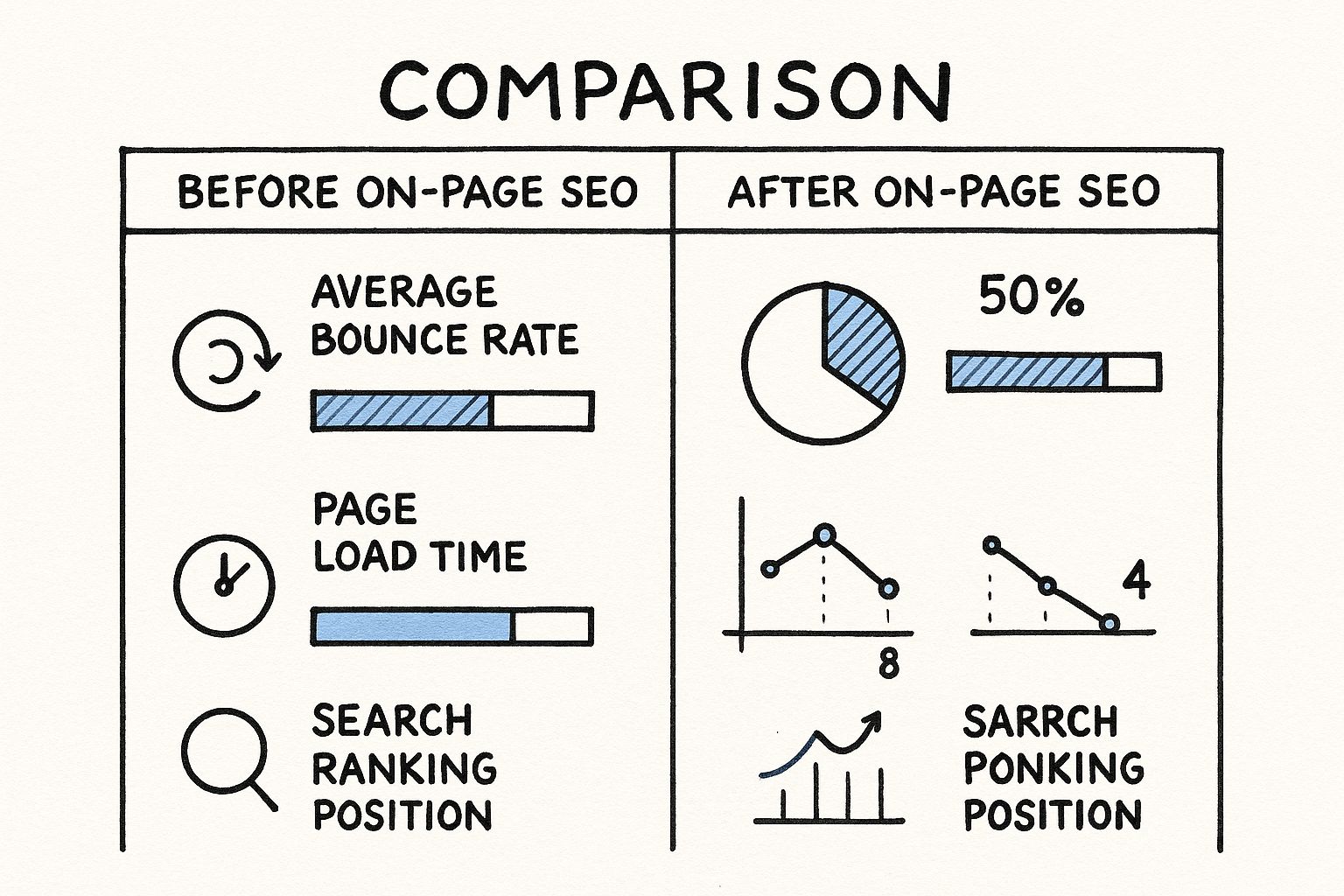
Thorough on-page optimization is essential for capturing these searches. The visual data below highlights the clear advantages of applying on-page SEO, showing a comparison of important website performance indicators before and after optimization for educational institutions.
As the information indicates, focused on-page SEO work can result in a notable decrease in bounce rate and page load time, along with a vital improvement in search ranking positions. This improved user experience and greater visibility directly help in attracting more potential families.
To better understand the distinct SEO approaches for different educational levels, the following table outlines key differences and priorities.
K-12 vs Higher Education SEO Comparison
Key differences in SEO strategies between K-12 schools and higher education institutions
| SEO Factor | K-12 Schools | Higher Education | Priority Level (K-12 / HE) |
|---|---|---|---|
| Primary Target Audience | Parents, guardians, local community | Prospective students, parents, researchers, alumni, industry partners | High / High |
| Keyword Focus | Localized terms, grade-specific programs, safety, "best schools near me" | Degree programs, research areas, career outcomes, university reputation, campus life | High / High |
| Content Strategy | Curriculum details, extracurriculars, school environment, admission process | Academic excellence, faculty profiles, student testimonials, research opportunities | High / High |
| Geographic Targeting | Hyper-local, focused on specific districts or neighborhoods | Regional, national, and international, depending on institution type | Very High / High |
| Decision Cycle | Shorter for lower grades, longer for high school; often family-driven | Longer, more complex; student-driven with parental influence | Medium / High |
| Reputation Signals | Parent reviews, community involvement, local news, safety records | Rankings, accreditations, notable alumni, research output, peer reviews | High / Very High |
| Program Specificity | Specific grade levels, special education, gifted programs, after-school care | Majors, minors, graduate programs, specialized research centers, online courses | High / Very High |
This comparison highlights that while both K-12 and higher education rely heavily on SEO, the specific tactics and areas of emphasis differ significantly due to their distinct audiences and objectives.
Beyond Keywords: Building Trust and Addressing Concerns
Although targeting appropriate keywords is vital, an effective K-12 SEO strategy extends further. Location-based optimization is very important, making sure your school is easily found in local search results when families look for "schools near me." Additionally, reputation management strategies are essential for establishing trust with careful parents who often depend on online reviews and testimonials.
Content must also be meticulously developed to speak to student interests and parental worries throughout the decision-making process. This means producing materials that answer practical questions about curriculum and admissions, and also content that highlights the school's culture and student experiences. Grasping these specific details is fundamental for successful SEO for education websites. You might find this interesting: Marketing for Schools: Strategies for Success.
Technical SEO Foundation That Search Engines Actually Reward

While specific approaches for different educational levels are important, a solid technical SEO foundation is essential for all effective SEO for education websites. This isn't about complex programming; instead, it focuses on basic elements search engines use to discover, interpret, and ultimately trust your school's online presence. Many institutions unfortunately neglect these key aspects, which can limit their online visibility.
Common Technical Pitfalls for Education Websites
Several frequent technical issues often affect education websites, negatively impacting their search engine performance. These problems can go unnoticed but may significantly confuse both users and search engine crawlers, making your important program information more difficult to find.
For example, broken internal links can act as dead ends for search engines, preventing them from completely indexing your website. Data indicates a wider problem: a large amount of online content is not properly set up, and this is evident in the education sector. Over 66% of backlinks are broken across the web, and 7.4% of pages ranking in Google's top 10 do not have a title tag, showing a broad need for better website upkeep. Explore more SEO statistics on Exploding Topics.
Furthermore, missing schema markup is a commonly overlooked opportunity. This specialized code, often defined using vocabularies from platforms like Schema.org, helps search engines understand specific details about your content, such as program specifics, event schedules, or campus locations. This can lead to more informative search results that attract a higher number of clicks. Without it, you aren't providing search engines with the clearest information about what your institution offers.
Conducting Meaningful Technical Audits
Identifying these issues involves performing thorough technical audits. Rather than just going through a standard checklist, these audits should aim to find real areas for improvement and help organize fixes based on their likely effect on search visibility and student enrollment.
This means concentrating on problems that directly influence how search engines crawl, index, and rank your pages. To boost enrollment, educational institutions can also draw lessons from successful SEO methods, much like those that benefit small businesses, by establishing regular maintenance practices. Discover SEO tips for small businesses from Denver Web Studio for additional perspectives.
By tackling these technical components—from mending broken site pathways to clearly describing your offerings with structured data—schools can significantly enhance their search engine visibility. Practical examples demonstrate that such technical improvements yield concrete enrollment increases, making your institution easier for prospective students to find. Learn more in our guide to Digital Marketing for Schools on Marcom Society.
Content That Converts Prospects Into Enrolled Students
While a good technical setup makes your website discoverable, content truly engages prospective students and families, guiding enrollment. Crafting material that connects means understanding their multi-stage decision process, each needing specific content. This is central to effective SEO for education websites.
Matching Content to the Prospective Student's Journey
The path from awareness to enrollment is complex. Effectively aligning material with each phase—awareness, consideration, and decision—is key. During the awareness stage, blog posts on broad educational questions or unique teaching philosophies attract a wide audience. An article on "Choosing the Right Learning Environment" can capture early interest.
As prospects enter consideration and decision phases, specific content is crucial. Effective options include:
- Detailed program guides
- Virtual campus tours with authentic student experiences
- Q&A sessions with faculty
Student success stories and testimonials, perhaps via video (with SEO-friendly transcripts), build trust and help prospects envision themselves at your institution.
Creating Compelling Stories and Ensuring They're Found
Storytelling makes data relatable. Sharing personal narratives of student achievements or unique campus programs makes your institution memorable. For this content to reach its audience, strategic keyword integration is vital. While technical SEO lays groundwork, knowing how to place keywords effectively in website content is fundamental for visibility.
This applies to all content, from campus life blogs to program landing pages. Aim to develop evergreen resources—valuable pieces that consistently attract and convert. Regularly updating older, high-performing posts with fresh information and CTAs extends their impact and relevance.
Organizing Content for Better Visibility and Prompting Action
A content cluster model, linking related articles to a central "pillar" page, can boost search rankings and user experience, signaling your expertise. Every piece of content should also guide readers. Clear calls-to-action (CTAs), like "Download Our Prospectus" or "Schedule a Virtual Tour," are crucial for converting interest into leads.
Strategic CTA placement significantly increases engagement. Ultimately, thoughtfully created, optimized content aligned with the student journey is foundational to achieving enrollment targets through SEO for education websites. Find more tips in this guide on how to master SEO for schools.
Local SEO Mastery For Schools That Dominate Their Markets

For most educational institutions, their community is rooted in specific geographic areas. This strong local connection makes local search optimization not just a helpful tactic, but a vital one for enrollment success. Effective SEO for education websites at the local level ensures that when families in your vicinity search for schools, yours appears as a prime option.
Optimize Your Google Business Profile For Maximum Impact
Often, a family's first digital interaction with your school is through your Google Business Profile (GBP). Claiming and carefully maintaining this profile is one of the most effective strategies for local SEO. Think of it as your school's online front door.
Ensure all information is accurate and complete:
- School Name, Address, and Phone number (NAP): Consistency here is vital.
- Website Link: Directing interested families to the right place.
- Hours of Operation: Remember to include special hours for holidays or breaks.
- School Description: Clearly state your unique values and what you offer.
- Categories and Attributes: Selecting terms like "Elementary School," "Private High School," or "Montessori School" helps Google connect you with relevant searches.
- Photos and Videos: Showcase your campus, facilities, student life, and events. Regularly updated visuals keep your profile fresh and inviting.
Additionally, using GBP Posts for announcements, upcoming open houses, or sharing recent blog content can greatly increase visibility and interaction. For schools with multiple campuses, creating and managing distinct GBP listings for each location is important for accurate local targeting.
Strategically Manage Online Reviews
Online reviews carry significant weight. Families increasingly depend on them to understand a school's atmosphere, quality of education, and parent satisfaction levels. Positive reviews build trust and can notably influence your local search ranking.
Develop a proactive plan for managing reviews:
- Encourage Feedback: Make it simple for current parents to leave reviews after positive experiences, such as school events or parent-teacher meetings.
- Respond Promptly and Professionally: Address both positive and negative reviews. A thoughtful response to criticism shows you value feedback and are committed to improvement.
This engagement shows both prospective families and search engines that your institution is active and cares about its community.
Build Local Citations That Matter
Local citations are mentions of your school's NAP information on other websites, such as online directories, community portals, and local business listings. Consistent and accurate citations across relevant platforms reinforce your school’s legitimacy and geographic relevance to search engines like Google. Prioritize quality over quantity; listings on well-regarded local and education-specific directories are more valuable.
Location-Based Keyword Strategies
Understanding how local families search is key. Your website content needs to incorporate location-based keywords that match searches like "best primary schools in [Your City]" or "after-school programs [Your Neighborhood]." This also includes program-specific searches, such as "IB program [Your Town]."
Consider creating dedicated pages or sections on your website that emphasize your connection to the local community. An "Our Community" page can feature local landmarks, partnerships, and why your school is a great fit for families in the area. Ensure your school’s full NAP details are consistently present, often in the website's footer. These efforts in SEO for education websites help search engines clearly identify the areas you serve. Seasonal enrollment patterns also influence local searches; for instance, "summer camp [Your City]" searches peak at certain times, and your content should reflect this.
To better understand what drives local search performance for schools, the following table breaks down important factors.
Local SEO Ranking Factors For Education
Most important local SEO factors affecting education website rankings
| Ranking Factor | Impact Level | Implementation Difficulty | Expected Timeline |
|---|---|---|---|
| Google Business Profile Signals | Very High | Medium | Short to Medium |
| Online Reviews (Quantity, Velocity, Diversity) | High | Medium | Ongoing |
| On-Page Local Signals (NAP, Keywords, Content) | High | Medium | Medium |
| Local Citation Signals (Consistency, Authority) | Medium | Medium | Medium to Long |
| Localized Link Building | Medium | High | Medium to Long |
| User Behavioral Signals (Click-through rate, Mobile Clicks to Call) | Medium | Indirect | Ongoing |
| Personalization | Medium | N/A (Algorithm Driven) | Ongoing |
Focusing on these local SEO components can greatly improve a school's online presence, draw in more suitable inquiries, and help it stand out in its local area.
Measuring What Actually Matters For Enrollment Growth
When it comes to SEO for education websites, figuring out if your efforts are truly paying off means looking past simple website statistics. Many educational institutions focus on vanity metrics like page views or social media engagement, but these numbers don't always show how SEO impacts student sign-ups. The main objective is to clearly link your search engine presence to actual student recruitment, proving a solid return on investment to decision-makers.
Moving Beyond Surface-Level Data
Attracting visitors to your institution's website is just the first step; the real work lies in turning that interest into actual student enrollments. Success in this area is best measured by tracking qualified leads, the number of application starts, and ultimately, enrollment conversions. This shift in focus means your SEO strategy aims to attract not just any visitor, but the right prospective students who are genuinely interested in enrolling.
For instance, while a high volume of page views on your "Admissions" page seems good, it’s more telling to know how many visitors took a further step, like clicking the "Apply Now" button or downloading a program guide. Such actions signal a much stronger interest and are better predictors of a future enrollment. This perspective changes SEO for education websites from merely a traffic-generation activity to a vital part of your enrollment strategy.
Connecting Search Efforts to Enrollment Outcomes
To effectively measure these outcomes, you need dependable tracking systems that connect website traffic from search engines to actual student applications and enrollments. Tools like Google Analytics and Google Search Console are fundamental for keeping an eye on organic search performance. However, their true capability is shown when they are set up to track specific conversion goals.
These important goals can include:
- Submission of online inquiry forms.
- Registrations for campus open days or virtual tour sessions.
- Downloads of detailed program brochures or application materials.
- The beginning of the online application process itself.
Monitoring these micro-conversions gives a much clearer insight into how well your SEO strategy is guiding potential students through the enrollment pipeline. It helps pinpoint which keywords and content are not just drawing in visitors, but are also prompting them to take meaningful steps towards becoming students.
Advanced Analytics for Deeper Insights
The path to enrollment for students considering educational programs is often a long one, involving many interactions across different channels. Because of this, basic analytics might not give a full view of how search marketing contributes. For example, multi-touch attribution models can help institutions understand the role of organic search and other marketing channels at different points in a student's decision-making journey, rather than just giving credit to the last click.
Furthermore, seasonal trend analysis is very important in the education sector. Interest in specific programs or enrollment periods can change a lot during the year. Analytics can identify these patterns, allowing schools to adjust their SEO for education websites and content strategies ahead of time. Looking at the long-term value of students who came from different traffic sources can also show the lasting effects of your SEO work, possibly revealing that students found through organic search tend to stay longer or engage more.
By concentrating on these significant metrics and using advanced analytical methods, educational institutions can greatly improve the effectiveness of their search marketing. This approach, centered on data, not only helps refine enrollment strategies but also delivers clear proof of how digital marketing investments contribute to growth, addressing the important need to show a return on investment.
Building An SEO Strategy That Grows With Your Institution
Strong search visibility isn't a set-it-and-forget-it task; it's a continuous effort. For educational institutions, an effective SEO for education websites strategy needs to be fluid. It must adjust to changes in search engine algorithms, how people search, and even how your own institution develops. Schools that think ahead know that flexibility is vital for consistent performance and expanding their reach over the long haul.
This kind of adaptability means creating an SEO plan that looks ahead and gets ready for what's next. The methods prospective students and their families use to find schools are always changing due to new tech and evolving tastes.
Navigating the Evolving Search Landscape
The online world is always shifting, so your SEO approach needs to keep pace. Search engines such as Google regularly tweak their algorithms. Sometimes these are big core updates, other times they are smaller, more subtle changes. Either way, these adjustments can affect your institution's website ranking for key search terms.
User habits aren't fixed either. The phrases students type into search bars, the devices they use (mobile search is still king), and the information sources they rely on are constantly in flux. For instance, more families are now using social media not just for socializing, but as a key research tool when looking at schools. Grasping these current discovery patterns is essential for successful SEO for education websites.
Preparing for Future Search Technologies
As we look to the future, new technologies will continue to shape how people find information. AI-driven search tools, such as Google's Search Generative Experience (SGE), are starting to alter how search results look and work. The complete effects aren't clear yet, but schools should think about how their content will fit into these new, more conversational and summary-focused formats.
Beyond standard text searches, new opportunities are cropping up. These developing channels provide fresh avenues for connecting with potential students and their families:
- Video Content Optimization: Video is a very compelling format. Making your video content—like virtual campus tours, student stories, or teacher interviews—search-friendly (on platforms such as YouTube, a huge search engine in its own right, and Google) can greatly widen your audience.
- Voice Search Readiness: With smart speakers and voice assistants becoming more widespread, preparing for voice search is growing in importance. This usually means targeting longer, more conversational search terms and making sure your content clearly answers frequent questions.
- Social Platform Integration: Social media activity doesn't directly control search rankings like backlinks do. However, a lively and engaging presence on the right social platforms can boost brand awareness, bring in website visitors, and indirectly help your SEO. As mentioned earlier, families are using these channels more and more for school research.
Building a Resilient and Agile SEO Program
To create an SEO plan that genuinely expands alongside your institution, the emphasis should be on long-term institutional objectives, not just quick ranking wins. This means either developing your own SEO expertise internally or collaborating with partners who grasp the need for ongoing learning and adjustment.
Think about these methods for a lasting strategy:
- Prioritize High-Quality, User-Focused Content: Develop thorough, useful content that truly meets the needs and answers the questions of your intended audience. This type of content usually holds up well despite algorithm updates.
- Stay Informed and Adapt: Keep an eye on SEO news, algorithm changes, and shifts in how users behave. Be ready to modify your methods as needed.
- Diversify Your Efforts: Avoid depending on just one SEO technique. A well-rounded plan incorporating technical SEO, content marketing, local SEO, and an understanding of new trends will be more robust.
- Integrate SEO Across Marketing Efforts: Make sure SEO isn't a standalone task but is woven into your broader marketing and communications plan for a more unified and effective outcome. For example, blog content can be reused for social media, email marketing, and even printed materials.
By adopting a flexible and forward-thinking mindset, your institution can ensure its SEO for education websites keeps producing positive outcomes, helping to boost enrollment and improve visibility for the foreseeable future.
Improve your school's marketing and communications by joining a community focused on your development. Connect with The MarCom Society to access expert knowledge, learn with others, and find useful resources made for K-12 professionals.