
When we talk about SEO in the context of education, we're really talking about making your school's website the go-to answer for parents and students when they search online. It’s a specialized approach that uses specific keyword, content, and technical strategies to get your institution noticed by the right people, ultimately helping to boost enrollment numbers.
Why SEO Is a Game-Changer for Student Recruitment
The path to enrollment has changed. It doesn't start with a campus tour or a school fair anymore—it begins with a search. A parent might type in "best private K-12 schools near me," or a student could be looking up "high school robotics clubs." Search engines have become the new front door to your school. If you're not visible there, you're missing out on a huge number of potential applicants.
A solid SEO strategy isn’t about trying to outsmart Google. It’s about genuinely understanding what your prospective families are searching for and then positioning your school as the perfect solution. This shifts your website from being a simple digital brochure to a powerful recruitment engine that’s working for you 24/7.
The Cost of Doing Nothing
Here's the thing: many schools are still behind the curve. A recent Higher Ed SEO Research Study found that an incredible 51% of universities don't have a formal SEO plan. This is a massive opportunity for any school ready to invest in its online presence. While half of your competition is practically invisible online, you can step in and capture that search traffic.
SEO is a direct investment in your institution's long-term sustainability. Each new student who discovers your school through an organic search is a testament to a strategy that builds on itself, delivering compounding returns year after year.
This is fundamentally different from paid advertising. With ads, your visibility vanishes the second you stop paying. With SEO, you're building a valuable asset that only grows stronger over time.
The Four Pillars of Educational SEO
To really get a handle on why this is so important for schools, it helps to understand the basics of What is Search Engine Optimization. At its core, SEO is all about making your website more useful and easy to find for both search engines and, more importantly, for people.
To build a successful SEO program for any school, we need to focus on four key areas. Think of them as the pillars holding up your entire digital recruitment strategy.
The Four Pillars of Educational SEO
| Pillar | Objective | Key Action |
|---|---|---|
| Technical SEO | Make your website fast, secure, and easy for Google to understand. | Conduct a technical audit to fix crawl errors and improve site speed. |
| On-Page SEO | Optimize individual pages for specific search queries. | Refine program pages and admissions info with relevant keywords. |
| Content Strategy | Answer the questions your target audience is asking. | Create blog posts and guides for parents on topics like "choosing a school." |
| Off-Page SEO | Build your school's authority and local presence online. | Get listed in local directories and earn mentions on community websites. |
By mastering these four areas, you create a comprehensive strategy that not only attracts more visitors but also turns those visitors into enrolled students.
Building Your SEO Foundation with Audits and Keywords
Before you can chart a course for where you’re going, you need to know exactly where you stand. That’s the first rule of any solid marketing plan. For your school's website, that means getting a clear picture of its current digital footprint—the good, the bad, and the broken. This all starts with a baseline SEO audit.
Think of it as a comprehensive health check for your website. The goal is to see your site through two different lenses: Google’s and a prospective parent's. An audit will uncover technical snags, content gaps, and hidden opportunities you’re likely missing.
Starting with a Technical Health Check
First things first, let's look under the hood. You need to diagnose any technical issues that could be quietly sabotaging your search rankings. Things like broken links, sluggish page speeds, or a site that’s a nightmare to use on a phone can absolutely tank your visibility and frustrate visitors.
A parent trying to check your tuition page on their phone isn't going to wait 10 seconds for it to load. They’ll just leave.
Google Search Console is your best friend here. It’s a free platform that shows you exactly how Google sees your site, flagging everything from crawl errors to security problems. For a really deep dive, this guide on how to do a website audit is a fantastic resource: https://blog.marcomsociety.org/how-to-do-a-website-audit/
This initial review will give you a prioritized to-do list. You might find that your "Admissions" section has a bunch of broken links, creating a dead-end experience for parents. Or maybe that beautiful photo gallery of the campus is what’s slowing down your entire homepage. Fixing these technical issues first means that all the great content you create later will be built on solid ground.
Uncovering What Your Audience Actually Searches For
Once your site’s technical health is in order, it's time to figure out what parents and students are actually typing into Google. Keyword research isn't about gaming the system; it’s about understanding the language your prospective families use every day. You want to align your school's message with the real-world questions they're asking.
Your research should focus on three main types of keywords:
- High-Intent Program Keywords: These are the money terms. Think "private kindergarten near me" or "high school with AP computer science." People using these phrases are actively looking to enroll.
- Informational Keywords: These come from families in the early research phase. They're searching for things like "how to choose a middle school" or "benefits of a STEM curriculum." Answering these questions establishes your school as a trusted authority.
- Branded Keywords: This is simply your school's name and any common variations. When someone searches for you by name, you need to own that first page of results. No question.
This is how SEO connects a family's initial search to their final decision to fill out an application.
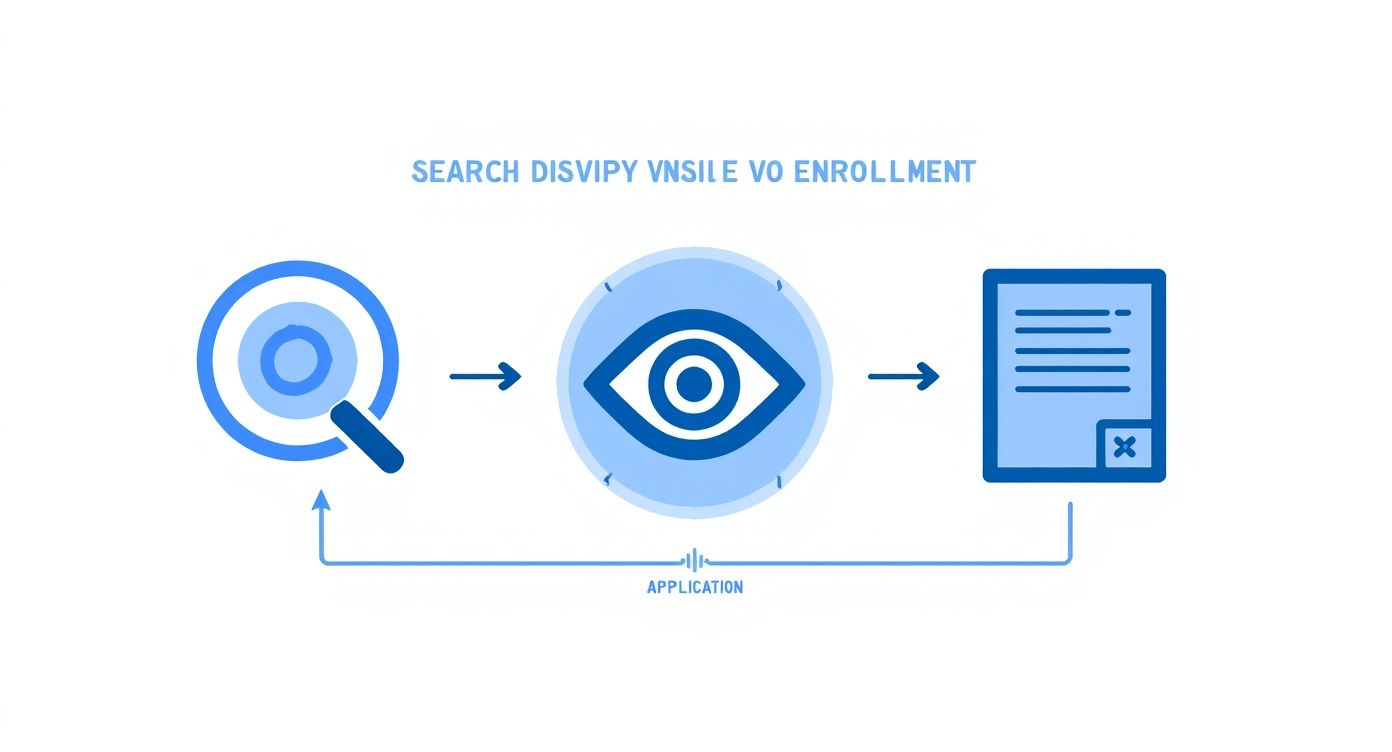
As you can see, showing up in search results is the crucial first step that gets families in the door.
The best keyword strategies are built on empathy. Put yourself in the shoes of a worried parent or an ambitious student. What would they ask Google? Your most valuable keywords are hidden in those answers.
For example, a parent probably isn't searching for your "pedagogical approach." They're far more likely to type in "best schools for a hands-on learning style." Grasping that subtle difference is what allows you to create content that genuinely connects. If you want to dig deeper into the basics, these comprehensive SEO resources are a great place to build your foundational knowledge.
By pairing a thorough audit with a smart keyword strategy, you create a powerful roadmap. You’ll know exactly what to fix, what content to create, and which search terms will bring the right families to your digital front door. This foundational work makes every other SEO effort you undertake that much more effective.
Making Your Digital Campus Search-Engine Friendly
Once you've nailed down your keyword strategy, it’s time to look inward and get your own house—your website—in order. This is where on-page and technical SEO come into the picture. We're talking about optimizing the core elements of your site that search engines see first, from your academic program pages to your admissions portal. The goal is simple: make your digital campus as clear to Google as it is welcoming to prospective families.

We'll start with your highest-value pages. Think of your title tags and meta descriptions as the digital billboard for each page. They are your first, and sometimes only, chance to grab a searcher's attention in a crowded results list. Make them count. They need to be punchy, include your target keyword, and give parents a compelling reason to click through to your site.
Sharpening Your Core Academic and Admissions Pages
Your academic and admissions pages are the online equivalent of a campus tour. They must be structured for easy reading by busy parents and for easy comprehension by search engine crawlers. That means breaking up long paragraphs with clear, keyword-focused headings (H2s and H3s) that logically guide the reader.
For instance, a generic heading like "About Our Engineering Program" doesn't do much. Instead, structure the page with more specific, helpful subheadings:
- Hands-On Curriculum and Learning Labs
- Meet Our Expert Faculty in Robotics and AI
- Career Outcomes for Engineering Graduates
- How to Apply: A Step-by-Step Guide
This isn't just for show. This structure makes the information much easier to scan and helps Google understand the depth and relevance of your content for specific searches. It’s a foundational piece of good on-page SEO.
A fantastic user experience is at the heart of modern SEO. If a prospective student finds your program page easy to navigate and genuinely informative, they'll stick around. Google absolutely notices that positive engagement and rewards you with better visibility.
A smart internal linking strategy is also non-negotiable. When you mention a unique elective on a program page, link directly to its course description. Talking about tuition? Link to your financial aid hub. This practice not only keeps users on your site longer but also helps spread link equity and authority across your entire domain.
Fortifying Your Technical Foundation
While compelling content gets all the attention, it’s a technically sound website that provides the stage. Technical SEO issues can quietly sabotage even the best content strategy. I’ve seen many schools overlook these "under the hood" factors, which gives you a huge opportunity to pull ahead of the competition.
A fast, secure, and mobile-friendly website is table stakes today. With most parents and students researching schools on their phones, a site that isn’t responsive is like having a campus with a locked front gate—it turns people away. Page speed is just as critical. A slow-loading admissions page sends a strong negative signal to Google and leads to frustrated visitors who will simply leave. For more on this, our guide to effective school website design is a great starting point.
Using Structured Data to Earn Rich Results
One of the most potent technical SEO tactics for schools is implementing structured data, often called schema markup. Think of it as a special vocabulary you add to your site's code that helps search engines understand your content with near-perfect clarity.
For schools, this is a game-changer. You can use specific schema "types" to explicitly tell Google about your:
- Courses: Including the name, description, and course code.
- Educational Programs: Defining degrees offered and any prerequisites.
- Events: Highlighting open house dates, application deadlines, and campus tours.
When you implement this markup correctly, Google may reward your school’s pages with "rich results." These are the enhanced listings you see in search results that include extra details like event dates or program info right below the main link. They are eye-catching, informative, and can dramatically increase your click-through rate, driving more of the right kind of traffic to your site. It’s a simple addition that makes you stand out.
Winning Local Search to Attract Nearby Students
Your school might have a website that reaches the whole world, but let's be honest: your next class of students probably lives just down the road. This is why local search isn't just a "nice to have"—it's a powerful engine for enrollment.
When a parent pulls out their phone and searches for "best private schools near me" or "kindergarten programs in Springfield," you have to be there. Showing up first isn't just about being seen; it's about being the trusted, go-to answer for families in your community at the exact moment they're looking.
https://www.youtube.com/embed/mpaUPYyEkpY
At the heart of all this is your Google Business Profile (GBP). Think of it as your school's digital storefront on Google Search and Maps. If it's incomplete or out of date, you're essentially leaving your front door locked. A fully built-out profile, on the other hand, works around the clock to attract new families. It's often their very first impression, so let's make it a great one.
Getting Your Google Business Profile Right
Your GBP is so much more than a pin on a map. It's an interactive space where you can show off your campus, build credibility, and answer a parent's questions before they even think to ask them. Nail this, and you'll control how your school appears in those critical local searches.
First things first, get the fundamentals perfect. Your school’s Name, Address, and Phone number (NAP) must be identical across your GBP and your website. Even a small variation, like "St." vs. "Street," can muddy the waters for search engines and hurt your local ranking.
From there, dive into these key areas:
- Pick the Right Categories: Don't just settle for "School." Get specific. Use primary and secondary categories like "Private School," "Elementary School," "Middle School," or "High School." This tells Google precisely who you serve.
- Show Off Your Campus: Use high-quality, recent photos and videos. Don't just tell parents about your vibrant community—show them! Post pictures of classrooms in action, your sports facilities, and happy students. A short virtual tour video can work wonders.
- Use the Q&A Feature: Get ahead of the game by adding common questions and your own answers. Think about things like tuition costs, application deadlines, or curriculum details. It provides instant help for parents and saves your admissions team time.
A well-managed Google Business Profile is a huge trust signal. When parents see recent photos, glowing reviews, and quick answers, it shows your school is active, engaged, and truly cares.
Don't forget about reputation management. Make it a habit to ask happy parents to leave a review. And when they do, respond! A quick, thoughtful reply to both positive and negative feedback shows you’re listening. Honestly, a good response to a critical review can be more reassuring to a prospective parent than ten 5-star ratings.
Building Your Presence in School Directories
Google doesn't just take your word for it. It cross-references your school's information across the web to confirm you are who and where you say you are. These mentions are called citations, and they're a huge factor in local search. The name of the game is consistency—your school's NAP info needs to be the same everywhere.
You'll want to focus on the directories and review sites where parents are already searching for schools. Building a solid, consistent profile on these platforms sends strong signals to Google that you're a legitimate and prominent local institution.
Get started with these heavy hitters:
Inconsistency is the number one enemy here. An old phone number on one site or a slightly different address on another creates confusion for search engines and, worse, for potential families. Taking an hour to audit and correct your listings on these key directories is a simple task that can give your local rankings a serious boost. By mastering your GBP and locking in your citations, you’ll start dominating those "near me" searches and put your school on the map for local families.
Creating Content That Connects with Future Students
Let's be honest: great SEO for schools isn't just about the technical stuff. It's really powered by high-quality content that genuinely helps prospective families. Your website has to be more than a static online brochure; it needs to become the go-to resource hub parents and students can't do without.
Making that mental shift is what separates the schools that just have an online presence from those that actively attract and enroll new students through search.
The whole point is to answer the real questions people are asking at every single stage of their decision-making process. Think about it—you want to create content that guides them from their very first "I wonder if…" all the way to hitting "submit" on their application.
Brainstorming Content for the Student Journey
To truly connect with families, you have to get inside their heads and anticipate what they’re worried about and what they’re excited about. A parent just starting their search has completely different questions than one who has narrowed it down to their final two school choices.
By mapping your content ideas to this journey, you make sure you’re delivering the right message at exactly the right time.
Here's how that breaks down in the real world:
- Awareness Stage: At this early point, parents are looking into broad topics. They aren't searching for your school by name yet, but for answers to their big-picture questions.
- Consideration Stage: Now they’re starting to compare options. They have a better idea of what they want and are actively weighing different schools—including yours.
- Decision Stage: This is the home stretch. They’re ready to apply and are looking for logistical details and that final bit of reassurance.
This table gives you a clear picture of how to align your content with what parents and students are actually thinking at each step.
Content Ideas for the Student Decision Journey
| Funnel Stage | Student/Parent Question | Content Format Idea |
|---|---|---|
| Awareness | "What are the benefits of a project-based curriculum?" | A detailed blog post explaining your educational philosophy. |
| Consideration | "How does School A's STEM program compare to School B's?" | A side-by-side comparison page or a downloadable guide. |
| Decision | "What are the exact steps to apply for financial aid?" | A clear, step-by-step video tutorial and checklist. |
Having a structured approach like this keeps you from just creating random blog posts. It focuses your team’s efforts on producing content that directly supports your enrollment goals.
High-Value Content Ideas That Actually Resonate
So, what kind of content builds real trust and sets you apart from the competition? The best pieces are always the ones that authentically showcase your school's unique culture and student outcomes. For a fantastic deep dive, check out this guide to content marketing for education.
Here are a few high-impact ideas I've seen work time and time again:
- Detailed Financial Aid Explainers: Don’t just post a list of tuition fees. Create a comprehensive guide that breaks down the entire financial aid process, explains the different types of aid you offer, and provides a clear timeline. That level of transparency builds incredible trust.
- "Day in the Life" Video Guides: Give prospective students a genuine peek into what life is really like on campus. Follow a current student around for a day, from classes to lunch to after-school activities. It’s so much more compelling than another polished promo video.
- Authentic Student and Alumni Success Stories: Go deeper than a simple quote. Feature in-depth interviews with alumni talking about their career paths and how your school truly prepared them for what came next. This is powerful social proof.
- Guides to Your Local Community: If you have families relocating to the area, create content about local parks, family-friendly restaurants, and different neighborhoods. This positions your school as a helpful community resource, not just a building.
The most powerful content in education SEO isn't about selling; it's about serving. When you prioritize answering a family's deepest questions with honesty and clarity, you naturally establish your institution as the trusted authority.
Building a Practical Content Calendar
Ideas are one thing, but execution is everything. This is where a content calendar becomes your best friend. It’s a simple tool—often just a spreadsheet—that maps out what content you'll publish, when it will go live, and who is responsible for getting it done.
You should aim to plan your calendar at least a quarter in advance, making sure it aligns with key admissions cycles. For instance, publish your financial aid guides well before application deadlines and push out information on summer programs in the spring.
This kind of proactive planning ensures you have a steady stream of relevant, timely content that supports your recruitment efforts all year long. It’s the engine that powers a successful, long-term SEO strategy.
Frequently Asked Questions About SEO for Education
Even with a solid playbook in hand, diving into SEO for the first time can feel a bit overwhelming. It’s only natural to have questions. Over the years, I've seen marketing and admissions teams run into the same practical hurdles, so let's tackle some of the most common ones head-on.
How Long Does It Take to See Real Results from SEO?
This is always the million-dollar question, and the honest answer is: it depends. SEO isn't a light switch you can just flip on. It's a long-term investment in building a valuable asset for your school.
Generally speaking, you can expect to see some encouraging initial movement in your rankings and website traffic within 3 to 6 months of consistent work. But the kind of results that really move the needle on enrollment—like showing up on page one for competitive searches like "best private high schools in [your city]"—that often takes closer to 6 to 12 months. Your starting point, how competitive your local area is, and the resources you put behind it will all shape that timeline.
Think of it like planting a garden. You do the hard work of preparing the soil and planting the seeds, but you don't get a harvest overnight. With steady watering and care, though, it grows into something that produces value year after year.
What Is the Biggest SEO Mistake Schools Make?
If I had to pick just one, it's treating SEO for education as a one-and-done project. It happens all the time: a school gets a new website, the agency "does the SEO," and everyone checks it off the list. But that's just not how this works.
Search engine algorithms are constantly being updated, new schools pop up, and the way parents search for information is always evolving. A truly successful strategy is an ongoing process of monitoring your performance, adapting to changes, and consistently creating fresh, helpful content. A website that was perfectly optimized two years ago can easily fall behind if it's just left to sit.
Can a Small School Compete with Larger Institutions?
Absolutely. In fact, this is where a smart SEO strategy can really shine. You might not outrank a massive, well-funded institution for a broad term like "engineering degrees," but you can absolutely own the more specific, long-tail keywords that matter to your ideal families.
This is where your unique identity becomes your greatest asset. Small schools often have an incredible advantage in building deep community connections and highlighting niche programs.
Focus on what makes you different. For example:
- Instead of "private schools," go after "K-8 schools with a focus on outdoor education."
- Build content around your core values, like an article on the "benefits of small class sizes for middle schoolers."
By zeroing in on these targeted areas, you can attract highly qualified families who are looking for exactly what you offer. It's about sidestepping the competition, not trying to beat them at their own game.
How Important Is Local SEO for a School?
For any school that relies on local enrollment, local SEO isn't just important—it’s everything. Think about it: when parents search for a school, there’s almost always a geographic element involved, even if they don't type it. A search for "best preschool programs" on a phone will automatically pull up local results.
This is why optimizing your Google Business Profile, gathering local parent reviews, and making sure your school's name, address, and phone number are consistent across online directories are so critical. These are the signals that get you on the Google Map pack and show you in those crucial "near me" searches, putting you right in front of families in your community. If you ignore local SEO, you're essentially invisible to the vast majority of your prospective parents.
How Does AI Search Change Our SEO Strategy?
The rise of AI-powered search, like Google's AI Overviews, is definitely changing the game, but it doesn't throw out the fundamentals. If anything, it makes creating high-quality, genuinely helpful content even more important. AI search engines want to give people direct, complete answers to their questions.
Your job is to make your content the source for those answers. This means structuring your website's pages to be conversational and thorough. A blog post titled "How Our STEM Program Prepares Students for Tech Careers" is far more valuable to an AI system than a simple page just listing courses. Using structured data (schema) also becomes a huge advantage here, as it explicitly tells search engines what your programs, events, and faculty are all about, leaving no room for confusion.
At The MarCom Society, we give K-12 marketing professionals the tools, expert guidance, and peer support they need to master challenges just like SEO. Join our community to get access to exclusive workshops, expert presentations, and a network of peers all working to elevate school marketing. Learn more and become a member.









