
The conversation around social media and schools used to be about if we should use it. That debate is over. Now, the real question for school leaders is how to use it effectively and safely.
Social media isn't just a nice-to-have anymore; it's a core part of how we communicate, build community, and celebrate our students.
Why Social Media in Schools Is No Longer Optional
In a world where everyone is connected online, schools can't afford to be silent. Your students, parents, and even prospective families are already on these platforms, forming opinions and looking for information about you. If you aren't part of that conversation, you're letting others define your school's story.
The numbers are staggering. By early 2025, an estimated 5.24 billion people around the globe will be active on social media—that’s nearly 64% of the world's population. You can dig into more of this data in the State of Social report from DataReportal. This, of course, includes the families in your district.
This puts school communicators in a unique position. On one hand, social media is an incredible tool for sharing what makes your school special. It gives you a direct line to:
- Showcase Success: Instantly post about that spelling bee win, a big game victory, or a beautiful art project.
- Build Community: Foster a real sense of connection where parents, students, and staff can all feel in the loop.
- Strengthen Your Brand: Give prospective families a genuine look at your school's culture and values, helping you stand out.
But we can't just focus on the good stuff. It would be a huge mistake to ignore the risks. These same platforms can become hotspots for cyberbullying, misinformation, and privacy issues that can hurt students and tarnish your school’s reputation.
An effective social media strategy isn't about avoiding risks—it's about managing them. By creating clear policies and proactive plans, schools can transform a potential liability into one of their most valuable strategic assets.
This guide is your roadmap. We’ll walk through how to tap into the massive benefits of social media, from boosting engagement to navigating a crisis, all while putting smart safeguards in place for your entire community. It’s time to move past fear and start using these tools with confidence and purpose.
How to Use Social media to Build Your School Community

A great social media presence does so much more than just send out announcements; it actively builds and nurtures the heart of your school community. Think of your channels as the digital town square—the go-to spot where parents, students, and staff can gather to celebrate wins, get the latest news, and simply feel connected.
That feeling of belonging is the bedrock of a strong school culture.
To really nail this, your content needs to do more than just inform. It has to tell a story. It has to create a conversation. When a parent scrolls through their feed and sees a photo of their child's art project or a quick video of an innovative classroom lesson, their connection to the school deepens instantly.
Celebrate Success and Foster Engagement
Your school is a goldmine of incredible stories, and social media is the perfect stage to share them. When you highlight student achievements—from the science fair winners to small but meaningful acts of kindness—you turn your social channels into a source of genuine pride and positivity.
This is how you turn passive followers into an actively engaged audience. Get them involved! Ask questions in your posts, run a fun poll to decide the theme for spirit week, or create a hashtag for the school play and invite parents to share their own photos.
Every single comment, like, and share strengthens the bonds between families and your school. It makes them feel like true partners in their child's education. For more practical tips on this, check out our guide on how to get parents involved in school activities.
Showcase Your Unique School Story
For families considering your school, your social media profiles are often their very first look behind the curtain. They're looking for more than a mission statement; they want to get a real feel for what it’s like to be part of your community.
So, use your platforms to give them that authentic peek inside.
- Faculty Spotlights: Share short, informal Q&As with teachers about why they love their subject.
- Program Highlights: Post a quick video of the robotics club in action or the orchestra tuning up for a concert.
- A "Day in the Life": Capture the small moments that make a day at your school special, from morning drop-off smiles to after-school club meetings.
This is the kind of storytelling that truly shows what your school values. It’s what sets you apart and helps attract families who are the perfect fit.
A well-managed social media presence is also your most reliable communication tool during a crisis. When you've already built a foundation of trust and engagement, your community knows exactly where to turn for timely and accurate information when it matters most.
Whether it's a simple snow day announcement or a more serious emergency, having that established, trusted channel lets you control the narrative, shut down misinformation, and give clear instructions. This kind of proactive communication doesn't just manage a situation—it builds confidence and proves that the school is a dependable source of truth, strengthening community trust even when things are tough.
Navigating the Real Risks of Social Media in Education
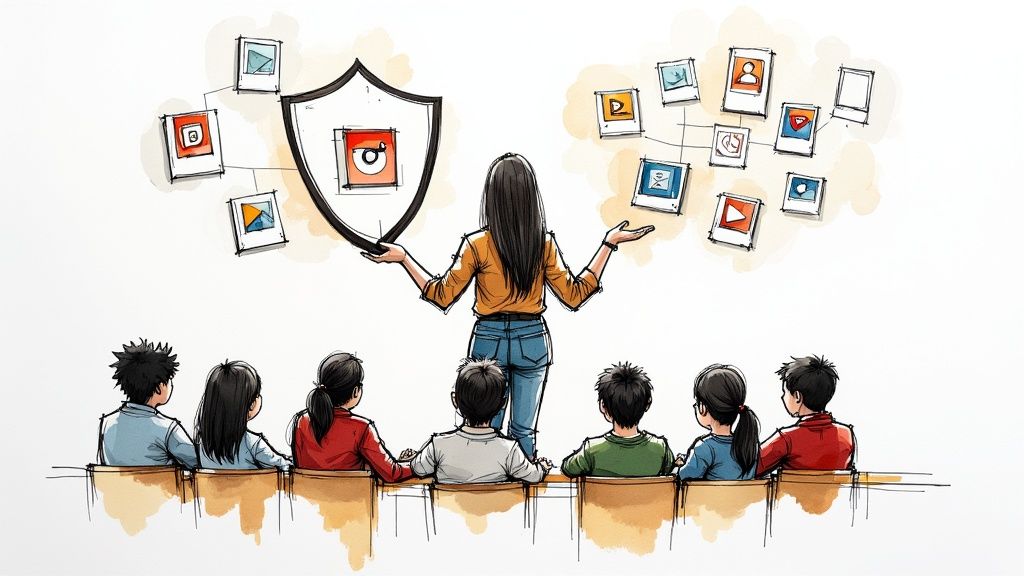
While the benefits are compelling, a smart strategy for social media and schools means looking the challenges straight in the eye. Ignoring the risks is like planning a field trip without a first-aid kit—it leaves your community unprepared and vulnerable. When you treat these issues as a matter of risk management, you can get ahead of them instead of just cleaning up messes.
The biggest concern, always, is student safety. Let's be honest: digital platforms can become breeding grounds for cyberbullying, privacy breaches, and exposure to content no child should see. These aren't just online problems; they spill over into the real world, affecting student well-being and the entire classroom environment. A school's duty to provide a safe space absolutely extends to its digital campus.
Protecting Students and Reputation
Beyond individual safety, your school's hard-earned reputation is on the line. On social media, misinformation spreads in a heartbeat, and a minor misunderstanding can escalate into a full-blown crisis before you’ve even had your morning coffee. One negative comment, a post taken out of context, or a misleading photo can erode the trust you've spent years building with families.
Your best defense is a good offense. That means having a plan in place:
- Clear Moderation Policies: Have firm, written-down rules for what’s acceptable on your channels. No ambiguity.
- Rapid Response Protocols: Who is on point when a crisis hits? Everyone should know their role for addressing negativity or false information.
- Digital Citizenship Education: Teach students the skills they need to spot and report harmful content. This empowers them to be part of the solution.
Getting this structure right is fundamental. Our complete guide to social media for schools dives much deeper into building these essential safeguards.
Managing Staff Interactions and Student Mental Health
Another tricky area to navigate is the interaction between staff and students online. Social media can blur professional lines in ways that create serious ethical and legal headaches. You absolutely need clear, enforceable policies that guide teachers on how to maintain professional boundaries in every online exchange.
Finally, we can't ignore the wider impact on student mental health. The sheer amount of time kids spend glued to their screens is a growing concern. Globally, people are spending over 14 billion hours on social media every single day, a figure that can have a direct impact on students' ability to focus, their academic work, and their social-emotional growth. You can see more data on this trend in Talkwalker's comprehensive social media statistics report.
Acknowledging these risks isn’t about scaring anyone away from social media. It’s about being prepared. Your best defense is a combination of strong policies, ongoing education for students and staff, and a commitment to fostering a positive and safe online community.
By facing these challenges head-on, you can build a more resilient social media program that not only protects students but also reinforces your school's core mission.
Creating a Social Media Policy That Actually Works
Once you understand the risks, the next logical step is moving from awareness to action. This is where a clear, comprehensive, and enforceable social media policy comes into play. Don't think of it as a list of "don'ts." Instead, see it as the playbook that empowers your team to use social media effectively while setting firm, understandable boundaries for everyone.
Without this guidance, staff, students, and even parents are left guessing what’s appropriate. That guesswork leads to inconsistency at best and preventable crises at worst. A strong policy is your first line of defense, making sure your school's online presence is both safe and powerful.
Defining Your Digital Guardrails
A truly effective policy needs to cover activity on official school accounts, but it also has to provide guidance for staff and students on their personal pages—especially when their activity connects back to the school. This document should be easy to find, read, and understand, so try to keep the legal jargon to a minimum.
You'll want to start by outlining the core components. We offer a deep dive in our complete guide here: https://blog.marcomsociety.org/social-media-policy-for-schools/. For now, think about covering these key areas:
- Account Management: Who holds the keys? Clearly define who is authorized to create accounts, post content, and speak on behalf of the school.
- Content Guidelines: What’s our voice? Establish rules for tone and branding to keep your messaging consistent and professional.
- Engagement Protocols: How do we respond? Create a clear flowchart for handling negative comments, direct messages, and potential online bullying.
- Privacy and Permissions: How do we protect our students? Detail the exact procedures for using student photos and names, ensuring you're fully compliant with regulations like FERPA and COPPA.
A policy is only as good as its relevance. It has to be a living document, reviewed and updated regularly to keep pace with new platforms and evolving online behaviors. An annual review is a good place to start.
Part of building out your policy involves defining your online personality. Creating strong social media brand guidelines is the key to maintaining a consistent voice and look across all your channels.
Essential Components of a School Social Media Policy
To help you get started, here's a checklist of the critical elements every school or district's social media policy should include. A well-defined policy like this provides the clarity, safety, and legal footing your team needs.
| Policy Component | Key Considerations |
|---|---|
| Purpose & Scope | Clearly state why the policy exists and who it applies to (e.g., staff, students, volunteers). |
| Account Ownership & Access | Define who can create official accounts and establish a secure process for managing login credentials. |
| Content Standards | Outline acceptable and prohibited content, including rules on tone, accuracy, and brand voice. |
| Student Privacy | Detail specific rules for using student images, names, and work, ensuring FERPA/COPPA compliance. |
| Staff Personal Use | Provide clear guidance for staff on professional boundaries and their conduct on personal accounts. |
| Engagement & Moderation | Set protocols for responding to comments, managing crises, and handling harassment or bullying. |
| Copyright & IP | Explain rules for using third-party content (music, photos) and sharing school-owned intellectual property. |
| Consequences | Clearly state the repercussions for violating the policy for both staff and students. |
Putting these pieces together creates a comprehensive framework that protects your school community while still allowing you to connect and engage online.
This diagram shows how the core pillars of social media governance fit together in a school setting.
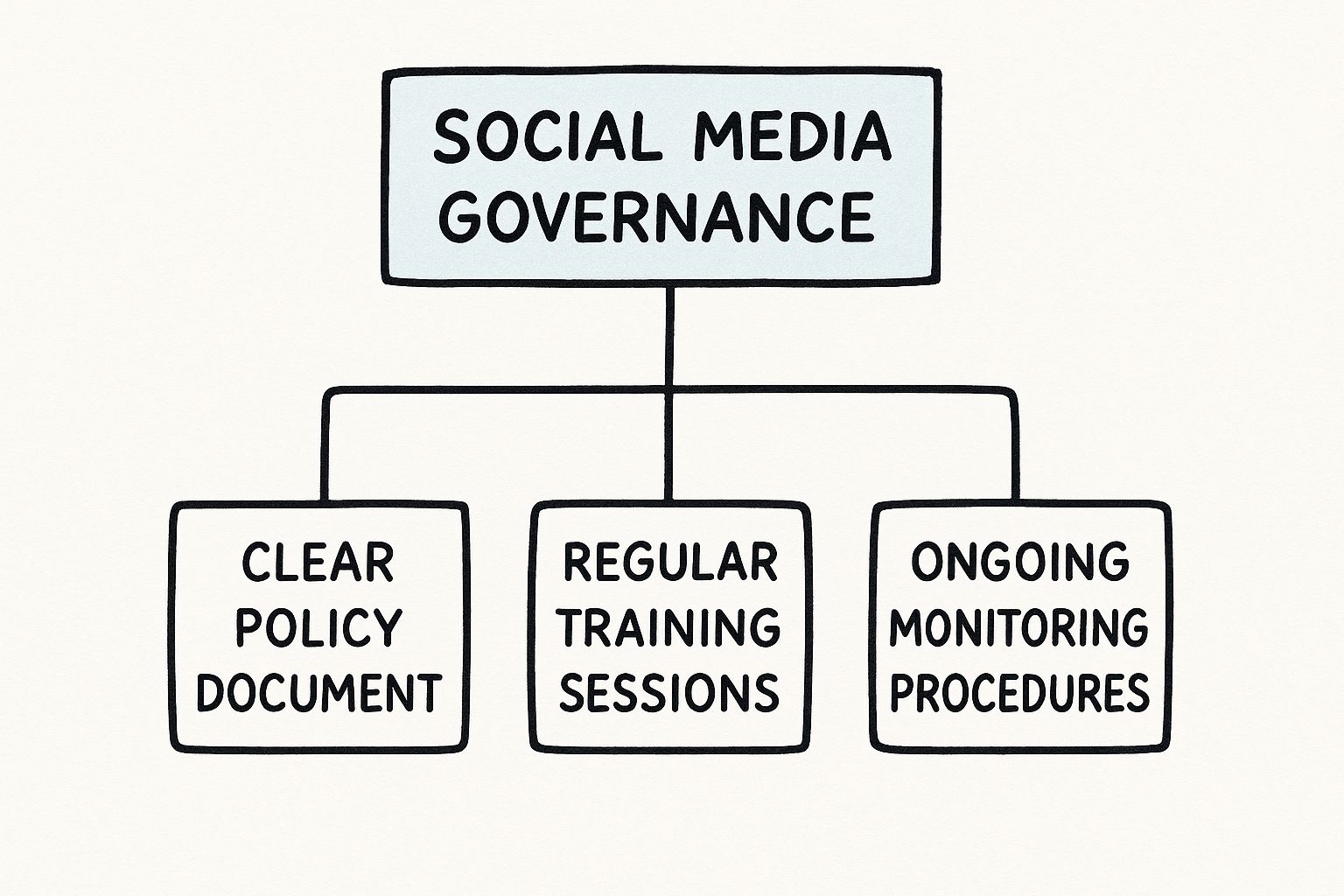
As you can see, a solid policy document is the foundation. But for it to work, it has to be supported by ongoing training and active monitoring. This three-legged stool approach ensures your guidelines are actually understood, followed, and adapted as things change.
Developing a Content Plan That Resonates with Your Audience

If your social media policy sets the guardrails, your content plan is the road map. Without one, your school's social media can quickly become a disjointed collection of random posts. A solid plan turns that feed into a purposeful story that reflects your school's mission and truly connects with your community.
The first step is figuring out who you're talking to and where they spend their time online. Each social media platform has its own vibe, its own audience, and its own purpose. Simply blasting the same message across every channel is like trying to give the same speech to a room of kindergarteners and a room of high school seniors—it just won’t land.
You have to tailor your content to fit the platform.
Matching Platforms to Your People
Think of each social media platform as a different room in your school, each one built for a specific group or activity. A smart approach to social media and schools means meeting your audience where they already are with content they'll actually find interesting and useful.
Here’s a simple way to think about it:
- Facebook for Current Families: This is your community bulletin board. It’s the perfect spot for detailed announcements, reminders about upcoming events, photo albums from the science fair, and celebrating classroom wins. Your current parents live here.
- Instagram for Prospective Families: Instagram is your school’s visual highlight reel. Use stunning photos and snappy, engaging Reels to tell a compelling story about your culture, your campus, and what makes your programs special. This is where you make a great first impression on families who are still shopping around.
- LinkedIn for Professional Connections: This is where you build your school’s professional brand. Share major institutional achievements, highlight the expertise of your faculty, post job openings, and connect with alumni and potential community partners.
This targeted strategy makes sure your message isn't just broadcast into the void—it's received by the people who care most. It turns your social channels from a megaphone into a powerful engine for building a real community.
A huge part of a successful content strategy is simply staying organized. You can make your life a lot easier by creating an effective social media content calendar.
Building Your Content Pillars
To get off the daily "what should I post today?" hamster wheel, build your strategy around content pillars. These are three to five core themes that tie directly back to your school's mission and values. Think of them as the main story arcs you'll return to again and again.
For example, your school's pillars might be:
- Student Success Stories: Highlighting big wins in academics, sports, and the arts.
- Faculty and Staff Spotlights: Introducing the incredible people who make your school a special place.
- Innovative Learning in Action: Showing off cool classroom projects, new tech, and unique teaching methods.
- Community and Culture: Capturing the spirit of school events, beloved traditions, and the energy of everyday life on campus.
When you focus on these pillars, you start to build a consistent and authentic narrative. You’re not just posting content; you’re telling your school’s story in a way that truly connects with every part of your audience.
Making Sure No Family Is Left Behind in Your Communication Strategy
A solid social media plan for your school can't just be about reaching the most connected families—it has to be about reaching every family. If you're relying only on digital channels to get the word out, you're unintentionally creating a gap, leaving behind families with limited internet access or those who aren't comfortable with the technology.
This isn't just a hypothetical problem. As of early 2025, a staggering 2.57 billion people around the world were still offline. That's 31.3 percent of the global population. This digital divide is a real barrier for students and parents who need access to online resources and important school updates. The Digital 2025 Global Statshot Report really puts a spotlight on the full scale of this issue.
When we assume every parent saw that Facebook post or caught that Instagram story, we risk creating an information gap that frays the fabric of our school community.
Building a Bridge Over the Digital Divide
To keep every family in the loop, your communication plan needs to be more than just digital. It should be a thoughtful mix of new and old-school methods. Think of it as a safety net with multiple layers, ensuring no one slips through the cracks. This isn't just about being fair; it's about building trust by showing you're committed to reaching everyone, wherever they are.
Here are a few simple but powerful ways to do it:
- Follow a post with a text. When you share something critical like a snow day announcement or parent-teacher conference sign-ups, send a district-wide text message right after.
- Use automated phone calls. A quick pre-recorded call is a reliable way to get important reminders to households that may not have smartphones or consistent internet.
- Send home a good old-fashioned flyer. For big events or important policy updates, a piece of paper in a student's backpack is still one of the most effective ways to make sure the message gets home.
A truly effective digital strategy is one that understands its own blind spots. When you back up your social media efforts with non-digital tools, you build a stronger, more equitable communication system that serves your entire community—not just the most tech-savvy members.
Common Questions About Social Media in Schools
No matter how well you plan, tricky situations are part of the job for any MarCom leader. And when it comes to the fast-moving world of social media, having answers ready for the tough questions is the key to responding with confidence.
Think of this section as your quick-reference guide. These aren't just canned answers; they're grounded in the core principles of a healthy social media program: protecting students, staying transparent, and always being strategic. If you keep those ideas front and center, you can handle just about anything that comes your way.
How Should We Handle Negative Comments or Cyberbullying?
The single most important thing here is to have a clear, consistent moderation policy that everyone on your team understands. The golden rule? Never react emotionally. Always follow the protocol.
When you get general negative comments or criticism, the best move is to respond publicly with a calm, professional offer to take the conversation offline. A simple, "We're sorry to hear about your experience. Please email us at [email] or call [phone number] so we can address this directly," works wonders. This does two things at once: it takes the heat out of the public thread and shows your entire community that you're responsive. Whatever you do, do not delete criticism unless it clearly violates your published policy (like using profanity or making personal attacks).
Cyberbullying is a different beast and demands an immediate, firm response.
- Delete or Hide: Your first priority is to protect the person being targeted. Remove the harmful content immediately.
- Document: Before you do anything else, grab a screenshot of the comment and the user's profile. This is your evidence.
- Block and Report: Block the user from your page and report their behavior directly to the platform.
- Escalate: Trigger your school's official anti-bullying protocol. This is the point where you may need to bring in administrators, parents, or even local authorities.
What Are the Legal Rules for Using Student Photos Online?
Student privacy is non-negotiable. You absolutely have to comply with laws like the Family Educational Rights and Privacy Act (FERPA), and the best way to do that is with explicit, written consent.
Make a media release form part of your registration packet at the start of every school year. It needs to be crystal clear, specifically mentioning that student photos and videos may appear on the school’s social media channels. From there, you must maintain a simple, accessible list of all students whose parents have opted out. Everyone who posts on your school’s behalf needs to check that list, every single time.
For an extra layer of safety, make it a habit to avoid pairing a student’s full name with their photo. It's much safer to use first names only or go with general captions like, "Our fifth graders put on an amazing show at the science fair!"
Which Social Media Platform Is Best for Our School?
There’s no magic answer here. The "best" platform is wherever your audience actually spends their time. A one-size-fits-all approach just doesn't work. You have to meet your different audiences where they are.
- Facebook: This is still home base for many of your current parents and staff. It’s perfect for detailed updates, photo albums from school events, and important announcements.
- Instagram: Think of this as your school's visual portfolio. It's all about showcasing your culture with high-quality photos and Reels, making it a powerful tool for attracting prospective families.
- X (formerly Twitter): This is for fast, bite-sized information. Use it for quick announcements, live updates from the big game, and sharing news with local media outlets.
- LinkedIn: This is your professional stage. It's the right place to post about major school achievements, recruit new staff, and highlight the expertise of your faculty to build institutional credibility.
Most schools get the best results by using a mix of platforms, tailoring the content to fit the audience on each one. It's the surest way to build a truly connected community.
Ready to connect with a community of peers who are navigating these same challenges? The MarCom Society offers expert-led workshops, collaborative sessions, and a private network of K-12 professionals dedicated to elevating school communications. Join us to refine your strategy and lead with confidence at https://marcomsociety.org.









