
It’s time to face the facts: social media isn't just creeping into our schools anymore. It's already here, fundamentally reshaping how we communicate, learn, and build our school culture. When we get it right, it's a game-changer for creating a connected, vibrant community. But let's be honest—without a smart plan, it can also become a massive headache, affecting student focus and well-being.
The New Reality of Social Media in Schools
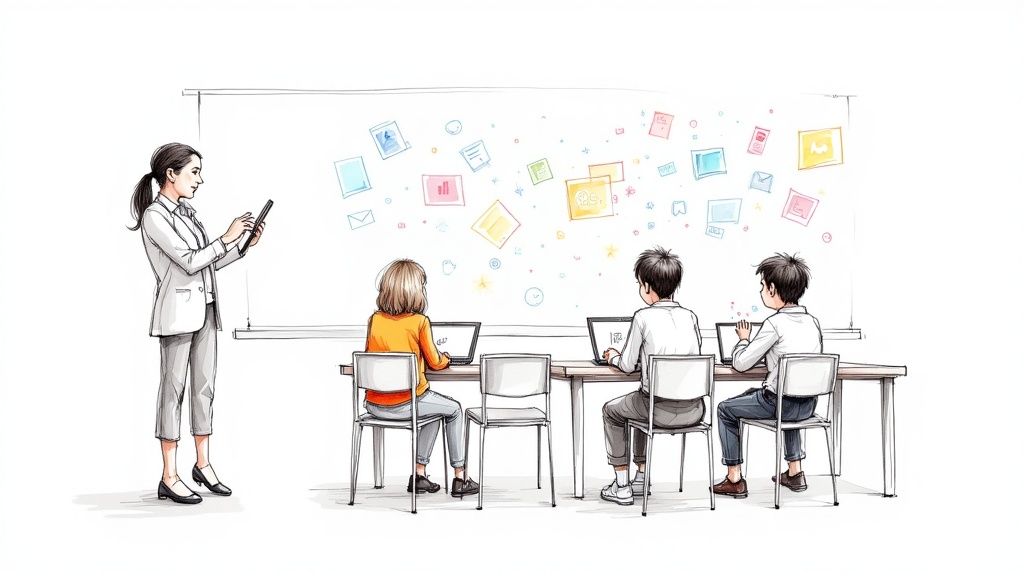
Thinking about social media in schools can feel like staring down a tidal wave. It's no longer just a whispered distraction in the hallway; it’s a powerful current that has completely changed how schools have to operate. This guide isn't about debating if social media belongs in education. That ship has sailed. Instead, we’re going to talk about how to manage it effectively.
Think of social media as any other powerful tool in your school. In the right hands, it can build incredible things—a strong community, engaged parents, celebrated students. In the wrong hands, or with no guidance at all, it can cause real problems. The only way forward is with a proactive, thoughtful strategy, not a reactive, panicked one.
A Dual-Edged Sword for Education
There are two sides to this coin. On one side, social media is an incredible asset for keeping parents in the loop, showcasing what makes your school special, and even bringing lessons to life in the classroom. On the other, it opens the door to very real challenges around student mental health, classroom focus, and online safety. We have to walk a fine line, and that requires a balanced perspective.
This new reality means schools can't afford to be silent online. To connect with our communities, we have to be part of the conversation. Platforms like Instagram, TikTok, and Facebook aren't just for fun anymore; they are essential communication channels. We're seeing a clear trend that an active, positive presence is crucial for engaging families—both current and prospective—especially as short-form video continues to dominate. You can dig deeper into social media trends in education to see just how much things are shifting.
The core challenge isn’t about banning social media from school life. It’s about weaving it in with purpose, turning potential distractions into genuine opportunities for connection and learning.
Setting the Stage for Success
To get this right, schools need a solid framework that encourages positive use while protecting against the risks. This is about more than just a list of "don'ts." It's about building a genuine culture of digital responsibility.
Here’s where we need to focus:
- Clear Policies: Everyone—students, staff, and parents—needs to know the rules of the road. What's acceptable? What's not? It has to be crystal clear.
- Proactive Education: We can't just expect students to know how to act online. We have to teach them digital citizenship so they can navigate the online world safely and ethically.
- Strategic Communication: Let's use our official school accounts to tell our story. We can build a positive brand, celebrate student wins, and keep our community informed.
- Parental Partnership: This isn't a job for schools alone. We need to team up with parents to make sure the messages about online behavior are consistent at home and at school.
By tackling these areas head-on, we can create a digital environment that is both safe and productive. The next sections will get into the practical, actionable strategies you can use to harness the good, confront the risks, and build a comprehensive social media plan for your school.
Bringing Social Media into Your School's Strategy
It's easy to get bogged down in the risks, but focusing only on the negatives of social media in schools is like owning a library and only worrying about paper cuts. When you approach these platforms with a clear purpose, they can completely change how your school connects with its community, celebrates students, and lives out its mission.
Think of your school's social media presence as its digital town square. It’s where parents, students, staff, and neighbors can come together to share news, cheer on achievements, and build a real sense of belonging. This isn't just about pushing out announcements; it's about creating a living, breathing extension of your school's culture online.
The real aim is to move from just broadcasting information to actually building a community. This shift turns passive followers into genuine advocates and makes a simple school page a source of pride and connection.
Building a Stronger School Community
One of the best things social media can do is strengthen the bond between home and school. We all know that when parents feel looped in and involved, students thrive. These platforms give you a direct, immediate, and visual way to bring parents right into the day-to-day life of the school.
A private Facebook group, for example, can be a fantastic tool for a specific grade level. Teachers can share photos from a science experiment, post a quick reminder about an upcoming field trip, or put out a call for parent volunteers. It creates a secure, dedicated space for communication that feels much more personal than a generic mass email.
In the same way, an Instagram account can become a visual scrapbook of everything that makes your school special. From photos of student art and big wins on the sports field to short clips from the school play, every post helps paint a picture of your school's vibrant identity. You're building school pride one snapshot at a time.
Improving Communication and Engagement
Good communication is the foundation of any successful school. Social media gives you the tools to make that communication more dynamic and responsive—which is crucial when 79% of people expect a reply to their feedback within 24 hours.
When you actively engage with your community online—by answering questions, acknowledging concerns, and celebrating positive comments—you're showing that you listen. That builds incredible trust and lets families know their voices matter.
Here are a few practical ideas to get the conversation started:
- Host Live Q&As: Use Facebook Live or Instagram Live for a chat with the principal or department heads before a new school year or during a big event.
- Run Fun Polls: Use Instagram Stories or Twitter polls to get feedback on lighthearted topics, like the theme for the next spirit week.
- Spotlight Your People: Create regular features like "Teacher Tuesdays" or "Student Spotlights" to highlight the amazing individuals who make your school what it is.
These kinds of activities create a genuine two-way conversation, making your community feel like they're part of the story, not just watching from the sidelines.
Unlocking New Ways to Learn
Beyond building community, social media can also be a surprisingly powerful teaching tool when brought into the classroom the right way. It’s a chance to meet students on their own turf and connect what they're learning to the digital world they already know so well.
Imagine a history class creating a Twitter account for a historical figure, tweeting key events from their perspective. Or a foreign language class using a platform like Flip to connect with a classroom in another country and practice their speaking skills.
The secret is to wrap these activities in clear learning goals and ground rules. When you do that, social media in schools stops being a distraction and becomes a space for creativity, collaboration, and deeper understanding. It's one more way to prepare students for the connected world they'll be entering.
Confronting and Mitigating Digital Risks
Let’s be honest. Handing students social media without talking about the risks is like giving them car keys without a lesson on stop signs. While these platforms can be incredible tools for connection, we can't just ignore the tough stuff—cyberbullying, privacy issues, and the real impact on student mental health. The goal isn’t to scare anyone, but to build a digital safety net.
The challenges are very real. Students today are navigating a world of instant misinformation and the crushing weight of online social comparison. Our job is to give them practical, tested strategies to make smart, safe choices for themselves.
It all starts with getting a clear picture of what they’re up against.
Identifying the Core Challenges
The dangers students face online are complex and can have lasting effects. One of the most prominent is cyberbullying, which uses social media to extend harassment beyond school walls, invading what should be a student's safe space at home. This relentless bullying is directly linked to higher rates of anxiety and depression in teenagers.
Student privacy is another huge piece of the puzzle. It’s crucial to get up to speed with expert tips on social media privacy concerns to help shield students from having their data misused or being contacted by strangers. Without guidance, it's all too easy for them to overshare personal details, leaving them vulnerable.
The real work for educators isn't just about policing what students do online. It's about fostering digital resilience—teaching them how to think critically about what they see, manage their digital footprint, and stand up for themselves and others.
The image below gives us a snapshot of how students are already using these platforms for school, which underscores why we need to be proactive about the risks.

As you can see, social media is already woven into their academic lives. That makes it our responsibility to address the flip side of the coin.
The Impact on Student Focus and Mental Health
Beyond direct threats, the always-on nature of social media takes a toll on a student's ability to focus and their overall well-being. These apps are designed to keep you scrolling, with a constant barrage of notifications and algorithm-fed content that can shatter concentration.
This isn't just a feeling; the data backs it up. One 2025 international study revealed that 68% of young people felt social media hurt their ability to concentrate on schoolwork. What’s more, 65% of them worried their social media habits could compromise their future academic or career opportunities.
This environment also creates a breeding ground for social comparison. Students are constantly measuring their own lives against the polished highlight reels of their peers, which can trigger feelings of inadequacy, anxiety, and low self-esteem that follow them right into the classroom.
A Practical Plan for Mitigation
Tackling these issues requires more than just a new rule in the handbook. It demands a proactive strategy that combines policy, education, and a shift in school culture. For a more comprehensive overview, you can check out https://blog.marcomsociety.org/social-media-and-schools/.
To get started, here are a few actionable steps your school can implement:
- Launch a Digital Citizenship Curriculum: We can't just assume students instinctively know how to act online. A formal curriculum can teach critical skills like online ethics, spotting misinformation, protecting personal data, and showing empathy online.
- Create Clear and Simple Reporting Channels: When something goes wrong, students and parents need a straightforward, confidential way to report cyberbullying or other concerns. It's just as important to have a clear protocol to ensure every report is taken seriously and handled quickly.
- Bring Parents on Board: Treat parents as your partners. Host workshops and share resources that help them set screen-time rules, use parental controls, and simply talk to their kids about being safe online.
- Promote Mental Health Resources: Make sure every student knows where they can turn for support. Talking about digital wellness in health class and making counselors easily accessible provides a vital safety net.
By weaving these practical steps into your school's fabric, you can create a culture where students don't just fear the risks—they feel empowered to navigate the digital world with confidence and skill.
Building a Practical School Social media Policy
A strong social media policy is your school's best defense against digital chaos. Think of it as the constitution for your school's online community—a foundational document that spells out the rights, responsibilities, and rules of engagement for everyone. Flying blind without one means you're just reacting to problems, which almost always leads to inconsistent enforcement and a whole lot of confusion.
A truly effective policy is more than just a list of "don'ts." It's a proactive guide that empowers everyone to use social media in schools in a smart, responsible way. By setting clear and fair expectations for students, staff, and even parents, you turn a world of gray areas into black-and-white clarity. This is the document that allows your school to tap into the good stuff social media offers while confidently managing the risks.
The goal here isn't to create a legal tome that gathers dust on a shelf. It's about building a practical, comprehensive guide that actually works in the real world—one that protects your students, your staff, and your school's reputation.
Defining Acceptable Use for Everyone
At the heart of any solid policy is a clear definition of acceptable use. This is where you draw the line between what is and isn't appropriate online behavior when it connects back to your school. You absolutely need separate, specific guidelines for different groups, because a teacher's responsibilities online are vastly different from a student's.
For students, this section should cover the basics of digital citizenship:
- Privacy and Personal Information: Simple rules on what never to share online, like home addresses, phone numbers, or detailed class schedules.
- Respectful Communication: No-nonsense rules against cyberbullying, hate speech, and harassing other students or staff.
- Academic Integrity: Clear policies that forbid using social media for cheating or passing around test answers.
For staff, the guidelines have to be even more buttoned-up:
- Professional Boundaries: Hard-and-fast rules about interacting with students on personal social media accounts. All communication should stay on official school channels.
- Confidentiality: A firm reminder that sharing confidential student information or internal school matters online is a serious breach of trust.
- Representing the School: Clarifying that, like it or not, staff are seen as representatives of the school, even on their personal profiles after hours.
Creating these distinct guidelines ensures everyone knows exactly what's expected of them, leaving no room for excuses or misunderstandings.
Managing Official School Accounts
Your school's official social media accounts are your digital front porch—they need to be managed with care and a consistent voice that reflects your school's values. A good policy nails down exactly who is in charge and what the procedures are.
First, decide who holds the keys. The best approach is to limit posting access to a small, trained team of communications staff or administrators. This keeps the messaging on-brand and drastically cuts down the risk of an old, forgotten password falling into the wrong hands.
A crucial element of managing official accounts is having a pre-approved crisis response plan. When negative comments or a crisis emerge, your team needs a playbook to follow, not a panic-driven scramble. This ensures a calm, measured, and effective response.
Your policy should also detail your comment moderation strategy. While the gut reaction might be to delete every negative comment, that can backfire and destroy trust. A much better tactic is to have clear rules for removing comments that are profane, contain personal attacks, or spread misinformation, while responding constructively to legitimate criticism. It shows you're actually listening. For a closer look at this, you can explore detailed strategies in this helpful social media policy for schools guide.
Outlining Consequences and Reporting
Let's be honest: a policy without consequences is just a suggestion. For your guidelines to have any real teeth, they must clearly state what happens when someone breaks the rules. These consequences should be tiered based on the severity of the offense, from a simple warning for a minor slip-up to suspension or other disciplinary action for serious issues like cyberbullying.
Just as important is a clear and accessible reporting system. Students and parents need to know exactly who to go to if they see or experience something that violates the policy. Make the process simple and confidential, and ensure everyone knows their concerns will be taken seriously and investigated promptly.
When you put in the work to create a policy that is clear, collaborative, and enforceable, you’re building a framework that protects your entire school community. It's the essential step in turning social media from a source of anxiety into a powerful tool for connection and celebration.
Bringing Social Media into the Classroom
Ready to turn social media in schools from a distraction into a dynamic learning tool? The secret is to shift the focus from passive scrolling to active creating. When you build lessons with clear academic goals, the platforms your students are already on can become powerful extensions of the classroom.
This isn't about giving students a free pass to browse their feeds. It's a deliberate move to meet them where they are, using their digital instincts to drive deeper understanding. The idea is to make learning more relevant and interactive by speaking their language.
Choosing the Right Platform for Your Lesson
The first, most critical step is matching the platform to the learning goal. Not every social network fits every subject. You have to think like a content strategist—what tool is best for the job? This ensures the technology supports the lesson, not the other way around.
Think about it this way:
- History & English: Imagine a class-run Twitter (now X) account "live-tweeting" a major historical event. Students could take on the personas of different figures, forcing them to distill key moments into 280 characters. It’s a fantastic way to teach concise writing and historical empathy.
- Science & Math: How do you explain photosynthesis or a complex theorem? Challenge students to break it down into a 60-second TikTok-style video. The format forces them to simplify complex ideas, which is the ultimate test of whether they've truly mastered the concept.
- Art & Music: Instagram is a natural fit for a visual portfolio. Students can display their artwork, document their creative process with behind-the-scenes shots, or post short performance clips. They learn how to curate and present their work to an audience.
- Foreign Languages: A private class Instagram account is perfect for daily vocabulary challenges. Each student could post a photo that represents a new word, creating a visual dictionary that makes learning a fun, collaborative game.
This approach makes abstract concepts tangible and shareable. If you're looking for more inspiration, you can find a ton of other great social media ideas for schools.
Setting Clear Expectations and Ground Rules
Let's be realistic: bringing social media into the classroom requires a solid framework to keep things on track. Without clear ground rules, even the most brilliant lesson plan can go sideways. You absolutely must establish the rules of engagement before anyone posts anything.
These rules need to be simple, direct, and non-negotiable. Think about creating a project-specific acceptable use policy covering everything from respectful communication to citing sources properly. The goal is to create a digital space that feels safe, focused, and productive.
The sheer scale of social media use shows why this is so important. Globally, people spend more than 14 billion hours daily on these platforms. With over three billion users, these online spaces are a huge part of your students' lives. It’s our job to teach them how to navigate that world with purpose. We also know that platform choice depends on age. For instance, among U.S. adults aged 18-29, YouTube (93%), Instagram (76%), and Snapchat (65%) are dominant. Understanding these trends helps you meet students on their turf.
The objective is to model responsible digital citizenship. By setting boundaries within a controlled academic project, you're teaching students transferable skills for managing their online interactions long after the lesson is over.
Ultimately, using social media in schools effectively comes down to intentional design. When you carefully select platforms, set firm boundaries, and tie every activity directly to a curriculum goal, you can turn a classroom liability into an incredible asset for genuine student engagement.
Fostering a Culture of Digital Citizenship
When it's all said and done, successfully bringing social media into schools isn't really about the apps or the policies. It's about the people. The strategies, the rules, and the classroom lessons are all just scaffolding for a much bigger, more important goal: building a genuine culture of digital citizenship.
This requires a fundamental shift in our thinking. We need to move away from a mindset of just preventing problems and toward proactively preparing students for the world they already live in. The digital world isn't some far-off future; it's their present reality. Our job is to give them the tools to navigate it with wisdom, kindness, and strength.
The True Measure of Success
The real victory here isn't a silent comments section or a picture-perfect school Instagram. Success is watching students walk across the graduation stage ready to be thoughtful, ethical, and engaged members of a deeply connected world.
It's about teaching them how to:
- Think Critically: To pause and question what they see online, spot bias, and know the difference between a solid source and clickbait.
- Act Ethically: To remember there's a human on the other side of the screen, stand up when they see someone being targeted, and add something positive to the conversation.
- Live Resiliently: To thoughtfully manage their digital footprint, protect their own privacy, and find a healthy balance between their online and offline lives.
The most important outcome is not compliance, but competence. We want students who follow the rules because they understand the why behind them, not just because they're afraid of getting in trouble.
This long-term vision changes our role from gatekeepers to mentors. It's a huge responsibility, but it's also an incredible opportunity.
By taking this on, educators are doing something far more meaningful than just managing another communication channel. You are shaping the character of the next generation of citizens, making sure they are not just passive consumers of content, but conscientious creators and leaders, no matter what they go on to do.
Frequently Asked Questions
It's natural to have questions when you're navigating the ins and outs of social media in schools. Administrators, teachers, and parents all have important concerns, from the daily grind of managing posts to figuring out what to do when things get tricky. Let's tackle some of the most common questions head-on.
What Should We Do About Negative Comments?
When a negative comment pops up, our first instinct is often to just delete it and make it go away. It’s a tempting thought, but it almost always backfires.
Deleting a comment can pour fuel on the fire. The person who posted it feels ignored, which can make them even angrier, and they might just post again—only louder this time. It also sends a bad message to your wider community, suggesting that you hide from any and all criticism.
The best approach is to respond, right there in public, with a calm and professional tone. Acknowledge their concern so they feel heard, and then offer to take the conversation offline to a more private space like email or a phone call. This approach shows you're responsive and willing to help, all while protecting everyone's privacy.
Of course, there are exceptions. Any comment that is profane, threatening, or constitutes hate speech should be deleted immediately, no questions asked. This should be spelled out in your school's policy. On platforms like Facebook, you also have the option to "hide" a comment, which is a good middle ground—the original poster and their friends can still see it, but it’s hidden from the public feed.
How Can We Keep Staff and Students Safe?
Keeping everyone safe online has to be the number one priority, and it starts with setting firm professional boundaries. Your school’s social media policy needs to be crystal clear: staff should not be “friending” or following students on their personal social media accounts. All communication should happen on official school platforms, period.
For students, education is everything. We need to actively teach them how to protect themselves online. This includes:
- Guarding Personal Information: Drill it into them never to post sensitive details like their home address, phone number, or where they are at any given moment.
- Using Strong Privacy Settings: Don't just tell them to use privacy settings; show them how. Walk them through locking down their profiles so they are in control of who sees what they post.
- Spotting Red Flags: Teach them what a suspicious message or friend request looks like and empower them to report anything that makes them feel uncomfortable.
What Is the Teacher's Role in Moderation?
When teachers bring social media into their classroom—say, with a private class Facebook group or an educational Instagram account—they are the moderators of that space. It’s their job to keep the discussion on track, respectful, and aligned with the lesson.
But they shouldn't be responsible for moderating the entire school's social media presence. That's a job for a dedicated communications person or an administrator. This ensures the school has one consistent voice, especially when handling sensitive issues or a full-blown crisis.
This split in duties is key. It lets teachers focus on what they do best—teaching—while a central team manages the bigger picture of community engagement. When everyone knows their role, you create a much safer and more effective online environment.
At The MarCom Society, we help K-12 marketing and communications pros build smart, safe digital strategies. We offer the resources, expert advice, and peer support you need to navigate these exact challenges. Join our community for exclusive workshops and connect with a network of colleagues who get it. Learn more at https://marcomsociety.org.









