
A social media school isn’t a brick-and-mortar building; it's a game-changing marketing strategy. It transforms your entire school community—from students and staff to parents and alumni—into a dynamic team of storytellers. This approach moves beyond the single marketing manager to build a vibrant, authentic online presence driven by the people who know your school best.
So, What Is a Social Media School, Really?
Imagine your school's social media feeds moving from a one-way monologue to a lively, genuine conversation. That’s the essence of the social media school model.
Instead of relying only on perfectly polished updates from a central office, this approach empowers everyone in your community to capture and share real, day-in-the-life moments. It’s a fundamental shift in how your school thinks about digital communications.
Think of it this way: a traditional strategy is like a solo performance, with one person trying to play all the instruments. A social media school, on the other hand, is a full orchestra. Every member contributes their unique sound, and together, they create a much richer, more compelling story about your school's culture, achievements, and spirit.
Why This Model Is a Must-Have Today
Today's families, especially those led by millennials and Gen Z parents, are looking for transparency and authentic connection. They tune out corporate-style marketing and are far more interested in seeing the genuine experiences that define a school.
This model speaks directly to that desire by showcasing real moments from real people. These small, authentic stories are incredibly powerful—they build trust and offer a true window into what life is really like on your campus.
The whole strategy is about decentralizing your storytelling to create a more authentic and engaging brand narrative. You're turning passive followers into active participants, which builds a stronger, more connected community both online and off.
The Untapped Power of Community Voices
The social media school model taps into your most powerful and often underused resource: your community's passion.
When a student shares a video from the science fair, a teacher posts a photo of a classroom breakthrough, or a parent tweets about a great basketball game, they’re creating powerful social proof. These organic, user-generated posts resonate far more deeply with prospective families than any official announcement ever could.
To get started, it’s crucial to understand foundational concepts, like the distinction between social listening and monitoring, to ensure your strategy is built on solid ground. This community-first approach couldn't be more relevant, especially with over 5 billion people using social media globally in 2024. That massive audience presents an incredible opportunity for schools to build a powerful, community-driven presence that truly stands out. You can discover more insights about social media's growth on Statista.com.
The Three Pillars of a Thriving Program
A successful "social media school" doesn’t just happen. It's carefully built on a strategic foundation, and getting that foundation right is everything. Think of it like building a house; you need solid pillars to support the entire structure. For this model, there are three essential pillars that work together to create a program that's both dynamic and secure: Community Empowerment, Content Authenticity, and Strategic Oversight.
Getting a handle on these three concepts is the first step toward transforming your school’s online presence from a one-way broadcast into a lively community conversation. They provide the structure needed for a decentralized, community-driven marketing model to truly take off.
This infographic shows the shift perfectly—moving from a single person trying to do it all to a whole community of storytellers working together.
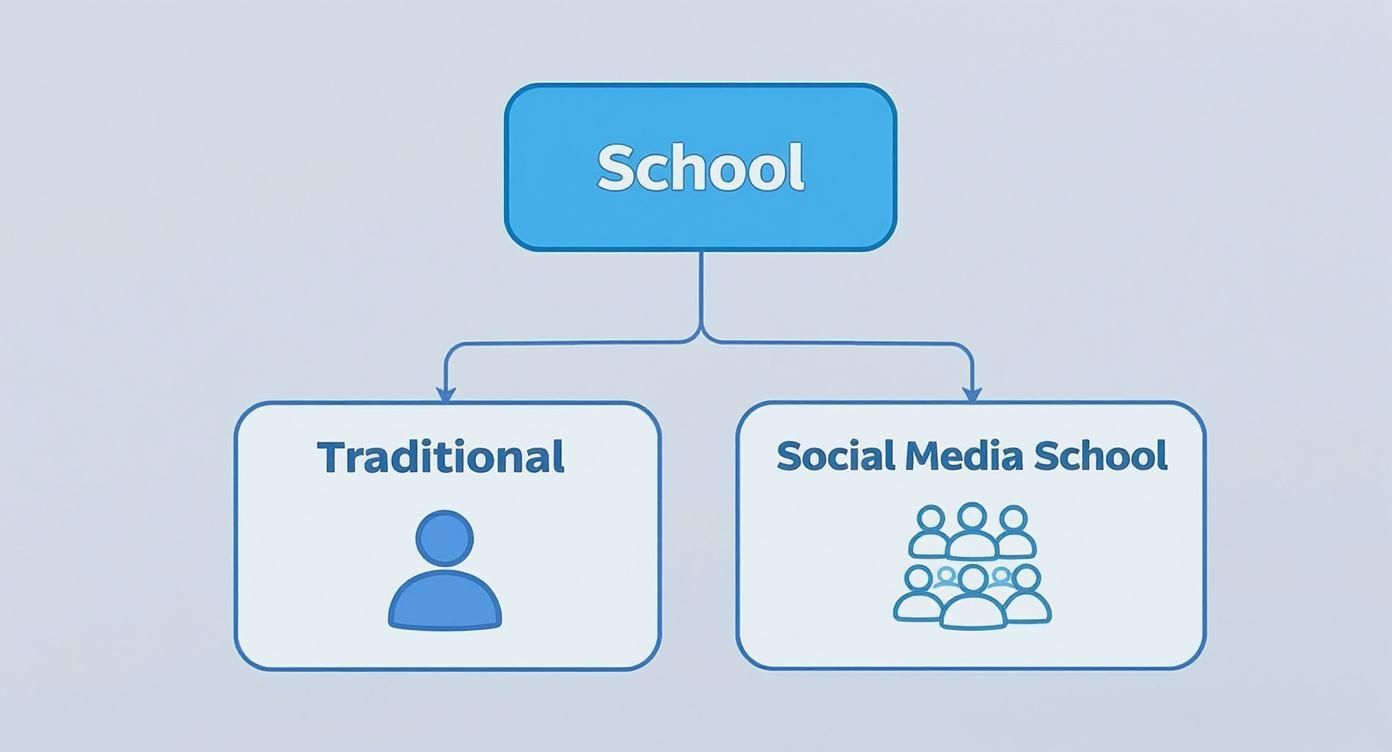
As you can see, the old way put all the pressure on one person. The social media school model, on the other hand, brings many contributors into the fold, creating something far more powerful.
Pillar 1: Community Empowerment
The first—and arguably most important—pillar is Community Empowerment. This is all about actively identifying, inspiring, and equipping members of your school community to become confident storytellers. That means everyone: students, teachers, staff, and even parents. The goal here is to help them shift from being passive consumers of school news to active participants in telling your school's story.
Empowerment really starts with a simple invitation. It means reaching out to all the different pockets of your school, from the robotics club to the theater department, and showing them how their unique stories fit into the bigger picture. Give them some simple tools, clear encouragement, and recognition for their efforts. Suddenly, creating content isn't just a marketing chore; it's a shared, celebrated community activity.
Pillar 2: Content Authenticity
Next up is Content Authenticity, which is the absolute heart and soul of this model. Today's families can spot overly polished, corporate-style marketing from a mile away, and frankly, they're tired of it. What really connects with them are the genuine, unscripted, and sometimes imperfect moments that define daily life at your school.
Just think about it. What truly captures the spirit of your campus? Is it the perfectly staged photo from a marketing shoot? Or is it a candid snapshot from the science fair, a blurry video of the winning goal at a soccer game, or a heartfelt post from a teacher celebrating a student's breakthrough?
Authenticity builds trust. When prospective families see real moments shared by real people, they get an honest glimpse into your school's culture, values, and community spirit. This kind of user-generated content is your most powerful marketing asset.
This approach just makes sense, as it lines up with how students already use these platforms. By 2025, an estimated 73% of college students will use social media for educational purposes, like collaborating on projects or finding learning materials. When you empower your community to share authentic content, you’re tapping into a behavior that already feels completely natural to them.
Pillar 3: Strategic Oversight
The final pillar, Strategic Oversight, provides the guardrails that keep your program on track and safe. I know, empowering dozens of creators can sound like a recipe for chaos. But with a clear framework, it becomes more like a well-conducted orchestra than a jumble of random noise. This is where your marketing team’s role evolves from being the sole content creator to the strategic director.
This oversight involves a few key components to ensure everything stays consistent and safe:
- Clear Guidelines: Create a simple, easy-to-understand set of rules for content. This should cover things like tone of voice, student privacy, and what makes a great post—without killing creativity.
- Simple Approval Workflows: Set up a straightforward process for submitting and approving content. It could be as easy as a shared Google Drive folder or a dedicated email address, just to ensure a final check before anything goes live.
- Unified Brand Voice: While you’re celebrating individual voices, they should all harmonize with the school's core mission and values. The director’s job is to make sure every post, no matter who creates it, feels like it belongs to your school.
When you bring these three pillars together, you create a powerful synergy. Community Empowerment fuels the program with passionate storytellers. Content Authenticity makes sure their stories are believable and engaging. And finally, Strategic Oversight guarantees that the collective effort is cohesive, on-brand, and effective.
To really see the difference, let’s look at how the traditional approach stacks up against the social media school model.
Comparing Traditional vs. Social Media School Models
This table breaks down the key operational and strategic differences, highlighting why shifting to a community-driven model can be so impactful.
| Aspect | Traditional Model | Social Media School Model |
|---|---|---|
| Content Creation | Centralized; done by 1-2 marketing staff. | Decentralized; sourced from students, staff, and parents. |
| Content Style | Polished, professional, and brand-focused. | Authentic, candid, and story-driven. |
| Voice & Tone | A single, official institutional voice. | A chorus of diverse, personal voices. |
| Volume & Frequency | Limited by staff bandwidth; often sporadic. | High volume; consistent stream of fresh content. |
| Community Role | Passive audience; consumers of content. | Active participants; co-creators of the school's story. |
| Goal of MarCom Team | To produce and publish all content. | To empower, guide, and curate community content. |
By building on this foundation, your school can create a much stronger social media and community engagement strategy. If you're looking for more tips, you can learn more about building community through social media in our article.
Building Your Social Media School Step by Step
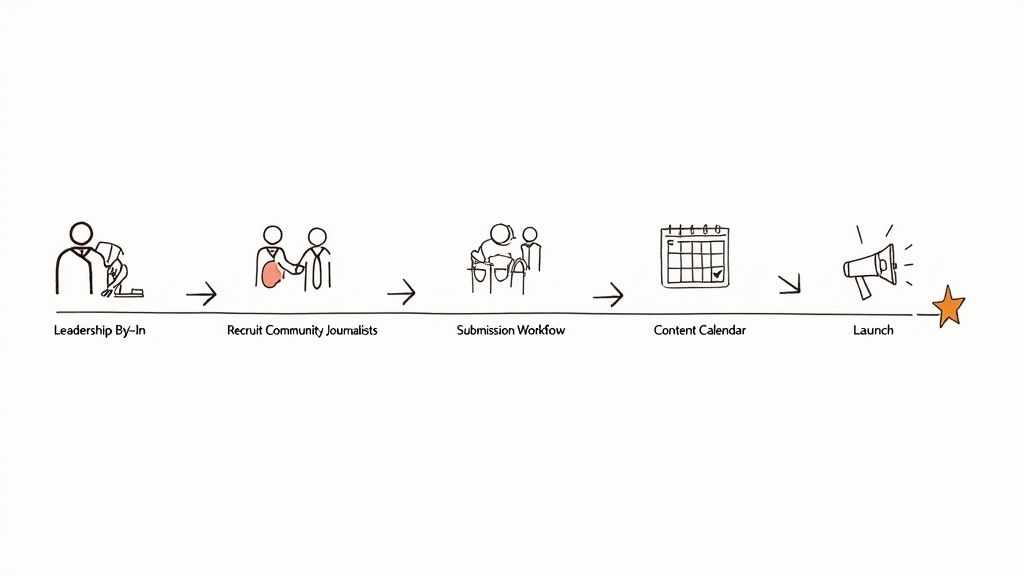
Shifting to a community-powered content model is a journey, not a sprint. This is your roadmap, broken down into manageable phases designed for busy school leaders. Follow these steps, and you can build a sustainable social media program from the ground up, turning your big idea into a vibrant reality.
The very first, and most critical, step is getting your school’s leadership on board. This isn’t just about getting a green light; it’s about turning them into champions for the program. You need to frame this as a strategic move that strengthens community ties and showcases what makes your school special—in a way that feels real and authentic.
Put together a quick presentation that highlights the wins: more engagement, genuine marketing stories, and a serious boost in school spirit. Just as important, be ready to tackle their concerns, like brand consistency and student privacy, head-on. Show them you’ve thought it through and have a solid plan.
Define Your Goals and Success Metrics
Before you can rally your community, you need to know why you’re rallying them. What does a "win" actually look like for your social media school? Your goals have to be specific, measurable, and tied directly to what your school is already trying to achieve with its marketing and communications.
Are you trying to get more applications? Boost parent engagement? Improve student retention? Whatever it is, define clear Key Performance Indicators (KPIs) so you can actually track your progress.
- Engagement Rate: Keep an eye on likes, comments, shares, and saves. This tells you what content is really hitting home.
- Website Clicks: How many people are clicking from social media over to your admissions page or school blog?
- Follower Growth: You’re looking for steady, organic growth on your main platforms, not just a one-time spike.
- User-Generated Content Volume: Set a realistic goal for how many photos, videos, and stories you want to receive from your community each month.
When you establish these metrics from day one, you’ll be able to prove the program’s value and make smart adjustments as you go.
Recruit Your Community Storytellers
Okay, leadership is on board and you know what you’re measuring. Now it’s time to assemble your team of storytellers. These are your volunteer "community journalists"—the students, faculty, and parents who will become the eyes and ears of your school.
Think about all the different pockets of your community. Reach out to the leaders of student clubs, department heads, coaches, and parent organizations. Explain what you're trying to do and ask them to nominate people who are passionate, reliable, and maybe already active on social media.
The goal isn’t to find professional photographers or writers. It's to find enthusiastic people who love your school and are excited to share its story from their unique perspective. Empowerment begins with a personal invitation.
Create a Simple Submission Workflow
A complicated process is the number one killer of good intentions. Your system for collecting and approving content has to be ridiculously simple for everyone, no matter how tech-savvy they are. If it’s clunky, your volunteers will give up before they even start.
Stick with familiar, user-friendly tools that don’t require a lot of training. The name of the game is removing friction.
Example Workflow Options:
- Shared Cloud Folder: Set up a dedicated Google Drive or Dropbox folder where people can easily upload photos and videos. You can use subfolders for different events or months to keep things tidy.
- Dedicated Email Address: Create a simple email like [email protected]. Community members can send their content and a quick description right there.
- Simple Online Form: Use a tool like Google Forms or Jotform to build a submission form. This is great for collecting content and all the necessary details—like who’s in the photo and what event it’s from—in a structured way.
Whichever path you choose, give your contributors crystal-clear, step-by-step instructions. The easier you make it for them to share, the more amazing content you'll get.
Develop a Collaborative Content Calendar
While you want authentic, in-the-moment content, a little structure goes a long way. A content calendar gives your storytelling a backbone, making sure you have a steady stream of posts that reflect your school’s identity and highlight key events. Think of it as a guide, not a rigid script.
Start by mapping out the school year. Plug in the big stuff: spirit week, parent-teacher conferences, sports seasons, the school play, and holidays. Then, brainstorm some content themes that connect to your school's core values, like "Innovation in the Classroom," "Community Service in Action," or "Artistic Expression."
Share a simplified version of this calendar with your storytellers. It helps them know what’s coming up and what kinds of moments to be on the lookout for, turning them from reactive sharers into proactive story-hunters.
Launch with Energy and Excitement
How you launch this program sets the tone for everything that comes next. So make it an event! Announce your "social media school" with genuine excitement across all your channels—the school newsletter, a student assembly, and of course, your social media platforms.
Celebrate your first batch of community journalists. Feature them in a blog post or a quick video to introduce them to everyone. Most importantly, start sharing the amazing content they send you right away. And always, always give them credit with a public thank you and a tag. That recognition is a powerful motivator that will encourage others to jump in. When you launch with real momentum, you start building a culture of participation that will keep your program going strong.
How Real Schools Are Winning with This Model
All the theory in the world doesn't mean much until you see it in action. Let's move past the concepts and look at how actual schools are using this model to build incredible school spirit, connect with their communities, and get real results.
These stories prove you don't need a massive marketing budget or a full-time social media manager. It’s all about finding the right people within your own walls and empowering them to tell the authentic stories that are already happening every day. When you get that right, you build a brand perception that top-down marketing just can't replicate.
High School Case Study: The Student-Led Instagram Takeover
Picture this: a great high school with a totally sterile Instagram feed. It was run by one well-meaning staff member, but the posts felt corporate and out of touch. They just weren't capturing the real energy of the school, and as a result, engagement was flat.
So, they tried something new. They piloted a student-led social media team, recruiting a handful of students from the journalism club and yearbook committee. They were given creative freedom over Instagram Stories and daily posts, with a teacher simply acting as a final check-point.
The change was immediate and dramatic. The students knew exactly what their friends wanted to see—the behind-the-scenes chaos of play rehearsals, quick interviews with athletes right after a big win, and polls on everything from spirit week themes to lunch specials. The content instantly became more vibrant, more genuine.
The school saw a 35% increase in open house registrations that admissions cycle. When asked, many families said the lively Instagram feed gave them a true feel for the campus culture and was the reason they decided to visit.
This worked because it swapped perfectly polished (and infrequent) posts for a constant stream of authentic, peer-to-peer moments. The students became the school's best marketers simply by being themselves.
Elementary School Case Study: The Private Parent Community
An elementary school was struggling to connect with parents beyond the standard weekly email. Parents felt like they were missing out on their child’s daily experience, only hearing from the school when there was a big event or a problem.
Their solution was as simple as it was brilliant: they created a private Facebook Group for each grade, managed by the teachers themselves. The purpose was crystal clear—this wasn't for official news, but for sharing the small, everyday wins.
Here’s why it was so effective:
- Daily Glimpses: Teachers posted quick photos of a science experiment bubbling over or a short video of students working together on a project.
- Celebrating Effort: The focus wasn't just on A+ work, but on celebrating creativity, teamwork, and those little "aha!" moments of discovery.
- Building Connections: Parents started talking to each other in the comments, asking for advice, and cheering each other on.
This simple act of opening a window into the classroom built a tremendous amount of trust and goodwill. A year-end survey revealed that 92% of parents felt more connected and informed because of the groups.
Key Takeaways from These Success Stories
These examples aren't one-offs; they highlight a few core truths that any school can put into practice.
- Empower the Right Voices. Students are the experts on student life. Teachers are the experts on the classroom. Give them the keys.
- Authenticity Beats Perfection. A shaky, exciting video of a last-second basket is always going to hit harder than a perfectly staged photo shoot. People connect with real moments.
- Meet Your Audience Where They Are. The high school went to Instagram because that's where teens live. The elementary school chose Facebook because that's where the parents were already comfortable.
- Start Small and Prove It. Neither school tried to do everything at once. They launched a focused pilot, showed it worked, and then built on that success. It's the best way to get buy-in and manage the change.
The Tech Stack That Makes It All Work

Let's be clear: running a decentralized content program doesn't mean unleashing total chaos. While the goal is to empower your community to tell your school's story, you need the right technology to provide guardrails. Think of your tech stack as the central nervous system for your social media school—it keeps everything organized, on-brand, and running smoothly.
Building this system doesn't mean you need a giant budget or a team of IT experts. In my experience, the best approach for most schools is to start with simple, familiar, and often free tools. The real goal is to create a workflow so intuitive that everyone, from a tech-savvy student to a parent volunteer, can use it without a second thought.
Tools for Easy Content Collection
First things first, you need a simple "digital dropbox" where your community can send their amazing photos, videos, and stories. The key here is to eliminate friction. If it’s complicated, people just won't do it.
- Google Forms: This is a fantastic—and free—place to start. You can whip up a simple form that asks for the photo or video, a quick description, names of students pictured (for privacy checks), and the creator’s name so you can give them credit. Every submission lands neatly in a single spreadsheet.
- A Dedicated Email Inbox: Sometimes, the simplest solution is the best. An easy-to-remember address like
[email protected]gives people a direct line to send content right from their phones. - Shared Cloud Storage: Platforms like Google Drive or Dropbox are perfect for this. Just create a shared folder where your designated storytellers can upload high-resolution files directly.
Platforms for Scheduling and Management
Once the content starts rolling in, you need a smart way to schedule and publish it across your channels. This is where a social media management tool becomes your best friend, saving you hours and ensuring you have a consistent presence online.
Many platforms offer free or deeply discounted plans for non-profits and schools. Tools like Buffer or Hootsuite let you schedule posts for Facebook, Instagram, and X (formerly Twitter) well in advance. This means you can sit down and plan out an entire week's worth of content in a single session.
Choosing the right scheduler is about finding a balance between features and simplicity. Your goal is to streamline the publishing process, not add another layer of complexity to your team’s workload.
This is also where knowing your audience really pays off. Research shows that the average user engages with nearly seven different social media platforms every month, so you have to know where your families are spending their time.
Systems for Asset Organization
As your content library grows, you absolutely need a way to keep it organized. A messy folder of unlabeled photos is a massive missed opportunity. This is where a simple digital asset management (DAM) system comes into play.
For most schools, Google Drive is more than enough. You can create a crystal-clear folder structure organized by school year, event type ("Athletics," "Arts," "Classroom Moments"), and even content status ("Needs Review," "Approved," "Published"). Over time, this digital library becomes a priceless archive of your school’s culture and history.
Getting this tech foundation right is what allows your program to run itself. Once it's humming along, you can even start exploring more advanced marketing automation strategies. As your program matures, integrating an AI Driven Marketing Strategy can take your efforts to an entirely new level.
Let's Tackle Your Biggest Questions
Pivoting to a new strategy always comes with a healthy dose of questions. I get it. Moving to a community-driven content model is a big shift, and it’s smart to think through all the angles. Here, I'll walk you through the most common concerns I hear from school leaders and offer some straightforward, practical answers.
My goal is to clear up any uncertainty so you can move forward with confidence, knowing you have a plan for any challenges that might pop up.
How Do We Keep Students Safe and Protect Their Privacy?
This is always the first question, and for good reason. It’s the most important one. When you have more people creating content, you absolutely need strong guardrails in place. The key isn’t to lock everything down, but to build a culture of safety and awareness from the very start.
First things first: create a crystal-clear, easy-to-understand social media policy just for this program. This document needs to spell out exactly what is and isn't okay.
Essential Safety Protocols to Put in Place:
- Photo Release Forms: Make sure you have up-to-date, signed media release forms for every single student. It should be simple for parents to opt out, and you must maintain a clear, easily accessible list of students who cannot be photographed.
- No Tagging Without Permission: This is a hard-and-fast rule. Never tag students in photos unless you have explicit, instance-by-instance consent from their parents.
- A Rock-Solid Approval Workflow: Every piece of content—no matter who took the photo or video—must pass through a designated staff member for review before it goes live. Think of this as your non-negotiable safety net.
Your approval workflow is basically quality control for safety. It’s that final check that guarantees every post aligns with your school's privacy standards and values. This one step can prevent nearly every potential issue before it even has a chance to happen.
What’s the Real Time Commitment for Our Staff?
This is a huge concern for teachers and staff who are already stretched thin. But the beauty of the social media school model is that it spreads the effort out. Instead of one person spending ten hours a week trying to be everywhere at once, you have twenty people spending just a few minutes each.
For your community storytellers, the time commitment is almost nothing. Their job is simply to capture the great moments that are already happening around them. Snapping a quick picture during a science experiment or filming a 15-second video at a pep rally takes, well, seconds. The real work falls to the program coordinator, who simply curates and schedules all the amazing content that comes in.
By decentralizing content creation, you're not adding a major new task to anyone's plate. You are simply creating an easy way for them to share the moments they are already experiencing. This shift transforms content creation from a burden into a small, shared act of community celebration.
How Do We Keep Our Brand Message Consistent?
With dozens of people contributing, how do you stop your social media from feeling like a chaotic mess? It all comes down to your strategic oversight. You’re the director of the orchestra, not the one playing every instrument.
Your brand's consistency is built on a shared understanding of your school's mission and voice. The best way to achieve this is with a simple, one-page style guide.
This guide should briefly cover:
- Tone of Voice: Are you inspiring, academic, fun, or community-focused? Give them a few keywords to steer them in the right direction.
- Core Themes: Remind your storytellers what you’re all about. Are you focused on innovation, collaboration, or school spirit?
- Visual Style: Offer simple tips. Things like favoring bright, natural light or capturing action shots instead of just posed photos can make a huge difference.
And remember, your content curator has the final say. They’re the ones who ensure every post, while unique, still feels like it belongs to your school. This oversight is what harmonizes all those different voices into a single, powerful chorus that reinforces your school’s unique identity.
How Can We Actually Measure if This is Working?
Measuring the success of a social media school goes way beyond counting likes and followers. True success is about engagement and community building. You need to track the metrics that show your content is actually connecting with people and inspiring them to act.
To get started, focus on a few key performance indicators (KPIs):
- Audience Engagement: Keep an eye on comments, shares, and saves. High engagement is a clear sign that you’re creating content your community genuinely values.
- User-Generated Content Volume: Track how many photos and videos your community submits each month. A steady increase here is a fantastic indicator of buy-in.
- Website Referrals: Use your analytics to see how many people are clicking from your social media profiles to important pages on your website, like admissions or event calendars.
- Qualitative Feedback: Don't just look at the numbers. Pay close attention to the comments and direct messages you receive. Positive stories and feedback from parents and students are powerful proof that you’re on the right track.
Ready to build a stronger, more connected school community? The MarCom Society provides the expert guidance, peer support, and practical resources you need to launch a successful social media school. Join our community of K-12 marketing professionals and gain the tools to make your school's story shine. Explore membership at The MarCom Society.









