
A strategic enrollment management plan isn't just another report that sits on a shelf. It's a living, breathing roadmap for your entire institution. Think of it as the connective tissue that links admissions, marketing, financial aid, and academic affairs, all working together to hit your ideal recruitment, retention, and graduation numbers. It’s about ditching the siloed approach and creating a unified strategy for long-term institutional health.
Why Traditional Enrollment Planning Is Failing
Let's be honest: the old playbook for university enrollment is broken. For years, institutions could pretty reliably predict future success by looking at past trends. That model has completely shattered. Trying to use those outdated methods in today's world is a surefire way to miss your targets and threaten your stability.
So, what happened? The entire landscape of higher education has changed. We're seeing huge demographic shifts, with the pool of traditional high school graduates shrinking in many parts of the country. This has turned up the heat on competition in a big way. Simply showing up at more college fairs and mailing more brochures just doesn't cut it anymore.
The Data Doesn't Lie
If you need proof, just look at the last few years. Many colleges built their 2025 projections using data from 2018-2020, but the world had other plans. Those forecasts are now practically useless.
Take the FAFSA situation, for example. A staggering 30% nationwide drop in submissions threw a massive wrench into financial aid pipelines and recruitment funnels. This kind of volatility is why institutions like the University of San Francisco had to revise its 2025 undergraduate enrollment forecast downward by nearly 9%. These are real-world adjustments driven by new, unpredictable realities.
This new environment demands agility. The challenges enrollment leaders are facing are complex and all tied together, which makes an integrated approach more critical than ever.
The days of treating enrollment as a simple, step-by-step transaction are long gone. When you build a strategic framework, you can align your resources with your real, long-term goals. It’s how you turn raw data into smart decisions that guide every single move you make.
Moving Beyond Departmental Silos
Too often, enrollment planning happens in a vacuum. The admissions team focuses on getting applications in the door, financial aid works on packages, and student affairs worries about retention—but they’re rarely all pulling in the same direction with a single, clear strategy. This creates friction, waste, and a lot of missed opportunities.
A true strategic enrollment management plan demolishes those walls. It gets recruitment, retention, finance, and academics all in the same room, working from the same playbook and chasing the same goals. This kind of shift is a big deal, much like the broader digital transformation in marketing that forced teams to integrate their efforts to survive.
A holistic strategy isn't just a "nice-to-have" anymore; it's the only way forward for institutions that want to grow and thrive for years to come. Without it, you’re just putting out fires instead of building a resilient system that can handle whatever comes next.
Building a Rock-Solid Foundation for Your Plan
Before you can map out where you're going, you need an honest, unvarnished look at where you are right now. A forward-thinking strategic enrollment management plan can't be built on assumptions. It has to be built on data. Jumping into strategy without this prep work is like trying to build a house on a shaky foundation—it’s bound to crumble.
Your first move is a deep institutional audit. I'm not just talking about last fall's final numbers. You need to dig into historical trends, looking back at least five to ten years, to see the real story. Which programs are thriving? Which ones are struggling to fill seats year after year? Where are you losing students between their first and second year?
This means getting your hands dirty with the data in a few key areas:
- Enrollment Patterns: Pore over application numbers, admit rates, and yield rates. Slice this data by program, geographic region, and student demographic to uncover hidden trends.
- Student Success Metrics: Don't stop at enrollment. Look at first-year retention, graduation rates, and student engagement. This tells you if you're not just enrolling students, but enrolling the right students who will succeed.
- Financial Aid Effectiveness: How much are your aid packages really influencing decisions? You need to know if you're losing best-fit students to competitors who are simply offering a better deal.
Laying this groundwork is all about creating a strategic framework from the ground up. The same principles apply whether you're building an enrollment strategy or learning how to create a winning development plan. It’s about ensuring every move you make is intentional and connected to the larger goal.
Understanding Your Competitive Landscape
Once you’ve got a clear picture of your internal situation, it's time to look outward. A thorough market analysis helps you understand the forces shaping your enrollment future. This is more than just listing nearby colleges; it's about becoming a student of your market.
Start by identifying your true competitors—both the obvious ones and the indirect ones. What are they great at, and where are their vulnerabilities? Compare their academic programs, tuition, and marketing messages to yours. This will tell you how they're positioning themselves and what value propositions they're pushing.
Next, get obsessed with demographic trends. Are high school graduation rates in your key recruitment areas projected to rise or fall? Are there new, emerging markets with college-bound students you haven't even considered? Catching these shifts early gives you a huge head start.
This infographic really nails the issue: outdated plans and changing demographics force institutions to react instead of lead.
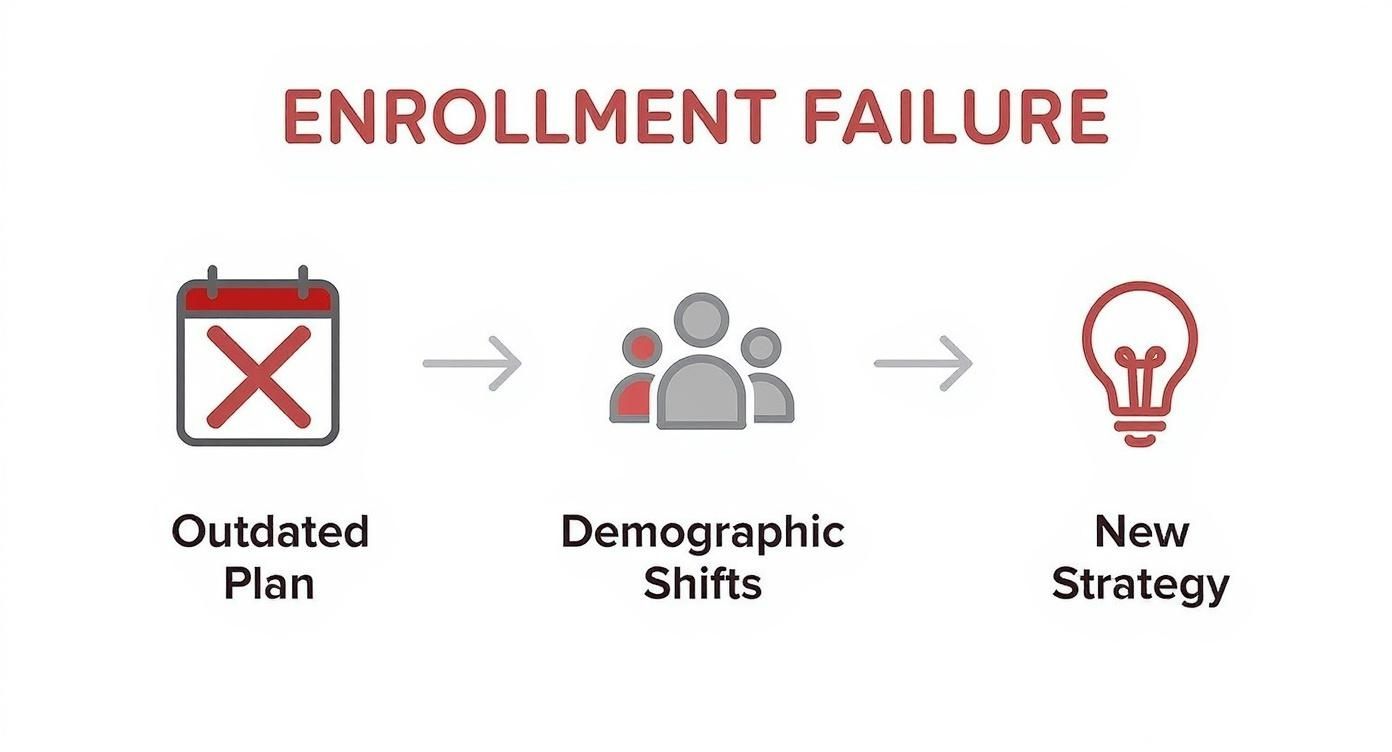
As you can see, institutional inertia and external market changes often lead to a frantic, reactive pivot. A proactive plan prevents this.
Assembling Your Cross-Functional SEM Team
Let’s be clear: a strategic enrollment plan is not a one-department job. Its success lives or dies on buy-in and collaboration from across the entire campus. That's why building a cross-functional SEM committee from day one is non-negotiable.
Think of this team as your strategic engine. It brings together diverse perspectives to make sure your plan is both ambitious and grounded in reality. The committee needs to include the leaders and doers who have a direct stake in enrollment outcomes.
Essential Members of Your SEM Committee
| Department | Role & Contribution |
|---|---|
| Admissions & Recruitment | Brings the on-the-ground reality of talking to students and families. |
| Financial Aid | Provides the hard data on affordability and how aid strategies are working. |
| Marketing & Communications | Shapes the institutional story and drives brand awareness and lead flow. |
| Academic Affairs | Aligns enrollment goals with program capacity and new program development. |
| Student Affairs | Owns the student experience and has deep insights into retention and success. |
| Finance & Administration | Keeps the plan tethered to the institution’s budget and revenue needs. |
Getting these folks in the same room from the start breaks down the silos that can poison even the best-laid plans. It’s a concept that’s central to achieving any major institutional goal, and you can learn more about the power of cross-departmental collaboration to see just how critical it is.
A successful SEM plan is built on a shared understanding of the data and a collective commitment to the institution’s future. Without this foundational work, even the most brilliant strategies will fail to gain traction.
Setting Goals That Drive Real Growth
You've done the hard work of digging into the data. Now, let's turn that research into a real, actionable roadmap. Honestly, a strategic enrollment management plan without clear, measurable goals isn't a plan at all—it's just a collection of interesting facts. This is where we stop talking in generalities like "increase enrollment" and start defining what success actually looks like for your institution.
Generic goals get you generic results. The most effective plans don't just aim for more students; they set nuanced, specific objectives that are all about the long-term health of the institution. These goals are all connected, influencing everything from the academic profile of your incoming class to the stability of your budget.
Defining Your Core Strategic Imperatives
Before you can get into the nitty-gritty of setting targets, you need to identify your big-picture priorities. We call these strategic imperatives. Think of them as the guiding stars for your entire plan—the non-negotiable outcomes that everything else has to support.
These aren't KPIs. They're broad statements of intent that keep everyone aligned with the university's core mission. For instance, your imperatives might look something like this:
- Enhancing Academic Excellence: We need to attract students who will thrive in our most rigorous programs and raise the bar for everyone.
- Fostering a Diverse Community: Our goal is to build a student body that reflects a rich mix of backgrounds, experiences, and perspectives.
- Ensuring Financial Sustainability: We have to generate the net tuition revenue required to fund our key priorities and invest in the future.
- Expanding Geographic Reach: It's time to reduce our reliance on local markets and start attracting students from new and emerging regions.
These imperatives provide the "why" behind all the detailed goals to come. They ensure that every department—from admissions to financial aid to marketing—understands how their work fits into the bigger picture.
For a great real-world example, look at the University of Colorado Colorado Springs (UCCS). They built their 2030 plan around five strategic imperatives tied directly to their main institutional plan. This structure is what helps them shift from a reactive to a proactive enrollment strategy. It's worth checking out how they connect their core pillars to specific enrollment goals.
From Broad Imperatives to SMART Objectives
With your guiding imperatives locked in, it's time to translate them into SMART objectives: Specific, Measurable, Achievable, Relevant, and Time-bound. This is where the rubber meets the road. Each objective has to be a crystal-clear, quantifiable target that leaves zero room for interpretation.
Let's unpack what that really means.
A well-crafted objective is a promise you make to your institution. It’s a clear benchmark that tells you whether your strategies are actually working or if you need to pivot. Without this level of clarity, you're just guessing.
Let's say one of your imperatives is "Fostering a Diverse Community." A vague goal like "recruit more diverse students" won't cut it. A SMART objective, on the other hand, gives you real teeth.
- Specific: Increase the enrollment of first-generation students.
- Measurable: Increase the percentage of incoming first-generation students from 18% to 22% of the freshman class.
- Achievable: This target is realistic, based on our market analysis showing a growing pool of first-gen applicants in key recruitment territories.
- Relevant: This directly supports our institutional commitment to access and our diversity-focused imperative.
- Time-bound: We will achieve this by the Fall 2026 enrollment cycle.
This level of detail turns a lofty idea into a concrete action item. It gives your teams a clear finish line to run toward and gives leadership a tangible way to measure progress. A robust SEM plan is built on a foundation of these precise, data-informed objectives.
To help visualize this, here’s a simple framework showing how you can cascade your broad imperatives down into concrete objectives for different teams.
Example SEM Goal Framework
| Strategic Imperative | Functional Area | SMART Objective Example | Key Performance Indicator (KPI) |
|---|---|---|---|
| Enhancing Academic Excellence | Admissions & Recruitment | Increase the average high school GPA of the incoming freshman class from 3.50 to 3.65 by Fall 2025. | Average GPA of deposited students |
| Fostering a Diverse Community | Financial Aid | Increase the number of need-based institutional grants awarded to underrepresented minority (URM) students by 15% for the 2025-26 academic year. | Total grant aid awarded to URM students; URM enrollment yield |
| Ensuring Financial Sustainability | Marketing & Communications | Generate 5,000 new inquiries from out-of-state markets through targeted digital campaigns by May 1, 2025, with a cost-per-inquiry under $75. | Number of inquiries by source; Cost-per-inquiry |
| Expanding Geographic Reach | Enrollment Operations | Implement a new CRM workflow to nurture applicants from three new designated recruitment territories, increasing applications from these areas by 20% by the Fall 2026 cycle. | Application volume by territory; Conversion rate from inquiry to applicant |
This table is just a starting point, of course. The key is to ensure every major priority has a clear, measurable objective tied to it, with specific teams owning the outcome. This is how you build accountability and create a plan that actually drives results.
Crafting Strategies That Actually Work
Alright, with your goals locked in, it's time to get to the heart of your strategic enrollment management plan. This is where the rubber meets the road—where we move from abstract ideas to concrete actions that will actually bring your vision to life.
Effective strategies aren't just a laundry list of "new things to try." They're targeted, integrated, and always, always laser-focused on the student's journey, from that very first Google search all the way to graduation day. Each strategy needs to be a direct, thoughtful answer to a specific goal you've set. Trying to boost out-of-state enrollment? Your playbook will look completely different than if you're working to improve retention for first-generation students. Precision is the name of the game here.
Modernizing Your Recruitment Playbook
Let's be honest: traditional tactics like college fairs and high school visits still have their place, but they can't be the star of the show anymore. Today’s students live online, and our recruitment efforts have to meet them there with a multi-channel approach that feels personal and genuine.
This is about more than just posting on social media. It means building a real digital marketing funnel that guides prospective students from initial curiosity to hitting "submit" on their application.
- Top-of-Funnel (Awareness): Use hyper-targeted digital ads on platforms like Instagram and TikTok to reach specific student profiles in new geographic areas. Think beyond generic campus photos—share unique program highlights or compelling student success stories.
- Mid-Funnel (Engagement): You need to capture their interest. Offer valuable content like a "Guide to Paying for College" or an immersive virtual tour in exchange for their contact info. Then, nurture those leads with automated email campaigns that deliver relevant information based on their interests.
- Bottom-of-Funnel (Conversion): Make it easy for them to say yes. Use personalized messages, send text reminders for deadlines, and offer one-on-one chats with admissions counselors or current students. The goal is to remove every ounce of friction from the process.
To make sure these strategies connect with everyone, your digital front door has to be open to all. Investing in effective web accessibility strategies for educational institutions isn't just a compliance issue; it's a critical part of ensuring no potential student is left behind because of a poorly designed website or application portal.
Leveraging Financial Aid as a Strategic Tool
Financial aid is so much more than a back-office function. It’s one of the most powerful levers you can pull in your entire enrollment plan. When wielded strategically, it can shape your incoming class, boost yield, and hit your net tuition revenue targets all at once.
Instead of just handing out aid packages, start thinking about how different award models influence student decisions. For instance, a small liberal arts college trying to elevate its academic profile could design a merit scholarship grid that heavily rewards students with GPAs above a certain mark. This sends a clear signal to the market about what the institution values and draws in the high-achieving students it wants.
Data is your best friend in this process. Predictive modeling can show you the likely impact of different aid strategies before you commit a single dollar. One university I know of used AI to fine-tune its scholarship distribution and achieved an astounding 90% yield among awarded students. That's the power of data-informed awarding.
Strategic financial aid isn't about giving away the most money. It's about investing the right amount of money in the right students to achieve your institutional goals.
Designing for Student Success and Retention
Getting a student to enroll is only half the job. A truly successful strategic enrollment management plan is just as concerned with making sure those students stick around and earn their degrees. Retention isn't an add-on; it has to be baked into the student experience from the very beginning.
The first year is where you can make the biggest impact. It’s the period with the highest attrition risk, so targeted support here pays huge dividends.
High-Impact Retention Strategies
| Strategy | Description | Why It Works |
|---|---|---|
| First-Year Seminars | Small, engaging courses that teach college-level skills like critical thinking while also creating immediate connections with faculty and peers. | Fosters a sense of belonging and academic community right from the start. |
| Proactive Academic Advising | Using data to spot at-risk students (e.g., poor midterm grades) so advisors can reach out before there's a crisis. | It shows students the institution is invested in them, shifting the dynamic from reactive problem-solving to proactive support. |
| Peer Mentorship Programs | Pairing new students with trained upper-division students who help them navigate the social and academic landscape. | Provides relatable, non-intimidating support from someone who has successfully walked the same path. |
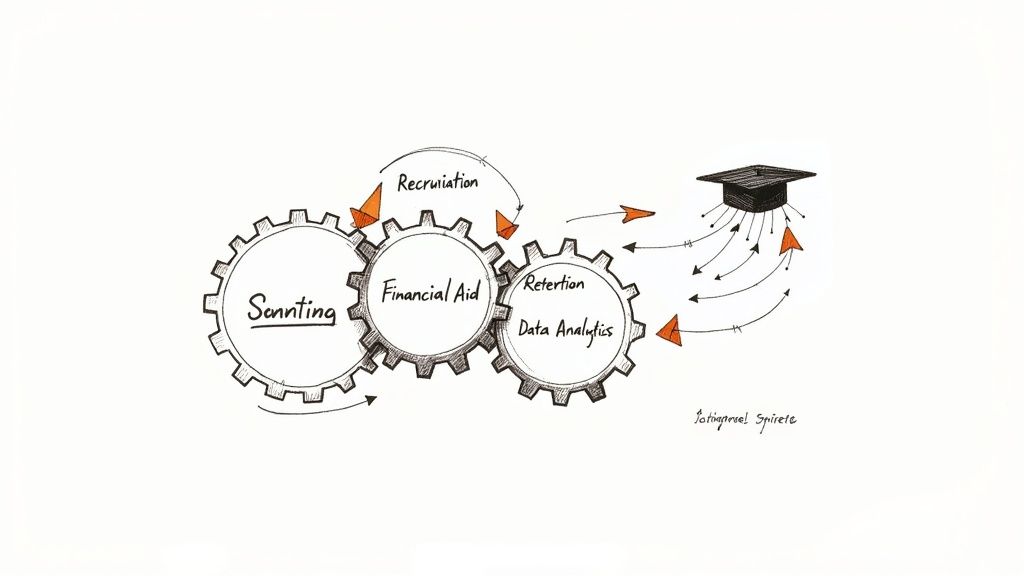
In the end, recruitment, financial aid, and retention aren't separate silos. They're deeply intertwined. The students you attract with smart marketing are the ones who will thrive because of your student success initiatives, all made affordable by a strategic financial aid model. This is the integrated approach that elevates a plan from good to truly great.
Measuring Progress and Adapting on the Fly
A strategic enrollment management plan isn't a "set it and forget it" document. If it ends up gathering dust on a shelf, it’s already failed. The best SEM plans are living, breathing guides that change and adapt based on what’s happening on the ground. Launching the plan is just the starting line; the real work is building a culture where data, not gut feelings, drives every single decision.
This is where many institutions stumble. To avoid that pitfall, you need a solid framework for monitoring your progress. It’s about getting past the vanity metrics and drilling down into the key performance indicators (KPIs) that actually tell you how healthy your enrollment funnel is.
Building Your SEM Dashboard
You can't manage what you don't measure. That’s why a centralized, easy-to-read SEM dashboard is non-negotiable. Think of it as your command center, translating a mountain of data into clear, actionable insights for the whole team. It needs to give you a real-time snapshot of the metrics that matter most.

The KPIs on your dashboard should tie directly back to the goals you set in the beginning. Some of the essentials I always recommend tracking include:
- Top-of-Funnel Health: Are your marketing efforts hitting the mark? Look at inquiry volume by source, traffic to key admissions pages, and social media engagement. This tells you if you're even reaching the right people.
- Application Pipeline: Keep a close watch on application submission rates and the number of completed applications. How do these figures stack up against this time last year?
- Conversion and Yield: This is where the rubber meets the road. Your admit rate is important, but your yield rate—the percentage of admitted students who actually enroll—is the ultimate measure of your institution's appeal.
- Class Composition: Are you hitting your diversity targets? What's the average academic profile of your deposited students? Are you filling seats in those high-priority academic programs?
This data is the lifeblood of your plan. Making smart choices requires a solid foundation in data-driven decision-making, a skill that separates successful enrollment teams from those just guessing.
The Rhythm of Review and Adaptation
Collecting data is pointless if you don't act on it. You have to establish a regular rhythm for review meetings where the SEM committee digs into the dashboard, discusses what the numbers are telling you, and decides what to do next.
A productive meeting cadence might look something like this:
- Weekly Check-ins: A quick, tactical huddle for the core admissions and marketing folks. The focus is on pipeline numbers and tweaking short-term recruitment efforts.
- Monthly KPI Reviews: A deeper dive with the full SEM committee. Here, you're looking for trends, checking progress against monthly targets, and spotting any red flags.
- Quarterly Strategic Reviews: A high-level session to see if your big-picture strategies are working. This is when you might decide to shift marketing dollars from one channel to another or rethink your financial aid models for the upcoming cycle.
An agile SEM plan isn’t about throwing your strategy out the window at the first sign of trouble. It’s about using data to make intelligent, timely adjustments that keep you on course to achieve your long-term goals.
This constant loop of review and refinement keeps your plan from becoming obsolete. Take Canada College, for example. They extended their SEM plan through 2028 and built in a process of continuous feedback from planning councils and senior leaders. This structure allows them to constantly tweak their strategies based on student needs and regional market shifts—a powerful example of a living plan in action.
Knowing When and How to Pivot
So, what does a pivot actually look like?
Let’s say your dashboard shows applications from a key out-of-state market are down 15% year-over-year, even though you’ve poured money into marketing there. Panic isn’t a strategy.
Instead, your team investigates. You learn that a direct competitor in that area just launched an aggressive new scholarship for students with an academic profile that mirrors your target audience. Now you have an insight you can act on.
Maybe you counter with a targeted digital ad campaign in that market, one that hammers home your unique program strengths. Or perhaps you get surgical, adjusting your own financial aid offers for top-tier applicants from that specific region to stay in the game. That’s the core of adaptive enrollment management: analyze, learn, and act.
Answering the Tough Questions About SEM Planning
Even with a solid roadmap, kicking off a full-scale strategic enrollment management plan always surfaces a lot of questions. It's a massive undertaking, and its ripple effects are felt in every corner of your institution. Let’s get into some of the most common hurdles and uncertainties that pop up for leaders during this process.
Think of this as the frank, practical advice you'd get over coffee with a seasoned pro. Tackling these issues head-on will save you a world of headaches later and help you build real momentum.
How Long Is This Really Going to Take?
This is always one of the first questions, and the only honest answer is: it depends. But let me be clear, this is a comprehensive process, not a quick fix. A plan slapped together over a summer retreat simply won't have the depth—or the buy-in—to actually work.
In my experience, you should budget anywhere from 12 to 18 months to develop a truly robust, data-informed plan.
That timeline gives you the breathing room to do this right:
- The Deep Dive (3-4 months): This is where you get your hands dirty, collecting and analyzing years of enrollment data, market research, and what your competitors are up to.
- Defining Your North Star (2-3 months): You'll work with your committee to hammer out the big-picture priorities and turn them into specific, measurable goals.
- Building the Playbook (4-6 months): Now you're crafting the detailed strategies for recruitment, financial aid, and retention.
- The Reality Check (2-3 months): This phase is all about circulating drafts, gathering honest feedback from stakeholders across campus, and refining the final document.
Trying to shortcut this timeline is a classic mistake. It almost always results in a plan that's out of touch with your institution's reality and lacks the campus-wide support it needs to get off the ground.
How Do I Get Everyone on Board?
Getting a plan approved by leadership is one thing. Getting the entire campus to feel a sense of ownership is a whole different ballgame. Real buy-in isn't about a signature on a document; it’s about fostering a campus-wide understanding that enrollment is everyone’s job.
Your best tool for this is transparency, right from day one. Your cross-functional SEM committee is the key. When you have faculty, student affairs staff, and finance folks in the room helping you build the plan, they naturally become its most passionate advocates out on campus.
A critical piece of advice: Don’t present a finished plan and ask for feedback. Instead, present the data and the challenges, and ask for help in building the solutions. This simple shift turns stakeholders from potential critics into genuine co-creators.
Beyond that, you have to communicate relentlessly. Share progress updates at faculty senate meetings, with the board, and in campus-wide newsletters. The more people understand the "why" behind your SEM plan, the more likely they are to get behind the "how."
How Do We Balance Goals That Seem to Conflict, Like Diversity and Revenue?
This is one of the thorniest challenges in SEM planning. How do you, for instance, increase student diversity while also hitting aggressive net tuition revenue goals? It can often feel like a zero-sum game, but I promise you, it doesn't have to be.
The solution lies in using sophisticated data and strategic financial aid modeling to find the sweet spot. Instead of seeing these goals as being in opposition, you have to treat them as interconnected pieces of a complex puzzle.
- Be surgical with your aid. Don't just raise the discount rate for everyone. Use predictive analytics to design scholarship programs that attract high-achieving students from underrepresented backgrounds—you might find they need less aid than you assumed.
- Expand your map. Pushing into new out-of-state or international markets can be a powerful two-for-one. It can boost revenue while also bringing fresh perspectives and greater diversity to your campus.
- Remember retention is revenue. Improving retention rates among your diverse student populations is a fantastic revenue strategy. Every student you keep is one you don’t have to spend a single dollar recruiting to replace.
At the end of the day, a truly well-crafted plan finds the synergy between these goals instead of forcing you to choose. It’s about making smart, data-driven investments that push multiple institutional priorities forward all at once.
Ready to build a community that can help you navigate these challenges and more? The MarCom Society is an exclusive professional network for K-12 marketing and communications leaders just like you. Gain access to expert workshops, peer support, and practical resources to elevate your school's strategy. Join our vibrant community and start building your next successful plan today.









