
A strategic enrollment plan is the lifeblood of a healthy school. It's so much more than a marketing document; think of it as a comprehensive, data-backed roadmap that gets everyone—from admissions and academics to finance—rowing in the same direction. It’s the school-wide strategy for achieving and, just as importantly, maintaining the right student population to fulfill your mission for years to come.
This isn't about just getting more applications. It's a proactive game plan that helps your school not just survive, but truly thrive.
Why Strategic Enrollment Planning Matters More Than Ever
Let's get real for a minute. The old "if you build it, they will come" model of school enrollment is a distant memory. Today, K-12 schools are wrestling with a perfect storm of pressures that makes a reactive, seat-of-your-pants approach incredibly risky.
These aren't just theoretical challenges; they are hitting schools hard in nearly every community. You’ve probably heard about the "enrollment cliff"—it’s a real demographic shift that means fewer school-aged children in many districts. At the same time, the educational marketplace is more crowded than ever, with charter schools, specialized magnet programs, and a host of other options competing for the same families.
Unifying Your School's Mission and Vision
I've seen it time and again: a truly effective strategic enrollment planning process is the ultimate silo-buster. It pulls everyone out of their departmental corners and rallies them around a single, unified purpose. Imagine your finance director not just knowing, but truly understanding the marketing team's target audience. Picture your faculty being able to clearly and passionately articulate the school's core value proposition to a visiting family. That's when the magic happens.
This kind of alignment is how you avoid the classic, frustrating pitfalls:
- Mixed Messages: Your admissions team promises a personalized, nurturing environment, but a prospective parent's first interaction with the front office feels cold and transactional. A good plan ensures the brand promise is lived out everywhere.
- Scattered Resources: The budget gets spread thin across a dozen "good ideas" instead of being strategically invested in the marketing initiatives that will actually move the needle on enrollment and retention.
- Constant Firefighting: You’re always reacting—to a sudden drop in inquiries, a competitor’s new program, or a negative comment on social media—instead of proactively shaping your school's future with data.
A well-crafted SEP takes enrollment from being "the admissions office's job" to a shared, all-hands-on-deck responsibility. It turns every single person in your community into a powerful ambassador for your school.
Building a Framework for Sustainable Growth
This guide is designed to be your practical playbook. We're moving past the high-level theory and digging into an actionable framework you can put to work immediately. We’ll walk through how to lead this critical process with confidence, starting with the two most important pillars: solid, data-driven analysis and authentic collaboration with your key stakeholders.
By truly committing to strategic enrollment planning, you're not just scrambling to fill seats for next fall. You're building a resilient, mission-driven school that is set up for long-term health and success. You gain the clarity to make smart, sometimes tough, decisions and the data to back them up.
Building Your Foundation on Data and Insights

A powerful strategic enrollment plan isn't built on wishful thinking or gut feelings. It’s constructed on a solid foundation of data. Before you can map out where you’re going, you need an honest, unflinching assessment of where your school stands right now. This initial situational analysis is the most critical part of the process, turning raw numbers into a clear, compelling story.
Think of yourself as an investigator. Your first mission is to look inward, gathering the internal data that reveals the true health of your enrollment engine. This means digging much deeper than the final enrollment count you celebrate each fall. You need to map out your entire admissions funnel to see exactly where prospective families are dropping off.
Auditing Your Internal Enrollment Data
Start by pulling multi-year data. You’re looking for patterns. Are you losing more families between the inquiry and tour stages, or is the drop-off bigger between application and acceptance? Pinpointing these leaks is the first step toward plugging them.
At the same time, take a hard look at student attrition. If you’re seeing a spike in students leaving between 7th and 8th grade, that’s not just an admissions problem—it's a school-wide challenge that your new plan absolutely must address.
A few key internal metrics to get you started:
- Historical Enrollment Trends: Track your total enrollment over the past 5-7 years, breaking it down by grade level to spot any worrying dips or encouraging growth.
- Admissions Funnel Conversion Rates: Calculate the percentage of families moving from one stage to the next: inquiry to tour, tour to application, application to acceptance, and finally, acceptance to enrollment.
- Student Attrition Rates: Identify which grades have the highest number of departures and, if you can, dig into the primary reasons why.
- Current Family Demographics: Get a clear picture of who you serve. Where do they live (zip codes)? What are their socioeconomic backgrounds? And how did they first hear about you?
The goal of this internal audit isn't just to collect numbers; it's to find the narrative hidden within them. A high attrition rate in middle school combined with low inquiry from that same age group tells a very specific story that your strategy needs to rewrite.
Scanning the External Landscape
With a clear internal picture, it's time to look beyond your campus. The world outside—your local community, demographic shifts, and competitor activity—has a huge impact on your ability to attract and retain families. This is where your strategic enrollment planning becomes truly proactive.
One of the biggest factors to analyze is local demographics. Are new housing developments bringing in young families, or is your community aging? Are birth rates in your region projected to decline, signaling that infamous "enrollment cliff"? Understanding these population trends helps you set realistic goals and might even point you toward new markets for recruitment.
To stay ahead, schools are rebuilding their plans based on recent performance data, digging into insights like program-level "melt" rates and student retention trends. Retention, especially for students transitioning between divisions, is now a critical focus. It’s a clear sign that sustainable enrollment management requires attention to the entire student lifecycle, not just recruitment.
Creating Your Enrollment Dashboard
Your situational analysis culminates in an essential tool: a dynamic enrollment dashboard. This isn't a static report you create once and forget about. It's a living, breathing command center that gives you a real-time snapshot of your school’s enrollment health.
To really make your data work for you, it’s helpful to understand the core principles of data-driven decision-making. Your dashboard is where you put those principles into practice.
Here’s a look at what should be on your dashboard.
Key Metrics for Your Enrollment Dashboard
This dashboard should be your single source of truth for key metrics, helping you track progress against the goals your plan will eventually set.
| Metric Category | Specific KPIs to Track | Why It Matters |
|---|---|---|
| Recruitment Funnel | Inquiries, Campus Visits, Applications Submitted, Offers Extended, New Enrollments | Tracks the health of your admissions pipeline from top to bottom and helps identify conversion bottlenecks. |
| Student Retention | Grade-level Attrition Rates, Mid-Year Withdrawals, Re-enrollment Percentage | Measures student and family satisfaction and is a critical indicator of long-term enrollment stability. |
| Financial Health | Net Tuition Revenue (NTR), Financial Aid as a Percentage of Budget, Sibling Enrollment | Provides insight into financial sustainability and the effectiveness of your tuition and aid strategies. |
| Community Demographics | Local Birth Rates, New Housing Starts, Competitor Enrollment Numbers, Key Feeder School Data | Offers a forward-looking view of your potential applicant pool and competitive landscape. |
| Marketing & Outreach | Website Traffic, Social Media Engagement, Open House Attendance, Cost Per Inquiry/Application | Connects marketing activities directly to enrollment outcomes, showing what’s working and what’s not. |
By combining this internal and external data, you move from guesswork to informed strategy. This sets the stage for an enrollment plan that is both ambitious and, most importantly, achievable.
Creating a Unified Vision with Key Stakeholders
https://www.youtube.com/embed/mDv7Q-ORZN0
Your data tells a powerful story, but frankly, it’s only half the battle. A strategic enrollment plan cooked up by a small, isolated team—no matter how brilliant—is destined to collect dust on a shelf. Real momentum, the kind that actually moves the needle, comes from building a shared vision across your entire school community. This crucial step transforms the plan from just another "admissions project" into a school-wide mission everyone can get behind.
Success in strategic enrollment planning is all about deep collaboration. You need insights from every corner of your campus, from the teachers who deliver on your educational promise every day to the business office that has to make the numbers work. Each department holds a critical piece of the puzzle.
Assembling Your Strategic Enrollment Committee
First things first: you need to form a dedicated Strategic Enrollment Planning (SEP) Committee. This group will be the engine that drives the whole process forward. Think of them less as a committee and more as champions for the plan within their own departments, ensuring accountability and keeping the energy up.
And don't just stack the committee with senior leaders. While you absolutely need the Head of School, division heads, and your directors of finance, admissions, and marketing, it's just as important to bring in other influential voices.
- Faculty Representatives: Get a tenured, respected teacher in the room—someone who can speak to the academic experience and what’s really happening in the classrooms.
- Student Support Staff: A college counselor or a student life coordinator has an incredible perspective on what students and their families are truly concerned about.
- Board Member: Having a trustee on board, especially one with a marketing or finance background, helps keep everything aligned with the school’s long-term strategic vision.
The whole point is to build a cross-functional team that sees challenges and opportunities from every possible angle. This diversity of thought is your single greatest asset for building a plan that's both ambitious and grounded in reality. You can get a deeper understanding of building these crucial relationships by exploring what is stakeholder engagement.
Facilitating Productive Kickoff Workshops
Once you have your team, it’s time for a kickoff workshop. This isn't just another meeting. It’s a facilitated, roll-up-your-sleeves session designed to get every assumption, concern, and brilliant idea out on the table. The objective here is to shift the mindset from individual departmental priorities to a unified set of enrollment goals.
A great workshop needs a solid, structured agenda. I always recommend starting by presenting the key findings from your data analysis. This immediately grounds the conversation in facts, not feelings or anecdotes, and ensures everyone is starting from the same understanding of your current situation.
The most powerful question you can ask in your kickoff meeting is this: "If we were to build our ideal student body from scratch to perfectly fulfill our school's mission, what would it look like?" This simple question shifts the focus from just filling empty seats to intentionally shaping your community.
Asking the Right Questions
To uncover those hidden opportunities and anticipate roadblocks, you have to ask really good, targeted questions. The insights you gather here will directly inform the strategies you build. It's time to go beyond the surface and spark some genuine dialogue.
Sample Questions for Key Departments
Here are some of the questions I’ve found most effective over the years.
| Department | Key Question to Ask | Why It's Important |
|---|---|---|
| Academic Leadership | "What academic programs are truly unique to us, and which ones are under-enrolled or might need a refresh?" | This connects your enrollment goals directly to your core educational "product," making sure you’re marketing your actual strengths. |
| Finance Office | "What’s the net tuition revenue per student we need to hit to stay healthy, and where is our real capacity for financial aid?" | This grounds every enrollment target in financial reality, which prevents you from setting ambitious but totally unsustainable goals. |
| Faculty & Staff | "What kind of student truly thrives here, and what are the biggest hurdles new families face when they join our community?" | This is pure gold. It’s on-the-ground intelligence about your school culture and the real-world student experience. |
When you engage your community this way—deliberately and inclusively—you build widespread ownership of the plan. It’s no longer your document; it's our document. And that's a plan everyone is motivated to bring to life, ensuring it succeeds long after the planning phase is over.
Defining Your Ideal Families and Core Message

You’ve organized the data and rallied your internal team. Now it’s time to get specific—really specific. The next move in building your strategic enrollment plan is to shift away from the generic idea of "parents" and start painting a vivid picture of the families who truly thrive in your school.
This is where you bring the data to life. We're talking about creating detailed family personas. These aren't just demographic checklists; they are rich, narrative-driven profiles that capture the values, goals, and worries of your ideal families. Think less about "parents aged 35-50" and more about "Community-Focused Carla" or "STEM-Seeker Steve."
Crafting Your Family Personas
To build these personas, circle back to the data you’ve already gathered. Who are your most successful and engaged current families? What do they have in common? Look at their professions, where they live, and what clubs or community activities they're involved in.
Then, you'll want to layer in the qualitative gold from your stakeholder workshops. Your faculty knows which students light up in their classrooms, and your admissions team has heard the same questions on tours a hundred times. For a deeper dive, check out these strategies for creating effective buyer personas to help you get started.
Make sure each persona includes these core components:
- Goals & Aspirations: What’s the ultimate dream they have for their child's education? Is it a competitive academic edge, a deep focus on character development, or a tight-knit community where their child feels they belong?
- Values & Priorities: What are their non-negotiables? This could be anything from a commitment to diversity and inclusion to a faith-based environment or a powerhouse arts program.
- Challenges & Pain Points: What keeps them up at night about their child’s current school? Maybe they feel their child is just a number in a massive public school or that the curriculum lacks rigor.
- Communication Habits: Where do they hang out online and in real life? Are they scrolling Instagram, or are they getting recommendations from a local parenting group on Facebook?
A great persona feels like a real person. Give them a name, a backstory, and a quote that sums up their core motivation. Something like: "I want a school where my daughter will be challenged academically but also truly known and valued as an individual."
Connecting Personas to Your Value Proposition
Once you have 2-4 distinct family personas fleshed out, you can start connecting the dots. The goal is to map your school's unique strengths directly to their specific needs, which allows you to craft a value proposition that really hits home. You’re moving away from a one-size-fits-all message and creating specific, compelling messages for each type of family you want to attract.
This level of precision is the cornerstone of modern strategic enrollment management. It's about getting the right message to the right family at the right time, a far cry from the old 'spray and pray' methods that just don't work anymore. As school budgets get tighter, this focused approach is essential for maximizing your impact.
This targeted messaging will become the playbook for all your marketing content.
Example of Persona-Driven Messaging
Here’s how this looks in practice:
| Persona Profile | Core Motivation | Tailored Message |
|---|---|---|
| STEM-Seeker Steve (Engineer parent, values innovation and career-readiness) | "I want my son to have a head start with the tech skills he'll need for the future." | "Go beyond theory in our state-of-the-art robotics lab and coding curriculum, where students learn to build, program, and innovate from day one." |
| Community-Focused Carla (Values connection, parent involvement, and character education) | "I want my family to be part of a warm, welcoming community that reinforces our family's values." | "Join a community where every family matters. Our focus on service learning and strong parent partnerships creates a supportive second home for your child." |
This approach turns your marketing from a megaphone shouting about school features into a real conversation. You start speaking directly to a family’s deepest hopes and biggest worries. That's how you break through the noise, attract the right families, and turn curious inquiries into enrolled members of your community.
Designing Your Recruitment and Retention Action Plan
You’ve done the hard work of organizing your data and defining your ideal families. Now it's time to bring that strategy to life. This is where we build the tangible, multi-channel marketing plan that will attract new students while nurturing your current families. Think of it as creating a living, breathing playbook with clear ownership and a realistic timeline.
The best plans I've seen always strike a balance, addressing both sides of the enrollment equation. Recruitment is essential for filling the pipeline, but strong retention is what keeps your school stable and vibrant year after year. Focusing on one at the expense of the other is a classic short-term fix that almost always creates long-term headaches.
This visual captures the continuous flow of a healthy enrollment cycle perfectly.
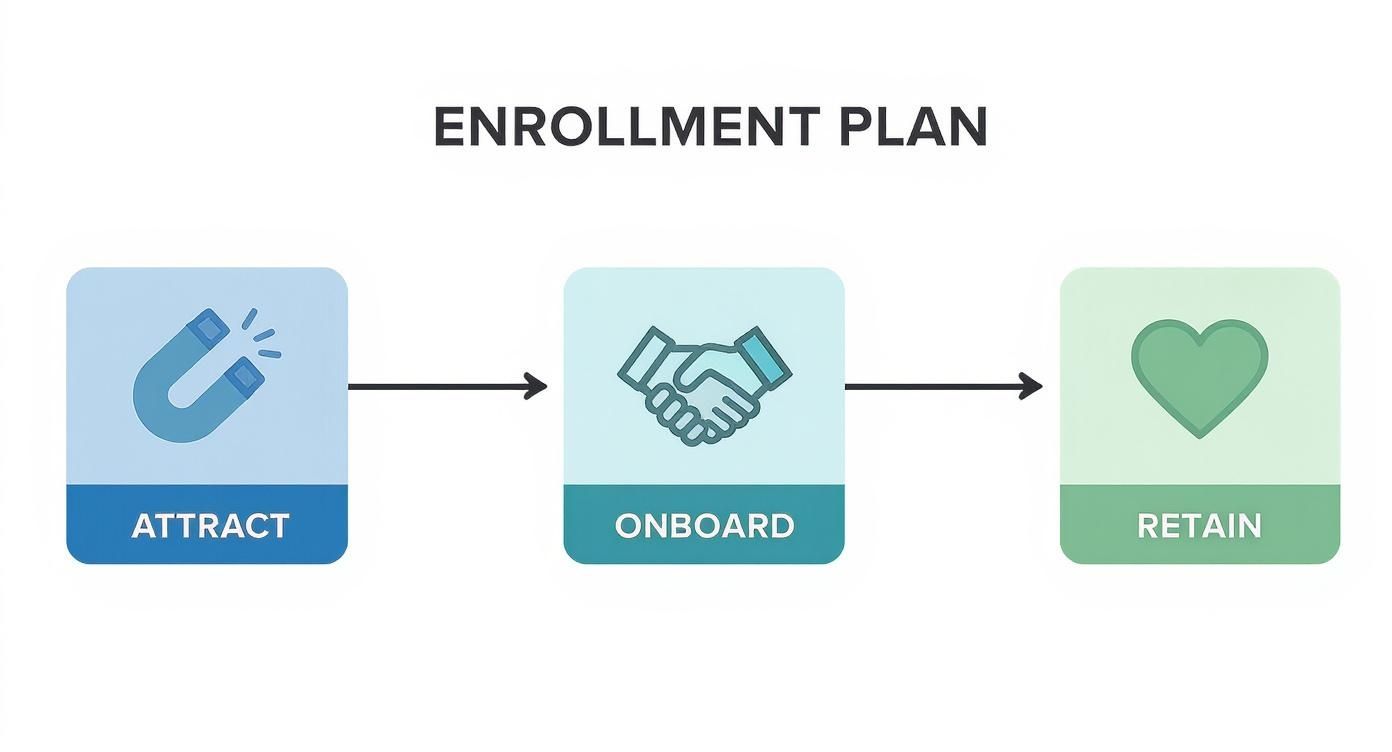
It’s a great reminder that attracting, onboarding, and retaining families is a continuous loop, not a straight line with a definite end.
Building Your Persona-Driven Recruitment Engine
Your recruitment strategy should be a direct reflection of the family personas you developed. Forget the old "spray and pray" approach. Instead, you'll be selecting channels and tactics that meet your specific audiences right where they are. This is how you make a limited budget work much, much harder.
Let’s look at how this plays out with a couple of common personas:
- For "STEM-Seeker Steve": Your action plan might prioritize targeted Facebook and LinkedIn ads aimed at parents working in local tech and engineering hubs. Your content should feature blog posts and videos highlighting your robotics club's recent win or a profile of an alum thriving in a STEM career.
- For "Community-Focused Carla": You’ll want to double down on hyper-local SEO to capture families searching for schools in their specific neighborhood. Spend your time building real relationships with local real estate agents and sponsoring community events like youth sports leagues or farmers' markets.
Your plan also needs to account for the growing need for flexible entry points. We're seeing families require more adaptable pathways into our schools. This means thinking strategically about how you handle mid-year transfers, re-entry points for students who may have left, or unique programs that cater to diverse family timelines. It's about ensuring your enrollment process is inclusive and forward-thinking.
The goal here is a seamless journey. A prospective family should see a consistent, compelling message about your school whether they encounter an Instagram ad, read a blog post, or attend an open house.
Shifting Focus From Enrollment to the Entire Family Journey
Retention doesn't just happen during re-enrollment season. It’s the culmination of a thousand positive touchpoints throughout the year. Your action plan needs to move beyond simply enrolling a student to intentionally onboarding and nurturing the entire family.
A solid retention plan kicks in the very moment a family says "yes." A warm, structured onboarding process is absolutely critical. Something as simple as assigning a current family as a "buddy" to a new family can make all the difference, turning first-day jitters into a true sense of belonging.
From there, your plan should detail proactive initiatives that build community and constantly reinforce the value of their decision.
High-Impact Retention Initiatives:
- Parent Ambassador Program: Empower your most enthusiastic current parents to become official ambassadors. They can help lead tours, call newly accepted families, and share their authentic experiences on social media. They are your most powerful and credible marketing asset, hands down.
- Proactive Re-enrollment Campaigns: Don't wait until February to start talking about next year. Launch a "Reasons We Love Our School" campaign in the fall, sharing testimonials and highlighting unique programs. Frame re-enrollment as an exciting continuation of their journey, not just another transaction.
- Regular "Pulse Check" Surveys: Use simple, short surveys to gauge family satisfaction. Asking questions like, "On a scale of 1-10, how likely are you to recommend our school?" helps you spot and address issues long before they lead to attrition.
When you focus on the complete journey, you not only improve retention rates but also create a thriving community of advocates. For more ideas, our guide on modern student recruitment strategies dives deeper into the importance of the student and family experience.
Creating a Timeline with Clear Ownership
Finally, an action plan without a timeline and clear owners is just a wish list. Your document needs to break down every initiative into quarterly priorities.
For each tactic, assign a "DRI"—a Directly Responsible Individual. This isn't the person who has to do all the work, but they are the one person accountable for making sure it gets done. This simple step creates clarity and stops great ideas from falling through the cracks. Now, your plan is truly ready to move from paper to reality.
Got Questions About Your Enrollment Plan?
As you start piecing together your school's strategy, you're bound to run into questions. That's a good thing—it means you're digging into the work. Let’s tackle some of the most common hurdles and questions that pop up for school leaders right about now.
How Often Should We Actually Update This Thing?
Think of your enrollment plan as a living, breathing guide, not a "set it and forget it" document collecting dust on a shelf. A major, ground-up rebuild is probably only necessary every three to five years.
However, the real magic happens in the regular check-ins. You absolutely must review your core goals and KPIs at least once a year to see what's working and what isn't.
Beyond that, your enrollment committee should be meeting quarterly. These meetings are where you stay nimble. A new charter school opens down the street, a major local company announces layoffs, a new social media platform takes off—things change fast, and your plan needs to be able to pivot without a total overhaul.
Any major event—a new Head of School, a big demographic shift in your city, or the launch of a signature academic program—should trigger an immediate gut-check of your plan’s core assumptions.
What's the Single Biggest Mistake Schools Make?
Easy. Creating the plan in a vacuum.
Time and time again, I see a well-meaning admissions or marketing office go off and build a beautiful plan, only to present it to the rest of the school's leadership as a finished product. This is a recipe for disaster.
When faculty, finance, and academic leaders aren't deeply involved from the start, you get a crippling disconnect. The plan ends up promising a student experience that doesn't quite match reality, and you get zero buy-in from the very people you need to bring it to life. Teachers don't see themselves in the messaging, and the business office is blindsided by the resource requests.
Success comes when the plan is a school-wide effort, built together on shared data and agreed-upon goals. It’s that simple.
How Can a Small School with a Tiny Budget Compete?
A small budget doesn't mean you can't have a big impact; it just means you have to be ruthless with your focus. Strategy is the art of making choices, and for a small school, it's about making a few really smart ones.
Your data is your superpower here. Dig in and find the one or two priorities that will give you the most bang for your buck.
- Losing too many accepted students over the summer? Forget a splashy new ad campaign and pour your energy into a killer summer communications plan to keep them connected and excited.
- Notice a pocket of mission-fit families in an underserved neighborhood? Concentrate your outreach efforts and build real relationships there.
- Is your middle school a weak link in retention? Invest your time and resources in improving that specific experience.
Above all, lean into what small schools do best: authentic, relationship-driven marketing. Things like parent ambassador programs, handwritten notes, and personal calls from the Head of School often have the highest ROI and don't cost a fortune.
How Do We Know if Any of This Is Actually Working?
Your success metrics have to be tied directly to the specific, measurable goals you set from the outset. Simply looking at your final enrollment number on the first day of school isn't enough—that's a lagging indicator. You need to track the leading indicators that tell you if you're on the right path all year long.
Key areas to watch closely:
- Funnel Activity: Are inquiries from your website up month-over-month? How's attendance at your campus tours and open houses?
- Conversion Rates: What percentage of families are moving from inquiry to application? From application to acceptance? Is your new messaging actually improving those numbers?
- Retention Data: Keep a sharp eye on your year-over-year persistence rates, any mid-year withdrawals, and parent satisfaction scores.
A simple dashboard that visualizes these KPIs is non-negotiable. It’s how you prove your value to the board and keep your team focused on the activities that truly move the needle.
At The MarCom Society, we provide the resources, expert guidance, and peer community to help you master every aspect of strategic enrollment planning. Join our community to access exclusive workshops, downloadable templates, and a network of professionals who understand the unique challenges you face. Elevate your school's marketing strategy today.