
In the competitive K-12 landscape, are your marketing and communication efforts proactive or perpetually reactive? Many school leaders find themselves caught in a cycle of last-minute event promotions, inconsistent messaging across platforms, and a constant struggle to prove ROI, all while facing declining enrollment inquiries. The root cause is often the absence of a cohesive, forward-thinking strategy. A strategic plan isn't just a corporate document that gathers dust in a binder; it's a living roadmap essential for boosting enrollment, deepening community engagement, and cementing a strong, sustainable school brand.
This article moves beyond generic advice to provide a definitive guide to solving these common pain points. We will explore ten proven strategic planning best practices, specifically adapted for the unique environment of K-12 schools. From conducting a thorough SWOT analysis to implementing an agile OKR framework, you will gain actionable insights to transform your communications from scattered tactics into a unified, mission-driven engine. Gaining buy-in from your entire team is a critical component of this process. For further insights into crafting effective messaging and ensuring your strategic communication reaches everyone, explore these internal communication best practices.
The goal is to empower you and your team to stop fighting fires and start building a strategic foundation that delivers measurable, long-term results. Each best practice outlined below is designed to be a practical tool, helping you build a comprehensive plan that not only looks good on paper but also drives meaningful growth and reinforces your school's unique value proposition.
1. Conduct a K-12 Focused SWOT Analysis: Uncover Your School's True Position
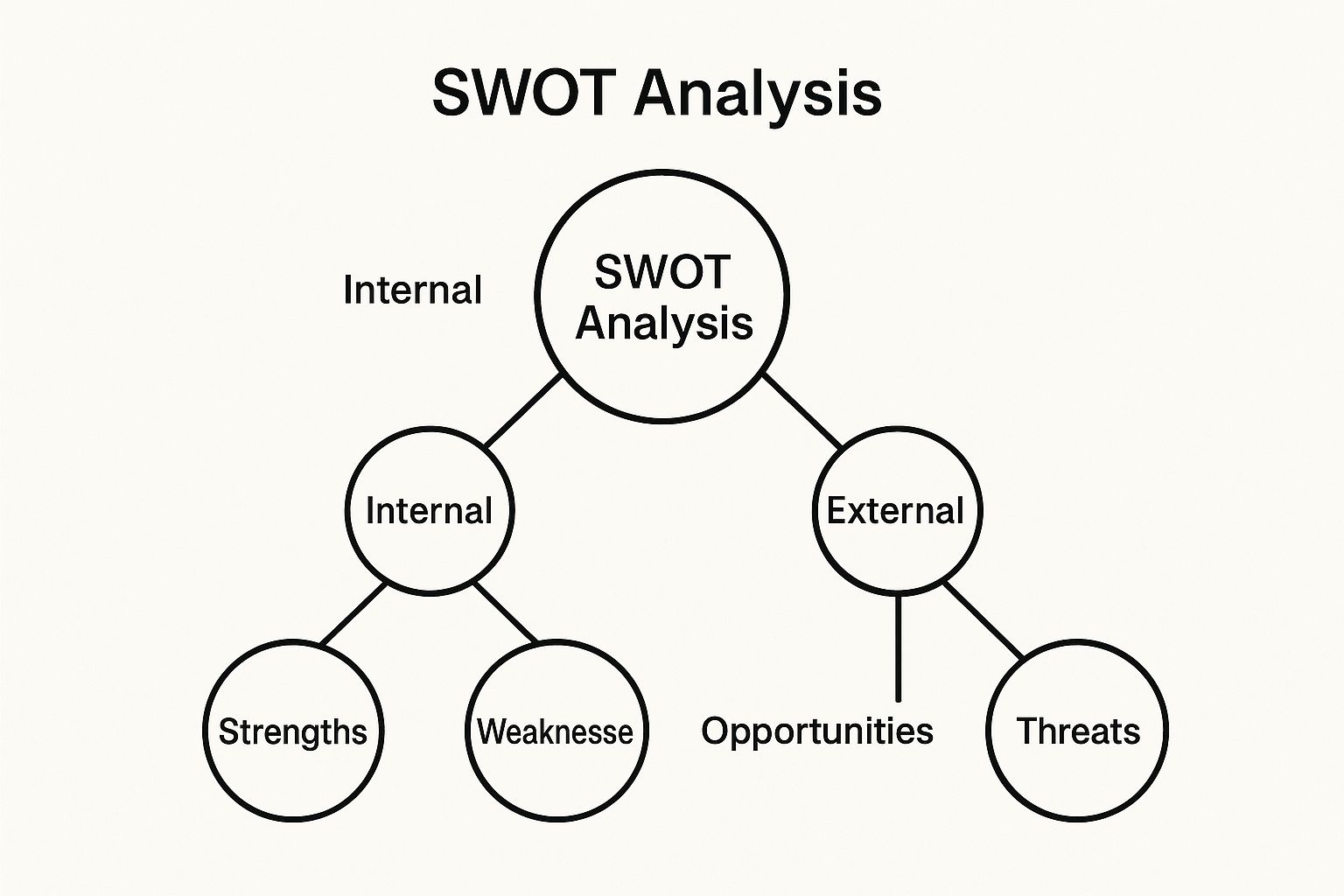
The first step in any effective strategic plan is understanding your starting point. While the SWOT (Strengths, Weaknesses, Opportunities, Threats) analysis is a classic business tool, its power is magnified when adapted specifically for the K-12 landscape. This isn't about corporate metrics; it's about evaluating your school’s unique position within its community and the broader educational environment. This foundational exercise is one of the most crucial strategic planning best practices because it provides the data-driven clarity needed to make informed marketing and communications decisions.
How to Apply SWOT in a School Context
To make your SWOT analysis actionable, ground it in the realities of school marketing. Instead of generic categories, use K-12 specific lenses:
- Strengths (Internal): What does your school do exceptionally well? This could be a renowned STEM program, a high faculty retention rate, a vibrant arts department, or a deeply engaged parent-teacher association.
- Weaknesses (Internal): Where do you fall short? Be honest about an outdated website, inconsistent parent communication, limited transportation options, or facilities that need upgrading.
- Opportunities (External): What external factors can you leverage? Consider new housing developments bringing young families to the area, a local business seeking partnership opportunities, or a competitor's recent negative press.
- Threats (External): What external challenges are on the horizon? This could be the growing popularity of local charter schools, declining enrollment due to demographic shifts, or proposed changes in state funding.
A school-specific SWOT isn't just a list; it's a diagnostic tool that reveals where to invest your limited marketing resources for the greatest impact.
Case Study in Action: Oakridge Academy
Oakridge Academy identified a "Weakness" in its digital presence; its social media was inconsistent and didn't engage prospective families. Simultaneously, they noted an "Opportunity" in the rising number of millennial parents in their district who rely heavily on social media for school research. By connecting the dots, they launched a targeted social media campaign featuring "day-in-the-life" student videos and virtual tours. The result was a 15% increase in open house attendance and a stronger connection with their target demographic. This shows how a focused SWOT can directly translate internal weaknesses into market-savvy opportunities.
2. Adopt a Balanced Scorecard Approach: Go Beyond Financials
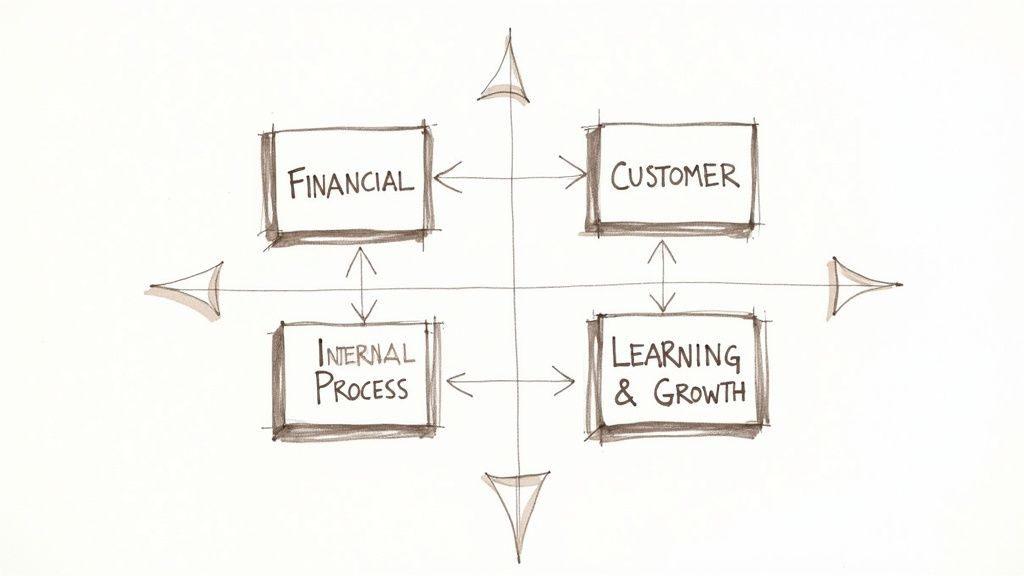
Once you understand your position, the next step is to create a holistic view of what success looks like. The Balanced Scorecard (BSC) is a strategic management system that moves beyond purely financial or enrollment-based metrics. Developed by Robert Kaplan and David Norton, it forces schools to consider their performance from four distinct yet interconnected perspectives. This methodology is one of the most effective strategic planning best practices because it ensures your goals are comprehensive, preventing the common pitfall of over-indexing on one area while neglecting others critical to long-term health.
How to Apply the Balanced Scorecard in a School Context
To translate this corporate framework for education, think of the four perspectives through a school-centric lens. This approach connects your high-level mission directly to day-to-day marketing and operational activities.
- Financial Perspective: How do we appear to our funders and board? Metrics could include meeting enrollment projections, successful fundraising campaigns, or optimizing operational costs.
- Customer (Parent/Student) Perspective: How do our families see us? This is measured by parent satisfaction surveys, student retention rates, and the school's brand reputation in the community.
- Internal Process Perspective: What must we excel at to satisfy our families? This involves improving the admissions process, streamlining parent communication channels, or enhancing curriculum delivery.
- Learning & Growth Perspective: How can we sustain our ability to change and improve? Focus on faculty professional development, technology integration, and fostering a culture of innovation.
The Balanced Scorecard prevents strategic tunnel vision. It ensures that a drive for higher enrollment doesn't come at the expense of student satisfaction or teacher development.
Case Study in Action: Jefferson County Public Schools
Jefferson County Public Schools faced declining enrollment and a perception of stagnating academic programs. They adopted a Balanced Scorecard to guide their five-year strategic plan. Under the "Customer Perspective," they set a key objective to "become the first choice for local families." This led to an "Internal Process" initiative to revamp their school choice and enrollment system, making it more user-friendly. Simultaneously, a "Learning & Growth" goal focused on training staff in new project-based learning curricula. By tracking metrics across all four areas, they achieved a 5% increase in student retention and won a regional award for parent communication, demonstrating how a balanced approach drives interconnected results.
3. Embrace Scenario Planning: Prepare for Multiple Futures
The educational landscape is in constant flux, shaped by demographic shifts, technological advancements, and policy changes. Simply projecting the current reality forward is a recipe for being caught off guard. Scenario planning is a powerful technique that moves beyond forecasting a single future and instead prepares your school for a range of plausible futures. This forward-thinking approach is one of the most vital strategic planning best practices as it builds institutional resilience and agility.
How to Apply Scenario Planning in a School Context
Scenario planning involves creating several distinct, data-backed narratives about what the future might hold. For a school, this isn't about predicting the next five years with certainty; it's about imagining different operational environments and building flexible strategies that can adapt.
- Scenario 1: The Digital Disruption: A future where online and hybrid learning models become dominant, forcing a major competitor school to close but also increasing demand for advanced digital literacy programs.
- Scenario 2: The Community Hub: A future where local population growth slows, and schools must evolve into multi-purpose community centers offering adult education and expanded services to remain viable.
- Scenario 3: The Funding Squeeze: A future where significant state funding cuts force difficult decisions about program offerings and a greater reliance on fundraising and new revenue streams.
- Scenario 4: The Enrollment Boom: A future where a major local corporation relocates to the area, creating a sudden and sustained influx of new families and straining existing capacity.
Scenario planning frees your team from the trap of single-point forecasting. It builds a strategic playbook that prepares your school to thrive, not just survive, no matter which future unfolds.
Case Study in Action: Ridgemont District
The Ridgemont District used scenario planning to anticipate potential demographic shifts. One scenario, "The Urban Exodus," explored the possibility of city families moving to their suburban area post-pandemic. They identified key indicators, like local housing market trends and remote work policies. When these indicators began to activate, the district was ready. They had already developed a phased plan to reopen a previously closed elementary school and a communications strategy to welcome new families. As a result, they managed a 20% enrollment surge over two years without the chaos and overcrowding that would have occurred without proactive planning.
4. OKRs (Objectives and Key Results): Drive Measurable Progress
While big-picture goals are important, they can feel distant and disconnected from daily tasks. The OKR (Objectives and Key Results) framework, popularized by tech giants like Intel and Google, bridges that gap by connecting ambitious goals with measurable, time-bound results. This system is one of the most effective strategic planning best practices for schools because it shifts the focus from busywork to tangible outcomes, ensuring every marketing initiative contributes directly to the strategic plan.
How to Apply OKRs in a School Context
OKRs break down your strategy into a simple, powerful structure. An Objective is the qualitative, inspirational goal you want to achieve, while Key Results are the quantitative metrics that prove you’ve achieved it.
- Objective (The "What"): This is your high-level goal. For a school, this might be "Become the top choice for STEM-focused families in our region." It's aspirational and sets a clear direction.
- Key Results (The "How"): These are the specific, measurable, and time-bound outcomes that track your progress. For the STEM objective, key results could be:
- Increase applications from families mentioning the STEM program by 20% by the end of the admissions cycle.
- Achieve a 50% increase in traffic to STEM-related pages on our website by Q2.
- Secure three media placements in local publications highlighting our new robotics lab within six months.
The power of OKRs lies in their clarity. They force your team to define what success actually looks like in numbers, moving beyond vague goals like "improve our marketing" to concrete, trackable targets.
Case Study in Action: Riverbend Preparatory School
Riverbend Prep set an ambitious "Objective" to enhance its reputation as an innovative leader in project-based learning. To make this real, they established clear Key Results: launch a new "Innovation Hub" section on their website, produce a video series showcasing student projects that achieved 10,000 views, and increase tour requests mentioning project-based learning by 30%. By regularly tracking these KRs, the team stayed aligned and focused. They exceeded two of their three targets, resulting in a noticeable uptick in mission-aligned applicants and providing concrete data to showcase their strategic success to the school board.
5. Adopt a Blue Ocean Strategy: Make the Competition Irrelevant
Instead of battling other schools for the same pool of prospective families in a crowded "red ocean" of competition, what if you could create a new, uncontested market space? This is the core idea behind Blue Ocean Strategy, a framework that shifts focus from outperforming rivals to creating new demand. This approach is one of the most transformative strategic planning best practices because it encourages schools to innovate value, simultaneously pursuing differentiation and lower cost to open up new opportunities.

How to Apply Blue Ocean Strategy in a School Context
For a school, this means breaking away from the traditional measures of success like test scores and athletic championships. Instead, you create a unique value proposition that appeals to a previously underserved segment of your community.
- Eliminate: What factors that your school has long competed on can be eliminated? Perhaps it's an expensive but low-enrollment niche program.
- Reduce: Which factors should be reduced well below the industry standard? This could be simplifying the admissions process or reducing reliance on traditional, costly advertising.
- Raise: Which factors should be raised well above the industry standard? This might involve creating an unparalleled parent communication platform or investing heavily in teacher professional development for a specific pedagogy.
- Create: Which factors should be created that the industry has never offered? This could be a flexible, hybrid learning model for families with non-traditional schedules or a curriculum centered entirely on project-based, real-world problem-solving.
A Blue Ocean Strategy isn’t about being the best in the existing market; it’s about creating a new market where your school is the only player.
Case Study in Action: The Global Pioneers Academy
The Global Pioneers Academy (GPA) was a small private school struggling to compete with larger, more established institutions. Instead of fighting a losing battle on sports and campus size, they adopted a Blue Ocean Strategy. They "created" a first-of-its-kind curriculum focused on global entrepreneurship and bilingualism for K-8 students, targeting families who valued practical, future-ready skills over traditional metrics. By "eliminating" a formal athletics department and "reducing" infrastructure costs, they made tuition more accessible. The result was a 40% increase in inquiries from a completely new demographic of families, making their local competition irrelevant to their target audience.
6. Analyze the Competitive Landscape with Porter's Five Forces
Beyond an internal SWOT analysis, truly effective strategic planning requires a deep understanding of the external competitive environment. Michael Porter's Five Forces model is a powerful framework that moves beyond direct competitors to analyze the broader pressures shaping your school's market. This is one of the most vital strategic planning best practices for schools operating in increasingly crowded educational marketplaces, as it provides a 360-degree view of the forces affecting enrollment and reputation.
How to Apply Porter's Five Forces in a School Context
This framework helps you evaluate the intensity of competition and the overall attractiveness of your educational market. Adapt the five forces to your specific K-12 environment:
- Threat of New Entrants: How easy is it for a new charter school, private academy, or microschool to open in your area? Consider regulatory hurdles, capital requirements, and brand loyalty.
- Bargaining Power of Buyers (Parents/Students): How much choice do families have? In a district with many high-performing options, parents have significant power, forcing schools to compete on programs, tuition, and outcomes.
- Bargaining Power of Suppliers (Faculty/Vendors): How much leverage do your key "suppliers" have? A shortage of qualified teachers or reliance on a single curriculum provider can increase their bargaining power and your costs.
- Threat of Substitute Products or Services: What are the alternatives to traditional schooling? This includes homeschooling, online academies, and specialized tutoring centers that can draw students away.
- Rivalry Among Existing Competitors: How intense is the competition with other local public, private, and charter schools for the same pool of students?
Porter's Five Forces shifts the focus from "who are our competitors?" to "what forces shape competition in our market?" This broader perspective uncovers risks and opportunities you might otherwise miss.
Case Study in Action: Gateway Charter School
Gateway Charter School used the Five Forces model and identified a high "Threat of Substitute Products" from a surge in local, high-quality online learning platforms. They also noted that the "Bargaining Power of Buyers" was high, as parents desired more flexible learning options. In response, Gateway developed and launched its own hybrid learning program, blending in-person instruction with a robust online curriculum. This strategic pivot not only mitigated the threat but also attracted a new segment of families, leading to a 12% increase in new student inquiries within the first year.
7. Foster Stakeholder Engagement and Buy-In: Build a Unified Vision
A strategic plan developed in a vacuum is destined to fail. True success hinges on engaging the diverse group of individuals who have a stake in your school's future: teachers, staff, parents, students, alumni, and community members. A systematic approach to identifying, analyzing, and involving these stakeholders ensures that the plan reflects the collective vision of your community, not just the administration. This process is one of the most vital strategic planning best practices as it transforms the plan from a document into a shared mission.
How to Apply Stakeholder Engagement in a School Context
To move beyond simple feedback forms, you must create a structured engagement strategy. This involves actively bringing different groups into the planning process to secure their buy-in and benefit from their unique perspectives.
- Identify and Map Stakeholders: Who is impacted by your plan? Map them based on their level of influence and interest. A high-influence, high-interest group like the teaching faculty requires deep collaboration, while a low-influence, high-interest group like local business owners might be kept informed through regular updates.
- Use Tailored Engagement Methods: Don't use a one-size-fits-all approach. Conduct town hall meetings and workshops for parents and faculty, create student focus groups to gather their input, and send targeted surveys to alumni. Learn more about the nuances of stakeholder engagement.
- Communicate Early and Often: Transparency is key. Share the planning timeline, key milestones, and opportunities for feedback from the very beginning. Regular communication prevents misinformation and makes stakeholders feel valued.
- Establish Formal Feedback Loops: Create clear, accessible channels for feedback, such as a dedicated email address or an online portal. Crucially, have a system in place to acknowledge and respond to this input, showing that it was heard and considered.
A strategic plan with genuine stakeholder buy-in doesn't just get approved; it gets championed. It turns passive observers into active partners in your school's success.
Case Study in Action: Northwood Preparatory
Northwood Preparatory was planning a major technology integration initiative. Initially, there was significant resistance from veteran teachers concerned about implementation and training. Instead of pushing forward, the administration created a "Tech Task Force" comprised of teachers, parents, IT staff, and even two student representatives. This group co-developed the rollout plan, identified training needs, and piloted the new technology in a few classrooms. By involving key stakeholders directly, Northwood turned its biggest critics into advocates for the plan. The result was a seamless, school-wide adoption of the new technology and a stronger, more collaborative school culture.
8. Institute Regular Strategy Reviews for Adaptive Management
A strategic plan is not a "set it and forget it" document; it's a living guide that must evolve with your school's environment. Instituting a formal process for regular strategy reviews turns your plan from a static artifact into a dynamic tool for adaptive management. This practice ensures your school remains agile, responsive, and aligned with its goals, even as internal and external conditions shift. Embracing this continuous cycle of review and adjustment is one of the most vital strategic planning best practices for long-term relevance and success.
How to Apply Adaptive Management in a School Context
True adaptive management requires a structured, recurring process. It's not about making reactive changes on the fly but about building a systematic rhythm of evaluation and course correction. The goal is to create a culture where the strategic plan is a constant reference point for decision-making.
- Establish a Review Cadence: Schedule formal strategy reviews at regular intervals. Quarterly reviews are ideal for tracking progress on key performance indicators (KPIs) and making tactical adjustments, while an annual review allows for a deeper assessment of the plan's overall validity and long-term goals.
- Define Triggers for Adjustment: Beyond scheduled reviews, identify specific triggers that would prompt an immediate strategy discussion. These could include a sudden drop in enrollment inquiries, the announcement of a new competitor school, significant changes in state education policy, or feedback from a major parent survey.
- Balance Stability with Agility: The objective isn't to constantly overhaul your entire strategy. The review process should differentiate between core mission-driven goals (which should remain stable) and the tactics used to achieve them (which can be flexible and adapted based on performance data).
A strategic plan gains its power not from its creation, but from its consistent use and adaptation. Regular reviews transform it from a document on a shelf into the school's operational North Star.
Case Study in Action: Northwood Preparatory School
Northwood Prep’s initial strategic plan included a goal to increase STEM enrollment by 25% over three years, with a key tactic being an annual on-campus science fair. After the first year, their quarterly review showed that while the fair was well-attended, it wasn't translating into new applications. Using this data, they adapted their approach for year two. Instead of just a fair, they launched a series of smaller, hands-on STEM workshops for middle school students in the community. This pivot, driven by a regular review process, resulted in a 40% increase in STEM-focused applications the following admission cycle, demonstrating how adaptive management can directly optimize outcomes.
9. Ensure Clear Vision, Mission, and Values Alignment
A strategic plan without a clear purpose is like a ship without a rudder. Your school's vision, mission, and values are the foundational elements that provide direction, purpose, and a shared identity. Aligning every goal and initiative with these core statements is one of the most critical strategic planning best practices, ensuring that your marketing efforts authentically reflect who you are and what you stand for. This alignment transforms your plan from a list of tasks into a meaningful roadmap toward a shared future.
How to Apply This in a School Context
These core statements must be more than just words on a website; they need to be living principles that guide daily decisions and communications. Ground them in the tangible experience of your school community:
- Vision Statement: This is your "big picture" aspiration. It answers the question, "What is the ultimate impact we want to have on our students and community?" It should be inspiring and future-focused, like "To cultivate a community of innovative, compassionate global citizens."
- Mission Statement: This is your "how." It defines your school's core purpose and what it does every day to achieve the vision. For example, "We provide a rigorous, inquiry-based curriculum within a supportive, diverse environment to empower students to reach their full potential."
- Core Values: These are the non-negotiable principles that guide behavior. Words like "Integrity," "Respect," and "Curiosity" become powerful when tied to specific actions and expectations for students, faculty, and staff.
A tightly aligned vision, mission, and set of values ensures every marketing message, program launch, and policy decision reinforces a consistent and compelling brand identity.
Case Study in Action: The Northwood School
The Northwood School, a K-8 institution, had a mission focused on "fostering intellectual curiosity." However, their strategic plan was heavily weighted toward standardized test preparation. This misalignment created confusion among parents and faculty. During their strategic planning process, they refocused, aligning their goals with their mission. They invested in project-based learning initiatives, a new "Invention Lab," and a speaker series featuring local innovators. By marketing these mission-aligned programs, they attracted families who valued creative thinking over rote memorization, resulting in a 20% increase in mission-fit applications and a more engaged student body. This demonstrates how aligning strategy with purpose creates powerful, authentic momentum.
10. Implementation Roadmapping and Resource Allocation
A brilliant strategic plan is only as valuable as its execution. Implementation roadmapping bridges the crucial gap between your high-level vision and the day-to-day actions required to achieve it. This practice involves creating a detailed, visual timeline that breaks down large strategic goals into manageable initiatives, assigning clear responsibilities, and allocating the necessary resources. It transforms abstract objectives into a concrete, actionable blueprint, making it one of the most vital strategic planning best practices for ensuring your plan doesn't just gather dust on a shelf.
How to Apply Roadmapping in a School Context
For a school marketing team, an implementation roadmap provides clarity and maintains momentum. It ensures everyone knows what they are responsible for, when it's due, and how their work contributes to the bigger picture.
- Break Down Strategy: Deconstruct your overarching marketing goals (e.g., "Increase enrollment by 10%") into specific initiatives like "Launch a new website," "Run a digital ad campaign," and "Host three virtual open houses."
- Assign Ownership and Timelines: For each initiative, assign a clear owner and set realistic start and end dates. This creates accountability and a sense of urgency.
- Identify Dependencies: Recognize which tasks must be completed before others can begin. For example, website photography must be finished before the new website can be designed.
- Allocate Resources: Be specific about the budget, staff time, and technology needed for each initiative. Include a contingency fund to handle unexpected costs or delays.
An implementation roadmap is not just a schedule; it's a commitment device that aligns your team, budget, and activities toward a shared, measurable outcome.
Case Study in Action: Crestwood Day School
Crestwood Day School's strategic plan called for enhancing its reputation as a leader in project-based learning. Their implementation roadmap broke this down into a year-long content marketing initiative. The roadmap detailed a quarterly blog series featuring student projects, a bi-monthly parent newsletter with faculty interviews on the topic, and a targeted social media video campaign. By allocating specific staff hours and a modest budget for video production, they followed the roadmap precisely. The result was a 40% increase in website traffic to their admissions page and a significant rise in inquiries specifically mentioning their project-based learning approach. This demonstrates how a clear roadmap directly translates a strategic goal into measurable marketing success.
Strategic Planning Best Practices Comparison
| Item | Implementation Complexity | Resource Requirements | Expected Outcomes | Ideal Use Cases | Key Advantages |
|---|---|---|---|---|---|
| SWOT Analysis (Strengths, Weaknesses, Opportunities, Threats) | Low | Low | Holistic view of strategic position | Initial strategic assessment, team brainstorming | Simple, intuitive, cost-effective |
| Balanced Scorecard Approach | High | High | Aligned performance measurement across perspectives | Comprehensive strategy execution and tracking | Links strategy to measurable outcomes |
| Scenario Planning | High | High | Preparedness for multiple future uncertainties | Long-term planning under uncertainty | Enhances strategic flexibility |
| OKRs (Objectives and Key Results) | Medium | Medium | Clear goal-setting with measurable results | Aligning teams and focusing priorities | Promotes transparency and rapid adjustment |
| Blue Ocean Strategy | High | Medium to High | New market creation, reduced competition | Innovation-driven growth and market expansion | Drives innovation and value creation |
| Porter's Five Forces Analysis | Medium | Medium | Understanding industry competitiveness | Industry analysis and strategic positioning | Systematic competitive environment analysis |
| Stakeholder Engagement and Buy-in | Medium | Medium | Increased support and reduced resistance | Complex projects requiring broad support | Improves decision quality and commitment |
| Regular Strategy Reviews and Adaptive Management | Medium | Medium | Ongoing strategy relevance and agility | Dynamic environments needing frequent updates | Builds strategic agility and learning |
| Clear Vision, Mission, and Values Alignment | Low | Low to Medium | Direction, purpose, and cultural cohesion | Foundational organizational guidance | Motivates and guides decision-making |
| Implementation Roadmapping and Resource Allocation | Medium to High | Medium to High | Effective strategy execution with accountability | Translating strategy into operational plans | Bridges strategy and execution gap |
Putting Your K-12 Strategic Plan into Action
Navigating the complex world of K-12 school marketing requires more than just creativity and hustle; it demands a solid, actionable strategy. Throughout this guide, we've explored ten powerful strategic planning best practices, moving from foundational analyses like SWOT and Porter's Five Forces to dynamic frameworks like OKRs and the Balanced Scorecard. We've seen how envisioning future challenges with Scenario Planning and creating new market space with a Blue Ocean Strategy can redefine what's possible for your institution.
The common thread connecting these diverse methodologies is a shift from reactive, day-to-day task management to proactive, goal-oriented leadership. A well-crafted strategic plan, built on clear alignment with your school's vision and values, becomes your North Star. It transforms your marketing and communications efforts from a series of disconnected activities into a cohesive engine driving enrollment, enhancing reputation, and building a vibrant, engaged community.
From Framework to Reality: Your Next Steps
The true value of these strategic planning best practices is not in knowing them, but in applying them. It can feel overwhelming to consider implementing all ten frameworks at once, but the journey to strategic excellence begins with a single, deliberate step.
Start by identifying the most pressing challenge your school faces right now.
- Is your brand message unclear? Begin with the Vision, Mission, and Values Alignment to create a strong foundation.
- Struggling to differentiate in a crowded market? A Blue Ocean Strategy workshop could unlock uncontested market space.
- Finding it hard to track progress and maintain momentum? Implementing OKRs can bring sharp focus and measurable accountability to your team.
- Worried about external market shifts? Conducting a Scenario Planning exercise will prepare you to adapt and thrive no matter what the future holds.
The key is to view these models not as rigid, unchangeable doctrines, but as a versatile toolkit. Select the tool that best fits your immediate need, master its application, and build from there. For example, your Implementation Roadmap might reveal a critical need to improve on-campus experiences for prospective families. As schools put their strategic plans into action, optimizing operational workflows and enhancing campus safety often become key areas of focus. This could lead you to explore solutions like optimizing school operations and safety with a Visitor Management System, a tactical decision that directly supports a broader strategic objective.
The Power of a Living Strategy
Remember, the most effective strategic plan is not a document that gathers dust on a shelf. It is a living, breathing guide that evolves with your school. The principles of Stakeholder Engagement ensure your plan has buy-in from the start, while Regular Strategy Reviews and Adaptive Management guarantee it remains relevant and responsive to new challenges and opportunities.
By embracing these strategic planning best practices, you are not just creating a marketing plan. You are building a sustainable framework for growth, innovation, and long-term success. You are empowering your team to make smarter decisions, allocate resources more effectively, and demonstrate the profound impact of their work on the entire school community. This strategic approach elevates your role from a communications specialist to a vital institutional leader, ready to guide your school toward a brighter, more secure future.
Ready to move from theory to mastery? Join The MarCom Society, a professional community designed for K-12 marketing leaders like you. Access expert-led workshops, collaborative peer groups, and exclusive resources that will help you implement these strategic planning best practices and drive real results for your school.









