Let's be honest: your school's most powerful marketing tool isn't a glossy brochure or a perfectly curated website. It's your students. A student ambassador program turns your current students into your most authentic storytellers, tapping into the power of peer-to-peer influence to connect with prospective families on a deeply personal level.
Why Student Ambassadors Are Your Best Marketing Asset
It's time to stop thinking of student ambassadors as just tour guides or a feel-good extracurricular. A well-run program is a core marketing strategy. It's about generating real social proof, building an authentic community vibe, and—yes—directly boosting your enrollment numbers.
The magic is in who's delivering the message. Prospective families expect the school to say great things about itself. But when a student shares a personal story? They lean in and listen. That genuine perspective is something you just can't buy.
The Unmatched Power of Peer-to-Peer Influence
Think about how you make big decisions. You probably ask for advice from someone you trust, someone who's been there. Choosing a school is no different. A parent wondering about the transition to middle school gets a much better answer from an 8th grader who just lived it than they will from a marketing director.
This is where the connection happens. An ambassador can say, "I was nervous about the science fair too, but my teacher, Mrs. Davison, stayed after school with me for a week to help me perfect my project." That one sentence says more about your supportive environment than an entire viewbook ever could.
Student ambassadors don't just recite facts; they share feelings. Their genuine enthusiasm and personal anecdotes build an emotional connection that marketing materials can't match, creating a powerful sense of trust and belonging for prospective families.
This is how you transform your school from an institution into a community in the eyes of a prospective family.
Tangible Benefits Beyond the Campus Tour
Sure, leading tours is a big part of the job, but the impact of a great student ambassador program goes so much further. Think of it as a content-generating machine and a direct line to improving your school's culture.
Here are just a few of the ripple effects I've seen:
- Authentic Content Creation: Your ambassadors can run an Instagram takeover for a day, write a blog post about their favorite class, or be the stars of a short video testimonial. This is the kind of student-generated content that actually gets noticed.
- Building School Spirit: Giving your most passionate students a microphone is a surefire way to boost school spirit. Their positive energy is infectious and spreads throughout the student body.
- Leadership Development: This isn't just a marketing win; it's a huge win for the students. They're learning public speaking, communication, and responsibility—skills that look fantastic on college applications and serve them for life.
- Diverse Representation: When you build your team thoughtfully, you can showcase the true diversity of your school. A prospective family seeing students from all different backgrounds and with varied interests makes your community feel that much more welcoming.
We can see the proof of this model in higher education, where global ambassador programs have become a cornerstone of student engagement. Take UCLA’s International Student Ambassadors program as an example. They bring in 30-40 ambassadors each year who represent over 60 countries and connect with an estimated 10,000 students. It’s a powerful demonstration of how a structured program can deliver massive, measurable results.
Designing Your Program's Strategic Blueprint
A great student ambassador program doesn't just happen. It’s built on a solid plan, not just on the excitement of a few enthusiastic students. Before you can tap into that energy, you need a clear blueprint that spells out exactly what success looks like and how you’ll get there. This initial work is what separates a program that fizzles out from one that delivers real results for your school's marketing and enrollment goals.
It all starts with asking the right questions. What do you actually want this program to accomplish? "Promoting the school" is too vague. You need concrete, measurable goals. Think in terms of "increasing open house attendance by 20%" or "boosting social media engagement from prospective families by 30%." Those are targets you can aim for and measure against.
A well-structured program creates a powerful cycle: it builds a strong community, that community establishes authentic trust with prospective families, and that trust directly drives enrollment growth.

As you can see, these pieces all feed into one another, creating a flywheel effect that strengthens your school’s reputation from the inside out.
Defining Ambassador Roles and Responsibilities
Once you know your goals, you can start thinking about what you’ll ask your ambassadors to do. The good news is that you don't need a team of identical, all-star public speakers. In fact, a program is much stronger when it includes students with different talents and personalities. This allows you to create specialized roles where students can truly shine.
You can tailor these roles to fit your school's unique needs, but here's a look at some of the most effective positions I've seen in action.
Key Roles Within a Student Ambassador Program
This table breaks down a few common ambassador roles, what they do, and the valuable skills students gain from the experience.
| Ambassador Role | Primary Responsibilities | Key Skills Developed |
|---|---|---|
| Campus Tour Guide | Lead engaging campus tours for prospective families, sharing personal stories and key school facts. | Public speaking, storytelling, customer service, interpersonal communication. |
| Social Media Creator | Create "day in the life" content, manage Instagram takeovers, and produce short video testimonials. | Content creation, digital marketing, brand management, creativity, video editing. |
| New Student Mentor | Connect with newly enrolled students to answer questions, ease their transition, and act as a friendly guide. | Mentorship, active listening, problem-solving, empathy, leadership. |
| Event Host | Greet and mingle with families at open houses, info nights, and other admissions events. | Networking, hospitality, professional etiquette, confidence. |
| Content Contributor | Write blog posts or student spotlight articles for the school's website or newsletter. | Writing, interviewing, time management, content marketing. |
By offering a variety of roles, you attract a wider range of students and give them a chance to develop skills that will serve them long after they graduate.
As you build out these roles, especially the social media ones, it's absolutely critical to establish clear social media brand guidelines. You want to give your ambassadors creative freedom, of course, but that creativity needs to live inside a framework that protects your school’s voice and brand.
Mapping Out Logistics and Leadership
With your goals and roles in place, it’s time to get down to the practical details. This is where many well-intentioned programs fall apart, so don’t skip this part. Start by outlining a realistic budget. Will you need t-shirts? Funds for a pizza party or an end-of-year thank you event? Account for it now.
Next, you need to find the right person to lead the program. This faculty or staff advisor is the glue that holds everything together. They aren't just a supervisor; they are a mentor who is genuinely invested in seeing these students grow. The best advisors are organized, easy to talk to, and completely dedicated to the school's mission.
Finding the right advisor is paramount. Look for a teacher or staff member who students already trust and admire. Their passion will set the tone for the entire program and inspire ambassadors to give their best effort.
Finally, draw up a clear timeline for recruitment and training. When will applications open and close? When will you hold interviews? When does training begin? Having this all mapped out makes the process feel professional and organized for everyone involved.
This entire blueprint becomes your guide. If you want a great starting point for putting this all on paper, you can adapt this excellent communications strategy template to fit your program’s needs. A little structure up front ensures your student ambassadors programs are set up for success from day one, turning your vision into a powerful force for your school.
Recruiting a Diverse and Passionate Team
Finding the right students is where a good ambassador program becomes a great one. It’s tempting to just pick the obvious leaders—the student body president, the valedictorian—but your best team will be a true cross-section of your school community. You need a group that reflects the real, vibrant, and diverse student body you actually have.
When a prospective family tours your school, they should be able to see their own child in your ambassadors. That means you need the quiet artist from the studio, the determined athlete from the field, and the curious coder from the tech lab. Their unique stories are your most powerful marketing tool because they're genuine.

Spreading the Word to Find Hidden Gems
So, how do you find these students? You have to go beyond a single flyer in the main hallway. That will only attract the students who are already involved in everything. To find those hidden gems, you need to cast a much wider net.
Your teachers are your secret weapon here. They see the students who have incredible potential but might not raise their hand for a leadership role. Send out a quick email asking for recommendations. Be specific: ask for students who are passionate, kind, and reliable, not just those with the highest GPAs.
Here are a few other ways to get the word out:
- Teacher & Department Head Nominations: Ask the art, STEM, or humanities departments to nominate students who shine in their specific areas.
- Classroom Shout-Outs: Give teachers a quick script to announce the opportunity in class, making it clear you're looking for all types of personalities and interests.
- Social Media Buzz: Use your school’s Instagram or Facebook to feature current students and talk about the perks of joining the ambassador team.
- The Power of a Personal Invite: Don’t underestimate how much a direct invitation can mean to a student. If you see a student who you think would be a great fit, tell them! It can be a huge confidence boost.
This multi-channel approach ensures you reach beyond the usual suspects and give everyone a chance to see themselves in this role.
Designing an Application That Reveals Character
Your application form is the first real filter. It needs to be designed to find passion and personality, not just list accomplishments. Sure, you can include a section for extracurriculars, but the real magic is in the questions you ask.
Ditch the generic "Why do you want to be an ambassador?" Instead, try prompts that get to the heart of their experience:
- "Tell us about a time you were really proud to be a student here. What happened?"
- "Imagine a new student is feeling lost on their first day. What would you do or say to help them?"
- "What's your favorite class or project you've ever worked on? What made it so great?"
These kinds of questions give you a glimpse into their storytelling ability, their empathy, and their authentic love for the school.
The whole point of the application and interview is to find students with genuine school spirit, a collaborative mindset, and solid communication skills. These are the non-negotiables for an effective ambassador.
Structuring an Interview to See Skills in Action
The final step is the interview, which should feel more like a conversation than an interrogation. You want to see their personality shine, not watch them squirm under pressure.
I've found that group interviews work wonders. Get a few candidates together and give them a quick scenario to work through. For example: "A family is worried their shy child will have trouble making friends. How would you all respond?"
Watching them interact is incredibly revealing. You’ll immediately spot the natural leaders, the good listeners, the collaborators, and the ones who can articulate a thoughtful, caring answer on the spot.
By making diversity and passion your North Star from day one, you’ll build a team that can genuinely connect with every single family that walks through your doors.
Training Your Ambassadors to Be Authentic Storytellers
You’ve assembled your team of student ambassadors, and their energy is contagious. But how do you channel that raw enthusiasm into a genuine voice for your school? The key is to empower them, not script them.
Your goal is to nurture confident, authentic storytellers who can share their real experiences—the good, the great, and the truly memorable—all while staying true to your school's brand. Forget memorized lines; a scripted ambassador sounds robotic and shatters the trust you're trying to build. Your role here isn't manager, it's mentor. You provide the framework and the facts, then you step back and let their personalities shine.
Building the Foundation: It Starts with Your School’s DNA
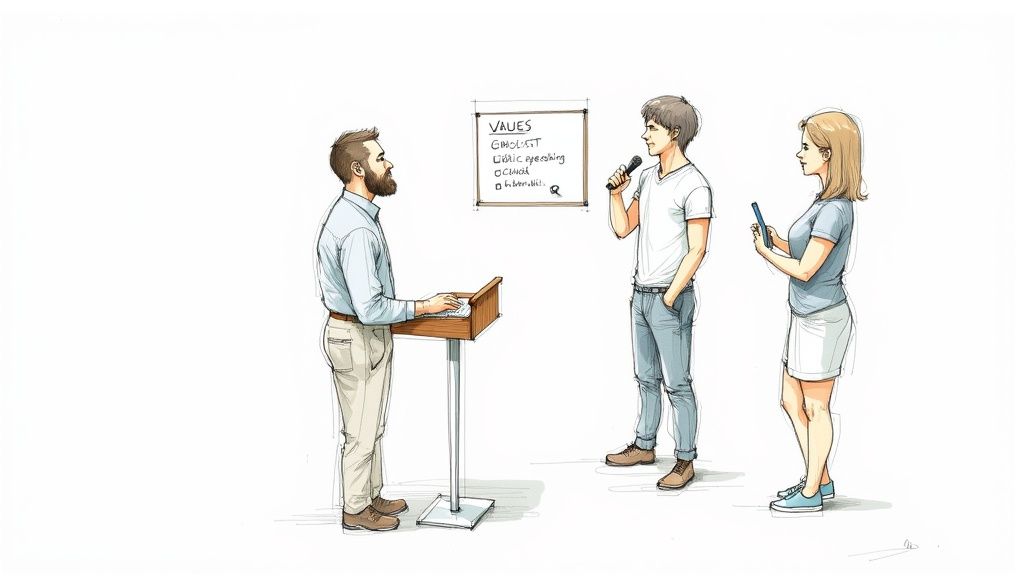
Before your students can tell your school's story, they have to feel it. The first order of business is a deep dive into your school’s mission, vision, and core values. But please, don’t just read them off a PowerPoint slide. Make it a conversation.
Ask them what these values mean in their day-to-day lives. If a core value is "community," prompt them for a time they truly felt it on campus—maybe it was a classmate helping them study for a tough exam or the entire school rallying behind the basketball team. This simple exercise connects abstract ideas to concrete, personal memories they can draw on later. This is the heart of effective storytelling in education.
Of course, they need the hard facts, too. Arm them with a "fast facts" sheet. This isn't a script; it’s a cheat sheet with key info like the founding year, number of student clubs, recent awards, or unique academic tracks. It’s there so they feel confident and have accurate information ready when asked.
A Sample Training Day Agenda
I've found that a full-day kickoff training is the best way to get your student ambassador program started. It builds incredible camaraderie and makes sure everyone is on the same page from day one. To keep the energy up, I recommend mixing learning sessions with hands-on practice and fun team-building breaks.
Here’s a blueprint you can adapt for your own school:
- 9:00 AM – Welcome & Icebreakers: Kick things off with some fun activities. The goal is to get them comfortable with each other and with you.
- 10:00 AM – Our School’s Story: This is where you cover the mission, values, and key brand messages.
- 11:00 AM – The Art of the Story: A hands-on workshop on how to find and share compelling personal anecdotes.
- 12:00 PM – Lunch & Team Building: A relaxed, no-pressure break to let them connect as a group.
- 1:00 PM – Public Speaking & Body Language: Give them practical tips and exercises to build confidence.
- 2:00 PM – Navigating Tough Questions: Use role-playing to practice answering tricky questions honestly and gracefully.
- 3:00 PM – Social Media Savvy: A quick session on brand guidelines and what makes authentic online content.
- 4:00 PM – Wrap-up & Swag: End on a high note! Celebrate their new roles and hand out their official ambassador t-shirts.
This kind of immersive day gives them a solid foundation, covering everything from core knowledge to practical skills.
Honing Their Communication Skills for the Real World
Public speaking is nerve-wracking for almost everyone, and students are no exception. Your training has to include practical workshops that build them up. Focus on simple, effective techniques: making eye contact, speaking clearly, and using open, welcoming body language.
Role-playing is, without a doubt, the most powerful tool in your training kit. It creates a safe space for students to practice before they're in front of a real family. Throw them some realistic scenarios they’re likely to face.
Here's a great one to try: "A prospective parent is worried their shy, introverted child will struggle to make friends here. What do you tell them?" This isn't a question they can answer with a fact sheet. It requires empathy and a personal story.
Practicing these conversations helps ambassadors learn to think on their feet and respond with genuine warmth. It’s this preparation that separates a good ambassador from a truly great one.
These skills also offer a huge personal benefit to the students themselves. Many successful programs are built on this model of mutual value. At the University of Iowa, a scholarship program for study abroad students requires them to serve as ambassadors upon their return. The results are incredible: 92% of these students reported a significant boost in their cross-cultural communication and leadership confidence.
Finally, don't let the training stop after one day. Short, monthly workshops are perfect for keeping skills sharp and students engaged. You can cover new topics like tips for filming a great "day in the life" video, advanced Q&A techniques, or a refresher on new school programs. This continuous mentorship ensures your ambassadors feel supported and valued, solidifying their role as one of your school's most powerful marketing assets.
Measuring Success and Keeping Students Engaged
https://www.youtube.com/embed/TRHgQgEq6rw
Getting your student ambassador program off the ground is a huge milestone, but let's be honest—the real work starts now. A truly great program needs consistent management to keep the momentum going and hard proof of its value to justify the investment. This means moving beyond good intentions and into the world of smart, sustainable operations and measurable results.
The day-to-day rhythm of your program hinges on great communication. An easy win? Set up a dedicated chat group on a platform your students actually use, like WhatsApp or even a private Instagram group. This channel becomes your command center for everything from quick reminders about upcoming tours to sharing candid photos from an open house.
Regular check-ins are also non-negotiable. These meetings, whether you hold them weekly or bi-weekly, are your chance to give constructive feedback, solve problems together, and, most importantly, listen. They are the pulse of your program, helping you understand what’s clicking and where your ambassadors need a little more support.
Tracking the Right Metrics for Your School
To prove your program’s worth, you need to track key performance indicators (KPIs) that tie directly back to your school's enrollment and marketing goals. It’s all about blending hard data with human stories to paint a complete picture of your program’s impact.
Think in two distinct categories: quantitative and qualitative metrics.
- Quantitative Metrics (The "What"): These are the concrete numbers you can count. Track things like the number of campus tours led by ambassadors, the click-through rates on links they share in their social posts, or the number of positive mentions on social media. When it comes to their online efforts, knowing how to measure social media engagement effectively is critical for assessing their real-world influence.
- Qualitative Metrics (The "Why"): This is where you find the context behind the numbers. Collect feedback from prospective families through post-tour surveys. Ask questions like, "How did your conversation with our student ambassador influence your perception of our school?" These testimonials are absolute gold.
Putting together a simple dashboard—even just in a spreadsheet—can help you visualize this data. When you can walk into a leadership meeting and show that tours led by ambassadors have a 15% higher application rate, you’re demonstrating undeniable ROI. For a deeper dive, check out our guide on how to measure social media engagement.
A successful student ambassador program is a powerful engine for community building and outreach. Globally, these programs have seen a dramatic rise in participation. Ambassadors are instrumental in mobilizing their peers, with some initiatives reporting a 40% increase in event participation in regions with active ambassadors. With 78% of ambassadors organizing at least three verified outreach activities, their collective efforts can reach tens of thousands of students.
Keeping Morale High Through Recognition and Celebration
Let's face it, your student ambassadors are volunteers giving you their most valuable asset—their time. Keeping them motivated is essential for the long-term health of your student ambassadors programs. Burnout is a real threat, and consistent recognition is the best antidote.
Celebration doesn't have to be complicated or expensive. Simply acknowledging their hard work and celebrating wins, both big and small, keeps morale high and reminds them how much their contributions matter.
Here are a few simple ideas to keep your team feeling valued:
- Public Shout-Outs: Feature an "Ambassador of the Month" on your school's Instagram or in the weekly parent newsletter. A little public praise goes a very long way.
- Exclusive Perks: Offer them special swag that only ambassadors get, like a unique hoodie, a custom tumbler, or first dibs on tickets to the school play.
- End-of-Year Celebration: Host a pizza party or a casual awards ceremony to thank them for their dedication. Handing out fun, personalized certificates ("Best Storyteller," "Most Enthusiastic Tour Guide") makes the event memorable.
- Leadership Opportunities: As your program grows, create roles like "Lead Ambassador" or "Training Mentor." This gives your seasoned students a chance to take on more responsibility and grow their own leadership skills.
By focusing on clear metrics and consistent engagement, you’ll build a program that not only delivers results but also becomes a coveted experience that students are excited to be a part of year after year.
Have Questions? Let's Troubleshoot
Even the most meticulously planned student ambassador program will have its share of curveballs. School marketing and admissions teams often hit the same roadblocks when launching a program or trying to breathe new life into an existing one.
So, let's walk through some of the most common questions I hear and get you some practical, real-world advice to help you move forward with confidence.
How Do We Ensure Ambassadors Stay On-Message Without Sounding Robotic?
This is a big one. The last thing you want is a team of students reciting marketing slogans. The fear of creating a team of scripted, insincere representatives is real, but thankfully, it's also entirely avoidable.
The secret is to train them on your school's core values and key facts, not on memorized lines. Authenticity is everything, and that comes from letting their genuine personalities and experiences shine through.
Start by equipping them with a simple "fast facts" sheet—think founding year, number of clubs, or unique academic programs. Then, teach them to weave these facts into their personal stories. It's the difference between a student saying, "We have 25 student clubs," and them sharing, "I was worried I wouldn't find my place, but with over 25 clubs, I ended up joining the robotics team and it's been the best part of my year." One is a statistic; the other is a story.
Your real goal is to empower ambassadors to share their own positive experiences. A heartfelt story about a favorite teacher or a memorable class project is infinitely more powerful than a perfectly recited tagline. Focus on authenticity, not perfection.
During training, I always recommend using role-playing exercises. It's a great, low-stakes way for them to practice answering questions naturally and find their own voice. Make it a habit to check in regularly and ask what stories are really connecting with prospective families—this helps everyone refine their approach over time.
What’s the Best Way to Handle Student Turnover Each Year?
Student turnover isn't a problem to be solved; it's a reality to be planned for. With students graduating every year, you need to build a program with a sustainable structure from day one. Your goal should be to create a system that doesn't need to be reinvented every single fall.
My favorite strategy is to implement a mentorship system. Have your experienced ambassadors (juniors and seniors) train and guide the new members (freshmen and sophomores). This creates a self-perpetuating cycle of knowledge transfer that makes your job so much easier.
Also, document everything. Create a shared digital folder—a program playbook, if you will—with all your processes, from recruitment checklists to training materials, so it’s all there for the next group.
At the end of each school year, make time for exit interviews with your graduating ambassadors. Their feedback is pure gold. They’ll tell you exactly what worked and what didn't, giving you the insights you need to make smart adjustments for the next cohort.
How Much Time Commitment Should We Expect?
This really depends on your program's goals, but a good rule of thumb for students is 2-4 hours per month. That usually breaks down to one monthly meeting and participation in one or two events, like an open house or campus tour.
For the staff advisor, the initial setup is the heaviest lift. You'll likely need to block off 10-15 hours for the initial planning, recruitment, and training push. Once the program is humming along, plan on 4-6 hours per month for managing communications, running meetings, and coordinating event schedules.
To keep burnout at bay for everyone involved, be crystal clear about the time commitment in the role description from the very beginning. Using a good scheduling tool and empowering student leaders to take on some of the organizational tasks can also make the workload much more manageable for the advisor.
How Do We Measure the ROI for School Leadership?
Ah, the ROI question. To get buy-in and prove your program's worth, you need to connect the dots between your ambassadors' activities and your school's enrollment goals. This isn't just about feel-good stories; it's about hard data.
Here’s how you can track the impact of your student ambassador program:
- Track Tour Data: Keep a close eye on the number of campus tours led by your ambassadors. A simple follow-up survey to those families asking about their tour experience can provide powerful testimonials.
- Use Unique Links or QR Codes: Give each ambassador a unique link or QR code to share on social media or at events. This allows you to track referral traffic directly to your admissions inquiry pages.
- Survey Event Attendees: Add a question to your open house or event feedback forms. Simply ask what influenced their decision to attend, and be sure to include "interaction with a student ambassador" as an option.
- Collect Testimonials: Start a running document of all the positive feedback you receive from new families who mention an ambassador by name. These qualitative data points are incredibly persuasive.
Package this data into a concise quarterly report for your leadership team. When you can show a clear, data-backed connection between ambassador activities and key metrics—like inquiries, campus visits, and applications—you build an undeniable case for the program's value.
Ready to build a thriving community for your school's marketing team? At The MarCom Society, we provide K-12 marketing professionals with the resources, expert guidance, and peer support needed to turn great ideas into impactful results. Join our exclusive community to access workshops, courses, and a network of professionals dedicated to elevating school marketing. Learn more and become a member today.