In the competitive K-12 landscape, attracting new families is only half the battle. The true measure of institutional health and long-term stability lies in keeping the students you have. Simply focusing on enrollment numbers is a reactive approach; a proactive one requires implementing robust students retention strategies that build loyalty, foster community, and create an environment where families choose to stay year after year.
This guide moves beyond theory to detail nine powerful, research-backed frameworks designed for immediate impact. We will explore actionable tactics, from leveraging data-driven early alert systems to fostering a genuine sense of belonging that permeates every aspect of school life. The goal is to provide practical steps your school can implement to not just reduce attrition but to cultivate a thriving, deeply engaged student body.
While many retention principles are universal, their application can vary. To explore specific actionable methods and gain a broader perspective on current best practices, consider these 9 proven student retention strategies for higher education for additional context. Now, let’s shift the focus from simply filling seats to building a stable educational community for the long term.
1. Early Alert Systems
Early alert systems are proactive intervention tools that identify at-risk students using data analytics and behavioral indicators before academic or personal challenges lead them to drop out. These platforms are central to modern student retention strategies, as they systematically monitor metrics like academic performance, attendance, and classroom engagement. When a student's data matches predefined risk factors, the system automatically triggers an alert, notifying advisors, faculty, or support staff to intervene.

Pioneered in higher education by leaders like Vincent Tinto and popularized by platforms such as EAB's Student Success Collaborative, this approach has proven highly effective. For example, Georgia State University famously increased its graduation rates by 22% using predictive analytics to provide targeted support to students flagged by their system.
How to Implement This Strategy
To effectively deploy an early alert system, focus on both the technology and the people involved. It is not just about collecting data; it's about creating a supportive response network.
- Secure Faculty Buy-In: Make the alert submission process quick and straightforward. If it’s too cumbersome, faculty won't use it.
- Establish Clear Protocols: Define who responds to alerts (e.g., academic advisor, counselor) and set a strict timeframe for follow-up to ensure timely intervention.
- Combine Data Types: Integrate quantitative data (grades, attendance) with qualitative faculty observations for a holistic view of student well-being.
- Communicate Purpose: Frame the system to students as a supportive tool designed to help them succeed, not a punitive measure.
2. Intrusive Academic Advising
Intrusive academic advising, also known as proactive advising, is a student-centered strategy where advisors initiate contact rather than waiting for students to seek help. This hands-on approach involves frequent, often mandatory check-ins, personalized guidance, and active monitoring of student progress. By intervening early and often, advisors can build strong relationships and address potential obstacles before they impact a student's academic journey, making it a powerful component of any school's students retention strategies.
Popularized by researcher Marc Lowenstein and championed by initiatives like Complete College America, this model has demonstrated remarkable success. The City University of New York's (CUNY) ASAP program, which uses intensive advising, has achieved graduation rates double the national average for similar institutions. Likewise, Valencia College saw persistence rates climb by 5% after mandating advising for all new students.
How to Implement This Strategy
Effective intrusive advising requires a structured, yet personalized, system of support. The goal is to create a safety net that empowers students without undermining their autonomy.
- Train Advisors Effectively: Equip staff with skills in motivational interviewing and appreciative advising to foster constructive, student-led conversations.
- Leverage Technology: Use scheduling platforms to automate appointment reminders and CRM systems to document all interactions, ensuring a consistent and trackable support history.
- Prioritize High-Risk Students: If resources are limited, begin by focusing proactive outreach on specific at-risk populations, such as first-generation students or those on academic probation.
- Integrate Career and Academic Goals: Frame advising conversations around students' long-term aspirations to connect academic requirements with their future career paths, increasing motivation.
3. First-Year Experience Programs
First-Year Experience (FYE) programs are comprehensive initiatives designed to ease the transition into college, providing new students with academic skills, social connections, and institutional knowledge. These programs, central to many students retention strategies, typically include specialized first-year seminars, learning communities, and coordinated support services that help students build a strong foundation for success during their critical first year.

Pioneered by John Gardner at the University of South Carolina with its "University 101" course, the FYE model has proven its value in boosting persistence. Institutions like Texas A&M University have seen 7% higher retention rates among participants in their living-learning programs, and Temple University improved first-year retention by 10% through its "Diamond Peer Teachers" program. This approach focuses on integrating students academically and socially, a key factor identified by theorist Vincent Tinto.
How to Implement This Strategy
A successful FYE program goes beyond a simple orientation; it requires intentional design that connects students to the campus community and equips them with essential skills for their academic journey.
- Make FYE Courses Credit-Bearing: Assigning academic credit significantly increases student motivation and signals the institutional importance of the course.
- Train Instructors Specifically: Equip faculty and staff with training on the unique developmental needs of first-year students to foster a supportive and engaging classroom environment.
- Integrate Academic and Life Skills: Include practical topics like time management, study strategies, and financial literacy alongside academic content to address the whole student.
- Connect Learning to Campus Resources: Intentionally integrate information about tutoring centers, wellness services, and career counseling directly into the curriculum to demystify support systems.
4. Learning Communities
Learning communities are a high-impact practice that groups students into cohorts to take multiple courses together, creating a shared academic and social experience. This structure intentionally fosters peer connections and a sense of belonging, which are critical components of effective student retention strategies. By linking courses thematically or having students move through a curriculum as a unified group, these communities create an integrated and supportive academic environment.
The concept, advocated by pioneers like Alexander Meiklejohn and contemporary researchers Vincent Tinto and Barbara Leigh Smith, has demonstrated powerful results. For instance, Temple University’s learning communities increased first-to-second-year retention by 9%, while LaGuardia Community College has shown significantly higher graduation rates for participants. These examples highlight how structured peer groups can directly improve persistence and completion.
How to Implement This Strategy
A successful learning community requires more than just block scheduling; it needs intentional design to foster deep connections and integrated learning.
- Create Thematic Connections: Link courses around a compelling theme, major, or a “big question” to give students a shared intellectual purpose.
- Provide Faculty Development: Offer dedicated planning time and professional development for faculty to collaborate on integrated assignments and teaching strategies.
- Structure Peer Interaction: Include built-in collaborative projects, study groups, and co-curricular activities that encourage students to work together and build relationships.
- Start with a Pilot: Begin with a small, focused pilot program for a specific student population (e.g., first-generation students, specific majors) to refine the model before scaling up.
5. Student Financial Support and Emergency Aid
Student financial support and emergency aid programs directly address a primary reason students leave school: financial instability. Rather than focusing on academic failure, these students retention strategies provide a crucial safety net. They offer emergency grants for unexpected crises like medical bills or car repairs, along with support for essentials like textbooks, food, and transportation, ensuring financial hurdles don't derail a student's education.
The work of researchers like Sara Goldrick-Rab and organizations such as The Hope Center and Single Stop USA has highlighted the widespread issue of student poverty. In response, institutions are seeing significant returns on investment. For example, Tacoma Community College's emergency fund helps prevent 80% of recipients from dropping out, while Georgia State University’s "Panther Retention Grants" have helped thousands of students persist toward graduation.
How to Implement This Strategy
Effective financial aid isn't just about providing funds; it's about creating an accessible and dignified support system that empowers students. This requires a holistic approach to financial wellness that combines immediate relief with long-term education.
- Simplify the Process: Keep applications for emergency aid short and straightforward. Ensure a rapid response time, as students in crisis cannot wait weeks for help.
- Train Staff as Advocates: Equip faculty and staff to recognize signs of financial distress and refer students to resources confidentially.
- Promote Financial Literacy: Combine emergency grants with financial counseling. Beyond direct aid, fostering responsible financial behavior is key; strategies like exploring ways of teaching children the value of money can prevent future financial barriers to enrollment.
- Track and Demonstrate ROI: Collect data on how aid impacts persistence rates. Use this information to justify the program to administrators and secure dedicated funding from donors.
6. Supplemental Instruction and Peer Tutoring
Supplemental Instruction (SI) and peer tutoring are proactive academic support models that leverage peer-to-peer learning to improve student success. Unlike traditional remediation, these programs offer regularly scheduled, collaborative study sessions led by trained students who have previously excelled in the course. This approach normalizes seeking help and fosters a supportive learning environment, particularly in historically difficult gateway courses.

The model was pioneered by Deanna Martin at the University of Missouri-Kansas City in 1973 and has since become a cornerstone of student retention strategies. For example, Louisiana State University’s SI program reduced failure rates in targeted STEM courses by 50%. Similarly, Rutgers University reports that 95% of SI participants successfully pass their courses, compared to just 75% of non-participants, demonstrating the model's significant impact.
How to Implement This Strategy
A successful SI or peer tutoring program depends on strategic planning, strong training, and consistent promotion. The goal is to integrate peer support seamlessly into the academic fabric of the institution.
- Target 'Gateway' Courses: Focus initial efforts on high-enrollment courses with historically high DFW (D, F, Withdraw) rates to maximize impact.
- Recruit and Train Peer Leaders: Select students who earned high grades and possess strong interpersonal skills. Provide them with robust initial training (8-10 hours) and ongoing professional development.
- Integrate Leaders into the Classroom: Have SI leaders attend class lectures alongside students from day one. This builds rapport and provides them with insight into course content and teaching methods.
- Promote Relentlessly: Use multiple channels like in-class announcements, emails, and social media to promote session schedules early and often. Frame the service as a tool for success available to all students.
- Track Data for Improvement: Monitor attendance and correlate it with final course grades and withdrawal rates to demonstrate effectiveness and justify program resources.
7. Mentoring Programs
Mentoring programs are a cornerstone of effective student retention strategies, pairing students with faculty, alumni, or peers for personalized guidance and support. These relationships create a strong sense of belonging and connection to the institution, addressing academic, personal, and professional development needs. By helping students navigate institutional culture and build social capital, mentors serve as a crucial support system that can significantly improve persistence.
This approach has been championed by organizations like the National Mentoring Partnership and federally funded TRIO programs, which support disadvantaged students. The impact is clear: the University of Texas at Austin's program for first-generation students increased retention by 8%, and City Colleges of Chicago saw a 15% increase in graduation rates by pairing students with dedicated "success coaches."
How to Implement This Strategy
A successful mentoring program requires thoughtful structure and intentional relationship-building, not just casual pairings. The goal is to create a reliable and supportive network that students can count on.
- Provide Structured Training: Equip mentors with skills in active listening, cultural competency, and setting appropriate boundaries to ensure a positive and professional relationship.
- Use Intentional Matching: Pair mentors and mentees based on shared academic interests, career goals, or personal backgrounds to foster stronger, more authentic connections from the start. A similar approach can be used when you build your student ambassador program.
- Define Clear Roles and Expectations: Clearly outline the time commitment, communication frequency, and responsibilities for both mentors and mentees to prevent misunderstandings.
- Monitor and Collect Feedback: Regularly check in on mentoring pairs to ensure the relationship is productive and beneficial. Be prepared to intervene or re-match if a pairing isn't working.
8. Structured Academic Pathways and Guided Pathways Reform
Structured academic pathways are a comprehensive redesign of the college experience that provides students with clear, organized roadmaps from enrollment to completion. This approach, often called Guided Pathways reform, helps eliminate the "cafeteria model" where students are overwhelmed by choices. Instead, it offers default program maps, broad "meta-majors," and streamlined curricula that reduce excess credits and help students make informed, efficient decisions about their academic and career goals.
This model is a powerful student retention strategy because it minimizes confusion and decision fatigue, ensuring students are always making progress toward a degree. Popularized by researchers like Thomas Bailey and Davis Jenkins at the Community College Research Center, it has demonstrated significant success. The City University of New York's (CUNY) ASAP program, which uses structured pathways, achieved a 55% graduation rate, far surpassing the 28% rate for similar students outside the program.
The following concept map visualizes the core components that work together to drive student completion within the Guided Pathways model.
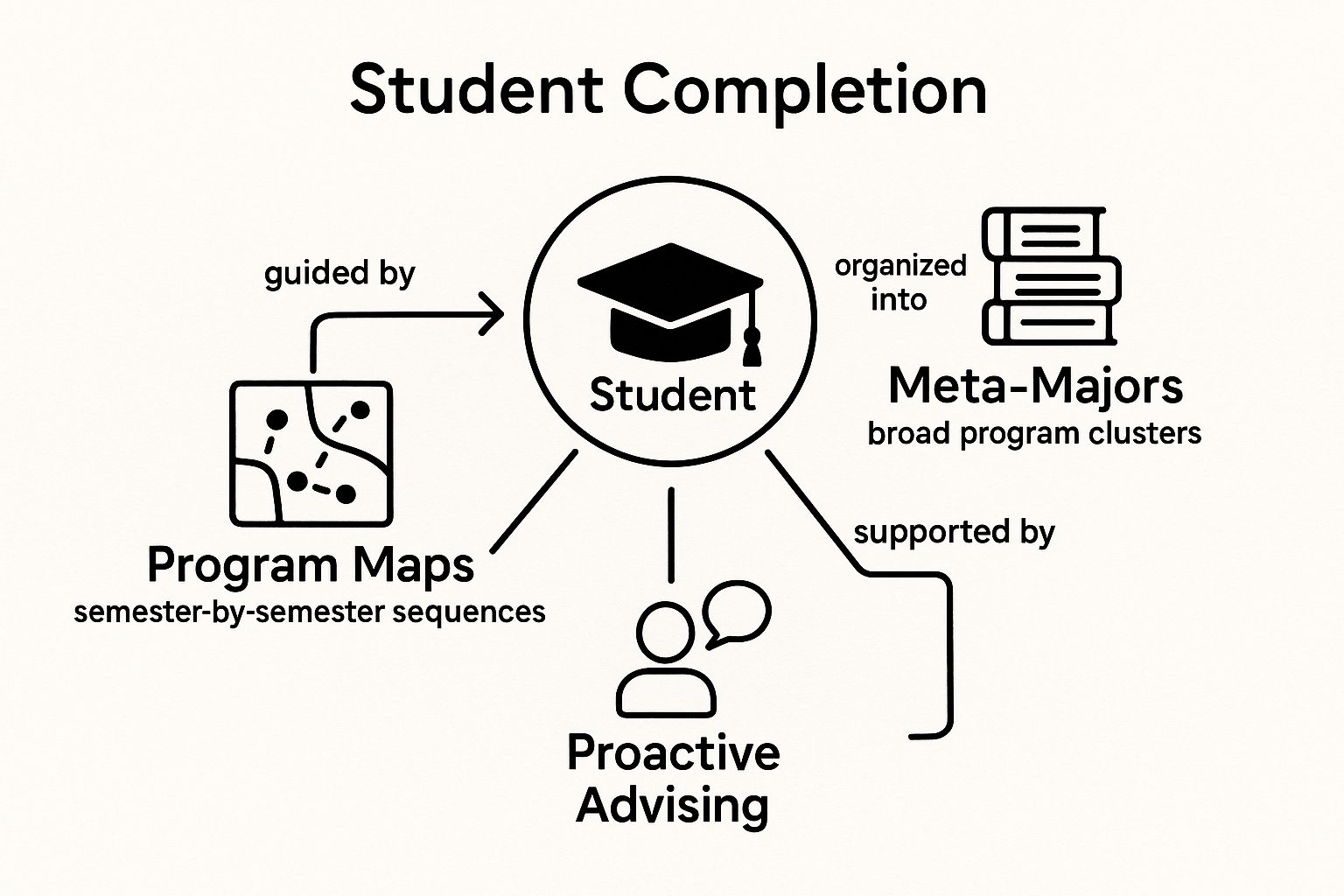
This visualization highlights how program maps, meta-majors, and proactive advising are interconnected pillars that directly support the central goal of student completion.
How to Implement This Strategy
Implementing Guided Pathways requires a systemic, institution-wide commitment to restructuring the student journey. It's not just an advising initiative; it's a fundamental change in how an institution operates.
- Map the Paths: Engage faculty to design clear, semester-by-semester program maps with well-defined learning outcomes. Group these maps into broader meta-majors to help new students explore interests without falling behind.
- Invest in Proactive Advising: Shift from transactional advising to a proactive, case-management model where advisors regularly check in, monitor progress on the pathway, and provide targeted support.
- Build Cross-Functional Teams: Create teams that include faculty, advisors, and student services staff to ensure a seamless and integrated student experience across all departments.
- Communicate Clearly: Market the pathways clearly to students from the very beginning of their journey. Ensure they understand the benefits of following a structured plan and know where to get help.
9. Sense of Belonging and Campus Climate Initiatives
Sense of belonging initiatives focus on creating inclusive campus environments where all students feel valued, respected, and socially connected to the institution. These students retention strategies address the critical psychological dimensions of persistence by fostering identity-affirming spaces, celebrating diversity, and actively combating discrimination. When students feel they belong, they are more engaged, motivated, and likely to succeed academically.
The work of researchers like Terrell Strayhorn has underscored that belonging is a fundamental human need directly linked to academic success. For instance, the University of Michigan's Comprehensive Studies Program for minority STEM students improved retention rates to 90% by creating a supportive cohort model. Similarly, the University of California San Diego's Black Resource Center has been instrumental in increasing Black student retention and graduation rates by providing a dedicated hub for community and support.
How to Implement This Strategy
Fostering a sense of belonging requires a systemic, campus-wide commitment rather than isolated programs. The goal is to embed inclusivity into the fabric of the institution.
- Conduct Regular Climate Surveys: Use anonymous surveys to gather honest feedback from students about their experiences and identify specific areas needing improvement.
- Provide Mandatory Inclusivity Training: Equip all faculty and staff with the tools to understand unconscious bias, practice inclusive pedagogy, and manage difficult conversations about diversity.
- Infuse Diverse Perspectives into Curriculum: Go beyond celebrating cultural heritage months by integrating diverse authors, histories, and viewpoints into coursework across all disciplines.
- Ensure Leadership Commitment: Institutional leaders must visibly and consistently champion diversity, equity, and inclusion initiatives to signal their importance. Explore effective community-building strategies on blog.marcomsociety.org to reinforce these efforts.
Student Retention Strategies Comparison
| Item | Implementation Complexity | Resource Requirements | Expected Outcomes | Ideal Use Cases | Key Advantages |
|---|---|---|---|---|---|
| Early Alert Systems | Medium to High | Significant technology and staff | Preventive support; improved retention (1-2 years) | Institutions with data capacity; advising teams | Early identification; data-driven; coordinated support |
| Intrusive Academic Advising | Medium | High advisor staffing and scheduling | Early problem detection; improved retention (1 semester to 1 year) | First-year, probation, first-generation students | Strong advisor-student relations; accountability |
| First-Year Experience Programs | Medium | Coordination across departments | Improved retention (10-20% higher) | New college students; transition support | Builds community; develops academic skills |
| Learning Communities | Medium to High | Faculty collaboration; scheduling | 5-10% retention and GPA improvement | Cohort-based learning; interdisciplinary | Peer support; integrated learning; deeper engagement |
| Student Financial Support and Emergency Aid | Low to Medium | Dedicated funding and rapid response | Immediate impact on retention | Students facing financial barriers | Addresses non-academic barriers; quick ROI |
| Supplemental Instruction and Peer Tutoring | Medium | Training and recruiting peer leaders | 0.5 GPA increase; 10-15% higher pass rates | High-risk and gateway courses | Cost-effective; reduces stigma; peer role models |
| Mentoring Programs | Medium to High | Coordination and mentor training | Improved retention (8-20%) | Underrepresented and first-generation students | Personalized support; professional networking |
| Structured Academic Pathways and Guided Pathways Reform | High | Institutional restructuring and training | 3-10% completion rate improvement (4-6 years) | Community colleges; students needing clear paths | Reduces confusion; equity focus; undergrad success |
| Sense of Belonging and Campus Climate Initiatives | Medium to High | Sustained institutional commitment | 25-30% higher retention; better mental health | Marginalized and diverse student populations | Inclusive environment; cultural competency |
From Strategy to Culture: Your Next Steps in Student Retention
We've explored a powerful toolkit of evidence-based student retention strategies, from the proactive alerts of Early Warning Systems to the community-building power of First-Year Experience programs. The journey through intrusive academic advising, supplemental instruction, and structured academic pathways reveals a clear, unifying theme: retention is not a single action but a comprehensive, interconnected ecosystem of support. These initiatives are not isolated fixes; they are foundational pillars that, when combined, create an environment where every student has the opportunity to thrive.
The common thread woven through each successful strategy is a deep commitment to understanding the individual student journey. Whether it's providing timely financial aid, fostering a sense of belonging through campus climate initiatives, or creating powerful connections via mentoring programs, the goal is to dismantle barriers before they derail a student's academic path. True retention work moves beyond simple data points and into the realm of human connection and institutional empathy.
Your Actionable Path Forward
Moving from theory to practice can feel daunting, but progress begins with focused, intentional steps. The most effective student retention strategies are not implemented all at once but are cultivated over time. Here’s how to start building momentum:
- Conduct a Needs Assessment: Begin by analyzing your school's specific challenges. Use student surveys, withdrawal data, and focus groups to identify the primary reasons students leave. Is the issue academic, financial, or social? Your data will point you toward the most impactful strategies to pilot first.
- Start Small and Pilot: Select one or two strategies from this list that directly address your most pressing needs. For example, if first-semester academic struggles are high, consider launching a targeted Supplemental Instruction program for key gateway courses. A smaller, well-executed pilot provides valuable lessons and generates early wins that build support for broader implementation.
- Establish Clear Metrics: Define what success looks like from the outset. Key performance indicators could include first-year persistence rates, course completion rates, student engagement scores, or utilization of support services. Regularly track and analyze this data to measure impact and justify future investment.
- Foster Cross-Departmental Collaboration: Retention is a shared responsibility. Break down silos between academic affairs, student services, admissions, and communications. Create a cross-functional retention committee to ensure that your strategies are integrated and that all departments are working toward a common goal of student success.
Ultimately, mastering these approaches transforms your institution's value proposition. It shifts the narrative from merely enrolling students to ensuring they succeed and complete their educational journey. This commitment creates a powerful ripple effect, boosting your school's reputation, strengthening alumni engagement, and creating a sustainable future where students don't just attend-they belong, persist, and flourish.
Ready to collaborate with peers and elevate your school's marketing and communication efforts? Join The MarCom Society to access a dedicated community of K-12 professionals, expert-led workshops, and resources designed to help you master challenges like implementing effective student retention strategies. Unlock the collective wisdom of your peers and build a thriving school community at The MarCom Society.